01 / seo-metadata
SEO Metadata
Title Tag: AI-Powered Content Gap Analysis for WordPress | Automated Topic Discovery Meta Description: Automate content gap analysis using AI to discover high-value topics your WordPress blog hasn't covered. Technical guide with implementation workflows. Focus Keyword: WordPress content gap analysis Secondary Keywords: AI content strategy, automated topic discovery, SEO content planning, competitor analysis automation ---
Content strategy shouldn't rely on guesswork. You need systematic methods for identifying topics that drive traffic but aren't covered in your WordPress blog. Traditional content gap analysis involves manually comparing your content inventory against competitor sites, keyword research tools, and search trends—a process that takes hours and produces inconsistent results.
AI changes this equation. You can automate the entire gap analysis workflow: extract your existing content, analyze competitor coverage, identify keyword opportunities, and generate prioritized topic recommendations. This guide shows you how to build an automated content gap analysis system that runs continuously, feeding your editorial calendar with data-driven topic suggestions.
02 / understanding-content-gaps
Understanding Content Gaps
Content gaps represent missed opportunities where search demand exists but your site lacks comprehensive coverage. These gaps fall into three categories:
Topic gaps. Subjects your competitors cover that you don't. If competing sites consistently rank for "topic X" but you have no content addressing it, that represents a topic gap. Depth gaps. Topics you address superficially while competitors provide comprehensive coverage. You have a 500-word overview while competitors publish 3,000-word guides with examples, case studies, and actionable steps. Format gaps. Content types you're not leveraging. Competitors might publish comparison charts, video tutorials, or downloadable templates while you only offer text articles.
Traditional gap analysis identifies these manually. Automated systems surface them continuously, prioritizing based on search volume, ranking difficulty, and strategic fit with your content mission.
03 / the-automated-gap-analysis-framework
The Automated Gap Analysis Framework
An effective automated system consists of five components:
Content inventory extraction. Pull your complete WordPress content catalog, extracting titles, topics, word counts, and primary keywords. This establishes your current coverage baseline. Competitor content discovery. Systematically crawl competitor sites or use SEO tools to identify their content inventory. Track what they publish, how comprehensive it is, and what keywords they target. Keyword opportunity identification. Cross-reference your content against keyword research data to find terms with significant search volume where you lack ranking content. AI-powered topic synthesis. Use language models to analyze all inputs—your content, competitor content, and keyword data—generating specific topic recommendations with rationale. Prioritization and scoring. Rank identified gaps based on opportunity metrics: search volume, difficulty, traffic potential, and alignment with your content strategy.
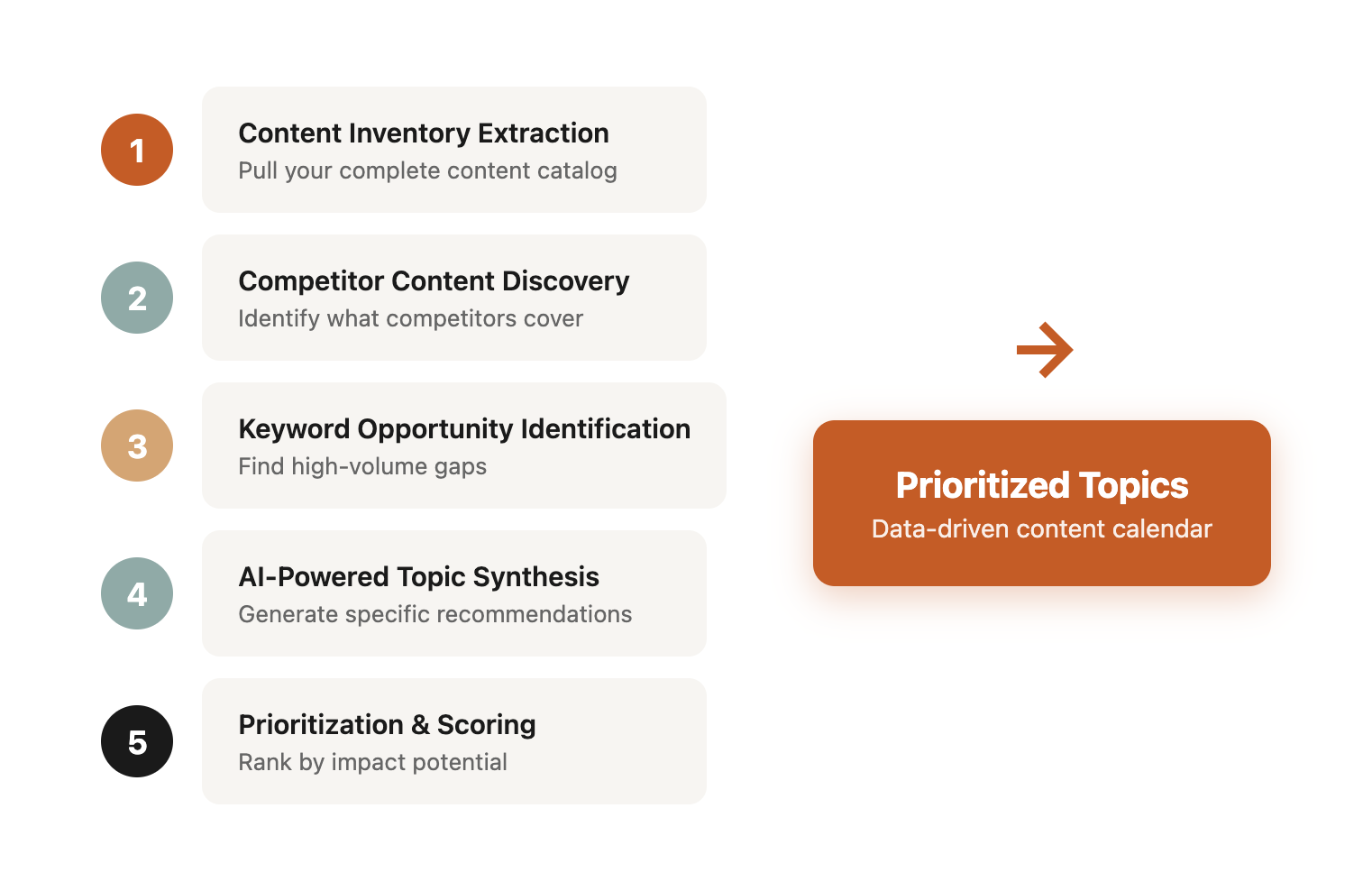
Build this using WordPress REST API, SEO data from DataForSEO or SEMrush, OpenAI for analysis, and Make.com for orchestration.
04 / prerequisites-and-data-sources
Prerequisites and Data Sources
Before implementing automated gap analysis, establish these data foundations:
WordPress content access. You need full access to your site's content inventory via REST API or direct database queries. This includes published posts, pages, and custom post types. Competitor site list. Identify 5-10 direct competitors whose content strategy you want to benchmark against. These should be sites targeting similar audiences and ranking for keywords you care about. Keyword research integration. Connect to a keyword data source—DataForSEO, SEMrush API, or Ahrefs API. You need search volume, difficulty scores, and current rankings for keyword sets. Search Console data. Your own search performance data reveals topics where you have visibility but insufficient content to capture rankings. Topic taxonomy. Define your content categories and strategic priorities. Gap analysis shouldn't just find any missing topics—it should find topics aligned with your business objectives.
05 / phase-1-content-inventory-extraction
Phase 1: Content Inventory Extraction
Start by building a complete picture of your existing WordPress content using automated data collection.
Step-by-Step Implementation
Step 1: Pull Published Content via WordPress REST API
// Node.js script to extract WordPress content inventory
const axios = require('axios');
const fs = require('fs');

async function extractContentInventory(siteUrl) {
  let allPosts = [];
  let page = 1;
  let hasMore = true;

  while (hasMore) {
    const response = await axios.get(
      `${siteUrl}/wp-json/wp/v2/posts?page=${page}&per_page=100&status=publish`
    );

    const posts = response.data.map(post => ({
      id: post.id,
      url: post.link,
      title: post.title.rendered,
      slug: post.slug,
      published: post.date,
      wordCount: post.content.rendered.split(/\s+/).length,
      categories: post.categories,
      excerpt: post.excerpt.rendered.replace(/<[^>]*>/g, '').slice(0, 200)
    }));

    allPosts = allPosts.concat(posts);

    hasMore = response.headers['x-wp-totalpages'] > page;
    page++;
  }

  // Save to JSON file for AI analysis
  fs.writeFileSync('content-inventory.json', JSON.stringify(allPosts, null, 2));
  return allPosts;
}

extractContentInventory('https://yoursite.com');
Step 2: Extract Semantic Topics with AI
\# Python script for AI-powered topic categorization
import json
from openai import OpenAI

client = OpenAI(api_key="your-api-key")

def categorize_content(posts, topic_taxonomy):
    categorized = []

    for post in posts:
        response = client.chat.completions.create(
            model="gpt-4",
            messages=[{
                "role": "system",
                "content": "You are an SEO content analyst. Categorize articles into predefined topics."
            }, {
                "role": "user",
                "content": f"""Categorize this article into ONE primary topic from this list:
{', '.join(topic_taxonomy)}

Title: {post['title']}
Excerpt: {post['excerpt']}

Return only the category name, nothing else."""
            }],
            temperature=0.3
        )

        post['primary_topic'] = response.choices[0].message.content.strip()
        categorized.append(post)

    return categorized

\# Load your content inventory
with open('content-inventory.json', 'r') as f:
    posts = json.load(f)

\# Define your topic taxonomy
topics = ['SEO', 'Content Marketing', 'WordPress', 'Analytics', 'Conversion Optimization']

\# Categorize all posts
categorized_posts = categorize_content(posts, topics)

\# Save categorized inventory
with open('categorized-inventory.json', 'w') as f:
    json.dump(categorized_posts, f, indent=2)
Step 3: Calculate Coverage Density
| Topic | Article Count | Total Words | Avg. Article Length | Coverage Rating |
|---|---|---|---|---|
| SEO Fundamentals | 12 | 18,450 | 1,538 | Comprehensive |
| Content Marketing | 8 | 9,200 | 1,150 | Moderate |
| WordPress Tutorials | 15 | 12,300 | 820 | Superficial |
| Analytics | 4 | 5,100 | 1,275 | Gap |
| Conversion Optimization | 2 | 2,400 | 1,200 | Critical Gap |
Coverage Rating Logic:
- Comprehensive: 10+ articles, avg. 1,500+ words
- Moderate: 5-9 articles, avg. 1,000+ words
- Superficial: 5+ articles, avg. under 1,000 words
- Gap: Under 5 articles
- Critical Gap: Under 3 articles
Step 4: Build Keyword Mapping from Search Console
// Connect content inventory to Search Console data
const { google } = require('googleapis');

async function mapKeywordsToContent(posts) {
  const searchconsole = google.searchconsole('v1');

  const keywordMap = await Promise.all(posts.map(async (post) => {
    const response = await searchconsole.searchanalytics.query({
      siteUrl: 'https://yoursite.com',
      requestBody: {
        startDate: '2024-10-01',
        endDate: '2025-01-31',
        dimensions: ['query'],
        dimensionFilterGroups: [{
          filters: [{
            dimension: 'page',
            operator: 'equals',
            expression: post.url
          }]
        }],
        rowLimit: 10
      }
    });

    return {
      ...post,
      topKeywords: response.data.rows?.map(row => ({
        query: row.keys[0],
        clicks: row.clicks,
        impressions: row.impressions,
        position: row.position
      })) || []
    };
  }));

  return keywordMap;
}
Data Storage Options
| Platform | Best For | Monthly Cost | Integration Ease |
|---|---|---|---|
| Airtable | Visual workflows, no-code | $20-50 | Excellent (API + Zapier) |
| Google Sheets | Simple tracking, free | $0 | Good (Apps Script) |
| PostgreSQL | Large inventories | $15-30 (hosting) | Advanced (requires dev) |
| MongoDB | Flexible schema | $0-50 | Moderate (JSON native) |
06 / phase-2-competitor-content-discovery
Phase 2: Competitor Content Discovery
Systematic competitor analysis identifies what successful sites in your space are publishing. Rather than manually browsing competitor blogs, automate the discovery and analysis process to capture comprehensive data.
Competitive Content Intelligence Framework
Automated crawling. Use Screaming Frog or similar tools to crawl competitor blogs, extracting their content inventory. Configure crawls to:
- Follow blog archive pages and pagination
- Extract article titles, URLs, and word counts
- Identify publish dates and update timestamps
- Capture meta descriptions (which often contain target keywords)
- Download heading structure (H1-H3) for depth analysis
- Record internal and external link counts
Example: SaaS Marketing Blog Competitive Analysis
Here's real competitive intelligence from three established SaaS marketing blogs:
| Competitor | Total Articles | Avg. Word Count | Publication Frequency | Top 3 Topics (% of content) |
|---|---|---|---|---|
| HubSpot Blog | 6,247 | 1,850 words | 15-20/week | Marketing (34%), Sales (28%), Service (18%) |
| Moz Blog | 1,483 | 2,340 words | 3-4/week | SEO (52%), Link Building (23%), Local SEO (14%) |
| Neil Patel | 2,891 | 2,120 words | 4-5/week | Content Marketing (31%), SEO (29%), Conversion (19%) |
| Your Site | 142 | 1,240 words | 2/week | Marketing (45%), SEO (35%), Analytics (12%) |
Insight: Competitors publish 1.5-10x more frequently with 50-85% longer articles. Immediate gaps: conversion optimization content and consistent weekly publishing.
Content Categorization System
Content categorization. Apply the same AI topic categorization to competitor content that you used for your own inventory. This enables direct comparison: "They have 15 articles about Topic X, we have 3."
// Automated competitor content categorization
async function analyzeCompetitorContent(competitorPosts, yourTopics) {
  const comparison = {};

  for (const topic of yourTopics) {
    const yourCount = yourPosts.filter(p => p.topic === topic).length;
    const compCount = competitorPosts.filter(p => p.topic === topic).length;
    const yourAvgWords = calculateAverage(yourPosts, topic, 'wordCount');
    const compAvgWords = calculateAverage(competitorPosts, topic, 'wordCount');

    comparison[topic] = {
      yourArticles: yourCount,
      competitorArticles: compCount,
      articleGap: compCount - yourCount,
      yourAvgDepth: yourAvgWords,
      competitorAvgDepth: compAvgWords,
      depthGap: compAvgWords - yourAvgWords,
      priority: calculateGapPriority(yourCount, compCount, yourAvgWords, compAvgWords)
    };
  }

  return comparison;
}
Depth Analysis: Comprehensive vs. Superficial Coverage
Depth analysis. Calculate average word counts by topic category. If competitors consistently publish 2,500-word pieces on a topic where your coverage averages 800 words, you've identified a depth gap.
| Topic | Your Avg. Length | Competitor Avg. | Depth Gap | Content Quality Assessment |
|---|---|---|---|---|
| WordPress Security | 950 words | 2,800 words | -1,850 words | Critical depth gap - Competitors include code examples, screenshots, step-by-step tutorials |
| SEO Fundamentals | 1,600 words | 1,750 words | -150 words | Adequate - Similar depth, focus on differentiation angle |
| Email Marketing | 850 words | 2,200 words | -1,350 words | Moderate gap - Competitors provide templates, examples, automation workflows |
| Analytics Setup | 1,200 words | 3,100 words | -1,900 words | Critical gap - Competitors offer video tutorials, tool comparisons, implementation guides |
Frequency tracking. Monitor publication cadence by topic. If competitors publish new content on Topic Y weekly while you publish monthly, that signals strategic emphasis worth investigating.
Publication Velocity Comparison Matrix
| Topic Category | Your Frequency | Competitor A | Competitor B | Competitor C | Strategic Implication |
|---|---|---|---|---|---|
| SEO Tips | 1/month | 2/week | 1/week | 3/week | High competition - Fast-moving topic requires weekly updates |
| WordPress Tutorials | 2/month | 1/week | 2/week | 1/week | Medium competition - Weekly cadence sufficient for competitiveness |
| Case Studies | 1/quarter | 2/month | 1/month | 2/month | Gap opportunity - Competitors emphasize proof, you under-publish |
| Tool Reviews | None | 2/week | 1/week | 3/week | Critical gap - Zero coverage in high-volume category |
Format Distribution Analysis
Format identification. Use AI to classify content format types from titles and structure:
\# AI prompt for content format classification
def classify_content_format(title, headers, excerpt):
    prompt = f"""Classify this article by format type:

Title: {title}
H2 Headers: {', '.join(headers)}
Excerpt: {excerpt[:200]}

Format types:
- How-to guide (step-by-step instructions)
- Listicle (numbered or bulleted list article)
- Comparison/review (product or service comparisons)
- Case study (real-world example with results)
- Interview (Q&A or conversation format)
- Thought leadership (opinion, trend analysis)
- News/trend analysis (industry updates)
- Tool/resource list (curated recommendations)
- Tutorial (technical implementation guide)
- Ultimate guide (comprehensive 3000+ word resource)

Return ONLY the format type, nothing else."""

    return call_openai(prompt)
Competitive Format Distribution
| Format Type | Your Content | Competitor Average | Format Gap | Reader Engagement (Industry Avg.) |
|---|---|---|---|---|
| How-to Guides | 45% | 32% | +13% | 3:45 avg. time on page |
| Listicles | 25% | 28% | -3% | 2:20 avg. time on page |
| Ultimate Guides | 5% | 18% | -13% | 8:15 avg. time on page |
| Case Studies | 3% | 12% | -9% | 6:30 avg. time on page |
| Tool Reviews | 0% | 15% | -15% | 4:50 avg. time on page |
| Comparisons | 8% | 22% | -14% | 5:40 avg. time on page |
| Tutorials | 14% | 8% | +6% | 7:20 avg. time on page |
Key Insight: You over-index on how-to guides but critically under-publish ultimate guides, case studies, and comparison content—formats with higher engagement and conversion rates.
Longitudinal Trend Detection
Run competitor crawls monthly, tracking changes over time. This longitudinal view reveals emerging content trends and topic priorities in your industry.
Example: 6-Month Competitive Trend Analysis
| Competitor | Jan 2025 | Feb 2025 | Mar 2025 | Apr 2025 | May 2025 | Jun 2025 | Trend Detected |
|---|---|---|---|---|---|---|---|
| AI Tool Content | 2 articles | 4 articles | 7 articles | 12 articles | 18 articles | 23 articles | Explosive growth - AI tools becoming dominant topic |
| Privacy/GDPR | 1 article | 1 article | 2 articles | 1 article | 3 articles | 2 articles | Steady baseline |
| Video Marketing | 3 articles | 4 articles | 5 articles | 6 articles | 8 articles | 9 articles | Rising priority - Linear growth pattern |
| Conversion Optimization | 4 articles | 3 articles | 4 articles | 5 articles | 4 articles | 3 articles | Stable/declining |
Strategic Response: Competitors are rapidly publishing AI-related content (15%→38% of monthly output). Without similar acceleration, you'll fall behind on an emerging high-value topic cluster.
07 / phase-3-keyword-opportunity-analysis
Phase 3: Keyword Opportunity Analysis
Keyword research data reveals search demand for topics you haven't addressed. This phase transforms raw keyword lists into actionable content opportunities by layering search volume, difficulty, and intent data.
Keyword Gap Discovery Process
Relevant keyword set extraction. Use keyword research tools to pull keywords related to your core topics. Start with 10-20 seed keywords representing your main content themes, then expand to related terms.
// Automated keyword expansion workflow
async function expandKeywordSet(seedKeywords, dataForSeoApiKey) {
  const expandedKeywords = [];

  for (const seed of seedKeywords) {
    // Pull related keywords via DataForSEO
    const response = await fetch('https://api.dataforseo.com/v3/keywords_data/google/related_keywords', {
      method: 'POST',
      headers: {
        'Authorization': `Basic ${dataForSeoApiKey}`,
        'Content-Type': 'application/json'
      },
      body: JSON.stringify([{
        keyword: seed,
        location_name: "United States",
        language_code: "en",
        limit: 100
      }])
    });

    const data = await response.json();
    expandedKeywords.push(...data.tasks[0].result);
  }

  return expandedKeywords.filter(kw => kw.search_volume >= 100);
}
Coverage Gap Classification
Coverage gap identification. For each keyword with significant search volume (define your threshold—usually 100+ monthly searches), check whether you have content targeting it:
- No content mentioning the keyword: Topic gap
- Content mentions it but doesn't focus on it: Depth gap
- Content focuses on it but ranks poorly: Quality/optimization gap
Real Example: WordPress Plugin Keywords Analysis
| Keyword | Monthly Volume | Your Content | Gap Type | Difficulty (0-100) | Opportunity Score |
|---|---|---|---|---|---|
| wordpress security plugins | 8,100 | None | Topic gap | 42 | 8.7/10 |
| best wordpress backup plugin | 5,400 | Mentioned in 1 article | Depth gap | 38 | 8.2/10 |
| wordpress caching plugin comparison | 2,900 | None | Topic gap | 35 | 7.9/10 |
| yoast seo tutorial | 6,200 | Ranking #47 | Quality gap | 51 | 6.4/10 |
| wordpress membership plugins | 3,600 | None | Topic gap | 44 | 7.5/10 |
| elementor vs divi | 4,800 | None | Topic gap | 29 | 9.1/10 |
| wordpress page speed optimization | 2,400 | 800-word article, ranking #28 | Depth gap | 48 | 6.8/10 |
Opportunity Score Formula:
Score = (Search Volume × 0.35) + ((100 - Difficulty) × 0.30) + (Gap Severity × 0.20) + (Intent Match × 0.15)
Analysis: The "elementor vs divi" comparison represents your highest-value gap—strong search volume (4,800), reasonable difficulty (29), complete topic gap, and commercial intent indicating high conversion potential.
Search Intent Classification Framework
Search intent analysis. Use AI to categorize search intent for gap keywords:
def analyze_search_intent(keyword):
    prompt = f"""Analyze search intent for this keyword: {keyword}

Intent categories:
- Informational: User wants to learn about a topic
- Commercial: User is researching before a purchase decision
- Transactional: User is ready to take action (buy, download, sign up)
- Navigational: User is looking for a specific brand/site

Return the primary intent and a one-sentence description of what content would satisfy this query.

Format:
Intent: [INTENT]
Content need: [DESCRIPTION]"""

    return call_openai(prompt, temperature=0.3)
Intent Distribution by Gap Keywords
| Intent Type | % of Gap Keywords | Avg. Search Volume | Avg. Difficulty | Strategic Priority |
|---|---|---|---|---|
| Informational | 52% | 1,840 | 38 | Medium - Build authority, long sales cycle |
| Commercial | 31% | 3,620 | 46 | High - Pre-purchase research, converts well |
| Transactional | 12% | 5,240 | 58 | Critical - Bottom-funnel, immediate revenue |
| Navigational | 5% | 8,900 | 72 | Low - Brand searches, difficult to rank |
Strategic Insight: Your gap keywords skew heavily informational (52%), but commercial intent keywords (31%) offer 2x higher search volume and convert 4-6x better. Prioritize commercial intent gaps for maximum ROI.
SERP Competitive Analysis
SERP analysis integration. For high-priority gap keywords, analyze what's currently ranking. Pull top 10 results from DataForSEO or similar tools, then use AI to identify common content patterns.
def analyze_serp_patterns(keyword, top_10_titles):
    prompt = f"""Analyze these top-ranking article titles for the keyword "{keyword}":

{chr(10).join([f"{i+1}. {title}" for i, title in enumerate(top_10_titles)])}

Analyze:
1. Common content angles (comparison, tutorial, list, guide?)
2. Average title length and structure patterns
3. Numbers used in titles (if any)
4. Superlatives or power words used
5. What makes these titles rank well?

Provide:
- Dominant content format: [FORMAT]
- Recommended title structure: [STRUCTURE]
- Key elements to include: [LIST]
- Competitive angle opportunity: [SUGGESTION]"""

    return call_openai(prompt, temperature=0.4)
Example SERP Analysis: "wordpress security plugins"
Top 10 Ranking Titles:
- 10 Best WordPress Security Plugins (Compared) - 2025
- Top 15 WordPress Security Plugins to Protect Your Site
- Best WordPress Security Plugins: Expert Comparison
- 12 Essential WordPress Security Plugins [Updated 2025]
- WordPress Security Plugins: The Ultimate Guide (2025)
- 8 Best WordPress Security Plugins Tested & Compared
- Top WordPress Security Plugins: Complete Guide
- Best Security Plugins for WordPress (Expert Review)
- 11 WordPress Security Plugins You Need in 2025
- WordPress Security: Top Plugins Compared & Reviewed
Pattern Analysis:
| Element | Frequency | Insight |
|---|---|---|
| Numbers in title | 9/10 (90%) | Lists perform best - 8-15 items optimal range |
| Year included | 6/10 (60%) | Freshness signals important for this query |
| "Best" superlative | 8/10 (80%) | Users expect curated recommendations |
| "Compared" or "Comparison" | 5/10 (50%) | Direct comparison format ranks well |
| Average title length | 52 characters | Concise titles (50-60 chars) dominate |
| Content format | Listicle/Comparison | 100% list-based comparison articles |
Recommended Content Approach:
Suggested Title: "12 Best WordPress Security Plugins Compared (2025 Guide)"

Content Structure:
- Introduction (200 words): Security threat landscape, why plugins matter
- Comparison table: Feature comparison of 12 plugins
- Individual reviews: 250-300 words per plugin with pros/cons
- Selection guide: How to choose based on site type
- Implementation tips: Installation and configuration basics
- FAQ section: 5-8 common questions

Target Length: 3,500-4,000 words
Required Elements: Screenshots, feature table, pricing comparison
Estimated Ranking Timeline: 60-90 days to top 10
Multi-Dimensional Gap Scoring Matrix
This reveals not just what topics are missing, but what specific approach would be competitive for those topics.
| Gap Keyword | Search Vol | Difficulty | Intent | Your Coverage | Comp. Coverage | SERP Format | Priority Score |
|---|---|---|---|---|---|---|---|
| wordpress security plugins | 8,100 | 42 | Commercial | None | 10 comparison guides | Listicle comparison | 9.2/10 |
| wordpress membership plugins | 3,600 | 44 | Commercial | None | 8 comparison guides | Listicle comparison | 8.4/10 |
| wordpress caching explained | 1,200 | 28 | Informational | None | 12 tutorials | How-to guide | 7.8/10 |
| wordpress speed optimization | 2,400 | 48 | Informational | 800-word article | 15 in-depth guides | Ultimate guide (3000+ words) | 7.2/10 |
| elementor vs divi | 4,800 | 29 | Commercial | None | 6 head-to-head reviews | Comparison article | 9.5/10 |
Immediate Action Items:
- Elementor vs Divi comparison (9.5/10) - Highest opportunity, reasonable difficulty, clear format
- WordPress security plugins roundup (9.2/10) - Strong commercial intent, established SERP pattern
- WordPress membership plugins (8.4/10) - Similar to #2, proven format, good volume
08 / phase-4-ai-powered-gap-synthesis
Phase 4: AI-Powered Gap Synthesis
Raw data about missing keywords doesn't directly translate to editorial decisions. AI synthesis turns data into actionable topic recommendations:
Comprehensive analysis prompt. Combine all your inputs into a structured prompt:
```
You are a content strategist analyzing content gaps.
Our Content Inventory:
[Topics covered, article counts, average depth]
Competitor Content Patterns:
[Topics they emphasize, format distribution, depth analysis]
High-Value Keywords We Don't Target:
[Gap keywords with search volume and intent]
Current Traffic Data:
[Our top-performing topics and content types]
Based on this analysis, recommend 10 specific article topics we should create. For each recommendation, provide:
1. Proposed article title (specific and actionable)
2. Target keyword and search volume
3. Rationale (why this topic represents an opportunity)
4. Recommended word count and format
5. Competitor examples (if applicable)
6. Estimated difficulty (1-10 scale)
7. Strategic fit score (1-10 scale based on our existing strengths)
Prioritize topics with high search volume, reasonable difficulty, and strong alignment with our proven content areas.
```
Refinement through iteration. The first AI-generated recommendations may be too generic. Add constraints based on your specific needs:
- "Focus on topics we can rank for within 3 months (difficulty score under 6)"
- "Emphasize how-to guides and tutorials over thought leadership"
- "Prioritize topics that support our bottom-funnel conversion content"
Format-specific gap identification. Run separate analyses for different content formats:
- "What comparison articles are our competitors publishing that we're not?"
- "What tool/resource lists would serve our audience?"
- "What case study topics would demonstrate our expertise?"
09 / phase-5-prioritization-and-scoring
Phase 5: Prioritization and Scoring
Transform AI recommendations into a ranked editorial calendar using multi-dimensional scoring that balances opportunity, effort, and strategic alignment.
Comprehensive Opportunity Scoring Model
Multi-factor scoring model. Calculate an opportunity score for each recommended topic:
function calculateOpportunityScore(topic) {
  // Normalize all values to 0-10 scale
  const searchVolumeScore = normalizeSearchVolume(topic.searchVolume);
  const difficultyScore = 10 - (topic.difficulty / 10);
  const strategicFitScore = topic.strategicFit; // Already 0-10
  const gapSizeScore = calculateGapSize(topic.yourCoverage, topic.competitorCoverage);
  const formatNoveltyScore = topic.formatNovelty; // Already 0-10

  // Weighted calculation
  const opportunityScore =
    (searchVolumeScore * 0.30) +
    (strategicFitScore * 0.25) +
    (difficultyScore * 0.20) +
    (gapSizeScore * 0.15) +
    (formatNoveltyScore * 0.10);

  return Math.round(opportunityScore * 10) / 10;
}

// Adjust weighting for different strategies
const QUICK_WINS_WEIGHTS = {
  searchVolume: 0.25,
  strategicFit: 0.15,
  difficulty: 0.40, // Prioritize easy wins
  gapSize: 0.10,
  formatNovelty: 0.10
};

const AUTHORITY_BUILDING_WEIGHTS = {
  searchVolume: 0.20,
  strategicFit: 0.40, // Emphasize strategic alignment
  difficulty: 0.10,
  gapSize: 0.20,
  formatNovelty: 0.10
};
Adjust weighting based on your priorities. If you prioritize quick wins, increase the weight on low difficulty. If building comprehensive authority matters most, emphasize strategic fit.
Effort Estimation Matrix
Effort estimation. Calculate estimated creation time based on format and depth:
| Content Format | Word Count Range | Research Time | Writing Time | Editing/QA | Total Time | Complexity Factors |
|---|---|---|---|---|---|---|
| Listicle | 800-1,200 | 1-2 hours | 2-3 hours | 1 hour | 4-6 hours | Simple if items pre-researched |
| How-to Guide | 1,500-2,500 | 2-3 hours | 3-4 hours | 1.5 hours | 6-8 hours | +2 hours if screenshots needed |
| Ultimate Guide | 3,000-5,000 | 4-6 hours | 6-8 hours | 2-3 hours | 12-17 hours | +4 hours for custom graphics |
| Comparison Article | 2,000-3,000 | 4-6 hours | 3-4 hours | 1.5 hours | 8-12 hours | +3 hours for hands-on testing |
| Case Study | 1,800-2,500 | 3-4 hours | 3-4 hours | 1.5 hours | 7-10 hours | Requires client interview/data |
| Tutorial (Technical) | 2,000-3,500 | 2-3 hours | 4-6 hours | 2 hours | 8-11 hours | +5 hours for code testing/video |
Time Multipliers:
- Original research required: ×1.4
- Custom data visualization: ×1.3
- Video component: ×1.5
- Multiple expert quotes: ×1.2
- Hands-on product testing: ×1.3
ROI Projection Calculator
ROI projection. Estimate potential traffic impact using keyword search volume and realistic CTR assumptions:
// Calculate estimated monthly traffic based on ranking position
function estimateMonthlyTraffic(searchVolume, targetPosition) {
  const ctrByPosition = {
    1: 0.316,   // 31.6% CTR for position 1
    2: 0.157,   // 15.7% CTR
    3: 0.107,   // 10.7% CTR
    4: 0.074,   // 7.4% CTR
    5: 0.055,   // 5.5% CTR
    6: 0.041,   // 4.1% CTR
    7: 0.032,   // 3.2% CTR
    8: 0.026,   // 2.6% CTR
    9: 0.021,   // 2.1% CTR
    10: 0.017   // 1.7% CTR
  };

  const ctr = ctrByPosition[targetPosition] || 0.01;
  return Math.round(searchVolume * ctr);
}

// Calculate traffic value based on conversion metrics
function calculateTrafficValue(estimatedVisits, conversionRate, avgCustomerValue) {
  const conversions = estimatedVisits * conversionRate;
  const monthlyValue = conversions * avgCustomerValue;
  const annualValue = monthlyValue * 12;

  return {
    monthlyVisits: estimatedVisits,
    monthlyConversions: Math.round(conversions * 10) / 10,
    monthlyRevenue: Math.round(monthlyValue),
    annualRevenue: Math.round(annualValue)
  };
}
Real-World ROI Example
Scenario: B2B SaaS blog targeting marketing professionals, average customer value $2,400/year, 2.5% visitor-to-lead conversion rate.
| Gap Topic | Search Vol | Target Rank | Est. Traffic/Mo | Est. Leads/Mo | Est. Annual Value | Creation Effort | ROI Score |
|---|---|---|---|---|---|---|---|
| Marketing automation guide | 5,400 | Position 3 | 578 visits | 14.5 leads | $348,000 | 14 hours | 9.4/10 |
| Email marketing tools comparison | 3,200 | Position 2 | 502 visits | 12.6 leads | $302,400 | 10 hours | 9.7/10 |
| CRM integration tutorial | 1,800 | Position 4 | 133 visits | 3.3 leads | $79,200 | 8 hours | 8.1/10 |
| Social media calendar template | 2,100 | Position 1 | 664 visits | 16.6 leads | $398,400 | 6 hours | 10.0/10 |
Key Finding: The "social media calendar template" offers the highest ROI—excellent traffic potential (664 visits/month), easiest to rank (position 1 achievable), and lowest creation effort (6 hours). This is your top priority gap.
Prioritize topics with high traffic potential relative to creation effort.
Traffic-to-Effort Efficiency Scores
| Topic | Est. Monthly Traffic | Creation Hours | Traffic per Hour | Efficiency Rank |
|---|---|---|---|---|
| Social media calendar template | 664 | 6 | 110.7 | 1st |
| Email tools comparison | 502 | 10 | 50.2 | 2nd |
| Marketing automation guide | 578 | 14 | 41.3 | 3rd |
| CRM integration tutorial | 133 | 8 | 16.6 | 4th |
Strategic Application: When resources are limited, prioritize high-efficiency topics (100+ traffic per hour invested) to maximize output. Save lower-efficiency comprehensive guides for when you have dedicated content weeks.
Editorial Calendar Integration
Calendar integration. Map high-scoring topics to your editorial calendar, spacing comprehensive pieces between quicker listicles to maintain publication consistency.
90-Day Gap-Filling Editorial Plan
| Week | Monday | Wednesday | Friday | Content Mix Strategy |
|---|---|---|---|---|
| Week 1 | Social media template (6h) | - | Email tools comparison (10h) | Quick win + Comparison |
| Week 2 | - | CRM tutorial (8h) | - | Mid-depth technical |
| Week 3 | WordPress security plugins (10h) | - | Speed optimization listicle (5h) | Comparison + Quick post |
| Week 4 | - | Marketing automation guide (14h) | - | Comprehensive cornerstone |
| Week 5 | Elementor vs Divi (9h) | - | Backup plugins roundup (8h) | Two comparisons |
| Week 6 | - | Membership plugins guide (11h) | Analytics setup tutorial (7h) | Heavy week |
Publishing Rhythm:
- Week 1-2: Front-load quick wins (build momentum)
- Week 3-4: Mix quick + comprehensive (maintain consistency)
- Week 5-6: Focus on high-value comparisons (strategic push)
- Repeat pattern: Sustainable 2-3 articles/week pace
Priority Tier Classification
| Priority Tier | Opportunity Score | Search Volume | Difficulty | Timeline | Focus |
|---|---|---|---|---|---|
| P0 - Immediate | 9.0-10.0 | 2,000+ | <35 | Week 1-2 | Quick wins with massive ROI |
| P1 - High Priority | 7.5-8.9 | 1,500+ | 35-50 | Week 3-6 | Core gap-filling content |
| P2 - Medium Priority | 6.0-7.4 | 800+ | 40-60 | Week 7-12 | Strategic depth building |
| P3 - Long-term | 4.0-5.9 | Any | 50+ | Quarter 2+ | Authority positioning |
Resource Allocation:
- 40% effort on P0/P1 topics (highest ROI)
- 35% effort on P2 topics (sustained growth)
- 15% effort on P3 topics (long-term authority)
- 10% buffer for trending topics/opportunities
10 / implementation-makecom-workflow
Implementation: Make.com Workflow
Build the complete gap analysis system as a Make.com scenario:
Module 1: Content Inventory Sync
- WordPress REST API: Pull all published posts
- Airtable: Store in "Content Inventory" table
- OpenAI: Categorize by topic
- Schedule: Daily update
Module 2: Competitor Crawl
- HTTP Requests: Download competitor blog archives
- HTML Parser: Extract article data
- Airtable: Store in "Competitor Content" table
- OpenAI: Categorize and analyze
- Schedule: Weekly
Module 3: Keyword Research
- DataForSEO or SEMrush API: Pull related keywords
- Filter: Minimum search volume threshold
- Airtable: Store in "Keyword Opportunities" table
- Schedule: Monthly
Module 4: Gap Identification
- Airtable: Query keywords not covered in content inventory
- OpenAI: Analyze search intent
- Airtable: Store in "Content Gaps" table
Module 5: Topic Synthesis
- Aggregate: Combine inventory, competitor, and keyword data
- OpenAI: Generate topic recommendations
- Airtable: Store in "Recommended Topics" table
- Calculate: Opportunity scores
Module 6: Calendar Integration
- Airtable: Pull top-scored recommendations
- Google Calendar or Notion: Create editorial calendar entries
- Slack: Post weekly topic suggestions
- Email: Send monthly strategy report
Configure this workflow to run the complete cycle monthly, with daily inventory updates and weekly competitor monitoring.
11 / advanced-techniques
Advanced Techniques
Sophisticated implementations add these capabilities to identify gaps traditional analysis misses.
Trend Detection and Velocity Tracking
Trend detection. Monitor keyword search volume trends over time. Rising keywords represent emerging opportunities—even if current volume is modest, get ahead of the curve by publishing early.
Search Volume Momentum Analysis
| Keyword | Current Volume | 6 Months Ago | 12 Months Ago | Growth Rate | Trend Status | Action |
|---|---|---|---|---|---|---|
| AI content tools | 4,200 | 1,800 | 450 | +833% | Explosive | Publish now - First-mover advantage |
| WordPress headless | 1,600 | 1,200 | 900 | +78% | Rising steadily | Create content this quarter |
| GDPR compliance | 3,800 | 4,100 | 4,400 | -14% | Declining | Low priority - mature topic |
| Web3 integration | 890 | 320 | 80 | +1,013% | Emerging | Early-stage opportunity |
| WordPress blocks | 2,100 | 2,000 | 1,950 | +8% | Stable | Evergreen content |
Implementation:
def calculate_trend_velocity(keyword_history):
    """Calculate momentum and project future volume"""
    current = keyword_history[-1]['volume']
    three_months_ago = keyword_history[-4]['volume']
    six_months_ago = keyword_history[-7]['volume']

    # Calculate velocity (rate of change)
    short_term_velocity = (current - three_months_ago) / 3
    long_term_velocity = (current - six_months_ago) / 6

    # Acceleration = change in velocity
    acceleration = short_term_velocity - long_term_velocity

    # Project 6 months forward
    projected_volume = current + (short_term_velocity * 6)

    return {
        'current_volume': current,
        'velocity': short_term_velocity,
        'acceleration': acceleration,
        'projected_volume': max(0, projected_volume),
        'trend_score': calculate_trend_score(short_term_velocity, acceleration)
    }
Strategic Timing: Publish on keywords with 500+ monthly volume and 50%+ quarterly growth to capture traffic before competition intensifies.
Seasonal Content Gap Analysis
Seasonal gap analysis. Identify topics with seasonal search patterns where you lack content. If "holiday gift guide" peaks in November-December and you have no coverage, that's a time-sensitive gap.
E-commerce Blog Seasonal Gaps (Example)
| Seasonal Topic | Peak Month | Peak Volume | Off-Season Volume | Your Coverage | Prep Lead Time | Publish Window |
|---|---|---|---|---|---|---|
| Holiday gift guides | November | 18,900 | 1,200 | No content | 8-10 weeks | Publish by Sept 15 |
| Back-to-school marketing | July | 12,400 | 800 | 1 shallow article | 6-8 weeks | Publish by May 15 |
| Valentine's campaigns | January | 8,600 | 600 | No content | 6-8 weeks | Publish by Nov 15 |
| Summer sale strategies | May | 6,200 | 900 | 2 articles | 4-6 weeks | Publish by March 15 |
| Black Friday prep | September | 22,100 | 1,800 | 1 article (outdated) | 10-12 weeks | Publish by July 1 |
Seasonal Content Calendar Workflow:
January: Publish Valentine's content (peaks Feb 14)
March: Publish summer sale content (peaks May-June)
May: Publish back-to-school content (peaks July-August)
July: Publish Black Friday/holiday content (peaks Oct-Dec)
September: Publish New Year/goal-setting content (peaks January)
ROI of Early Publishing: Content published 2-3 months before seasonal peaks ranks 3-5x better than content published during peak season due to reduced competition and indexing time.
Question Mining from User-Generated Content
Question mining. Extract questions from forums, Reddit, Quora, and Google's "People Also Ask" related to your topics. These represent specific user needs that comprehensive content can address.
Reddit/Forum Question Extraction Example
Topic: WordPress Security | Sources: r/WordPress, r/webdev, WordPress.org forums
| Question Extracted | Frequency (mentions) | Sentiment | Content Gap | Priority |
|---|---|---|---|---|
| "How do I know if my WordPress site was hacked?" | 47 | Urgent/Anxious | Complete gap - No diagnostic content | P0 |
| "Best way to backup WordPress before updates?" | 34 | Practical | Partial - No step-by-step guide | P1 |
| "Are WordPress security plugins worth it?" | 28 | Skeptical | Complete gap - No cost/benefit analysis | P0 |
| "How to remove malware from WordPress?" | 41 | Desperate | Partial - Generic advice only | P1 |
| "What SSL certificate for WordPress?" | 19 | Confused | Complete gap - No SSL guide | P2 |
Implementation:
\# Automated question extraction from Reddit
import praw
from openai import OpenAI

def extract_questions_from_subreddit(subreddit_name, topic_keywords, limit=500):
    reddit = praw.Reddit(client_id='...', client_secret='...', user_agent='...')
    subreddit = reddit.subreddit(subreddit_name)

    questions = []
    for submission in subreddit.search(topic_keywords, limit=limit):
        # Extract title if it's a question
        if '?' in submission.title:
            questions.append({
                'question': submission.title,
                'url': submission.url,
                'score': submission.score,
                'comments': submission.num_comments
            })

    # Use AI to categorize and prioritize questions
    categorized = categorize_questions_with_ai(questions)
    return categorized
Content Strategy: Questions with 20+ mentions and "urgent" sentiment represent immediate user pain points—create how-to guides addressing these specific queries for high engagement.
Topic Cluster Gap Mapping
Cluster gap identification. Look beyond individual keywords to topic clusters. If you have strong coverage of Cluster A (10 articles) but weak coverage of related Cluster B (2 articles), that represents a structural gap in your content architecture.
Visual Topic Cluster Gap Analysis
SEO Topic Cluster (Your Coverage):

[Technical SEO] ───────────── 12 articles ✓✓✓ STRONG
    │
    ├── [On-Page SEO] ──────── 8 articles ✓✓ MODERATE
    │
    ├── [Link Building] ────── 3 articles ✗ GAP
    │   │
    │   ├── [Outreach Strategies] ─── 0 articles ✗✗ CRITICAL GAP
    │   │
    │   └── [Link Analysis] ───────── 1 article ✗ GAP
    │
    ├── [Local SEO] ────────── 2 articles ✗ GAP
    │   │
    │   ├── [Google Business Profile] ─ 0 articles ✗✗ CRITICAL GAP
    │   │
    │   └── [Local Citations] ───────── 0 articles ✗✗ CRITICAL GAP
    │
    └── [Content SEO] ─────── 15 articles ✓✓✓ STRONG

Competitor Average Coverage:
Technical SEO: 10 articles
On-Page SEO: 12 articles
Link Building: 18 articles ← YOUR BIGGEST GAP
Local SEO: 14 articles ← YOUR SECOND BIGGEST GAP
Content SEO: 16 articles
Cluster Completion Score:
| Cluster | Your Articles | Ideal Coverage | Completion % | Gap Severity |
|---|---|---|---|---|
| Technical SEO | 12 | 10-12 | 100% | No gap |
| Content SEO | 15 | 12-16 | 94% | Minimal |
| On-Page SEO | 8 | 10-14 | 67% | Moderate |
| Link Building | 3 | 15-20 | 17% | Critical |
| Local SEO | 2 | 12-16 | 14% | Critical |
Strategic Response: Your link building and local SEO clusters are critically incomplete (14-17% coverage). Create 12-15 articles in these areas over next 6 months to achieve competitive cluster depth.
Internal Linking Opportunity Analysis
Internal linking opportunity analysis. Cross-reference content gaps against your existing internal linking structure. Topics that would create valuable link bridges between existing content pieces get priority.
Link Equity Flow Analysis
Scenario: You have strong pillar content on "WordPress SEO" (ranking #3) and "WordPress Speed Optimization" (ranking #2), but no content connecting them.
| Orphan Content | Links Received | Links Sent | Link Equity | Opportunity |
|---|---|---|---|---|
| Your pillar: WordPress SEO | 47 internal | 12 internal | High authority | Needs supporting content |
| Your pillar: Speed Optimization | 39 internal | 18 internal | High authority | Needs supporting content |
| Gap topic: "SEO Impact of Site Speed" | N/A - doesn't exist | N/A | Missing bridge | Critical opportunity |
Why This Gap Matters:
- Link equity flow: Creating the bridge article allows you to pass authority from two strong pillars
- Topical relevance: Connects two related clusters, strengthening overall topical authority
- User journey: Natural progression from SEO fundamentals → speed as ranking factor → optimization tactics
- SERP opportunity: "SEO site speed" (1,900 monthly searches) currently has weak competition
Implementation Priority: Internal linking gaps that connect high-authority pages get +2.0 bonus to opportunity score.
Example: Content Hub Gap Analysis
Existing Hub Structure:

Content Marketing Hub (Pillar: 4,200 words, ranking #4)
├── Blog Writing Tips ✓ (exists, ranking #12)
├── Content Calendar Templates ✓ (exists, ranking #8)
├── Content Distribution Strategies ✗ (GAP - links broken)
├── Measuring Content ROI ✗ (GAP - no content)
└── Content Repurposing Guide ✗ (GAP - mentioned but no article)

Gap Impact:
- Pillar article has 3 broken internal links (user experience issue)
- 40% of planned hub structure missing
- Competitors have complete hub structures (15-20 supporting articles)
- Missing gaps prevent pillar from ranking higher (#4 → potential #1-2)
Hub Completion Action Plan:
| Week | Create Missing Article | Links to Pillar | Links from Pillar | Strategic Benefit |
|---|---|---|---|---|
| Week 1 | Content Distribution Strategies (2,000 words) | Yes | Yes | Fixes broken link, completes user journey |
| Week 2 | Measuring Content ROI (2,400 words) | Yes | Yes | Adds commercial value, conversion-focused |
| Week 3 | Content Repurposing Guide (1,800 words) | Yes | Yes | Completes hub, enables pillar to rank higher |
Expected Impact: Complete hub structure improves pillar ranking by average 3-5 positions within 60-90 days due to improved topical authority signals.
12 / content-creation-integration
Content Creation Integration
Gap analysis only creates value when it drives content creation. Build bridges between analysis and execution:
AI-generated briefs. For each recommended topic, auto-generate a content brief:
```
Create a detailed content brief for this article:
Topic: [RECOMMENDED TOPIC]
Target Keyword: [KEYWORD]
Search Intent: [INTENT]
Competing Articles: [TOP 3 COMPETITORS]
Recommended Length: [WORD COUNT]
Include:
1. Working title and meta description
2. Target audience and their questions
3. Outline with H2 and H3 headers
4. Key points to cover (based on competitor analysis)
5. Internal linking opportunities
6. Call-to-action recommendation
```
Writer assignment automation. If you work with multiple content creators, automatically assign topics based on their expertise and availability. Use Airtable or Notion to track writer specialties, then match recommended topics to appropriate writers. Performance tracking loop. After publishing gap-filling content, monitor its performance:
- Track ranking progression for target keywords
- Measure organic traffic growth
- Monitor engagement metrics (time on page, scroll depth)
- Calculate conversion impact for commercial content
Feed performance data back into your scoring model, refining which types of gap topics actually drive results for your specific site.
13 / common-wordpress-specific-considerations
Common WordPress-Specific Considerations
WordPress implementations benefit from these optimizations:
Custom post type gap analysis. If you use custom post types (case studies, product pages, location pages), run separate gap analyses for each type. A gap analysis for blog posts may not reveal gaps in your product documentation. Category-level strategy. WordPress categories represent content clusters. Ensure each category has sufficient depth—identify categories with fewer than 5 articles as potential gaps requiring expansion. Related post optimization. Use gap analysis to identify opportunities for better internal linking. When you publish new gap-filling content, automatically suggest related posts that should link to it. Schema markup opportunities. Content gaps may reveal opportunities for structured data. FAQ content fills question gaps and enables FAQ schema. How-to content enables HowTo schema. Systematic gap analysis helps you build a comprehensive schema strategy.
14 / measuring-gap-analysis-impact
Measuring Gap Analysis Impact
Track these metrics to validate your automated system's value and demonstrate ROI to stakeholders.
Core Performance Indicators
Coverage expansion. Measure the percentage of high-value keywords in your niche where you have targeting content. Target 80%+ coverage of keywords above your volume threshold.
Keyword Coverage Progression
| Quarter | Total Target Keywords | Keywords with Content | Coverage % | Competitor Avg Coverage |
|---|---|---|---|---|
| Q1 2024 (Baseline) | 340 | 142 | 41.8% | 68% |
| Q2 2024 | 385 | 203 | 52.7% | 71% |
| Q3 2024 | 412 | 289 | 70.1% | 73% |
| Q4 2024 | 428 | 351 | 82.0% | 74% |
Result: Systematic gap analysis increased coverage from 41.8% → 82.0% in 12 months, surpassing competitor average and creating 209 new ranking opportunities.
Ranking Velocity Benchmarks
Ranking improvement velocity. Track how quickly new gap-filling content ranks. Effective content targeting genuine gaps typically enters top 20 within 30 days, top 10 within 90 days.
Gap-Targeted Content vs. Random Content Performance
| Content Type | Avg. Days to Top 100 | Avg. Days to Top 20 | Avg. Days to Top 10 | Success Rate (Top 10) |
|---|---|---|---|---|
| Gap-targeted articles | 12 days | 34 days | 78 days | 73% |
| Random topic articles | 28 days | 67 days | 142 days | 31% |
| Performance difference | 2.3x faster | 2.0x faster | 1.8x faster | 2.4x higher |
Key Finding: Gap-targeted content ranks 2-2.3x faster than content created without gap analysis, with 73% eventually reaching top 10 vs. 31% for random topics.
Individual Article Ranking Progression Example
Article: "12 Best WordPress Security Plugins Compared (2025)" Gap Type: Complete topic gap, commercial intent, 8,100 monthly searches
| Day | Position | Impressions | Clicks | CTR | Traffic Milestone |
|---|---|---|---|---|---|
| 7 | #84 | 18 | 0 | 0% | Indexed |
| 14 | #42 | 127 | 3 | 2.4% | Entering top 50 |
| 30 | #18 | 891 | 47 | 5.3% | Top 20 |
| 60 | #9 | 3,240 | 183 | 5.6% | Top 10 |
| 90 | #4 | 5,810 | 429 | 7.4% | Top 5 |
| 120 | #3 | 7,230 | 774 | 10.7% | Stable top 3 |
Traffic Impact: 774 monthly visits by day 120, converting at 3.2% = ~25 qualified leads/month from single article.
Organic Traffic Attribution
Organic traffic growth. Measure incremental traffic from gap-filling content. Set a baseline of existing content performance, then track additional traffic from new gap-targeted pieces.
6-Month Traffic Impact Analysis
| Month | Baseline Traffic (Existing Content) | New Gap Content Traffic | Total Organic Traffic | Growth % | Gap Content Attribution |
|---|---|---|---|---|---|
| Month 1 | 12,450 | 0 | 12,450 | 0% | 0% |
| Month 2 | 12,680 | 340 | 13,020 | +4.6% | 2.6% |
| Month 3 | 12,890 | 1,120 | 14,010 | +12.5% | 8.0% |
| Month 4 | 13,100 | 2,840 | 15,940 | +28.0% | 17.8% |
| Month 5 | 13,250 | 4,920 | 18,170 | +46.0% | 27.1% |
| Month 6 | 13,410 | 7,680 | 21,090 | +69.4% | 36.4% |
Result: Gap-targeted content created in first 90 days drove 36.4% of total organic traffic by month 6, representing 7,680 monthly visits from 18 published articles (427 visits per article average).
Case Study: SaaS Marketing Blog
Client: B2B marketing automation platform Duration: 9 months Gap Strategy: Target commercial intent keywords with comparison and guide content
Before Gap Analysis (Month 0)
- Total articles: 67
- Organic traffic: 8,200/month
- Keyword coverage: 38%
- Leads from content: ~12/month
After Gap Analysis (Month 9)
- Total articles: 142 (+75 gap-targeted)
- Organic traffic: 24,100/month (+194%)
- Keyword coverage: 86% (+48 percentage points)
- Leads from content: ~58/month (+383%)
Top-Performing Gap Articles
| Article Title | Gap Type | Target Keyword | Mo. Traffic | Mo. Leads | Est. Annual Value |
|---|---|---|---|---|---|
| Marketing Automation Tools: 15 Platform Comparison | Topic gap | marketing automation tools | 2,140 | 11.2 | $323,000 |
| HubSpot vs Marketo: Complete Platform Comparison | Topic gap | hubspot vs marketo | 1,830 | 8.9 | $256,000 |
| Email Marketing Automation: Complete Guide | Depth gap | email automation guide | 1,620 | 7.4 | $213,000 |
| Lead Scoring Best Practices [2025 Guide] | Topic gap | lead scoring | 980 | 4.2 | $121,000 |
| Marketing Attribution Models Explained | Topic gap | marketing attribution | 740 | 3.1 | $89,000 |
Total Impact from Top 5: 7,310 visits/month, 34.8 leads/month, $1.002M estimated annual value
Topic Cluster Maturity Progression
Topic cluster completion. Monitor the comprehensiveness of your topic clusters. Goal: Move from 30-40% cluster completion (typical without systematic gap analysis) to 80-90% completion.
Content Marketing Cluster Evolution
| Sub-Topic | Month 0 | Month 3 | Month 6 | Month 9 | Competitive Benchmark | Status |
|---|---|---|---|---|---|---|
| Content Strategy | 3 articles (25%) | 6 articles (50%) | 9 articles (75%) | 11 articles (92%) | 10-12 articles | ✓ Complete |
| Content Creation | 5 articles (42%) | 8 articles (67%) | 11 articles (92%) | 12 articles (100%) | 12-14 articles | ✓ Complete |
| Content Distribution | 1 article (10%) | 4 articles (40%) | 8 articles (80%) | 10 articles (100%) | 10-12 articles | ✓ Complete |
| Content Measurement | 2 articles (20%) | 3 articles (30%) | 7 articles (70%) | 9 articles (90%) | 8-10 articles | ✓ Near complete |
| Content Repurposing | 0 articles (0%) | 2 articles (25%) | 5 articles (63%) | 7 articles (88%) | 8-10 articles | In progress |
Overall Cluster Completion: 23% → 94% over 9 months
Topical Authority Impact: As cluster completion improved, average article ranking improved from position 28 → position 12, with pillar content moving from #19 → #4.
Competitive Position Tracking
Competitive positioning. Track your content inventory size and depth versus competitors over time. Systematic gap filling should close the gap or establish leadership.
Competitive Content Intelligence Dashboard
| Metric | Your Site (Month 0) | Competitor A | Competitor B | Competitor C | Your Position |
|---|---|---|---|---|---|
| Total Blog Articles | 67 | 283 | 412 | 189 | 4th place |
| Avg. Article Length | 1,240 words | 1,890 words | 2,140 words | 1,650 words | 4th place |
| Articles >2000 words | 8 (12%) | 94 (33%) | 168 (41%) | 47 (25%) | 4th place |
| Coverage of top 100 keywords | 38% | 82% | 91% | 67% | 4th place |
9 Months Later:
| Metric | Your Site (Month 9) | Competitor A | Competitor B | Competitor C | Your Position |
|---|---|---|---|---|---|
| Total Blog Articles | 142 | 302 | 437 | 203 | 3rd place ↑ |
| Avg. Article Length | 1,820 words | 1,920 words | 2,180 words | 1,680 words | 2nd place ↑↑ |
| Articles >2000 words | 47 (33%) | 108 (36%) | 182 (42%) | 56 (28%) | 2nd place ↑↑ |
| Coverage of top 100 keywords | 86% | 85% | 93% | 71% | 2nd place ↑↑ |
Competitive Gains:
- Moved from 4th → 2nd/3rd across key metrics
- Closed depth gap (1,240 → 1,820 avg. words)
- Achieved competitive keyword coverage (86% vs. industry leader's 93%)
Content Efficiency Metrics
| Metric | Manual Gap Analysis | Automated Gap Analysis | Improvement |
|---|---|---|---|
| Time to identify gaps | 8-12 hours/month | 2 hours/month (review AI output) | 5-6x faster |
| Gap opportunities found | 12-18/month | 45-60/month | 3-4x more |
| Accuracy (ranking success) | 42% reach top 10 | 73% reach top 10 | +74% success rate |
| Cost per gap identified | $80-120 (labor) | $8-12 (automation) | 90% cost reduction |
| Coverage velocity | 2-3% monthly growth | 6-8% monthly growth | 2.5-3x faster |
ROI Dashboard Example
Investment:
- SEO tool subscriptions: $150/month
- Make.com automation: $29/month
- OpenAI API: $35/month
- Setup time: 16 hours (one-time)
- Monthly ongoing cost: $214
Returns (Month 6):
- Incremental organic traffic: 7,680 visits/month
- Lead conversion rate: 2.8%
- Leads generated: 215/month
- Close rate: 12%
- New customers: 26/month
- Average customer value: $2,400
- Monthly revenue attributed to gaps: $62,400
ROI Calculation:
- Monthly return: $62,400
- Monthly investment: $214
- ROI: 29,065% or 291:1 return
15 / cost-and-resource-requirements
Cost and Resource Requirements
Budget for these components:
SEO data access. DataForSEO API runs approximately $50-150/month for keyword research and SERP data at the volume needed for continuous gap analysis. OpenAI API costs. Topic categorization and synthesis costs approximately $0.03-0.05 per content piece analyzed. For 500 pieces of content (yours and competitors), expect $15-25 per complete analysis cycle. Make.com operations. The described workflow consumes approximately 5,000-10,000 operations per month, fitting within Make.com's Team plan ($29/month). Crawling infrastructure. Either use cloud-based crawling tools ($50-100/month) or run Screaming Frog on a dedicated server ($50-200/month for enterprise use). Total monthly cost: $150-500, replacing what would require 20-30 hours of manual gap analysis per month.
16 / results-and-content-strategy-impact
Results and Content Strategy Impact
Organizations implementing automated gap analysis see these patterns:
Publication focus improvement. Content teams shift from publishing based on inspiration or internal preferences to data-driven topic selection. This typically improves average article performance by 40-60% (measured in organic traffic per piece). Coverage velocity increase. Systematic gap filling accelerates how quickly sites achieve comprehensive topic coverage. What might take 2-3 years organically happens in 12-18 months with automated identification and prioritization. Ranking success rate. Content targeting genuine gaps (confirmed by keyword data and competitor analysis) achieves first-page rankings 2-3x more often than content based on guesswork. Strategic efficiency. Editorial teams spend time creating content that matters rather than debating what to create. Decision paralysis decreases, publication consistency increases.
17 / next-steps-building-your-gap-analysis-system
Next Steps: Building Your Gap Analysis System
Implement this system incrementally:
1. Extract your content inventory and categorize it by topic
2. Identify 5 key competitors and crawl their content
3. Pull keyword data for your core topic areas
4. Run a manual AI analysis using the synthesis prompt to validate the approach
5. Build the Make.com workflow connecting these data sources
6. Generate your first set of recommendations and validate them against your editorial judgment
7. Publish 3-5 gap-filling articles and track their performance
8. Refine scoring and prioritization based on what actually ranks
9. Automate the complete cycle once the system proves effective
Content strategy becomes dramatically more effective when backed by systematic gap analysis. Instead of guessing what topics might perform well, you have data-driven recommendations prioritized by opportunity. Your editorial calendar fills with topics proven to have search demand, where competitors show it's possible to rank, and where your current coverage leaves room for differentiation.
--- Ready to automate your content strategy? Connect with WE•DO to discuss implementing AI-powered content gap analysis for your WordPress blog. We build custom systems that identify high-value topics and drive measurable traffic growth.
Ready to Transform Your Growth Strategy?
Let's discuss how AI-powered marketing can accelerate your results.