Most B2B content marketing doesn't generate pipeline. Companies publish blog posts, update LinkedIn, and check the "content marketing" box. But when you trace deals back to their source, content rarely shows up as a meaningful contributor.
The reason? B2B content marketing fails when it treats content like a broadcast channel instead of a demand generation system. Publishing individual blog posts without a strategic architecture is like building roads that don't connect to anything. Users arrive, consume one piece of content, and leave without taking the next step in their buyer journey.
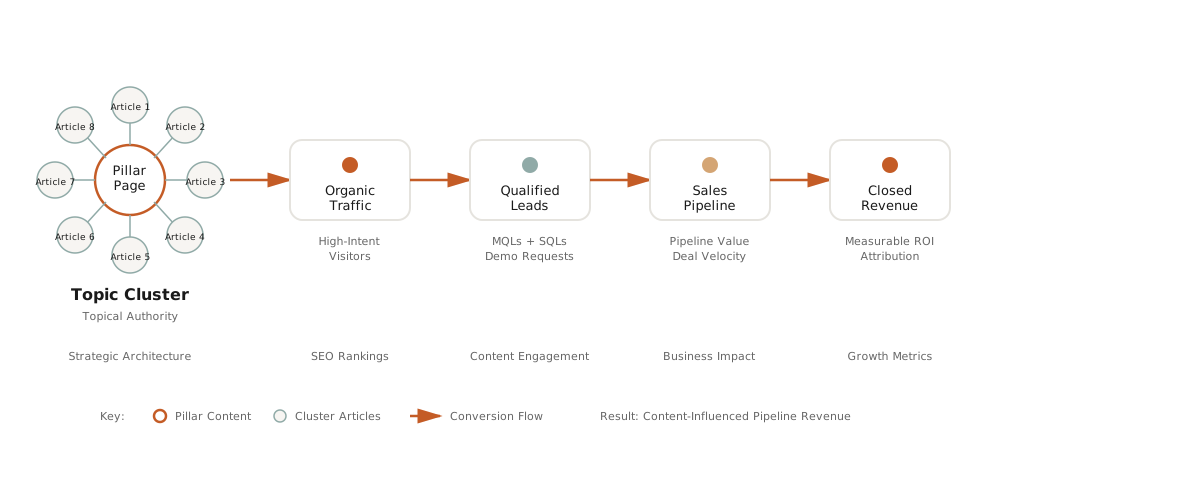
Here's how to build a B2B content marketing engine that actually generates pipeline revenue through topic cluster architecture, strategic distribution, and measurable attribution.
01 / why-content-marketing-matters-more-for-b2b-than
Why Content Marketing Matters More for B2B Than B2C
B2B buying cycles create unique content requirements that don't exist in consumer marketing:
B2B vs B2C Content Dynamics
| Factor | B2B | B2C | Content Implication |
|---|---|---|---|
| Decision Timeline | 3-18 months | Minutes to days | Need content for every stage over extended period |
| Touchpoints to Close | 12-27 interactions | 1-5 interactions | Multiple content formats required per buyer |
| Decision Makers | 5-8 stakeholders | 1-2 individuals | Content must address different personas/concerns |
| Purchase Motivation | ROI, risk mitigation | Emotion, desire | Education and proof dominate over persuasion |
| Research Behavior | 70% complete before contact | 20-30% before purchase | Content must work independently of sales team |
| Average Deal Size | $5K-$500K+ | $50-$5K | Higher stakes = deeper content requirements |
Real Example: SaaS Buyer Journey
A B2B SaaS company analyzed 200 closed deals and found:
- Average time from first content touchpoint to close: 4.7 months
- Average number of content pieces consumed: 13.4
- Decision committee size: 6.2 people
- Content types that influenced decision:
- Comparison/alternatives pages: 89% of deals
- Case studies: 76% of deals
- Technical documentation: 68% of deals
- Thought leadership blog posts: 58% of deals
- ROI calculators/tools: 44% of deals
When they implemented a topic cluster strategy that mapped content to buyer journey stages and personas, content-influenced pipeline increased 127% in 12 months.
This is why B2B content marketing can't be an afterthought. Your buyers are actively researching for months before they ever talk to sales. Content is your only chance to influence that research phase.
02 / the-topic-cluster-model-for-b2b-pipeline-generat
The Topic Cluster Model for B2B Pipeline Generation
Topic clusters organize content into strategic hubs that guide buyers through their journey while building topical authority for SEO.
Topic Cluster Architecture
A topic cluster consists of:
1. Pillar Page (Hub)
- Comprehensive resource on core topic (2,500-5,000 words)
- Targets high-volume head term keyword
- Links to all supporting content
- Serves as definitive guide
- Example: "Complete Guide to Marketing Automation for B2B SaaS"
2. Cluster Content (Spokes)
- 10-20 supporting articles on subtopics (1,000-2,000 words each)
- Target long-tail keywords and specific questions
- Link back to pillar page
- Address different buyer journey stages and personas
- Example: "How to Integrate Marketing Automation with Salesforce"
3. Internal Linking Structure
- All cluster content links to pillar
- Pillar links to all cluster content
- Related cluster articles link to each other
- Creates semantic relationship signals for search engines
Topic Cluster Model Diagram
                    [Pillar Page]
                  Marketing Automation
                         |
        _________________|_________________
       |         |        |        |       |
    [Blog 1] [Blog 2] [Blog 3] [Blog 4] [Blog 5]
    Lead      Email    Sales     ROI      Platform
    Scoring   Workflows Alignment Calculator Comparison
       |         |        |        |       |
    [Blog 6] [Blog 7] [Blog 8] [Blog 9] [Blog 10]
    (Each links back to pillar and related cluster content)
Why Topic Clusters Work for B2B
SEO Benefits:
- Google's algorithm favors topical depth over isolated articles
- Internal linking passes authority throughout cluster
- Comprehensive coverage increases chances of ranking for related queries
- Easier to defend rankings against competitors
User Experience Benefits:
- Buyers find related answers without leaving your site
- Natural progression through buyer journey
- Demonstrates expertise and thought leadership
- Reduces friction in research process
Pipeline Benefits:
- More pageviews per session = more engagement
- Clear next steps guide users toward conversion
- Content addresses multiple stakeholder concerns
- Better attribution data from connected journeys
Case Study: B2B Manufacturing Company
Before Topic Clusters:
- 180 blog posts published over 3 years
- Posts ranked individually, no strategic connection
- Average pages per session: 1.4
- Organic traffic: 8,200 visits/month
- Content-influenced MQLs: 12/month
After Implementing 5 Topic Clusters:
- Reorganized existing content into clusters
- Created 5 pillar pages for core offerings
- Added 35 new cluster articles over 6 months
- Updated internal linking across all content
- Average pages per session: 3.8 (+171%)
- Organic traffic: 24,600 visits/month (+200%)
- Content-influenced MQLs: 67/month (+458%)
- Content-influenced pipeline: $890K/month
The difference? Strategic architecture that guided buyers through connected journeys instead of isolated content experiences.
03 / content-types-that-drive-b2b-pipeline
Content Types That Drive B2B Pipeline
Different content formats serve different buyer journey stages and decision-maker personas. Map your content strategy across this matrix:
Buyer Journey Stage Content Framework
1. Awareness Stage: Problem Recognition
Goal: Help buyers identify and understand their problem Personas: Individual contributors, managers researching solutions Content Types:
- Thought leadership blog posts
- Industry trend analyses
- Problem definition guides
- Educational webinars
- Research reports
Example Topics:
- "7 Signs Your Sales Team Needs Marketing Automation"
- "Why B2B Companies Are Shifting from MQLs to Pipeline Metrics"
- "The True Cost of Manual Lead Routing"
Conversion Goals: Newsletter signup, content download, social follow
2. Consideration Stage: Solution Evaluation
Goal: Position your solution as viable option, address objections Personas: Managers, directors evaluating multiple vendors Content Types:
- Comparison/alternative pages
- Product capability guides
- Implementation timelines
- Pricing guides
- Demo videos
Example Topics:
- "[Competitor] vs [Your Product]: Feature Comparison"
- "How to Choose Marketing Automation Software: Buyer's Guide"
- "What to Expect in Your First 90 Days with [Product]"
Conversion Goals: Demo request, free trial, pricing consultation
3. Decision Stage: Final Validation
Goal: Provide proof and de-risk the purchase decision Personas: VP/C-level executives, procurement, legal Content Types:
- ROI calculators
- Case studies with specific results
- Customer testimonials by industry/role
- Technical documentation
- Security/compliance guides
Example Topics:
- "How [Company] Generated $2.3M in Pipeline with Marketing Automation"
- "Marketing Automation ROI Calculator: Estimate Your Return"
- "Enterprise Security & Compliance: SOC 2, GDPR, HIPAA"
Conversion Goals: Sales meeting, proposal request, contract negotiation
4. Implementation/Retention Stage: Success & Advocacy
Goal: Drive product adoption, expansion, and referrals Personas: Existing customers, customer success teams Content Types:
- Setup guides and tutorials
- Best practice frameworks
- Advanced feature training
- Success stories from similar companies
- Community resources
Example Topics:
- "Advanced Lead Scoring Models: Beyond Demographics"
- "10 Marketing Automation Workflows Every Team Should Build"
- "How to Prove Marketing's Revenue Impact to Your CEO"
Conversion Goals: Feature adoption, account expansion, referrals, case study participation
Content-to-Pipeline Mapping Table
| Buyer Stage | Primary Content Types | Average Time in Stage | Key Metrics | Pipeline Impact |
|---|---|---|---|---|
| Awareness | Blog posts, guides, webinars | 1-3 months | Traffic, engagement, email signups | Indirect (builds audience) |
| Consideration | Comparisons, demos, case studies | 1-2 months | Demo requests, trial starts | Medium (qualified leads) |
| Decision | ROI content, security docs, references | 2-4 weeks | Proposal requests, sales meetings | High (deal velocity) |
| Implementation | Tutorials, best practices, community | Ongoing | Feature adoption, NPS, referrals | High (expansion, advocacy) |
Strategic Principle: Most B2B companies over-index on awareness content and under-invest in decision-stage content. The highest-converting content lives at the bottom of the funnel, but it requires prospects already in your pipeline.
Build topic clusters that span ALL stages, not just awareness.
04 / building-your-topic-cluster-strategy
Building Your Topic Cluster Strategy
Here's a systematic approach to developing topic clusters that align with your buyer journey and business goals:
Step 1: Identify Core Topics (Pillar Candidates)
Your pillar topics should align with:
- Your core product/service categories
- High-value keywords your buyers search for
- Topics where you have genuine expertise
- Subjects that matter throughout buyer journey
Pillar Topic Selection Framework:
| Criteria | How to Evaluate | Example |
|---|---|---|
| Business Relevance | Does this topic connect to revenue? | "Marketing Automation" (sells our product) |
| Search Volume | Monthly searches for head term | 12,000+ searches/month |
| Keyword Difficulty | Can you realistically rank? | KD 30-60 (achievable with cluster) |
| Content Depth | Can you create 15+ related articles? | Yes (workflows, integrations, ROI, etc.) |
| Buyer Intent | Do searchers become customers? | High commercial intent |
Example Pillar Topics for B2B SaaS Company:
- Marketing Automation (Primary offering)
- Lead Generation Strategies (Top-of-funnel problem)
- Sales Enablement (Adjacent value proposition)
- Marketing Attribution (Key buyer concern)
- Account-Based Marketing (Strategic use case)
Aim for 3-7 pillar topics initially. You'll expand over time, but starting with focus prevents dilution.
Step 2: Map Cluster Content to Buyer Journey
For each pillar topic, brainstorm 15-25 supporting articles that address:
- Different buyer journey stages
- Different persona concerns
- Specific questions/objections
- Long-tail keyword opportunities
Example: "Marketing Automation" Cluster Content Map
Awareness Stage (Problem Recognition):
- "7 Signs You've Outgrown Your Email Marketing Tool"
- "The Hidden Costs of Manual Lead Management"
- "Marketing Automation vs Email Marketing: What's the Difference?"
Consideration Stage (Solution Evaluation):
- "HubSpot vs Marketo vs Pardot: Feature Comparison"
- "How to Calculate Marketing Automation ROI Before You Buy"
- "Marketing Automation Implementation Timeline: What to Expect"
- "Open Source vs Enterprise Marketing Automation Platforms"
Decision Stage (Final Validation):
- "10 Questions to Ask Marketing Automation Vendors"
- "Marketing Automation Case Study: How [Company] Generated 300% More MQLs"
- "Enterprise Security Requirements for Marketing Automation"
- "Marketing Automation Pricing Guide: What You'll Really Pay"
Implementation Stage (Customer Success):
- "Marketing Automation Setup Checklist: First 30 Days"
- "15 Essential Marketing Automation Workflows to Build First"
- "How to Train Your Team on Marketing Automation"
- "Integrating Marketing Automation with Salesforce: Step-by-Step"
Step 3: Conduct Keyword Research
For each article idea, identify:
- Primary keyword target
- Search volume
- Keyword difficulty
- Related questions/topics to address
Keyword Research Tools:
- Google Keyword Planner (free, good for B2B search volume)
- Ahrefs or Semrush (paid, comprehensive competitive analysis)
- AnswerThePublic (free, good for question-based keywords)
- Your own site search data (what are visitors already searching for?)
Keyword Selection Criteria for B2B:
| Metric | Ideal Range | Why |
|---|---|---|
| Search Volume | 100-2,000/month | B2B niches have lower volume than B2C; 100+ is meaningful |
| Keyword Difficulty | 15-50 | Achievable with quality content and internal linking |
| Commercial Intent | High | Look for keywords with buying intent, not just information seeking |
| Relevance to Product | Direct or adjacent | Every article should connect to your solution eventually |
Don't chase high-volume keywords with no commercial intent. A keyword with 200 searches/month from qualified buyers beats 5,000 searches from students researching a class project.
Step 4: Create Pillar Pages First
Build your pillar content before cluster articles. This gives you:
- Foundation to link cluster content back to
- URL authority that distributes to cluster
- Clear structure for organizing supporting content
Pillar Page Structure:
-
Introduction (300-500 words)
- What this topic is
- Why it matters for your audience
- What readers will learn
-
Core Sections (2,000-3,500 words)
- 5-8 major subtopics
- Each section 300-500 words
- Include examples, data, visuals
- Link to related cluster content
-
Resources Section (200-300 words)
- Links to all cluster articles
- Organized by topic or buyer stage
- Brief description of each resource
-
Call-to-Action
- Relevant next step (demo, download, consultation)
- Low-friction conversion option (newsletter, tool)
Pillar Page SEO Checklist:
- Target keyword in H1, first paragraph, 2-3 subheadings
- Meta description with target keyword (150-160 chars)
- URL structure:
/topic-name/(short, clean) - Table of contents with jump links
- 5-10 internal links to cluster content
- 3-5 external links to authoritative sources
- Images with descriptive alt text
- Schema markup (Article or HowTo)
Step 5: Develop Cluster Content Systematically
Create cluster articles in strategic order:
Priority 1: Decision-Stage Content (Weeks 1-4)
- Comparison pages
- Case studies
- ROI/pricing content
- These drive immediate pipeline impact
Priority 2: Consideration-Stage Content (Weeks 5-10)
- How-to guides
- Buyer's guides
- Implementation resources
- These qualify and educate active buyers
Priority 3: Awareness-Stage Content (Weeks 11-20)
- Thought leadership
- Problem definition
- Industry trends
- These build long-term audience
Why this order? Bottom-of-funnel content converts faster. Build conversion pathways first, then drive traffic to them.
Cluster Article Structure (1,000-2,000 words):
-
Hook (100-150 words)
- Specific problem or question
- Why it matters
- What this article covers
-
Body Content (700-1,500 words)
- 3-5 main sections with H2 headings
- Actionable insights and examples
- Data or case studies where relevant
-
Internal Links (embedded throughout)
- Link to pillar page in introduction
- Link to 2-3 related cluster articles
- Link to conversion pages (demo, pricing)
-
Conclusion + CTA (100-200 words)
- Key takeaways
- Next step recommendation
- Conversion opportunity
Step 6: Optimize Internal Linking
Internal linking architecture is what makes topic clusters work for SEO and user experience.
Internal Linking Rules:
- Every cluster article links to pillar page (usually in introduction and conclusion)
- Pillar page links to every cluster article (in resources section)
- Related cluster articles link to each other (2-3 contextual links per article)
- Use descriptive anchor text (not "click here" but "learn how to calculate marketing automation ROI")
- Link to conversion pages (demo, pricing, contact) from relevant articles
Internal Link Distribution Example:
Pillar Page "Marketing Automation Guide"
  → Links OUT to: 20 cluster articles, demo page
  ← Links IN from: 20 cluster articles, homepage, main navigation

Cluster Article "HubSpot vs Marketo Comparison"
  → Links OUT to: Pillar page, 3 related cluster articles, demo page
  ← Links IN from: Pillar page, 2 related cluster articles
The pillar page becomes your highest-authority page through concentrated internal linking, which helps all cluster content rank better.
05 / distribution-strategy-getting-your-content-in-fr
Distribution Strategy: Getting Your Content in Front of Buyers
Publishing content isn't enough. B2B distribution requires a multi-channel approach that meets buyers where they're already researching.
1. SEO-First Content Creation
Before writing any article:
- Research target keywords and search intent
- Analyze top-ranking competitor content
- Identify content gaps you can fill better
On-Page SEO Fundamentals:
- Primary keyword in title, H1, first paragraph, 2-3 H2s
- Secondary keywords naturally throughout
- Meta description that drives clicks (150-160 chars)
- Image alt text with descriptive keywords
- Internal links to related content
- External links to authoritative sources
- Mobile-responsive formatting
- Fast page load speed (under 3 seconds)
Technical SEO for Content:
- Clean URL structure (
/blog/keyword-topic/) - Schema markup (Article, FAQ, HowTo)
- XML sitemap inclusion
- Canonical tags (avoid duplicate content)
- Social sharing meta tags (Open Graph, Twitter Card)
Organic search should be your primary long-term distribution channel. Content that ranks drives compounding traffic without ongoing ad spend.
2. LinkedIn and Social Amplification
B2B buyers live on LinkedIn. Your content distribution strategy must include active social promotion.
LinkedIn Content Strategy:
Company Page Posts:
- Share every new article within 24 hours of publishing
- Use native document posts for key insights
- Create carousel posts summarizing pillar content
- Post 3-5x per week minimum
Executive/Employee Advocacy:
- Have team members share content from personal profiles
- Rewrite headlines for social (don't just copy blog title)
- Add personal commentary ("Here's why this matters...")
- Tag relevant connections and companies
LinkedIn Article Publishing:
- Republish select blog posts as LinkedIn articles
- Cross-link back to your website
- Engage with comments to boost visibility
Social Promotion Framework:
| Platform | Post Frequency | Content Types | Primary Goal |
|---|---|---|---|
| 3-5x/week | Article shares, insights, data highlights | Drive traffic, build thought leadership | |
| Twitter/X | 1-2x/day | Quick insights, article threads, engagement | Build awareness, share timely content |
| 2-3x/week | Longer-form insights, case studies | Reach decision-makers in certain industries | |
| YouTube | 1-2x/month | Video summaries of pillar content | Capture video search traffic |
Amplification Tactics That Work:
- Employee advocacy programs (team shares content)
- Paid social promotion for high-value content (boost top articles)
- Community engagement (answer questions in relevant groups)
- Influencer partnerships (co-create or guest post)
3. Email Nurture Integration
Your email list is your owned audience. Use content to nurture subscribers toward conversion.
Email Content Strategy:
1. Weekly Newsletter
- Share new articles + brief insights
- Curate external resources (builds trust)
- Include one clear CTA
- Segment by buyer stage when possible
2. Automated Drip Sequences
- Welcome series: Introduce brand + share pillar content
- Topic-based sequences: Send cluster content based on interests
- Re-engagement campaigns: Share best-performing content
3. Triggered Campaigns
- Download a guide → Send related articles
- Attend webinar → Share implementation resources
- Request demo → Send decision-stage content (case studies, ROI)
Email-to-Content Connection Points:
| Email Type | Content to Include | Goal |
|---|---|---|
| Welcome Email | Link to pillar page matching signup source | Orient new subscriber |
| Weekly Newsletter | 2-3 recent articles + 1 evergreen pillar | Drive traffic, build habit |
| Lead Nurture Sequence | Progression through buyer journey content | Educate toward demo/trial |
| Re-engagement Campaign | "Our most popular content" (top 5 articles) | Recapture inactive subscribers |
Track email→content→conversion paths. You'll discover which articles actually drive pipeline.
4. Sales Enablement Content
Your sales team should use your content throughout the deal cycle.
How Sales Should Use Content:
Prospecting:
- Share relevant blog posts in cold outreach
- Reference thought leadership to build credibility
- Use content as reason to follow up
Discovery/Qualification:
- Send educational content based on prospect's stated challenges
- Share case studies from similar companies
- Provide buyer's guides to educate multiple stakeholders
Proposal/Negotiation:
- Include ROI calculators and pricing guides
- Reference security/compliance documentation
- Share customer success stories
Sales Enablement Best Practices:
- Create content library organized by buyer stage and industry
- Add content recommendations to CRM (Salesforce tasks)
- Track which content gets shared in deals that close
- Train sales team on how/when to share content
When sales actively uses your content, you can measure content's direct impact on deal velocity and close rates.
06 / measuring-content-marketing-roi-attribution-for
Measuring Content Marketing ROI: Attribution for B2B
B2B attribution is complex because deals involve multiple touchpoints over months. But you need to measure content's pipeline impact to justify continued investment.
Attribution Models for B2B Content
1. First-Touch Attribution
- Credits content that initiated buyer journey
- Pros: Shows top-of-funnel performance
- Cons: Ignores nurture and decision-stage influence
- Best for: Measuring awareness content effectiveness
2. Last-Touch Attribution
- Credits final content interaction before conversion
- Pros: Shows what directly drives conversions
- Cons: Ignores all earlier touchpoints
- Best for: Measuring bottom-funnel content
3. Multi-Touch Attribution
- Distributes credit across all content touchpoints
- Pros: Most accurate picture of content's role
- Cons: Complex to implement and track
- Best for: Comprehensive content ROI analysis
4. Time-Decay Attribution
- Gives more credit to recent touchpoints
- Pros: Balances early awareness and late decision influence
- Cons: Still requires sophisticated tracking
- Best for: B2B with long sales cycles
Recommended Approach: Use multi-touch or time-decay attribution if you have the tracking infrastructure. If not, track BOTH first-touch and last-touch to understand content's full journey impact.
Key Content Marketing Metrics
Traffic & Engagement Metrics:
- Organic traffic by topic cluster
- Pages per session (measure internal linking effectiveness)
- Average time on page
- Scroll depth
- Return visitor rate
Lead Generation Metrics:
- Content downloads
- Newsletter signups
- Demo requests from content
- Trial starts from content
- Form fills attributed to content
Pipeline Metrics (Most Important):
- MQLs influenced by content (any touchpoint)
- SQLs influenced by content
- Pipeline value influenced by content
- Closed-won deals influenced by content
- Average deal size for content-influenced vs non-influenced
Content Efficiency Metrics:
- Cost per content piece
- Traffic per content piece
- Leads per content piece
- Pipeline per content piece
- ROI per content piece
Attribution Tracking Example:
| Metric | Q1 2025 | Q2 2025 | Change | Notes |
|---|---|---|---|---|
| Organic Traffic | 18,400 | 31,200 | +70% | Topic clusters launched Q2 |
| Content-Influenced MQLs | 89 | 156 | +75% | Tracking improved + more content |
| Content-Influenced Pipeline | $780K | $1.4M | +79% | Stronger bottom-funnel content |
| Content-Influenced Closed-Won | $210K | $420K | +100% | Decision-stage content working |
| Content Cost per MQL | $124 | $89 | -28% | Efficiency improving |
Implementing Content Attribution
Tool Stack for Tracking:
1. Google Analytics 4
- Set up custom events for content interactions
- Track scroll depth and time on page
- Create segments for content consumers
- Build conversion paths reports
2. CRM (Salesforce, HubSpot)
- Track content downloads as activities
- Log email opens/clicks on content
- Record which content assets sales shares
- Custom fields for content influence
3. Marketing Automation (HubSpot, Marketo, Pardot)
- Score leads based on content engagement
- Trigger workflows from content downloads
- Track campaign member status
- Multi-touch attribution reporting
4. Specialized Attribution Tools (optional)
- Bizible/Marketo Measure
- DreamData
- Attribution
- Full-funnel reporting and custom models
Simple Attribution Tracking (if you don't have advanced tools):
- UTM Parameters: Tag all content links in email and social (
?utm_source=linkedin&utm_medium=social&utm_campaign=topic-cluster-ma) - Content Offer Tracking: Unique forms/CTAs per content piece to track conversions
- CRM Custom Fields: Add "Content Influenced" checkbox and "First Content Touchpoint" field
- Monthly Reporting: Pull list of all deals that interacted with content, calculate % and revenue
Sample Report Structure:
Content Marketing Performance - January 2026

Traffic:
- Total Organic Visitors: 24,600 (+12% MoM)
- Top Performing Cluster: Marketing Automation (8,400 visits)
- Top Article: "HubSpot vs Marketo Comparison" (1,240 visits, 89 demo requests)

Lead Generation:
- Content Downloads: 340 (+18% MoM)
- Newsletter Signups: 520 (+22% MoM)
- Demo Requests from Content: 67 (+31% MoM)

Pipeline Impact:
- Content-Influenced MQLs: 156 (54% of all MQLs)
- Content-Influenced SQLs: 78 (49% of all SQLs)
- Content-Influenced Pipeline Created: $1.4M (61% of pipeline)
- Content-Influenced Closed-Won: $420K (58% of revenue)

ROI:
- Content Investment: $18,500 (team time + tools + writers)
- Pipeline Generated: $1.4M
- Revenue Generated: $420K
- ROI: 22.7x
Track these metrics monthly. You'll identify which content drives results and where to invest more.
07 / common-b2b-content-marketing-mistakes
Common B2B Content Marketing Mistakes
Even experienced marketing teams fall into these traps:
Mistake 1: Publishing Without Strategy
The Problem: Writing individual articles based on what "sounds interesting" instead of strategic buyer journey mapping.
The Fix: Build topic clusters mapped to buyer journey stages. Every piece of content should have a clear purpose and fit into your overall architecture.
Mistake 2: Ignoring Bottom-of-Funnel Content
The Problem: Over-investing in awareness content (blog posts about industry trends) and under-investing in decision-stage content (comparisons, case studies, ROI content).
The Fix: Create decision-stage content first. It converts faster and helps you prove content ROI, which justifies continued investment.
Mistake 3: No Distribution Plan
The Problem: Publishing content and assuming "if we build it, they will come."
The Fix: Spend as much time on distribution as creation. Plan email promotion, social sharing, sales enablement, and paid amplification before you hit publish.
Mistake 4: Writing for Everyone
The Problem: Generic content that tries to appeal to all audiences ends up resonating with no one.
The Fix: Define specific buyer personas and create content for each. An article for CFOs should look different than one for marketing managers.
Mistake 5: No Internal Linking
The Problem: Each article exists in isolation. Users read one post and leave.
The Fix: Implement topic cluster linking architecture. Every article should link to 3-5 related pieces of content.
Mistake 6: Not Tracking Attribution
The Problem: Can't prove content's impact on pipeline, so budget gets cut when times are tough.
The Fix: Implement attribution tracking from day one. Track content touches in CRM and report on content-influenced pipeline monthly.
Mistake 7: Inconsistent Publishing
The Problem: Publish 10 articles one month, nothing for three months, then a burst of activity.
The Fix: Commit to consistent publishing cadence. 2-4 articles per month consistently beats 20 articles sporadically.
Mistake 8: Keyword Stuffing
The Problem: Awkwardly forcing keywords into content to "optimize for SEO," which makes it unreadable.
The Fix: Write for humans first. Use keywords naturally in titles, headings, and where they fit contextually. Google's algorithm is smart enough to understand semantic relevance.
Mistake 9: No Content Refresh Strategy
The Problem: Content decays over time. Old statistics, outdated screenshots, broken links hurt rankings and credibility.
The Fix: Audit content quarterly. Update top-performing articles with fresh data, new examples, and improved SEO. Republish with new date.
Mistake 10: Treating Content as a Project, Not a Program
The Problem: Launch content initiative, publish for 3-6 months, then move on to next shiny tactic.
The Fix: Content marketing is compounding. The longer you invest consistently, the better returns. Commit to 12-24 months minimum before judging results.
08 / building-your-b2b-content-engine-implementation
Building Your B2B Content Engine: Implementation Roadmap
Here's a 90-day plan to launch a topic cluster content strategy:
Month 1: Foundation & Strategy
Week 1-2: Research & Planning
- Analyze buyer journey and identify content gaps
- Interview sales team about common buyer questions
- Review analytics: what content already performs well?
- Conduct keyword research for 3-5 pillar topics
- Map out topic cluster structure (pillar + 15+ cluster articles per topic)
Week 3-4: Create First Pillar Page
- Write comprehensive 2,500-3,500 word pillar page
- Optimize for target keyword
- Design visual assets (diagrams, screenshots)
- Publish and promote pillar page
- Set up tracking and attribution
Deliverables: Strategic content plan, first pillar page published
Month 2: Build Cluster Content
Week 5-8: Publish Decision-Stage Content
- Write 4-6 bottom-funnel articles (comparison, case studies, ROI)
- Optimize each for long-tail keywords
- Implement internal linking to pillar
- Create lead magnets/CTAs for each article
- Promote via email, social, sales enablement
Focus: Convert active buyers currently in your pipeline
Deliverables: 4-6 decision-stage articles published, email promotion campaigns
Month 3: Scale & Measure
Week 9-10: Publish Consideration Content
- Write 4-6 mid-funnel articles (how-to, buyer's guides)
- Internal linking across cluster
- Social promotion campaign
Week 11-12: Measure & Optimize
- Analyze performance data (traffic, engagement, conversions)
- Identify top-performing content
- Refresh underperforming content
- Plan next quarter's content priorities
- Report on content-influenced pipeline
Deliverables: 4-6 consideration-stage articles, performance report, Q2 content plan
Ongoing: Month 4+
Content Production:
- Publish 4-8 articles per month
- Balance across buyer journey stages
- Expand to additional topic clusters
- Refresh top content quarterly
Distribution & Promotion:
- Email newsletter weekly
- Social promotion 3-5x/week
- Sales enablement integration
- Paid promotion for top content
Measurement & Optimization:
- Monthly performance reporting
- Quarterly content audits
- A/B test CTAs and formats
- Refine attribution model
09 / content-marketing-the-long-game-that-compounds
Content Marketing: The Long Game That Compounds
B2B content marketing isn't a quick win. It's a compounding investment that builds value over time. The content you publish today will drive pipeline six months from now. The topic clusters you build this quarter will rank higher and generate more leads next year.
Most companies give up too early because they expect immediate results. Content marketing takes 6-12 months to gain traction and 12-24 months to show strong ROI. But once it's working, it becomes your most efficient customer acquisition channel.
The Compounding Effect of Content:
| Timeline | What's Happening | Expected Results |
|---|---|---|
| Months 1-3 | Building foundation, publishing initial content | Low traffic, minimal leads, building search authority |
| Months 4-6 | Content starts ranking, internal linking creates SEO lift | Traffic growing 15-30% MoM, first content-influenced deals |
| Months 7-12 | Topic clusters mature, multiple articles rank page 1 | Traffic growing 20-50% MoM, content is 30-50% of pipeline |
| Months 13-24 | Established authority, organic content scales | Content drives 50-70% of pipeline, lowest CAC channel |
| Year 2+ | Dominant search positions, content flywheel spinning | Content is primary demand gen engine, high ROI |
The companies that win with B2B content marketing are the ones that commit to the strategy, execute consistently, measure rigorously, and optimize relentlessly.
Start with one topic cluster. Build the pillar page, create 10-15 supporting articles, distribute strategically, and measure results. Once you prove the model works, scale to additional clusters.
Your buyers are researching right now. The question is whether they're finding your content or your competitors'.
10 / ready-to-build-a-content-engine-that-drives-pipe
Ready to Build a Content Engine That Drives Pipeline?
At WE•DO, we help B2B companies build topic cluster content strategies that generate measurable pipeline revenue. We handle everything from keyword research and content creation to distribution and attribution tracking.
We've helped B2B SaaS, manufacturing, professional services, and technology companies increase content-influenced pipeline by 200-400% through strategic content architecture.
Schedule a content strategy consultation to discuss your buyer journey, content gaps, and growth goals. Or explore our SEO & content services to learn how we combine content marketing with technical SEO for maximum organic growth.
Related Resources: