The rules of B2B organic acquisition have fundamentally changed. For years, ranking on page one of Google was the endgame for enterprise marketing teams. But in 2026, your buyers are discovering solutions through ChatGPT, Perplexity, and Google's AI Overviews before they ever reach your website. Traditional SEO alone is no longer enough.
This creates both a challenge and an opportunity. B2B companies that adapt their organic growth strategy to this new reality will dominate their categories. Those that don't will watch their hard-won rankings lose effectiveness as traffic patterns shift toward AI-mediated search.
This guide covers the complete B2B organic growth playbook: proven SEO fundamentals, emerging AI search optimization strategies, content marketing frameworks that drive pipeline, and programmatic approaches that scale efficiently. Whether you're a SaaS company, professional services firm, or industrial manufacturer, these strategies will help you build sustainable organic growth.
01 / why-b2b-organic-growth-matters-more-than-ever
Why B2B Organic Growth Matters More Than Ever
Organic search remains the highest-ROI channel for B2B companies, but the landscape is evolving rapidly. Consider these shifts:
Traditional search behavior is fragmenting. Buyers no longer start every research session with Google. They ask ChatGPT for vendor comparisons, use Perplexity to analyze technical specifications, and rely on AI Overviews for quick answers without clicking through to websites.
Purchase cycles are getting longer and more complex. The average B2B software purchase now involves 6-10 decision makers and 3-6 months of research. Your content needs to support buyers across this entire journey, not just capture them at the bottom of the funnel.
Competition for attention is intensifying. Every category has more players creating more content. Undifferentiated blog posts and generic "ultimate guides" no longer cut through. You need strategic depth and genuine expertise to rank and convert.
The good news: companies that build comprehensive organic growth strategies see compounding returns. Strong domain authority, topical authority in your niche, and structured content ecosystems become moats that competitors struggle to overcome.
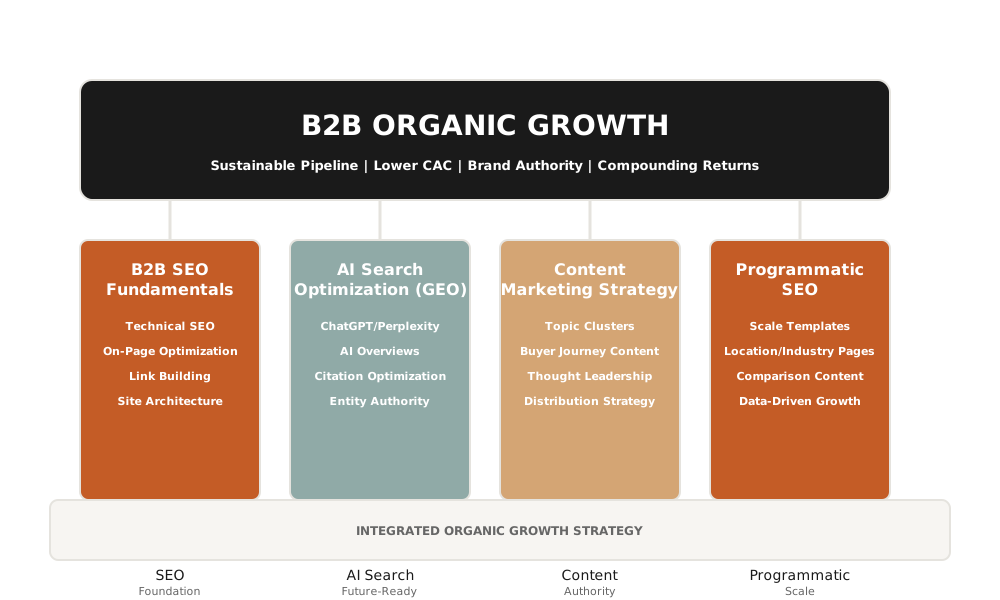
Let's break down the four pillars of B2B organic growth and how to execute each one effectively.
02 / pillar-1-b2b-seo-strategy-fundamentals
Pillar 1: B2B SEO Strategy Fundamentals
SEO for B2B companies is fundamentally different from B2C or local search optimization. You're targeting smaller search volumes with higher intent, longer buying cycles, and stakeholders who need to justify ROI to multiple decision makers.
Technical SEO Foundation
Before investing in content or link building, ensure your technical foundation is solid. Enterprise websites often suffer from fundamental issues that limit their organic potential:
Site architecture and crawlability. Large B2B websites frequently have hundreds or thousands of pages across product lines, case studies, resources, and documentation. Poor information architecture creates crawl depth issues where important pages sit 4-5 clicks from the homepage. Implement a hub-and-spoke model where pillar pages link to supporting content and back again.
Page speed and Core Web Vitals. B2B sites with heavy product imagery, embedded videos, and complex interactive tools often struggle with performance. Google's Core Web Vitals directly impact rankings. Prioritize Largest Contentful Paint (LCP) under 2.5 seconds, First Input Delay (FID) under 100ms, and Cumulative Layout Shift (CLS) under 0.1.
Mobile optimization. While B2B buyers often research on desktop, mobile traffic accounts for 40-50% of initial research sessions. Responsive design isn't optional, and mobile page speed deserves dedicated optimization.
International SEO for global B2B. Companies selling across regions need proper hreflang implementation, regional content customization, and country-specific domain strategies. Half-implemented international SEO creates duplicate content issues and dilutes ranking potential.
On-Page SEO for B2B
B2B on-page optimization requires balancing technical precision with readability for sophisticated audiences.
Keyword targeting strategy. Focus on commercial intent keywords and problem-solution queries. "Project management software for construction" outperforms "best project management software" for B2B because it signals specific buyer need. Research not just primary keywords but the semantic clusters around them.
Content depth and expertise. Google's Helpful Content system rewards genuine expertise and comprehensive coverage. A 1,200-word generic blog post won't compete against a 3,500-word guide with original frameworks, data, and insights. Show don't tell your expertise.
Structured data implementation. Schema markup helps search engines understand your content type and context. Implement Organization schema, Product schema for your offerings, Article schema for blog posts, and FAQ schema for common questions. This becomes even more critical for AI search optimization.
Internal linking strategy. Strategic internal links pass authority, establish topical relationships, and guide users through your content. Every blog post should link to 3-5 related pieces and your core conversion pages. Use descriptive anchor text that includes target keywords naturally.
B2B Link Building
Link acquisition for B2B requires different tactics than consumer industries. Your goal is authority and relevance, not volume.
Digital PR and thought leadership. Contribute expert commentary to industry publications, participate in original research studies, and build relationships with journalists covering your sector. A single link from a tier-one industry publication carries more weight than dozens of generic directory links.
Strategic partnerships and integrations. B2B companies with technology partnerships, integration ecosystems, or service provider networks can earn high-quality links through these relationships. Co-marketing campaigns, integration marketplace listings, and joint webinars all create link opportunities.
Original research and data. Publishing proprietary research, industry benchmarks, or survey data attracts natural backlinks from journalists, analysts, and other companies citing your findings. This strategy compounds over time as authoritative content continues earning links months or years after publication.
Broken link building and resource pages. Identify high-authority sites in your industry with broken links or outdated resource pages. Reach out with superior replacement content. This tactic requires more effort but yields higher success rates than generic outreach.
For comprehensive coverage of B2B SEO implementation, see our complete guide to B2B SEO best practices and enterprise SEO scaling strategies.
03 / pillar-2-ai-search-optimization-and-generative-e
Pillar 2: AI Search Optimization and Generative Engine Optimization
The rise of AI-powered search represents the biggest shift in organic acquisition since mobile. ChatGPT, Perplexity, Claude, and Google's AI Overviews are changing how buyers discover and evaluate B2B solutions.
Understanding Generative Engine Optimization (GEO)
Generative Engine Optimization is the practice of optimizing content for AI language models and AI-mediated search experiences. Unlike traditional SEO where the goal is ranking position, GEO focuses on citation frequency, answer quality, and brand mentions within AI-generated responses.
Why GEO matters for B2B. When a prospect asks ChatGPT "What are the best enterprise resource planning systems for manufacturing?" they receive a curated answer with 3-5 vendor recommendations. If your brand isn't mentioned, you've lost a potential buyer before they ever visit your website. GEO determines whether you're in that initial consideration set.
Key differences between SEO and GEO. Traditional SEO optimizes for ranking algorithms and click-through rates. GEO optimizes for being cited as a source, providing clear structured answers, and establishing topical authority that AI models recognize. Rankings matter less than representation in generated answers.
The citation economy. AI models cite sources they find authoritative, comprehensive, and current. Building citation-worthy content requires depth, structured information, and clear attribution of facts and claims. Think like you're writing for a research assistant who needs to cite reliable sources.
Optimizing for ChatGPT, Perplexity, and AI Overviews
Each AI search platform has different characteristics, but several optimization strategies work across all of them:
Structured, scannable content formats. AI models excel at extracting information from well-structured content. Use clear headings, bullet points, tables, and definitions. Answer questions directly and completely before elaborating. Put key information high in the content where it's easier to extract.
Entity optimization and semantic clarity. AI models understand entities (companies, products, people, concepts) and their relationships. Clearly define what your company does, what problems you solve, and who you serve. Use consistent terminology and establish entity relationships through context and schema markup.
Comprehensive topic coverage. AI models favor sources that comprehensively cover a topic over those that skim the surface. A 3,000-word guide with unique insights outperforms ten 500-word blog posts on related subtopics. Build content hubs that demonstrate deep expertise.
Citation-worthy statistics and research. Include original data, research citations, and specific statistics. AI models cite sources when they provide concrete, verifiable information. "Conversion rates improved by 47%" is more citable than "significant improvement in conversions."
Freshness and recency signals. AI models weight recent content more heavily for time-sensitive queries. Regularly update cornerstone content, publish content with current dates, and address recent developments in your industry.
Comparative content and evaluative frameworks. B2B buyers use AI search to evaluate options and compare alternatives. Content that objectively compares solutions, provides evaluation frameworks, or helps buyers make informed decisions gets cited frequently.
Measuring GEO Performance
Traditional SEO metrics like keyword rankings don't fully capture AI search visibility. Track these signals instead:
Brand mention frequency in AI responses. Regularly query AI platforms with relevant buyer questions and track whether your brand appears in responses. "What are the leading CRM platforms for real estate?" should consistently surface your brand if you compete in that space.
Citation analysis. When AI models cite your content, note which pages and content types get referenced most often. This reveals what resonates as authoritative.
Zero-click search implications. Google's AI Overviews often answer questions without users clicking through. While this reduces traffic, being featured in the Overview establishes credibility and can drive branded searches later in the buying journey.
Traffic patterns from AI search. Some AI platforms now include links to sources. Monitor referral traffic from these platforms as they grow.
For deeper coverage of AI search optimization, explore our guides on what Generative Engine Optimization is and how it works, the key differences between GEO and SEO, and specific tactics to rank in ChatGPT, Perplexity, and AI Overviews.
04 / pillar-3-b2b-content-marketing-strategy
Pillar 3: B2B Content Marketing Strategy
Content marketing drives B2B organic growth, but only when executed strategically. Random blog posts don't move the needle. You need a systematic approach that builds topical authority, supports the entire buyer journey, and converts traffic into pipeline.
The Topic Cluster Model
Topic clusters have become the dominant content strategy framework for B2B SEO because they align with how search engines assess topical authority and how buyers actually research solutions.
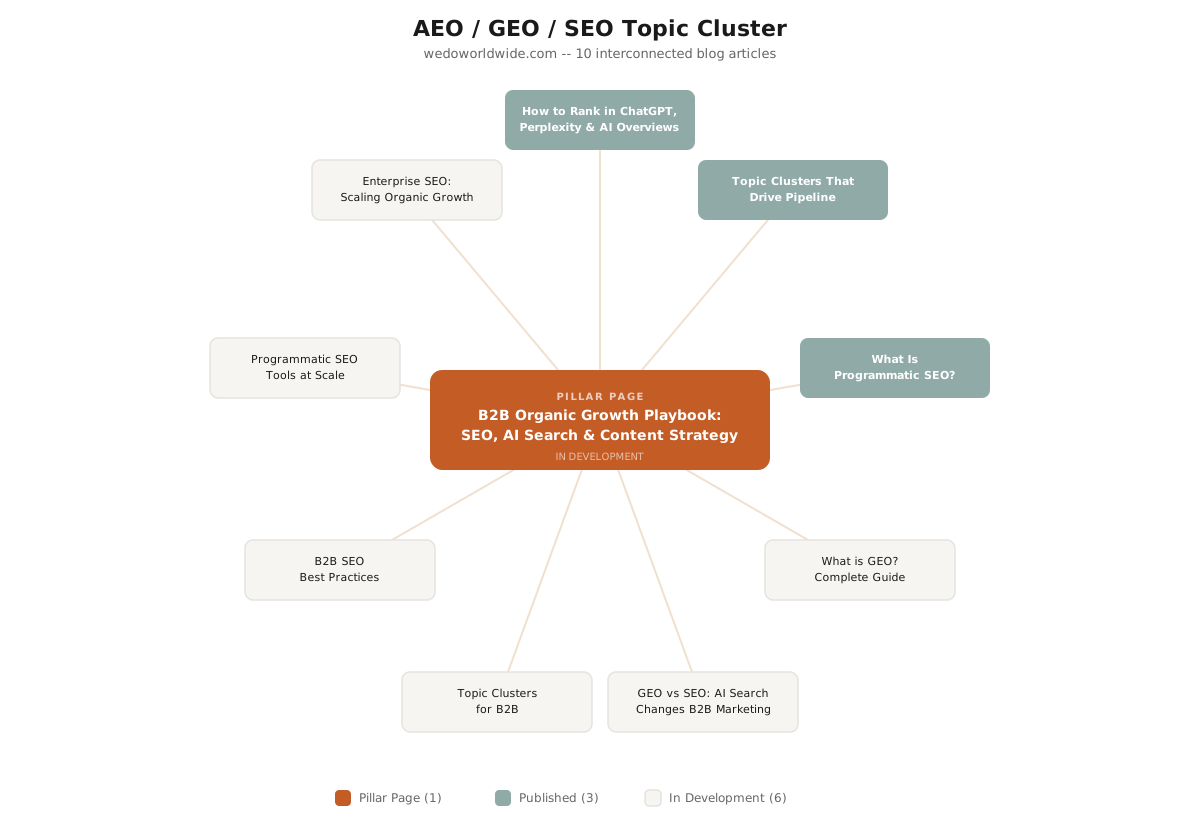
Pillar-and-spoke architecture. A topic cluster consists of one comprehensive pillar page covering a broad topic and 5-15 supporting cluster posts covering specific subtopics in depth. All cluster posts link back to the pillar, and the pillar links out to each cluster post. This structure signals topical authority to search engines.
Choosing pillar topics. Effective pillar topics have sufficient search volume and business relevance. They should align with your core value proposition and represent significant buyer research areas. "Marketing automation" is a pillar topic for a marketing software company. "Email deliverability best practices" is a cluster post supporting that pillar.
Cluster content depth. Each cluster post should comprehensively cover its specific subtopic. A cluster post on "lead scoring models" should rival or exceed the depth of any competing content on that specific topic. Surface-level cluster posts weaken the entire cluster's authority.
Internal linking strategy for clusters. Every cluster post links back to the pillar with keyword-rich anchor text. The pillar links to each cluster post. Cluster posts link to related cluster posts within the same topic family. This creates a dense internal linking network that search engines recognize as comprehensive topic coverage.
Topic clusters and buyer journey mapping. Structure clusters to support buyers at different stages. Awareness-stage cluster posts address problems and explore solutions. Consideration-stage content compares approaches and evaluates options. Decision-stage content provides implementation guidance and ROI frameworks.
Content Types That Drive B2B Pipeline
Different content formats serve different purposes in the B2B buying journey. Effective content strategies deploy multiple formats strategically.
Long-form guides and playbooks. Comprehensive guides (2,500-5,000 words) that provide complete frameworks for solving specific problems build authority and capture high-intent traffic. These often serve as pillar content in topic clusters.
Case studies and customer stories. Decision-stage buyers need proof that your solution delivers results. Case studies that follow a clear structure (challenge, solution, results with metrics) convert high-intent traffic. Include specific results, implementation timelines, and customer quotes.
Comparison content. "X vs Y" and "Best X for Y" content captures buyers actively evaluating options. This content drives high conversion rates when it honestly evaluates trade-offs and guides buyers to the right choice for their needs, even if that's sometimes not you.
Original research and industry benchmarks. Publishing proprietary research establishes thought leadership and earns backlinks. Survey your customers, analyze usage data, or compile industry statistics. Update annually to maintain relevance.
Tools, calculators, and interactive content. ROI calculators, assessment tools, and interactive content provide immediate value, capture leads, and earn links. A well-designed calculator can become your highest-converting landing page.
Technical documentation and implementation guides. For technical B2B products, searchable documentation serves both SEO and customer success purposes. Prospects evaluating your solution want to see how it actually works.
Content Distribution and Amplification
Creating strong content isn't enough. B2B companies need systematic distribution strategies to maximize reach and impact.
Email marketing integration. Promote new content to your email list, segment by topic relevance, and repurpose content into email series. Blog posts can become multi-part email courses.
LinkedIn and social distribution. LinkedIn drives significant B2B traffic. Share content consistently, engage in industry discussions, and encourage your team to amplify content through their networks.
Sales enablement. Equip your sales team with content for specific buyer objections, decision stages, and use cases. Track which content accelerates deals and creates more of what works.
Paid amplification for high-value content. Use targeted LinkedIn ads or Google ads to promote cornerstone content to high-value audiences. Amplifying your best content reaches buyers who won't find it organically.
Partnership and co-marketing. Collaborate with complementary vendors, service providers, or industry organizations to extend reach. Guest posting, webinar partnerships, and co-authored research all amplify distribution.
For detailed implementation guidance, see our deep-dive guides on B2B content marketing and topic clusters and how to structure topic clusters for maximum ranking potential.
05 / pillar-4-programmatic-seo-for-b2b-scale
Pillar 4: Programmatic SEO for B2B Scale
When you need to rank for hundreds or thousands of keyword variations, manual content creation doesn't scale. Programmatic SEO uses data and templates to generate large volumes of targeted landing pages efficiently.
What Is Programmatic SEO
Programmatic SEO creates landing pages at scale by combining database content with page templates. Instead of manually writing 500 city-specific landing pages, you create one template and populate it with data for each location. Instead of manually creating comparison pages for every competitor combination, you generate them programmatically.
When programmatic SEO makes sense for B2B. This approach works best when you have:
- A large dataset to leverage (locations, product combinations, use cases, industries, integrations)
- Significant search volume across keyword variations with similar intent
- The ability to provide genuinely useful information on each generated page
- Resources to build and maintain the technical infrastructure
The quality imperative. Google's algorithms detect and penalize thin, auto-generated content. Successful programmatic SEO requires each generated page to provide real value. Include unique data, thoughtful organization, and functionality that justifies the page's existence.
Programmatic SEO Use Cases for B2B
Several programmatic approaches work particularly well for B2B companies:
Location-based landing pages. Service businesses with multiple locations (accounting firms, IT support companies, commercial contractors) can create location-specific pages that rank for "[service] in [city]" searches. Include local data, testimonials from that area, and relevant case studies to avoid thin content issues.
Industry or vertical-specific pages. If your solution serves multiple industries, create industry-specific landing pages that speak to particular pain points, regulations, and use cases. "Construction project management software" and "healthcare project management software" attract different buyers with different needs.
Integration and compatibility pages. B2B software companies can create pages for every integration, API partnership, or compatible platform. "Salesforce integration," "HubSpot integration," etc. These pages capture bottom-funnel traffic from buyers evaluating ecosystem compatibility.
Comparison and alternative pages. Generate pages comparing your solution to every significant competitor and alternatives. "[Competitor] alternative" and "[Your product] vs [Competitor]" queries capture high-intent traffic. Include honest comparisons and help buyers make informed decisions.
Use case and feature variations. Create pages for different use cases, feature combinations, or application scenarios. "Time tracking for remote teams" and "time tracking for agencies" can both rank despite similar functionality if they address specific needs.
Building Programmatic SEO Infrastructure
Successful programmatic SEO requires technical capability and content quality in equal measure.
Data foundation. You need clean, structured data for each variable you're targeting. For location pages, this includes demographic data, market information, and local statistics. For comparison pages, this includes competitive intelligence and feature matrices. Incomplete data produces thin pages that don't rank.
Template design. Your templates need enough structure to scale but enough flexibility to avoid identical pages. Include data-driven unique elements, dynamic content blocks, and structured information that provides value beyond keyword stuffing.
Internal linking strategy. Programmatically generated pages need internal links to and from your core site. Build hub pages that link to groups of related programmatic pages. Create automated internal linking between related programmatic pages.
Technical implementation. Most programmatic SEO uses server-side rendering to ensure crawlability, dynamic URL structures for scalability, and CMS integration for ongoing management. Static site generators work well for programmatic SEO at scale.
Quality control and monitoring. Set up monitoring to catch technical issues, track performance across page groups, and identify underperforming templates. Regularly audit sample pages to ensure quality remains high.
Incremental rollout. Don't launch 10,000 pages at once. Start with a subset, measure performance, refine your approach, and scale gradually. This minimizes risk and allows optimization before full deployment.
For comprehensive coverage of programmatic strategies, see our guides on what programmatic SEO is and how it drives B2B growth and the tools and strategies needed to execute programmatic SEO at scale.
06 / integrating-the-four-pillars
Integrating the Four Pillars
The most effective B2B organic growth strategies integrate these four pillars rather than treating them as separate initiatives.
Start with SEO fundamentals. Technical SEO and on-page optimization create the foundation. Fix site speed, implement proper schema markup, optimize information architecture, and build link acquisition processes. Without this foundation, other efforts deliver diminished returns.
Build content depth through topic clusters. Develop 3-5 core topic clusters aligned with your buyer journey and business priorities. Create comprehensive pillar content and supporting cluster posts that establish topical authority. This content serves both traditional SEO and AI search optimization.
Optimize for AI search as you create content. Build GEO principles into your content process from the start. Structure content for extraction, include citation-worthy data, and address buyer questions directly. Content optimized for AI search also performs well in traditional search.
Deploy programmatic SEO for scale. Once you have core content and proven templates, identify opportunities for programmatic expansion. Use programmatic approaches to capture long-tail variations and underserved keyword segments at scale.
Measure holistically. Track traditional SEO metrics (rankings, organic traffic, backlinks), AI search visibility (brand mentions, citation frequency), and business outcomes (MQLs, pipeline, closed revenue from organic). Optimize for business impact, not vanity metrics.
07 / common-b2b-organic-growth-challenges
Common B2B Organic Growth Challenges
Even with solid strategies, B2B companies encounter predictable challenges:
Long lag between effort and results. SEO and content marketing require 3-6 months to show meaningful results and 12-18 months to realize full potential. Set expectations accordingly and track leading indicators (content published, links acquired, keyword movements) while waiting for traffic and conversion improvements.
Competition for crowded keywords. Many B2B categories have saturated keyword competition. Success requires either building overwhelming authority over time or finding underserved keyword angles through deeper buyer research.
Limited resources for consistent execution. Effective organic growth requires sustained effort. Publishing four blog posts and then going silent for six months produces minimal results. Even small teams can succeed with focused, consistent execution in a narrow topical area.
Difficulty measuring ROI. Organic traffic doesn't map neatly to revenue, especially with long B2B sales cycles. Implement closed-loop analytics connecting organic traffic to opportunities and closed deals. Track assisted conversions and multi-touch attribution.
Technical and resource constraints. Many B2B companies have legacy website platforms, complex technical environments, and limited development resources. Prioritize high-impact technical fixes and work incrementally rather than waiting for perfect conditions.
08 / building-your-b2b-organic-growth-roadmap
Building Your B2B Organic Growth Roadmap
Here's how to approach building a comprehensive organic growth strategy:
Quarter 1: Foundation and strategy. Conduct technical SEO audit and fix critical issues. Complete keyword research and competitive analysis. Define topic clusters and content strategy. Establish baseline metrics and tracking.
Quarter 2: Content development and AI optimization. Create pillar content for priority topic clusters. Launch first 5-8 cluster posts per pillar. Implement GEO best practices. Build internal linking structure. Begin link building outreach.
Quarter 3: Expansion and programmatic testing. Continue cluster content development. Launch programmatic SEO pilot for one use case. Expand link acquisition. Begin seeing traffic and ranking improvements.
Quarter 4: Scale and optimization. Analyze performance data and double down on what works. Scale programmatic approaches. Update and expand existing content. Build advanced internal linking. Measure business impact and refine strategy.
Ongoing: Maintenance and growth. SEO and content marketing require continuous effort. Plan for ongoing content production, link acquisition, technical maintenance, content updates, and performance optimization.
09 / the-competitive-advantage-of-integrated-organic
The Competitive Advantage of Integrated Organic Growth
B2B companies that execute integrated organic growth strategies build sustainable competitive advantages:
Compounding returns over time. Strong content continues driving traffic and conversions for years. Domain authority and topical authority become moats that competitors struggle to overcome. The gap between early movers and late adopters widens over time.
Lower customer acquisition costs. Organic channels have higher upfront costs but lower marginal costs than paid advertising. Once content ranks and converts, it continues producing results without ongoing spend. Mature organic programs achieve CAC well below paid channels.
Higher quality leads. Buyers who find you through organic search have self-qualified their interest and educated themselves through your content. They convert at higher rates and close faster than cold leads from interruptive channels.
Brand authority and trust. Consistently appearing in search results, being cited by AI platforms, and providing valuable content establishes your brand as a category authority. This trust translates to higher conversion rates and pricing power.
Resilience and diversification. Organic channels provide stability during economic downturns when paid budgets get cut. They diversify your acquisition mix and reduce dependence on any single channel.
10 / working-with-wedo-on-b2b-organic-growth
Working With WE•DO on B2B Organic Growth
WE•DO specializes in building integrated organic growth engines for B2B companies. We combine technical SEO expertise, content strategy, AI search optimization, and programmatic approaches to drive measurable pipeline and revenue growth.
Our approach starts with understanding your business model, buyer journey, and competitive landscape. We develop custom strategies aligned with your specific goals and resources. We execute with precision and measure what matters: business impact, not just traffic.
Whether you need comprehensive SEO audits, topic cluster development, AI search optimization, programmatic SEO implementation, or end-to-end organic growth strategy, we bring the expertise and execution capability to deliver results.
Ready to build your B2B organic growth engine? Contact WE•DO to discuss your goals and explore how we can help you dominate organic acquisition in your category.