The SEO tactics that got you to $10M in organic traffic won't get you to $50M.
When you're managing a B2B website with 10,000+ pages, multiple business units, global markets, and a dozen stakeholders who all have opinions about the homepage, the scrappy startup SEO playbook stops working.
Enterprise SEO isn't just "SEO at scale." It's a fundamentally different discipline that requires organizational alignment, technical sophistication, and strategic frameworks that can withstand the complexity of large organizations.
This guide shows you how to build an enterprise SEO program that drives measurable business outcomes while navigating the unique challenges that emerge when SEO becomes a company-wide initiative.
01 / what-makes-enterprise-seo-different
What Makes Enterprise SEO Different
Enterprise SEO operates at a scale and complexity that renders traditional small-business tactics ineffective.
Here's what distinguishes enterprise SEO from standard optimization:
| Dimension | SMB SEO | Enterprise SEO |
|---|---|---|
| Scale | 50-500 pages | 10,000-1M+ pages |
| Team Structure | 1-2 generalists | Cross-functional teams (5-20+ specialists) |
| Deployment Cycles | Days to weeks | Weeks to quarters |
| Stakeholder Management | Founder or marketing manager | C-suite, product, engineering, legal, multiple BUs |
| Technical Complexity | Single tech stack, simple CMS | Legacy systems, custom platforms, multiple integrations |
| Content Governance | Informal processes | Formalized workflows, approval chains, compliance review |
| Budget Authority | Direct control | Competing priorities, committee approval |
| Success Metrics | Rankings and traffic | Revenue attribution, pipeline impact, market share |
The fundamental challenge isn't managing more pages. It's orchestrating SEO across an organization where dozens of people can impact organic performance, but nobody owns it entirely.
02 / the-unique-challenges-of-enterprise-seo
The Unique Challenges of Enterprise SEO
Before you can scale organic growth, you need to understand the obstacles that make enterprise SEO fundamentally harder than small-site optimization.
Organizational Complexity
Enterprise SEO fails more often due to organizational dysfunction than technical problems.
Common organizational challenges include:
Siloed teams with competing priorities. Engineering wants site speed. Product wants new features. Marketing wants content flexibility. Legal wants risk mitigation. SEO sits at the intersection of all these interests, often without the authority to mandate changes.
Slow decision-making processes. What a startup can deploy in a week takes enterprises months. Change requests move through approval committees, legal review, compliance checks, and change management processes that can extend timelines indefinitely.
Lack of executive understanding. When the C-suite doesn't understand SEO's strategic value, you compete for resources with initiatives that have clearer short-term ROI. Without executive sponsorship, SEO becomes a nice-to-have rather than a strategic priority.
Change freezes and deployment restrictions. Q4 holiday freezes. End-of-year blackouts. Post-acquisition integration holds. Enterprises have legitimate reasons to restrict changes, but these constraints can paralyze SEO progress for months at a time.
Technical Debt and Legacy Systems
Large organizations accumulate technical decisions that constrain future SEO efforts.
Custom or legacy CMS platforms that weren't built with SEO in mind. You can't just "add a plugin" when your content management system was custom-built in 2012 and requires a six-month development cycle to modify.
Multiple interconnected systems where content lives in different databases, gets pulled through various APIs, and renders through complex JavaScript frameworks that search engines struggle to crawl.
Outdated code and architecture that violates current best practices but is too expensive or risky to refactor. You inherit decisions made years ago by teams that are long gone.
International and Multi-Language Complexity
Enterprise B2B companies often serve global markets, multiplying SEO complexity.
Hreflang implementation at scale. Managing geo-targeting tags across thousands of pages in dozens of language/region combinations creates exponential complexity. One misconfigured tag can cannibalize traffic across entire markets.
Localization versus translation. True localization requires understanding market-specific search behavior, not just translating keywords. The German market searches differently than the Swiss market, even when both use German.
Content governance across regions. Ensuring SEO standards apply consistently across decentralized regional teams, each with their own marketing priorities and local agencies.
Crawl Budget and Indexation Management
When you have hundreds of thousands of pages, you need to actively manage how search engines allocate crawl resources.
Parameter-based URLs from filters, sorting options, and tracking codes can create millions of low-value URL variations that waste crawl budget.
Duplicate and thin content that dilutes your site's authority and confuses search engines about which version to rank.
Orphaned pages that aren't linked from anywhere on your site but exist in your XML sitemap, creating indexation inefficiencies.
Slow-loading pages that limit how many pages search engine crawlers can access in a given timeframe.
Enterprise SEO requires proactive crawl budget management through robots.txt configuration, strategic use of noindex tags, and architectural decisions that guide crawlers toward your most valuable content.
03 / building-an-enterprise-seo-strategy-that-works
Building an Enterprise SEO Strategy That Works
Strategy precedes tactics. Before you optimize a single page, you need a strategic framework that aligns SEO with business objectives and organizational realities.
Connect SEO to Business Outcomes
Executive stakeholders don't fund SEO programs because of keyword rankings. They fund programs that demonstrably impact revenue.
Your enterprise SEO strategy must connect organic performance to business metrics that matter to decision-makers:
Revenue attribution. Show how organic traffic contributes to pipeline and closed revenue. This requires integration with your CRM and marketing attribution model.
Customer acquisition cost (CAC). Demonstrate that organic acquisition costs less than paid channels when calculated correctly.
Customer lifetime value (LTV). Prove that organically acquired customers have higher retention rates or larger contract values.
Market share in organic search. Track share of voice for high-value keywords relative to competitors. This metric resonates with competitive executives.
When you tie SEO performance to these business outcomes, you transform from a cost center executing tactics to a strategic function driving growth.
Set Enterprise-Level KPIs Beyond Rankings
Traditional SEO metrics (keyword rankings, organic sessions) matter for tactical execution but fail to communicate strategic value.
Enterprise SEO programs should track metrics at multiple levels:
Executive dashboard (monthly/quarterly):
- Organic revenue and pipeline contribution
- Market share of organic visibility (vs. competitors)
- Customer acquisition cost from organic channels
- New customer acquisition from organic traffic
Director/Manager dashboard (weekly/monthly):
- Organic traffic by business unit or product line
- Conversion rate from organic visitors
- Content engagement metrics
- Technical health scores
Individual contributor dashboard (daily/weekly):
- Keyword rankings by priority tier
- Indexed pages vs. total pages
- Core Web Vitals performance
- Crawl efficiency metrics
The key is tailoring metrics to the audience. Your VP of Marketing doesn't need daily ranking updates. Your SEO specialist doesn't need quarterly revenue forecasts.
Develop SEO Governance and Documentation
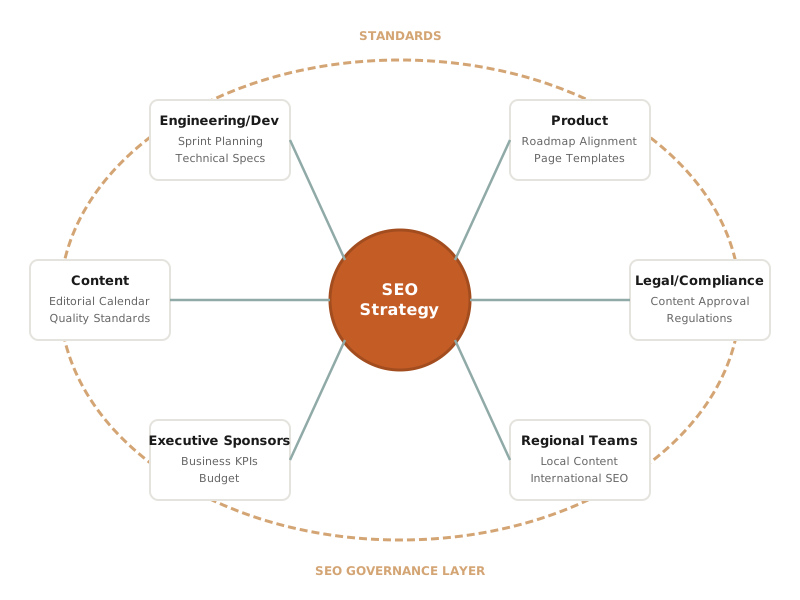
Governance determines who can make what changes, how SEO requirements get incorporated into projects, and how you maintain standards across a large organization.
Effective SEO governance includes:
SEO playbooks and standards. Document your optimization standards, technical requirements, and best practices in a centralized knowledge base. When new team members join or regional teams need guidance, they consult the playbook rather than reinventing solutions.
Change request processes. Establish how SEO reviews happen before major site changes. This might be a formal ticket in your project management system or a required sign-off in your deployment checklist.
Role definitions and decision rights. Clarify who owns what decisions. Who can approve new subdomains? Who decides on URL structure? Who has authority to modify robots.txt?
Training and enablement programs. Systematic onboarding for new team members and ongoing education for stakeholders who impact SEO (developers, product managers, content creators).
Without governance, enterprise SEO devolves into chaos where different teams optimize differently, breaking each other's implementations.
Integrate SEO Into Product Development
The biggest SEO opportunities in enterprise organizations come from embedding SEO into product and engineering workflows, not from optimizing existing content.
This requires:
SEO representation in product planning. Your SEO lead should attend product roadmap meetings and provide input before features are designed, not after they're built.
SEO requirements in user stories. Technical SEO requirements should be documented in Jira tickets or whatever project management system your engineering team uses. "Implement proper heading hierarchy" becomes a requirement, not an afterthought.
Pre-launch SEO reviews. Before any major feature launches, it goes through an SEO checklist covering technical implementation, content optimization, and tracking setup.
When SEO becomes a product function instead of a marketing afterthought, you prevent the problems that are expensive to fix later.
04 / technical-seo-at-enterprise-scale
Technical SEO at Enterprise Scale
Technical excellence is table stakes for enterprise SEO. At scale, small technical issues compound into major problems.
Site Architecture for Massive Scale
Enterprise sites need architectural planning that small sites can ignore.
Hierarchical structure that limits depth. Your most important pages should be no more than three clicks from the homepage. When you have 100,000 pages, this requires intentional information architecture, not just adding pages wherever they fit.
Hub-and-spoke content models. Organize content into topic clusters with pillar pages that link to supporting content. This approach helps search engines understand topical authority and improves internal linking efficiency.
Strategic subdomain vs. subfolder decisions. Subdomains (blog.company.com) are treated as separate sites by search engines. Subfolders (/blog/) consolidate authority. For most B2B enterprises, subfolders are preferable unless you have specific business reasons for separation.
Faceted navigation and filter management. E-commerce and SaaS sites often generate thousands of filtered URLs (products sorted by price, filtered by category, etc.). Without proper parameter handling, these create duplicate content and waste crawl budget.
Crawl Budget Optimization
Google allocates a finite crawl budget to your site based on your site's authority and server capacity. Wasting crawl budget means important pages don't get crawled frequently.
According to Google's documentation on crawl budget management, sites with more than a million pages should actively manage crawl efficiency.
Identify crawl waste. Use server log analysis to see what Googlebot actually crawls. Often you'll find crawlers spending time on low-value pages (old blog posts that never get traffic, parameter-based duplicates, staging environments that shouldn't be accessible).
Block low-value URLs via robots.txt. Prevent crawlers from accessing URL parameters, internal search results, filtered views that don't need to rank independently.
Fix redirect chains. When Page A redirects to Page B which redirects to Page C, you waste crawl budget. Redirect directly from A to C.
Improve server response time. Slow servers limit how many pages Googlebot can crawl. Faster response times allow more crawl capacity.
Maintain a strategic XML sitemap. Your sitemap should include your most important, frequently updated pages. It shouldn't be a comprehensive list of every URL on your site.
International SEO Implementation
B2B enterprises serving global markets need sophisticated international SEO.
Hreflang tags for geo-targeting. These tags tell search engines which version of a page to serve to users in different countries or languages. Implementing hreflang correctly across thousands of pages requires automation and validation.
Google's international targeting documentation provides technical specifications for hreflang implementation.
URL structure decisions. Choose between ccTLDs (example.de, example.fr), subdomains (de.example.com), or subfolders (/de/, /fr/). For most B2B companies, subfolders offer the best balance of authority consolidation and market clarity.
Market-specific keyword research. Don't just translate your English keywords. Research how each market actually searches for your solutions. B2B software buyers in Germany don't search the same way as French buyers, even for the same product.
Localized content, not just translated content. True localization adapts messaging, examples, case studies, and calls-to-action for each market. Machine translation handles language conversion; localization handles cultural adaptation.
JavaScript Rendering and Technical Implementation
Modern enterprise sites rely heavily on JavaScript frameworks (React, Angular, Vue) that create SEO challenges.
Server-side rendering (SSR) or static generation. These approaches ensure that HTML content exists when Googlebot crawls your pages, rather than requiring JavaScript execution to render content.
Dynamic rendering. Serve static HTML to search engine crawlers while serving JavaScript-rendered content to users. This is a pragmatic workaround when SSR isn't feasible.
Critical content in initial HTML. Ensure that your most important content (headings, body copy, internal links) exists in the initial HTML payload, not only after JavaScript executes.
Schema Markup at Scale
Structured data helps search engines understand your content and enables rich results in search.
Programmatic schema implementation. Don't manually add schema to thousands of pages. Implement schema through your CMS templates or build automation that generates appropriate schema based on page type.
Organization and corporate contact schema. Establish your corporate entity in Google's Knowledge Graph with Organization schema.
Product and service schema for B2B. Even if you're not e-commerce, structured data about your products and services helps search engines understand what you offer.
FAQ and How-to schema. These increase your chances of appearing in rich results and voice search answers.
05 / content-strategy-at-enterprise-scale
Content Strategy at Enterprise Scale
Content is still the foundation of SEO, but enterprise content strategy requires processes, governance, and prioritization that small operations don't need.
Editorial Governance and Content Operations
When dozens of people create content across multiple teams, you need systems to maintain quality and SEO standards.
Content creation workflows. Formalized processes from ideation through publication, with defined roles (who researches keywords, who writes, who optimizes, who reviews, who publishes).
SEO content briefs. Standardized brief templates that provide writers with target keywords, competitive analysis, required sections, and optimization guidelines.
Quality assurance checklists. Before content publishes, it goes through SEO review covering keyword usage, internal linking, meta tags, heading structure, and image optimization.
Content approval chains. Define who needs to approve what content. Product marketing approves product pages. Legal reviews certain claim categories. Subject matter experts validate technical accuracy.
Balancing New Content with Optimization
Enterprise sites often have thousands of underperforming pages. Should you create new content or optimize what exists?
The answer: both, strategically.
Content audits to identify opportunities. Systematically review your content inventory to find:
- High-traffic pages with poor conversion rates (optimization opportunity)
- Pages ranking positions 11-20 that could reach page one with improvements
- Outdated content that needs refreshing
- Thin content that should be consolidated or expanded
- Duplicate content that should be merged
Prioritization frameworks. You can't optimize everything at once. Prioritize based on:
- Business value (revenue potential, strategic importance)
- SEO opportunity (current rankings, search volume, competitive landscape)
- Effort required (minor edits vs. complete rewrites)
Programmatic content creation. For certain content types (location pages, product specifications, integrations listings), consider programmatic SEO approaches that generate pages at scale using templates and data sources. Our guide to programmatic SEO tools and strategies covers implementation approaches.
Content Hub and Topic Cluster Models
B2B enterprises should organize content into thematic hubs that demonstrate topical authority.
Pillar content provides comprehensive coverage of a core topic. This is your authoritative resource that targets high-volume, competitive keywords.
Cluster content goes deep on specific subtopics, linking back to the pillar. These pieces target more specific, lower-volume keywords that collectively drive significant traffic.
This approach, which we cover in depth in our guide to B2B SEO best practices, accomplishes several goals:
- Establishes topical authority with search engines
- Improves internal linking structure
- Creates a better user experience through related content discovery
- Provides a content framework that scales
06 / cross-team-collaboration-and-organizational-alig
Cross-Team Collaboration and Organizational Alignment
Enterprise SEO success depends on your ability to work effectively with teams you don't manage.
Working with Engineering and Product Teams
SEO needs things from engineering teams: technical implementations, site speed improvements, bug fixes, new functionality. Engineering teams are busy and prioritize their own roadmaps.
Speak their language. Frame SEO requests in terms engineers understand. Instead of "improve our SEO," say "reduce JavaScript bundle size to improve initial page load time" or "implement server-side rendering for product pages."
Quantify impact and effort. Engineers prioritize work based on impact-to-effort ratios. Show that fixing duplicate content across 10,000 pages has major impact and can be solved with a template change (low effort).
Get involved early. Attend sprint planning meetings. Review technical specifications before implementation. It's easier to influence architecture decisions before code is written than to refactor afterward.
Build relationships, not just tickets. Understand the pressures engineering teams face. Offer to help with their goals (maybe site speed improvements help both SEO and their performance metrics). Engineers are more likely to prioritize requests from people they trust.
Securing Executive Buy-In
C-suite executives care about SEO to the extent it impacts business outcomes they're measured on.
Connect SEO to strategic objectives. If the CEO wants to enter new markets, show how SEO can drive cost-effective customer acquisition in those markets. If the board wants to improve margins, demonstrate SEO's superior CAC compared to paid channels.
Competitive positioning. Executives respond to competitive intelligence. "Our main competitor gets 3x more organic traffic than we do, representing $5M in equivalent paid media value" gets attention.
Risk mitigation. Frame technical SEO problems as business risks. "Our current site architecture makes us vulnerable to traffic loss if Google changes ranking algorithms" resonates differently than "we should improve site structure."
Executive-friendly reporting. Your executive dashboard should fit on one page, focus on business metrics (revenue, market share, competitive position), and update quarterly. Don't bury executives in tactical data.
Building SEO into Company Culture
The most effective enterprise SEO programs embed SEO thinking across the organization.
SEO champions in each department. Identify people in product, engineering, content, and other teams who understand SEO and can advocate for it in their domains.
Regular training and enablement. Offer quarterly "SEO 101" sessions for new employees and "What's new in SEO" updates for existing teams.
Celebrate wins broadly. When organic traffic hits milestones or specific SEO initiatives drive revenue, communicate that success across the company. This builds momentum and reminds stakeholders why SEO matters.
Make SEO visible. When someone searches your brand and finds great results, share that internally. When you rank for a competitive term, show the team. Visibility builds appreciation.
07 / building-your-enterprise-seo-team
Building Your Enterprise SEO Team
Team structure matters as much as individual skills.
Enterprise SEO Team Structure
How you organize your SEO team depends on company size, industry, and organizational structure. Here are common models:
| Role | Responsibilities | Typical Team Size |
|---|---|---|
| VP/Director of SEO | Strategy, executive communication, budget, cross-functional alignment | 1 per enterprise |
| Technical SEO Lead | Site architecture, crawl optimization, JavaScript rendering, Core Web Vitals | 1-2 for 10k+ pages |
| Content SEO Manager | Content strategy, editorial governance, keyword research, content optimization | 1-2, scales with content volume |
| SEO Analysts | Competitive research, reporting, opportunity identification, testing | 2-5 depending on scale |
| SEO Developers | Implementation of technical requirements, automation, schema deployment | 1-3 if building custom tools |
| International SEO Specialist | Hreflang management, localization strategy, regional coordination | 1+ for global companies |
Centralized vs. distributed models. Some enterprises have centralized SEO teams that support all business units. Others embed SEO specialists within each business unit or product line. Hybrid models often work best: centralized strategy and technical SEO with distributed content SEO specialists.
Essential Skills for Enterprise SEO
Enterprise SEO teams need a broader skill set than small-site optimization requires.
Technical proficiency. Understanding of site architecture, server configuration, JavaScript frameworks, and developer workflows. You don't need to be a full-stack developer, but you need to speak the language.
Data analysis. Ability to work with large datasets, build meaningful dashboards, conduct statistical analysis, and derive actionable insights from complex data.
Project management. Enterprise SEO involves managing multiple workstreams, coordinating with various teams, and keeping initiatives on track despite organizational complexity.
Stakeholder communication. Translating technical SEO concepts into business language, building consensus, and influencing without authority.
Business acumen. Understanding your company's business model, competitive dynamics, customer journey, and strategic priorities well enough to align SEO accordingly.
Build vs. Buy: When to Hire Agencies
Most enterprise organizations use a hybrid model: in-house team for strategy and ongoing management, agency or contractors for specialized needs or capacity expansion.
Keep in-house:
- Strategic direction and prioritization
- Stakeholder management and internal advocacy
- Technical SEO oversight and architecture decisions
- Content strategy and editorial governance
- Performance monitoring and reporting
Consider outsourcing:
- Content production at scale
- Link building and digital PR
- Specialized technical implementations
- International SEO for markets you're entering
- Competitive research and market analysis
- Supplemental capacity for major projects
The in-house team should always own the strategy and relationships. Agencies execute within that framework.
08 / enterprise-seo-tools-and-platforms
Enterprise SEO Tools and Platforms
Tool selection matters more at enterprise scale because manual processes don't scale to thousands of pages.
Enterprise SEO Platform Comparison
| Platform | Best For | Approximate Cost | Key Strengths | Limitations |
|---|---|---|---|---|
| Conductor | Large enterprises with complex needs | $30k-$150k+/year | AI-powered insights, workflow management, unlimited users | Premium pricing |
| BrightEdge | Fortune 500 companies needing attribution | $50k-$200k+/year | Revenue attribution, market share tracking | Complex implementation, steep learning curve |
| Semrush Enterprise | Multi-channel marketing teams | $400-$5k+/month | Broad feature set across SEO/PPC/content | Can be overwhelming, data across 45+ reports |
| Ahrefs | Strong backlink analysis needs | $99-$999/month (contact for enterprise) | Industry-leading backlink index, intuitive UI | Built as research tool, limited workflow features |
| Botify | Technical SEO for massive sites | Contact for pricing | Log file analysis, crawl budget optimization | Steep learning curve, technical focus |
Platform selection criteria:
- Scale capacity (can it handle your page count and data volume?)
- Cross-functional collaboration features (do multiple teams need access?)
- Integration with existing tools (analytics, CMS, CRM, data warehouse)
- API access for custom reporting and automation
- Training and support quality
- Total cost including hidden fees (per-seat pricing, premium support, professional services)
Essential Tool Stack Beyond the Platform
Enterprise SEO teams typically need multiple specialized tools:
Technical SEO:
- Screaming Frog or Sitebulb for comprehensive crawling
- Google Search Console for indexation monitoring
- Log file analyzers for crawl budget insights
Content optimization:
- Clearscope, MarketMuse, or similar for content intelligence
- Grammarly Business for writing quality
- Content management workflows (Monday.com, Asana, Jira)
Performance monitoring:
- Google Analytics 4 for traffic and conversion tracking
- Data visualization (Looker, Tableau, Power BI)
- Real-time alerting systems for traffic drops
Competitive intelligence:
- Multiple keyword tracking tools for comprehensive coverage
- Share-of-voice monitoring
- Backlink monitoring and competitive link analysis
Automation and Custom Development
Enterprise SEO generates repetitive tasks that should be automated.
Automated reporting. Build dashboards that update automatically rather than manually pulling reports each week.
Schema deployment. Generate structured data programmatically based on page type and content rather than manually adding schema to each page.
Content audits. Script audits that automatically identify thin content, missing meta descriptions, broken internal links, or other technical issues.
Crawl monitoring. Set up automated crawls that alert you to new issues rather than discovering problems during monthly reviews.
The ROI on automation is clear: your team focuses on strategy and optimization rather than data collection and manual checks.
09 / measuring-enterprise-seo-success
Measuring Enterprise SEO Success
Measurement frameworks must serve multiple audiences: executives want business impact, managers want operational metrics, and individual contributors need actionable tactical data.
Executive Reporting: Proving Business Impact
Your quarterly executive report should fit on one page and answer three questions:
- How is organic search contributing to business growth?
- How do we compare to competitors?
- What should we prioritize next quarter?
Key metrics for executive reporting:
- Organic revenue or pipeline contribution (absolute and percentage of total)
- Year-over-year growth in organic traffic and revenue
- Customer acquisition cost from organic vs. other channels
- Market share of organic visibility (your share vs. competitors for key terms)
- Major wins (new rankings, traffic milestones, competitive gains)
Reporting format: Visual dashboard with minimal text, clear trend lines, competitive benchmarks, and one strategic recommendation.
Reporting frequency: Quarterly, with monthly updates only if significant issues or opportunities arise.
Operational Metrics for SEO Directors and Managers
Middle management needs more granular metrics to understand performance drivers and operational health.
Traffic and engagement:
- Organic sessions by channel (brand vs. non-brand, product vs. content)
- Engagement metrics (time on site, pages per session, scroll depth)
- Conversion rates by segment and landing page
Technical health:
- Indexed pages vs. total pages
- Core Web Vitals performance
- Crawl errors and server response times
- Mobile usability issues
Content performance:
- Top-performing content by traffic and conversions
- New content performance
- Content decay (pages losing traffic)
Competitive position:
- Keyword ranking distribution (page 1, top 3, positions 11-20)
- Visibility scores and share of voice
- Competitive gap analysis
Attribution Models for Enterprise SEO
Enterprise organizations need sophisticated attribution to understand how SEO contributes to the customer journey.
Multi-touch attribution. B2B buyers interact with your brand multiple times before converting. Multi-touch models credit organic search appropriately when it plays an early, middle, or late-stage role.
Position-based attribution. This model gives extra weight to first and last touchpoints while crediting middle interactions. It works well for B2B where first touch often comes from organic content research.
Integration with CRM and marketing automation. Connect your SEO platform with Salesforce, HubSpot, or whatever CRM you use. Track which organic visits eventually convert to SQLs and closed revenue.
Custom attribution. Build models that reflect your actual sales cycle. If your average deal involves 7 touchpoints over 6 months, your attribution should account for that reality.
Forecasting and ROI Modeling
Enterprise SEO requires forecasting future impact to secure budget and resources.
Traffic forecasting. Based on current ranking positions and projected improvements, estimate future organic traffic. This requires understanding click-through rates by position, search volume trends, and realistic ranking improvement timelines.
Revenue modeling. Convert traffic forecasts to revenue projections using your conversion rates and average deal values.
Scenario planning. Model different investment scenarios: "If we invest $X in content creation, we project Y increase in organic traffic leading to Z revenue."
Competitive scenarios. "If competitor A continues their current SEO investment trajectory while we maintain our current approach, we project losing $X in market share over 18 months."
These models don't need to be perfectly accurate. They need to be directionally useful for decision-making.
10 / integrating-ai-search-optimization-at-enterprise
Integrating AI Search Optimization at Enterprise Scale
The search landscape has expanded beyond traditional Google results to include AI-powered answer engines (ChatGPT, Perplexity, Google AI Overviews).
Enterprise B2B companies must optimize for both traditional search engines and AI systems that increasingly influence B2B purchase decisions.
Why AI Search Matters for Enterprise B2B
B2B buyers use AI tools throughout their research process. They ask ChatGPT for vendor comparisons, use Perplexity to research solutions, and rely on Google AI Overviews for quick answers.
If your content doesn't appear in these AI-generated responses, you're invisible to a growing segment of your target market.
Answer Engine Optimization (AEO) focuses on making your content citation-worthy for AI systems. This complements traditional SEO rather than replacing it.
Key differences:
- Traditional SEO optimizes for rankings; AEO optimizes for citations
- SEO targets keywords; AEO targets topics and questions
- SEO values backlinks; AEO values authoritative, well-structured content
- SEO focuses on Google; AEO spans multiple AI platforms
AEO Implementation for Enterprise Organizations
Enterprise AEO requires systematic approaches, not one-off optimizations.
Content structure for AI comprehension. AI systems favor content that clearly answers questions with well-structured information:
- Question-and-answer formats
- Clear definitions and explanations
- Structured comparisons (tables, lists)
- Step-by-step processes
- Expert attribution and credentials
E-E-A-T signals at scale. Expertise, Experience, Authority, and Trust matter even more for AI citations. Systematically add:
- Author bylines with credentials
- Publication dates and update timestamps
- Expert quotes and original research
- Clear sourcing and citations
- About pages that establish authority
Monitoring AI visibility. Track whether your content appears in:
- ChatGPT responses for key queries
- Perplexity citations
- Google AI Overviews
- Other AI platforms your audience uses
This requires new monitoring tools and processes beyond traditional rank tracking.
Enterprise AEO governance. Incorporate AEO requirements into your existing content governance:
- Update content brief templates to include AEO considerations
- Add AEO checklist items to QA processes
- Train content creators on AI-friendly formatting
- Monitor AI citation performance alongside traditional rankings
For a comprehensive overview of how AEO fits into modern B2B marketing, see our B2B organic growth playbook.
11 / common-enterprise-seo-pitfalls-and-how-to-avoid
Common Enterprise SEO Pitfalls and How to Avoid Them
Learn from others' mistakes rather than making them yourself.
Over-Reliance on Technology Without Strategy
Enterprise organizations often believe buying an expensive SEO platform will solve their problems. It won't.
Tools enable execution of good strategy. They don't replace strategic thinking or organizational alignment.
Avoid this by: Establishing your strategy, processes, and team structure before selecting tools. Choose technology that supports your approach, not technology that dictates your approach.
Analysis Paralysis
With hundreds of thousands of pages and countless optimization opportunities, enterprise SEO teams can spend months analyzing without executing.
Perfect information isn't achievable. Make decisions with the data you have.
Avoid this by: Setting clear prioritization criteria, implementing agile sprints for SEO projects, and shipping improvements incrementally rather than waiting for the perfect comprehensive solution.
Ignoring the Basics While Chasing Advanced Tactics
Enterprise SEO teams sometimes focus on sophisticated initiatives while neglecting fundamental issues.
You don't need a complex topic cluster strategy if 40% of your pages have duplicate meta descriptions or your site speed is terrible.
Avoid this by: Regular technical audits that identify and prioritize foundational issues. Fix crawl errors, page speed, mobile usability, and indexation before optimizing for featured snippets.
Underestimating Change Management
Technical SEO solutions are often easier than organizational change management. You can build a perfect redirect strategy, but if nobody follows it, it fails.
Avoid this by: Investing in documentation, training, and stakeholder communication. Build systems that make the right thing easy and the wrong thing difficult.
Siloed SEO Instead of Integrated Approach
When SEO operates in isolation from product, engineering, and other marketing channels, you miss opportunities and create conflicts.
Avoid this by: Embedding SEO into cross-functional workflows, attending planning meetings for other teams, and building relationships across departments.
12 / next-steps-building-your-enterprise-seo-program
Next Steps: Building Your Enterprise SEO Program
Enterprise SEO isn't a project with a finish line. It's an ongoing strategic function that requires sustained investment, organizational commitment, and continuous optimization.
If you're building an enterprise SEO program from scratch:
-
Secure executive sponsorship. Without C-suite support, you'll struggle to get resources and cross-functional cooperation.
-
Audit your current state. Understand your technical foundation, content inventory, organizational capabilities, and competitive position.
-
Develop a strategic roadmap. Prioritize initiatives based on business impact, competitive gaps, and organizational readiness.
-
Build your team. Hire or develop the skills you need, whether in-house, agency, or hybrid.
-
Establish governance and processes. Document standards, create workflows, build training programs.
-
Start executing. Begin with high-impact quick wins that build momentum and demonstrate value.
-
Measure and communicate. Track business impact, report to stakeholders, celebrate wins.
Enterprise SEO is challenging. The organizational complexity, technical scale, and stakeholder management requirements exceed what most marketers face in their careers.
But when executed well, enterprise SEO becomes a sustainable competitive advantage that compounds over time, driving customer acquisition at a fraction of the cost of paid channels.
The tactics that got you to $10M in organic traffic won't get you to $50M. But the strategic framework outlined here will.
About the Author: Mike McKearin is the founder of WE•DO Growth Agency, where his team helps B2B companies scale organic growth from startup to enterprise. WE•DO has worked with organizations from 50-person startups to Fortune 500 companies, building SEO programs that align marketing, engineering, and executive teams around measurable organic growth.