You have pages ranking on Google right now that almost nobody clicks.
They show up in search results. They get impressions. But they sit in positions 5 through 20 -- just far enough down that searchers scroll right past them. Every month, those pages represent hundreds or thousands of missed clicks.
Most SEO strategies focus on creating new content or targeting new keywords. That work matters. But it ignores the fastest path to more organic traffic: optimizing what's already working.
We call this strike zone optimization. It's the practice of identifying pages that rank in positions 5-20, scoring them by opportunity, and applying targeted fixes to push them into the top positions where clicks actually happen.
01 / the-click-cliff-is-real
The Click Cliff Is Real
Search behavior follows a steep curve. The page in position 1 captures roughly 28.5% of all clicks for a given query. Position 2 gets 15.7%. Position 3 gets 11%.
By position 5, you're down to 7.2%. By position 10, you're at 2.5%. Everything on page 2 splits less than 1% of total clicks.
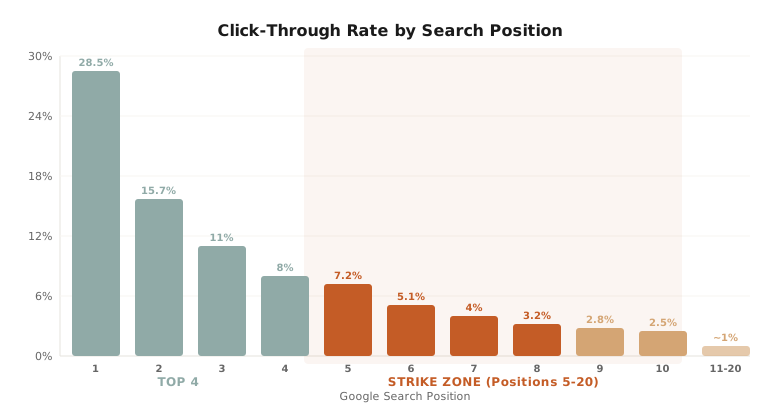
That means a page sitting in position 8 is getting roughly one-ninth the traffic it would get in position 1. Move it up three spots and you could triple its clicks. Move it to position 1 and you're looking at a 10x increase -- with zero new content required.
This is the math behind strike zone optimization. You're not building from scratch. You're finishing what Google has already started rewarding.
02 / what-is-the-strike-zone
What Is the Strike Zone?
The strike zone is the set of pages on your site ranking in positions 5-20 for at least one keyword with meaningful search volume. These pages have already proven to Google that they're relevant. They've earned their way to the neighborhood. They just haven't cracked the top spots yet.
We specifically look at pages that meet three criteria:
- Ranking in positions 5-20. Close enough to page 1 that targeted optimization can move the needle. Pages in positions 30 or 50 need a different strategy.
- At least 50 impressions over 90 days. This filters out long-tail queries with so little volume that a ranking improvement won't generate meaningful traffic.
- Keyword difficulty that makes the push realistic. A page ranking 8th for a keyword with a difficulty score of 95 needs a fundamentally different investment than one ranking 8th for a keyword at difficulty 30.
These three filters narrow thousands of ranking keywords down to the pages where effort-to-impact ratio is highest.
03 / how-we-score-opportunities
How We Score Opportunities
Not every strike zone page is equal. A page ranking 6th for a high-volume, low-difficulty keyword with strong engagement is a better investment than a page ranking 18th for a low-volume, high-difficulty keyword that visitors bounce from.
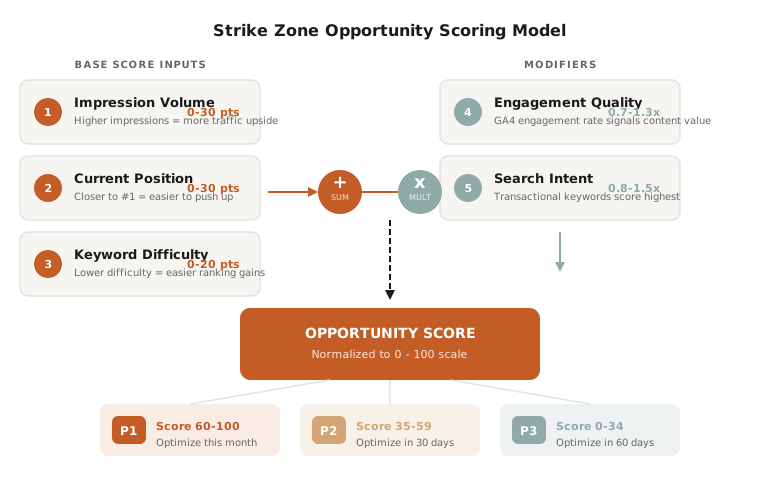
We use a composite scoring model that weighs four factors:
1. Impression Volume
Higher impressions mean more traffic potential when position improves. A page with 5,000 impressions at position 8 has far more upside than one with 50 impressions at the same position.
We use a logarithmic scale here because the difference between 100 and 500 impressions matters more than the difference between 5,000 and 10,000.
2. Current Position
Pages closer to the top of page 1 are easier to push up and capture disproportionately more clicks per position gained. A page at position 6 is one or two good optimizations away from the top 3. A page at position 18 needs a more substantial overhaul.
We score this in buckets:
- Positions 5-7 get the highest score. These are one or two spots from the top 3 -- highest ROI.
- Positions 8-10 are the bottom of page 1. Strong potential with moderate effort.
- Positions 11-15 sit at the top of page 2. They need meaningful work but have clear upside.
- Positions 16-20 are deep page 2. These require significant investment and get prioritized lower unless other signals are strong.
3. Keyword Difficulty
This is where third-party data from tools like DataForSEO comes in. Keyword difficulty estimates how hard it is to rank higher for a given term based on the strength of the current top-ranking pages.
We invert this score -- lower difficulty gets rewarded. A page ranking 7th for a keyword with difficulty 25 is a far better target than one ranking 7th for a keyword with difficulty 80.
4. Engagement Quality
We pull GA4 data to understand what happens after someone clicks. A page with a 65% engagement rate tells us the content resonates -- it just needs better rankings. A page with a 15% engagement rate tells us the content needs work before a ranking push will convert to business value.
High engagement acts as a multiplier on the opportunity score. Low engagement reduces it.
5. Search Intent
The commercial value of a keyword matters. A transactional keyword like "cloud migration services pricing" has direct conversion potential. An informational keyword like "what is cloud migration" builds awareness but converts differently.
We apply an intent modifier that boosts transactional and commercial keywords and keeps informational ones at baseline.
The final output is a score from 0 to 100 for every qualifying page, sorted by priority.
04 / what-the-output-looks-like
What the Output Looks Like
When we run a strike zone analysis for a client, the deliverable includes:
An executive summary with four headline metrics: total strike zone pages found, untapped impressions, estimated additional monthly clicks if pages move to position 3, and the average current position across all opportunities.
A visual scatter plot showing every strike zone page plotted by position and impression volume. Bubble size represents opportunity score. This makes it immediately clear where the biggest wins are clustered.
A scored opportunity table with every qualifying page ranked by score, showing the primary keyword, current position, impressions, click-through rate, keyword difficulty, engagement rate, and priority tier.
Detailed page cards for the top 10-15 opportunities. Each card breaks down the specific keywords driving impressions, the GA4 engagement metrics, what SERP features are in play, and 2-4 specific recommendations for that page.
A quick wins section that filters to pages in positions 5-10 with keyword difficulty under 40 and more than 200 impressions. These are the pages where a content refresh, a few internal links, or an updated meta description could move the needle within weeks.
A phased action plan broken into three tiers:
- This month: Score 60-100. The highest-impact pages with specific actions.
- Next 30 days: Score 35-59. Solid opportunities that need slightly more effort.
- Next 60 days: Score 0-34. Worth pursuing once the top-tier pages are handled.
05 / the-playbook-what-we-actually-do-to-move-pages-u
The Playbook: What We Actually Do to Move Pages Up
Scoring pages is only useful if you know what to do with the results. Here's how we translate strike zone findings into ranking improvements.
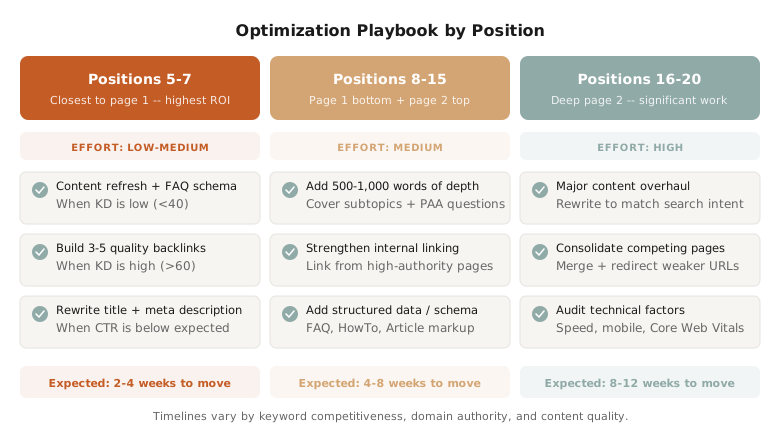
For Pages at Positions 5-7
These are your closest opportunities. Often, targeted refinements are enough.
If keyword difficulty is low (under 40): Content refresh. Expand thin sections, add FAQ schema, update the publish date, and strengthen the introduction. Google rewards freshness, and a meaningful update can bump a page one or two positions quickly.
If keyword difficulty is high (over 60): Link building. You need authority signals. Build 3-5 quality backlinks to the page and add internal links from your highest-authority pages. This is where we look at the client's existing content to identify linking opportunities that aren't being used.
If click-through rate is below expected for the position: Rewrite the title tag and meta description. The page is ranking fine -- people just aren't clicking. A/B test titles with stronger hooks, add the year, include numbers, and make the value proposition clearer.
For Pages at Positions 8-15
These pages need more depth and stronger signals.
Add 500-1,000 words of meaningful content that addresses related subtopics, answers "People Also Ask" questions, and covers the topic more comprehensively than competitors. Target featured snippet formats: tables, numbered lists, and direct answer paragraphs.
Strengthen internal linking from your highest-traffic pages. If your homepage or a pillar page links to this content, it passes authority. We audit the client's full internal link structure to find the best link sources.
Implement structured data if it's missing. FAQ schema, HowTo markup, Article schema -- whatever's relevant. Rich results increase visibility and click-through rate even before position improves.
For Pages at Positions 16-20
These need the most work but still represent real opportunity because the page has already earned Google's attention.
Major content overhaul. Rewrite to better match the dominant search intent for the target keyword. If every page ranking above you is a comparison guide and yours is a product page, you need to shift the format.
Consolidate competing pages. If you have two or three pages splitting authority for similar keywords, merge them into one authoritative piece. Redirect the weaker URLs to the stronger one.
Audit technical factors. Page speed, mobile experience, Core Web Vitals. At this position range, technical issues can be a ranking anchor.
06 / why-this-works-better-than-starting-from-scratch
Why This Works Better Than Starting from Scratch
Creating a new piece of content from zero is a 6-12 month investment before it reaches competitive rankings. You need to publish, earn links, build topical authority, and wait for Google to crawl and index and eventually trust the page.
Strike zone pages have already done that work. Google knows they exist. Google considers them relevant enough to show in positions 5-20. The trust baseline is set.
When you optimize a strike zone page, you're working with momentum instead of against inertia. The typical timeline to see meaningful position improvement on a well-targeted strike zone page is 4-8 weeks. Some quick wins move in days.
That doesn't mean you shouldn't create new content. You should. But if you're choosing where to invest your next 20 hours of SEO effort, optimizing three strike zone pages will almost always outperform publishing one new article targeting a keyword you don't rank for yet.
07 / real-numbers-what-a-position-move-is-worth
Real Numbers: What a Position Move Is Worth
Here's a simple way to think about the value.
Take a page currently ranking at position 8 with 1,000 monthly impressions. At position 8, expected CTR is about 3.2%, so you're getting roughly 32 clicks per month.
Move that page to position 3. Expected CTR jumps to 11%. Same 1,000 impressions now produce 110 clicks per month. That's 78 additional monthly visits from a single page.
Now multiply that across 10, 20, or 50 strike zone pages. The aggregate traffic gain from systematically optimizing these pages often rivals what a brand-new content strategy would produce in its first year -- and it happens in a fraction of the time.
For clients with commercial or transactional intent keywords in their strike zone, these aren't just visits. They're people actively searching for what you sell. A position improvement on a page targeting "managed IT services for healthcare" or "custom fishing rod blanks" drives revenue, not just traffic metrics.
08 / when-to-run-a-strike-zone-analysis
When to Run a Strike Zone Analysis
We typically recommend strike zone analysis in these situations:
- Quarterly SEO reviews. The strike zone shifts as Google re-evaluates rankings. Pages move in and out of the 5-20 range. Running the analysis every quarter keeps your optimization targets current.
- After a content push. If you've published a batch of new content over the past 3-6 months, some of those pages have likely entered the strike zone. This is the right time to refine them.
- When organic traffic plateaus. If you've been investing in SEO and growth has stalled, the strike zone almost always reveals untapped potential that doesn't require new content creation.
- Before budget planning. The scored output makes it straightforward to estimate the traffic impact of SEO investment and prioritize resources where they'll move the needle fastest.
09 / the-difference-between-this-and-just-doing-seo
The Difference Between This and "Just Doing SEO"
Every agency says they optimize content. The difference is precision.
A generic SEO engagement might audit your site, deliver a list of recommendations, and check in monthly. That's fine for broad coverage. But it doesn't tell you which of your 200 indexed pages deserves attention this week, what specific action to take on each one, or how much traffic you'll gain if the optimization works.
Strike zone analysis produces a ranked, scored list of pages with specific actions mapped to each one. It pulls from three separate data sources -- search performance, site engagement, and keyword intelligence -- and synthesizes them into a single priority framework.
The output isn't a 40-page audit you'll read once and file away. It's a working action plan your team can execute against immediately.
10 / start-with-what-you-have
Start With What You Have
Your site is already ranking for keywords you care about. Some of those rankings are close enough to page 1 that targeted optimization can push them over the line within weeks.
That's the strike zone. And it's where we see the fastest, most measurable SEO wins for every client we work with.
If you want to see where your strike zone opportunities are, get in touch. We'll pull your data, score the opportunities, and show you exactly where the low-hanging fruit is hiding in your search rankings.