Manually creating hundreds or thousands of SEO-optimized landing pages isn't just inefficient—it's impossible. If you're trying to scale organic visibility across multiple service areas, locations, integrations, or use cases, you need programmatic SEO. But here's the reality: programmatic SEO without the right tools is like trying to build a skyscraper with hand tools.
The difference between successful programmatic SEO campaigns and those that fail often comes down to your tech stack. The right combination of content generation platforms, data management tools, and automation systems can help you create thousands of valuable, indexed pages that drive qualified traffic. The wrong approach leads to thin content, indexation problems, and wasted resources.
In this guide, we'll walk through the essential tools and strategies for implementing programmatic SEO at scale, specifically for B2B companies looking to dominate their market through organic search.
01 / why-tools-matter-for-programmatic-seo
Why Tools Matter for Programmatic SEO
Let's be clear: you cannot execute programmatic SEO manually. The entire concept hinges on automation and systematic content generation. When you're creating 500 location-based service pages or 1,000 integration landing pages, you need infrastructure that can:
- Generate unique, valuable content at scale without creating duplicate content penalties
- Manage and update data from multiple sources dynamically
- Maintain consistent templates while allowing for customization
- Monitor indexation and performance across thousands of pages
- Identify and fix quality issues before they impact rankings
The challenge isn't just volume—it's maintaining quality and uniqueness across that volume. Google's algorithms are sophisticated enough to detect thin, templated content that provides no unique value. Your tools need to help you create pages that are genuinely useful to users while being technically sound for search engines.
This is where your tech stack becomes your competitive advantage. Companies that invest in the right programmatic SEO infrastructure can scale their organic presence faster and more effectively than competitors relying on manual content creation.
02 / the-programmatic-seo-tech-stack
The Programmatic SEO Tech Stack
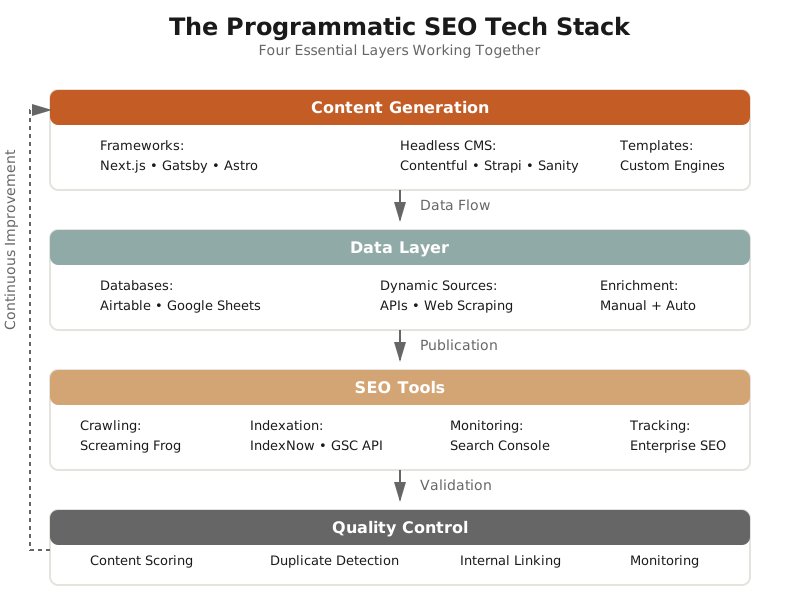
Building a successful programmatic SEO operation requires four categories of tools working together seamlessly. Here's how to construct your tech stack.
Content Generation Tools
Your content generation layer determines how efficiently you can create and deploy pages at scale.
Headless CMS Platforms
Headless content management systems separate your content from presentation, giving you unprecedented flexibility in how you generate and display programmatic content.
Contentful excels for enterprise B2B companies that need robust content modeling and multi-channel publishing. You can create content types for your programmatic pages (like location pages or integration pages) with custom fields, then generate thousands of entries programmatically through their API. Contentful's strength is in sophisticated content relationships and localization.
Strapi offers an open-source alternative with excellent API-first architecture. It's ideal for mid-market B2B companies that want control over their infrastructure without enterprise costs. Strapi's customizable admin panel makes it easy for non-technical teams to manage content models and review programmatically generated content.
Sanity provides real-time collaboration and flexible content modeling with a modern developer experience. Its GROQ query language is particularly powerful for complex content relationships in programmatic SEO scenarios.
Static Site Generators
Static site generators turn your data and templates into HTML pages that load instantly and scale infinitely.
Next.js has become the gold standard for programmatic SEO because of its hybrid approach. You can generate static pages at build time for consistent content while using incremental static regeneration for pages that need periodic updates. Next.js's dynamic routing makes it trivial to create URL patterns like /integrations/[tool-name] or /services/[city-name] and populate them from your data source.
Gatsby remains excellent for content-heavy B2B sites pulling data from multiple sources. Its GraphQL data layer lets you query content from your CMS, databases, APIs, and files in a unified way. Gatsby's image optimization is particularly valuable when you're generating thousands of pages with visual content.
Astro is the newest contender, focusing on performance through partial hydration. It's ideal when you're generating large numbers of content-heavy pages that don't need much interactivity. Astro's "ship less JavaScript" philosophy can give you an edge in Core Web Vitals, which matters for SEO.
Custom Template Engines
Sometimes you need complete control. Custom template engines built with Node.js, Python, or PHP give you flexibility to implement complex logic that determines page content based on multiple data points. This approach requires more development resources but can generate more sophisticated, valuable content that stands out from obvious templates.
Data Tools
Your data layer is the foundation of programmatic SEO quality. Garbage in, garbage out applies here more than anywhere else.
Airtable as Data Source
Airtable strikes a perfect balance between database power and spreadsheet accessibility. You can build sophisticated data models with relationships, formulas, and validation rules while keeping the interface accessible to non-technical team members.
For programmatic SEO, Airtable excels at managing the data that powers your pages. Create a base with tables for locations, services, features, and content blocks. Use linked records to establish relationships (which services are available in which locations), and formulas to generate unique combinations. Airtable's API makes it straightforward to pull this data into your static site generator.
The real power comes from Airtable's interface allowing content teams to enrich your programmatic data. While pages generate automatically, humans can add location-specific details, service descriptions, or custom content blocks that make individual pages more valuable.
Google Sheets Integration
Google Sheets works well for simpler programmatic SEO projects or as a data entry interface for stakeholders who don't need access to your full tech stack. The Google Sheets API is robust and well-documented, making it easy to pull data into your build process.
Consider using Google Sheets when you need real-time collaboration on data entry or when you're working with stakeholders who are more comfortable with spreadsheets than databases.
API Integrations for Dynamic Data
The most valuable programmatic pages incorporate dynamic data that keeps them current and useful. API integrations let you pull real-time information into your static pages during build time.
For example, if you're creating integration pages for your B2B SaaS product, you might pull current feature lists, pricing, and user counts from each integration partner's API. If you're building location pages, you could pull local business data, demographics, or market information from relevant APIs to make each page genuinely useful to users in that location.
Web Scraping Considerations
Web scraping can supplement your data sources, but proceed carefully. Only scrape publicly available data, respect robots.txt files, and never violate terms of service. Scraped data should enhance human-created content, not replace it.
Ethical uses include gathering publicly available business listings, aggregating public data to create comparison resources, or monitoring competitor pricing to ensure your content stays current. Always add unique value beyond the scraped data.
SEO Tools
Your SEO tool layer ensures your programmatically generated pages actually get indexed and ranked.
Screaming Frog for Scale Auditing
Screaming Frog Spider is essential for crawling and auditing large numbers of programmatically generated pages. Configure it to crawl your staging environment before launch to catch issues like:
- Pages with duplicate or missing title tags
- Thin content that doesn't meet your minimum standards
- Broken internal links
- Missing or duplicate meta descriptions
- Pages with slow load times
- Incorrect canonical tags
Screaming Frog's custom extraction features let you validate that your templates are populating correctly across all pages. You can extract specific elements and verify they're unique and valuable.
IndexNow and Search Console API
Getting thousands of new pages indexed quickly requires proactive submission. IndexNow protocol (supported by Microsoft Bing, Yandex, and others) lets you instantly notify search engines about new or updated URLs. Implement IndexNow in your build process to automatically submit new programmatic pages as they're generated.
For Google, use the Search Console API to submit sitemaps and monitor indexation status. Set up automated monitoring to alert you when indexation rates drop, which often signals quality issues Google's algorithms have detected.
Rank Tracking at Scale
Traditional rank tracking tools struggle with thousands of programmatic pages. You need enterprise SEO platforms like Conductor, BrightEdge, or seoClarity that can track rankings for large keyword sets and group them by page template or category.
Focus on tracking representative keywords for each template type. If you've generated 500 city-based service pages, track rankings for your target keywords in 20-30 representative cities rather than all 500. This gives you signal on template performance without overwhelming your rank tracking budget.
Quality Control Tools
Quality control separates successful programmatic SEO from thin content penalties.
AI Content Quality Scoring
Build or implement AI-based quality scoring to evaluate programmatic content before publication. Your scoring system should evaluate:
- Uniqueness across your generated pages
- Readability and comprehension level
- Keyword relevance and natural usage
- Content depth compared to ranking competitors
- Presence of valuable, specific information vs generic content
Set minimum quality thresholds and only publish pages that exceed them. Pages that don't meet standards either need more data to work with or shouldn't be generated at all.
Duplicate Content Detection
Run similarity analysis across your generated pages to ensure sufficient uniqueness. Tools like Copyscape or custom scripts using text similarity algorithms can identify pages that are too similar to each other.
Your goal isn't complete uniqueness—your pages will share template structure and common elements. But the core content that makes each page valuable should be meaningfully different. A good threshold is less than 30% similarity in the main content area.
Automated Internal Linking
Strategic internal linking at scale requires automation. Build systems that:
- Identify topically related pages to link together
- Create contextual anchor text based on page content
- Distribute link equity strategically to your highest-value pages
- Avoid over-optimization by varying anchor text naturally
Your internal linking automation should create a hub-and-spoke structure where programmatic pages support your main service pages and pillar content.
03 / implementation-strategies
Implementation Strategies
Having the right tools means nothing without proper implementation strategy. Here's how to put your tech stack to work.
The Template-First Approach
Start by designing your page templates before worrying about scale. Create three to five versions of each template manually, focusing on making each one genuinely valuable. This lets you:
- Test what data you actually need to create valuable pages
- Identify opportunities to incorporate unique, specific information
- Validate that your template structure supports good user experience
- Ensure pages can rank before you generate hundreds more
Only after you've validated that your templates can create valuable, rankable pages should you scale production. Many programmatic SEO failures happen because companies generate thousands of pages from untested templates.
Data Enrichment for Unique Value
The difference between thin content and valuable programmatic pages is data richness. Each page needs enough unique, specific information to justify its existence.
For location pages, that might mean incorporating local market data, demographics, case studies from that area, or location-specific service details. For integration pages, include specific use cases, technical details about the integration, customer testimonials using both products together, and implementation guidance.
Budget time and resources for data enrichment. Even with automation, human input makes programmatic content valuable. Your content team should review representative samples from each template and identify where additional data or customization would improve value.
Progressive Enhancement
Don't try to launch perfect pages at massive scale immediately. Use a progressive enhancement approach:
Phase 1: Generate basic but valuable pages using your core data. Launch a small batch (50-100 pages) and monitor performance for 30-60 days. Measure indexation rates, rankings, traffic, and user engagement metrics.
Phase 2: Based on Phase 1 performance, enhance your templates with additional data sources, more sophisticated content logic, or richer multimedia. Apply improvements to existing pages and generate the next batch.
Phase 3: Implement advanced features like dynamic content updates, user-generated content integration, or personalization. Scale to your full page target.
This approach lets you learn and improve while minimizing risk. If your initial batch doesn't perform, you've only invested in hundreds of pages, not thousands.
Indexation Management
Getting pages indexed is often harder than creating them. Google has become more conservative about indexing large numbers of similar pages, especially from sites without strong authority.
Crawl Budget Optimization: Structure your site architecture so search engines can efficiently crawl programmatic pages. Use logical URL hierarchies, proper internal linking, and XML sitemaps organized by template type.
Strategic Noindexing: Not every programmatically generated page needs to be indexed. If you create comparison pages for every possible combination of your products, some will be more valuable than others. Use noindex on low-value combinations while keeping them accessible for users who need them.
Indexation Monitoring: Track indexation rates by template type in Search Console. If Google isn't indexing your programmatic pages, it's sending you a message about quality or value. Don't fight low indexation with more aggressive submission—improve page quality.
04 / scaling-strategies-for-b2b
Scaling Strategies for B2B
B2B programmatic SEO requires different approaches than B2C. Here are the template types that work best for B2B companies.
Location + Service Pages
For B2B companies with service area coverage, location pages capture high-intent local searches. The key is making each location page genuinely useful to prospects in that area.
Go beyond just swapping city names in a template. Include local market data, case studies from clients in that region, region-specific regulations or considerations, and details about how your service addresses local challenges.
URL structure: /services/[service-name]/[city-state] or /[city-state]/[service-name]
Integration Pages
For B2B SaaS companies, integration pages are programmatic SEO gold. Prospects searching for "your-product + their-existing-tool" are high-intent and far along the buyer journey.
Create pages for each integration you support (or plan to support). Include technical details about how the integration works, specific use cases, setup instructions, and customer testimonials using both products together.
URL structure: /integrations/[tool-name] or /integrate/[tool-name]
Comparison Matrices
Comparison pages capture branded searches from prospects evaluating alternatives. Generate pages for your-product vs [competitor] and [competitor] alternative.
These pages require careful balance. Be honest about differences while highlighting your advantages. Include detailed feature comparisons, pricing comparisons (when appropriate), and guidance on which solution fits different use cases.
URL structure: /vs/[competitor-name] or /compare/[your-product]-vs-[competitor]
Use-Case Landing Pages
B2B buyers search for solutions to specific problems. Generate landing pages for every meaningful combination of your solution and industry, company size, or use case.
For example, a marketing automation platform might create pages for "marketing automation for B2B SaaS," "marketing automation for manufacturing," "marketing automation for startups," etc.
The key is genuine customization. Each use-case page should include industry-specific challenges, relevant features, appropriate case studies, and tailored messaging that speaks to that specific audience.
URL structure: /solutions/[industry] or /for/[use-case]
05 / measuring-programmatic-seo-performance
Measuring Programmatic SEO Performance
Different metrics matter for programmatic SEO than traditional content.
Indexation Rates
Track what percentage of your generated pages actually get indexed. Healthy indexation rates (above 70%) indicate Google sees value in your pages. Low indexation is a quality signal that requires investigation.
Break indexation rates down by template type. One template might perform well while another struggles, indicating where you need to improve data richness or content value.
Organic Traffic Per Template
Measure aggregate traffic by template type rather than obsessing over individual page performance. Your goal is to validate that each template type generates meaningful traffic collectively.
For example, if you generated 200 integration pages, they don't each need to rank number one. If collectively they generate 10,000 monthly organic visits from high-intent prospects, the template is successful.
Conversion Rates by Page Type
Not all programmatic pages convert equally. Location pages might have high conversion rates because they capture high-intent local searches. Comparison pages often convert well because prospects are far along their journey. Use-case pages might generate more early-stage leads.
Understanding conversion performance by template type helps you prioritize which programmatic approaches deserve more investment and which need improvement or sunsetting.
Revenue Attribution
Ultimately, programmatic SEO should drive revenue. Use closed-loop analytics to track revenue generated from each template type. This might reveal that certain programmatic approaches generate significant traffic but low revenue, while others drive fewer visitors who convert at higher rates and values.
06 / common-pitfalls-and-how-to-avoid-them
Common Pitfalls and How to Avoid Them
Learn from others' mistakes in programmatic SEO.
Pitfall 1: Generating Pages for Every Possible Combination
Just because you can generate a page doesn't mean you should. Not every product-location-industry combination has search volume or produces valuable content.
Solution: Validate demand before generation. Check search volume for representative keywords. Create pages only where there's actual search demand or clear user value.
Pitfall 2: Insufficient Data Richness
Thin content kills programmatic SEO. Pages that only swap a few variables in otherwise identical content won't rank or provide value.
Solution: Establish minimum data requirements for each template. If you don't have enough unique information to make a page valuable, don't generate it.
Pitfall 3: Neglecting User Experience
Programmatic pages often feel generated—and users notice. Generic content, awkward phrasing from variable substitution, and irrelevant sections hurt both SEO and conversions.
Solution: Test user experience with real users. Conduct user testing on representative pages from each template. Fix awkward phrasing and structural issues before scaling.
Pitfall 4: Set-and-Forget Mentality
Programmatic pages require ongoing maintenance. Data becomes outdated, competitors outrank you, and search algorithms evolve.
Solution: Build update cycles into your process. Review template performance quarterly and refresh data regularly. Implement systems to automatically update dynamic elements.
Pitfall 5: Ignoring Mobile Experience
Programmatic pages with heavy data tables or complex layouts often break on mobile devices.
Solution: Mobile-first design for programmatic templates. Test on actual devices, not just browser resize. Simplify complex data presentations for small screens.
07 / when-to-diy-vs-hire-an-agency
When to DIY vs Hire an Agency
Deciding whether to build programmatic SEO in-house or partner with an agency depends on several factors.
DIY Makes Sense When:
- You have strong technical resources in-house (developers comfortable with static site generators, APIs, and database management)
- Your programmatic SEO needs are straightforward (one or two template types, clear data sources)
- You have time to experiment and iterate (6-12 month timeline)
- You want complete control over your tech stack and implementation
Hire an Agency When:
- You need results faster (agencies bring proven processes and existing infrastructure)
- Your use case is complex (multiple template types, sophisticated data enrichment requirements)
- You lack technical resources (no developers or they're fully allocated to product)
- You want expertise in SEO strategy alongside technical execution
At WE•DO, we've implemented programmatic SEO for B2B clients ranging from professional services firms to SaaS companies. We bring the full tech stack, proven templates, and SEO expertise to launch programmatic campaigns in 60-90 days rather than 6-12 months.
The right choice depends on your resources, timeline, and the complexity of your programmatic SEO needs.
08 / getting-started-with-programmatic-seo
Getting Started with Programmatic SEO
Programmatic SEO represents a massive opportunity for B2B companies to scale organic visibility beyond what's possible with traditional content creation. But success requires the right tools working together effectively.
Start by auditing your current tech stack against the requirements outlined here. Identify gaps in your content generation, data management, SEO tools, or quality control capabilities. Then make strategic investments to build a complete system rather than trying to force inadequate tools to work.
Remember that programmatic SEO is ultimately about creating value at scale, not just pages at scale. The companies that succeed focus first on making individual pages genuinely useful, then systematize that value creation. Tools enable that process, but they can't replace the strategic thinking about what makes your programmatic pages worth ranking.
Ready to scale your organic visibility through programmatic SEO? Contact our team to discuss how we can help you implement a programmatic SEO strategy that drives qualified traffic and revenue for your B2B business.
Related Reading: