Every B2B marketer faces the same challenge: you need thousands of pages to compete for organic search traffic, but you only have resources to create dozens. Traditional content creation simply doesn't scale fast enough.
Enter programmatic SEO—a strategy that lets companies generate thousands of optimized pages automatically, without sacrificing quality. If you've ever wondered how Zapier ranks for 10,000+ integration searches or how G2 dominates comparison queries, you're looking at programmatic SEO in action.
This guide breaks down what programmatic SEO is, how it works, when B2B companies should use it, and the real risks you need to manage.
01 / what-is-programmatic-seo
What Is Programmatic SEO?
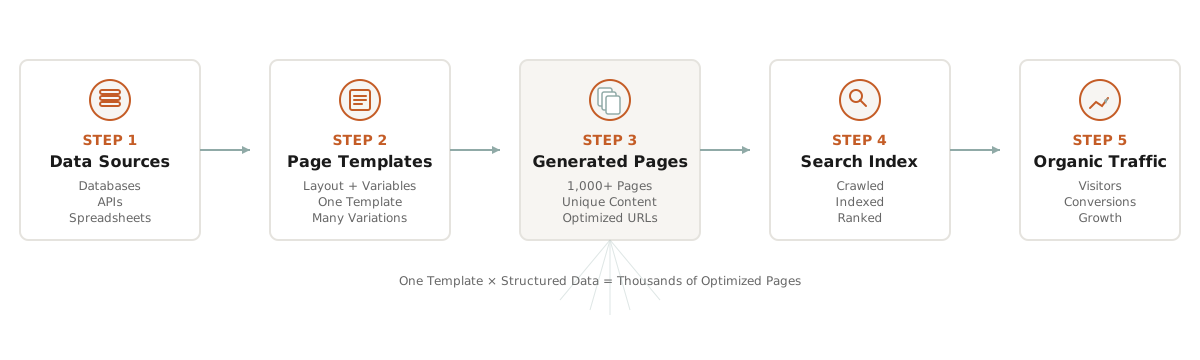
Programmatic SEO is the practice of creating large numbers of landing pages at scale by combining templates with structured data. Instead of manually writing each page, you build one template and populate it dynamically with data from databases, APIs, or spreadsheets.
The key difference from traditional SEO: you're not creating individual pieces of content. You're building a system that generates content based on patterns.
For example, a marketing software company might create:
- One template for "Best CRM for [industry]"
- A database with 50 industries
- Structured data about CRM features relevant to each industry
The result: 50 unique landing pages, each targeting a specific industry search query, generated from a single template.
The strategy works because many searches follow predictable patterns. If people search for "Slack integration with Asana," they're likely also searching for "Slack integration with Trello," "Slack integration with Monday," and hundreds of other tool combinations. One template can serve all these queries.
02 / how-programmatic-seo-works
How Programmatic SEO Works
Programmatic SEO follows a four-step technical process:
1. Template Creation
Start with a page template that defines the structure and repeatable elements. The template includes:
- Fixed elements (headers, navigation, calls-to-action)
- Variable fields (product names, locations, features, specifications)
- Content blocks that pull from your data source
- Schema markup for structured data
The template must be flexible enough to accommodate different data inputs while maintaining a consistent user experience.
2. Data Sources
Your content quality depends entirely on your data quality. Common data sources include:
- Internal databases (product catalogs, service locations, customer data)
- Public APIs (pricing data, reviews, specifications, integration details)
- Structured datasets (geographic data, industry classifications, demographic information)
- Manual research (compiled into spreadsheets or databases)
The best programmatic SEO strategies combine multiple data sources to create genuinely useful pages, not just keyword-stuffed templates.
3. Dynamic Page Generation
When a user visits a URL (or when a search engine crawls it), your system:
- Identifies which data set to use based on the URL parameters
- Pulls relevant data from your database or API
- Populates the template with that data
- Renders a complete HTML page
This can happen server-side (generating static HTML files) or client-side (rendering content dynamically). Server-side generation is typically better for SEO because it ensures search engines can easily crawl and index the content.
4. Quality Control at Scale
The biggest risk in programmatic SEO is generating thousands of low-quality pages. Quality control requires:
- Content validation rules (minimum word counts, required data fields)
- Duplicate content detection
- Manual spot-checks of generated pages
- User engagement monitoring
- Regular content updates as source data changes
Successful programmatic SEO treats generated pages like any other content asset—they need ongoing maintenance and optimization.
03 / real-world-programmatic-seo-examples
Real-World Programmatic SEO Examples
Zapier's Integration Pages (10,000+ Pages)
Zapier built its organic search dominance on programmatic SEO. They created templates for every possible integration between apps in their platform.
URL structure: zapier.com/apps/[app-1]/integrations/[app-2]
Content pattern:
- Integration overview
- Popular automation workflows (pulled from actual user data)
- Step-by-step setup instructions
- Related integrations
Why it works: Each page targets a specific integration query with genuinely useful content. They're not just keyword pages—they show real workflows and help users solve actual problems.
B2B replication: If your product integrates with other tools, this pattern works immediately. Even with 20 integrations, that's 400 potential pages (20 x 20 combinations).
G2's Comparison Pages
G2 generates thousands of software comparison pages automatically by pulling data from their review database.
URL structure: g2.com/compare/[product-a]-vs-[product-b]
Content pattern:
- Side-by-side feature comparison tables
- Review score summaries
- Pricing comparisons
- User review excerpts
- Alternative recommendations
Why it works: They aggregate existing data (reviews, features, pricing) into a useful format. The pages answer real buying questions.
B2B replication: If you have competitive intelligence data, product specifications, or customer feedback, you can build comparison pages that help buyers make decisions.
Wise's Currency Conversion Pages
Wise (formerly TransferWise) created landing pages for every currency pair conversion.
URL structure: wise.com/us/currency-converter/[currency-1]-to-[currency-2]
Content pattern:
- Live conversion calculator
- Historical exchange rate charts
- Country-specific sending information
- Related currency conversions
Why it works: They provide actual utility (working calculator) combined with helpful context. The pages serve a functional purpose beyond just ranking.
B2B replication: If your service varies by location, industry, or other variables, you can create localized landing pages that provide real value to each segment.
HubSpot's Marketing Statistics Pages
HubSpot generates collections of statistics for various marketing topics.
URL structure: hubspot.com/marketing-statistics/[topic]
Content pattern:
- Curated list of relevant statistics
- Data visualization
- Source citations
- Related statistics pages
- Strategic insights and takeaways
Why it works: They aggregate valuable data that marketers need for presentations, proposals, and planning. The pages become reference resources that earn links and repeat visits.
B2B replication: If you have access to industry data, research, or benchmarks, you can create reference pages organized by topic, industry, company size, or other relevant filters.
04 / when-programmatic-seo-makes-sense-for-b2b
When Programmatic SEO Makes Sense for B2B
Programmatic SEO isn't right for every company. It works best when you have:
Large Product Catalogs
Companies with hundreds or thousands of products can't manually create optimized pages for every item. Programmatic SEO lets you:
- Generate product pages from inventory databases
- Create category and filter pages automatically
- Build comparison pages between product variations
Best for: Manufacturing companies, distributors, parts suppliers, equipment vendors.
Location-Based Services
If you serve multiple geographic markets, you need location-specific pages. Programmatic approaches let you:
- Create city and region landing pages
- Generate localized content based on geographic data
- Build pages for location + service combinations
Best for: Service providers, professional services firms, facility operators, contractors.
Integration and Compatibility Pages
If your product works with other tools or systems, you need pages for each integration. Programmatic SEO enables:
- Integration landing pages for each partner tool
- Compatibility matrices showing which products work together
- Setup guides for specific integration scenarios
Best for: SaaS companies, API platforms, technology providers, middleware solutions.
Comparison and Alternative Pages
Buyers actively search for comparisons and alternatives. You can programmatically create:
- Your product vs. competitor comparisons
- Alternative product recommendations
- Feature comparison matrices
- "Best [product type] for [use case]" pages
Best for: Any company in a competitive category with clear feature differentiation.
Industry-Specific Landing Pages
If your solution serves multiple industries, you need industry-specific messaging. Programmatic SEO lets you:
- Create industry landing pages with relevant use cases
- Generate case studies organized by industry
- Build resource libraries filtered by industry
Best for: Horizontal SaaS, professional services, enterprise software, consulting firms.
05 / the-programmatic-seo-process
The Programmatic SEO Process
Here's how to implement programmatic SEO for your B2B company:
Step 1: Identify Scalable Page Patterns
Look for searches where:
- The query structure is predictable ("X integration with Y," "best X for Y," "X in [city]")
- You can provide unique value for each variation
- There's meaningful search volume across multiple variations
- You have (or can get) the data needed to populate pages
Use keyword research tools to find patterns. If you see dozens of similar searches with slight variations, you've found a programmatic opportunity.
Step 2: Build Data Infrastructure
Before creating templates, organize your data:
- Centralize data sources: Combine information from your CRM, product database, support docs, and external APIs
- Structure your data: Create a schema that defines required fields, optional fields, and relationships
- Validate data quality: Ensure completeness, accuracy, and consistency
- Plan for updates: Build processes to keep data current
The quality of your generated pages is limited by the quality of your data. Invest time here.
Step 3: Create Templates with Unique Value
Your template must provide value beyond just inserting keywords. Include:
- Functional elements: Calculators, comparison tools, interactive features
- Data visualization: Charts, tables, graphs that make information digestible
- Actionable content: Step-by-step guides, checklists, templates
- Social proof: Customer examples, reviews, testimonials (when relevant)
- Clear calls-to-action: Next steps appropriate to buying stage
The template should work equally well for all data combinations. Test with edge cases.
Step 4: Generate and Index Pages
Decide on your technical approach:
- Static site generation: Pre-build all pages (best for SEO, but requires rebuild on data changes)
- Server-side rendering: Generate pages on request (more flexible, slightly slower)
- Hybrid approach: Pre-build high-value pages, render others on demand
Make sure search engines can discover and crawl your pages:
- Create comprehensive XML sitemaps
- Use internal linking to connect related pages
- Monitor crawl stats in Google Search Console
- Ensure fast page load times
Step 5: Monitor and Optimize
Track performance metrics:
- Indexing rate: Are search engines indexing your pages?
- Ranking distribution: What positions are pages reaching?
- Engagement metrics: How do users interact with generated pages?
- Conversion rates: Are pages driving business outcomes?
Continuously improve:
- A/B test template variations
- Update content as data changes
- Add new data sources to enrich pages
- Prune or consolidate underperforming pages
06 / risks-and-challenges
Risks and Challenges
Programmatic SEO carries real risks that can result in penalties or wasted effort:
Thin Content Penalties
Google penalizes pages that provide little value to users. Risks include:
- Templates that only swap keywords without meaningful content variation
- Pages that duplicate information from other pages on your site
- Content that doesn't match search intent
Mitigation: Add unique, useful content to each page. Include data visualization, functional tools, or information that can't be found elsewhere. If a page doesn't serve users, don't create it.
Crawl Budget Management
If you generate 100,000 pages but Google only crawls 1,000 per week, you have a problem. Search engines allocate limited crawl budget based on site authority and perceived value.
Mitigation: Prioritize your most valuable pages. Use crawl directives strategically. Monitor crawl stats and adjust based on actual search engine behavior. Consider staging your rollout instead of launching everything at once.
Maintaining Quality at Scale
As your data changes, your pages need updates. Outdated information damages user trust and search rankings.
Mitigation: Build automated quality checks into your system. Set up alerts for data gaps or inconsistencies. Create a maintenance schedule for reviewing and updating generated content. Plan for resources to manage the system long-term.
Duplicate Content Issues
If multiple pages contain similar information, search engines may filter out duplicates or have trouble determining which to rank.
Mitigation: Ensure each page targets a distinct keyword and provides unique value. Use canonical tags appropriately. Consider consolidating pages that are too similar.
User Experience Degradation
Automatically generated pages can feel robotic or unhelpful if not done well.
Mitigation: Test your pages with real users. Include human-written introductions and explanations. Add visual elements and interactivity. Make sure navigation works intuitively.
07 / programmatic-seo-vs-traditional-content-creation
Programmatic SEO vs Traditional Content Creation
Both approaches have their place in a complete B2B SEO strategy.
Use programmatic SEO when:
- You need to target hundreds of similar search queries
- You have structured data that can populate pages
- Search intent is informational or transactional
- Speed to market is critical
- Resources for manual content creation are limited
Use traditional content creation when:
- Search intent requires nuanced, strategic content
- You're targeting competitive, high-value keywords
- You need thought leadership positioning
- Content requires expert analysis or original research
- You're creating pillar content or comprehensive guides
The most effective B2B SEO programs use both. Create in-depth, authoritative content manually for your core topics and competitive keywords. Use programmatic SEO to scale coverage for long-tail variations and specific use cases.
For example, a marketing automation platform might:
- Manual content: "The Complete Guide to B2B Marketing Automation" (pillar content)
- Programmatic content: 50 pages for "Marketing automation for [industry]" + 100 pages for "[Marketing automation platform] vs [competitor]"
The pillar content establishes authority and ranks for head terms. The programmatic pages capture long-tail traffic and specific use cases.
08 / getting-started-with-programmatic-seo
Getting Started with Programmatic SEO
If you're convinced programmatic SEO makes sense for your business, start small:
- Identify one page pattern with clear value and search demand
- Build a dataset with 20-50 variations (enough to validate the approach, not so many you can't manage)
- Create a template and test with your dataset
- Launch and measure for 90 days
- Iterate based on results before expanding to additional patterns
Programmatic SEO is powerful, but it requires ongoing investment in data infrastructure, quality control, and optimization. Done well, it can transform your organic search presence and drive substantial growth.
For more advanced strategies and tools to scale your programmatic SEO efforts, check out our guide on programmatic SEO tools and strategies at scale.
If you're managing SEO for a large organization, learn how to coordinate programmatic and traditional SEO in our enterprise SEO guide.
And for a complete framework that integrates programmatic SEO with content strategy and AI search optimization, see our B2B organic growth playbook.
Ready to explore programmatic SEO for your business? Let's talk about how to identify opportunities and build the infrastructure to scale your organic growth.