B2B SEO isn't just B2C SEO with a different audience. It's a fundamentally different discipline that requires specialized strategies, distinct metrics, and a deeper understanding of complex buyer journeys. While B2C brands chase viral keywords and mass traffic, B2B companies must focus on precision targeting, authority building, and pipeline generation.
In this definitive guide, we'll break down the essential B2B SEO best practices that drive organic growth in 2026. Whether you're building an SEO program from scratch or optimizing an existing strategy, these proven frameworks will help you generate qualified leads, shorten sales cycles, and demonstrate clear ROI from organic search.
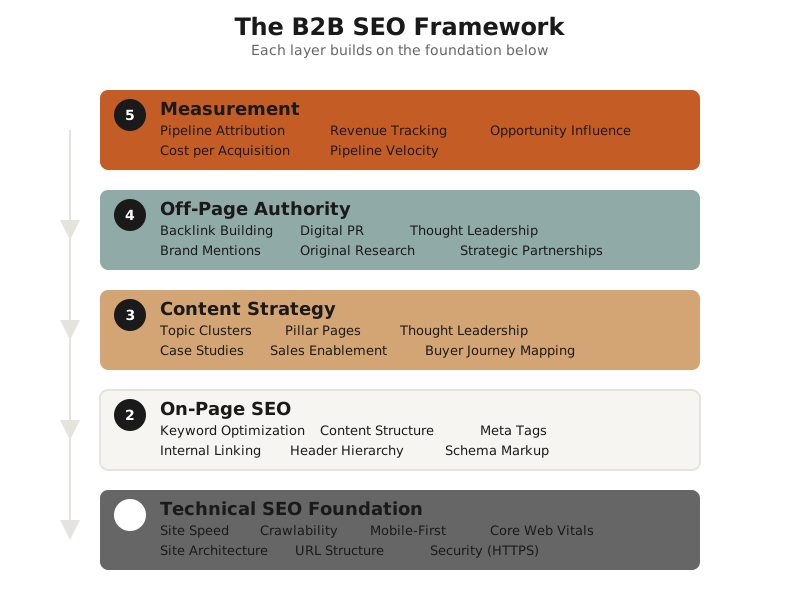
01 / why-b2b-seo-is-fundamentally-different-from-b2c
Why B2B SEO Is Fundamentally Different from B2C
Before diving into tactics, it's critical to understand what makes B2B SEO unique. These distinctions should inform every strategic decision you make:
Longer, more complex sales cycles. B2B purchases often involve months of research, multiple stakeholders, and significant financial commitments. Your SEO strategy must support prospects throughout this extended journey, not just capture quick conversions. This means creating content for every stage, from initial awareness to vendor comparison to post-purchase optimization.
Multiple decision-makers and influencers. A typical B2B purchase involves 6-10 stakeholders with different priorities, pain points, and search behaviors. Your content must address technical buyers, financial decision-makers, end users, and executive sponsors. Each persona searches differently and requires distinct content experiences.
Lower search volumes, higher value. B2B keywords typically show 10-100x lower search volume than consumer equivalents. A keyword with 50 monthly searches might seem insignificant until you realize each visitor represents a potential $50,000 annual contract. This changes how you evaluate keyword opportunities and measure success.
Intent signals matter more than volume. A B2C brand might optimize for "running shoes" (500,000 searches), while a B2B company targets "enterprise resource planning implementation partners" (200 searches). The latter drives qualified pipeline; the former drives traffic. In B2B SEO, understanding and matching search intent is exponentially more important than ranking for high-volume terms.
Longer content, deeper expertise. B2B buyers expect comprehensive resources that demonstrate domain expertise. Surface-level blog posts won't cut it. Your content must show genuine understanding of industry challenges, technical nuances, and practical implementation details. This is why 2,500+ word guides outperform 800-word blog posts in B2B search results.
02 / keyword-strategy-for-b2b-targeting-intent-not-vo
Keyword Strategy for B2B: Targeting Intent, Not Volume
Building an effective B2B keyword strategy requires rethinking how you identify, evaluate, and prioritize search opportunities.
Bottom-of-Funnel vs Top-of-Funnel Keywords
The most valuable B2B keywords sit at the bottom of the funnel, where prospects are actively evaluating solutions. These commercial-intent keywords drive pipeline, not just traffic.
Bottom-of-funnel indicators:
- Comparison terms: "HubSpot vs Salesforce," "best marketing automation platforms"
- Solution-specific: "enterprise CRM implementation," "B2B marketing automation services"
- Vendor evaluation: "Workday pricing," "SAP alternatives"
- Implementation and integration: "Salesforce Slack integration," "migrating from Marketo to HubSpot"
These keywords often have modest search volumes (50-500 monthly searches) but exceptional conversion rates because searchers are making buying decisions.
Top-of-funnel keywords address broader challenges and questions before prospects have determined their solution category. Examples include "how to improve sales productivity," "marketing attribution models explained," or "what is account-based marketing."
These awareness-stage keywords generate higher volumes but longer conversion timelines. They're essential for building authority and capturing prospects early in the buyer journey, but shouldn't dominate your keyword portfolio at the expense of commercial-intent terms.
Mapping Keywords to Buyer Journey Stages
Create a keyword map that aligns search terms with specific funnel stages:
Awareness stage: Problem-focused, educational queries. Prospects are identifying challenges but haven't determined solutions. Content: educational blog posts, guides, industry reports.
Consideration stage: Solution-category searches. Prospects understand their problem and are researching solution types. Content: comparison guides, solution overviews, framework articles.
Decision stage: Vendor and implementation searches. Prospects are evaluating specific providers and planning implementation. Content: case studies, service pages, implementation guides, ROI calculators.
Retention/expansion stage: Often overlooked in B2B SEO. Existing customers search for optimization, integration, and advanced usage information. Content: knowledge bases, advanced tutorials, integration guides.
This mapping helps you create content that matches where prospects are in their journey, not just what they're searching for.
Finding Keywords Your ICP Actually Searches
Generic keyword research tools surface high-volume terms that may not align with your ideal customer profile. Use these B2B-specific research methods:
Mine your CRM and sales conversations. Review closed-won opportunity notes, call recordings, and email threads. What language do qualified prospects use? What questions do they ask repeatedly? These phrases often make excellent long-tail keywords that tools don't surface.
Analyze competitor backlink profiles. Tools like Ahrefs and SEMrush show which pages attract the most backlinks for competitors. These high-authority pages typically target valuable commercial keywords worth pursuing.
Survey existing customers. Ask how they first became aware of their problem, what terms they searched, and what content influenced their decision. This qualitative research reveals search patterns that data alone misses.
Leverage AI search query expansion. With the rise of conversational AI search, understand how prospects might ask questions to ChatGPT, Perplexity, or Google SGE. These natural-language queries often reveal content gaps in traditional keyword research.
Monitor sales enablement questions. What questions do sales teams ask marketing for content to support? These indicate gaps in your keyword coverage and opportunities to create high-value assets.
03 / technical-seo-foundations-for-b2b-websites
Technical SEO Foundations for B2B Websites
Technical SEO creates the infrastructure for organic visibility. While B2B websites share many technical requirements with B2C sites, certain elements deserve special attention.
Site Architecture for B2B
B2B sites typically contain more pages than B2C counterparts: service pages for multiple offerings, case studies, resource libraries, industry-specific landing pages, and extensive documentation. This complexity requires intentional architecture.
Siloed structure by solution or industry. Organize content into clear hierarchies that mirror how prospects think about solutions. A marketing automation platform might structure content by solution (lead generation, email marketing, analytics) or industry (healthcare, financial services, manufacturing). Choose the primary structure based on your buyer journey patterns.
Topic cluster model. Build comprehensive topic clusters around core service areas. Create pillar pages that provide broad coverage of a topic, supported by 10-15 cluster content pieces that explore specific aspects in depth. Internal link from cluster content back to pillars, and from pillars to relevant cluster pieces.
Flatten navigation depth. Every important page should be accessible within 3 clicks from the homepage. Deep hierarchies dilute crawl equity and make pages harder to discover. If prospects need to click through multiple layers to reach service pages or case studies, those pages will struggle to rank.
Implement faceted navigation carefully. Resource centers with filtering by industry, solution, content type, and topic can create thousands of URL variations. Use canonical tags, strategic noindex directives, and parameter handling in Google Search Console to prevent duplicate content issues.
Page Speed and Core Web Vitals
B2B websites often struggle with performance due to enterprise technology stacks, heavy forms, chat widgets, and analytics scripts. Poor page experience impacts rankings and conversion rates.
Optimize Largest Contentful Paint (LCP). Target LCP under 2.5 seconds. Common B2B culprints include unoptimized hero images, slow-loading webinar registration forms, and render-blocking resources. Use lazy loading for below-the-fold content and optimize image delivery through CDNs.
Minimize Cumulative Layout Shift (CLS). B2B sites frequently suffer from layout shifts caused by late-loading ads, pop-ups, and chat widgets. Reserve space for dynamic elements, load resources in consistent order, and test on actual devices used by your ICP.
Improve First Input Delay (FID) / Interaction to Next Paint (INP). Interactive elements like calculators, configurators, and assessment tools must respond quickly. Defer non-critical JavaScript, optimize third-party scripts, and implement service workers for better resource caching.
Mobile optimization despite desktop-heavy traffic. Even if 70% of your traffic comes from desktop, Google uses mobile-first indexing. Ensure forms are usable on mobile, content is readable without zooming, and navigation is touch-friendly.
Internal Linking Structure
Strategic internal linking distributes authority, helps Google understand content relationships, and guides visitors to conversion opportunities.
Link from high-authority pages to conversion pages. Your most linked-to pages (often blog posts and resources) should link to service pages, case studies, and other conversion-focused content. This passes authority and creates conversion pathways.
Use descriptive anchor text. Generic "click here" or "learn more" anchors waste SEO value. Use keyword-rich, descriptive anchors: "enterprise SEO services" instead of "our services."
Create content bridges. Link related blog posts to each other, creating comprehensive content experiences. A post about B2B content marketing should link to related articles on topic clusters, SEO, and distribution strategies.
Implement breadcrumb navigation. Breadcrumbs help users understand site structure, reduce bounce rates, and generate breadcrumb schema markup that appears in search results.
04 / on-page-optimization-for-b2b-content
On-Page Optimization for B2B Content
B2B on-page optimization balances SEO best practices with the need to demonstrate expertise and drive conversions.
Landing Pages vs Blog Content
These content types serve different purposes and require different optimization approaches.
Service landing pages must simultaneously rank for commercial keywords and convert visitors. Include clear value propositions, benefit-focused copy, social proof elements (client logos, testimonials, case study links), specific service descriptions, and prominent CTAs. Target 800-1,500 words with H2 sections addressing key buyer questions.
Blog posts build authority, target top-of-funnel keywords, and create entry points to your site. Structure posts with clear H2 and H3 hierarchies, include relevant internal links to conversion pages, optimize for featured snippets with concise answers, and aim for 1,500-3,000 words depending on topic depth.
Case studies serve dual purposes: social proof for conversion and content for SEO. Optimize titles and meta descriptions for relevant keywords, structure with clear problem-solution-results framework, include specific metrics and outcomes, and create industry-specific case study hub pages that aggregate relevant examples.
Service Pages That Rank and Convert
Service pages face the dual challenge of ranking for competitive commercial keywords while convincing prospects to take action.
Lead with value, not features. Begin with a clear headline that articulates the outcome or transformation your service delivers. Follow with a concise paragraph explaining the core value proposition. Only then introduce specific features and methodologies.
Address the "why" before the "what." Explain why this service matters and what problems it solves before describing how you deliver it. This mirrors how B2B buyers actually evaluate vendors.
Include trust signals throughout. Scatter social proof elements (client logos, testimonials, case study links, awards, certifications) throughout the page, not just at the bottom. Position them near CTAs to reduce friction.
Create conversion opportunities at multiple commitment levels. Not every visitor is ready to "request a demo." Offer lower-commitment CTAs like "download service overview," "see case study," or "calculate ROI" alongside your primary conversion goal.
Optimize for position zero and featured snippets. Include an FAQ section at the bottom of service pages addressing common questions. Format answers concisely (40-60 words) to optimize for featured snippet inclusion.
Case Studies and Social Proof for SEO
Case studies often underperform in SEO because they're treated purely as sales collateral. Optimized properly, they can rank for valuable commercial keywords.
Title optimization. Instead of "Client Success Story," use keyword-rich titles: "How [Industry] Company Increased Pipeline 340% with Account-Based Marketing." This targets industry-specific commercial keywords.
Structure for skimmability. Use clear sections: Challenge, Solution, Results, Key Metrics. Include pull quotes, data visualizations, and bulleted lists to break up text.
Create industry-specific case study hubs. Build landing pages that aggregate case studies by industry ("Healthcare Marketing Case Studies," "Financial Services SEO Case Studies"). These hub pages can rank for industry-specific commercial keywords.
Extract blog content from case studies. Turn case studies into blog posts that explore specific tactics in depth. Link from the blog post to the full case study, creating internal linking value and content variety.
05 / off-page-seo-and-authority-building
Off-Page SEO and Authority Building
B2B link building requires specialized approaches that reflect how business audiences discover and evaluate vendors.
B2B Link Building Strategies
Traditional B2B link building tactics (guest posting, directory submissions) rarely drive meaningful results. Focus on these higher-value approaches:
Original research and data studies. Conduct industry surveys, compile benchmark reports, or analyze trends in your sector. Original data attracts natural backlinks from journalists, analysts, and other content creators. Promote actively to relevant publications and communities.
Digital PR and thought leadership. Position executives as industry experts through contributed articles in trade publications, expert commentary on industry news, and speaking engagements that generate coverage. These activities build authority and earn authoritative backlinks.
Strategic partnerships and integrations. Technology partnerships, integration partnerships, and channel partnerships often generate backlinks from partner websites, directories, and marketplaces. These links signal relevance and authority in your category.
Resource creation for practitioners. Build genuinely useful tools, calculators, templates, or frameworks that practitioners in your space actually use. A well-executed ROI calculator or assessment tool can earn hundreds of backlinks over time.
Industry association and community participation. Membership in relevant trade associations, participation in industry working groups, and contributions to open-source projects can generate authoritative backlinks and strengthen topical authority signals.
Thought Leadership Content Distribution
Creating exceptional content is half the battle. Strategic distribution amplifies reach and attracts backlinks.
Repurpose research for multiple formats. Turn a comprehensive report into blog posts, infographics, presentation decks, webinar content, and social posts. Each format reaches different audiences and creates distinct link opportunities.
Build relationships with industry journalists. Develop ongoing relationships with reporters and editors who cover your space. Offer yourself as an expert source, share relevant data proactively, and provide commentary on industry developments.
Participate in relevant communities. Engage authentically in industry forums, LinkedIn groups, Reddit communities, and Slack channels where your ICP gathers. Share insights and resources without overt self-promotion. Valuable participation drives traffic and sometimes backlinks.
Leverage customer and partner networks. Encourage satisfied customers to share case studies, link to your resources, or mention your collaboration in their content. Make it easy by providing social share copy, graphics, and relevant content assets.
06 / content-strategy-that-serves-sales-and-seo
Content Strategy That Serves Sales and SEO
The most effective B2B content strategies align SEO goals with sales enablement needs, creating assets that both rank and close deals.
Topic Clusters for B2B
The topic cluster model has become essential for B2B SEO success. Rather than creating isolated blog posts, organize content into interconnected clusters around core themes.
Identify pillar topics. Choose 3-5 broad topics central to your business and buyer journey. For a marketing automation company, these might be "lead generation," "marketing attribution," "email marketing," and "account-based marketing."
Create comprehensive pillar pages. Develop 3,000-5,000 word pillar pages that provide broad coverage of each topic. These pages target head terms with significant search volume and serve as the hub for related cluster content.
Develop cluster content. Create 10-15 supporting articles that explore specific aspects of each pillar topic in depth. These target long-tail variations and specific questions prospects ask as they research solutions.
Implement strategic internal linking. Link all cluster content back to the relevant pillar page, and link from pillar pages to related cluster content. This creates strong topical authority signals and helps visitors explore related concepts.
Map clusters to buyer journey stages. Ensure each topic cluster includes content for awareness, consideration, and decision stages. This creates a complete content experience that supports prospects throughout their research process.
For a detailed framework on implementing topic clusters, see our guide on B2B content marketing topic clusters that drive pipeline.
Content That Serves Sales Teams
The best B2B content serves both organic search and sales enablement purposes.
Create content for common sales objections. Address frequent concerns, misconceptions, and competitive questions in blog posts and resources. Sales teams can share these assets in conversations, and prospects often discover them through organic search.
Develop stage-specific resources. Create downloadable resources, ROI calculators, implementation guides, and comparison frameworks that sales teams can share at relevant deal stages. Optimize these resources for search to create additional discovery paths.
Build competitive comparison content. Address "[Your Brand] vs [Competitor]" searches directly with fair, accurate comparisons that highlight your differentiation. These pages capture high-intent traffic and support sales conversations.
Maintain updated, comprehensive FAQs. Develop robust FAQ sections addressing technical questions, implementation concerns, pricing questions, and integration details. These rank well and reduce sales cycle friction by answering questions proactively.
07 / measuring-b2b-seo-success-pipeline-over-traffic
Measuring B2B SEO Success: Pipeline Over Traffic
B2B SEO success isn't measured by traffic or rankings alone. The metrics that matter demonstrate business impact.
Pipeline Attribution and Revenue Metrics
Connect SEO performance to revenue outcomes:
Track assisted conversions. Use Google Analytics and CRM integration to identify how many opportunities and closed deals included organic search in their journey. Most B2B deals involve multiple touchpoints; give organic search credit for its role in the pipeline.
Monitor opportunity influence rate. Calculate the percentage of closed-won opportunities that engaged with organic content during their buyer journey. If 60% of closed deals visited your blog or resource center, your SEO program is clearly driving revenue.
Measure cost per opportunity. Divide your total SEO investment by the number of opportunities generated with organic search as a touchpoint. Compare this to paid advertising CPO to demonstrate efficiency.
Calculate customer acquisition cost (CAC) by channel. Break down CAC by acquisition channel. Organic search typically shows lower CAC than paid channels once programs mature, demonstrating long-term ROI.
Track pipeline velocity. Measure whether prospects who engage with organic content move through the pipeline faster than those acquired through other channels. Well-optimized educational content often accelerates sales cycles by addressing questions proactively.
Beyond Vanity Metrics
Don't let these metrics distract from business outcomes:
Organic traffic growth alone is insufficient. Traffic from irrelevant keywords or unqualified audiences inflates numbers without driving business results. Always segment traffic by quality indicators like time on site, pages per session, and conversion actions.
Keyword rankings are directional indicators. Ranking #1 for a keyword matters only if that keyword drives qualified traffic and conversions. Focus on ranking for commercial-intent keywords that your ICP actually searches.
Domain authority and link metrics are inputs, not outcomes. These metrics influence SEO performance but don't directly measure business impact. Use them to diagnose technical issues and identify opportunities, not to prove ROI.
Focus on qualified conversion metrics. Demo requests, consultation bookings, and content downloads from qualified prospects matter more than generic newsletter signups or ebook downloads that attract unqualified audiences.
08 / the-2026-factor-integrating-generative-engine-op
The 2026 Factor: Integrating Generative Engine Optimization
The SEO landscape continues evolving rapidly as AI-powered search experiences reshape how prospects discover and evaluate solutions. Generative Engine Optimization (GEO) has emerged as a critical complement to traditional SEO.
Understand AI search behavior. ChatGPT, Perplexity, Google SGE, and other AI search tools are increasingly used for business research. These platforms prioritize different content signals than traditional search engines. Content that performs well in AI search tends to be comprehensive, well-structured, includes specific data and examples, cites authoritative sources, and addresses questions directly.
Optimize for AI citations. AI search tools cite sources when generating responses. Increase citation likelihood by creating authoritative, comprehensive resources on specific topics, using clear, factual language that's easy to parse, including relevant statistics and data points, and building topical authority through topic clusters.
Create conversational content formats. AI search responds better to content that answers questions conversationally. Structure content with clear question-and-answer formats, anticipate follow-up questions prospects might ask, use natural language rather than keyword-stuffed copy, and include practical examples and step-by-step guidance.
Maintain technical SEO fundamentals. While AI search tools access content differently than traditional crawlers, core technical SEO practices remain important. Ensure proper schema markup for entities and relationships, maintain clean site structure and internal linking, optimize for mobile and page speed, and keep content fresh and updated.
For a comprehensive understanding of how GEO complements traditional SEO, read our complete guide: What Is Generative Engine Optimization: The Complete GEO Guide.
09 / putting-it-all-together-your-b2b-seo-roadmap
Putting It All Together: Your B2B SEO Roadmap
Building a high-performing B2B SEO program requires strategic thinking, consistent execution, and patience. Here's how to sequence your efforts:
Foundation phase (Months 1-3):
- Audit technical SEO and fix critical issues
- Conduct comprehensive keyword research mapped to buyer journey
- Develop content strategy with pillar topics identified
- Implement proper tracking and analytics
Growth phase (Months 4-9):
- Create pillar pages for core topics
- Publish cluster content consistently
- Build authoritative backlinks through thought leadership
- Optimize high-value service and product pages
Scale phase (Months 10+):
- Expand topic clusters into new areas
- Optimize and refresh existing high-performing content
- Develop advanced SEO initiatives (structured data, international expansion)
- Refine measurement and pipeline attribution
Continuous optimization:
- Monitor search console and analytics for opportunities
- Update content as industry trends evolve
- Test and optimize conversion elements on high-traffic pages
- Track competitive movements and adjust strategy accordingly
B2B SEO success isn't built overnight. The strategies outlined in this guide require commitment, resources, and patience. But companies that execute these best practices consistently generate compounding returns: qualified organic traffic that drives pipeline, authoritative content that enables sales teams, and measurable revenue impact that justifies continued investment.
For a complete framework that integrates SEO with content marketing and AI search optimization, explore our B2B Organic Growth Playbook.
Ready to build an SEO program that drives qualified pipeline, not just traffic? Let's talk about your organic growth strategy.
About WE•DO: We help B2B companies build sustainable organic growth engines through strategic SEO, content marketing, and integrated digital strategies. Our team combines deep technical expertise with business acumen to deliver measurable results: qualified leads, shortened sales cycles, and clear ROI.