Your buyers are using ChatGPT, Perplexity, and Google AI Overviews to research solutions. The question is: are they finding you?
Generative Engine Optimization (GEO) is the practice of optimizing your content and brand presence so AI platforms cite, recommend, or mention you when prospects ask questions related to your business.
This isn't theoretical. ChatGPT reaches over 800 million weekly users. Google's AI Overviews appear in at least 16% of all searches—significantly higher for commercial and comparison queries. Perplexity processes over 100 million queries monthly.
When someone asks "best project management software for remote teams" or "which CRM integrates with HubSpot," AI platforms synthesize answers from across the web. If your brand isn't part of those answers, you don't exist in that buying journey.
This guide explains what GEO is, how it works, why it matters for B2B companies, and the specific framework for getting cited by AI platforms.
01 / what-is-generative-engine-optimization-clear-def
What is Generative Engine Optimization? (Clear Definition)
Generative Engine Optimization (GEO) is the practice of structuring content, establishing brand authority, and managing your digital presence to maximize visibility in AI-generated responses from platforms like ChatGPT, Perplexity, Google AI Overviews, and Claude.
Unlike traditional SEO, which optimizes for rankings and clicks in search engine results pages, GEO optimizes for citations and mentions inside the AI-generated answers themselves.
The goal is to become a trusted source that AI platforms reference when users ask questions related to your expertise, products, or industry.
02 / how-generative-ai-search-actually-works
How Generative AI Search Actually Works
Understanding how AI platforms generate answers is critical to optimizing for them.
The Retrieval Process
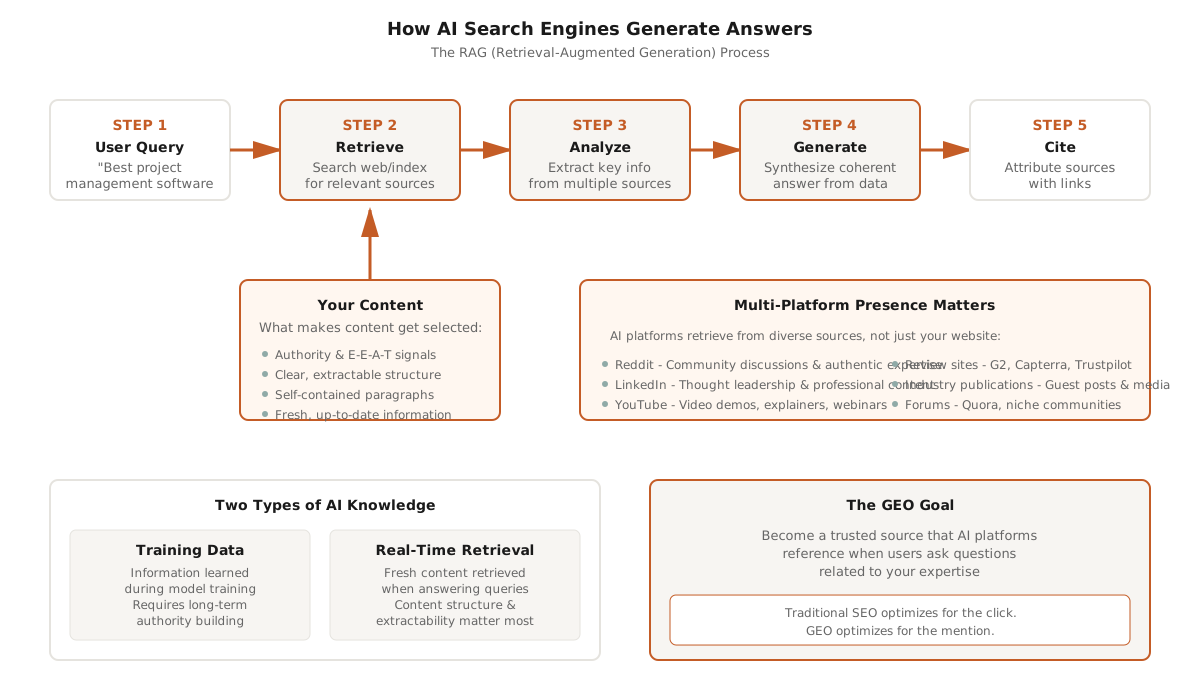
When you ask ChatGPT or Perplexity a question, the system doesn't search the entire internet in real-time. Here's what actually happens:
-
Query Understanding: The AI interprets your question and identifies what information it needs to provide an accurate answer.
-
Content Retrieval: The system retrieves relevant passages from its training data or performs real-time web searches (depending on the platform and mode).
-
Passage Extraction: Content is broken into chunks and converted into numerical representations called vectors. The most relevant passages are identified based on semantic similarity to the query.
-
Synthesis: The AI assembles these retrieved passages into a coherent answer, often combining information from multiple sources.
-
Citation: Depending on the platform, sources may be cited inline, listed at the bottom, or displayed as reference links.
Two Types of AI Knowledge
AI platforms use two distinct knowledge sources:
Training Data Knowledge: Information the model learned during its training phase. This includes content that was widely available and authoritative at the time of training. Getting into training data requires long-term, consistent publishing and authority building.
Real-Time Retrieval: Platforms like ChatGPT with browsing enabled, Perplexity with web search, and Google AI Overviews retrieve fresh content in real-time to answer queries. This is where content structure and extractability matter most.
03 / why-geo-matters-for-b2b-companies
Why GEO Matters for B2B Companies
B2B buyers are conducting more research using AI platforms before they ever visit your website.
The Shift in B2B Discovery
Consider this typical B2B buying journey:
Traditional path: Buyer searches Google → clicks through to your website → reads your content → fills out a form → sales contact
AI-assisted path: Buyer asks ChatGPT or Perplexity for recommendations → receives synthesized answer with 3-5 options → researches only the brands mentioned → contacts sales directly
In the second path, if you're not mentioned by the AI, you never enter the consideration set. The buyer doesn't know you exist.
The Data Behind AI Adoption
Several trends make GEO critical for B2B:
ChatGPT reached 100 million users faster than any application in history. Enterprise adoption is accelerating, with companies integrating AI assistants into research workflows.
Gartner predicts a potential 25% decline in traditional search volume by 2027 as users shift to AI platforms for direct answers.
Google's AI Overviews appear for billions of searches monthly, with particularly high visibility for comparison queries and high-intent commercial searches—exactly where B2B buyers operate.
Competitive Visibility Gap
Most B2B companies aren't tracking their AI visibility at all. This creates a strategic opportunity.
While competitors focus exclusively on traditional SEO metrics, early movers in GEO are establishing brand authority in AI responses before the market becomes saturated.
04 / key-ranking-factors-for-generative-search
Key Ranking Factors for Generative Search
AI platforms don't use the same ranking algorithm as Google. The factors that determine citations in AI-generated answers differ in emphasis and application.
Authority and E-E-A-T Signals
AI systems prioritize sources that demonstrate Experience, Expertise, Authoritativeness, and Trustworthiness.
Author credentials matter: Content authored by identified subject matter experts with verifiable credentials performs better than anonymous content.
Brand reputation signals: Your domain authority, backlink profile, and overall web presence still influence whether AI platforms trust your content as a source.
Third-party validation: Being mentioned positively across review sites, industry publications, Reddit discussions, and other platforms signals credibility to AI systems.
Content Structure and Extractability
AI platforms extract specific passages from your content to construct answers. Content structure directly impacts whether your information can be extracted and used accurately.
Self-contained paragraphs: Each paragraph should express one complete idea that makes sense when read in isolation, without references to "as mentioned above" or "this is why."
Clear, descriptive headings: Heading structure helps AI understand what each section covers and locate relevant information quickly.
Front-loaded information: State the main point at the beginning of paragraphs rather than building up to it at the end.
Specific facts and data: Concrete numbers, statistics, and clear statements are easier for AI to extract than vague generalizations.
Entity Clarity and Structured Data
AI systems need to understand what your brand is, what category you belong to, and what you're authoritative for.
Consistent brand descriptions: Your brand description should be consistent across your website, LinkedIn, Crunchbase, review platforms, and industry directories.
Schema markup: While we don't fully understand how schema influences AI citations, structured data helps machines understand your content across systems. Use JSON-LD schema for products, organizations, FAQs, and other relevant types.
Clear categorization: Make it unambiguous what category your products or services belong to. If you sell marketing automation software, that should be crystal clear across all properties.
Freshness and Recency
AI platforms prioritize current information, especially for topics where timeliness matters.
Regular content updates: Updating existing high-authority pages signals freshness without requiring entirely new content.
Publication dates: Clear publication and update dates help AI systems assess content recency.
Real-time data: For queries requiring current data (pricing, statistics, trends), AI platforms favor recently published content.
Multi-Platform Presence
AI visibility extends far beyond your website. Platforms like Reddit, YouTube, LinkedIn, and industry publications play significant roles in AI citations.
In Semrush's analysis of AI citations, Reddit, LinkedIn, and YouTube ranked among the most frequently cited sources across major AI platforms.
This means your owned content on these platforms—product demos on YouTube, thought leadership on LinkedIn, helpful answers in relevant subreddits—increases your total AI visibility footprint.
05 / how-geo-relates-to-traditional-seo
How GEO Relates to Traditional SEO
GEO doesn't replace SEO. It builds on the same foundation while shifting the focus from rankings to citations.
What Stays the Same
The core principles of effective SEO still apply to GEO:
Content quality: You still need to publish valuable, well-researched content that serves real user needs.
Technical accessibility: Your site still needs to be crawlable, fast, and mobile-friendly.
Authority building: You still need credible signals of expertise and trustworthiness.
User intent: You still need to understand what your audience is actually searching for.
AI systems prefer the same qualities that traditional search engines reward: authoritative, well-structured, accessible content.
What Changes
GEO introduces several strategic shifts:
| Aspect | Traditional SEO | GEO |
|---|---|---|
| Primary Goal | Rank in top search positions | Be cited in AI-generated answers |
| Success Metrics | Rankings, clicks, organic traffic | Citations, share of voice, mention sentiment |
| User Behavior | User clicks through to your site | AI includes you in response; user may never click |
| Optimization Focus | Title tags, meta descriptions, keyword targeting | Self-contained content, entity clarity, multi-platform presence |
| Key Platforms | Google, Bing | ChatGPT, Perplexity, Google AI Overviews, Claude |
| Content Structure | Comprehensive long-form preferred | Extractable, self-contained passages critical |
| Credibility Signals | Backlinks, domain authority | Backlinks plus unlinked mentions across platforms |
The most important difference: traditional SEO optimizes for the click. GEO optimizes for the mention.
The Complementary Relationship
Strong traditional SEO creates the foundation that makes GEO possible.
Your technical infrastructure, content quality, and domain authority influence whether AI platforms trust your content as a reliable source. Without that foundation, GEO tactics have little to build on.
At the same time, GEO extends your visibility into spaces where traditional SEO doesn't reach—inside the AI-generated answers that users increasingly rely on.
For a detailed comparison, see our guide on how GEO compares to traditional SEO.
06 / step-by-step-geo-implementation-framework
Step-by-Step GEO Implementation Framework
Implementing GEO systematically increases your probability of appearing in AI-generated answers.
Step 1: Audit Your Current AI Visibility
Before optimizing for GEO, understand your current baseline.
Manual testing: Query AI platforms (ChatGPT, Perplexity, Google AI Overviews) with questions your prospects would ask. Track whether your brand appears in responses.
Use GEO tracking tools: Platforms like Semrush's AI Visibility Toolkit or AthenaHQ track your brand mentions across AI platforms, measure share of voice against competitors, and monitor sentiment.
Identify visibility gaps: Document topics where competitors appear but you don't. These represent your highest-priority optimization opportunities.
Step 2: Optimize for Entity Clarity
Make it easy for AI systems to understand what your brand is and what you're authoritative for.
Standardize brand descriptions: Create a canonical brand description (50-75 words) that clearly states what your company does, what category you belong to, and what differentiates you. Use this consistently across:
- Your website's About page and homepage
- LinkedIn company page
- Crunchbase profile
- Industry directories
- Review platforms (G2, Capterra, etc.)
Implement schema markup: Add Organization schema to your homepage with your brand name, description, logo, and social profiles. Use Product schema for product pages. Add FAQ schema for common questions.
Clarify your expertise areas: Create topic authority hubs on your site that clearly establish what you're an expert in. If you're a B2B marketing agency, you should have comprehensive resources on topics like B2B SEO best practices.
Step 3: Structure Content for Extractability
Rewrite or restructure your most important content to make it easy for AI to extract and reference.
Use self-contained paragraphs: Each paragraph should express one complete idea that makes sense when read in isolation. Avoid references like "as we discussed earlier" or "this is why."
Front-load key information: Put the most important point at the start of each paragraph and section.
Add descriptive headings: Use H2 and H3 headings that clearly signal what each section covers. Good example: "How to Measure GEO Success." Bad example: "Measuring What Matters."
Include specific data: Add statistics, research findings, specific numbers, and concrete examples rather than vague generalizations.
Create FAQ sections: FAQ sections are naturally structured for extraction. Answer specific questions your prospects ask with clear, self-contained answers.
Step 4: Build Multi-Platform Presence
Extend your expertise beyond your website to platforms AI systems frequently cite.
Create valuable YouTube content: Product demos, explainer videos, webinars, and educational content give AI platforms video sources to reference. In our work helping B2B companies with ranking in ChatGPT and Perplexity, YouTube consistently appears in citation sources.
Participate strategically in Reddit: Join subreddits where your target audience asks questions. Provide genuinely helpful answers (not sales pitches). Authentic expertise builds trust with both the community and AI systems analyzing these discussions.
Publish on LinkedIn: Executive thought leadership on LinkedIn establishes authority and gives AI platforms additional signals about your expertise.
Earn media mentions: Guest posts in industry publications, podcast appearances, and media coverage create third-party validation that AI systems interpret as credibility signals.
Maintain review profiles: Keep your profiles on G2, Capterra, Trustpilot, and industry-specific review sites up to date with accurate information and encourage satisfied customers to leave detailed reviews.
Step 5: Earn Unlinked Brand Mentions
Research suggests that unlinked brand mentions (where your brand is mentioned but not linked) may carry significant weight in AI citations.
Monitor brand mentions: Use tools like Google Alerts, Mention, or Brand24 to track where your brand is discussed across the web.
Provide value in communities: Answer questions on Quora, industry forums, and niche communities where your expertise is relevant.
Create shareable research: Original research, data studies, and surveys generate natural brand mentions when others reference your findings.
Build relationships with creators: When industry influencers, podcasters, and thought leaders mention your brand positively in their content, it creates signals AI systems can interpret.
Step 6: Demonstrate E-E-A-T
AI platforms prioritize sources that demonstrate Experience, Expertise, Authoritativeness, and Trustworthiness.
Author transparency: Add detailed author bios to your content. Include credentials, experience, and expertise that qualify the author to write on the topic.
Cite your sources: When making claims, link to authoritative sources. This increases trust and provides additional context AI systems can verify.
Update content regularly: Fresh, maintained content signals ongoing expertise. Add update dates to show content is current.
Show real experience: Case studies, client results, and specific examples demonstrate actual experience, not just theoretical knowledge.
Step 7: Measure and Iterate
GEO requires ongoing measurement and refinement.
Track citation frequency: Monitor how often your brand appears in AI responses to relevant queries. Tools like Semrush's AI Visibility Toolkit automate this across platforms.
Measure share of voice: Compare your citation rate to competitors. If AI answers 100 questions about your category, what percentage mention you versus competitors?
Monitor sentiment: Track whether mentions are positive, neutral, or negative. High citation frequency with negative sentiment is worse than no citations at all.
Identify high-value prompts: Document which specific questions trigger mentions of your brand. These reveal the topics you "own" in AI platforms.
Iterate based on data: Double down on topics where you're already cited. Invest in closing gaps where competitors appear but you don't.
07 / how-to-measure-geo-success
How to Measure GEO Success
Traditional analytics platforms can't track GEO performance. You need new measurement frameworks.
AI-Specific Metrics
Citation Frequency: How often your brand appears in AI-generated answers when users ask relevant questions. Track this across different topic areas and platforms.
Share of Voice: Your citation rate compared to competitors. If AI platforms answer 100 queries about "best CRM software," how many times do you appear versus Salesforce, HubSpot, and others?
Mention Sentiment: Whether AI platforms frame your brand positively, neutrally, or negatively when citing you. A high citation rate with negative sentiment damages your brand.
Prompt Context: Which specific questions or topics trigger mentions of your brand. This reveals where you have authority in AI knowledge bases.
Platform Coverage: Which AI platforms cite you. Different platforms may have different source preferences and training data.
Bridging AI Visibility to Business Impact
The measurement challenge with GEO is attribution. When an AI platform recommends your product, the prospect may never click through to your site immediately. They might Google your brand name later, sign up the following week, or remember you when they're ready to buy.
This creates an "attribution gap" that traditional analytics can't capture.
Branded search correlation: Track whether increases in AI visibility correlate with increases in branded search volume.
Direct traffic patterns: Monitor direct traffic trends. Prospects who learn about you from AI platforms may type in your URL directly.
Survey prospects: Ask new leads "How did you first hear about us?" and include "AI assistant (ChatGPT, Perplexity, etc.)" as an option.
Track at the category level: Monitor whether overall organic traffic and conversions increase as you build AI visibility, even if direct attribution is impossible.
Recommended GEO Tools
Semrush AI Visibility Toolkit: Tracks brand mentions, share of voice, and sentiment across ChatGPT, Perplexity, Google AI Overviews, and other platforms. Provides competitive benchmarking.
AthenaHQ: Attributes AI visibility impact directly to website performance. Designed for enterprise teams and data-driven agencies.
Manual testing: Regularly test key queries in ChatGPT, Perplexity, and Google yourself to spot-check your visibility.
08 / common-geo-questions-and-misconceptions
Common GEO Questions and Misconceptions
Does GEO work for every business?
GEO matters most for businesses where prospects research solutions before purchasing. This includes virtually all B2B companies, complex consumer products, and any category where buyers compare options.
If your customers use AI platforms to ask questions related to your business (and they increasingly do), GEO is relevant.
How long does GEO take to show results?
GEO operates on two timelines:
Real-time retrieval improvements can show impact in weeks to months as you publish optimized content that AI systems retrieve and cite.
Training data inclusion takes longer—potentially many months to years—as your brand becomes established enough to be included in future model training datasets.
The volatility in AI citations means results aren't linear. Brands that build strong foundations show up more consistently over time, even as individual citations fluctuate.
Is GEO just SEO with a new name?
No. While GEO builds on SEO fundamentals, it requires different optimization priorities and measurement frameworks.
SEO optimizes for rankings and clicks. GEO optimizes for citations and mentions inside AI-generated answers. The technical foundation overlaps significantly, but the strategic focus differs.
The relationship is complementary: strong SEO creates the foundation that makes GEO possible, and GEO extends your visibility into new discovery channels.
Can small companies compete with large brands in GEO?
Yes. AI platforms don't automatically favor large brands. They favor clear, authoritative, well-structured content that matches user intent.
Smaller companies with deep expertise in focused niches can outperform larger competitors when their knowledge is clearer, better structured, and more tightly aligned with specific topics.
Niche authority often beats broad recognition in AI citations.
What's the biggest mistake companies make with GEO?
Treating GEO as a separate tactic rather than an integrated extension of content strategy, SEO, brand building, and customer experience.
Effective GEO requires alignment across multiple disciplines: content teams creating extractable information, SEO ensuring technical accessibility, brand teams maintaining consistency across platforms, PR earning credible mentions, and product ensuring customer experiences generate positive reviews.
Companies that try to "bolt on" GEO without this strategic alignment see limited results.
09 / what-to-do-next-your-geo-starting-point
What to Do Next: Your GEO Starting Point
If you're just beginning with GEO, start here:
Week 1-2: Test your current AI visibility. Query ChatGPT, Perplexity, and Google with 10-20 questions your prospects would ask. Document whether your brand appears.
Week 3-4: Audit your entity clarity. Review your brand descriptions across your website, LinkedIn, review sites, and directories. Ensure they're consistent and clearly state what you do.
Week 5-8: Optimize your 5-10 most important pages for extractability. Rewrite key sections to use self-contained paragraphs, clear headings, and front-loaded information.
Ongoing: Build your multi-platform presence systematically. Create one valuable YouTube video per month. Participate authentically in one relevant community. Publish thought leadership consistently.
The companies that establish AI visibility early are building a strategic moat. As more businesses recognize the importance of GEO, competition for AI citations will increase.
Acting now positions you ahead of that curve.
Want to go deeper on specific aspects of GEO?
-
B2B Organic Growth Playbook: SEO, AI Search, and Content Strategy - The complete framework for B2B organic visibility across both traditional and AI-driven search.
-
How to Rank in ChatGPT, Perplexity & AI Overviews - Platform-specific strategies for getting cited by each major AI search engine.
-
GEO vs SEO: How AI Search Changes B2B Marketing - A detailed comparison of how GEO and SEO strategies differ and work together.
-
B2B SEO Best Practices: Definitive Guide - The SEO fundamentals that create the foundation for effective GEO.
11 / about-the-author
About the Author
Mike McKearin is the founder of WE•DO Growth Agency, where his team helps B2B companies optimize for both traditional search and AI assistants. WE•DO's clients appear in ChatGPT citations, Perplexity results, and Google AI Overviews through systematic content and technical optimization.