You have been doing SEO for years. Traffic was predictable. You knew the playbook.
Now your rankings look fine, but organic traffic is dropping. Your buyers are asking ChatGPT instead of Google. Your competitors are getting cited in AI answers while your brand stays invisible.
Welcome to the GEO vs SEO conversation every B2B marketer needs to have.
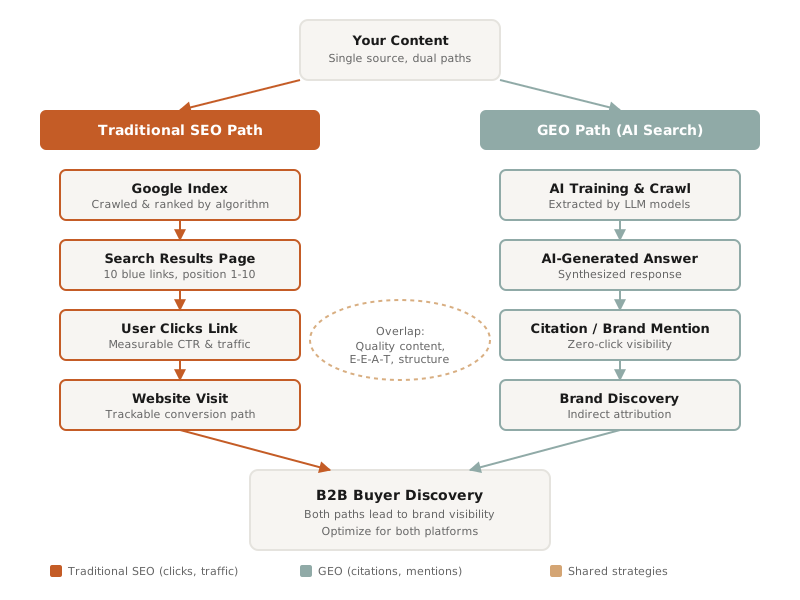
This is not about choosing one over the other. It is about understanding what each does, where they overlap, and how to allocate resources between traditional Search Engine Optimization (SEO) and Generative Engine Optimization (GEO).
01 / what-is-seo-what-is-geo
What Is SEO? What Is GEO?
Before we compare them, clear definitions matter.
SEO (Search Engine Optimization) is the practice of optimizing your website to rank higher in traditional search engine results pages. You target keywords, build backlinks, improve site speed, and create content that helps Google understand what you offer. Success means appearing on page one when someone searches for your solution.
GEO (Generative Engine Optimization) is the practice of structuring your content so AI platforms like ChatGPT, Perplexity, Google Gemini, and Claude can cite you in their answers. You optimize for clarity, authority, and extraction. Success means being referenced when someone asks an AI assistant for buying advice.
The goal is the same: connect your expertise with people searching for it. The delivery mechanism is different. SEO surfaces links. GEO delivers answers.
02 / geo-vs-seo-at-a-glance
GEO vs SEO at a Glance
Here is the high-level comparison every B2B marketer should understand.
| Factor | Traditional SEO | Generative Engine Optimization (GEO) |
|---|---|---|
| Primary Platform | Google, Bing, traditional search engines | ChatGPT, Perplexity, Claude, AI Overviews |
| User Output | List of 10 blue links per page | Single synthesized answer with citations |
| Success Metric | Rankings, organic traffic, CTR | Citations, brand mentions, answer inclusion |
| Content Goal | Rank high in search results | Get referenced in AI-generated answers |
| Query Length | 2-4 words average | 15-23 words average (conversational) |
| Traffic Model | Click-through to your website | Zero-click or citation-based visibility |
| Authority Signal | Backlinks from trusted domains | Cited sources, structured data, clear answers |
| Format Priority | Keyword-optimized pages | Question-based content, FAQs, structured data |
| Measurement Tools | Google Search Console, Ahrefs, Semrush | Profound, GoodGEO, manual AI testing |
Both aim to help buyers find you. The mechanics are fundamentally different.
03 / what-traditional-seo-still-does-better
What Traditional SEO Still Does Better
SEO is not dead. It is still the foundation for organic visibility. Here is what traditional search engine optimization does better than GEO.
Drives measurable website traffic. Google still processes billions of searches daily. When someone clicks a search result, they land on your site. You can track conversions, attribute revenue, and measure ROI with precision.
Supports bottom-of-funnel conversion. When someone searches "best HRIS software for 200 employees," they are close to buying. SEO helps you capture that high-intent traffic and convert it into demos and customers.
Builds long-term authority. Ranking for competitive B2B keywords signals credibility. Your position in search results becomes a trust signal. Buyers notice when you consistently appear at the top for their searches.
Provides transparent measurement. Google Search Console shows exactly which queries drive traffic. You can see rankings, impressions, clicks, and conversions. The data is granular and actionable.
Captures visual and local search. Image search, maps, local pack results, and product listings still matter. SEO is the only way to optimize for these formats.
If your B2B buyers still start their journey by searching "solution name + reviews" or "how to solve problem," SEO remains essential.
04 / what-geo-does-differently-and-why-it-matters-now
What GEO Does Differently (And Why It Matters Now)
GEO operates on different principles. Here is what makes Generative Engine Optimization distinct and why it matters for B2B marketing in 2026.
Optimizes for conversational queries. Buyers ask AI assistants full questions: "What CRM should a 50-person SaaS company use if we need HubSpot integration and pipeline forecasting?" GEO ensures your content answers these detailed, natural-language queries.
Prioritizes answer extraction. AI models scan for clear, direct answers. Your content needs to be structured so an LLM can extract the answer and cite you as the source. That means schema markup, FAQ sections, and explicit problem-solution framing.
Values clarity over keyword density. Traditional SEO rewarded keyword repetition. GEO rewards concise, well-organized explanations. Bullet points, tables, and labeled sections help AI models parse and reuse your content.
Expands distribution beyond your site. AI platforms cite Reddit threads, YouTube transcripts, LinkedIn posts, and industry publications. If your content only exists on your blog, you limit your GEO reach. Multi-platform distribution increases citation probability.
Shifts metrics from clicks to mentions. Success is not about traffic. It is about brand visibility in AI-generated answers. When ChatGPT recommends your software or Perplexity cites your methodology, buyers encounter your brand before they ever visit your site.
Reduces dependence on backlinks. While authority still matters, GEO places more weight on content structure and clarity. A well-formatted, trustworthy answer can get cited even without hundreds of backlinks.
The biggest difference: GEO optimizes for being the answer, not just appearing in the list of potential answers.
05 / where-geo-and-seo-overlap
Where GEO and SEO Overlap
Despite their differences, GEO and SEO share a foundation. Many optimization tactics benefit both approaches.
High-quality, original content performs in both. Generic, thin content gets ignored by search engines and AI models. Original research, specific examples, clear frameworks, and practical advice rank well and get cited frequently.
User intent drives both strategies. Whether someone types a query into Google or asks ChatGPT, they have a specific need. Content that directly addresses that need outperforms vague, keyword-stuffed alternatives.
Technical foundations matter for both. Fast site speed, mobile optimization, clean URLs, logical site structure, and proper indexing help search engines and AI models discover and understand your content.
E-E-A-T principles apply to both. Experience, Expertise, Authoritativeness, and Trustworthiness matter. Both Google and AI platforms prioritize content from credible sources with transparent authorship and verifiable expertise.
Structured data benefits both. FAQ schema, HowTo schema, Organization schema, and Product schema help search engines and AI models extract meaning from your pages. Clear metadata improves visibility across platforms.
Multimedia enriches both. Charts, diagrams, videos, and transcripts improve understanding. Search engines can index multimedia assets. AI models can parse transcripts and image alt text to understand context.
The overlap is significant. A strong SEO foundation makes GEO easier to implement.
06 / how-ai-search-is-changing-b2b-buyer-behavior
How AI Search Is Changing B2B Buyer Behavior
The shift from traditional search to AI-assisted search is not theoretical. The data shows real changes in how B2B buyers research solutions.
Zero-click searches are increasing. Nearly 60% of Google searches now end without a click. AI Overviews, featured snippets, and instant answers mean buyers get information without visiting your site. If your content is not cited, you stay invisible.
Conversational queries are longer. Traditional search queries average 2-4 words. AI-assisted queries average 15-23 words. Buyers ask complete questions and expect complete answers. Your content needs to match that level of detail.
AI platforms are gaining search volume. ChatGPT now drives 10% of new signups for some B2B SaaS companies. Perplexity is the default search engine for early adopters. Google Gemini is built into Android devices. AI search is not coming. It is here.
Buyers research across multiple platforms. A typical B2B buyer might start on ChatGPT, verify answers on Google, check Reddit threads, watch YouTube reviews, and read LinkedIn posts. Your brand needs visibility across all these channels, not just Google.
Trust in AI recommendations is growing. When an AI assistant cites your brand as a solution, buyers perceive it as a filtered, pre-vetted recommendation. That initial trust shortens the sales cycle.
Attribution is harder. When a buyer encounters your brand in an AI-generated answer, they may search for you directly later. That shows up as branded search, not AI-assisted discovery. Your analytics undercount AI influence.
This is not a future trend. This is current B2B buyer behavior in 2026.
07 / resource-allocation-framework-how-much-to-invest
Resource Allocation Framework: How Much to Invest in Each
The question every B2B marketing leader asks: how do I split my budget between SEO and GEO?
Here is a practical framework based on your current position and goals.
Budget Allocation by Stage
| Your Current State | SEO Investment | GEO Investment | Why |
|---|---|---|---|
| No existing SEO foundation | 80% | 20% | Build authority, traffic, and technical infrastructure first. GEO requires content worth citing. |
| Strong SEO, no GEO | 60% | 40% | Maintain rankings while adapting top content for AI citation. Your existing authority gives you a GEO advantage. |
| Competitive market, high AI adoption | 50% | 50% | Your buyers are already using AI assistants. Equal investment captures both channels. |
| Early adopters, tech-forward buyers | 40% | 60% | Your audience searches on ChatGPT and Perplexity first. Prioritize AI visibility. |
| Established brand, defending position | 70% | 30% | Protect existing rankings while experimenting with GEO. Your brand recognition buffers AI disruption. |
These percentages represent time, budget, and focus, not rigid formulas. Adjust based on buyer behavior data and platform analytics.
Signals You Should Increase GEO Investment
Shift more resources to GEO if you see these indicators:
- Organic traffic declining despite stable or improving rankings
- Branded search increasing while non-branded search decreases
- Buyers mentioning ChatGPT or Perplexity in sales conversations
- Competitors getting cited in AI answers while you are not
- Your target keywords triggering AI Overviews in Google
- Your industry has active AI-assisted research behavior
Signals You Should Maintain High SEO Investment
Keep SEO as your primary focus if:
- Your buyers still primarily use Google for research
- Conversion tracking shows strong ROI from organic search
- You compete in highly commercial, transactional keywords
- Your site has technical SEO issues limiting visibility
- You have authority gaps compared to competitors
- Your content library is thin or outdated
The best approach is not either-or. It is both, with the right balance for your market.
08 / when-to-prioritize-geo-over-seo-and-vice-versa
When to Prioritize GEO Over SEO (And Vice Versa)
Certain situations call for leaning heavily into one approach.
Prioritize GEO When:
Your buyers are early adopters. Tech-forward industries like AI, developer tools, and SaaS platforms have high AI assistant usage. These buyers ask ChatGPT first, Google second.
You have strong existing SEO. If your site already ranks well, you have the authority and content foundation to succeed with GEO. Adapt what works instead of starting from scratch.
You need thought leadership visibility. GEO is effective for establishing expertise. When AI assistants cite your methodology or framework, it positions you as an authority.
Your market has limited search volume. Niche B2B markets may not have enough Google search volume to justify heavy SEO investment. GEO lets you reach those buyers through AI-assisted research.
Prioritize SEO When:
You need measurable traffic and conversions. SEO delivers trackable website visits, form fills, and demo requests. If you need attribution, SEO is clearer.
You compete in high-intent, commercial keywords. Keywords like "buy X software" or "X pricing" still drive clicks. SEO captures that bottom-of-funnel traffic.
Your site has technical problems. Slow load times, poor mobile experience, indexing issues, or broken internal links hurt both SEO and GEO. Fix these first.
Your content is thin or generic. GEO requires content worth citing. If your blog lacks depth, expertise, or originality, SEO helps you build that foundation.
Your buyers still rely on Google. Not every industry has shifted to AI search. If your customers say they found you on Google, keep investing there.
Context matters. Your allocation should reflect buyer behavior, not industry hype.
09 / the-integrated-approach-unified-search-strategy
The Integrated Approach: Unified Search Strategy
The most effective approach combines SEO and GEO into a unified organic search strategy.
Here is how to integrate both without duplicating effort.
1. Build Content That Works for Both
Start with high-quality, structured content that serves both search engines and AI models.
- Write clear, direct answers to buyer questions
- Use headers, bullet points, and tables for easy parsing
- Include FAQ sections with concise, standalone answers
- Add schema markup for key content types
- Cite credible sources and link to supporting data
- Write in natural, conversational language
This foundation works for Google and ChatGPT.
2. Optimize Existing SEO Content for GEO
You do not need to start from scratch. Adapt your best-performing SEO content.
- Add question-based headers that match conversational queries
- Break dense paragraphs into scannable sections
- Include summary boxes or key takeaway sections
- Add FAQ schema to high-traffic pages
- Create companion pieces on Reddit, LinkedIn, and YouTube
- Update bylines to show author credentials and expertise
Your existing authority gives you a GEO head start.
3. Expand Distribution Beyond Your Website
AI platforms cite content from multiple sources, not just your blog.
- Publish answers on Reddit and Quora
- Share insights on LinkedIn (articles and posts)
- Create YouTube videos with full transcripts
- Contribute to industry publications and podcasts
- Answer questions on community forums
- Engage in discussions where your buyers research
Broader distribution increases citation probability.
4. Measure Both Channels Separately
Track SEO and GEO with different tools and metrics.
For SEO:
- Google Search Console for rankings and traffic
- Ahrefs or Semrush for backlinks and keyword tracking
- Google Analytics for conversions and attribution
For GEO:
- Manual testing in ChatGPT, Perplexity, Claude, and Gemini
- Tools like Profound or GoodGEO for citation tracking
- Branded search volume as a proxy for AI discovery
- Sales conversations asking how buyers found you
Different metrics, same goal: buyer visibility.
5. Prioritize Quality Over Volume
Both SEO and GEO reward depth, not quantity.
One comprehensive guide that answers a buyer question fully outperforms ten shallow blog posts. Focus on creating authoritative content that buyers and AI assistants trust.
10 / practical-next-steps
Practical Next Steps
If you are ready to integrate GEO into your existing SEO strategy, here is where to start.
Week 1: Audit your top SEO content. Identify your 10 highest-traffic pages. Check if they include FAQ sections, structured data, and clear answers to specific questions.
Week 2: Test your brand in AI platforms. Open ChatGPT, Perplexity, Claude, and Google Gemini. Ask buyer-intent questions related to your product or service. See if your brand gets cited. Record the results.
Week 3: Optimize 3-5 pages for GEO. Add FAQ schema, rewrite headers as questions, break up dense text, and include summary sections. Test again in AI platforms.
Week 4: Expand one piece of content to other platforms. Take your best-performing article and adapt it for LinkedIn, Reddit, or YouTube. Cite your own content and link back to your site.
Month 2: Track citation frequency. Set a calendar reminder to test AI platforms monthly. Track which content gets cited, which competitors appear, and where you are invisible.
Month 3: Build a question library. Collect the actual questions your buyers ask in sales calls, support tickets, and LinkedIn comments. Create content that answers those questions directly.
This is not a complete overhaul. It is an iterative optimization of what you already do well.