Your competitors are getting cited by AI assistants. Are you?
When someone asks ChatGPT "What's the best marketing automation platform for B2B?" or tells Perplexity "Find SaaS companies with strong customer retention strategies"—your content either gets cited or it doesn't. There's no page 2. No position 4-7. The AI either references you as an authoritative source or ignores you entirely.
This matters more than most B2B companies realize. ChatGPT processes 100 million queries per day. Perplexity handles millions more. Google's AI Overviews now appear on 15% of searches—and that percentage is climbing.
These platforms don't rank websites the way Google does. They select sources based on different signals, different crawling behavior, and different authority assessments. What worked for traditional SEO won't automatically work here.
This guide walks through exactly how each AI platform selects sources—and the specific tactics that get your B2B content cited.
01 / how-each-ai-platform-selects-sources
How Each AI Platform Selects Sources
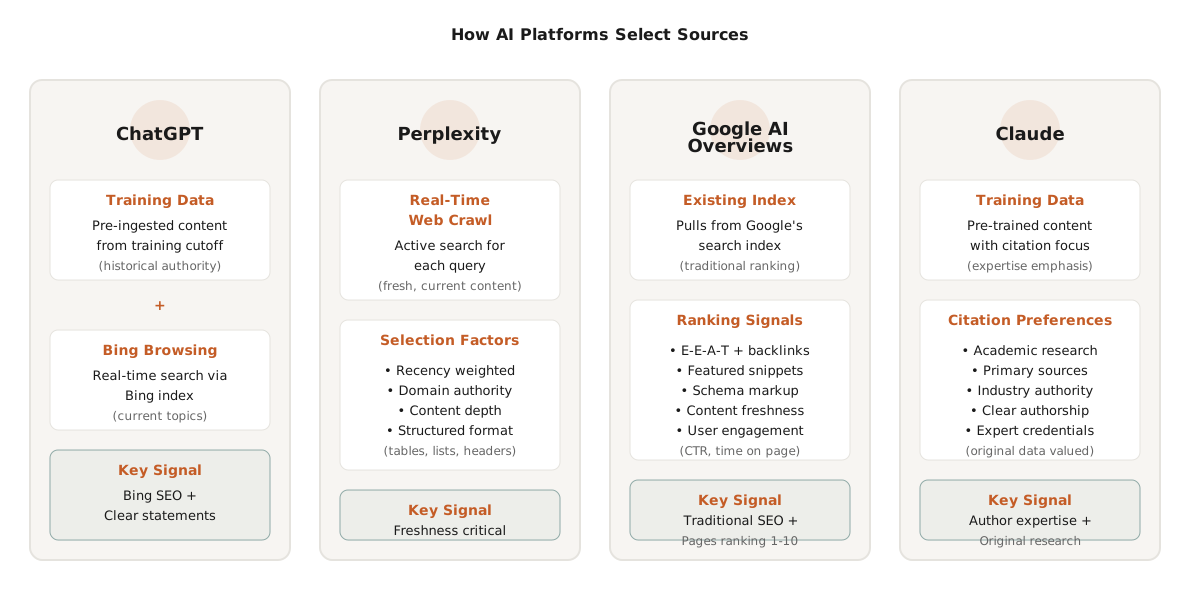
Understanding how AI assistants find and cite content is the foundation for optimizing for them.
ChatGPT: Training Data + Browsing + Bing Index
ChatGPT operates in two modes depending on the query:
Trained knowledge mode: For general questions, ChatGPT responds from its training data (text ingested before its knowledge cutoff). If your content was crawled and indexed during training, it influences responses even without real-time retrieval.
Browsing mode: For current topics or when users explicitly ask for sources, ChatGPT searches the web via Bing, retrieves relevant pages, and synthesizes answers with citations. Your visibility in Bing's index directly affects whether you get cited.
What this means for optimization:
- Historical authority matters (content that existed during training windows)
- Bing SEO matters more than you think (it feeds ChatGPT's browsing)
- Clear, extractable statements increase citation likelihood
- Schema markup helps ChatGPT identify structured information
Perplexity: Real-Time Web Crawling
Perplexity doesn't rely on pre-trained knowledge alone. It actively crawls the web for each query, retrieves current information, and synthesizes answers with inline citations.
How Perplexity selects sources:
- Recency weighted heavily (newer content often preferred)
- Domain authority signals (backlinks, mentions, trust)
- Content depth on specific topics (comprehensive beats superficial)
- Structured formatting (tables, lists, headers extract cleanly)
What this means for optimization:
- Freshness is critical—update content regularly
- Topical depth beats keyword stuffing
- Clear hierarchical structure (H2s, H3s) improves extraction
- Being cited once makes future citations more likely
Google AI Overviews: Existing Index + Ranking Signals
Google's AI Overviews (formerly SGE) pull from Google's existing search index. If you don't rank organically for a query, you won't appear in the AI Overview for that query.
How Google selects AI Overview sources:
- Traditional ranking signals (backlinks, E-E-A-T, technical SEO)
- Featured snippet optimization (direct answers to questions)
- Structured data and schema markup
- Content freshness and update signals
- User engagement metrics (CTR, time on page)
What this means for optimization:
- Traditional SEO still matters most here
- Featured snippet optimization directly feeds AI Overviews
- FAQ schema and Q&A structured data critical
- Pages ranking 1-10 have best shot at inclusion
Claude: Training Data + Citation Preferences
Claude (like ChatGPT) relies on training data but emphasizes citation quality. When sources are included, Claude tends to cite:
- Academic and research publications
- Primary sources (original research, case studies)
- Authoritative industry sources (recognized brands, established publications)
- Content with clear authorship and credentials
What this means for optimization:
- Author expertise signals matter
- Original data and research boost citation likelihood
- Clear sourcing of claims (you cite others, AI cites you)
- Established domain authority helps
02 / the-8-factors-that-get-your-content-cited-by-ai
The 8 Factors That Get Your Content Cited by AI
Across all platforms, certain content characteristics consistently improve citation rates.
1. Authority and Expertise Signals
AI systems assess whether content comes from a credible source.
What AI looks for:
- Author credentials and bios
- Domain authority (backlinks, mentions, age)
- Industry recognition (awards, media coverage, speaking)
- Association with trusted entities (universities, major brands, publications)
How to strengthen authority signals:
Add author bios to every piece of content:
<div class="author-bio">
  <strong>About the Author:</strong> [Name] is [Title] at [Company],
  with [X] years of experience in [Industry]. Previously at [Recognized Company],
  [Name] has helped [specific achievement with numbers].
</div>
Build citations from authoritative sources in your industry. Guest posts on recognized publications, speaking at industry conferences, and partnerships with established brands all create authority signals AI systems recognize.
Publish original research and data. Content with proprietary insights gets cited more than content that aggregates others' work.
2. Clear, Quotable Statements
AI systems extract claims. The clearer and more definitive your statements, the more likely they are to be cited.
Weak: "Many companies find that marketing automation can help improve efficiency in various ways."
Strong: "B2B companies using marketing automation see 14.5% higher sales productivity and 12.2% reduction in marketing overhead, according to Nucleus Research."
The difference: specificity, data, attribution. AI can quote the strong statement directly. The weak statement says nothing concrete enough to extract.
Apply this pattern:
- Lead with the claim
- Support with data
- Attribute to source
- Make it extractable (complete thought in 1-2 sentences)
3. Data and Statistics
AI systems prioritize content that includes quantitative information. Claims backed by numbers get cited more frequently than subjective opinions.
What works:
- Specific percentages: "67% of B2B buyers"
- Concrete numbers: "surveyed 1,247 marketing directors"
- Comparative data: "3.4x higher conversion rate"
- Time-based metrics: "within 90 days"
- Source attribution: "according to Gartner"
Format data for extraction:
Use tables for comparisons:
| Platform | Average Response Time | Citation Format | Best For |
|---|---|---|---|
| ChatGPT | 2-3 seconds | Inline references | General knowledge |
| Perplexity | 4-6 seconds | Numbered sources | Research queries |
| Claude | 2-4 seconds | Conversational citations | Analysis requests |
Tables extract cleanly into AI responses and make your content more citable than prose descriptions.
4. Structured Formatting
AI systems extract structured content more easily than dense paragraphs.
Hierarchy that AI understands:
## Primary Topic (H2)
### Specific Subtopic (H3)
#### Implementation Detail (H4)

- Bulleted lists for items
- Numbered lists for sequences
- Tables for comparisons
- Blockquotes for key takeaways
Why structure matters:
When AI scans your page, clear hierarchy signals what's important and how information relates. Headers as questions ("How does marketing automation improve ROI?") make extraction even easier.
Schema markup for machines:
Implement FAQ schema on content that answers specific questions:
{
  "@context": "https://schema.org",
  "@type": "FAQPage",
  "mainEntity": [{
    "@type": "Question",
    "name": "How do AI assistants select which sources to cite?",
    "acceptedAnswer": {
      "@type": "Answer",
      "text": "AI assistants evaluate content based on authority signals, content structure, factual accuracy, recency, and relevance to the query. Pages with clear hierarchical structure, cited data, and expert authorship are cited most frequently."
    }
  }]
}
Google, ChatGPT, and other AI systems use this structured data to identify questions and answers for direct extraction.
5. Freshness and Recency
AI platforms weight recent content more heavily than outdated material—especially for topics where currency matters.
Freshness signals AI detects:
- Publication date in metadata and visible on page
- Last updated date
- References to current year in content ("In 2026, B2B buyers...")
- Citations to recent research and data
- Discussion of recent developments
How to maintain freshness:
Set a quarterly update schedule for your top-performing content. Update statistics, add recent examples, refresh screenshots, and revise the "last updated" date.
Include year references naturally:
- "As of February 2026..."
- "Current data shows..."
- "Recent research from 2026 indicates..."
Link to recent sources. Citations from the past 12-24 months signal that content is actively maintained.
6. Entity Relationships
AI systems understand entities (people, companies, concepts) and their relationships. Content that clearly establishes entity connections gets cited more accurately.
What are entities?
Entities are real-world things AI recognizes: companies (Salesforce, HubSpot), concepts (marketing automation, lead scoring), people (industry experts), places, products, and technologies.
How to strengthen entity relationships:
Use consistent, exact names for companies and products:
- "Salesforce Marketing Cloud" (not "Salesforce's marketing platform")
- "HubSpot" (not "a major CRM provider")
Link entities to authoritative sources:
- Link company names to their official websites
- Link concepts to Wikipedia or industry definitions
- Link products to official product pages
Include entity-rich context: "Marketing automation platforms like HubSpot, Marketo, and ActiveCampaign help B2B companies nurture leads through the sales funnel."
This establishes clear relationships AI systems understand and can cite accurately.
7. Technical Accessibility
AI can only cite content it can access and parse.
Technical requirements:
- Fast page load (Core Web Vitals passing)
- Mobile-friendly design
- Clean HTML structure
- No crawl blocks in robots.txt
- HTTPS (secure connection)
- No JavaScript-only content (AI crawlers need HTML)
Check accessibility:
Test in ChatGPT's browsing mode:
- Open ChatGPT
- Ask it to retrieve your specific URL: "What does [your-url] say about [topic]?"
- If ChatGPT can't access or parse your content, fix technical issues
Test in Perplexity:
- Ask a question your content answers
- See if your URL appears in citations
- If not, check if Perplexity can access your domain at all
Check Bing indexing (feeds ChatGPT):
site:yourdomain.com [topic]
If pages don't appear in Bing, they won't be cited by ChatGPT in browsing mode.
8. Brand Mentions Across the Web
AI systems assess authority partially based on how often your brand is mentioned elsewhere—even without direct backlinks.
Where brand mentions matter:
- Industry publications and news sites
- Social media platforms (especially LinkedIn for B2B)
- Forums and community discussions (Reddit, industry-specific forums)
- Podcasts and video content (transcripts get indexed)
- Press releases and media coverage
- Academic papers and research citations
How to build brand mentions:
Contribute expert commentary to industry publications. Journalists quote sources they trust, and those quotes create brand mentions AI systems recognize.
Participate in industry discussions on LinkedIn, Twitter, and relevant forums. Thoughtful contributions get referenced and linked.
Publish original research and share it widely. Industry reports and data studies get cited across multiple sources.
Speak at conferences and on podcasts. Transcripts and coverage create additional brand mentions.
03 / platform-specific-tactics
Platform-Specific Tactics
While the eight factors above apply across platforms, each AI assistant has optimization opportunities specific to how it works.
ChatGPT-Specific Tactics
Optimize for Bing: ChatGPT's browsing uses Bing. Submit your sitemap to Bing Webmaster Tools, monitor Bing indexing, and fix crawl errors.
Use conversational language: ChatGPT responds well to content written in Q&A format. Structure blog posts as questions with direct answers.
Include "According to" citations: When ChatGPT browses your content and sees you citing sources ("According to Gartner..."), it's more likely to cite you as a credible aggregator.
Test and iterate: Ask ChatGPT questions your content should answer. If it doesn't cite you, rewrite with clearer statements and retry in a week.
Perplexity-Specific Tactics
Update frequently: Perplexity heavily weights recency. Content updated within the past 30 days has significantly higher citation rates.
Use numbered lists and tables: Perplexity's citations often pull directly from structured elements. Format key information as extractable lists.
Include summary sections: "Key Takeaways" or "Summary" sections at the beginning or end of content get cited more frequently.
Leverage Reddit and forums: Perplexity often cites Reddit discussions. Participating in relevant subreddits with links back to your content can drive citations.
Google AI Overviews-Specific Tactics
Target featured snippets: Content formatted for featured snippets often appears in AI Overviews. Use question headers with concise answers immediately following.
Implement FAQ schema: Google AI Overviews pull heavily from FAQ schema. Add FAQ structured data to all relevant pages.
Optimize for passage ranking: AI Overviews extract specific passages. Use clear section headers so individual sections can rank independently.
Focus on ranking positions 1-10: AI Overviews almost exclusively pull from first-page results. If you don't rank organically, you won't appear in the AI Overview.
Claude-Specific Tactics
Emphasize credentials: Claude weights authorship and expertise. Include detailed author bios with specific credentials.
Cite primary research: Claude prefers citing content that itself cites authoritative sources. Reference academic papers, industry research, and primary data sources.
Write for analysis: Claude excels at synthesis and analysis. Content that goes beyond surface-level descriptions gets cited more when users ask analytical questions.
04 / how-to-measure-ai-search-visibility
How to Measure AI Search Visibility
Unlike traditional SEO where you track rankings, AI visibility requires different measurement approaches.
Manual Citation Testing
Test specific queries in each platform monthly:
Create a query list:
- 5-10 questions your content should answer
- Mix of branded (include your company name) and unbranded queries
- Cover your core topics and expertise areas
Test systematically:
- Open ChatGPT, Perplexity, Google (for AI Overviews), and Claude
- Ask each question in each platform
- Document which platforms cite your content
- Note exact phrasing of citations and context
Track over time: Create a simple spreadsheet:
| Query | ChatGPT Cited? | Perplexity Cited? | AI Overview Cited? | Claude Cited? | Last Updated |
|---|---|---|---|---|---|
| What is B2B marketing automation? | Yes | No | Yes | No | 2026-02-12 |
Re-test monthly to track changes.
Referral Traffic Analysis
Some AI platforms send referral traffic you can track.
In Google Analytics:
- Check Acquisition > Traffic acquisition
- Look for referrals from perplexity.ai, chatgpt.com, and other AI platforms
- Track traffic trends over time
Note: ChatGPT browsing doesn't always pass referrer data, so absence of traffic doesn't mean you're not being cited.
Brand Mention Monitoring
Track how often your brand appears in AI responses (even without URL citations).
Method: Ask AI platforms questions where your company should be mentioned as an example or case study. Track whether you're included in generated lists of companies, solutions, or examples.
"What are examples of B2B companies using AI marketing successfully?"
If your company appears in responses, it signals strong entity recognition and authority.
Bing and Search Console Data
Bing Webmaster Tools:
- Monitor impressions and clicks from Bing
- Check crawl stats (ChatGPT browsing uses Bing infrastructure)
- Review indexing status
Google Search Console:
- Track AI Overview appearances (Google reports these separately)
- Monitor featured snippet captures (strong predictor of AI Overview inclusion)
- Check "Discover" traffic (AI-driven content recommendation)
05 / quick-start-checklist-for-b2b-companies
Quick-Start Checklist for B2B Companies
Start optimizing for AI visibility today with this prioritized checklist.
Week 1: Foundation
- Test 5 queries in ChatGPT and Perplexity—are you cited?
- Submit sitemap to Bing Webmaster Tools
- Audit your top 10 pages for author bios (add if missing)
- Verify Core Web Vitals pass (use Google PageSpeed Insights)
- Check robots.txt isn't blocking AI crawlers
Week 2-3: Content Optimization
- Add FAQ schema to your top 5 performing pages
- Rewrite page openings to include direct, quotable answers
- Convert at least one dense paragraph to a comparison table
- Add "last updated" dates to all blog content
- Review and strengthen 3 pieces with additional data/statistics
Week 4: Ongoing Systems
- Create monthly calendar for content updates (keep top 10 pages fresh)
- Set up Bing Webmaster Tools monitoring
- Build query testing spreadsheet for monthly AI citation checks
- Identify 3 industry publications for guest contribution (build authority)
- Document current AI visibility baseline for future comparison
Month 2-3: Expansion
- Implement FAQ schema across all relevant pages
- Publish one original research piece with proprietary data
- Restructure underperforming content with question-based headers
- Build 5 high-quality backlinks from industry sources
- Create "Key Takeaways" sections for all blog posts (Perplexity optimization)
Ongoing: Measurement
- Test query list in AI platforms monthly
- Review referral traffic from AI sources quarterly
- Update top-performing content quarterly
- Monitor industry mentions and brand citations
- Track featured snippet captures (Google Search Console)
06 / the-bottom-line
The Bottom Line
Getting cited by AI assistants isn't about gaming algorithms—it's about being genuinely authoritative, clearly structured, and technically accessible.
The B2B companies winning AI visibility are the ones that:
- Publish data-backed, expert content
- Structure information for easy extraction
- Keep content current and well-maintained
- Build authority through industry recognition
- Make content technically accessible to AI crawlers
Start with the quick-start checklist. Test your current visibility. Optimize your best-performing content first. Measure results monthly. Iterate based on what works.
The AI search landscape is evolving rapidly, but the fundamentals remain: create valuable, authoritative content and make it easy for AI systems to find, understand, and cite.
If you want help implementing this—from technical audits to content optimization to ongoing monitoring—our team specializes in AI-era SEO for B2B companies. We've built the systems, done the testing, and know what actually drives citations.
For deeper context on how AI search is changing B2B marketing, see our complete guides: What is Generative Engine Optimization (GEO), GEO vs SEO: How AI Search Changes B2B Marketing, and B2B Organic Growth Playbook: SEO, AI Search & Content Strategy.
About the Author: Mike McKearin is the founder of WE•DO Growth Agency, where his team helps B2B companies optimize for both traditional search and AI assistants. WE•DO's clients appear in ChatGPT citations, Perplexity results, and Google AI Overviews through systematic content and technical optimization.