Most agencies talk about using AI. We built our entire operation around it.
At WE•DO, Claude Code isn't a tool we use occasionally—it's a full-time team member handling everything from client reports to WordPress site management. After a year of building and refining this system, here's exactly how it works.
01 / the-problem-we-solved
The Problem We Solved
Managing 100+ clients creates predictable bottlenecks:
- Report generation eats 2-3 hours per client per month
- Data aggregation requires logging into 5-6 platforms per client
- Content creation varies wildly in voice and quality
- Technical tasks get backlogged while strategy work takes priority
- Meeting follow-ups fall through the cracks
Traditional solutions—hiring more people, using templates, batching work—help but don't scale. We needed something fundamentally different.
02 / the-solution-an-ai-operating-system
The Solution: An AI Operating System
We call it WEDO-OS. It's a unified system where Claude Code agents handle operational work while humans focus on strategy and relationships.
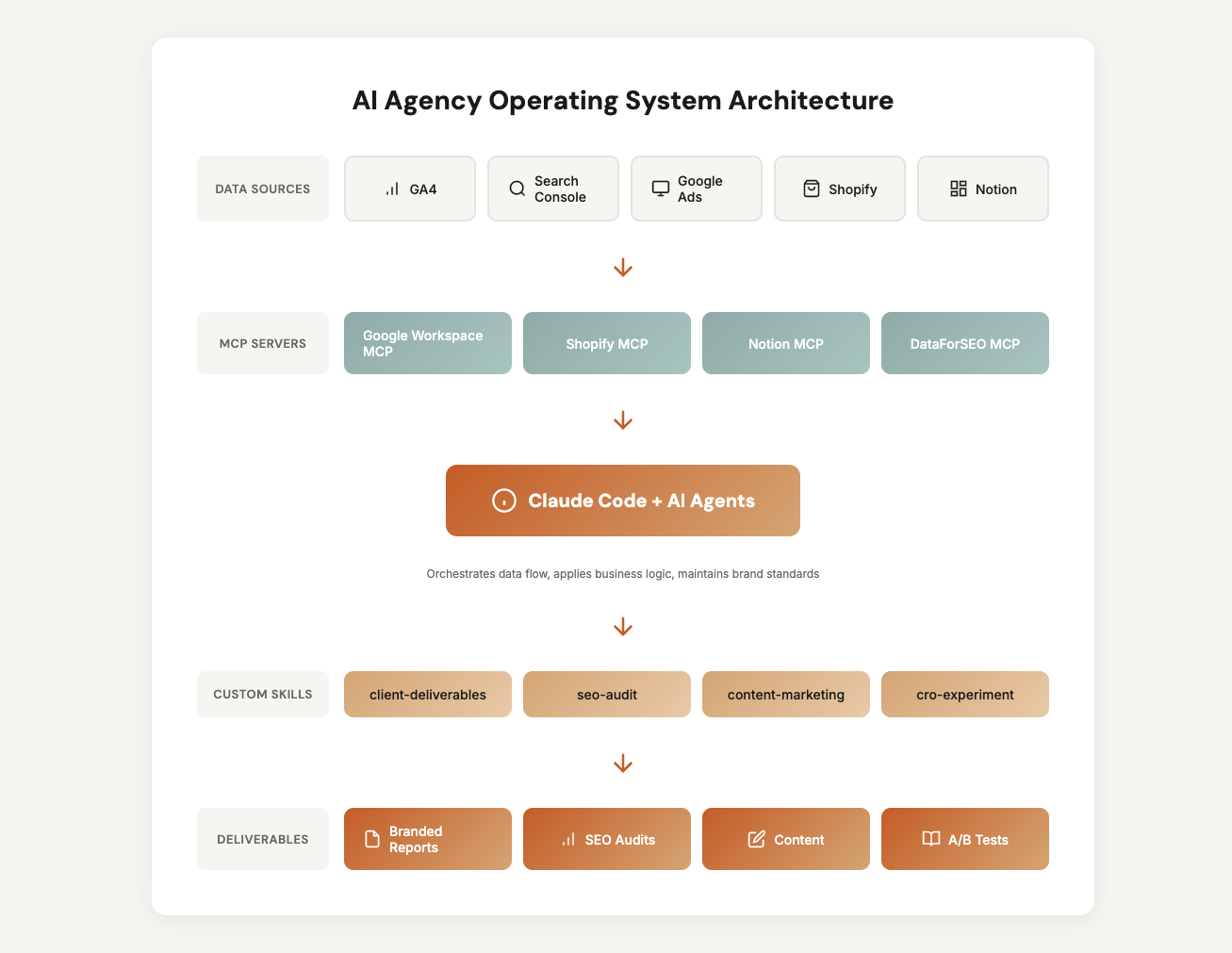
The key insight: Claude Code with MCP (Model Context Protocol) integrations can access the same data sources your team uses--GA4, Google Search Console, Google Ads, Notion, Shopify, WordPress--and produce work that matches your brand standards. This is AI enablement at the operational level, where the right AI tools for business automation connect into a unified system.
03 / how-it-actually-works
How It Actually Works
1. Client Reporting: From Hours to Minutes
Every month, clients expect performance reports. With 100+ clients, that's potentially 300+ hours of report generation.
Our solution: A client-deliverables skill that generates 43 types of branded reports automatically.
The workflow:
- Pull data from GA4, GSC, Google Ads via MCP connections
- Apply calculations (MoM changes, YoY trends, conversion rates)
- Render into HTML templates with our brand styling
- Deploy to Vercel for shareable URLs
- Log to Notion for tracking
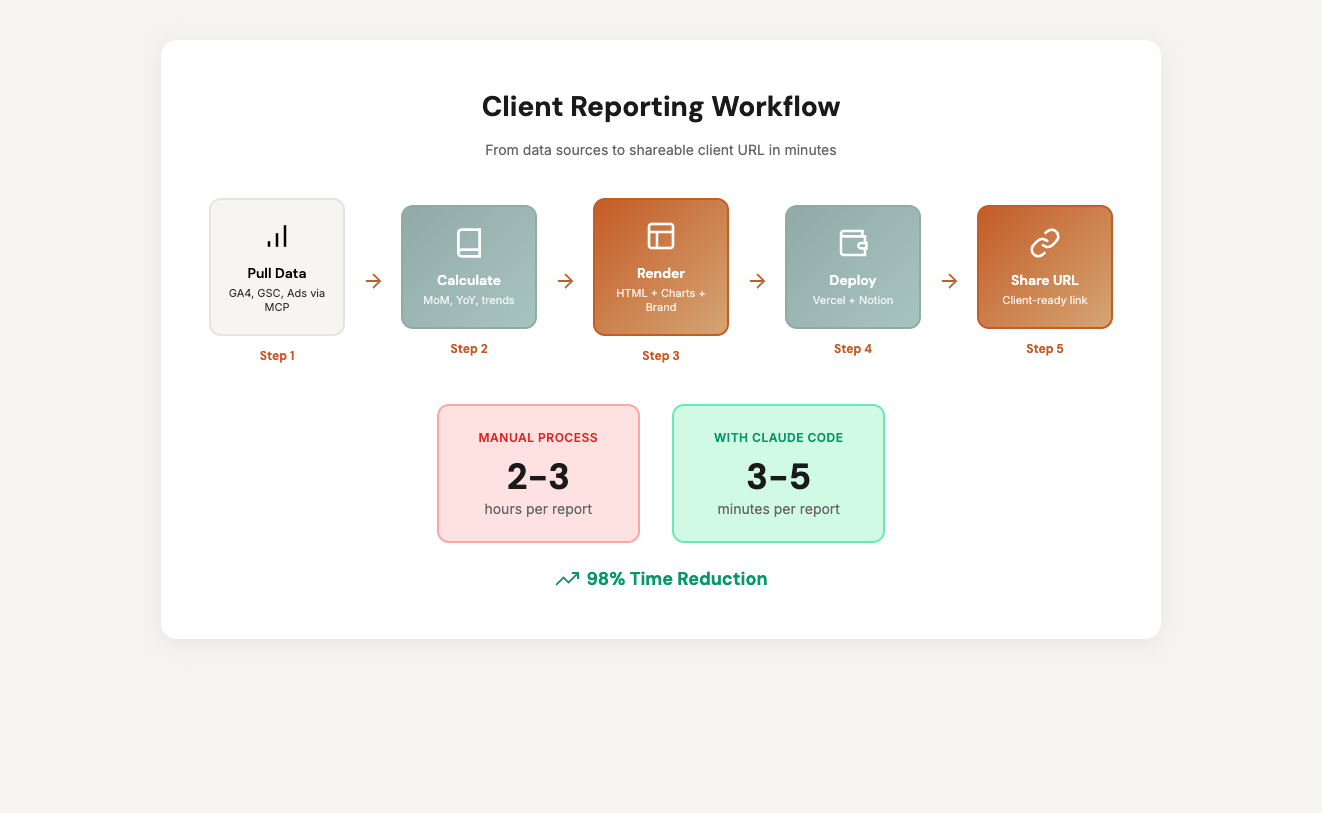
What used to take 2-3 hours now takes 3-5 minutes. Not because the report is lower quality—it's actually more consistent—but because the data aggregation and formatting happens automatically.
The reports include:
- KPI cards with period-over-period changes
- Interactive charts (traffic trends, channel mix, rankings)
- Prioritized recommendations based on the data
- Consistent WE•DO branding (colors, fonts, logos)
2. SEO Audits: Comprehensive Analysis at Scale
SEO audits typically require crawling the site, checking Search Console, analyzing backlinks, reviewing content, and synthesizing findings. It's easily a full day of work.
Our seo-audit skill combines multiple data sources:
| Data Source | What It Provides |
|---|---|
| Screaming Frog | Technical crawl data, schema, page structure |
| Google Search Console | Rankings, impressions, CTR, coverage issues |
| GA4 | Traffic, engagement, conversion data |
| DataForSEO | Competitor analysis, keyword gaps, backlinks |
| SEO MCP | On-page optimization scores |
The audit scores each category (Technical, On-Page, Content, Links) from 0-100 and produces prioritized recommendations.
Real example: A client's site had 482 broken pages leaking link equity. The audit identified this in seconds, along with 597 broken backlinks pointing to non-existent content. Manual discovery would have taken hours.
3. Content Creation: Brand-Consistent at Scale
Content is where AI gets tricky. Generic AI content sounds generic. We solved this with brand-specific agents.
Each major client gets a brand skill that captures:
- Voice attributes (formal vs. casual, technical vs. accessible)
- Tone guidelines (authoritative, empathetic, energetic)
- Target audience personas
- Key messaging points
- Terminology preferences
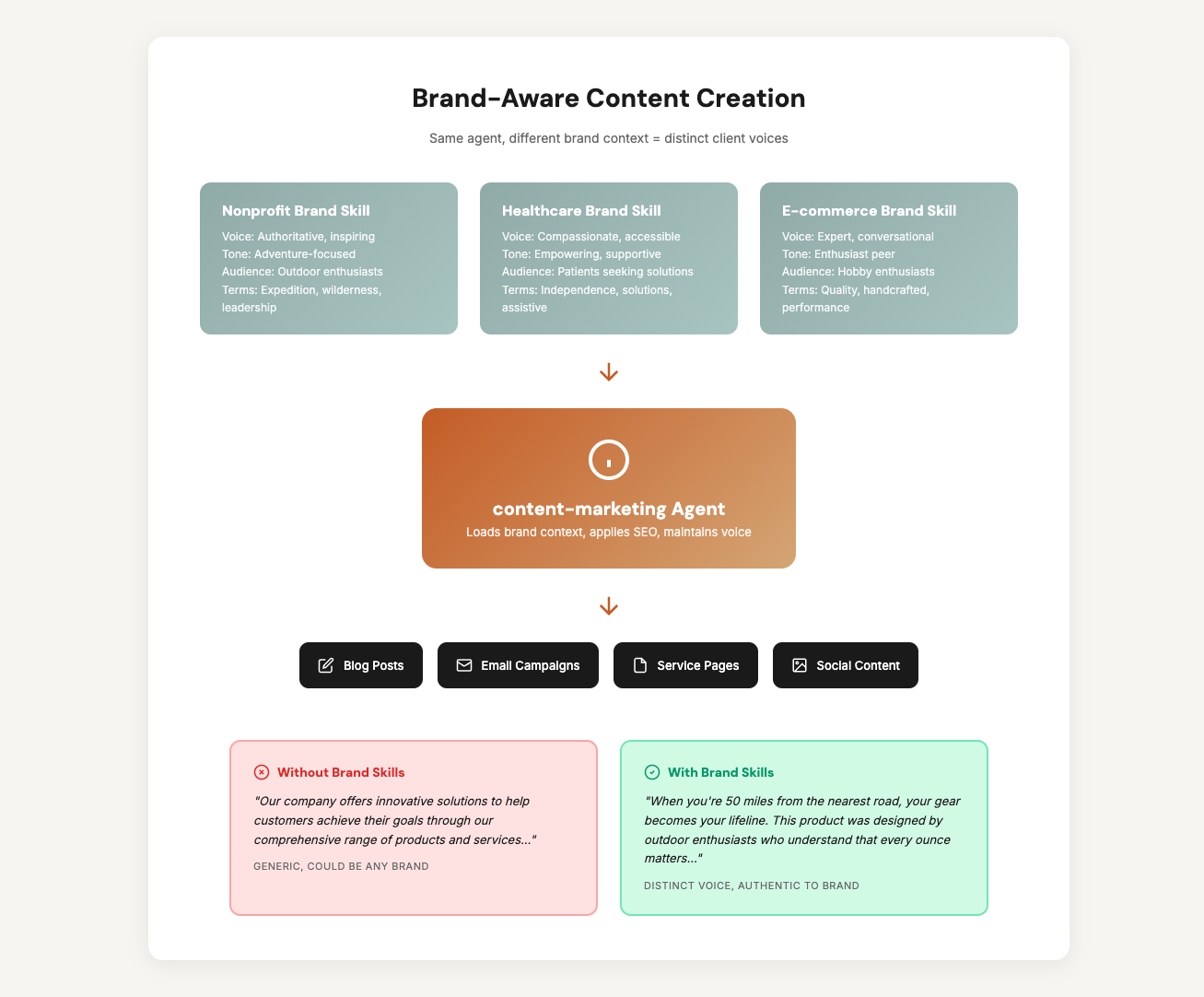
When the content-marketing agent creates content for a wilderness education nonprofit, it writes differently than when it creates content for a healthcare accessibility provider. Same agent, different brand context.
The content includes:
- SEO optimization (keywords, meta descriptions, headers)
- Internal linking recommendations
- Proper frontmatter for CMS publishing
- Consistent formatting
4. WordPress Management: 12 Sites, One Command
We manage WordPress sites on WP Engine for multiple clients. Each site needs:
- Plugin updates and security monitoring
- Database optimization
- Performance diagnostics
- Content updates
Our wordpress-operations agent connects via SSH and uses WP-CLI to run operations across all sites.
\# Check plugin updates across all managed sites
ssh client-a-prod wp plugin list --update=available
ssh client-b-prod wp plugin list --update=available
ssh client-c-prod wp plugin list --update=available
\# ... continues for all 12 sites
A complete portfolio audit—12 sites, plugins, security, performance—takes 15 minutes instead of 2 hours.
5. Meeting Intelligence: From Transcripts to Tasks
Every client meeting generates action items. Without a system, these get lost in notes.
Our Fathom MCP integration:
- Automatically syncs meeting recordings and transcripts
- Organizes them by client in the correct folder
- Extracts action items
- Creates linked tasks in Notion
Nothing falls through the cracks because the system captures everything automatically.
6. CRO Experiments: Rapid Variant Generation
Testing page variations typically requires:
- Capturing the current page
- Creating HTML variants
- Setting up the test infrastructure
- Deploying to staging
Our cro-experiment skill handles this with single-variable methodology:
- Capture the exact page state (including all CSS, assets)
- Generate focused variants (one change per test)
- Convert to Beaver Builder format
- Deploy via SSH to staging
- Create draft pages for client review
A landing page A/B test that used to take a day of development work now takes 10-15 minutes.
04 / the-integration-layer-mcp-servers
The Integration Layer: MCP Servers
The magic happens through MCP (Model Context Protocol) servers that give Claude Code direct access to data sources.
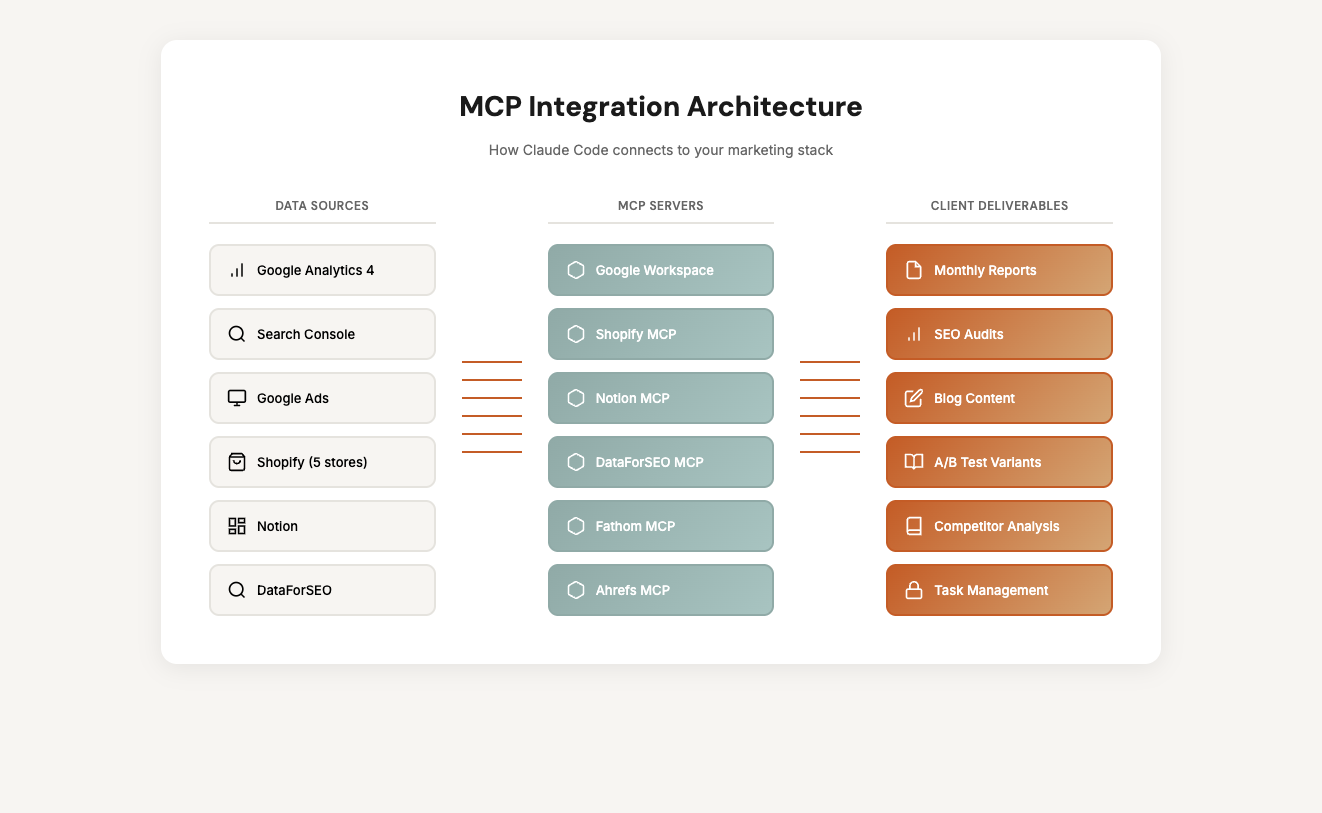
Our active integrations:
| MCP Server | Capabilities |
|---|---|
| Google Workspace | Gmail, Calendar, Google Ads, GA4, Search Console |
| Notion | Tasks, clients, time tracking, meeting notes |
| Shopify (5 stores) | Products, orders, customers, analytics |
| DataForSEO | Keywords, rankings, backlinks, competitor data |
| Fathom | Meeting transcripts and action items |
| Ahrefs | Backlink analysis and competitor research |
| Hunter | Email finding and verification |
Each integration adds capability. Combined, they create something more powerful than any individual tool.
05 / real-examples-what-this-looks-like-in-practice
Real Examples: What This Looks Like in Practice
Example 1: Monthly Report Generation
Command: "Create monthly report for Client A January 2026"
What happens:
- Load the client-deliverables skill
- Pull GA4 data from their property - traffic, engagement, conversions
- Pull GSC data - rankings, impressions, CTR
- Pull Google Ads data - spend, ROAS, conversions
- Calculate period-over-period changes
- Render HTML with Chart.js visualizations
- Deploy to Vercel
- Create Notion record
- Return shareable URL
Time: 3-5 minutes
Example 2: Competitive Analysis
Command: "Build competitor analysis for Client B focusing on their top 2 competitors"
What happens:
- Query DataForSEO for competitor keyword profiles
- Analyze backlink differences
- Calculate traffic estimates and keyword gaps
- Identify content opportunities
- Generate comparison visualizations
- Render branded report
- Deploy and return URL
Time: 10-15 minutes
Example 3: Site-Wide Plugin Audit
Command: "Audit plugins across all WordPress sites for security issues"
What happens:
- SSH into each of 12 managed sites
- Run
wp plugin list --update=available - Cross-reference with known vulnerability databases
- Compile findings into priority-ranked report
- Recommend specific update sequences
Time: 15 minutes for all 12 sites
06 / the-business-impact
The Business Impact
Efficiency Gains
- Report generation: 2-3 hours → 3-5 minutes (98% reduction)
- SEO audits: Full day → 30 minutes (90% reduction)
- WordPress portfolio audits: 2 hours → 15 minutes (88% reduction)
- Content briefs: 1-2 hours → 10 minutes (85% reduction)
Quality Improvements
- Consistency: Every deliverable uses the same brand standards
- Accuracy: Direct data connections eliminate copy/paste errors
- Completeness: Automated checklists ensure nothing is missed
- Speed: Faster turnaround means more responsive client service
Scale Without Headcount
The controversial part: This system lets us manage 100+ clients without proportionally scaling the team. That's not about replacing people—it's about redirecting human time from operational tasks to strategic work.
The humans focus on:
- Client relationships and strategy
- Creative problem-solving
- Complex analysis that requires judgment
- New service development
The AI handles:
- Data aggregation and formatting
- Routine report generation
- Technical maintenance
- Content drafting and optimization
07 / how-we-built-this
How We Built This
Building this system took a year of iteration. Key decisions:
1. Standardized Templates
Every deliverable type has a consistent HTML template. This ensures brand consistency and makes the system maintainable.
2. Direct Data Connections
Rather than relying on CSV exports, MCP servers provide real-time access to data sources. This eliminates stale data issues.
3. Brand Skills for Each Client
Major clients get dedicated brand skills that capture their voice, tone, and messaging. This prevents the "AI voice" problem.
4. Notion as Source of Truth
All tasks, clients, time entries, and notes live in Notion. This creates a searchable audit trail of all work.
5. Auto-Commit for Safety
The workspace auto-commits every 5-30 minutes. We've never lost work due to crashes or sync issues.
08 / what-we-learned
What We Learned
AI Works Best for Structured Tasks
Report generation, data aggregation, template-based content—these are perfect for AI. Ambiguous strategy work still needs humans.
Integrations Are Everything
Claude Code without MCP connections is just a chatbot. With integrations, it becomes an operational system that can actually get work done. Our AI enablement framework explains how to think about building these integration layers systematically.
Brand Context Matters
Generic AI content is obvious. Client-specific brand skills make the difference between "clearly AI" and "could have been written by the team."
You Still Need Human Review
AI handles 90% of the work, but human review catches the 10% of edge cases and ensures quality. We don't send anything to clients without a human check.
09 / whats-next
What's Next
We're expanding the system with:
- Automated anomaly detection: Alert when client metrics show unusual patterns
- Predictive recommendations: Suggest optimizations before performance declines
- Cross-client insights: Identify patterns that work across similar clients
- Client self-service: Let clients generate their own reports on demand
The goal isn't to remove humans from the process. It's to give humans leverage—to let one person do the work of five by automating the operational overhead that used to consume most of our time.
10 / try-it-yourself
Try It Yourself
If you're running an agency or managing multiple clients, the Claude Code + MCP approach is worth exploring. Start with one integration—Google Analytics or Search Console—and build from there.
The investment pays off quickly. The first month of saved reporting time usually covers the setup cost. Everything after that is compound returns.
Want to see this system in action for your business? Let's talk about a growth audit where we can show you exactly what AI-powered marketing operations looks like.