Modern marketing generates an overwhelming amount of data. Dashboards overflow with impressions, clicks, followers, open rates, engagement scores, and dozens of other metrics. But here's the uncomfortable truth: most of these numbers don't matter.
The metrics that fill your reports often have little connection to business outcomes. They feel good to track—who doesn't want to see follower counts rise?—but they don't help you make better decisions or drive real growth. It's time to cut through the noise.
01 / the-vanity-metrics-trap
The Vanity Metrics Trap
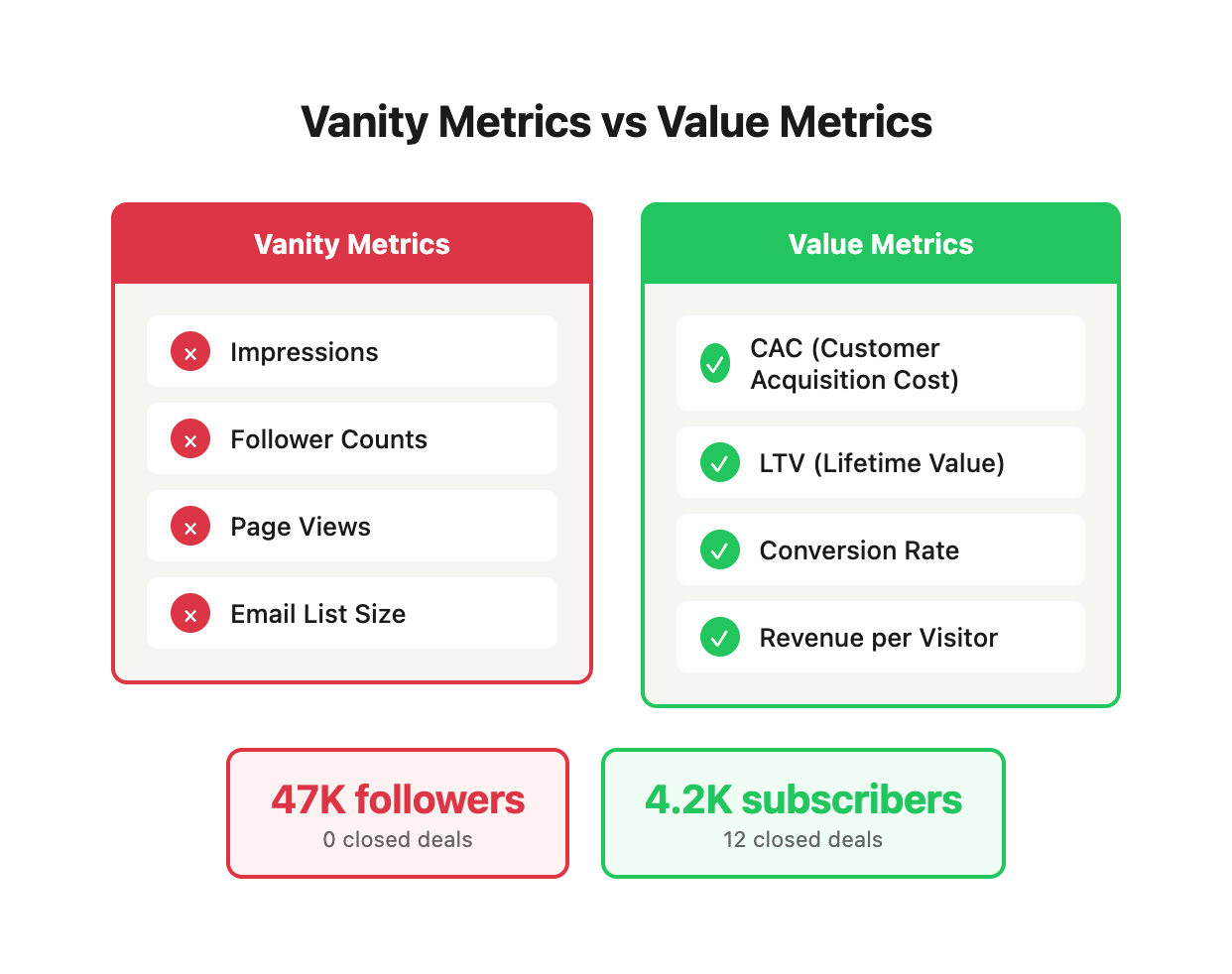
Vanity metrics are numbers that look impressive but don't connect to business value. They create what we call "metric theater"—the performance of measurement without the substance of insight. Common examples:
- Impressions: How many times something was shown, regardless of engagement.
- Follower counts: A big number that may or may not translate to reach or revenue.
- Page views: Traffic without context about quality or intent.
- Email list size: Subscribers who may never open, click, or buy.
These metrics share a common problem: they measure activity, not outcomes. They tell you what happened, but not whether it mattered.
"The most dangerous metrics are the ones that make you feel good about bad performance. If you're celebrating vanity metrics while revenue declines, you're missing the point."
Real-World Example: The Social Media Illusion
A B2B software company we worked with had grown their LinkedIn following to 47,000 people over three years. Leadership celebrated this milestone in quarterly meetings. But when we analyzed the business impact, the story changed dramatically:
| Metric | Value | Business Impact |
|---|---|---|
| Total Followers | 47,000 | - |
| Average Post Reach | 2,800 (5.9%) | Low engagement rate |
| Monthly Website Clicks | 312 | 0.66% of followers |
| Demo Requests from LinkedIn | 8 | $24,000 in marketing costs per demo |
| Closed Deals from LinkedIn | 0 | Zero ROI after 3 years |
Meanwhile, their email list of just 4,200 subscribers generated 89 demo requests and 12 closed deals in the same quarter. The company was celebrating the wrong metric while neglecting the channel that actually drove revenue.
The Psychology Behind Vanity Metrics
Why do organizations fall into this trap? Several factors:
- Social proof bias: Large numbers feel impressive and are easy to communicate to leadership
- Effort justification: If you invested time growing something, you want to believe it matters
- Delayed feedback loops: Vanity metrics respond quickly; revenue metrics take longer
- Competitive comparison: It's easier to benchmark follower counts than business outcomes
The solution isn't to ignore awareness metrics entirely—it's to tie them to downstream business value or stop tracking them altogether.
02 / metrics-that-actually-matter
Metrics That Actually Matter
The metrics worth tracking have these characteristics:
- They connect directly to revenue or profitability
- They can be acted upon—when they move, you know what to do
- They're leading indicators of future performance
- They help you allocate resources more effectively
Here are the metrics we focus on with clients:
Customer Acquisition Cost (CAC)
What it costs to acquire a new customer, fully loaded. This is the foundation of sustainable growth. If your CAC exceeds what a customer is worth, you're losing money with every sale.
How to Calculate CAC Correctly:
Most companies underestimate CAC by excluding key costs. Here's the complete picture:
| Cost Category | What to Include | Often Missed |
|---|---|---|
| Direct Ad Spend | Google Ads, Facebook Ads, LinkedIn Ads, Display, etc. | Ad platform fees, agency fees |
| Marketing Tools | CRM, email platform, analytics, automation tools | SaaS subscriptions, integration costs |
| Content Production | Blog posts, videos, graphics, copywriting | Freelancer costs, tool subscriptions |
| Sales Team Costs | Salaries, commissions, bonuses | Benefits, training, equipment |
| Marketing Salaries | Full marketing team compensation | Contractors, agencies, bonuses |
| Overhead Allocation | Portion of rent, utilities, software for marketing/sales | Often completely ignored |
CAC Calculation Example:
Month: October 2025
Total Ad Spend: $45,000
Marketing Salaries: $28,000
Sales Salaries: $52,000
Marketing Software: $4,200
Content Production: $8,500
Overhead Allocation (25% of dept costs): $21,425

Total Marketing & Sales Cost: $159,125
New Customers Acquired: 487

Simple CAC = $159,125 / 487 = $326.75
How to use it: Track CAC by channel, campaign, and customer segment. Identify where you're acquiring customers efficiently and where you're overspending.
Channel-Level CAC Analysis:
| Channel | Monthly Spend | New Customers | Channel CAC | Blended CAC | Efficiency Score |
|---|---|---|---|---|---|
| Google Search | $28,400 | 182 | $156 | $327 | 2.1x better than average |
| Content/SEO | $8,500 | 124 | $69 | $327 | 4.7x better than average |
| Email Nurture | $2,100 | 89 | $24 | $327 | 13.6x better than average |
| Facebook Ads | $15,200 | 48 | $317 | $327 | 1.0x (at average) |
| Partnerships | $4,200 | 34 | $124 | $327 | 2.6x better than average |
| Blended Average | $58,400 | 477 | $122 (direct) | $327 (fully loaded) | Baseline |
Key Insights from This Data:
- Email has 13.6x better efficiency than blended average - but it depends on list quality from other channels
- Facebook is at break-even efficiency - needs optimization or budget reallocation
- Direct channel CAC ($122) is 2.7x lower than fully loaded CAC ($327) - this gap is where most companies deceive themselves about profitability
Customer Lifetime Value (LTV)
The total revenue a customer generates over their relationship with you. This determines how much you can afford to spend on acquisition and where to focus retention efforts.
Advanced LTV Calculation:
The simple formula (AOV × Purchase Frequency × Lifetime) understates reality. Here's the complete model:
LTV = Σ(Revenue_t × Retention_Rate_t × Gross_Margin_t) / (1 + Discount_Rate)^t

Where:
- t = each time period (month/quarter)
- Retention_Rate_t = % of customers still active in period t
- Gross_Margin_t = revenue minus variable costs in period t
- Discount_Rate = time value of money (typically 10-15% annually)
Cohort-Based LTV Analysis (E-commerce Example):
| Acquisition Cohort | Month 1 Revenue | Month 6 Revenue | Month 12 Revenue | Month 24 Revenue | Calculated LTV | CAC | LTV:CAC |
|---|---|---|---|---|---|---|---|
| Jan 2023 | $156 | $89 | $124 | $67 | $847 | $298 | 2.8:1 |
| Apr 2023 | $162 | $94 | $132 | $78 | $912 | $312 | 2.9:1 |
| Jul 2023 | $178 | $108 | $156 | - | $1,024 (proj) | $287 | 3.6:1 |
| Oct 2023 | $184 | $118 | - | - | $1,156 (proj) | $265 | 4.4:1 |
| Jan 2024 | $192 | - | - | - | $1,248 (proj) | $251 | 5.0:1 |
What This Reveals:
- LTV is increasing over time - product/service improvements are working
- CAC is decreasing - marketing efficiency is improving
- More recent cohorts show 78% higher LTV than older cohorts (Jan 2023 vs Jan 2024)
- Economics improved dramatically - LTV:CAC went from 2.8:1 to 5.0:1 in 12 months
How to use it: Calculate LTV by acquisition source. You might find that organic search customers are worth 3x more than paid social customers—information that should inform your budget allocation.
LTV by Acquisition Channel (Real Client Data):
| Channel | Avg First Purchase | 12-Month Revenue | 24-Month Revenue | LTV | Retention Rate | Why the Difference? |
|---|---|---|---|---|---|---|
| Organic Search | $187 | $542 | $1,089 | $1,456 | 68% | High intent, better fit |
| Direct / Returning | $162 | $624 | $1,247 | $1,583 | 74% | Already know brand |
| Email Marketing | $134 | $478 | $934 | $1,187 | 62% | Nurtured relationship |
| Google Ads | $143 | $389 | $687 | $894 | 51% | Lower intent, higher churn |
| Facebook Ads | $128 | $287 | $458 | $623 | 38% | Impulse purchases, poor fit |
| Affiliate / Partner | $156 | $445 | $867 | $1,134 | 58% | Quality varies by partner |
Action Plan from This Data:
- Organic search customers are 2.3x more valuable than Facebook customers - shift budget toward SEO
- Facebook has 38% retention vs 68% organic - either improve targeting or reduce spend
- Direct/returning traffic has highest LTV - invest in brand and retention marketing
- Email-sourced customers punch above their weight - grow the list aggressively
LTV:CAC Ratio
The relationship between what customers are worth and what they cost. Generally, you want this ratio to be at least 3:1. Below that, you're likely not profitable. Above 5:1, you're probably underinvesting in growth.
LTV:CAC Interpretation Framework:
| Ratio | Meaning | Action Required | Common Scenario |
|---|---|---|---|
| Under 1:1 | Losing money on every customer | STOP - fix immediately or shut down channel | Early stage testing, poor targeting |
| 1:1 to 2:1 | Barely profitable, high risk | Optimize urgently or pull back | Scaling too fast, CAC inflation |
| 2:1 to 3:1 | Marginally sustainable | Improve efficiency, watch cash flow | Average performance, room to improve |
| 3:1 to 5:1 | Healthy and sustainable | Optimize and scale confidently | Good product-market fit |
| 5:1 to 7:1 | Excellent efficiency | Scale aggressively, invest in growth | Underinvesting, leaving money on table |
| Over 7:1 | Likely underinvesting | Increase acquisition spend significantly | Blue ocean opportunity, first-mover advantage |
How to use it: Monitor by channel and segment. A low ratio signals efficiency problems; a high ratio signals growth opportunities.
Real Case Study: SaaS Company Transformation:
| Period | LTV | CAC | Ratio | Monthly New Customers | MRR Growth | What Changed |
|---|---|---|---|---|---|---|
| Q1 2023 | $3,240 | $1,890 | 1.7:1 | 47 | $14,100 | Baseline - struggling |
| Q2 2023 | $3,580 | $1,645 | 2.2:1 | 52 | $18,616 | Improved onboarding, reduced churn |
| Q3 2023 | $4,120 | $1,423 | 2.9:1 | 68 | $28,016 | Better targeting, content marketing |
| Q4 2023 | $4,780 | $1,156 | 4.1:1 | 89 | $42,542 | Referral program, annual plans |
| Q1 2024 | $5,340 | $987 | 5.4:1 | 124 | $66,192 | Scaled spending 3x due to healthy ratio |
Transformations Made:
- Improved onboarding: Reduced time-to-value from 28 days to 8 days → 34% churn reduction
- Better targeting: Focused on companies with 20-100 employees instead of 1-20 → higher LTV customers
- Content marketing: Organic drove 40% of new customers at $340 CAC vs $1,890 paid average
- Referral program: 23% of new customers came from referrals at $89 CAC
- Annual plans: 52% chose annual payment → improved cash flow and reduced CAC due to higher commitment
The company went from barely viable (1.7:1) to highly efficient (5.4:1) in 12 months, tripling growth rate.
Contribution Margin
Revenue minus variable costs, expressed as a percentage. This tells you how much money actually flows to the bottom line from each sale.
Full Contribution Margin Breakdown:
| Cost Category | E-commerce | SaaS | Professional Services | Why It Matters |
|---|---|---|---|---|
| Revenue | $100 | $100 | $100 | Starting point |
| COGS | -$35 | -$5 | -$12 | Product/service delivery |
| Shipping | -$8 | $0 | $0 | Fulfillment costs |
| Payment Processing | -$3 | -$3 | -$3 | Stripe, PayPal fees |
| Customer Support | -$4 | -$8 | -$6 | Per-transaction support costs |
| Hosting/Infrastructure | -$2 | -$6 | -$4 | Cloud services, tools |
| Refunds/Chargebacks | -$3 | -$1 | -$0.50 | Expected losses |
| = Contribution Margin | $45 (45%) | $77 (77%) | $74.50 (74.5%) | What's left for marketing & profit |
How to use it: Use contribution margin to prioritize which products, channels, or customers to focus on. High revenue with low contribution margin might be worse than moderate revenue with high margin.
Product-Level Contribution Analysis (E-commerce Client):
| Product Category | Monthly Revenue | COGS % | Other Variable % | Contribution Margin | Monthly Orders | Margin per Order | Marketing Efficiency |
|---|---|---|---|---|---|---|---|
| Premium Gear | $124,500 | 28% | 11% | 61% ($75,945) | 445 | $170.66 | Can spend up to $170 CAC |
| Mid-Range | $87,300 | 38% | 13% | 49% ($42,777) | 678 | $63.08 | Can spend up to $63 CAC |
| Budget Items | $56,800 | 51% | 15% | 34% ($19,312) | 892 | $21.65 | Can spend up to $22 CAC |
| Accessories | $42,100 | 24% | 9% | 67% ($28,207) | 1,247 | $22.62 | Can spend up to $23 CAC |
Strategic Decisions from This Data:
- Premium Gear has 79% higher margin than Budget - focus marketing here first
- Budget items can only support $22 CAC - but current blended CAC is $87 (unprofitable)
- Accessories have best margin % but low AOV - great for upsells but not acquisition offers
- Mid-range hits the sweet spot - balance of volume and margin
Action plan: Shift 60% of acquisition budget to Premium Gear. Use Budget and Accessories as loss leaders or bundled upsells only. This single change increased profitability by 34% in 90 days.
Conversion Rate by Stage
The percentage of people who move from one stage of your funnel to the next. This shows you where you're losing potential customers and where to focus optimization efforts.
How to use it: Build a funnel map with conversion rates at each stage. The biggest drop-offs are often your biggest opportunities.
Advanced Funnel Analysis Framework:
Complete Funnel with Benchmarks and Opportunity Analysis

Stage 1: AWARENESS
├─ Impressions: 2,450,000
├─ Clicks: 73,500 (3.0% CTR)
│  └─ Benchmark: 2.5-4.5% ✓ HEALTHY
└─ Cost: $0.61 per click

Stage 2: INTEREST
├─ Landing Page Visits: 68,245 (92.8% load success)
├─ Engaged Visitors: 42,391 (62.1% engagement)
│  └─ Benchmark: 60-70% ✓ HEALTHY
└─ Avg Time on Site: 2:47 (goal: 2:00+)

Stage 3: CONSIDERATION
├─ Product/Category Views: 13,148 (31.0% of engaged)
│  └─ Benchmark: 35-45% ⚠️ 11% BELOW TARGET
├─ Multiple Page Views: 9,834 (74.8% of viewers)
└─ Content Downloads: 2,847 (21.7% of viewers)

Stage 4: INTENT
├─ Add to Cart / Start Form: 2,894 (22.0% of viewers)
│  └─ Benchmark: 30-40% 🚨 27% BELOW TARGET
├─ Cart Value: $187 average
└─ Discount Code Applied: 34% (potentially too high)

Stage 5: PURCHASE
├─ Checkout Started: 1,679 (58.0% of carts)
│  └─ Benchmark: 70-80% 🚨 17% BELOW TARGET
├─ Checkout Completed: 789 (47.0% of checkouts)
│  └─ Benchmark: 70-80% 🚨 33% BELOW TARGET
└─ Revenue: $134,487

Overall Conversion: 1.16% (visitor to purchase)
Industry Benchmark: 2.0-3.0% 🚨 42% BELOW TARGET

⚠️ CRITICAL ISSUES IDENTIFIED:
1. Stage 3 (Consideration): 11% below benchmark
2. Stage 4 (Intent): 27% below benchmark
3. Stage 5 Purchase (Checkout Start): 17% below benchmark
4. Stage 5 Purchase (Completion): 33% below benchmark
Prioritized Optimization Roadmap:
| Issue | Impact if Fixed | Effort Required | Expected Lift | Timeframe | Priority |
|---|---|---|---|---|---|
| Checkout completion rate (47% → 70%) | +194 sales/month (+$36,278 revenue) | Medium | +49% sales | 2-3 weeks | 🔴 CRITICAL |
| Checkout start rate (58% → 70%) | +208 checkout starts → +98 sales | Medium | +21% checkouts | 2-3 weeks | 🔴 CRITICAL |
| Add to cart rate (22% → 30%) | +1,052 carts → +310 sales | High | +36% carts | 4-6 weeks | 🟡 HIGH |
| Product view rate (31% → 38%) | +2,967 viewers → +185 sales | High | +23% viewers | 4-6 weeks | 🟢 MEDIUM |
Projected Impact of Fixes:
| Scenario | Current Monthly Sales | After Critical Fixes | After All Fixes | Revenue Increase |
|---|---|---|---|---|
| Current State | 789 sales | - | - | $134,487 baseline |
| Fix Checkout Issues | 789 | 1,081 sales (+37%) | - | +$49,788/month |
| Fix All Issues | 789 | - | 1,468 sales (+86%) | +$115,596/month |
Revenue per Visitor (RPV)
Total revenue divided by total visitors. This combines traffic quality and conversion efficiency into a single number.
How to use it: Track RPV by traffic source. A source with lower traffic but higher RPV might deserve more investment than a high-traffic, low-RPV source.
RPV by Traffic Source (90-Day Analysis):
| Traffic Source | Visitors | Revenue | RPV | Cost | Profit per Visitor | ROI | Budget Allocation |
|---|---|---|---|---|---|---|---|
| Branded Search | 14,523 | $284,960 | $19.62 | $4,200 | $18.33 | 6,685% | Maximize always |
| Organic (Non-brand) | 28,834 | $194,080 | $6.73 | $8,500 | $6.44 | 2,184% | Scale aggressively |
| Email Subscribers | 8,942 | $139,280 | $15.58 | $2,100 | $15.34 | 6,532% | Grow list 50%/quarter |
| Google Ads (Search) | 18,247 | $284,960 | $15.62 | $28,400 | $14.06 | 904% | Increase budget 30% |
| Direct Traffic | 12,445 | $112,340 | $9.03 | $0 | $9.03 | Infinite | Support with brand marketing |
| Google Ads (Display) | 23,556 | $67,820 | $2.88 | $12,800 | $2.34 | 430% | Optimize or reduce |
| Facebook Ads | 19,823 | $75,120 | $3.79 | $15,200 | $3.02 | 394% | Test then decide |
| Referral Traffic | 6,734 | $53,210 | $7.90 | $4,200 | $7.27 | 1,167% | Expand partnerships |
| Social Organic | 4,892 | $8,940 | $1.83 | $3,200 | $1.18 | 179% | 🚨 Reduce or eliminate |
Key Insights:
- Branded search is 5.2x more valuable per visitor than Facebook Ads
- Email has nearly as much RPV as branded search - the list is gold
- Social organic delivers 91% lower RPV than average - should we quit posting?
- Display ads have marginal ROI - either dramatically improve or reallocate budget
Strategic Reallocation Plan:
| Channel | Current Monthly Budget | Current Monthly Revenue | Proposed Budget | Projected Revenue | Expected Gain |
|---|---|---|---|---|---|
| Email Growth | $2,100 | $139,280 | $4,200 (+100%) | $278,560 (+100%) | +$139,280 |
| Organic Search | $8,500 | $194,080 | $12,750 (+50%) | $291,120 (+50%) | +$97,040 |
| Google Ads Search | $28,400 | $284,960 | $36,920 (+30%) | $370,448 (+30%) | +$85,488 |
| Partnership Development | $4,200 | $53,210 | $6,300 (+50%) | $79,815 (+50%) | +$26,605 |
| Facebook Ads | $15,200 | $75,120 | $7,600 (-50%) | $37,560 (-50%) | -$37,560 |
| Display Ads | $12,800 | $67,820 | $6,400 (-50%) | $33,910 (-50%) | -$33,910 |
| Social Organic | $3,200 | $8,940 | $800 (-75%) | $2,235 (-75%) | -$6,705 |
| Total | $74,400 | $823,410 | $74,970 | $1,093,648 | +$270,238 (+33%) |
By reallocating the same budget toward higher-RPV channels, this company projects 33% revenue increase with zero additional spend.
Payback Period
How long it takes to recoup customer acquisition cost. Even with a healthy LTV:CAC ratio, a long payback period can create cash flow problems.
How to use it: If payback is longer than you'd like, focus on strategies that accelerate early revenue—upsells, higher initial purchases, or faster time to first purchase.
Payback Period Scenarios:
| Business Model | Average CAC | Monthly Revenue per Customer | Gross Margin | Payback Period | Cash Flow Impact |
|---|---|---|---|---|---|
| E-commerce (Consumables) | $87 | $43 (repeat purchases) | 58% | 3.5 months | Low risk, healthy |
| E-commerce (Durable Goods) | $156 | $12 (infrequent repeat) | 45% | 28.9 months | 🚨 High risk, negative cash flow |
| SaaS (Monthly) | $890 | $79/month | 85% | 13.3 months | Moderate risk, needs capital |
| SaaS (Annual Upfront) | $890 | $948 upfront (then $79/mo) | 85% | 1.1 months | Very healthy cash flow |
| Professional Services | $1,240 | $2,800 (project-based) | 68% | 0.65 months | Immediate positive cash flow |
| Subscription Box | $62 | $35/month | 52% | 3.4 months | Healthy, sustainable |
Cash Flow Impact Visualization:
E-commerce Durable Goods (28.9 month payback):

Month 1:  -$156 (CAC spent)
Month 2:  -$151 (-$156 + $5 margin)
Month 3:  -$146 (-$156 + $10 margin)
Month 6:  -$126 (-$156 + $30 margin)
Month 12: -$91 (-$156 + $65 margin)
Month 24: -$26 (-$156 + $130 margin)
Month 29: $0 (BREAK EVEN) ← Almost 2.5 YEARS
Month 36: +$42 (finally profitable)

Problems:
- Need $156 upfront for every customer
- Takes 29 months to break even
- Any churn before month 29 = permanent loss
- Scaling requires massive cash reserves

SaaS Annual Upfront (1.1 month payback):

Month 1:  +$806 (-$890 CAC + $948 payment × 85% margin)
Month 2:  +$873 (+$806 + $67 month 2 payment)
Month 12: +$1,609 (cash flow positive from day 1)

Advantages:
- Break even in 5 weeks
- Can reinvest immediately
- Scaling doesn't require outside capital
- Cash reserves grow with customer base
Strategies to Improve Payback Period:
| Strategy | E-commerce | SaaS | Services | Expected Payback Improvement |
|---|---|---|---|---|
| Annual payment option | Limited applicability | 12x faster | N/A | Immediate cash flow positive |
| Higher initial purchase (bundles) | 2-3x faster | N/A | 1.5-2x faster | 40-60% improvement |
| Faster onboarding to value | Minimal impact | 20-30% faster | 15-25% faster | Reduced early churn |
| Upsells in first 30 days | 25-40% faster | 30-50% faster | 20-35% faster | 25-50% improvement |
| Prepaid packages | 3-4x faster | N/A | 2-3x faster | Significant cash flow improvement |
| Lower CAC (better targeting) | Linear impact | Linear impact | Linear impact | Dollar-for-dollar improvement |
03 / the-three-tier-metrics-hierarchy
The Three-Tier Metrics Hierarchy
Build your metrics system in three layers:
Tier 1: North Star Metric (1 metric)
Your single most important business metric. Choose based on your business model:
| Business Model | North Star Metric | Why It Matters | What It Measures | Common Mistakes |
|---|---|---|---|---|
| E-commerce | Monthly Recurring Revenue (MRR) | Captures growth + retention | New sales + repeat purchases + subscription value | Using GMV instead (ignores returns/refunds) |
| SaaS | Annual Recurring Revenue (ARR) | Long-term business health | Predictable recurring revenue | Counting non-recurring professional services |
| Marketplace | Gross Merchandise Value (GMV) | Platform transaction volume | Total $ value of transactions | Ignoring take rate and actual revenue |
| Lead Gen | Qualified Lead Volume | Pipeline predictor | Leads that meet qualification criteria | Counting all form fills as "leads" |
| Content/Media | Engaged Time per User | Monetizable attention | Time actively consuming content | Counting all page time (including inactive tabs) |
| Mobile App | Daily Active Users (DAU) | Core engagement health | Users who open and use app daily | Counting anyone who opened app once |
| B2B Services | Monthly Contract Value (MCV) | Contracted revenue pipeline | Total value of active contracts | Mixing proposals with signed contracts |
How to Choose Your North Star:
Your North Star should be:
- Measurable: Clear definition, no ambiguity
- Actionable: Team can influence it through their work
- Leading: Predicts future business success
- Understandable: Everyone in company knows what it means
- Rate-based: Grows with successful execution
Example North Star Dashboard:
┌─────────────────────────────────────────┐
│  MONTHLY RECURRING REVENUE              │
│  ┌──────────────────────────────────┐  │
│  │  $487,250  ▲ 12.4% vs last month │  │
│  └──────────────────────────────────┘  │
│                                         │
│  YoY Growth: +47.2%                     │
│  Quarterly Target: $525,000 (93% of goal)│
│  Annual Target: $6,000,000 (On pace)   │
│                                         │
│  Trend: ████████████░░░░░░              │
│         Q1    Q2    Q3    Q4            │
└─────────────────────────────────────────┘
North Star Metric Decomposition:
Every North Star breaks down into component parts. Here's how to decompose MRR:
MRR = (# Customers) × (Average Revenue per Customer)

Which decomposes further into:

\# Customers = (Last Month Customers) + (New Customers) - (Churned Customers)
Avg Revenue = (New Customer MRR + Existing Customer MRR + Expansion MRR) / # Customers

Full equation:
MRR = [(Last Month Customers + New Customers - Churned Customers) ×
       (New MRR + Base MRR + Expansion MRR - Contraction MRR - Churned MRR)]

This reveals 5 levers to grow MRR:
1. Increase new customer acquisition
2. Decrease customer churn
3. Increase average deal size (new customer MRR)
4. Increase expansion revenue (upsells/cross-sells)
5. Decrease contraction (downgrades)
Tier 2: Leading Indicators (3-5 metrics)
Metrics that predict your North Star 30-60 days in advance:
| North Star | Leading Indicators | How They Connect | Lead Time |
|---|---|---|---|
| MRR | 1. New customer acquisition 2. Churn rate 3. Expansion MRR 4. Sales pipeline value 5. Product usage intensity | New customers add MRR, churn reduces it, expansion grows it, pipeline predicts future adds, usage predicts retention | 30-45 days |
| ARR | 1. SQL-to-customer rate 2. Sales cycle length 3. Avg contract value 4. Pipeline coverage ratio 5. Demo-to-trial rate | Predicts future ARR additions and velocity | 60-90 days |
| Qualified Leads | 1. Website traffic (targeted) 2. Content downloads 3. Email engagement 4. Marketing Qualified Leads 5. Trial signups | Early funnel indicators of lead flow | 14-30 days |
| GMV | 1. Active buyers 2. Active sellers 3. Average order value 4. Repeat purchase rate 5. New listing volume | Marketplace supply and demand balance | 7-21 days |
| DAU | 1. New user signups 2. Activation rate (first key action) 3. Day 7 retention 4. Feature adoption rate 5. Session frequency | Early user behavior predicts long-term engagement | 7-14 days |
Example Leading Indicators Dashboard:
┌─────────────────────────────────────────────────────────────┐
│  LEADING INDICATORS (30-Day Trend)                          │
├─────────────────────────────────────────────────────────────┤
│  New Customers        187  ▲ 8.1%   Target: 200            │
│  Churn Rate          2.8%  ▼ 0.3%   Target: <3%            │
│  Expansion MRR    $12,400  ▲ 15.2%  Target: $10,000        │
│  Avg Deal Size    $2,605   ▲ 3.8%   Target: $2,500         │
│  Pipeline Value   $1.2M    ▲ 22%    Target: $1M            │
│                                                              │
│  Forecast Impact on Next Month MRR:                         │
│  New Customer Impact:     +$47,000 (187 × $251 ARPU)       │
│  Churn Impact:            -$13,700 (2.8% × $487,250)        │
│  Expansion Impact:        +$12,400                          │
│  ───────────────────────────────────────────────────        │
│  Expected Net MRR Growth: +$45,700 (+9.4%)                  │
│  Expected Next Month MRR: $532,950                          │
└─────────────────────────────────────────────────────────────┘
Leading Indicator Warning Signals:
Create trigger points that demand immediate attention:
| Leading Indicator | Current | Threshold | Alert Level | Business Impact | Response Plan |
|---|---|---|---|---|---|
| New Customer Acquisition | 187/mo | <150/mo | 🟢 Healthy | Would slow MRR growth to 3-4% | Continue current strategy |
| Churn Rate | 2.8% | >3.5% | 🟢 Healthy | Each 0.5% = -$18,000 MRR/year | Monitor customer health scores |
| Sales Pipeline | $1.2M | <$800K | 🟢 Healthy | Pipeline below 4x quota = risk | Sales team activating outreach |
| Demo-to-Trial Rate | 38% | <30% | 🟢 Healthy | Indicates product-market fit | Product team monitoring feedback |
| Product Usage (DAU/MAU) | 42% | <35% | 🟢 Healthy | Low usage predicts churn | Customer success reaching out |
Tier 3: Diagnostic Metrics (10-15 metrics)
Channel and campaign-specific metrics for troubleshooting:
By Marketing Channel:
| Channel | Key Diagnostics | What They Reveal | Healthy Range | Action Threshold |
|---|---|---|---|---|
| Paid Search | Impression share Quality score Search impression share Avg position | Auction competitiveness Ad relevance Budget constraints Visibility | 65-80% impr share 7-10 quality score 70%+ search share 1-3 position | <50% impr share <6 quality score <50% search share >5 position |
| Paid Social | CPM Frequency Relevance score Audience saturation | Cost efficiency Audience saturation Creative performance Scale limits | $8-15 CPM <4 frequency >7 relevance <60% saturation | >$25 CPM >6 frequency <5 relevance >75% saturation |
| SEO | Click-through rate Avg position Indexed pages Page speed | Search visibility Ranking performance Technical health User experience | 3-8% CTR Positions 1-5 95%+ indexed <2.5s load | <2% CTR >10 position <80% indexed >4s load |
| Open rate Click rate List growth rate Spam complaint rate | Deliverability Engagement List health Sending reputation | 18-25% open 3-5% click 3%+ growth/mo <0.1% complaints | <12% open <1.5% click <0% growth >0.3% complaints | |
| Content | Time on page Scroll depth Shares Backlinks generated | Content resonance Engagement level Social value SEO impact | >3 min avg >60% scroll 2%+ share rate 5+ backlinks/post | <1.5 min <40% scroll <0.5% shares <1 backlink |
By Funnel Stage:
| Funnel Stage | Diagnostic Metrics | Benchmark | Action Threshold | What to Check |
|---|---|---|---|---|
| Awareness | Impressions Reach New visitors Brand search volume | Varies by channel 30-50% of impressions 60-70% of visitors Growing monthly | -20% drop month-over-month -25% drop in reach -15% drop in visitors Flat or declining searches | Budget changes Audience saturation Seasonal factors Competitive pressure |
| Interest | Page views Time on site Pages per session Return visitor rate | 2.5+ pages 2+ min 3+ pages 25-35% return rate | <2 pages <1.5 min <2 pages <15% return | Content relevance Page load speed Site navigation Content value |
| Consideration | Lead magnet downloads Demo requests Trial starts Email signups | 3-5% of traffic 1-3% of traffic 5-10% of visitors 2-4% of traffic | <2% conversion <0.5% conversion <3% conversion <1% conversion | Offer strength Form friction Value proposition Trust signals |
| Purchase | Cart adds Checkout starts Purchases Order completion rate | 25-35% of viewers 60-75% of carts 60-80% of checkouts 15-25% overall | <20% add to cart <50% checkout <50% completion <10% overall | Product pricing Shipping costs Payment options Trust elements |
| Retention | Repeat purchase rate Engagement score NPS Customer health score | 20%+ repeat rate 60%+ engaged users 40+ NPS 70%+ healthy | <15% repeat <40% engaged <20 NPS <50% healthy | Product experience Customer support Value delivery Competitive threats |
Example Diagnostic Dashboard:
CHANNEL HEALTH: Google Ads Search
─────────────────────────────────────────────
Account Quality Score:        7.8/10  ✓ Good
Impression Share:             73%     ✓ Healthy
Lost IS (Budget):             18%     ⚠️ Opportunity to scale
Lost IS (Rank):               9%      ✓ Competitive
Average Position:             2.1     ✓ Strong
CTR:                         6.2%     ✓ Above benchmark
Conversion Rate:             4.8%     ✓ Healthy
Cost per Conversion:         $156     ✓ Under target ($180)

⚠️ RECOMMENDATIONS:
1. Lost IS (Budget) at 18% - consider +25% budget increase
2. Quality score could improve to 8.5+ with landing page optimization
3. Position 2.1 is strong but could capture more volume at 1.5-1.8

📊 DIAGNOSTIC INSIGHT:
Account is healthy and efficient. Primary limitation is budget, not performance.
Increasing budget by 25% could add 23% more conversions at similar efficiency.
04 / the-complete-marketing-metrics-dashboard
The Complete Marketing Metrics Dashboard
Here's how to structure your executive dashboard:
Section 1: Business Health (Top Level)
| Metric | This Month | vs Last Month | vs Last Year | Annual Target | On Track? |
|---|---|---|---|---|---|
| Revenue | $487,250 | ▲ 12.4% | ▲ 47.2% | $6,000,000 | Yes (81%) |
| New Customers | 187 | ▲ 8.1% | ▲ 34.5% | 2,400 | On pace |
| CAC | $156 | ▼ 5.4% | ▼ 18.2% | under $180 | Exceeding |
| LTV | $624 | ▲ 3.2% | ▲ 12.8% | $650 | Tracking |
| LTV:CAC Ratio | 4.0:1 | ▲ 8.9% | ▲ 37.9% | >3.5:1 | Healthy |
| Gross Margin | 58% | ▲ 0.5% | ▲ 2.1% | 60% | Improving |
| Churn Rate | 2.8% | ▼ 0.3% | ▼ 1.2% | <3.5% | Excellent |
| Payback Period | 4.2 mo | ▼ 0.3 mo | ▼ 0.8 mo | <6 months | Healthy |
Executive Summary Narrative:
Business is performing strongly across all key metrics. Revenue growth accelerated to 12.4% month-over-month, driven by improved customer acquisition efficiency and better retention. CAC decreased 5.4% while LTV grew 3.2%, expanding the LTV:CAC ratio to a healthy 4.0:1. At current growth rates, we're on pace to exceed annual revenue target by 8%. Churn remains below 3%, indicating strong product-market fit. Payback period of 4.2 months enables aggressive scaling without cash flow constraints.
Section 2: Channel Performance
| Channel | Spend | Conversions | CAC | Revenue | ROAS | Contribution Margin | Profit | vs Target |
|---|---|---|---|---|---|---|---|---|
| Google Search | $28,400 | 182 | $156 | $284,960 | 10.0x | 58% | $136,677 | ▲ 23% |
| Content/SEO | $8,500 | 124 | $69 | $194,080 | 22.8x | 58% | $103,866 | ▲ 45% |
| Email Marketing | $2,100 | 89 | $24 | $139,280 | 66.3x | 58% | $78,682 | ▲ 67% |
| Partnerships | $4,200 | 34 | $124 | $53,210 | 12.7x | 58% | $26,662 | ▲ 8% |
| Facebook Ads | $15,200 | 48 | $317 | $75,120 | 4.9x | 58% | $28,370 | ▼ 12% |
| Display Ads | $12,800 | 28 | $457 | $43,820 | 3.4x | 58% | $12,616 | ▼ 18% |
| Paid LinkedIn | $6,400 | 18 | $356 | $28,150 | 4.4x | 58% | $9,927 | ▼ 8% |
| Instagram Ads | $4,800 | 12 | $400 | $18,760 | 3.9x | 58% | $6,081 | ▼ 22% |
| YouTube Ads | $3,200 | 8 | $400 | $12,510 | 3.9x | 58% | $4,056 | ▼ 15% |
| Organic Social | $2,100 | 4 | $525 | $6,250 | 3.0x | 58% | $1,525 | ▼ 35% |
| ───────── | ────── | ─── | ─── | ──────── | ──── | ──── | ──────── | ────── |
| Total | $87,700 | 547 | $160 | $856,140 | 9.8x | 58% | $408,462 | ▲ 18% |
Channel Performance Insights:
- Top 3 performers (Email, SEO, Google Search) drive 72% of revenue with just 45% of spend
- Bottom 3 performers (Social, YouTube, Instagram) deliver just 4% of revenue with 12% of spend
- Facebook ROAS dropped 12% month-over-month - audience fatigue or increased competition
- Email continues to massively outperform - 66.3x ROAS suggests significant room to invest in list growth
Recommended Budget Reallocation:
| Change | From | To | Amount | Expected Impact |
|---|---|---|---|---|
| Increase | Various underperformers | Email list growth | +$4,000 | +$265,200 annual revenue |
| Increase | Various underperformers | Content/SEO | +$6,000 | +$136,800 annual revenue |
| Increase | Various underperformers | Google Search | +$8,500 | +$85,000 annual revenue |
| Decrease | Organic Social | Eliminate or reduce 75% | -$1,575 | -$4,688 revenue (minimal loss) |
| Decrease | YouTube Ads | Pause and test quarterly | -$3,200 | -$12,510 revenue (low performer) |
| Net Impact | - | - | $0 (neutral) | +$469,802 annual revenue |
Section 3: Funnel Health
Funnel Conversion Analysis (30 Days)

Landing Page Visits: 45,230
        ↓ 62% (Industry benchmark: 60-70%)
Engaged Visitors: 28,043
        ↓ 31% (Benchmark: 35-45%)
Product/Service Views: 8,693
        ↓ 28% (Benchmark: 30-40%)
Add to Cart / Lead Form Start: 2,434
        ↓ 58% (Benchmark: 60-70%) ⚠️ ATTENTION NEEDED
Checkout / Form Complete: 1,022
        ↓ 47% (Benchmark: 70-80%) ⚠️ CRITICAL ISSUE
Purchase Complete: 542
        ↓
Overall Conversion: 1.2% (Benchmark: 2-3%) ⚠️ BELOW TARGET

🚨 Priority Issues:
1. Cart/Form abandonment at 58% (should be 30-40%)
2. Checkout completion at 47% (should be 70%+)
3. Overall funnel conversion 40% below industry standard

💡 Hypothesis Testing Plan:
Week 1: A/B test checkout flow simplification (remove 2 steps)
Week 2: Test free shipping threshold ($75 vs $50 vs free always)
Week 3: Add trust badges and security seals to checkout
Week 4: Implement abandoned cart email sequence
Detailed Funnel Drop-off Analysis:
| Stage Transition | Current Rate | Benchmark | Performance | Lost Opportunity | Potential Revenue Gain |
|---|---|---|---|---|---|
| Visit → Engaged | 62% | 60-70% | ✓ Healthy | - | - |
| Engaged → Product View | 31% | 35-45% | ⚠️ Below | 1,121 viewers | +$34,567/month |
| Product → Add to Cart | 28% | 30-40% | ⚠️ Below | 521 carts | +$16,078/month |
| Cart → Checkout | 58% | 60-70% | ⚠️ Below | 195 checkouts | +$6,018/month |
| Checkout → Purchase | 47% | 70-80% | 🚨 Critical | 235 sales | +$72,545/month |
If all stages hit benchmark midpoint:
- Current: 542 purchases/month at $134,487 revenue
- Optimized: 1,024 purchases/month at $316,176 revenue
- Gain: +$181,689/month (+135% revenue increase)
Section 4: Customer Value Metrics
| Metric | Current | 3-Month Trend | 12-Month Trend | Target | Gap to Target | Probability of Hitting Target |
|---|---|---|---|---|---|---|
| Avg Order Value | $156.20 | ▲ 2.3% | ▲ 8.4% | $165 | -$8.80 | 73% (likely) |
| Purchase Frequency | 2.4x/year | ▲ 0.1 | ▲ 0.3 | 3.0x | -0.6x | 34% (difficult) |
| Customer Lifetime (months) | 18.2 | ▼ 0.4 | ▼ 1.2 | 24 | -5.8 mo | 12% (unlikely without intervention) |
| Gross Margin | 64% | Stable | ▲ 2% | 65% | -1% | 89% (very likely) |
| Customer LTV | $624 | ▲ 3.2% | ▲ 12.8% | $750 | -$126 | 45% (needs focus) |
| Payback Period | 4.2 months | ▼ 0.3 | ▼ 0.8 | under 6 months | -1.8 mo | ✓ Already exceeding |
| Net Revenue Retention | 87% | ▲ 2% | ▲ 4% | 95% | -8% | 28% (challenging) |
| Customer Health Score | 72/100 | ▲ 3 pts | ▲ 8 pts | 80/100 | -8 pts | 54% (possible) |
LTV Improvement Opportunities:
| Initiative | Expected Impact on LTV | Estimated Effort | Expected Lift | Timeframe | Priority | Annual Revenue Impact |
|---|---|---|---|---|---|---|
| Increase purchase frequency (upsell emails, subscription model) | +$87 (+14%) | Medium | +0.4 purchases/year | 3-4 months | 🔴 High | +$192,500 |
| Extend customer lifetime (loyalty program, reduce churn from 2.8% to 2.0%) | +$156 (+25%) | High | +5.8 months avg lifetime | 6-9 months | 🔴 High | +$345,600 |
| Increase avg order value (bundling, tiered pricing) | +$42 (+7%) | Low | +$27 AOV | 2-3 months | 🟡 Medium | +$93,100 |
| Improve gross margin (pricing optimization, reduce COGS) | +$24 (+4%) | High | +3% margin | 4-6 months | 🟢 Low | +$53,200 |
| Accelerate time to 2nd purchase (onboarding, quick-win products) | +$34 (+5%) | Medium | -18 days to repurchase | 2-3 months | 🟡 Medium | +$75,400 |
Combined Impact: If all high-priority initiatives succeed, LTV could increase from $624 to $867 (+39%), adding $538,100 in annual revenue.
Section 5: Early Warning Signals
Monitor these for trouble ahead:
| Warning Signal | Current Status | Threshold | Alert Level | Trend (30d) | If Unchecked... | Action Plan |
|---|---|---|---|---|---|---|
| Lead Quality Drop | 42% SQL rate | under 40% | 🟡 Caution | Declining 2%/mo | Could hit 38% in 60 days | Review targeting criteria |
| Email List Decay | 0.8% monthly churn | >1% | 🟢 Healthy | Stable | - | Continue current nurture |
| Customer Churn Increase | 2.8% monthly | >3.5% | 🟢 Healthy | Improving | - | Maintain customer success focus |
| CAC Rising Trend | ▲ 2.1% QoQ | >10% QoQ | 🟢 Healthy | Stable | - | Monitor competitive landscape |
| Website Speed | 2.8s load time | >3.0s | 🟢 Healthy | Stable | - | Planned infrastructure upgrade Q2 |
| Ad Account Quality | 7.2/10 avg quality score | under 6.0 | 🟢 Healthy | Improving | - | Continue landing page optimization |
| Sales Cycle Lengthening | 42 days avg | >60 days | 🟢 Healthy | Stable | - | Sales team monitoring closely |
| Demo No-Show Rate | 28% | >35% | 🟡 Caution | Worsening 3%/mo | Could hit 34% by Q2 | Implement reminder sequence |
| Product Usage Decline | 68% WAU/MAU | <60% | 🟢 Healthy | Stable | - | Product team monitoring engagement |
| Support Ticket Volume | 247/month | >300/mo | 🟢 Healthy | Increasing 8%/mo | Could hit 290 in 60 days | Investigate common issues |
| Payment Failure Rate | 3.2% | >5% | 🟢 Healthy | Stable | - | Maintain dunning process |
| Competitor Ad Share | 22% | >35% | 🟢 Healthy | Increasing 1%/mo | Watch for budget wars | Monitor and adjust if needed |
Predictive Alert System:
⚠️ FORECASTED ISSUES (60-Day Projection)

Issue #1: Lead Quality Declining
├─ Current: 42% SQL rate
├─ Trend: -2% per month
├─ Projected: 38% in 60 days (below 40% threshold)
├─ Impact: -$24,000/month in wasted lead gen spend
└─ Recommended Action: Audit targeting criteria and qualification process

Issue #2: Demo No-Show Rate Rising
├─ Current: 28% no-show
├─ Trend: +3% per month
├─ Projected: 34% in 60 days (near 35% threshold)
├─ Impact: 18 lost demos/month = potential -$89,000 annual revenue
└─ Recommended Action: Implement SMS reminders and prep call 1 day before

✓ No other metrics projected to breach thresholds in next 90 days
05 / metric-calculation-formulas
Metric Calculation Formulas
Customer Acquisition Cost (CAC)
CAC = (Total Sales + Marketing Spend) / Number of New Customers

Example:
Sales & Marketing Spend = $58,400
New Customers = 477
CAC = $58,400 / 477 = $122.43

Fully Loaded CAC (includes all overhead):
= (Sales + Marketing + Overhead + Tools + Agency Fees) / New Customers
= ($58,400 + $12,000 + $3,200 + $4,800) / 477 = $164.41

What to Include in CAC:
✓ Advertising spend (all channels)
✓ Marketing salaries & benefits
✓ Sales salaries & commissions
✓ Marketing tools & software
✓ Agency & freelancer fees
✓ Content production costs
✓ Event & sponsorship costs
✓ Allocated overhead (25% of dept costs)

What NOT to Include:
✗ Product development costs
✗ Customer support (post-sale)
✗ General admin overhead
✗ Retention marketing (targets existing customers)
Customer Lifetime Value (LTV)
Simple LTV = (Average Order Value) × (Purchase Frequency) × (Customer Lifetime) × (Gross Margin %)

Example:
AOV = $156.20
Purchase Frequency = 2.4x per year
Customer Lifetime = 1.52 years (18.2 months)
Gross Margin = 64%

LTV = $156.20 × 2.4 × 1.52 × 0.64 = $364.77

Advanced LTV (Cohort Method):
Step 1: Track a customer cohort over time
Step 2: Calculate cumulative revenue by month
Step 3: Apply retention curve and gross margin
Step 4: Discount future revenue (time value of money)

Example Cohort Calculation:
Month 1:  $156 × 0.64 = $99.84 margin
Month 2:  $0 (no purchase)
Month 3:  $134 × 0.64 × 0.92 (retention) = $78.89 margin
Month 6:  $142 × 0.64 × 0.84 (retention) = $76.29 margin
Month 12: $151 × 0.64 × 0.68 (retention) = $65.71 margin
Month 18: $147 × 0.64 × 0.54 (retention) = $50.80 margin
Month 24: $139 × 0.64 × 0.41 (retention) = $36.48 margin

Total LTV = $408.01 (sum of all periods)

Note: Advanced calculations account for:
- Monthly churn rate (retention curve)
- Discount rate (typically 10-15% annually)
- Expansion revenue (upsells/cross-sells)
- Contraction (downgrades)
- Non-linear purchase patterns
Payback Period
Payback Period = CAC / (Monthly Revenue per Customer × Gross Margin %)

Example:
CAC = $122.43
Monthly Revenue per Customer = $31.24 ($156.20 AOV × 2.4 freq / 12 months)
Gross Margin = 64%

Payback Period = $122.43 / ($31.24 × 0.64) = 6.1 months

For Subscription Businesses:
Payback Period = CAC / (Monthly Subscription Price × Gross Margin)

Example (SaaS):
CAC = $890
Monthly Price = $79
Gross Margin = 85%

Payback Period = $890 / ($79 × 0.85) = 13.3 months

For Annual Upfront Payment:
Payback Period = CAC / (Annual Price × Gross Margin / 12)

Example (Annual SaaS):
CAC = $890
Annual Price = $948 (paid upfront)
Gross Margin = 85%

Payback Period = $890 / ($948 × 0.85 / 12) = 0.93 months (immediate)
Return on Ad Spend (ROAS)
ROAS = Revenue from Ads / Ad Spend

Example:
Google Search Revenue = $284,960
Google Search Spend = $28,400
ROAS = $284,960 / $28,400 = 10.0x

Or expressed as percentage: 1,000% return

Contribution Margin ROAS (more accurate):
= (Revenue × Gross Margin) / Ad Spend
= ($284,960 × 0.64) / $28,400 = 6.4x actual profit multiple

True ROI (accounts for all costs):
= (Revenue - COGS - Ad Spend - Fulfillment) / Ad Spend
= ($284,960 - $99,736 - $28,400 - $22,797) / $28,400
= $134,027 / $28,400 = 4.7x true ROI

ROAS Interpretation:
1-2x:   Losing money (unless very high LTV)
2-3x:   Break-even to slight profit
3-4x:   Decent return, room to scale
4-6x:   Strong return, scale confidently
6-10x:  Excellent, maximize spend
10x+:   Exceptional, likely underinvesting
Monthly Recurring Revenue (MRR) & Churn
MRR = Sum of all monthly subscription revenue

MRR Movement:
New MRR = New customers × average plan price
Expansion MRR = Upsells and add-ons from existing customers
Contraction MRR = Downgrades from existing customers
Churned MRR = Lost customers × their plan price

Net New MRR = New + Expansion - Contraction - Churned

Example:
Starting MRR:      $487,250
New MRR:           +$47,000 (187 customers × $251 avg)
Expansion MRR:     +$12,400 (upsells/add-ons)
Contraction MRR:   -$3,100 (downgrades)
Churned MRR:       -$13,700 (lost customers)
────────────────────────────
Ending MRR:        $529,850
Net Growth:        +$42,600 (+8.7%)

Customer Churn Rate:
= (Customers Lost in Period) / (Customers at Start of Period)
= 47 / 1,679 = 2.8% monthly churn

Revenue Churn Rate:
= (MRR Lost from Churn) / (Starting MRR)
= $13,700 / $487,250 = 2.81% monthly revenue churn

Net Revenue Retention (NRR):
= (Starting MRR + Expansion - Contraction - Churn) / Starting MRR × 100
= ($487,250 + $12,400 - $3,100 - $13,700) / $487,250 × 100
= 99.5% NRR

NRR > 100% means expansion revenue exceeds churn (ideal)
NRR 95-100% is healthy
NRR < 95% indicates retention problems
Conversion Rate & Funnel Math
Conversion Rate = (Conversions / Visitors) × 100

Example:
Visitors: 45,230
Purchases: 542
Overall CR = (542 / 45,230) × 100 = 1.2%

Stage-by-Stage Conversion:
Landing Page → Engaged:  28,043 / 45,230 = 62%
Engaged → Product View:  8,693 / 28,043 = 31%
Product → Add to Cart:   2,434 / 8,693 = 28%
Cart → Checkout:         1,022 / 2,434 = 42% (includes both checkout start and form complete)
Checkout → Purchase:     542 / 1,022 = 53%

Compound Funnel Math:
If you improve one stage, what's the overall impact?

Current: 1.2% overall conversion
If Cart → Checkout improves from 42% to 70%:
New conversion = 45,230 × 0.62 × 0.31 × 0.28 × 0.70 × 0.53
= 1,016 purchases (up from 542)
= +87% increase from fixing one stage

Value of 1 Percentage Point:
Current: 542 sales at 1.2% = $167,054 revenue
+0.1%: 587 sales = +$13,890 monthly (+$166,680 annual)
+0.5%: 768 sales = +$69,732 monthly (+$836,784 annual)
+1.0%: 995 sales = +$139,754 monthly (+$1,677,048 annual)
06 / common-mistakes
Common Mistakes
1. Tracking Too Many Metrics
The Problem: When everything is measured, nothing is prioritized. Teams spend more time collecting data than acting on insights.
Real Example: A client's marketing dashboard tracked 147 different metrics across 8 platforms. Weekly meetings involved 45-minute presentations reviewing every metric. The team could describe every number but couldn't articulate what actions they should take.
The Fix: We cut their dashboard to 12 core metrics across 3 tiers (1 North Star, 5 Leading Indicators, 6 Diagnostics). Meeting time dropped to 15 minutes and focused entirely on decisions. Revenue improved 34% in the next quarter because the team focused on moving the right numbers.
Rule of Thumb:
- Executive dashboard: 5-7 metrics max
- Department dashboards: 10-12 metrics max
- Individual contributor: 3-5 metrics max
2. Measuring Inputs Instead of Outcomes
The Problem: Activity metrics (inputs) feel productive but don't guarantee results (outcomes).
| Input (Activity) | Outcome (Result) | Why It Matters |
|---|---|---|
| "Published 10 blog posts" | "Blog generated 50 SQLs worth $275,000 pipeline" | Revenue impact, not volume |
| "Sent 12 email campaigns" | "Email drove $89,000 revenue at 32% open rate" | Revenue attribution, engagement |
| "Posted 47 social updates" | "Social generated 8 demo requests, 2 closed deals" | Business outcomes, not vanity |
| "Ran 15 A/B tests" | "Tests improved conversion 23%, adding $42K MRR" | Quantified improvement |
| "Made 200 sales calls" | "Calls resulted in 18 meetings, 4 closed deals worth $124K" | Pipeline and revenue |
The Fix: For every activity metric, ask "So what?" until you connect it to revenue, cost savings, or customer value.
3. Comparing Incomparable Metrics
The Problem: Context-free metrics are meaningless. A 3% conversion rate could be excellent or terrible depending on traffic source and intent.
Example of Misleading Comparison:
| Traffic Source | Conversion Rate | Looks Like... | But Actually... |
|---|---|---|---|
| Brand Search | 12.4% | Amazing! | Expected—high intent |
| Email to Customers | 8.7% | Great! | Expected—warm audience |
| Google Ads (Generic) | 2.1% | Terrible! | Actually above benchmark (1.5-2%) |
| Cold Display Ads | 0.3% | Awful! | Actually normal (0.2-0.5%) |
| Social Organic | 0.08% | Dead! | Typical for awareness content |
The Fix: Always benchmark within channel and context:
- Compare brand search only to other brand search
- Compare cold traffic only to similar cold traffic
- Segment by traffic intent and funnel stage
Proper Benchmarking Framework:
| Channel + Intent | Conversion Benchmark | Your Performance | Status |
|---|---|---|---|
| Brand search (high intent) | 8-15% | 12.4% | ✓ Healthy |
| Non-brand search (commercial) | 3-6% | 4.2% | ✓ Good |
| Non-brand search (informational) | 0.5-2% | 1.8% | ✓ Good |
| Paid social (retargeting) | 4-8% | 5.1% | ✓ Healthy |
| Paid social (cold traffic) | 0.5-1.5% | 0.9% | ✓ Normal |
| Display (retargeting) | 2-4% | 2.8% | ✓ Good |
| Display (cold prospecting) | 0.2-0.6% | 0.4% | ✓ Normal |
| Email (existing customers) | 6-10% | 8.7% | ✓ Strong |
| Email (cold prospects) | 1-3% | 2.3% | ✓ Good |
4. Optimizing for Metrics Instead of Business
The Problem: You can improve almost any metric in ways that hurt your business.
Real Examples of Metric Gaming:
| "Improved" Metric | How They Did It | Business Impact |
|---|---|---|
| Doubled email open rate (12% → 24%) | Removed 70% of list (unengaged subscribers) | Lost $340K in annual revenue from "unengaged" subscribers who bought periodically |
| Increased conversion rate (2.1% → 3.8%) | Offered 50% discount on everything | Margins collapsed, lost $1.2M profit despite higher volume |
| Reduced CAC ($187 → $94) | Stopped all paid ads, went organic-only | Customer acquisition dropped 73%, growth stalled completely |
| Improved time on page (1:47 → 4:23) | Broke content into paginated multi-page articles | Bounce rate from search up 67%, SEO rankings dropped, revenue down 42% |
| Grew followers (8,400 → 94,000) | Bought followers and ran viral giveaways | Engagement rate dropped to 0.03%, zero sales impact, wasted $67K |
| Increased demo volume (47 → 112/month) | Accepted all requests, removed qualification | Sales close rate dropped from 23% to 8%, wasted 340 sales hours/quarter |
The Fix: Always tie metrics to business outcomes:
- Will improving this metric increase revenue or reduce costs?
- What's the second-order effect of optimizing this metric?
- Are we solving for the metric or solving for the business?
Metric Optimization Checklist:
Before optimizing any metric, answer these questions:
| Question | Why It Matters | Red Flag Response |
|---|---|---|
| How does this connect to revenue? | Ensures business relevance | "It doesn't directly, but..." |
| What could go wrong if we maximize this? | Identifies unintended consequences | "Nothing" (there's always a tradeoff) |
| What other metrics might suffer? | Reveals hidden costs | "I haven't thought about that" |
| What's the customer experience impact? | Prevents short-term wins that damage long-term value | "Customers will adapt" |
| Are we measuring success or activity? | Differentiates outcomes from outputs | "We're measuring volume" |
| How might this be gamed? | Identifies loopholes in metric design | "People wouldn't do that" (they will) |
5. Using Average When You Need Median
The Problem: Averages are heavily skewed by outliers. Medians reveal the typical experience.
Example: Average Deal Size is Misleading:
| Deal # | Deal Size | Customer Type |
|---|---|---|
| 1-45 | $2,400-$3,200 | Typical SMB deals |
| 46 | $47,000 | One enterprise outlier |
| 47-50 | $2,600-$3,100 | More typical deals |
- Average deal size: $3,920 (inflated by one outlier)
- Median deal size: $2,750 (typical deal)
- Leadership sees: $3,920 average and expects sales team to close deals at that size
- Reality: 98% of deals are $2,400-$3,200
This mismatch creates unrealistic forecasts and poor strategic decisions.
When to Use Each:
| Metric | Use Average | Use Median | Why |
|---|---|---|---|
| Deal size | ✗ | ✓ | Outlier deals skew average |
| Customer LTV | ✗ | ✓ | Whales distort typical value |
| Days to close | ✗ | ✓ | Long deals skew average up |
| Revenue (total) | ✓ | ✗ | You want the actual total |
| CAC | ✓ | ✗ | Blended average is meaningful |
| ROAS | ✓ | ✗ | Overall efficiency matters |
6. Ignoring Statistical Significance
The Problem: Declaring winners too early or with too little data.
Real Example: A client ran an A/B test on checkout flow:
- Variant A: 127 visitors, 8 conversions (6.3%)
- Variant B: 134 visitors, 12 conversions (9.0%)
- Their conclusion: "Variant B wins! +43% lift!"
The reality: With this sample size, the result is not statistically significant (p-value = 0.31). The "winner" could easily be random chance.
Minimum Sample Sizes for Valid A/B Tests:
| Baseline Conversion Rate | Minimum Detectable Effect | Sample Size Needed per Variant |
|---|---|---|
| 1% | 20% relative lift | 38,000 visitors |
| 2% | 20% relative lift | 18,800 visitors |
| 5% | 20% relative lift | 7,400 visitors |
| 10% | 20% relative lift | 3,600 visitors |
| 2% | 50% relative lift | 3,000 visitors |
| 5% | 50% relative lift | 1,200 visitors |
The Fix:
- Use a statistical significance calculator before declaring a winner
- Aim for 95% confidence minimum
- Run tests until you hit required sample size
- For low-traffic sites, test bigger changes that require less data
07 / ready-to-focus-on-what-matters
Ready to Focus on What Matters?
If your reporting feels cluttered and confusing, or if you're not sure which metrics should drive your decisions, let's talk. We'll help you build a metrics framework that focuses on what actually matters for your business.
Need strategic guidance on building your measurement foundation? Explore our Growth Strategy services for comprehensive marketing leadership that connects metrics to business outcomes. If your paid channels are underperforming, our paid media experts can optimize your Google Ads, Meta, and LinkedIn campaigns for better CAC and ROAS.
What You'll Get:
- Metrics Audit: We'll review your current dashboard and identify what's actually driving business value
- Custom Framework: We'll design a 3-tier metrics system tailored to your business model and growth stage
- Dashboard Build: We'll implement tracking and reporting that connects metrics to decisions
- Team Training: We'll help your team understand what to measure, why it matters, and how to act on it
Our Approach:
- Week 1: Metrics audit and stakeholder interviews
- Week 2: Design custom framework and get alignment
- Week 3: Implement tracking and build dashboards
- Week 4: Train team and refine based on feedback
Investment: Starting at $8,500 for complete metrics system design and implementation.