Somewhere along the way, A/B testing became synonymous with testing button colors. Red vs. green. "Buy Now" vs. "Add to Cart." These tests are easy to run, easy to understand, and almost always a waste of time.
Real conversion optimization isn't about incremental tweaks to design elements. It's about understanding user psychology, identifying conversion barriers, and running experiments that test genuine hypotheses. Here's how to make your testing program actually matter.
01 / the-problem-with-trivial-tests
The Problem with Trivial Tests
Why do so many testing programs focus on trivial changes? Because they're safe. Testing button colors:
- Requires no research or hypothesis development
- Has low implementation cost
- Produces clear, simple results
- Can be run continuously
The problem? These tests rarely produce meaningful lifts. A 0.3% improvement in button click rate isn't going to transform your business. And if every test delivers marginal results, you'll eventually conclude that "testing doesn't work for us."
The Real Cost of Trivial Testing
Beyond wasted time, trivial tests have hidden costs that compound over time:
Organizational Impact of Trivial Testing
| Cost Category | Impact | Annual Business Cost (Example: $10M Revenue) |
|---|---|---|
| Opportunity Cost | Could have run 3-5 meaningful tests instead | $200K-500K in missed revenue lift |
| Team Morale | Designers and developers lose faith in testing | 15-20% reduction in experiment velocity |
| Decision Paralysis | "Testing culture" becomes excuse for inaction | 30-60 day delays on strategic decisions |
| Platform Costs | A/B testing tools charge per test or visitor | $15K-50K annually for low-value tests |
| Statistical Pollution | Running too many tests increases false positives | 5-10% of "wins" are actually noise |
Real Example: SaaS Company Testing Trap
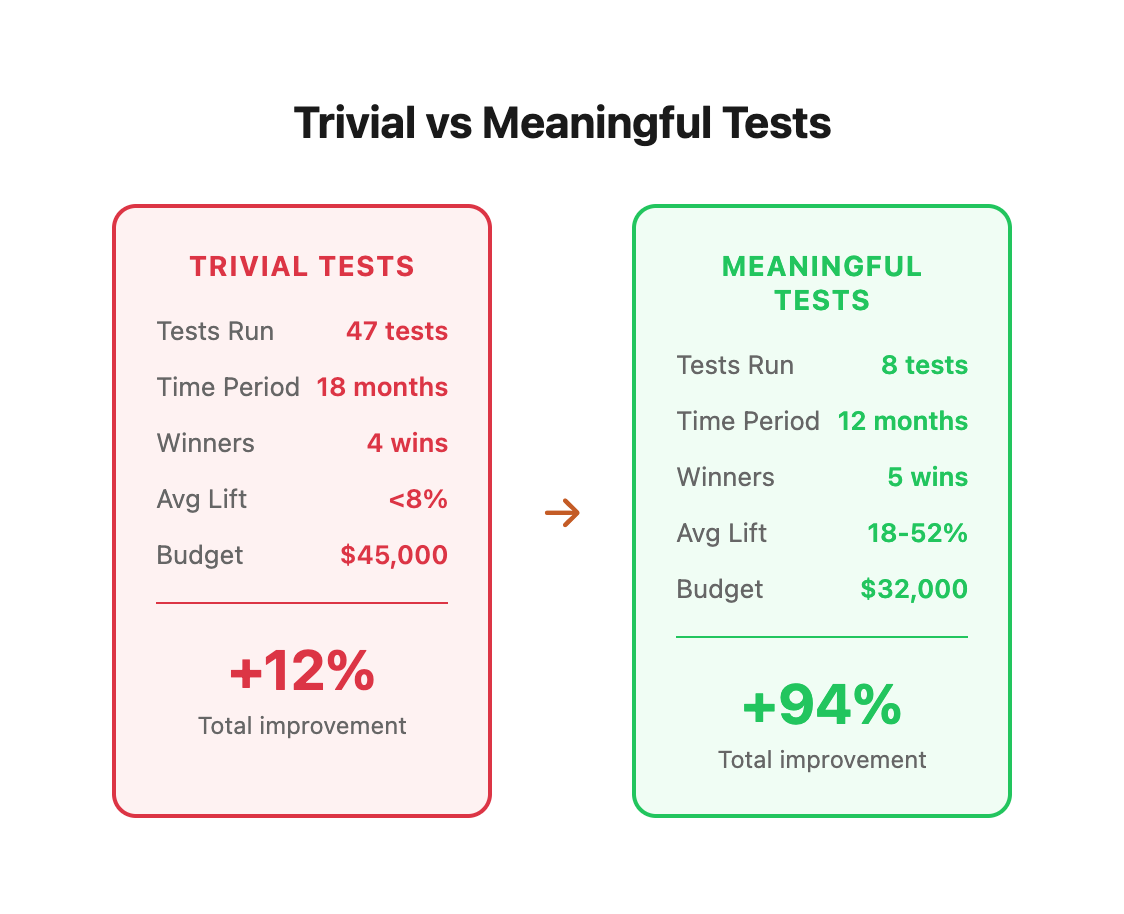
A B2B SaaS company we worked with had run 47 tests over 18 months:
- 43 tests on button colors, CTA copy variations, and form layouts
- 4 tests actually won (but all under 8% lift)
- Total compound impact: ~12% improvement
- Testing budget: $45,000
- Team hours invested: 380 hours
When we shifted their focus to meaningful tests:
- 8 tests over 12 months
- 5 tests won (lifts ranging from 18-52%)
- Total compound impact: 94% improvement
- Testing budget: $32,000
- Team hours invested: 240 hours
The difference? They stopped testing what was easy and started testing what mattered.
"The best testing programs we've seen run fewer tests, but those tests actually matter. One good test is worth a hundred trivial ones."
02 / what-makes-a-test-meaningful
What Makes a Test Meaningful?
A meaningful test has these characteristics:
1. It's Based on a Real Hypothesis
Not "I wonder if green converts better than blue" but "We believe users abandon at checkout because they're unsure about shipping costs, and showing estimated delivery dates will reduce abandonment."
Hypothesis Structure Template:
IF we [CHANGE],
THEN [EXPECTED OUTCOME] will happen,
BECAUSE [REASONING BASED ON USER PSYCHOLOGY/DATA]
Example Hypotheses:
| Weak (Avoid) | Strong (Use) |
|---|---|
| "Green button might convert better" | "IF we change the CTA to high-contrast orange, THEN click-through rate will increase by 15%+, BECAUSE the button currently blends with our green header and users aren't noticing it (heatmap data shows low engagement)" |
| "We should add testimonials" | "IF we add 3 specific customer results above the pricing table, THEN conversions will increase by 20%+, BECAUSE our exit surveys show 67% of non-buyers cite 'lack of proof it works' as their primary objection" |
| "Mobile experience needs work" | "IF we reduce our mobile checkout to 5 fields (from 12), THEN mobile conversion rate will increase by 25%+, BECAUSE analytics show 58% mobile cart abandonment happens at the address entry step" |
Real hypotheses come from:
- User research and customer interviews (qualitative insights)
- Analytics data showing friction points (quantitative evidence)
- Heatmaps and session recordings (behavioral observation)
- Customer support feedback (objection identification)
- Exit surveys and on-site polls (direct user voice)
The Research Framework for Building Hypotheses
Before you test anything, gather evidence from multiple sources. Here's a systematic approach:
Research Source Priority Matrix
| Research Method | Insight Quality | Implementation Cost | Time to Results | Best For |
|---|---|---|---|---|
| Session Recordings | High | Low | 1-2 days | Finding friction points |
| Exit Surveys | Very High | Medium | 3-7 days | Understanding objections |
| Customer Interviews | Very High | High | 1-2 weeks | Deep psychology insights |
| Analytics Funnel | Medium | Very Low | 1 day | Quantifying drop-off |
| Heatmaps | Medium | Low | 1-2 days | Attention and interaction |
| Support Tickets | High | Very Low | 1 day | Common objections |
Case Study: E-commerce Brand Hypothesis Development
Background: E-commerce store selling premium outdoor gear, 3.2% conversion rate, wanted to test product pages.
Research Process:
-
Analytics Review (Day 1):
- 42% of visitors viewed 3+ product images
- 28% scrolled to reviews section
- Only 8% clicked size guide
- Average time on page: 1m 47s
-
Session Recordings (Days 2-3):
- Watched 50 sessions of cart abandoners
- 31 users repeatedly clicked between product images and size chart
- 18 users added to cart, then returned to check dimensions
- Pattern: Size uncertainty drives hesitation
-
Exit Survey (Days 4-7):
- Asked non-buyers: "What stopped you from purchasing?"
- 44% selected "Not sure it will fit/work for my needs"
- 23% selected "Price too high"
- 18% selected "Need to research more"
-
Customer Interviews (Week 2):
- Called 12 recent customers
- Common theme: "I measured my current [product] before ordering"
- Insight: They need to visualize dimensions in context
Resulting Hypothesis:
IF we add an interactive "Size in Your Space" tool that shows product
dimensions overlaid on common reference objects (car trunk, doorway, etc.),
THEN conversion rate will increase by 25%+,
BECAUSE 44% of non-buyers cite fit uncertainty, session recordings show
repeated image-to-spec checking behavior, and customer interviews reveal
they measure existing items for comparison.
Test Result: 34% conversion lift, implemented permanently.
2. It Tests a Meaningful Difference
If users can't notice the difference between variations, the difference won't matter. Meaningful tests involve:
- Different value propositions
- Different page structures
- Different user flows
- Different pricing or offer structures
Test Impact Spectrum
| Test Type | Typical Lift Range | User Notice Level | Implementation Effort | When to Use |
|---|---|---|---|---|
| Button Color/Size | 0-5% | Subconscious | Very Low | Never (noise level) |
| CTA Copy Changes | 2-12% | Conscious | Low | When copy is clearly broken |
| Form Field Reduction | 10-30% | Very Obvious | Medium | High-friction forms |
| Value Prop Rewrite | 15-40% | Very Obvious | Medium | Messaging unclear |
| Page Structure | 20-50% | Completely Different | High | Fundamental flow issues |
| Pricing Strategy | 25-200% | Completely Different | High | Business model tests |
Real Example: Page Structure Test
Company: B2B software company, $2M ARR, 1.8% trial signup rate
Control: Traditional long-form sales page
- Hero section with generic headline
- 5 feature sections (walls of text)
- Single CTA at bottom
- Testimonials buried at 70% scroll
- 12-minute average time on page
- 1.8% conversion rate
Variant: Problem-focused structure
- Hero: Customer's specific pain point (with data)
- "The Real Cost of [Problem]" calculator (interactive)
- 3 customer stories (video testimonials)
- Feature comparison table
- Multiple CTAs at friction points
- 6-minute average time on page
- 4.7% conversion rate
Result: 161% lift in signups. Why? Because the structure matched the buyer's mental journey, not the company's feature list.
3. It Could Fail
If you're 99% sure which variation will win, you're not learning anything. Good tests have genuine uncertainty—that's what makes them worth running.
The Learning Value Framework
| Outcome | Learning Value | Business Value | What to Do Next |
|---|---|---|---|
| Huge Win (50%+ lift) | Medium | Very High | Implement immediately, test adjacent hypotheses |
| Moderate Win (15-40% lift) | High | High | Implement, document learnings, iterate |
| Small Win (5-15% lift) | Medium | Low | Question if real or noise, continue test |
| No Difference (±5%) | Very High | None | Valuable learning—hypothesis was wrong |
| Loss (-10%+) | Very High | Negative | Critical learning—understand why |
The most valuable tests are the ones where your team is split 50/50 on which variation will win. That means you're testing at the edge of your understanding.
Real Example: Pricing Page Test That "Failed"
Company: SaaS startup, testing pricing transparency
Hypothesis:
IF we show full pricing upfront (instead of "Contact Sales"),
THEN qualified leads will increase by 30%+,
BECAUSE surveys show 73% of visitors want to see pricing before talking to sales.
Team Confidence: 85% thought transparency would win
Result: 22% decrease in qualified leads
Why It Failed:
- Follow-up interviews revealed high-intent buyers actually preferred sales calls
- "Contact Sales" button filtered out low-budget shoppers
- Showing pricing attracted more tire-kickers who filled forms but never bought
- The company was selling $50K+ contracts, not self-serve SaaS
Learning Value: Massive. Changed entire go-to-market strategy to focus on high-touch sales. Saved 6 months of building self-serve infrastructure they didn't need.
4. The Result Will Change Behavior
Before running any test, ask: "What will we do differently based on the result?" If the answer is "nothing much," don't run the test.
Decision Impact Matrix
| Test Result Scenario | Decision Impact | Test Worth Running? |
|---|---|---|
| "If it wins by 10%+, we'll roll out globally" | High (affects all users) | Yes |
| "If it wins, we'll apply the pattern to other pages" | High (affects strategy) | Yes |
| "If it wins, we'll make it permanent" | Medium (single page only) | Maybe |
| "If it wins, we'll consider it" | Low (no clear action) | No |
| "We're curious what will happen" | None (no decision tied) | No |
03 / tests-worth-running
Tests Worth Running
Here are the categories of tests that actually move the needle:
Value Proposition Tests
How you communicate your value is more important than how you style it. Test different angles:
- Lead with features vs. lead with benefits
- Rational arguments vs. emotional appeals
- Problem-focused vs. solution-focused messaging
Value Proposition Testing Framework
| Approach | When It Works | Example | Expected Impact |
|---|---|---|---|
| Feature-Led | Technical buyers, established category | "AI-powered analytics with 50+ integrations" | 10-25% lift for technical audience |
| Benefit-Led | Mainstream buyers, clear outcome | "Double your sales in 90 days" | 20-40% lift for outcome-focused |
| Problem-Led | High-pain markets, unaware buyers | "Tired of losing deals to competitors?" | 30-60% lift when pain is acute |
| Social Proof-Led | Crowded markets, trust issues | "Join 50,000 companies like Nike and Toyota" | 15-35% lift with strong brands |
| Transformation-Led | Before/after obvious, visual results | "From chaos to clarity in 30 minutes" | 25-50% lift with clear contrast |
Real Test: B2B Software Homepage
Control (Feature-Led): Headline: "Enterprise Resource Planning for Modern Teams" Subhead: "Cloud-based ERP with AI-powered insights, real-time reporting, and 200+ integrations" Result: 2.3% trial signup rate
Variant A (Problem-Led): Headline: "Still Managing Inventory in Spreadsheets?" Subhead: "Manufacturing teams waste 14 hours per week on manual data entry. We automate it." Result: 5.1% trial signup rate (122% lift)
Variant B (Transformation-Led): Headline: "From 3-Day Reporting to Real-Time Insights" Subhead: "See exactly what's happening in your operation, right now" Result: 4.4% trial signup rate (91% lift)
Winner: Problem-Led. Why? The target market (small manufacturers) had acute pain and didn't even know modern solutions existed. They needed the problem called out explicitly.
Social Proof Tests
How you demonstrate credibility matters. Test different approaches:
- Customer testimonials vs. usage statistics
- Expert endorsements vs. peer reviews
- Prominent vs. subtle placement
Social Proof Effectiveness by Industry
| Industry | Most Effective Proof | Typical Lift | Why It Works |
|---|---|---|---|
| B2B SaaS | Customer logos + case studies | 25-45% | Buyers want proof of enterprise use |
| E-commerce | Star ratings + review count | 15-30% | Social validation from peers |
| Healthcare | Certifications + doctor endorsements | 35-60% | Authority and trust critical |
| Financial | Security badges + usage stats | 20-40% | Risk mitigation paramount |
| Education | Student outcomes + alumni testimonials | 30-55% | Results-driven decision |
Social Proof Hierarchy Framework
1. Specific Results (Highest Impact)
   "Sarah increased revenue 340% in 90 days"
   ↓
2. Named Testimonials with Photos
   Real person, real story, real face
   ↓
3. Usage Statistics
   "Join 50,000+ companies"
   ↓
4. Brand Logos (Lowest Impact)
   Generic logo wall
Real Test: SaaS Pricing Page Social Proof
Control:
- Generic testimonial: "Great product! - John S."
- Placed in sidebar
- No context or results
- 4.2% conversion rate
Variant:
- Specific result: "We cut support tickets by 67% in the first month. The ROI was immediate." - Jennifer Martinez, Director of Customer Success, TechCorp (Series B, 200 employees)
- Placed directly above pricing table
- Included company size/stage context
- 6.8% conversion rate (62% lift)
Key Insight: Specificity + relevance + placement = compounding effects
Friction Reduction Tests
Every step in your funnel loses people. Test removing friction:
- Single-page vs. multi-step checkout
- Guest checkout vs. required registration
- Form field reduction
Friction Audit Framework
| Friction Type | Identification Method | Typical Impact | Test Priority |
|---|---|---|---|
| Cognitive Friction | Users pause/hesitate on recordings | 20-40% abandonment | High |
| Data Entry Friction | Form field abandonment rate | 15-35% abandonment | High |
| Trust Friction | Exit surveys cite security/privacy | 25-50% abandonment | Very High |
| Navigation Friction | Rage clicks, back button usage | 10-25% abandonment | Medium |
| Decision Friction | Time on page >3x average | 30-60% abandonment | High |
Friction Calculation Formula
Friction Score = (Steps × Complexity) + (Fields × Difficulty) + Uncertainty

Where:
- Steps = Number of distinct actions required
- Complexity = Technical difficulty (1-10 scale)
- Fields = Number of form inputs
- Difficulty = Cognitive load per field (1-5 scale)
- Uncertainty = Unknown outcomes (0-20 penalty)

Example:
Traditional Checkout: (4 steps × 3) + (12 fields × 2) + 15 = 51
Optimized Checkout: (1 step × 1) + (5 fields × 1) + 5 = 11

Friction Reduction: 78%
Real Test: E-commerce Checkout Friction
Control (Multi-Step):
- Step 1: Account creation (5 fields)
- Step 2: Shipping address (7 fields)
- Step 3: Payment method (8 fields)
- Step 4: Review order
- Completion rate: 34%
Variant A (Single-Page):
- All fields on one page (20 fields visible)
- Guest checkout option at top
- Completion rate: 41% (21% lift)
Variant B (Progressive Disclosure):
- Start with email only
- Shipping fields appear after email
- Payment appears after shipping validated
- Auto-fills data where possible
- Completion rate: 52% (53% lift)
Winner: Progressive Disclosure. Why? It reduced perceived friction while maintaining single-page flow.
Field-Level Friction Analysis
| Field Type | Average Abandonment | Friction Score | Optimization Strategy |
|---|---|---|---|
| 5% | Low | Add social login option | |
| Phone Number | 18% | High | Make optional, explain why needed |
| Address (manual) | 24% | Very High | Add autocomplete/Google Places |
| Password (creation) | 22% | High | Allow social login or magic link |
| Credit Card | 15% | Medium | Add Apple Pay/Google Pay |
| CVV Code | 8% | Low | Explain security value |
| Billing = Shipping Checkbox | -12% (reduces friction) | Negative | Always include this option |
Offer Structure Tests
How you present your offer can matter more than the offer itself:
- Pricing presentation and anchoring
- Bundle configurations
- Guarantee framing
Pricing Psychology Framework
| Pricing Structure | Psychological Effect | Best Use Case | Typical Impact |
|---|---|---|---|
| Anchoring (High-Low-Medium) | Makes middle option feel reasonable | 3+ tier pricing | 30-60% choose middle tier |
| Decoy Pricing | Makes target option obvious winner | SaaS plans, subscriptions | 20-40% shift to target tier |
| Bundle Pricing | Increases perceived value | E-commerce, multiple products | 25-45% lift in AOV |
| Charm Pricing ($99 vs $100) | Subconscious value perception | Consumer products <$500 | 5-15% lift (low ticket) |
| Prestige Pricing (Round) | Suggests premium quality | Luxury, B2B, high-ticket | 10-25% lift (high ticket) |
| Comparative Pricing | Highlights savings vs alternative | Competitive markets | 15-35% lift |
Real Test: SaaS Pricing Page Structure
Control (3-Tier Traditional):
Starter: $29/mo
Professional: $79/mo
Enterprise: $199/mo
Distribution: 45% Starter, 35% Pro, 20% Enterprise ACV: $94/customer
Variant (Anchored with Decoy):
Basic: $29/mo (limited features, no support)
Professional: $79/mo [MOST POPULAR] (all features, email support)
Business: $149/mo (all Pro + dedicated support + API)
Enterprise: $299/mo (custom everything)
Distribution: 12% Basic, 61% Professional, 22% Business, 5% Enterprise ACV: $128/customer (36% increase)
Key Changes:
- Added "Basic" tier as lower anchor (makes $79 feel reasonable)
- Labeled middle tier "Most Popular" (social proof)
- Created clear differentiation between tiers
- Made "Business" tier obviously better value than old Enterprise
Guarantee Framing Test
Control: "30-day money-back guarantee" Conversion rate: 3.8%
Variant A: "Try it free for 30 days. If you don't see results, we'll refund every penny." Conversion rate: 4.9% (29% lift)
Variant B: "60-day results guarantee: If you don't [specific outcome], get a full refund + $50 for your time" Conversion rate: 5.7% (50% lift)
Why B Won: It removed risk AND demonstrated confidence in results. The $50 bonus showed they actually stand behind the promise.
04 / running-better-tests
Running Better Tests
Start with Research
Never run a test without understanding why. Spend time on qualitative research before you spend resources on testing. Talk to customers. Review session recordings. Understand the problem before testing solutions.
Research Time Allocation Guidelines
| Research Phase | Time Investment | Expected Output | ROI Multiple |
|---|---|---|---|
| Analytics Review | 2-4 hours | Quantified drop-off points | 3-5x |
| Session Recordings | 4-8 hours | Behavioral patterns | 5-10x |
| Exit Surveys | 3-7 days | Primary objections | 8-15x |
| Customer Interviews | 5-10 hours | Deep psychological insights | 10-25x |
| Competitive Analysis | 3-5 hours | Market positioning context | 4-8x |
Rule of Thumb: Spend 3-5x more time on research than test implementation. A well-researched test will outperform 10 random tests.
The 5-Interview Rule
After conducting hundreds of customer interviews, we've found a pattern: You'll discover 80% of your most valuable insights in the first 5 interviews.
Interview Response Pattern:
| Interview # | New Insights | Cumulative Coverage | Diminishing Returns |
|---|---|---|---|
| 1 | 8-12 unique insights | 40-50% | High value |
| 2 | 5-8 new insights | 65-75% | High value |
| 3 | 3-5 new insights | 80-85% | Medium value |
| 4 | 1-3 new insights | 85-90% | Medium value |
| 5 | 1-2 new insights | 88-92% | Decreasing |
| 6-10 | 0-1 per interview | 90-95% | Low value |
Stop at 5 unless: You're seeing completely new themes, or you have distinct customer segments that need separate analysis.
Calculate Sample Size First
Know how long you'll need to run before you start. If you don't have enough traffic to reach significance in a reasonable timeframe, either don't run the test or test something with bigger expected impact.
Statistical Significance Calculator
Z-score = (p₂ - p₁) / √[(p₁(1-p₁)/n₁) + (p₂(1-p₂)/n₂)]

Where:
- p₁ = control conversion rate
- p₂ = variant conversion rate
- n₁ = control sample size
- n₂ = variant sample size

If Z-score > 1.96, result is significant at 95% confidence
If Z-score > 2.58, result is significant at 99% confidence
Significance Thresholds Table
| Confidence Level | Z-Score | P-Value | False Positive Risk | When to Use |
|---|---|---|---|---|
| 90% | 1.645 | 0.10 | 10% | Early directional signals only |
| 95% | 1.96 | 0.05 | 5% | Standard test threshold |
| 99% | 2.58 | 0.01 | 1% | High-stakes business decisions |
| 99.9% | 3.29 | 0.001 | 0.1% | Mission-critical changes |
Example Calculation:
Test: Product page headline change
- Control: 2,150 visitors, 86 conversions (4.0%)
- Variant: 2,150 visitors, 112 conversions (5.2%)
Z = (0.052 - 0.040) / √[(0.040×0.960/2150) + (0.052×0.948/2150)]
Z = 0.012 / √[0.0000179 + 0.0000229]
Z = 0.012 / 0.00639
Z = 1.88
Result: 93.9% confidence (below 95% threshold - continue test)
Sample Size Requirements by Baseline Conversion Rate
| Baseline CR | To Detect 10% Lift | To Detect 25% Lift | To Detect 50% Lift |
|---|---|---|---|
| 1% | 38,300 per variation | 6,200 per variation | 1,600 per variation |
| 2% | 19,100 per variation | 3,100 per variation | 800 per variation |
| 5% | 7,600 per variation | 1,250 per variation | 320 per variation |
| 10% | 3,800 per variation | 625 per variation | 160 per variation |
| 20% | 1,900 per variation | 320 per variation | 85 per variation |
Traffic Requirements Calculator
Days Required = (Sample Size × 2) / (Daily Traffic × Test Allocation %)

Example:
Need 7,600 per variation (15,200 total)
Daily traffic: 500 visitors
Test allocation: 80% (400 visitors in test)
Days = 15,200 / 400 = 38 days

Reality: Need ~6 weeks to reach significance
When You Don't Have Enough Traffic:
| Traffic Level | Strategy | Example |
|---|---|---|
| <100/day | Don't A/B test—use sequential testing | Launch variant, measure for 30 days, compare to historical |
| 100-500/day | Test big swings only (30%+ expected lift) | Radical redesigns, major offer changes |
| 500-2,000/day | Mix of moderate and big tests | Value prop tests, page structure tests |
| 2,000+/day | Can test incrementally | Full optimization program possible |
Run Fewer, Better Tests
A testing program that runs 50 trivial tests per year will be outperformed by one that runs 10 meaningful tests. Quality over quantity.
Test Impact Comparison
| Program Type | Tests/Year | Win Rate | Avg Lift | Compound Effect | Business Impact |
|---|---|---|---|---|---|
| Trivial Tests | 50 | 25% | +3% each | 1.03¹² = 42% | Marginal |
| Meaningful Tests | 10 | 40% | +12% each | 1.12⁴ = 57% | Transformational |
Why Meaningful Tests Win:
- Larger absolute lifts compound faster
- Higher confidence in results (less noise)
- Deeper learnings inform future tests
- Team morale improves with clear wins
The Compounding Effect Explained
When you run a test and implement the winner, you're not just getting that single lift—you're raising the baseline for all future tests. This is where meaningful tests dramatically outperform trivial ones.
12-Month Compounding Comparison
| Month | Trivial Test Program (3% avg lift) | Meaningful Test Program (12% avg lift) |
|---|---|---|
| Start | 100 conversions/month | 100 conversions/month |
| Month 1 | 103 (test win) | 100 (research phase) |
| Month 2 | 106.1 (test win) | 100 (research phase) |
| Month 3 | 109.3 (test win) | 112 (first test win) |
| Month 4 | 112.5 (test win) | 112 (research phase) |
| Month 5 | 115.9 | 112 (research phase) |
| Month 6 | 119.4 (test win) | 125.4 (second test win) |
| Month 9 | 130.5 | 140.5 (third test win) |
| Month 12 | 142.6 | 157.4 (fourth test win) |
Meaningful tests win by 10% despite running 80% fewer tests.
Document Everything
The value of testing compounds when you learn from past results. Document hypotheses, results, and learnings. Build an institutional knowledge base.
Test Documentation Template
\# Test Name: [Descriptive Name]
**Date:** YYYY-MM-DD to YYYY-MM-DD
**Page/Flow:** [URL or Flow Name]
**Status:** [Running | Won | Lost | No Difference | Inconclusive]

## Hypothesis
IF we [change],
THEN [outcome] will happen,
BECAUSE [reasoning with data source]

## Research Evidence
- Analytics: [key findings]
- Recordings: [behavioral patterns]
- Surveys: [objection data]
- Interviews: [psychological insights]

## Test Details
- **Control:** [description + screenshot]
- **Variant:** [description + screenshot]
- **Traffic Split:** 50/50
- **Duration:** X days
- **Sample Size:** X per variation

## Results

| Metric | Control | Variant | Change | Confidence |
|--------|---------|---------|--------|------------|
| Primary | X% | X% | +X% | 95%+ |
| Secondary | X% | X% | +X% | 95%+ |

## Learnings
1. [Key insight from test]
2. [Unexpected finding]
3. [Implication for future tests]

## Next Steps
- [ ] Implement winner
- [ ] Test adjacent hypothesis
- [ ] Apply pattern to [other pages]
Test Knowledge Base Structure
/testing-program
  /hypotheses
    /backlog.md (prioritized test ideas)
    /rejected.md (ideas we decided not to test and why)
  /tests
    /2024-01-homepage-value-prop.md
    /2024-02-pricing-anchor.md
    /2024-03-checkout-friction.md
  /patterns
    /winning-patterns.md (reusable insights)
    /losing-patterns.md (what doesn't work)
  /insights
    /customer-psychology.md (deep insights from interviews)
    /friction-map.md (known friction points across site)
05 / the-real-goal
The Real Goal
The goal of A/B testing isn't to produce winning tests—it's to produce learning. Sometimes a "losing" test teaches you more than a "winning" one.
The best testing programs create a culture of experimentation where decisions are informed by data, hypotheses are constantly generated and tested, and the organization gets smarter over time.
Learning vs. Winning Mindset
| Winning Mindset (Avoid) | Learning Mindset (Adopt) |
|---|---|
| "We need more green lights" | "We need more insights" |
| Celebrate only winners | Celebrate insights from winners AND losers |
| Avoid risky tests | Test at the edge of understanding |
| Test things you know will win | Test where team is split 50/50 |
| Hide failures | Document and share failures |
| Repeat proven patterns | Challenge proven patterns |
The Most Valuable "Losing" Tests
Sometimes tests that lose teach you more than tests that win. Here are real examples:
Case 1: Social Proof Backfire
Test: Added "Join 50,000+ users" badge to SaaS homepage Expected: 20%+ lift (social proof always works, right?) Result: 18% decrease in signups Learning: The product was positioning as "exclusive" and "enterprise." Large user count made it seem commodity/consumer. Changed messaging to "Trusted by 200+ enterprise companies" and got 32% lift.
Case 2: Friction That Converts
Test: Removed phone number field from lead form (friction reduction) Expected: 30%+ increase in leads Result: 47% increase in leads, but 68% decrease in sales-qualified leads Learning: Phone field was actually qualifying leads. People willing to give phone number were serious buyers. Kept phone field, improved overall funnel efficiency.
Case 3: Price Transparency Disaster
Test: Show pricing upfront instead of "Request Demo" Expected: 25%+ increase in qualified leads Result: 41% decrease in demos booked Learning: High-ticket B2B buyers (>$50K contracts) actually prefer sales conversations. They want custom solutions, not off-the-shelf pricing. Reverted and focused on improving demo process instead.
The Documentation Payoff
Companies that document tests systematically see:
| Benefit | Impact | Timeline |
|---|---|---|
| Faster Hypothesis Generation | 3x more test ideas per month | 3-6 months |
| Higher Win Rate | +15-25% more tests achieve significance | 6-12 months |
| Team Alignment | 60% reduction in subjective debates | 1-3 months |
| Compound Learning | Each test informs 2-3 future tests | 12+ months |
| Onboarding Speed | New team members productive in days vs weeks | Immediate |
06 / ready-to-run-tests-that-matter
Ready to Run Tests That Matter?
If your testing program has stalled or you're not seeing meaningful results, let's talk. Our CRO & Analytics team will help you identify the tests that will actually move your business forward.
What You'll Get:
- Conversion Audit - We'll review your funnel and identify the highest-impact friction points
- Research Roadmap - A prioritized list of hypotheses worth testing based on your data
- Testing Strategy - A 90-day experimentation plan focused on meaningful lifts
- Implementation Support - Help running tests, analyzing results, and applying learnings
Stop testing button colors. Start testing what matters.