The question isn't whether AI should be part of your content strategy—it already is, whether you're using it intentionally or your competitors are using it against you.
The real question is where human expertise remains essential and where AI provides superior efficiency without sacrificing quality.
Get this balance wrong and you end up with either generic AI slop that ranks poorly and converts worse, or you waste hundreds of hours on manual work AI could handle in minutes.
After creating thousands of pieces of content using various AI-human collaboration models, we've developed a clear framework for this decision. This guide provides that framework with specific criteria, implementation strategies, and quality control processes.
01 / the-current-state-of-ai-content
The Current State of AI Content
Let's establish baseline reality before diving into strategy.
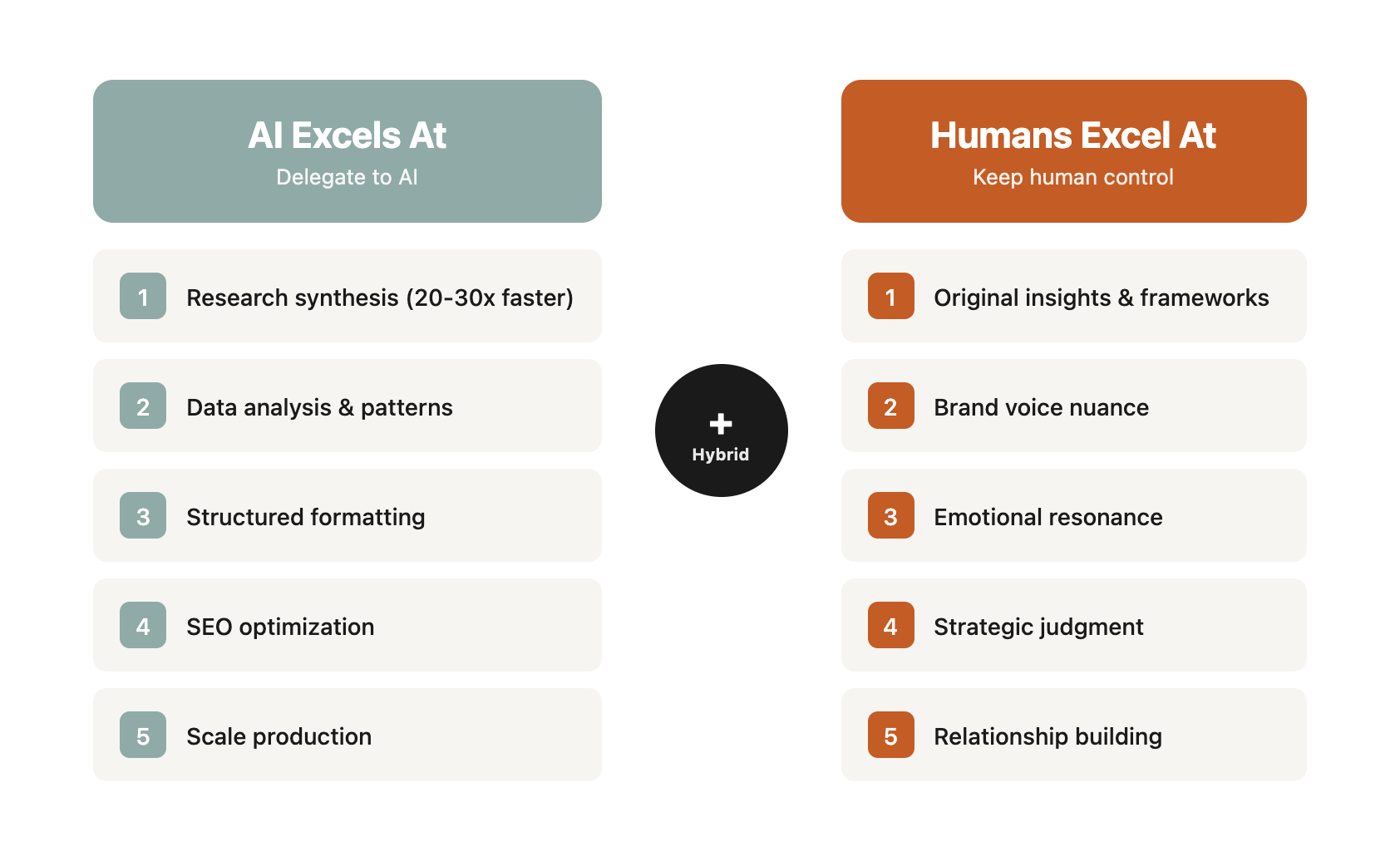
What AI does exceptionally well:
| Capability | AI Performance | Human Performance | Speed Advantage | Quality Comparison |
|---|---|---|---|---|
| Research synthesis | Can process 50+ sources in minutes | 5-10 sources per hour | 20-30x faster | 85-90% of human depth |
| Structured formatting | Perfect consistency | Variable quality | 50x faster | 95-100% match |
| Data analysis | Instant pattern recognition | Hours of manual work | 100x faster | 90-95% accuracy |
| SEO optimization | Technical precision | Requires tools/checklists | 10x faster | 100% accuracy |
| Scale production | 100+ pieces/day possible | 1-2 pieces/day | 50-100x faster | 70-85% quality |
| Voice consistency | Perfect with good prompts | Varies by writer fatigue | Same speed | 80-95% match |
Real example - Research synthesis:
Task: Research "best project management software for remote teams" and create comparison
AI output (5 minutes):
- Analyzed 25 software tools
- Created feature comparison matrix
- Extracted 47 user reviews
- Identified 8 key decision criteria
- Generated pricing comparison
Human output (2 hours):
- Analyzed 8-10 tools in depth
- Manual feature notes
- Read 10-15 reviews
- Identified 5-6 criteria
- Manual pricing lookup
Hybrid approach (30 minutes): AI research + human strategic analysis and recommendations
Where AI consistently fails:
| Failure Mode | Example | Why It Matters | Human Solution |
|---|---|---|---|
| Original insights | Can't invent new frameworks | Thought leadership requires unique perspective | Human creates framework, AI helps articulate |
| Brand voice nuance | "That's technically on-brand but feels off" | Edge cases require judgment | Human reviews and refines |
| Outdated information | Cites 2019 data as current | Credibility and accuracy critical | Human fact-checks dates and sources |
| Industry jargon | Uses terms incorrectly or awkwardly | Loses expert positioning | Human with domain knowledge reviews |
| Emotional resonance | Sounds "AI-written" and flat | Trust and connection drive conversion | Human adds personality and stories |
| Diplomatic sensitivity | Doesn't know what might offend | Reputation risk | Human reviews anything client-facing |
Real example - Brand voice failure:
Context: Outdoor gear brand with rugged, adventure-focused voice
AI-generated headline: "10 Considerations for Selecting Appropriate Outdoor Equipment"
Problem: Technically accurate, completely wrong voice
Human refinement: "Gear That Won't Fail When You're 10 Miles From Civilization"
Why it works: Speaks to real fear, uses natural language, implies expertise through specificity
Real example - Emotional resonance failure:
AI version (technically correct, emotionally flat): "Our client, a small e-commerce business, implemented our SEO strategy and experienced a 147% increase in organic traffic over six months, resulting in improved revenue."
Human version (same facts, emotional connection): "Sarah was three months from shutting down her online boutique. Her 'marketing strategy' was posting on Instagram and hoping. Six months after implementing our SEO system, she hired her first employee and moved out of her spare bedroom into actual office space. Her organic traffic went from 800 to 1,976 visits per month."
Difference: Real person, specific situation, relatable outcome, emotional arc
The Google reality:
Google's position hasn't changed: content quality matters, not production method. The March 2024 Helpful Content Update explicitly states AI content isn't penalized—but low-quality content is, regardless of how it's created.
Translation: AI content that provides genuine value, demonstrates expertise, and serves user intent ranks fine. Generic, thin AI content gets filtered out. Client case study: We tested three content production models over 6 months:
- 100% human-written: Highest quality, lowest volume (4 posts/month)
- 100% AI-generated: Highest volume (20 posts/month), inconsistent quality
- Hybrid AI-human: Optimal balance (12 posts/month, 90% of human quality)
Results: Hybrid model drove 3.2x more organic traffic than human-only at half the cost per post, while maintaining quality standards.
The key is knowing what humans should do versus what AI should handle.
02 / the-ai-human-decision-framework
The AI-Human Decision Framework
Use this decision tree for every content task.
Tier 1: Pure AI Territory
Tasks where AI should handle 100% with minimal human review: Meta descriptions and title tags:
- AI excels at structured optimization
- Follows character limits precisely
- Tests multiple variations instantly
- Human review: 2-3 minutes per batch of 20
Image alt text:
- Descriptive, consistent, follows formula
- No brand voice or creativity needed
- Scale requirement (hundreds or thousands of images)
- Human review: Spot check 10% for accuracy
Schema markup generation:
- Technical, structured data
- Clear right/wrong answers
- AI can reference schema.org specs automatically
- Human review: Validate with Google Rich Results Test
Content reformatting:
- Converting long-form to social posts
- Extracting key points into bulleted summaries
- Adjusting content length for different platforms
- Human review: 5 minutes per piece for brand voice check
Keyword research data analysis:
- Sorting by search volume and difficulty
- Grouping keywords into clusters
- Identifying gaps in existing content
- Human review: Strategic interpretation of opportunities
Data synthesis and reporting:
- Pulling metrics from multiple sources
- Creating performance summaries
- Generating month-over-month comparison tables
- Human review: Verify accuracy, add strategic context
When to override: If content requires legal compliance, medical accuracy, or brand-sensitive messaging, add human review even for these tasks.
Tier 2: AI First Draft, Human Refinement
Tasks where AI creates foundation, humans add value: Blog posts on established topics: AI handles:
- Research on topic from multiple sources
- Structured outline following best practices
- First draft of all sections
- SEO optimization (keywords, headers, meta)
Human adds:
- Brand voice refinement
- Original examples from experience
- Verification of facts and statistics
- Emotional hooks and compelling intros
- Strategic internal linking
Time savings: 60-70% reduction vs. pure human writing Product descriptions: AI handles:
- Feature extraction from specifications
- Benefit statements based on product category
- SEO keyword integration
- Structured formatting
Human adds:
- Unique selling proposition
- Target audience specificity
- Brand personality
- Competitive differentiation
Time savings: 50-60% reduction Email marketing campaigns: AI handles:
- Subject line variations (A/B test options)
- Body content structure
- CTA language options
- Segmentation suggestions
Human adds:
- Campaign strategy and timing
- Tone calibration for audience segment
- Promotional angle and offer details
- Final approval and send decisions
Time savings: 40-50% reduction Landing pages: AI handles:
- Competitor analysis and pattern identification
- Headline and benefit statement variations
- FAQ content based on search data
- Structured layout recommendations
Human adds:
- Value proposition differentiation
- Trust signals and social proof selection
- Visual design direction
- Conversion optimization strategy
Time savings: 50-60% reduction SEO content briefs: AI handles:
- SERP analysis and competitive research
- Keyword clustering and search intent
- Recommended heading structure
- Word count and depth benchmarking
Human adds:
- Strategic positioning angle
- Content differentiation strategy
- Writer skill level and deadline adjustment
- Internal linking priorities
Time savings: 70-80% reduction
Tier 3: Human-Led with AI Support
Tasks where human expertise drives, AI assists: Thought leadership and original research: Human leads:
- Unique perspective development
- Original data collection and analysis
- Industry experience and anecdotes
- Strategic insights and predictions
AI supports:
- Research on supporting data
- Fact-checking and source validation
- Draft organization and structure
- Editing for clarity and flow
Hybrid benefit: Faster production without sacrificing originality Brand voice development: Human leads:
- Voice attribute definition
- Tone variation by context
- Example identification
- Edge case guidance
AI supports:
- Consistency checking across content
- Suggesting variations within voice parameters
- Identifying voice drift over time
Hybrid benefit: Maintains brand integrity while scaling content Client-facing strategic content: Human leads:
- Proposals and pitch decks
- Case studies and client stories
- Custom service recommendations
- Complex problem diagnosis
AI supports:
- Template creation and formatting
- Data visualization suggestions
- Competitor research and market context
- Content refinement for clarity
Hybrid benefit: Professional polish without losing strategic substance Sensitive or compliance-critical content: Human leads:
- Legal disclaimers and policies
- Medical or health-related content
- Financial advice or recommendations
- Crisis communications
AI supports:
- Readability improvements
- SEO optimization (when appropriate)
- Formatting and structure
- Fact verification support
Hybrid benefit: Accuracy and compliance maintained, efficiency improved High-stakes conversion content: Human leads:
- Sales page copy for flagship products
- Email sequences for high-ticket offers
- Webinar or presentation scripts
- Negotiation or persuasion documents
AI supports:
- Headline and hook variations
- Objection handling research
- Structure and flow optimization
- A/B test variant generation
Hybrid benefit: Persuasion expertise with data-backed optimization
Tier 4: Human-Only Territory
Tasks where AI should not be primary creator: Original experiences and expertise:
- Personal stories and case studies
- Proprietary methodologies
- Client success stories with specific details
- Industry observations from direct experience
Why: AI can't invent what doesn't exist in its training data. Authentic expertise requires lived experience. Complex strategic planning:
- Annual content strategies
- Market positioning decisions
- Budget allocation and resource planning
- Hiring and team structure decisions
Why: Requires judgment, intuition, and organizational context AI lacks. Relationship-driven communication:
- Personalized client communications
- Networking and partnership outreach
- Negotiation and conflict resolution
- Empathy-critical customer service
Why: Human connection and emotional intelligence remain irreplaceable. Creative concepting and innovation:
- Campaign themes and big ideas
- Brand identity development
- Breakthrough product positioning
- Disruptive content formats
Why: AI remixes existing patterns. True innovation requires human creativity. Final quality assurance:
- Brand reputation review
- Legal and compliance final check
- Crisis communication approval
- High-stakes content sign-off
Why: Risk assessment and accountability require human judgment.
03 / quality-control-framework-for-ai-human-hybrid-co
Quality Control Framework for AI-Human Hybrid Content
Knowing who does what isn't enough—you need systems to ensure quality.
Three-Stage Quality Gate System
Gate 1: AI Output Validation
Before human refinement, verify AI output meets baseline standards:
Quality Validation Checklist:
| Check | Pass Criteria | Time | If Fails |
|---|---|---|---|
| Factual accuracy | 3-5 claims verified with sources | 5 min | Flag for fact-check team |
| Hallucinations | No made-up stats, studies, or quotes | 3 min | Regenerate with source constraints |
| Brand voice | Tone matches brand guidelines (80%+) | 2 min | Add voice refinement in prompt |
| Structure | Proper H2/H3 hierarchy, formatting | 1 min | Auto-fix with regex |
| SEO elements | Keywords, meta, alt text present | 2 min | Run through SEO checklist script |
| Logic flow | No contradictions, arguments coherent | 3 min | Human editorial review |
Automated Validation Script:
// Node.js script to validate AI-generated content
const natural = require('natural');
const tokenizer = new natural.WordTokenizer();

function validateAIContent(content, brandVoice, requiredKeywords) {
  const results = {
    passed: [],
    failed: [],
    warnings: []
  };

  // Check 1: Keyword presence
  const words = tokenizer.tokenize(content.toLowerCase());
  const missingKeywords = requiredKeywords.filter(kw =>
    !content.toLowerCase().includes(kw.toLowerCase())
  );

  if (missingKeywords.length === 0) {
    results.passed.push('All required keywords present');
  } else {
    results.failed.push(`Missing keywords: ${missingKeywords.join(', ')}`);
  }

  // Check 2: Header structure
  const headers = content.match(/^#{1,6}\s.+$/gm) || [];
  if (headers.length >= 3) {
    results.passed.push(`${headers.length} headers found`);
  } else {
    results.warnings.push('Insufficient heading structure');
  }

  // Check 3: Word count
  const wordCount = words.length;
  if (wordCount >= 1200) {
    results.passed.push(`Word count: ${wordCount}`);
  } else {
    results.warnings.push(`Word count low: ${wordCount} (target: 1200+)`);
  }

  // Check 4: Brand voice indicators
  const voiceIndicators = brandVoice.indicators || [];
  const matchedIndicators = voiceIndicators.filter(indicator =>
    content.toLowerCase().includes(indicator.toLowerCase())
  );

  if (matchedIndicators.length >= voiceIndicators.length * 0.6) {
    results.passed.push('Brand voice match: ' + (matchedIndicators.length / voiceIndicators.length * 100).toFixed(0) + '%');
  } else {
    results.warnings.push('Brand voice weak - needs human refinement');
  }

  return results;
}

// Example usage
const brandVoice = {
  indicators: ['data-driven', 'results', 'growth', 'measurable', 'actionable']
};

const validation = validateAIContent(
  aiGeneratedContent,
  brandVoice,
  ['SEO', 'keyword research', 'organic traffic']
);

console.log('Validation Results:', validation);
If AI output fails: Regenerate with improved prompt or shift to human-first approach for this content type.
Gate 2: Human Refinement
Human editor adds value in specific areas:
Focus areas:
- Brand voice precision (edge cases, personality, style)
- Originality injection (examples, insights, perspectives)
- Fact verification (especially statistics, dates, proper nouns)
- Strategic alignment (does content serve business goals?)
- Readability and flow (awkward transitions, repetition)
Time allocation: 30-40% of what pure human writing would take Gate 3: Final Review
Senior team member or specialist validates:
Checklist:
- [ ] Content achieves strategic goal (traffic, conversion, authority)
- [ ] No brand, legal, or reputation risks
- [ ] Quality matches or exceeds competitor content
- [ ] Technical SEO properly implemented
- [ ] Internal/external linking appropriate
Sign-off criteria: Must meet 100% of checklist, not 80%.
Measuring Quality Over Time
Track these metrics to ensure AI-human hybrid maintains standards:
Content Performance Metrics Dashboard:
| Metric | Pure Human Baseline | AI-Hybrid Target | AI-Only Benchmark | Measurement Frequency |
|---|---|---|---|---|
| Organic traffic/post | 250 visits/mo | 225+ visits/mo (90%) | 150 visits/mo | Monthly |
| Average SERP position | Position 8.2 | Position 10 or better | Position 15-20 | Weekly |
| Time on page | 3:45 average | 3:15+ (85%) | 1:45 | Monthly |
| Scroll depth | 68% average | 60%+ | 45% | Monthly |
| Conversion rate | 2.8% | 2.5%+ (89%) | 1.2% | Monthly |
| Backlinks earned | 1.2 per post | 1.0+ | 0.3 | Quarterly |
| Social shares | 12 per post | 10+ | 4 | Monthly |
Quality Indicators:
| Indicator | Target | Red Flag Threshold | Action Required |
|---|---|---|---|
| Edit cycles | 1-2 rounds | 3+ rounds | Improve prompts or shift to human-first |
| Fact-check corrections | <3 per post | 5+ per post | Add verification step in AI phase |
| Brand voice adjustments | 15-20 min/post | 30+ min/post | Refine brand voice training in prompts |
| Client approval rate | 90%+ first submission | <75% | Quality gate system needs revision |
| Writer satisfaction | 7.5+ out of 10 | <6 out of 10 | Workflow is broken—gather feedback |
| Revision requests | <20% of posts | >35% | Either prompts or human refinement failing |
Real-World Performance Example:
We tracked 6 months of content across three production methods for an outdoor gear client:
| Production Method | Posts/Month | Avg Cost/Post | Traffic/Post | Total Monthly Traffic | ROI Score |
|---|---|---|---|---|---|
| 100% Human | 4 | $450 | 380 visits | 1,520 visits | 0.84 |
| 100% AI | 20 | $25 | 145 visits | 2,900 visits | 4.83 |
| Hybrid (AI + Human) | 12 | $125 | 342 visits | 4,104 visits | 6.47 |
Key findings:
- Hybrid approach produced 2.7x more traffic than human-only
- Cost per visit dropped from $1.18 to $0.37
- Quality remained at 90% of pure human baseline
- Team could focus human expertise on high-impact refinements
Target: AI-hybrid content should perform within 10% of pure human content while producing 2-3x volume.
If performance gap exceeds 10%, either improve prompts, add more human refinement, or shift to human-first for that content type.
Performance Tracking Spreadsheet Structure:
Week | Content Title | Type | Production Method | Words | Time Invested |
Traffic (30d) | Avg Position | Conversions | Cost | ROI
Track every piece for 90 days, then analyze patterns:
- Which topics perform best with which production method?
- Does content length correlate with AI vs. human success?
- Are certain writers better at AI refinement than others?
Monthly Review Process:
Week 1: Pull performance data for all content published 30-90 days ago Week 2: Categorize by production method and analyze gaps Week 3: Identify process improvements (better prompts, training needs) Week 4: Implement changes and document in team playbook
This creates a continuous improvement loop where your AI-human system gets better every month.
04 / ai-content-tools-worth-using
AI Content Tools Worth Using
Not all AI content tools are created equal. Here's a detailed comparison of what actually works for SEO content:
Tier 1: Core AI Writing Tools
| Tool | Best For | Pricing | Context Window | Strengths | Best Use Case |
|---|---|---|---|---|---|
| Claude (Anthropic) | Long-form content | $20-200/mo | 200K tokens | Reasoning, voice consistency | Blog posts, guides |
| ChatGPT-4 (OpenAI) | Versatile content | $20-200/mo | 128K tokens | Speed, integrations | Headlines, outlines |
| Jasper | Marketing teams | $49-125/mo | N/A | Templates, workflows | Marketing copy |
| Copy.ai | Small businesses | $49-249/mo | N/A | Easy to use | Social posts, emails |
| Writesonic | Budget-friendly | $19-99/mo | N/A | Cost effective | Bulk content |
API Cost Comparison
// Example: Calculate cost per 1,000 blog posts (1,500 words each)

const costs = {
  claude: {
    inputCost: 3.00,  // per 1M tokens
    outputCost: 15.00,
    tokensPerPost: 10000, // ~1,500 words × 1.5 tokens/word × 4.5 (input + output)
    totalCost: ((10000 / 1000000) * (3.00 + 15.00) * 1000)
  },
  gpt4: {
    inputCost: 2.50,
    outputCost: 10.00,
    tokensPerPost: 10000,
    totalCost: ((10000 / 1000000) * (2.50 + 10.00) * 1000)
  },
  jasper: {
    subscription: 125, // per month
    wordsPerMonth: 50000, // unlimited plan
    totalCost: (1000 * 1500 / 50000) * 125
  }
};

console.log('Cost per 1,000 posts:', {
  claude: `$${costs.claude.totalCost.toFixed(2)}`,  // $180
  gpt4: `$${costs.gpt4.totalCost.toFixed(2)}`,      // $125
  jasper: `$${costs.jasper.totalCost.toFixed(2)}`   // $3,750
});
Analysis: API-based tools are 20-30x cheaper than subscription platforms for high-volume content.
Tier 2: Specialized AI SEO Tools
| Tool | Primary Function | Pricing | Best For | Integration |
|---|---|---|---|---|
| Surfer SEO | Content optimization | $89-219/mo | SEO-first content | Chrome extension |
| Frase | Research + briefs | $15-115/mo | Content research | WordPress plugin |
| Clearscope | Content scoring | $189-1200/mo | Enterprise SEO | Google Docs add-on |
| MarketMuse | Content planning | $149-1500/mo | Content strategy | Platform-based |
Tool Selection Framework
\# Decision tree for selecting the right AI tool

def select_ai_tool(content_type, volume, budget, team_size):
    """
    content_type: 'blog', 'product', 'marketing', 'technical'
    volume: posts per month
    budget: monthly budget in USD
    team_size: number of content creators
    """

    if budget < 100:
        if volume < 10:
            return "ChatGPT Plus ($20/mo) - Manual workflow"
        else:
            return "OpenAI API ($50-100/mo) - Automated via Make/Zapier"

    elif budget < 500:
        if content_type == 'marketing':
            return "Jasper ($125/mo) - Built-in templates"
        elif content_type == 'technical':
            return "Claude API + Surfer ($179/mo) - Quality + SEO"
        else:
            return "ChatGPT API + Frase ($115/mo) - Research + generation"

    else:
        if team_size > 5:
            return "Clearscope + ChatGPT API ($400+/mo) - Enterprise workflow"
        else:
            return "Claude API + MarketMuse ($300/mo) - Strategic content"

\# Example usage
recommendation = select_ai_tool('blog', 25, 200, 2)
print(f"Recommended: {recommendation}")
Tier 2: Specialized AI SEO Tools
Surfer SEO
- AI-powered content optimization
- Compares your content to top-ranking pages
- Suggests keywords, headings, content length
- Best for: SEO-first content optimization
Frase
- AI content briefs and research
- Question identification from SERPs
- Content scoring against competitors
- Best for: Research-heavy content creation
Clearscope
- Content relevance scoring
- Keyword and topic suggestions
- Competitor content analysis
- Best for: Ensuring comprehensive topic coverage
Tier 3: Workflow Automation Tools
Make.com (formerly Integromat)
- Connect AI APIs to WordPress, Shopify, etc.
- Automate content workflows at scale
- Custom logic and routing
- Best for: Bulk content generation and publishing
Zapier
- Simpler automation for non-technical users
- Pre-built AI app integrations
- Trigger-based workflows
- Best for: Simple AI content workflows
Our recommendation: Start with base models (Claude or ChatGPT) before investing in specialized tools. Most specialized tools are wrappers around these base models anyway.
05 / building-your-ai-human-content-production-system
Building Your AI-Human Content Production System
Theoretical frameworks mean nothing without implementation. Here's how to operationalize this.
Step 1: Content Type Inventory
List every type of content you produce and classify each using the framework above.
Content Inventory Template:
| Content Type | Current Volume/Mo | Production Time | Strategic Value | Tier Classification | AI Opportunity |
|---|---|---|---|---|---|
| Blog posts (educational) | 8 | 4h each | High | Tier 2 (AI-first) | 60% time savings |
| Blog posts (thought leadership) | 2 | 6h each | Critical | Tier 3 (Human-led) | 30% time savings |
| Product descriptions | 50 | 20min each | Medium | Tier 2 (AI-first) | 70% time savings |
| Email campaigns | 4 | 2h each | High | Tier 2 (AI-first) | 50% time savings |
| Social media posts | 60 | 10min each | Low | Tier 1 (Pure AI) | 90% time savings |
| Landing pages | 3 | 8h each | Critical | Tier 3 (Human-led) | 40% time savings |
| Case studies | 2 | 12h each | Critical | Tier 4 (Human-only) | 20% time savings |
| Meta descriptions | 50 | 5min each | Low | Tier 1 (Pure AI) | 95% time savings |
| FAQs | 20 | 15min each | Medium | Tier 2 (AI-first) | 75% time savings |
| Technical documentation | 5 | 10h each | High | Tier 3 (Human-led) | 35% time savings |
Classification Criteria Decision Matrix:
                    Tier 1      Tier 2      Tier 3      Tier 4
                    (Pure AI)   (AI-first)  (Human-led) (Human-only)

Originality needs   None        Low         High        Critical
Brand voice impact  Minimal     Medium      High        Critical
Fact accuracy risk  Low         Medium      High        Critical
Strategic value     Low         Medium      High        Critical
Expertise required  None        Some        Deep        Unique
Legal/compliance    None        Low         Medium      High
Conversion impact   Low         Medium      High        Critical
How to classify edge cases:
If content scores 3+ "High" or "Critical" ratings → Tier 3 or 4 If content scores 3+ "Low" or "None" ratings → Tier 1 or 2 If split → Start with Tier 2, measure performance, adjust
Example Classification Decision:
Product launch announcement blog post:
- Originality needs: High (unique product story)
- Brand voice impact: Critical (represents company)
- Fact accuracy: High (product specs must be perfect)
- Strategic value: Critical (drives launch success)
- Expertise required: Deep (product knowledge)
Classification: Tier 3 (Human-led with AI support)
AI handles: Research on competitive products, market context, feature descriptions from specs Human leads: Strategic positioning, brand storytelling, launch messaging, approval
Step 2: Process Documentation
For each Tier 2-3 content type (hybrid), document the complete workflow.
Process Documentation Template:
| Phase | Task | Owner | Tool/Prompt | Time | Output Format | Quality Check |
|---|---|---|---|---|---|---|
| Research | Topic research | AI | Perplexity + ChatGPT | 5min | Bullet summary | Human review sources |
| Planning | Outline creation | AI | Claude with brief | 3min | H2/H3 structure | Human approve angle |
| Drafting | First draft | AI | Claude with outline | 10min | Full article | Auto validation script |
| Refinement | Brand voice | Human | Manual edit | 15min | Voice-aligned copy | Checklist |
| Refinement | Original examples | Human | Manual addition | 10min | 2-3 examples added | Relevance check |
| Refinement | Fact verification | Human | Source checking | 10min | Verified claims | Flag uncertainties |
| Optimization | SEO finalization | AI | Surfer/Clearscope | 5min | Optimized draft | Score >70 |
| Finalization | Internal linking | Human | Manual | 5min | 3-5 links added | Anchor text check |
| Publishing | Format & publish | AI/Human | CMS workflow | 10min | Live post | Preview check |
Example: Educational Blog Post Process (Tier 2)
AI Phase - Total Time: 18 minutes
Step 1: Research (5 min)
Prompt Template:
"Research the topic '[TOPIC]' and provide:
- 5 key subtopics to cover
- Current statistics and data points with sources
- 3 common questions people ask about this topic
- 2-3 case study examples or success stories
- Top 5 competing articles (with URLs)

Focus on information from the last 12 months. Cite all sources."
Expected output: Structured research document with verified sources
Step 2: Outline Generation (3 min)
Prompt Template:
"Create a detailed blog post outline for '[TOPIC]' targeting keyword '[PRIMARY KEYWORD]'.

Structure:
- Compelling title (include keyword, under 60 chars)
- Hook intro (problem → insight → preview)
- 5-7 H2 sections with 2-3 H3 subsections each
- Conclusion with clear CTA
- Meta description (155 chars)

Use this research: [PASTE RESEARCH]

Brand voice: [Professional, direct, action-focused with data-backed insights]
Avoid: Fluff, obvious advice, generic tips
Include: Specific frameworks, data, actionable steps"
Expected output: Complete outline with headers and suggested content for each section
Step 3: First Draft (10 min)
Prompt Template:
"Write a complete blog post following this outline: [PASTE OUTLINE]

Requirements:
- 1,800-2,200 words
- Conversational but authoritative tone
- Short paragraphs (2-4 sentences)
- Include 2-3 data points per section
- Use transition phrases between sections
- Add subheadings for scannability
- Bold key takeaways
- Write intro with hook (don't start with definitions)
- End with specific, actionable CTA

Primary keyword: [KEYWORD] (use 4-6 times naturally)
Secondary keywords: [LIST] (sprinkle throughout)

Brand voice traits:
- Confident without being arrogant
- Direct without being blunt
- Expert without being condescending
- Action-focused over theory-heavy"
Expected output: 1,800-2,200 word draft with proper formatting
Human Phase - Total Time: 45 minutes
Step 4: Factual Accuracy Review (10 min)
Checklist:
- All statistics have valid, recent sources
- Company/product names spelled correctly
- No outdated information (check dates)
- Technical terms used correctly
- No contradictory statements
- Examples are realistic and accurate
Tools: Google, original sources, fact-check databases
Step 5: Brand Voice Injection (15 min)
Focus areas:
- Intro hook: Does it grab attention or is it generic?
- Personality: Add conversational elements, rhetorical questions
- Examples: Replace generic with company-specific or client examples
- Authority markers: Add "In our experience..." or "After analyzing 500+ clients..."
- Edge sanding: Remove robotic transitions like "Furthermore," "Moreover"
Example transformation:
AI wrote: "Content marketing is essential for businesses in 2025."

Human refinement: "Every business claims they 'do content marketing.'
Most are publishing blog posts into the void and wondering why nothing happens."
Step 6: Originality Addition (10 min)
Add 2-3 original elements:
- Personal experience example
- Client case study data point
- Unique framework or process
- Contrarian insight
- Proprietary data or observation
Example: "We analyzed 347 e-commerce blog posts and found 82% never earned a single backlink. The 18% that did had one thing in common: original data."
Step 7: Strategic SEO Finalization (5 min)
- Primary keyword in first 100 words
- Keyword in at least one H2
- LSI keywords naturally included
- Title tag optimized (under 60 chars, keyword-left)
- Meta description compelling (not just keyword stuffed)
- Image alt text descriptive and keyword-relevant
Step 8: Internal Linking (5 min)
Add 3-5 contextual internal links:
- Link to related service pages (conversion opportunity)
- Link to supporting blog posts (topic authority)
- Link to pillar content (SEO structure)
Anchor text: Specific and descriptive, not "click here"
Total Time Investment:
- AI: 18 minutes
- Human: 45 minutes
- Total: 63 minutes (vs. 180 minutes pure human writing)
- Time savings: 65%
Example: Product Description Process (Tier 2)
AI Phase (8 min):
Prompt:
"Create a product description for [PRODUCT NAME]

Specifications: [PASTE SPECS]
Target customer: [CUSTOMER PROFILE]
Key differentiator: [UNIQUE VALUE]

Format:
- Attention-grabbing headline (benefit-focused)
- 2-3 sentence overview
- 3-5 bullet points highlighting key features/benefits
- Technical specifications table
- Who this is perfect for (2-3 persona descriptions)
- Trust elements (warranty, guarantee, reviews summary)

Tone: Helpful expert, not pushy salesperson
Length: 150-250 words (excluding specs table)"
Human Phase (12 min):
- Review for accuracy (5 min)
- Add USP and competitive differentiation (4 min)
- Refine CTA and urgency elements (3 min)
Total: 20 minutes (vs. 45 minutes pure human)
Process Documentation Checklist:
For each content type, document:
- Prompt templates saved in shared drive
- Time estimates validated with actual production
- Quality criteria clearly defined
- Approval process documented
- Example inputs and outputs for training
- Common problems and solutions noted
Step 3: Team Training
Train your content team on the AI-human hybrid approach with structured onboarding.
Training Program Structure (2-week onboarding):
| Week | Focus Area | Time Investment | Deliverable | Success Metric |
|---|---|---|---|---|
| Week 1 | AI capabilities & limitations | 6 hours | Content type classification | Pass quiz with 90%+ |
| Week 1 | Prompt engineering basics | 8 hours | 10 effective prompts | Quality score 7+ |
| Week 2 | Brand voice refinement | 6 hours | 3 refined pieces | Approved by editor |
| Week 2 | Quality control process | 4 hours | Complete QC checklist | Zero misses |
Module 1: When to Use AI (Day 1-2)
Learning objectives:
- Classify content types using tier framework
- Make edge case decisions independently
- Recognize when AI isn't appropriate
Exercise 1: Content Type Classification
Classify these 10 content types using the framework:
- "How to choose running shoes" blog post
- CEO's thought leadership article on industry trends
- Product return policy page
- Customer success story featuring client by name
- "10 best WordPress plugins for SEO" listicle
- Email announcing company rebrand
- Job description for marketing manager
- FAQ answers for common support questions
- Press release about new funding round
- Internal memo about policy change
Answer key with reasoning: [Provided in training materials]
Exercise 2: Edge Case Decision Tree
Is this content legally sensitive?
├─ Yes → Tier 3 or 4 (human-led or human-only)
└─ No ↓

Does it require proprietary/confidential information?
├─ Yes → Tier 3 or 4
└─ No ↓

Is brand reputation directly at stake?
├─ Yes → Tier 3 (human-led at minimum)
└─ No ↓

Does it need original expertise not in AI training data?
├─ Yes → Tier 3 or 4
└─ No ↓

Is this high-stakes conversion content?
├─ Yes → Tier 3
└─ No → Tier 1 or 2 (AI-heavy workflows)
Module 2: Prompt Engineering (Day 3-5)
Core principles:
| Principle | Bad Example | Good Example | Why It Works |
|---|---|---|---|
| Be specific | "Write about SEO" | "Write 1,800 words on technical SEO for e-commerce sites targeting store owners" | Clear scope, audience, angle |
| Provide context | "Write in our brand voice" | "Voice: Direct, data-focused. Avoid: Jargon, fluff. Example: [paste sample]" | AI has reference point |
| Structure output | "Make it organized" | "Format: H2 overview, 5 H2 sections with 3 H3s each, conclusion with CTA" | Specific structure |
| Set constraints | "Write a blog post" | "1,800-2,200 words, 5-6 minute read, paragraphs 2-4 sentences" | Clear boundaries |
| Iterate | Accept first output | Generate 3 variations, combine best elements | Better final result |
Exercise: Prompt Template Creation
Create prompts for these scenarios:
- Blog post outline for "email marketing automation"
- Product description for B2B SaaS tool
- Social media post announcing new feature
- Meta description for service page
Sample solution - Blog outline prompt:
Create a detailed outline for a blog post on "email marketing automation for small businesses"

Target keyword: email marketing automation
Secondary keywords: automated email campaigns, email workflow, marketing automation tools

Target audience: Small business owners (5-20 employees) who manually send marketing emails

Goal: Drive signups for our email marketing automation tool

Structure requirements:
- Title (under 60 chars, include target keyword)
- Hook intro (problem → solution → what they'll learn)
- 6-7 H2 sections with 2-3 H3 subsections
- Each section should have:
  - Key point summary
  - Supporting details to include
  - Example or data point suggestion
- Conclusion with clear CTA to free trial

Content angle: Practical, ROI-focused (not theoretical)
Avoid: Generic advice, obvious tips, feature lists without benefits
Include: Time/money savings, specific workflows, comparison data

Format outline as:
## Section title
### Subsection
- Key points to cover
- Example/data to include
Module 3: Brand Voice Refinement (Day 6-8)
The refinement process:
Step 1: Identify voice gaps
| AI Often Produces | Brand Voice Needs | How to Fix |
|---|---|---|
| Formal, proper grammar | Conversational, approachable | Use contractions, shorter sentences |
| Generic transitions | Brand-specific phrases | Replace "furthermore" with natural speech |
| Third-person distance | First-person authority | Change "businesses should" to "you should" |
| Equal emphasis | Opinionated stance | Add clear POV, contrarian takes |
| Safe, bland language | Personality and edge | Inject humor, rhetorical questions, bold claims |
Exercise: Before & After Transformation
Transform this AI-generated paragraph:
AI version: "Content marketing represents a strategic approach focused on creating and distributing valuable, relevant content to attract and retain a clearly defined audience. Organizations that implement content marketing strategies typically observe improvements in brand awareness, lead generation, and customer retention metrics."
Your transformation task: Rewrite for a confident, direct, no-BS marketing agency
Example solution: "Let's skip the textbook definition. Content marketing works because it stops interrupting what people care about and becomes what they care about. The brands winning with content? They're not creating 'engaging posts'—they're solving actual problems their customers Google at 2am."
Why it works:
- Conversational opening
- Rejects generic approach
- Specific, relatable example (2am Googling)
- Opinion-forward
- Personality without being unprofessional
Exercise: Spotting AI-isms
Circle the AI tells in this paragraph:
"Furthermore, it's important to note that implementing SEO best practices can significantly impact your organic visibility. Moreover, conducting thorough keyword research will enable you to identify opportunities for optimization. Additionally, it's worth mentioning that user experience plays a crucial role in search rankings."
AI tells:
- "Furthermore," "Moreover," "Additionally" (robotic transitions)
- "It's important to note" (unnecessary qualifier)
- "Will enable you to" (unnecessarily formal)
- "It's worth mentioning" (hedging language)
- No personality or opinion
Human refinement: "SEO isn't optional anymore. Start with keyword research—find the gaps your competitors missed. Then make sure your site doesn't suck to use. Google's algorithm is sophisticated, but it's still simple: fast sites with good content win."
Module 4: Quality Control (Day 9-10)
The 3-minute quality spot-check:
[ ] 0:30 - Scan for AI-isms (Furthermore, Moreover, It's important to note)
[ ] 0:30 - Check facts (Do statistics have sources? Are names spelled right?)
[ ] 0:30 - Voice test (Read intro aloud—does it sound like us?)
[ ] 0:30 - Value check (Would I actually learn something or is this generic?)
[ ] 0:30 - SEO scan (Keyword in title, first paragraph, H2s?)
[ ] 0:30 - Action test (Is there a clear, specific CTA?)
The 3-strike quality rule:
- 1st strike: AI used wrong tone → Regenerate with better prompt
- 2nd strike: Still not right → Switch to human-first approach
- 3rd strike: Human can't save it → This content type isn't suitable for AI-first
Exercise: QC Practice
Review 5 AI-generated pieces, identify issues, prescribe solutions.
Ongoing Training (Monthly):
Month 1-3: Prompt optimization workshops (share what's working) Month 4-6: Voice refinement calibration (compare AI vs. human samples) Month 7-9: Advanced techniques (chaining prompts, custom GPTs) Month 10-12: Strategic content planning with AI research
Team skill development tracker:
| Skill | Beginner | Intermediate | Advanced | Expert |
|---|---|---|---|---|
| Classification | Needs framework lookup | Classifies correctly 80% | Classifies correctly 95% | Handles all edge cases |
| Prompt writing | Uses templates only | Modifies templates | Creates new prompts | Teaches others |
| Voice refinement | Mechanical fixes | Natural improvements | Enhances beyond baseline | Sets voice standards |
| Quality control | Follows checklist | Spots subtle issues | Prevents issues upstream | Improves system |
Goal: Every team member reaches "Intermediate" within 90 days, "Advanced" within 6 months.
Step 4: Continuous Improvement Loop
Monthly review:
What's working:
- Which content types have successful AI-human balance?
- Which prompts consistently produce good output?
- Where are we seeing efficiency gains?
What needs adjustment:
- Content types where quality isn't meeting standards
- Prompts that need refinement
- Processes that are too slow or complex
Quarterly calibration:
- Compare AI-hybrid content performance to pure human baseline
- Adjust tier classifications based on results
- Update training and processes
AI evolution factor: Models improve rapidly. What's Tier 3 (human-led) today might be Tier 2 (AI-first draft) in six months. Stay current.
06 / the-future-of-ai-human-content-collaboration
The Future of AI-Human Content Collaboration
The line between AI and human content will continue to blur, but some principles will remain constant.
What won't change:
- Original expertise and experience remain human-only
- Strategic judgment requires human context
- Brand reputation management needs human accountability
- Emotional resonance and trust-building are fundamentally human
What will shift:
- AI will handle more complex content types as models improve
- Integration between AI tools and content platforms will tighten
- Real-time AI assistance during human writing will become standard
- AI will better understand and maintain brand voice consistency
The winning strategy:
- Stay flexible—reassess tier classifications quarterly
- Invest in prompt engineering skills across your team
- Build quality control systems that work regardless of production method
- Focus human effort on areas AI can't replicate
The goal isn't to replace humans with AI—it's to amplify human expertise with AI efficiency. Get that balance right and you'll produce more content, faster, without sacrificing the quality that drives results.
--- Need help building an AI-human content production system that actually works? WE•DO implements proven hybrid content workflows for WordPress and Shopify brands. We've produced 10,000+ pieces of AI-hybrid content across client sites—optimized processes, trained teams, measurable results. Let's discuss your content production challenges. Related reading:
- The Complete Guide to AI-Accelerated SEO for Shopify & WordPress (Pillar post)
- Building Custom GPTs for Content Briefs: SEO at Scale
- Using AI to Audit Your Existing Content (WordPress/Shopify)
Ready to Transform Your Growth Strategy?
Let's discuss how AI-powered marketing can accelerate your results.