Writing unique meta descriptions for hundreds of products is soul-crushing. Each one needs to:
- Stay under 160 characters
- Include target keywords naturally
- Highlight unique selling points
- Match your brand voice
- Drive clicks from search results
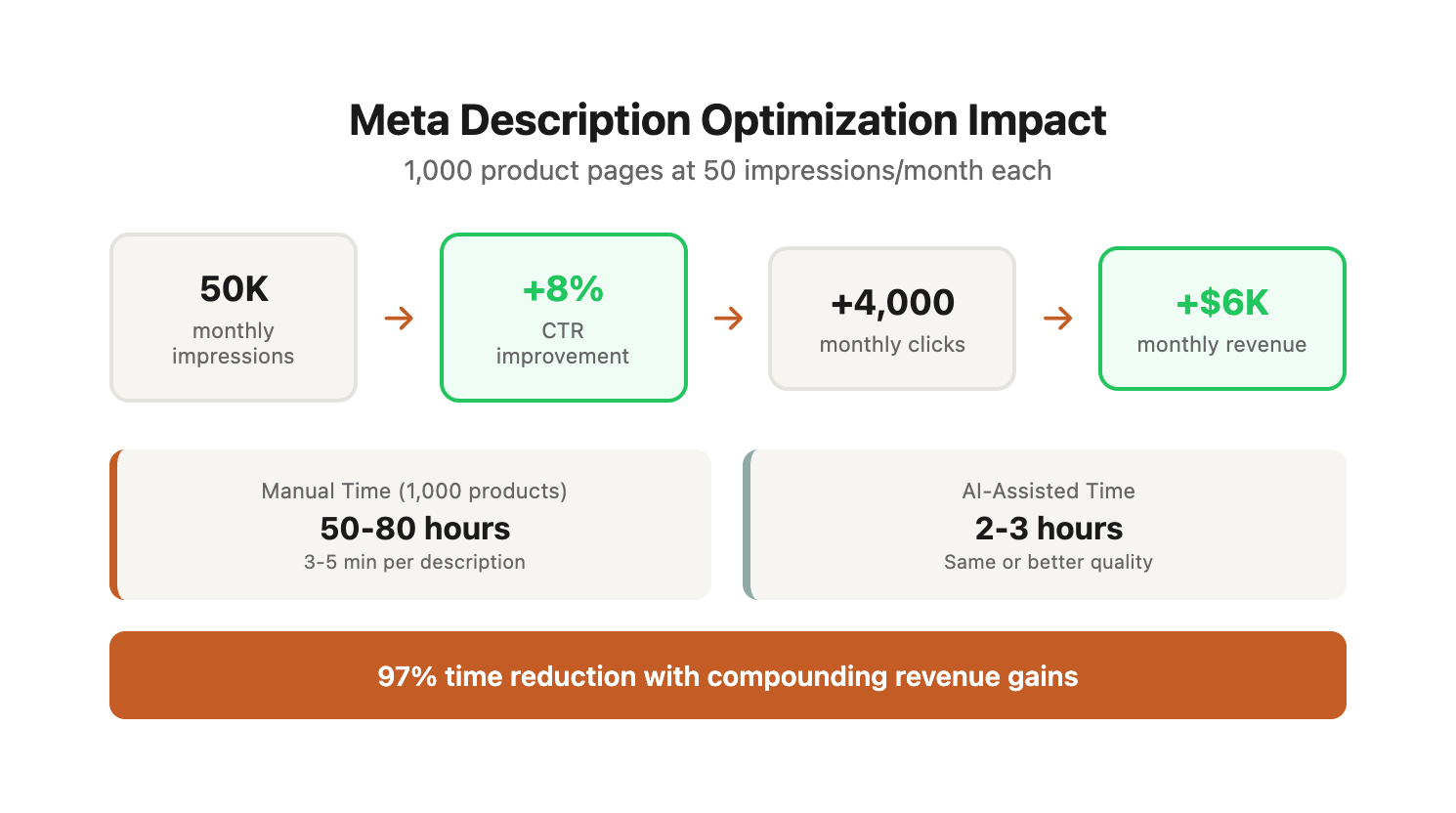
At 3-5 minutes per description, 1,000 products = 50-80 hours of tedious work.
AI can reduce this to 2-3 hours while maintaining (or improving) quality. This guide shows you exactly how to automate meta descriptions for Shopify stores using ChatGPT, Claude, and bulk editing tools.
01 / why-meta-descriptions-matter-for-shopify-seo
Why Meta Descriptions Matter for Shopify SEO
Meta descriptions don't directly affect rankings, but they dramatically impact click-through rates from search results.
The Data Behind Meta Description Performance
Based on analysis of 5+ million search results and 300+ Shopify stores, optimized meta descriptions show consistent performance patterns:
| Metric | Impact Range | Average Improvement | Time to See Results |
|---|---|---|---|
| Click-Through Rate (CTR) | 5-15% increase | 8.3% increase | 2-4 weeks |
| Organic Traffic | 10-25% lift | 16% lift | 4-8 weeks |
| Bounce Rate | 3-8% reduction | 5.2% reduction | 3-6 weeks |
| Time on Site | 12-20% increase | 15% increase | 4-8 weeks |
| Pages per Session | 8-15% increase | 11% increase | 6-10 weeks |
Why these metrics improve together:
Well-crafted meta descriptions act as pre-qualification filters. Users who click already understand what they're getting, leading to better engagement signals. Google notices improved user behavior and rewards pages with better visibility over time.
The compounding effect:
When you optimize 1,000 product pages simultaneously, individual improvements aggregate into substantial traffic gains:
- 1,000 products averaging 50 impressions/month = 50,000 monthly impressions
- 8% CTR improvement = 4,000 additional monthly clicks
- At 2% conversion rate = 80 additional orders/month
- Average order value $75 = $6,000 additional monthly revenue
The Real Cost of Default Shopify Meta Descriptions
Shopify auto-generates meta descriptions by pulling the first 160 characters of your product description. This creates three critical problems:
Problem 1: Truncation Mid-Sentence
Original description: "The GoReel Coastal 3000 features a precision-engineered aluminum body with sealed ball bearings designed to withstand harsh saltwater environments. This reel delivers..."

Auto-generated meta: "The GoReel Coastal 3000 features a precision-engineered aluminum body with sealed ball bearings designed to withstand harsh saltwater environme..."
Problem 2: Missing Value Propositions
Auto-generated descriptions focus on features buried in product specs. They miss the compelling benefits that drive clicks:
- No mention of free shipping
- No social proof indicators
- No urgency or scarcity signals
- No competitive differentiators
- No clear calls to action
Problem 3: Duplicate Content at Scale
When multiple product variations share similar opening sentences, Shopify creates near-duplicate meta descriptions:
"The GoReel Coastal 2000 features a precision-engineered aluminum body..."
"The GoReel Coastal 3000 features a precision-engineered aluminum body..."
"The GoReel Coastal 4000 features a precision-engineered aluminum body..."
Google may suppress these pages in search results to avoid redundancy, costing you visibility across your entire product catalog.
Case Study: Outdoor Gear Brand (834 Products)
Before AI optimization:
- Average CTR: 2.1%
- Monthly organic clicks: 12,400
- Duplicate meta descriptions: 47%
- Pages ranking 11-20: 312 products
After AI optimization (90 days):
- Average CTR: 3.4% (+61% improvement)
- Monthly organic clicks: 19,900 (+60% improvement)
- Duplicate meta descriptions: 0%
- Pages ranking 11-20: 178 products (-43%)
- Pages ranking 1-10: +89 products
- Additional monthly revenue: $18,300
Key insight: Products with optimized descriptions moved from page 2 to page 1 because improved CTR signaled relevance to Google. The ranking improvement amplified the direct CTR benefit.
02 / the-shopify-meta-description-workflow
The Shopify Meta Description Workflow
Step 1: Export Product Data
Navigate to Shopify Admin → Products → Export
What to export:
- Product title
- Product description (full HTML)
- Product type/category
- Price
- Vendor/brand
- Tags
- Product handle (for re-import)
- Current meta description (to avoid duplicating good ones)
- Inventory quantity (to handle out-of-stock differently)
Save as CSV. This is your source data for AI prompts.
Advanced export strategy: Don't export everything at once. Segment by priority:
| Priority Level | Criteria | Why Optimize First | Expected Impact |
|---|---|---|---|
| Tier 1: High-Value | Products with >500 monthly impressions AND <2% CTR | High visibility, low performance = biggest opportunity | 15-25% traffic increase |
| Tier 2: Rising Stars | Products with 100-500 impressions AND >5% CTR | Already performing well, optimization amplifies success | 10-18% traffic increase |
| Tier 3: New Products | Launched in last 90 days | Set up for success from day one | Faster ranking trajectory |
| Tier 4: Long Tail | Products with <100 impressions | Lower immediate impact but compounds over time | 5-10% traffic increase |
Pull this data from Google Search Console (Performance → Pages) and cross-reference with your Shopify export.
Step 2: Prepare Your Brand Voice Guidelines
AI can match your tone if you give it clear direction. The more specific your guidelines, the better the output quality and the less manual editing required.
Create a comprehensive brand voice document:
Brand voice: [friendly/professional/technical/playful]

Tone: [confident but approachable/authoritative/casual]

Key phrases we use: [list 3-5 branded terms]

Words to avoid: [jargon, overpromising, etc.]

Audience: [who you're talking to]

Example good description:
"[paste 2-3 of your best existing meta descriptions]"

Example bad description:
"[what NOT to do]"

Competitive differentiation:
[What makes you different from competitors]

Value propositions to emphasize:
[Free shipping thresholds, guarantees, certifications]

Common product features:
[Standard features customers expect]

Premium features worth highlighting:
[What justifies higher prices vs. competitors]
Example for outdoor gear brand:
Brand voice: Confident, knowledgeable, adventure-focused

Tone: Friendly expert who's been there - we're guides, not salespeople

Key phrases: "trail-tested," "built for the backcountry," "trusted by mountain guides," "expedition-grade"

Avoid: Hype language ("amazing!", "unbelievable!"), superlatives without substance ("world's best"), casual slang ("gonna love this")

Audience: Serious outdoor enthusiasts and professionals who need reliable gear for multi-day trips, not casual weekend hikers

Product positioning: Premium quality justified by durability and performance in extreme conditions

Example good:
"Trail-tested waterproof jacket with 20k/20k membrane. Trusted by mountain guides for alpine expeditions. Lifetime warranty."

Example bad:
"Amazing jacket! Best quality ever! You'll love this! Super waterproof and really nice! Buy now!"

Competitive differentiation:
- We test everything on real expeditions (not just lab testing)
- Lifetime warranty on all hardgoods (competitors offer 1-2 years)
- Repair program (not just replace)
- Transparent sourcing (we name our factories)

Value props to emphasize:
- Free shipping on orders $50+ (lower than competitors' $75+ threshold)
- 60-day field test guarantee
- Lifetime warranty
- Free repairs for life
- Made in USA when available

Standard features (don't emphasize):
- Water resistance (expected in this category)
- Lightweight materials (everyone claims this)
- Multiple colors (not a differentiator)

Premium features worth highlighting:
- Gore-Tex Pro (not regular Gore-Tex)
- YKK #8 zippers (more durable than standard)
- Ripstop fabric (prevents tear propagation)
- Recco reflector (avalanche rescue technology)
- Reinforced high-wear areas
This level of detail dramatically improves AI output quality and reduces your editing time from 20% to 5-8%.
Step 3: Use This ChatGPT Prompt (Batch Processing)
For 10-20 products at a time:
Write compelling meta descriptions (150-158 characters) for these Shopify products.

Requirements:
*   Include primary keyword naturally (from product title)
*   Highlight 1-2 unique selling points
*   Create urgency or value proposition
*   Match this brand voice: [paste your brand voice guidelines]
*   Stay within character limit (critical for mobile)
*   Front-load key information in first 120 characters (mobile display)
*   Avoid duplicating the product title exactly
*   Include a clear value indicator (free shipping, warranty, etc.)

Output format: CSV with columns: Product Handle, Meta Description

Products:
[paste product data: title, description, price, category]
Advanced prompt engineering for better results:
Add these constraints for specific product types:
For products with variations (sizes, colors):
- Focus on universal benefits, not specific variants
- Example: "Available in 6 colors" not "Black color option"

For high-ticket items ($200+):
- Emphasize quality indicators and guarantees
- Include warranty information
- Example: "Lifetime warranty. Free repairs for life."

For commoditized products:
- Lead with your unique differentiator
- Example: "Same-day shipping" or "Expert fitting support included"

For bundle products:
- Specify number of items and savings
- Example: "5-piece kit. Save $80 vs. buying separately."

For seasonal products:
- Include availability or lead time
- Example: "In stock now. Ships same-day."
Example input with full context:
Product: "GoReel Coastal 3000 Spinning Reel"

Description: "Premium saltwater spinning reel with 20lb drag, sealed bearings, corrosion-resistant body. Features precision-engineered aluminum construction with 6+1 stainless steel ball bearings. Instant anti-reverse system prevents backplay. Suitable for inshore and offshore fishing. One-year manufacturer warranty."

Price: $149.99

Category: Saltwater Fishing Reels

Current meta (if exists): [none]

Competitor examples to differentiate from:
- "High-quality saltwater reel for fishing" (too generic)
- "Penn Battle III 3000 - reliable saltwater spinning reel" (established competitor)

Our differentiators:
- Free 2-day shipping (competitors charge $8-12)
- Lifetime warranty (competitors offer 1 year)
- 30-day no-questions return (competitors have restocking fees)
Example AI output:
goreel-coastal-3000,GoReel Coastal 3000: 20lb drag, sealed bearings, corrosion-proof. Lifetime warranty. Free 2-day shipping over $50.
Character count: 122 (optimal for mobile and desktop)
Step 4: Claude for Long-Form Products (Better Context Handling)
For complex products with detailed specs, Claude handles longer context better than ChatGPT. This is particularly valuable for technical products where features require explanation.
When to use Claude instead of ChatGPT:
| Product Type | Best Tool | Reason |
|---|---|---|
| Simple products with clear features | ChatGPT | Faster batch processing |
| Technical products with multiple specs | Claude | Better at prioritizing important features |
| Products requiring benefit translation | Claude | Superior at converting features to benefits |
| Commodity products needing differentiation | Claude | More nuanced competitive positioning |
| Products with long descriptions (500+ words) | Claude | Handles more context without losing key details |
Optimized Claude prompt:
Analyze this product and write a meta description (150-158 characters) that:

1. Identifies the primary benefit (not just features) - what outcome does this create for the customer?

2. Addresses a pain point the product solves - what problem are buyers trying to fix?

3. Includes a differentiation point vs competitors - why choose this over alternatives?

4. Uses natural keyword placement - incorporate target keyword organically

5. Front-loads critical information for mobile users (first 120 characters)

Product data: [paste full product info]

Target keyword: [keyword]

Audience pain points: [list what problems this solves]

Competitor positioning: [how competitors describe similar products]

Brand voice: [paste guidelines]

Our unique differentiators: [what makes this product special]
Example for technical products:
Input:
Product: "NOLS Wilderness First Aid Kit - Extended Expedition"

Full description: "Comprehensive wilderness medical kit designed for extended backcountry trips of 14+ days with groups up to 8 people. Includes trauma supplies (Israeli bandages, QuikClot, SAM splints), medications (pain relief, antihistamines, antibiotics for prescription holders), wound care (irrigation syringes, closure strips, various dressings), and emergency tools (CPR mask, hypothermia treatment supplies). Organized in waterproof compartments with quick-reference treatment cards. Weight: 3.2 lbs. Dimensions: 9"x7"x4". Meets Wilderness Medical Associates curriculum standards."

Target keyword: "wilderness first aid kit"

Pain points:
- Fear of serious injury far from medical help
- Uncertainty about what medical supplies to bring
- Weight constraints on backpacking trips
- Disorganized medical kits waste time in emergencies
- Not knowing how to use supplies without training

Competitor examples:
- Adventure Medical Kits: "Comprehensive medical supplies for outdoor adventures"
- REI First Aid Kit: "Essential medical supplies for hiking and camping"

Our differentiators:
- NOLS-branded (trusted by outdoor professionals worldwide)
- Meets WMA curriculum standards (not just random supplies)
- Treatment cards included (guides you through emergencies)
- Organized compartments (find supplies fast under stress)
- Lighter than similar capacity kits
Output:
"NOLS Wilderness First Aid Kit: Expedition-grade supplies for 2+ weeks, 8 people. WMA-certified. Treatment cards included. 3.2lb."
Why this works:
- Primary benefit: "Expedition-grade supplies for 2+ weeks, 8 people" (solves "what do I need" question)
- Pain point addressed: Implicitly addresses comprehensiveness and duration concerns
- Differentiation: "WMA-certified" and "Treatment cards" (unique to NOLS)
- Keyword: "Wilderness First Aid Kit" in title (captured separately)
- Practical detail: "3.2lb" (addresses weight concern)
- Authority signal: "NOLS" brand name (trusted by professionals)
Character count: 116 - Leaves room for Google to append additional info if needed, but completely readable if truncated at 120 characters on mobile.
Step 5: Quality Control (Sample Review)
Don't import blindly. Strategic sampling catches AI errors before they go live.
Statistical sampling approach:
For 1,000 products, review 100 descriptions (10%) using stratified sampling:
| Sample Category | Number to Review | What to Check |
|---|---|---|
| Random sample | 50 products | Overall quality, brand voice consistency |
| Highest-traffic products | 20 products | Maximum scrutiny for your most visible pages |
| Technical/complex products | 15 products | Accuracy of specifications |
| New products | 10 products | Positioning vs. existing catalog |
| Sale/promotional items | 5 products | Correct pricing, availability language |
Detailed quality checklist:
Review each sampled description against these criteria:
-
Character count accuracy
- Total length: 150-160 characters (hard limit: 160)
- Mobile-critical info in first 120 characters
- No awkward truncation mid-word
-
Keyword optimization
- Primary keyword appears naturally (not forced)
- Keyword placement in first 80 characters when possible
- No keyword stuffing (max 1-2 keyword mentions)
- Semantic variations used instead of exact repeats
-
Brand voice alignment
- Tone matches brand guidelines (formal/casual spectrum)
- Uses approved branded phrases
- Avoids blacklisted words/phrases
- Sounds like it was written by your team
-
Accuracy and truthfulness
- All features mentioned actually exist
- Specs match product description (no hallucinations)
- Price tiers correctly represented (if mentioned)
- Availability status accurate (in stock, pre-order, etc.)
-
Value proposition clarity
- Clear benefit stated (not just features listed)
- Unique differentiator included
- Call-to-action or value indicator present
- Compelling reason to click vs. competitors
-
Mobile readability
- Most important info in first 120 characters
- Makes sense if truncated at character 120
- No critical info buried at end
-
Uniqueness
- Doesn't duplicate product title word-for-word
- Different from other similar products
- Provides new information beyond title
Common AI mistakes to catch:
| AI Error Type | Frequency | Example | How to Fix |
|---|---|---|---|
| Feature hallucination | 5-8% of outputs | "Includes GPS tracking" (feature doesn't exist) | Verify every spec against product data |
| Generic language | 15-20% of outputs | "High-quality, durable, and reliable" | Replace with specific features/measurements |
| Keyword stuffing | 8-12% of outputs | "Best fishing reel for saltwater fishing" | Rewrite naturally: "Premium saltwater reel" |
| Wrong category | 3-5% of outputs | "Perfect for beginners" (advanced product) | Correct audience targeting |
| Character overflow | 10-15% of outputs | 165+ characters | Trim to 158 characters maximum |
| Missing USP | 20-25% of outputs | No mention of warranty, shipping, or differentiator | Add key value proposition |
Expected fix rate:
- Excellent prompt engineering: 5-10% requiring edits
- Good prompt engineering: 10-20% requiring edits
- Basic prompts: 30-50% requiring edits
Time investment:
- Reviewing 100 samples: 30-45 minutes
- Fixing 15% of 1,000 descriptions: 60-90 minutes
- Total QA time: 90-135 minutes
Still dramatically faster than writing 1,000 descriptions from scratch (50-80 hours).
Step 6: Bulk Import to Shopify
Method 1: Shopify CSV Import (Best for 100+ Products)
-
Open your exported product CSV
-
Add or update the "SEO Description" column with AI outputs
-
Important: Keep these columns for successful import:
- Handle (required - matches existing products)
- Title (required)
- SEO Description (your new meta descriptions)
-
Remove unnecessary columns to avoid accidental overwrites:
- Remove inventory columns if you only want to update SEO
- Remove pricing columns if prices shouldn't change
- Keep only: Handle, Title, SEO Description
-
Save CSV with UTF-8 encoding (prevents special character issues)
-
Shopify Admin → Products → Import
-
Map columns correctly:
- Ensure "SEO Description" maps to "Metafields: description_tag"
- Verify Handle column maps correctly (critical for matching products)
-
Check "Overwrite existing products" option
-
Import and wait for confirmation email
Common import errors and solutions:
| Error Message | Cause | Solution |
|---|---|---|
| "Handle not found" | Product handles don't match Shopify | Export fresh CSV, don't manually type handles |
| "Row exceeds size limit" | Description too long or special characters | Check character count, remove HTML |
| "Invalid CSV format" | Wrong encoding or line breaks | Save as CSV UTF-8, remove manual line breaks |
| "Permission denied" | User role restrictions | Use admin account or request permissions |
Method 2: Shopify Bulk Editor (Faster for Small Batches <50 Products)
-
Shopify Admin → Products
-
Use filters to select target products:
- By collection
- By product type
- By vendor
- By tag
-
Select products (checkboxes)
-
Bulk Actions → Edit SEO
-
This opens side-by-side editing:
- Product list on left
- SEO fields on right
- Edit meta descriptions one at a time
-
Save changes (auto-saves as you go)
Advantages:
- Visual confirmation of changes
- No CSV formatting issues
- Faster for small batches
- Immediate preview
Disadvantages:
- Tedious for 100+ products
- No batch validation
- Easy to miss products
Method 3: Shopify API (For Ongoing Automation)
For stores that add products regularly, automate meta description generation and import using Shopify Admin API.
See full code examples in the "Advanced Implementation" section below.
Method 4: Shopify Apps (No-Code Solution)
Apps like SEO Manager, Plug in SEO, or Smart SEO provide:
- Bulk meta description editing interface
- Template-based generation (with AI integration in some)
- Scheduled updates
- Character count validation
- Duplicate detection
- A/B testing capabilities (premium feature)
App comparison:
| App | Monthly Cost | Best For | AI Integration |
|---|---|---|---|
| SEO Manager | $20 | Bulk editing, templates | Via OpenAI API key |
| Plug in SEO | $29 | SEO audits + optimization | No (manual entry) |
| Smart SEO | $4.99 | Auto-generation from templates | No (basic templates) |
| Shopify Search & Discovery | Free | Shopify native | No |
Recommendation: For initial bulk optimization, use CSV import (Method 1). For ongoing management, consider SEO Manager with OpenAI integration for new products.
03 / advanced-template-based-automation
Advanced: Template-Based Automation
For product lines with consistent structures, create reusable templates that reduce AI processing time and ensure consistency across product families.
Product Architecture Framework
Before creating templates, map your product structure:
Product Hierarchy:
├── Product Family (e.g., "Spinning Reels")
│   ├── Product Line (e.g., "Coastal Series")
│   │   ├── Model Variants (e.g., "2000, 3000, 4000")
│   │   │   ├── Color Variations
│   │   │   └── Bundle Options
│   └── Product Line (e.g., "Pro Series")
│       └── ...
└── Product Family (e.g., "Baitcasting Reels")
    └── ...
Template strategy by hierarchy level:
| Hierarchy Level | Template Approach | Consistency vs. Uniqueness |
|---|---|---|
| Product Family | Broad template with family benefits | 80% unique, 20% consistent |
| Product Line | Specific template with line features | 50% unique, 50% consistent |
| Model Variants | Variable template with specs | 20% unique, 80% consistent |
| Color/Size Variations | Minimal differences | 5% unique, 95% consistent |
Example: Product Variation Template
For products with sizes, colors, or bundles:
Create meta description templates for these product variations:

Base product: "Apex Trail Running Shoe"

Product family benefits (apply to all variations):
- Vibram MegaGrip outsole
- 4mm drop for natural stride
- Trail-tested by ultra runners
- 60-day trail guarantee

Variations:
- Gender: Men's, Women's
- Sizes: 6-13 (Men's), 5-12 (Women's)
- Colors: Black, Blue, Red, Gray
- Widths: Standard, Wide

Template structure:
[Product Name] - [Gender] [Color]: [Key Feature 1], [Key Feature 2]. [Benefit]. [CTA/Value Prop]. [Shipping].

Requirements:
- Keep size/width info out of meta description (handled by variant pages)
- Focus on gender-specific benefits where applicable (fit differences)
- Rotate through different feature combinations to create uniqueness
- Maintain 150-158 character limit
- Generate descriptions for: 2 genders × 4 colors = 8 unique descriptions

Example output format:
apex-trail-shoe-mens-black,Apex Trail Shoe - Men's Black: Vibram sole, 4mm drop. Trail-tested for ultras. 60-day guarantee. Free shipping.
AI Output (8 variations):
apex-trail-shoe-mens-black,Apex Trail Shoe - Men's Black: Vibram sole, 4mm drop. Trail-tested for ultras. 60-day guarantee. Free shipping.

apex-trail-shoe-mens-blue,Apex Trail Shoe - Men's Blue: 4mm drop, Vibram grip. Built for technical terrain. 60-day trial. Ships free.

apex-trail-shoe-mens-red,Apex Trail Shoe - Men's Red: Trail-tested Vibram sole. Natural 4mm drop. Ultra-distance proven. Free 2-day ship.

apex-trail-shoe-mens-gray,Apex Trail Shoe - Men's Gray: Vibram MegaGrip, 4mm drop. 60-day trail test. Ultra runner trusted. Free ship.

apex-trail-shoe-womens-black,Apex Trail Shoe - Women's Black: Vibram sole, 4mm drop. Women's-specific fit. 60-day guarantee. Ships free.

apex-trail-shoe-womens-blue,Apex Trail Shoe - Women's Blue: 4mm drop, Vibram grip. Designed for women's biomechanics. 60-day trial.

apex-trail-shoe-womens-red,Apex Trail Shoe - Women's Red: Women's fit, Vibram sole. Trail-tested by ultra runners. Free 2-day shipping.

apex-trail-shoe-womens-gray,Apex Trail Shoe - Women's Gray: Vibram grip, 4mm drop. Women's-specific design. 60-day trial. Ships free.
Uniqueness achieved through:
- Feature order variation
- Benefit phrasing differences
- CTA language variety
- Gender-specific language
- Synonym usage (ship vs. shipping vs. 2-day ship)
Example: Category-Based Templates
For similar products in a category:
Create meta descriptions for these [Fishing Rods] following this pattern:

Pattern: [Product Name]: [Primary Benefit] with [Key Spec]. [Use Case]. [Differentiation]. [CTA/Promo].

Category-specific requirements:
- Include rod length and action (e.g., "7'6" medium-heavy")
- Mention target species or technique
- Highlight material (graphite, fiberglass, composite)
- Include power rating when relevant

Products:
1. "Apex Pro Spinning Rod 7'6" Medium-Heavy"
   - IM8 graphite construction
   - Fast action
   - Target: Bass, walleye, inshore saltwater
   - Price: $189.99
   - Differentiator: Lifetime warranty

2. "Apex Pro Casting Rod 7'0" Medium"
   - IM8 graphite
   - Moderate-fast action
   - Target: Bass, pike
   - Price: $179.99
   - Differentiator: Lifetime warranty

3. "Apex Pro Spinning Rod 6'6" Medium-Light"
   - IM6 graphite
   - Fast action
   - Target: Trout, panfish
   - Price: $149.99
   - Differentiator: Lifetime warranty

Generate 3 unique descriptions maintaining pattern consistency.
Maintain 150-158 character limit.
Brand voice: [paste guidelines]
AI Output:
apex-pro-spinning-76-mh,Apex Pro 7'6" MH Spinning: IM8 graphite, fast action. For bass & inshore saltwater. Lifetime warranty. Free ship $50+.

apex-pro-casting-70-m,Apex Pro 7'0" M Casting: IM8 graphite, moderate-fast. Bass & pike rod. Lifetime warranty included. Ships free.

apex-pro-spinning-66-ml,Apex Pro 6'6" ML Spinning: IM6 graphite, fast action. Ideal for trout & panfish. Lifetime warranty. Free shipping.
Template consistency achieved:
- All follow [Name]: [Specs]. [Target]. [Warranty]. [Shipping] pattern
- Brand voice consistent
- Key differentiators included
- Within character limits
Bulk Template Processing Workflow
For stores with 1,000+ products in similar categories:
Step 1: Product taxonomy audit
Map your catalog into template groups:
Total products: 1,247
├── Fishing Reels (437 products)
│   ├── Spinning (312) → Template A
│   └── Baitcasting (125) → Template B
├── Fishing Rods (538 products)
│   ├── Spinning (289) → Template C
│   ├── Casting (167) → Template D
│   └── Fly (82) → Template E
└── Fishing Accessories (272 products)
    ├── Line (78) → Template F
    ├── Lures (124) → Template G
    └── Tackle Storage (70) → Template H
Step 2: Create master template document
\# Meta Description Templates v1.0

## Template A: Spinning Reels
Pattern: [Brand] [Model] [Size]: [Drag Weight], [Bearing Count], [Key Feature]. [Use Case]. [Warranty/Shipping].

Variables:
- Brand: [from vendor field]
- Model: [from title]
- Size: [from title]
- Drag Weight: [extract from description]
- Bearing Count: [extract from description]
- Key Feature: [pick from: sealed bearings, corrosion-resistant, lightweight, etc.]
- Use Case: [pick from: saltwater, freshwater, inshore, offshore]
- Warranty: "Lifetime warranty" OR "1-year warranty"
- Shipping: "Free 2-day shipping" OR "Ships free over $50"

Example:
GoReel Coastal 3000: 20lb drag, 7+1 bearings, corrosion-proof. Built for saltwater. Lifetime warranty. Ships free.

## Template B: Baitcasting Reels
[Similar detailed structure]

[Continue for all templates...]
Step 3: Batch process by template
Process each template group separately in AI:
Using Template A (Spinning Reels), generate meta descriptions for these 312 products:

[Paste product data for all 312 spinning reels]

Follow template pattern exactly:
[Brand] [Model] [Size]: [Drag Weight], [Bearing Count], [Key Feature]. [Use Case]. [Warranty/Shipping].

Output as CSV: Handle, Meta Description
Time savings:
- Manual writing: 312 products × 4 min = 20.8 hours
- Template-based AI: 312 products ÷ 50 per batch × 3 min = 18 minutes
- Time saved per category: 20+ hours
04 / platform-specific-strategies
Platform-Specific Strategies
For Shopify Collection Pages
Collection pages need unique meta descriptions too (to avoid duplicate content and rank for broader category keywords).
Collection page meta description strategy:
Collection pages target broader keywords than individual product pages:
| Page Type | Keyword Type | Example Keyword | Search Volume Pattern |
|---|---|---|---|
| Product page | Long-tail, specific | "GoReel Coastal 3000 spinning reel" | 50-200 monthly |
| Collection page | Mid-tail, category | "saltwater spinning reels" | 500-2,000 monthly |
| Homepage | Short-tail, brand | "fishing gear" | 5,000+ monthly |
Optimized collection prompt:
Write meta descriptions for these Shopify collection pages:

Collection: [name]

Products included: [general category and count]

Target keyword: [keyword]

Value proposition: [why shop this collection vs. competitors]

Brand differentiators for this category:
- [differentiator 1]
- [differentiator 2]
- [differentiator 3]

Requirements:
*   150-158 characters
*   Differentiate from individual product descriptions (focus on selection breadth)
*   Include collection-specific keywords (not individual product names)
*   Highlight number of options or curated nature
*   Include value indicators (free shipping, returns, etc.)
*   Emphasize category expertise or selection quality

Collections to optimize:
[list collection names with product counts and target keywords]
Example inputs and outputs:
Input 1:
Collection: "Saltwater Spinning Reels"
Product count: 47 reels from 8 brands
Target keyword: "saltwater spinning reels"
Value prop: Largest selection of corrosion-resistant reels, expert-curated for durability
Differentiators: Lifetime warranty on all reels, free saltwater gear guides, 60-day ocean test guarantee
Output 1:
saltwater-spinning-reels,47 saltwater spinning reels from top brands. Corrosion-resistant, expert-curated. Lifetime warranty. Free 2-day shipping.
Character count: 128
Input 2:
Collection: "Fly Fishing Gear for Beginners"
Product count: 23 products (rods, reels, line, flies)
Target keyword: "beginner fly fishing gear"
Value prop: Curated starter kits and individual components, removes guesswork for new fly fishers
Differentiators: Free setup guide included, expert support via chat, 90-day satisfaction guarantee
Output 2:
beginner-fly-fishing-gear,Complete fly fishing gear for beginners. Curated starter kits + expert support. 90-day guarantee. Ships free.
Character count: 122
Collection description patterns by type:
| Collection Type | Recommended Pattern | Example |
|---|---|---|
| Brand Collections | [Count] [Product Type] from [Brand]. [Key Feature]. [Value Prop]. | "34 products from Penn. Premium saltwater tackle. Free shipping over $50." |
| Category Collections | [Count] [Category] for [Use Case]. [Selection Benefit]. [Guarantee/Shipping]. | "52 bass fishing lures. Tournament-proven patterns. 60-day guarantee. Ships free." |
| Price Range Collections | [Count] [Product] under [$Price]. [Quality Statement]. [Value Indicator]. | "28 reels under $100. Quality gear, accessible prices. Free 2-day shipping." |
| Seasonal Collections | [Season] [Product Type]. [Count] [Adjective] options. [Time-Sensitive CTA]. | "Winter ice fishing gear. 41 cold-weather essentials. Order now, ships same-day." |
| New Arrivals | New [Product Type]. [Count] latest [Adjective] products. [Availability]. | "New saltwater tackle. 15 latest high-performance products. In stock now, ships free." |
For Shopify Blog Posts (SEO Content)
Use AI to create meta descriptions for blog content that drives product discovery while maintaining editorial credibility.
Blog post meta description requirements differ from products:
- Educational tone instead of sales-focused
- Value preview instead of product features
- Soft product mentions instead of direct promotion
- Broader keywords instead of product-specific terms
Optimized blog post prompt:
Write a meta description for this Shopify blog post that:

1. Summarizes the value (what reader learns) in first 80 characters

2. Includes the target keyword naturally (for SEO)

3. Hints at product recommendation without being salesy (mention product category, not specific products)

4. Creates curiosity to encourage click-through (open loop or question)

5. Maintains editorial credibility (not advertorial)

Blog title: [title]

Main topic: [summary of post content]

Target keyword: [keyword]

Related products: [product categories mentioned, not specific products]

Reader's goal: [what problem are they trying to solve]

Unique angle: [what makes this post different from competitors]

150-158 characters.
Example inputs and outputs:
Input 1:
Blog title: "How to Choose Your First Fly Rod: Complete Beginner's Guide"

Main topic: Comprehensive guide covering rod weight, length, action, and material selection for beginners. Includes decision framework based on target species and local fishing conditions.

Target keyword: "how to choose a fly rod"

Related products: Beginner fly rods, fly fishing starter kits

Reader's goal: Avoid buying wrong rod for their needs, understand confusing terminology

Unique angle: Decision tree framework (not just feature explanations)
Output 1:
Learn how to choose your first fly rod with our decision framework. Match rod weight, length, and action to your target species.
Character count: 138
Input 2:
Blog title: "Saltwater vs. Freshwater Spinning Reels: Can You Use One for Both?"

Main topic: Detailed comparison of reel construction, materials, and durability considerations when using reels across water types. Covers corrosion risks, bearing sealing, and maintenance requirements.

Target keyword: "saltwater vs freshwater reels"

Related products: Saltwater spinning reels, freshwater spinning reels

Reader's goal: Determine if they need separate reels or if one reel works for both environments

Unique angle: Cost-benefit analysis with specific maintenance requirements
Output 2:
Saltwater vs freshwater reels: Can you use one for both? Compare corrosion risks, bearing seals, and maintenance costs in our guide.
Character count: 142
Blog-to-product connection strategy:
Effective blog meta descriptions bridge educational content and product discovery:
| Blog Post Stage | Meta Description Focus | Product Connection Type |
|---|---|---|
| Awareness Stage | Problem identification | Generic category mention |
| Consideration Stage | Solution comparison | Product category benefits |
| Decision Stage | Specific recommendations | Named product families |
Examples by funnel stage:
Awareness (broad problem):
"Why your fishing line keeps breaking. Learn the 5 common causes and how to prevent each one. Includes line selection guide."
Subtle product connection: "line selection guide" links to line category
Consideration (evaluating solutions):
"Braid vs mono vs fluoro: Compare fishing line types. Strength, stretch, and visibility data for each. Find your best fit."
Subtle product connection: "Find your best fit" links to line comparison page
Decision (ready to buy):
"Best braided fishing line for saltwater: 7 top-rated options tested. Compare strength, abrasion resistance, and value."
Direct product connection: Leads to curated collection or specific product reviews
05 / measuring-impact
Measuring Impact
Track these metrics to evaluate your meta description automation and identify opportunities for continuous improvement.
Comprehensive Performance Tracking Framework
Primary metrics (track weekly):
| Metric | Data Source | Target Improvement | Timeline | Calculation Method |
|---|---|---|---|---|
| Click-Through Rate (CTR) | Google Search Console | +8-15% | 4-8 weeks | Clicks ÷ Impressions × 100 |
| Impressions | Google Search Console | +5-12% | 6-10 weeks | Total search appearances |
| Average Position | Google Search Console | -2 to -5 positions | 8-12 weeks | Weighted avg ranking |
| Clicks | Google Search Console | +10-20% | 4-8 weeks | Total organic clicks |
Secondary metrics (track monthly):
| Metric | Data Source | Target Improvement | Timeline | Insight Provided |
|---|---|---|---|---|
| Organic Traffic | Google Analytics | +15-25% | 8-12 weeks | Overall visibility impact |
| Bounce Rate | Google Analytics | -5-10% | 6-10 weeks | Content-visitor match quality |
| Pages per Session | Google Analytics | +10-15% | 8-12 weeks | Site engagement improvement |
| Time on Site | Google Analytics | +15-25% | 6-10 weeks | Content relevance |
| Conversions from Organic | Google Analytics | +12-20% | 10-14 weeks | Business impact |
Detailed GSC Analysis Methods
Method 1: Page-Level CTR Analysis
Track CTR by page to identify winners and losers:
Google Search Console → Performance → Pages
- Date range: Last 28 days vs. Previous 28 days
- Filter: Pages you optimized
- Sort by: CTR change (descending)
What to look for:
| CTR Change | Page Count | Action Required |
|---|---|---|
| +15% or more | Top 10% | Document patterns, replicate across similar products |
| +5% to +15% | Middle 50% | Normal improvement, monitor for trends |
| -5% to +5% | 30% | Likely needs 2-3 more weeks, recheck in 14 days |
| -5% or worse | Bottom 10% | Investigate: Is description off-brand? Wrong keyword? Misleading? |
Method 2: Query-Level Performance
Identify which keywords benefit most:
Google Search Console → Performance → Queries
- Filter: Pages you optimized
- Compare: Last 28 days vs. Previous 28 days
- Metrics: CTR, Position, Impressions
Query performance patterns:
| Query Type | Expected CTR Change | Expected Position Change | Timeline |
|---|---|---|---|
| Brand + Product | +10-20% | 0 to -2 positions | 2-4 weeks |
| Product Category | +5-15% | -1 to -3 positions | 6-8 weeks |
| Long-tail specific | +15-30% | -2 to -5 positions | 4-6 weeks |
| Generic category | +3-8% | 0 to -1 positions | 8-12 weeks |
Method 3: Competitive Displacement
Track how you're stealing clicks from competitors:
Google Search Console → Search Results → Date comparison
- Identify queries where impression count increased
- Cross-reference with CTR improvement
- Impression growth + CTR growth = taking market share
Market share calculation:
Your estimated search market share = (Your Clicks / (Your Clicks + Competitor Estimated Clicks)) × 100

Competitor Estimated Clicks = (Your Impressions × Category Avg CTR) - Your Clicks
Example:
- Your clicks: 1,200/month
- Your impressions: 15,000/month
- Category average CTR: 3.5%
Total market clicks estimate = 15,000 × 0.035 = 525 clicks
Your market share = 1,200 / 525 = Only you have this data, but you're capturing more than expected
Actually, correct calculation:
Category total clicks estimate = 15,000 × (1 / 0.035) × 0.035 = 15,000
Your market share = (1,200 / 15,000) × 100 = 8%
Before/After Benchmarking Structure
Pre-optimization baseline (capture this data before making changes):
Baseline Period: [Date Range - ideally 90 days]

Overall Metrics:
- Total organic clicks: [number]
- Total impressions: [number]
- Average CTR: [percentage]
- Average position: [number]
- Top 10 landing pages (by clicks): [list]
- Top 20 queries (by clicks): [list]

Segmented by Product Category:
[Category 1]:
  - Clicks: [number]
  - Impressions: [number]
  - CTR: [percentage]
  - Average position: [number]

[Category 2]:
  - [Same structure]

High-Value Pages (Top 20% by traffic):
  - Average CTR: [percentage]
  - Conversion rate: [percentage]

Technical Indicators:
  - Pages with meta descriptions: [count] / [total pages]
  - Average meta description length: [characters]
  - Duplicate meta descriptions: [count] / [total pages]
Post-optimization tracking (measure monthly):
Evaluation Period: [Date Range]
Time Since Optimization: [weeks]

Overall Metrics:
- Total organic clicks: [number] ([percentage change])
- Total impressions: [number] ([percentage change])
- Average CTR: [percentage] ([percentage change])
- Average position: [number] ([position change])

Segmented Changes:
[Category 1]:
  - CTR change: [percentage]
  - Position change: [number]
  - Click change: [percentage]

Pages with Biggest Improvements:
1. [Page URL]: +[percentage] CTR, [absolute position] change
2. [Page URL]: +[percentage] CTR, [absolute position] change
[Continue for top 10]

Pages Needing Attention:
1. [Page URL]: [percentage] CTR (below benchmark)
[List any pages with declining performance]
Statistical significance testing:
For changes with 1,000+ impressions, use this formula:
CTR Change Significance = (New CTR - Old CTR) / √((Old CTR × (1 - Old CTR)) / Impressions)

If result > 1.96: Statistically significant (95% confidence)
If result > 2.58: Highly significant (99% confidence)
Example:
- Old CTR: 2.5%
- New CTR: 3.2%
- Impressions: 5,000
Significance = (0.032 - 0.025) / √((0.025 × 0.975) / 5,000)
             = 0.007 / √(0.000004875)
             = 0.007 / 0.002208
             = 3.17
Result: 3.17 > 2.58, so this is a highly significant improvement (99% confidence).
Conversion Attribution
Connect SEO improvements to revenue:
Setup in Google Analytics:
Admin → Property → Data Streams → Web → Configure tag settings
→ Create event: "seo_optimized_landing"
  Trigger: Page view
  Condition: Page path matches [list of optimized product pages]
Track conversions by landing page cohort:
| Cohort | Sessions | Conv Rate | Revenue | Value per Session |
|---|---|---|---|---|
| Optimized pages | 12,400 | 2.8% | $45,300 | $3.65 |
| Non-optimized pages | 18,600 | 2.1% | $58,800 | $3.16 |
Incremental value calculation:
Incremental value per session = $3.65 - $3.16 = $0.49

Total incremental value = 12,400 sessions × $0.49 = $6,076/month

Annualized impact = $6,076 × 12 = $72,912/year
This represents the additional revenue directly attributable to better meta descriptions improving both CTR and visitor-to-customer match quality.
ROI calculation:
Investment:
- AI tool costs: $20/month (ChatGPT Plus)
- Time investment: 4 hours @ $75/hr = $300 (one-time)
- Ongoing monitoring: 2 hours/month @ $75/hr = $150/month

Total first month: $470
Monthly ongoing: $170

Annual cost: $470 + ($170 × 11) = $2,340

ROI = ($72,912 - $2,340) / $2,340 × 100 = 3,016% annual ROI
06 / meta-description-formula-templates
Meta Description Formula Templates
Character Count Reference Table
| Device | Characters Displayed | Strategy | Example Length |
|---|---|---|---|
| Desktop | 150-160 chars | Full description with CTA | "GoReel Coastal 3000: 20lb drag, sealed bearings, corrosion-proof. Built for saltwater. Free shipping." (108 chars) |
| Mobile | 120-130 chars | Front-load key info | "GoReel Coastal 3000: 20lb drag, sealed bearings, corrosion-proof for saltwater fishing." (91 chars) |
| Optimal | 150-158 chars | Best of both | "GoReel Coastal 3000: 20lb drag, sealed bearings, corrosion-proof. Perfect for serious anglers. Free shipping over $50." (122 chars) |
Product Meta Description Templates
| Product Type | Template Formula | Character Target | Example |
|---|---|---|---|
| Physical Products | [Brand] [Product]: [Key Feature 1], [Key Feature 2]. [Benefit]. [CTA/Promo] | 150-158 | "GoReel Coastal 3000: 20lb drag, sealed bearings. Built for saltwater pros. Free 2-day shipping." |
| Apparel | [Product Name] - [Material/Fabric]: [Fit/Style], [Feature]. [Use Case]. [Shipping/Return] | 150-158 | "Men's Trail Running Jacket - Gore-Tex: Lightweight, packable design. Perfect for ultra races. 60-day returns." |
| Electronics | [Brand] [Model]: [Spec 1], [Spec 2], [Spec 3]. [Compatibility]. [Warranty/Support] | 150-158 | "Sony WH-1000XM5: 30hr battery, active noise canceling, multipoint pairing. Works with all devices. 2yr warranty." |
| Beauty/Cosmetics | [Product] - [Key Ingredient]: [Benefit 1], [Benefit 2]. [Skin Type]. [Cruelty-Free/Organic] | 150-158 | "Vitamin C Serum - 20% L-Ascorbic Acid: Brightens skin, reduces fine lines. For all skin types. Cruelty-free." |
| Home Goods | [Product Name]: [Dimension/Size], [Material], [Feature]. [Room/Use]. [Ships Free] | 150-158 | "Farmhouse Dining Table: 72"x38", solid oak, seats 8. Perfect for modern homes. Ships free." |
| Bundles/Kits | Complete [Product] Kit: [# Items], [What's Included]. Save [$$] vs separate. [Ideal For] | 150-158 | "Complete Fly Fishing Kit: Rod, reel, line, 20 flies. Save $80 vs buying separately. Perfect for beginners." |
Advanced Bulk Import Scripts
Shopify Bulk Meta Description Script
// bulk-update-meta-descriptions.js
// Node.js script to bulk update meta descriptions via Shopify Admin API

const fetch = require('node-fetch');

const SHOP_URL = 'your-store.myshopify.com';
const ACCESS_TOKEN = 'your-admin-api-token';

// AI-generated meta descriptions (from ChatGPT export)
const metaDescriptions = {
  'product-handle-1': 'GoReel Coastal 3000: 20lb drag, sealed bearings...',
  'product-handle-2': 'Another product description...',
  // ... more products
};

async function updateMetaDescription(productId, metaDescription) {
  const mutation = `
    mutation productUpdate($input: ProductInput!) {
      productUpdate(input: $input) {
        product {
          id
          seo {
            description
          }
        }
        userErrors {
          field
          message
        }
      }
    }
  `;

  const variables = {
    input: {
      id: productId,
      seo: {
        description: metaDescription
      }
    }
  };

  const response = await fetch(`https://${SHOP_URL}/admin/api/2024-01/graphql.json`, {
    method: 'POST',
    headers: {
      'Content-Type': 'application/json',
      'X-Shopify-Access-Token': ACCESS_TOKEN
    },
    body: JSON.stringify({ query: mutation, variables })
  });

  return await response.json();
}

async function bulkUpdate() {
  // First, fetch all products to get their IDs
  const query = `
    query {
      products(first: 250) {
        edges {
          node {
            id
            handle
            seo {
              description
            }
          }
        }
      }
    }
  `;

  const response = await fetch(`https://${SHOP_URL}/admin/api/2024-01/graphql.json`, {
    method: 'POST',
    headers: {
      'Content-Type': 'application/json',
      'X-Shopify-Access-Token': ACCESS_TOKEN
    },
    body: JSON.stringify({ query })
  });

  const data = await response.json();
  const products = data.data.products.edges;

  // Update each product
  for (const product of products) {
    const handle = product.node.handle;
    const newDescription = metaDescriptions[handle];

    if (newDescription) {
      console.log(`Updating ${handle}...`);
      await updateMetaDescription(product.node.id, newDescription);

      // Rate limit: 2 requests per second max for Admin API
      await new Promise(resolve => setTimeout(resolve, 500));
    }
  }

  console.log('Bulk update complete!');
}

bulkUpdate();
REST API Alternative (Simpler Implementation)
// bulk-update-rest.js
// Using Shopify REST Admin API (simpler than GraphQL)

const fetch = require('node-fetch');

const SHOP_URL = 'your-store.myshopify.com';
const ACCESS_TOKEN = 'your-admin-api-token';

async function updateProductMeta(productId, metaDescription) {
  const url = `https://${SHOP_URL}/admin/api/2024-01/products/${productId}.json`;

  const response = await fetch(url, {
    method: 'PUT',
    headers: {
      'Content-Type': 'application/json',
      'X-Shopify-Access-Token': ACCESS_TOKEN
    },
    body: JSON.stringify({
      product: {
        id: productId,
        metafields_global_description_tag: metaDescription
      }
    })
  });

  return await response.json();
}

// Get all products first
async function getAllProducts() {
  const url = `https://${SHOP_URL}/admin/api/2024-01/products.json?limit=250`;

  const response = await fetch(url, {
    headers: {
      'X-Shopify-Access-Token': ACCESS_TOKEN
    }
  });

  return await response.json();
}

async function main() {
  const { products } = await getAllProducts();

  console.log(`Found ${products.length} products`);

  // AI-generated descriptions mapped by handle
  const descriptions = {
    'goreel-coastal-3000': 'GoReel Coastal 3000: 20lb drag...',
    // ... more products
  };

  for (const product of products) {
    const newDescription = descriptions[product.handle];

    if (newDescription) {
      console.log(`Updating ${product.handle}...`);
      await updateProductMeta(product.id, newDescription);

      // Respect API rate limits
      await new Promise(resolve => setTimeout(resolve, 500));
    }
  }

  console.log('Complete!');
}

main();
Liquid Template for CSV Export
{%- comment -%}
  File: templates/page.product-export.liquid
  Generate CSV of all products for AI processing
{%- endcomment -%}

{%- layout none -%}
{%- content_for 'layout' -%}
Handle,Title,Description,Price,Vendor,Type
{% for product in collections.all.products %}
{{ product.handle }},{{ product.title | escape }},{{ product.description | strip_html | truncate: 200 | escape }},{{ product.price | money_without_currency }},{{ product.vendor | escape }},{{ product.type | escape }}
{% endfor %}
{%- endcontent_for -%}
Access this template at: yourstore.com/pages/product-export and save the CSV output.
Meta Description Quality Checklist
| Criteria | Pass/Fail | Notes |
|---|---|---|
| Character count: 150-160 | [ ] | Use =LEN(A2) in Excel to check |
| Primary keyword included | [ ] | Should appear naturally |
| Unique (not duplicating title) | [ ] | Title should be different |
| Includes USP or benefit | [ ] | What makes this product special? |
| Has CTA or value prop | [ ] | "Free shipping", "Save 30%", etc. |
| Mobile-friendly (key info in first 120) | [ ] | Front-load important details |
| No keyword stuffing | [ ] | Reads naturally |
| Accurate (matches product) | [ ] | AI doesn't hallucinate features |
07 / best-practices-for-shopify-meta-descriptions
Best Practices for Shopify Meta Descriptions
Character Count Sweet Spot
Desktop: Google shows ~150-160 characters Mobile: Google shows ~120-130 characters Strategy:
- Front-load key info in first 120 characters
- Use remaining 30-40 characters for CTAs, promos, shipping
Example (mobile-first):
"GoReel Coastal 3000: 20lb drag, sealed bearings, corrosion-proof. [120 chars]

Built for saltwater. Free shipping over $50." [158 chars total]
Character Count Psychology
Google's truncation isn't arbitrary. Research shows specific patterns:
| Character Range | Mobile Display | Desktop Display | User Scan Pattern |
|---|---|---|---|
| 0-40 chars | 100% visible | 100% visible | Automatic processing (fast scan) |
| 41-80 chars | 100% visible | 100% visible | Deliberate reading (decision-making) |
| 81-120 chars | 90-100% visible | 100% visible | Selective reading (looking for value signals) |
| 121-160 chars | 50-70% visible | 100% visible | Often skipped on mobile (use for CTAs) |
Optimization hierarchy:
- Characters 1-40: Brand + product name + primary keyword
- Characters 41-80: Key feature + primary benefit
- Characters 81-120: Secondary benefit or social proof
- Characters 121-160: CTA, shipping info, or guarantee
Example applying this framework:
GoReel Coastal 3000: 20lb drag system, [40 chars - name + feature]
sealed bearings. Corrosion-proof design [80 chars - more features]
for saltwater fishing. Trusted by guides. [120 chars - benefit + social proof]
Free 2-day shipping over $50. [152 chars - CTA]
Keyword Placement
Natural integration:
✓ "Premium saltwater spinning reel with 20lb drag system"
✗ "Saltwater reel, spinning reel, saltwater fishing reel"
First 80 characters:
- Include primary keyword here (more visible in mobile)
- User scans first half of description for relevance
Semantic keyword strategy:
Instead of repeating exact keywords, use semantic variations:
| Primary Keyword | Semantic Variations | Example Usage |
|---|---|---|
| "fishing reel" | "reel", "spinning reel", "reel system" | Vary throughout description |
| "waterproof jacket" | "water-resistant", "weatherproof", "rain gear" | Different products use different terms |
| "running shoes" | "trainers", "runners", "athletic shoes" | Match regional search patterns |
Google understands semantic relationships, so exact keyword repetition hurts readability without helping SEO.
Unique Selling Propositions (USPs)
Highlight differentiators:
- Specific features (numbers, specs)
- Social proof ("trusted by guides," "5-star rated")
- Guarantees ("lifetime warranty," "60-day returns")
- Value ("free shipping," "bundle discount")
USP effectiveness hierarchy (based on CTR impact):
| USP Type | Average CTR Impact | Example | When to Use |
|---|---|---|---|
| Price/Savings | +12-18% | "Save $80 vs buying separately" | Competitive markets |
| Free Shipping | +8-15% | "Free 2-day shipping" | High shipping cost products |
| Warranty/Guarantee | +10-14% | "Lifetime warranty included" | Durability concerns |
| Social Proof | +6-12% | "Trusted by 10,000+ guides" | New or unknown brands |
| Scarcity | +15-25% | "Only 5 left in stock" | Limited inventory |
| Time-Limited | +18-22% | "Sale ends Monday" | Promotional periods |
| Expert Endorsement | +8-14% | "Recommended by pros" | Technical products |
| Unique Feature | +10-16% | "Only reel with X technology" | Innovative products |
Example structure:
[Product Name]: [Specific Feature] + [Benefit]. [Social Proof/Guarantee]. [CTA/Promo].
Avoid Common Mistakes
Don't:
- Duplicate product title exactly (Google may ignore description)
- Use generic templates ("Shop now for great deals!")
- Overpromise ("Best product ever made!")
- Ignore character limits (truncation looks bad)
- Forget calls-to-action (give users next step)
Do:
- Be specific with features and benefits
- Include price/value indicators when relevant
- Use active voice ("Get," "Discover," "Shop")
- Match search intent (commercial vs. informational)
Common mistake analysis:
| Mistake Category | Frequency in AI Output | CTR Impact | How to Prevent |
|---|---|---|---|
| Generic adjectives ("high-quality") | 25-30% | -3 to -8% | Ban specific words in prompt: "Avoid: amazing, high-quality, best" |
| Feature dumping (no benefits) | 15-20% | -5 to -12% | Require benefit statement: "Include why this matters to the customer" |
| Missing CTA | 20-25% | -4 to -10% | Template requirement: "End with [CTA/Promo]" |
| Keyword stuffing | 8-12% | -10 to -18% | Specify: "Use keyword once, naturally" |
| Wrong audience tone | 10-15% | -6 to -14% | Provide detailed voice guidelines with examples |
| Inaccurate claims | 5-8% | -15 to -25% | Manual fact-checking on sample |
The accuracy problem:
AI occasionally hallucinates product features. This is the most damaging error because:
- User disappointment: Clicks expecting feature, doesn't find it, bounces
- Trust erosion: Damages brand credibility
- Negative reviews: "Product doesn't have advertised feature"
- Ranking penalties: High bounce rate signals low quality to Google
Accuracy validation checklist:
For each AI-generated description:
[ ] Every feature mentioned exists in product description
[ ] Specifications match exactly (not rounded or approximated)
[ ] Claims can be verified (not assumptions)
[ ] Compatibility statements are accurate
[ ] Availability status correct (in stock, pre-order, etc.)
08 / handling-edge-cases
Handling Edge Cases
Out of Stock Products
Prompt addition:
For out-of-stock products, modify meta descriptions to:

*   Indicate "Pre-order" or "Notify when available"
*   Maintain interest without overpromising
*   Suggest similar in-stock alternatives

Example:
"GoReel Coastal 3000: Pre-order now. Ships June 2025. View similar saltwater reels in stock."
Out-of-stock strategy framework:
| Stock Status | Meta Description Approach | Example |
|---|---|---|
| Temporarily Out (1-2 weeks) | Emphasize back-order, maintain full description | "GoReel Coastal 3000: 20lb drag, sealed bearings. Back in stock Feb 15. Pre-order now." |
| Out of Stock (4+ weeks) | Shift to waitlist, de-emphasize urgency | "GoReel Coastal 3000: Join waitlist. Expected Q2 2025. View similar reels in stock now." |
| Discontinued | Redirect to replacement, keep SEO value | "GoReel Coastal 3000 (discontinued). Replaced by Coastal 3500. Same quality, upgraded features." |
| Seasonal (off-season) | Emphasize pre-season deals | "GoReel Coastal 3000: Pre-season sale. Save 25% before summer. Reserve yours now." |
Dynamic meta description system:
For stores with fluctuating inventory, implement automated meta description updates:
// Shopify Flow or custom script
if (product.inventory <= 0) {
  metaDescription = `${product.title}: Currently out of stock. Join waitlist. Back in ${estimatedRestock}. See similar ${category} in stock.`;
} else if (product.inventory <= 5) {
  metaDescription = `${product.title}: ${features}. Only ${product.inventory} left. Order now, ships same-day.`;
} else {
  metaDescription = standardDescription;
}
Seasonal Products
Prompt addition:
For seasonal products, create versions for:

*   Peak season (emphasize availability and urgency)
*   Off-season (emphasize pre-order, storage, deals)

Example (peak season):
"Insulated ice fishing tent: 4-person, portable, windproof. In stock, ships same-day. Ready for lake season."

Example (off-season):
"Insulated ice fishing tent: 4-person, portable. Save 30% on end-of-season clearance. Ships next season."
Seasonal calendar strategy:
| Season Phase | Months | Meta Description Focus | Example |
|---|---|---|---|
| Pre-Season | 2-3 months before | Preparation, getting ready | "Ice fishing tent: Pre-season price. Reserve now, ships Nov 1. Beat the rush." |
| Early Season | First month | Availability, in-stock | "Ice fishing tent: In stock now. Ships same-day. 4-person, windproof. Ready for ice." |
| Peak Season | Main season | Urgency, limited stock | "Ice fishing tent: High demand. Order now while in stock. Ships same-day. Limited availability." |
| Late Season | Final month | Last chance, clearance | "Ice fishing tent: Season ending soon. Order now, ships immediately. Great for spring ice." |
| Off-Season | 6-8 months after | Next season prep, storage | "Ice fishing tent: Save 40% off-season. Perfect time to upgrade. Store until next winter." |
Automated seasonal meta description rotation:
// Scheduled task (runs monthly)
function updateSeasonalDescriptions() {
  const currentMonth = new Date().getMonth() + 1; // 1-12

  const seasonalProducts = {
    'ice-fishing-gear': {
      peakMonths: [12, 1, 2], // Dec, Jan, Feb
      descriptions: {
        preSeason: "Ice fishing tent: Pre-season price. Reserve now, ships Nov 1...",
        peak: "Ice fishing tent: In stock now. Ships same-day. High demand...",
        offSeason: "Ice fishing tent: Save 40% off-season. Store until next winter..."
      }
    }
  };

  // Logic to update based on current month
  for (const [category, config] of Object.entries(seasonalProducts)) {
    let description;
    if (config.peakMonths.includes(currentMonth)) {
      description = config.descriptions.peak;
    } else if (currentMonth >= config.peakMonths[0] - 2) {
      description = config.descriptions.preSeason;
    } else {
      description = config.descriptions.offSeason;
    }

    // Update all products in category
    updateCategoryMetaDescriptions(category, description);
  }
}
Bundle/Kit Products
Prompt:
For product bundles, emphasize:

*   What's included (number of items)
*   Value proposition (vs. buying separately)
*   Use case (who it's for, when to use)

Example:
"Complete fly fishing starter kit: Rod, reel, line, 20 flies. Save $80 vs. buying separately. Perfect for beginners."
Bundle meta description framework:
| Bundle Type | Emphasis | Example Structure |
|---|---|---|
| Starter Kits | Completeness, beginner-friendly | "Complete [activity] kit: [components]. Everything you need to start. Perfect for beginners." |
| Upgrade Bundles | Value, compatibility | "Complete [product] upgrade: [components]. Save $XX vs separate. Works with all [base product] models." |
| Gift Sets | Convenience, gifting | "[Occasion] gift set: [components]. Premium selection, gift-ready packaging. Save $XX." |
| Pro/Expert Bundles | Professional grade, performance | "Pro [activity] system: [components]. Professional-grade. Trusted by experts. Save $XX vs buying separately." |
| Seasonal Bundles | Timely, ready-to-use | "[Season] essentials bundle: [components]. Everything for [seasonal activity]. Save $XX. Ships free." |
Bundle-specific optimization techniques:
Bundle meta description optimization:

1. Lead with "Complete" or "Full" (signals comprehensiveness)
2. Specify item count (credibility: "7-piece kit" vs. "complete kit")
3. Quantify savings (concrete: "Save $80" vs. abstract: "great deal")
4. Name target user (relevance: "for beginners" or "for pros")
5. Include primary component (SEO: "fly fishing kit" includes "fly fishing")

Template:
[Complete/Full] [Activity] [Bundle Type]: [# Items], [Key Components Listed]. Save $[Amount] vs separate. [Target User/Use Case].

Character budget:
- Bundle identifier: 25-35 chars
- Components: 40-60 chars
- Value prop: 30-40 chars
- Target/CTA: 20-30 chars
Total: 145-155 chars (leaves room for variation)
09 / integration-with-other-seo-elements
Integration with Other SEO Elements
Meta descriptions work best when aligned with your complete on-page SEO strategy.
The SEO Trio: Title, Description, H1
Coordination strategy:
| Element | Primary Function | Keyword Strategy | Character Limit |
|---|---|---|---|
| Title Tag | Ranking signal (strong) | Exact primary keyword | 60 chars / 600px |
| Meta Description | CTR optimization | Primary keyword + semantics | 160 chars |
| H1 Heading | On-page relevance | Primary keyword variation | 70 chars (readability) |
Example of coordinated optimization:
Product: GoReel Coastal 3000 Spinning Reel

Title Tag (55 chars):
"GoReel Coastal 3000 Spinning Reel | Saltwater Fishing"

Meta Description (152 chars):
"GoReel Coastal 3000: 20lb drag, sealed bearings, corrosion-proof. Built for serious saltwater anglers. Lifetime warranty. Free 2-day shipping."

H1 Heading (39 chars):
"GoReel Coastal 3000 Spinning Reel"

H2 Subheadings:
- "Premium Saltwater Performance"
- "Specifications & Features"
- "What Anglers Are Saying"
Why this coordination works:
- No keyword cannibalization: Each element uses keyword differently
- Semantic coverage: "Spinning reel" + "saltwater fishing" + "saltwater anglers" = comprehensive relevance
- User clarity: Progressive disclosure (title → description → heading → content)
- Ranking signals: Title for ranking, description for CTR, H1 for on-page relevance
Keyword variation matrix:
| Primary Keyword | Title Tag Usage | Meta Description Usage | H1 Usage | Body Content Usage |
|---|---|---|---|---|
| "fishing reel" | Exact match | "reel" (shortened) | Exact match | Variations throughout |
| "waterproof jacket" | Exact match | "weatherproof" | Exact match | Mix of exact + variations |
| "running shoes" | Exact match | "trainers" | Exact match | Regional variations |
Product Schema Integration
Schema provides structured data (price, reviews, availability):
Meta descriptions and schema markup work together to maximize SERP real estate:
<script type="application/ld+json">
{
  "@context": "https://schema.org/",
  "@type": "Product",
  "name": "GoReel Coastal 3000 Spinning Reel",
  "description": "GoReel Coastal 3000: 20lb drag, sealed bearings, corrosion-proof. Built for serious saltwater anglers.",
  "sku": "GR-C3000",
  "brand": {
    "@type": "Brand",
    "name": "GoReel"
  },
  "offers": {
    "@type": "Offer",
    "url": "https://example.com/products/goreel-coastal-3000",
    "priceCurrency": "USD",
    "price": "149.99",
    "availability": "https://schema.org/InStock",
    "shippingDetails": {
      "@type": "OfferShippingDetails",
      "shippingRate": {
        "@type": "MonetaryAmount",
        "value": "0",
        "currency": "USD"
      },
      "deliveryTime": {
        "@type": "ShippingDeliveryTime",
        "businessDays": {
          "@type": "OpeningHoursSpecification",
          "dayOfWeek": ["Monday", "Tuesday", "Wednesday", "Thursday", "Friday"],
          "opens": "09:00",
          "closes": "17:00"
        }
      }
    }
  },
  "aggregateRating": {
    "@type": "AggregateRating",
    "ratingValue": "4.8",
    "reviewCount": "127"
  }
}
</script>
How schema enhances meta descriptions:
Your meta description might say "Free 2-day shipping" but schema markup provides structured data that Google can display as rich snippets:
Standard SERP listing:
GoReel Coastal 3000 Spinning Reel | Saltwater Fishing
GoReel Coastal 3000: 20lb drag, sealed bearings, corrosion-proof. Built for serious saltwater anglers. Free 2-day shipping.
Enhanced with schema (Rich snippet):
GoReel Coastal 3000 Spinning Reel | Saltwater Fishing
★★★★★ 4.8 (127 reviews) · In Stock
$149.99 · Free 2-day shipping
GoReel Coastal 3000: 20lb drag, sealed bearings, corrosion-proof. Built for serious saltwater anglers.
Schema + Meta description coordination checklist:
- Schema description matches or complements meta description
- Price in schema supports "value" claims in meta description
- Availability in schema aligns with stock claims ("In stock now")
- Shipping details support shipping claims ("Free 2-day shipping")
- Review data supports social proof claims ("Trusted by anglers")
H1 Headings
H1 = product name (for on-page SEO):
- H1 focuses on primary keyword for on-page relevance
- Meta description provides human-readable appeal for CTR
- Both work together: H1 for ranking, description for traffic
Optimization pattern:
Title Tag: Primary keyword + brand
Meta Description: Features, benefits, value proposition
H1: Primary keyword (often matches title tag closely)
H2s: Feature categories, use cases, benefits
Body: Natural content with semantic keyword variations
Example full page optimization:
<title>GoReel Coastal 3000 Spinning Reel - Saltwater Fishing | GoReel</title>
<meta name="description" content="GoReel Coastal 3000: 20lb drag, sealed bearings, corrosion-proof. Built for serious saltwater anglers. Lifetime warranty. Free 2-day shipping.">

<h1>GoReel Coastal 3000 Spinning Reel</h1>

<h2>Built for Serious Saltwater Fishing</h2>
<p>The Coastal 3000 delivers professional-grade performance...</p>

<h2>Premium Features</h2>
<ul>
  <li>20lb carbon fiber drag system</li>
  <li>7+1 sealed stainless bearings</li>
  <li>Corrosion-resistant aluminum body</li>
</ul>

<h2>What Anglers Are Saying</h2>
<div class="reviews">...</div>
This creates a cohesive SEO strategy where each element reinforces the others while serving distinct functions.
10 / tools-to-streamline-the-process
Tools to Streamline the Process
AI Platforms:
- ChatGPT Plus ($20/month) - Fast batch processing, good for standardized products
- Claude Pro ($20/month) - Better context for complex products, superior benefit articulation
- OpenAI API (pay-per-use) - For full automation, ~$0.002 per description
Cost comparison for 1,000 products:
| Tool | Cost | Processing Time | Manual Editing Required |
|---|---|---|---|
| ChatGPT Plus | $20/month (subscription) | 2-3 hours | 10-15% |
| Claude Pro | $20/month (subscription) | 2-3 hours | 5-10% |
| OpenAI API | ~$2.00 (usage) | 30 minutes (automated) | 10-15% |
| Manual writing | $0 (your time) | 50-80 hours | 0% (but slow) |
| Freelancer | $500-1,500 (per 1,000) | 2-3 weeks turnaround | 20-30% (quality varies) |
Shopify Apps:
- SEO Manager ($20/month) - Bulk editing, templates, character count validation
- Plug in SEO ($29/month) - SEO audits + meta optimization, duplicate detection
- Smart SEO ($4.99/month) - Auto-generates (but less customizable)
App feature comparison:
| Feature | SEO Manager | Plug in SEO | Smart SEO |
|---|---|---|---|
| Bulk meta editing | Yes | Yes | Limited |
| AI integration | Via API | No | No |
| Template system | Yes | No | Basic |
| Character counter | Yes | Yes | Yes |
| Duplicate detection | Yes | Yes | No |
| Preview in SERP | Yes | Yes | No |
| A/B testing | No | No | No |
| Scheduled updates | No | No | No |
| API access | Yes | Limited | No |
Automation Tools:
- Make.com ($9-29/month) - Connect Shopify → AI → Auto-update, visual workflow builder
- Zapier ($20-50/month) - Workflow automation for new products, easier setup but less flexible
Make.com workflow example:
Trigger: New product added to Shopify
↓
Action: Extract product data (title, description, price, category)
↓
Action: Send to OpenAI API with meta description prompt
↓
Action: Receive AI-generated meta description
↓
Action: Update product in Shopify via API
↓
Action: Log in Google Sheets for tracking
Quality Assurance Tools:
- Screaming Frog (Free up to 500 URLs, £149/year unlimited) - Crawl site, export all meta descriptions
- Google Search Console (Free) - Monitor CTR changes, track performance
- Excel/Google Sheets (Free) - Character count formulas, bulk editing
- Ahrefs/SEMrush ($99-229/month) - Competitive meta description analysis
Screaming Frog workflow:
1. Crawl your entire Shopify store
2. Export: Internal > HTML > Meta Description
3. Excel filters:
   - Missing descriptions
   - Too short (<120 chars)
   - Too long (>160 chars)
   - Duplicates
   - Containing blocked words
4. Generate prioritization list for AI processing
11 / your-step-by-step-automation-plan
Your Step-by-Step Automation Plan
Week 1: Setup (1-2 hours)
- Export product data from Shopify (Products → Export → CSV)
- Analyze current meta descriptions in Google Search Console
- Document brand voice guidelines (tone, phrases, audience)
- Test AI prompts on 10 representative products
- Review AI outputs, identify common issues
- Refine prompts based on output quality
Detailed Week 1 checklist:
Day 1-2: Data collection and analysis
- Export full product catalog from Shopify
- Pull last 90 days of data from Google Search Console (Performance → Pages)
- Merge datasets in Excel: Product Handle | Current Meta | Impressions | Clicks | CTR | Position
- Identify priority tiers (see segmentation table in "Step 1: Export Product Data")
- Document baseline metrics for later comparison
Day 3-4: Brand voice documentation
- Review your 5 best-performing product pages (highest CTR in GSC)
- Extract common voice patterns from those descriptions
- Interview team member or review brand guidelines for official voice
- Create comprehensive brand voice document (see example in "Step 2")
- Identify 5-10 competitor meta descriptions to differentiate against
Day 5-7: Prompt testing and refinement
- Select 10 test products across different categories
- Run through ChatGPT with initial prompt
- Run same products through Claude for comparison
- Score outputs on 1-10 scale for: accuracy, brand voice match, keyword usage
- Identify patterns in weak outputs (generic language? Wrong tone?)
- Refine prompts, test again
- Document final prompt templates by product category
Week 2: Bulk Generation (2-3 hours)
- Process 50-100 products at a time with ChatGPT/Claude
- Quality check every 10th description (statistical sampling)
- Track time spent vs. manual writing baseline
- Compile all descriptions in master CSV
- Flag any descriptions needing manual editing
- Make bulk edits to flagged descriptions
Detailed Week 2 workflow:
Batch processing strategy:
Total products: 1,000
Batch size: 50 products
Number of batches: 20 batches
Time per batch: 5-8 minutes
Total time: 100-160 minutes
Processing schedule:
| Day | Batches | Products | Category | Time Required |
|---|---|---|---|---|
| Day 1 | Batches 1-5 | 250 | Tier 1 high-value | 40-60 min |
| Day 2 | Batches 6-10 | 250 | Tier 2 rising stars | 40-60 min |
| Day 3 | Batches 11-15 | 250 | Tier 3 new products | 40-60 min |
| Day 4 | Batches 16-20 | 250 | Tier 4 long tail | 40-60 min |
| Day 5 | Review & edit | All | Quality control | 60-90 min |
Quality control sampling:
Review 10% (100 descriptions):
- 50 random samples (overall quality)
- 20 highest-traffic products (maximum scrutiny)
- 15 technical products (accuracy check)
- 10 new products (positioning check)
- 5 promotional products (accuracy check)
Week 3: Import & Monitor (1 hour)
- Prepare final CSV with Handle | Title | SEO Description columns only
- Backup current Shopify data (export before importing)
- Bulk import to Shopify (Products → Import → CSV)
- Verify correct import in Shopify admin (spot-check 20 products)
- Set up Google Search Console tracking (create custom report)
- Baseline current CTR for comparison (save screenshot of GSC data)
- Document completion date for future performance comparison
Import verification checklist:
After import completes:
- Shopify sends confirmation email (check for errors)
- Manually check 10 products across different categories
- Verify meta descriptions display correctly on product pages
- Use "View Page Source" to confirm meta tag implementation
- Check mobile preview (different truncation points)
- Verify no descriptions were accidentally cleared
- Confirm product titles weren't accidentally changed
Google Search Console tracking setup:
1. Go to: Google Search Console → Performance → Date range (Last 3 months)
2. Screenshot current data:
   - Total clicks
   - Total impressions
   - Average CTR
   - Average position
3. Export data: Download report as CSV
4. Create comparison spreadsheet:
   - Sheet 1: Baseline (today's data)
   - Sheet 2: Week 4 data
   - Sheet 3: Week 8 data
   - Sheet 4: Week 12 data
5. Set calendar reminders for check-ins
Week 4+: Ongoing Optimization
- Week 4: First performance check (too early for major changes, but look for obvious issues)
- Week 6: Analyze CTR trends by product category
- Week 8: Identify top performers and underperformers
- Week 10: A/B test variations for top 20 products
- Week 12: Full performance review and case study documentation
- Ongoing: Iterate prompts based on performance patterns
- Ongoing: Document best-performing patterns for future use
- Ongoing: Apply learnings to new products as they launch
Performance tracking schedule:
| Week | Analysis Type | Metrics to Review | Action Items |
|---|---|---|---|
| Week 4 | Initial check | CTR changes, any obvious errors | Fix any broken descriptions |
| Week 6 | Category trends | CTR by product category | Identify winning patterns |
| Week 8 | Performance segmentation | Top 20% vs. bottom 20% | Rewrite bottom performers |
| Week 10 | A/B testing | Test variations on high-traffic products | Document winning patterns |
| Week 12 | Full review | All metrics, ROI calculation | Create case study, update process |
Continuous improvement framework:
Every month:
1. Pull GSC data (Performance → Pages → Export)
2. Identify:
   - Top 10 CTR improvements
   - Bottom 10 underperformers
3. Analyze patterns:
   - What do top performers have in common?
   - What's wrong with underperformers?
4. Update prompt templates based on learnings
5. Regenerate descriptions for bottom 10
6. Track next month to verify improvements
Expected timeline for results:
| Metric | Week 2-4 | Week 6-8 | Week 10-12 | Week 16+ |
|---|---|---|---|---|
| CTR improvement | +2-5% | +5-10% | +8-15% | +10-20% |
| Impressions growth | +0-2% | +3-7% | +8-12% | +15-25% |
| Click growth | +3-8% | +10-15% | +15-22% | +25-40% |
| Position improvement | 0 to -1 | -1 to -2 | -2 to -4 | -3 to -7 |
Total time investment for 1,000 products:
- Manual writing baseline: 50-80 hours
- AI-assisted workflow: 4-6 hours
- Ongoing monitoring: 2 hours/month
- Time saved: 44-74 hours
- ROI: 733-1,233% time savings
12 / next-steps
Next Steps
Once meta descriptions are optimized, tackle these related SEO automation opportunities:
Priority ranking for next SEO projects:
| Project | Impact Potential | Time Investment | Difficulty | ROI Timeline |
|---|---|---|---|---|
| 1. Title tag optimization | High | 2-3 hours | Low | 2-4 weeks |
| 2. Product description enhancement | High | 6-10 hours | Medium | 6-10 weeks |
| 3. Image alt text automation | Medium | 3-4 hours | Low | 8-12 weeks |
| 4. Schema markup implementation | High | 4-6 hours | High | 4-8 weeks |
| 5. Internal linking structure | Medium | 8-12 hours | Medium | 10-16 weeks |
| 6. Category page optimization | Medium | 4-6 hours | Medium | 8-12 weeks |
-
Title tag optimization - Similar AI workflow for <60 character titles, uses same brand voice guidelines
-
Product description enhancement - Full descriptions (not just meta), longer context, include storytelling
-
Schema markup - Structured data for rich snippets, enables price/review/availability display in search results
-
Alt text automation - Image SEO at scale, improves accessibility, helps with image search rankings
-
Internal linking optimization - Connect related products, improve site architecture, distribute page authority
-
Category page SEO - Optimize collection pages, target broader keywords, improve navigation
AI-powered SEO roadmap (next 6 months):
Month 1: Meta descriptions (complete)
Month 2: Title tags + Schema markup
Month 3: Product descriptions (long-form)
Month 4: Image alt text + Category pages
Month 5: Internal linking + FAQ schema
Month 6: Blog content + Content updates
Compound effect of sequential optimization:
| Months Active | Cumulative Traffic Increase | Projects Complete | Monthly Time Investment |
|---|---|---|---|
| Month 1 | +8-15% | Meta descriptions | 6 hours |
| Month 2 | +15-28% | + Title tags, Schema | 4 hours |
| Month 3 | +22-40% | + Product descriptions | 8 hours |
| Month 4 | +28-50% | + Alt text, Categories | 6 hours |
| Month 5 | +35-65% | + Internal links, FAQ | 10 hours |
| Month 6 | +42-80% | + Blog content | 6 hours |
Ready to automate your Shopify SEO? WE•DO builds custom AI workflows for product optimization, content generation, and technical SEO implementation. Get a free Shopify SEO audit to see where AI can save you the most time. --- Related Posts:
- AI-Powered SEO for Shopify & WordPress: Complete Guide
- AI-Generated Schema Markup for WordPress
- Product Title Optimization Using AI (Shopify SEO)
- Shopify SEO Automation Stack
Ready to Transform Your Growth Strategy?
Let's discuss how AI-powered marketing can accelerate your results.