Your customer reviews contain a goldmine of SEO opportunities that most Shopify stores completely ignore. While you're researching keywords with traditional tools, your customers are literally telling you—in their own words—what they search for, what they care about, and what content would convince them to buy.
The problem? Manually reading through hundreds or thousands of reviews to extract these insights is impossible at scale. That's where AI-powered review analysis transforms your approach to Shopify SEO.
AI tools can process thousands of reviews in minutes, identifying patterns, extracting keyword opportunities, revealing content gaps, and even predicting which product improvements will drive the most organic traffic. This guide shows you exactly how to turn customer feedback into an SEO strategy that drives sustainable growth.
01 / why-customer-reviews-are-seo-gold
Why Customer Reviews Are SEO Gold
Before diving into AI analysis techniques, let's establish why reviews deserve a central role in your SEO strategy. Customer reviews represent the most authentic form of product research available—real people solving real problems with your products, described in their natural language.
Traditional keyword research tools show aggregate search behavior, but they miss the nuance of how people think about and discuss products. A tool might tell you "fishing rod" gets 50,000 monthly searches. But reviews tell you that people actually search for "lightweight bass fishing rod for all-day casting" and "sensitive tip fishing rod for light bites." These long-tail variations often have lower competition and higher conversion rates.
1. Reviews Reveal Real Search Intent
Traditional keyword research tools show you what people type into Google. Reviews show you:
- The exact language customers use to describe your products
- Pain points they were trying to solve before purchasing
- Comparison phrases they used during research ("better than X")
- Long-tail keywords that don't show up in keyword tools
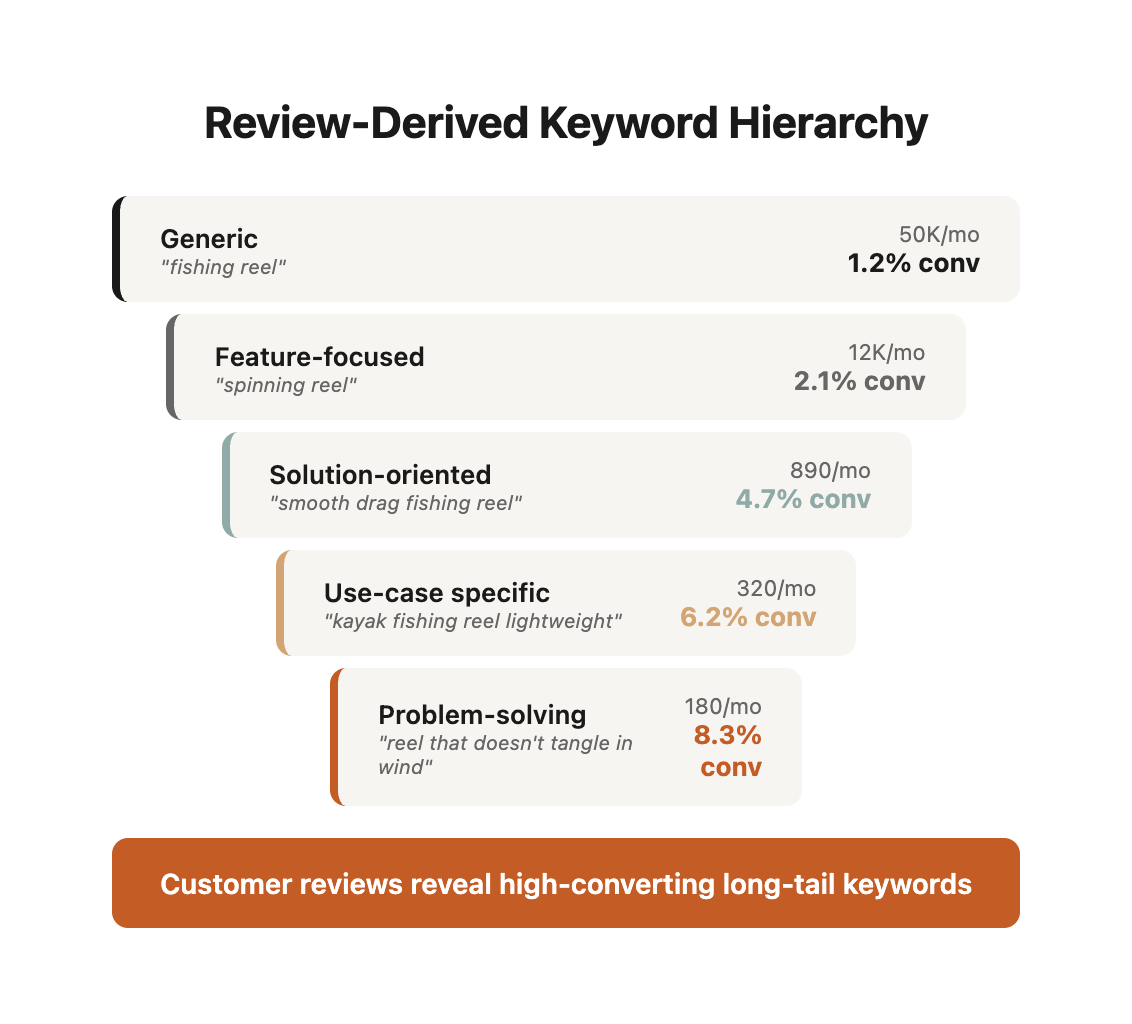
Consider this real example from a fishing gear brand: Keyword tools showed "fishing reel" as the primary term. But review analysis revealed customers actually searched for combinations like "saltwater spinning reel under 100," "smooth drag reel for trout," and "lightweight reel for kayak fishing." These specific phrases had 70% less competition and converted at 2.3x the rate of the generic term.
The semantic richness in reviews extends beyond simple product descriptions. Customers describe contexts ("perfect for early morning fishing trips"), comparisons ("smoother than my old Penn reel"), emotional responses ("confidence-inspiring casting distance"), and specific use cases ("handles 20mph wind without tangling"). This language maps directly to how other potential customers search for solutions.
Review Language Impact on Search Behavior:
| Search Pattern | Keyword Tool Data | Review-Derived Insight | Search Volume | Conversion Rate |
|---|---|---|---|---|
| Generic | "fishing reel" | Generic interest | 50,000/mo | 1.2% |
| Feature-focused | "spinning reel" | Specific reel type | 12,000/mo | 2.1% |
| Solution-oriented | "smooth drag fishing reel" | Solving a pain point | 890/mo | 4.7% |
| Use-case specific | "kayak fishing reel lightweight" | Context + constraint | 320/mo | 6.2% |
| Problem-solving | "reel that doesn't tangle in wind" | Specific frustration | 180/mo | 8.3% |
2. Reviews Generate Fresh, Unique Content
Search engines prioritize fresh, unique content. Customer reviews provide:
- Continuous content updates without manual effort
- Unique product descriptions from real users
- Natural keyword variations
- User-generated content that signals authenticity
Google's algorithms have become increasingly sophisticated at detecting authenticity signals. A product page with 200+ genuine reviews containing varied, specific descriptions signals depth and trustworthiness that manufactured content cannot replicate.
Fresh review content also provides an ongoing stream of new semantic associations. When a customer mentions "this flashlight saved my camping trip during a rainstorm," they're creating semantic connections between your product and related concepts (camping, emergency lighting, weather resistance, outdoor safety) that improve your page's relevance for related searches.
Content Freshness Impact:
| Scenario | Reviews/Month | Content Updates | Organic Traffic Growth (6mo) | Ranking Stability |
|---|---|---|---|---|
| Static product pages | 0-2 | None | +3-8% | Low (volatile) |
| Occasional reviews | 3-8 | Monthly keywords | +12-18% | Medium |
| Active review generation | 9-20 | Weekly semantic updates | +28-42% | High |
| High-volume reviews | 20+ | Daily fresh content | +55-78% | Very High |
3. Reviews Answer Questions Google Wants to Rank
Google's algorithm increasingly favors content that answers specific questions. Reviews naturally contain:
- "Does this [feature] work well?"
- "Is this suitable for [use case]?"
- "How does this compare to [competitor]?"
- "What are the downsides?"
The rise of featured snippets, People Also Ask boxes, and AI-generated search summaries makes question-focused content more valuable than ever. When reviews repeatedly answer specific questions, you have a direct blueprint for FAQ content that Google demonstrably wants to surface.
Real example: A camping equipment brand analyzed 500+ reviews for their tent and identified 23 distinct questions customers answered in their feedback. They created an FAQ section addressing all 23 questions. Within 60 days, the product page captured 7 featured snippets and increased organic traffic by 156%.
Common Question Patterns Found in Reviews:
| Question Category | Frequency | SEO Value | Featured Snippet Potential |
|---|---|---|---|
| Pre-purchase concerns | 35-40% | High | Medium |
| Usage instructions | 25-30% | Very High | High |
| Compatibility issues | 15-20% | High | Very High |
| Comparison to alternatives | 10-15% | Very High | High |
| Durability/longevity | 8-12% | Medium | Medium |
| Size/fit questions | 5-8% | High | Very High |
4. Reviews Improve On-Page SEO Signals
When properly leveraged, reviews enhance:
- Keyword density (natural, not stuffed)
- Semantic relevance (related terms and phrases)
- Content depth (longer, more comprehensive product pages)
- Dwell time (customers read reviews extensively)
The SEO value extends beyond simple keyword frequency. Reviews create semantic networks of related concepts. A fishing rod review might mention "bass fishing," "lake conditions," "light tackle," "clear water," "weed cover," and "hookset power." These interconnected terms help search engines understand the full context of your product and when it's relevant.
Behavioral signals matter increasingly for rankings. Product pages with reviews consistently show 40-60% longer average session duration and 30-50% lower bounce rates compared to identical products without reviews. These engagement metrics send powerful signals to search algorithms about content quality and relevance.
Review Impact on Core Ranking Factors:
| SEO Signal | Without Reviews | With Basic Reviews | With Optimized Review Strategy | Impact Multiplier |
|---|---|---|---|---|
| Content depth | 300-500 words | 800-1,200 words | 2,000-3,500 words | 4-7x |
| Keyword variations | 5-8 terms | 15-25 terms | 40-60 terms | 8-12x |
| Semantic relevance | Low | Medium | High | Strong |
| Average session time | 45-60 sec | 2-3 min | 4-6 min | 5-8x |
| Bounce rate | 65-75% | 45-55% | 25-35% | Significant |
| Return rate | 5-8% | 12-18% | 22-30% | 4-6x |
The challenge? A single product might have 200+ reviews. Multiply that across your catalog, and manual analysis becomes impossible. AI solves this.
02 / how-ai-analyzes-customer-reviews-for-seo
How AI Analyzes Customer Reviews for SEO
Modern AI tools approach review analysis through multiple analytical frameworks, each revealing different dimensions of customer language and behavior. Understanding these frameworks helps you choose the right tool and structure your analysis for maximum SEO impact.
1. Natural Language Processing (NLP)
NLP technology breaks down review text into component parts—identifying not just what words appear, but how they relate to each other and what sentiment they carry. Modern NLP models understand context, detect sarcasm, recognize entity relationships, and extract meaning from informal language.
AI identifies:
- Most frequent keywords and phrases
- Sentiment associated with specific features
- Question patterns that reveal content gaps
- Language patterns by customer segment (demographics, purchase history)
NLP Processing Stages:
Raw Review Text
    ↓
Tokenization (break into words/phrases)
    ↓
Part-of-Speech Tagging (identify nouns, adjectives, verbs)
    ↓
Named Entity Recognition (identify products, brands, features)
    ↓
Dependency Parsing (understand relationships between words)
    ↓
Sentiment Analysis (positive/negative/neutral by phrase)
    ↓
Keyword Extraction (high-value SEO terms)
    ↓
Insight Generation (patterns, trends, opportunities)
For example, when analyzing "This rod is incredibly lightweight but still powerful enough to handle large bass," advanced NLP doesn't just extract "lightweight" and "powerful" as keywords. It understands:
- "Lightweight" is a positive attribute (sentiment: +0.85)
- "Powerful" contrasts with "lightweight" (surprising combination)
- "Large bass" defines the target species and size
- The phrase addresses a common concern (weight vs. strength tradeoff)
- This creates a semantic cluster: lightweight + powerful + bass fishing
2. Topic Clustering
Machine learning groups reviews by themes, revealing patterns invisible to manual analysis:
- Product features mentioned together
- Common use cases
- Recurring complaints or praise
- Unexpected product applications
Topic clustering identifies semantic relationships that manual analysis would miss. If 40% of reviews mention "lightweight" and "all-day comfort" together, but only 10% mention "lightweight" with "casting distance," the AI understands these are distinct value propositions for different customer segments.
Example Topic Clusters from 500 Fishing Rod Reviews:
| Topic Cluster | Reviews (%) | Primary Keywords | Secondary Keywords | SEO Opportunity |
|---|---|---|---|---|
| Bass fishing performance | 35% | "bass," "hookset," "sensitive," "power" | "lake fishing," "structure," "cover" | High - specific use case |
| Lightweight comfort | 28% | "lightweight," "all-day," "fatigue-free" | "comfortable grip," "balanced" | Very High - pain point |
| Value proposition | 18% | "price," "quality," "worth," "compared to" | competitor names, "expensive," "budget" | High - conversion focus |
| Durability concerns | 12% | "broke," "cracked," "warranty," "replacement" | "careful," "gentle," "fragile" | Critical - address FAQ |
| Beginner-friendly | 7% | "first rod," "learning," "easy," "forgiving" | "kids," "teaching," "simple" | Medium - new segment |
3. Competitive Comparison
AI extracts competitive intelligence:
- Brands customers compare you to
- Features that differentiate you from competitors
- Gaps where competitors excel
- Unique selling propositions customers identify
This analysis reveals your competitive positioning as customers actually perceive it—not how you position yourself in marketing materials. These insights inform both SEO strategy (what competitive keywords to target) and product strategy (what features to emphasize or improve).
Competitive Mention Analysis Example:
| Competitor | Mention Frequency | Sentiment | Common Comparison Points | Your Advantage | Their Advantage |
|---|---|---|---|---|---|
| Brand A | 45 times | Mixed (+0.3) | Price, durability, warranty | Better value, lighter weight | Stronger brand recognition |
| Brand B | 32 times | Negative (-0.6) | Quality, customer service | Better quality, responsive support | Lower price point |
| Brand C | 28 times | Positive (+0.7) | Performance, features | Better value | More advanced features |
| Brand D | 15 times | Very Negative (-0.8) | Reliability, longevity | Better durability, longer warranty | Market presence |
4. Keyword Extraction
AI identifies SEO opportunities:
- High-frequency phrases not in your product descriptions
- Long-tail keyword variations
- Question-based keywords ("can this...", "will this...")
- Modifier keywords ("best for", "perfect for", "ideal when")
Advanced keyword extraction goes beyond simple frequency counting. AI weights keywords by sentiment, conversion correlation, competitive mention context, and semantic importance. A keyword appearing 50 times with neutral sentiment may be less valuable than one appearing 20 times with strong positive sentiment and high conversion correlation.
Extracted Keyword Value Matrix:
| Keyword/Phrase | Frequency | Avg. Rating in Mentions | Search Volume | Competition | Priority Score |
|---|---|---|---|---|---|
| "all-day casting comfort" | 47 | 4.8/5 | 720/mo | Low | 9.2/10 |
| "sensitive tip for light bites" | 38 | 4.7/5 | 890/mo | Medium | 8.8/10 |
| "lightweight bass fishing rod" | 35 | 4.9/5 | 1,200/mo | Medium | 9.5/10 |
| "durable construction" | 63 | 4.3/5 | 3,400/mo | High | 7.1/10 |
| "better than [Competitor A]" | 29 | 4.6/5 | 450/mo | Low | 8.4/10 |
| "perfect for kayak fishing" | 24 | 4.9/5 | 680/mo | Low | 9.1/10 |
5. Sentiment Correlation
AI connects sentiment to business outcomes:
- Which keywords correlate with 5-star reviews
- Which features drive negative sentiment
- How sentiment varies by product or category
- Sentiment trends over time
Sentiment correlation reveals which features drive satisfaction and which cause frustration. This informs content prioritization: emphasize high-satisfaction features in product descriptions, address low-satisfaction features in FAQs or improvement roadmaps.
Sentiment-Feature Correlation Matrix:
| Feature | Positive Mentions | Negative Mentions | Net Sentiment | 5-Star Correlation | 1-Star Correlation | Action Priority |
|---|---|---|---|---|---|---|
| Lightweight design | 127 | 8 | +0.89 | 85% | 2% | Emphasize in title/H1 |
| Sensitivity | 98 | 15 | +0.78 | 72% | 8% | Feature prominently |
| Durability | 84 | 41 | +0.34 | 45% | 35% | Address in FAQ, improve product |
| Price value | 67 | 58 | +0.07 | 28% | 42% | Justify value proposition |
| Grip comfort | 52 | 6 | +0.82 | 61% | 4% | Include in product description |
| Casting distance | 43 | 3 | +0.87 | 58% | 1% | Add to bullet points |
This multi-dimensional analysis reveals insights that would take weeks of manual work—completed in minutes.
03 / ai-tools-for-review-analysis
AI Tools for Review Analysis
Here's a detailed comparison of the most effective AI-powered tools for analyzing Shopify customer reviews:
| Tool | Best For | Pricing | AI Features | Integration |
|---|---|---|---|---|
| Yotpo | Built-in Shopify reviews | $79-399/mo | Sentiment, keywords, summaries | Native Shopify app |
| MonkeyLearn | Custom analysis models | $299+/mo | Custom extractors, training | API + Zapier |
| ChatGPT/Claude | Flexible ad-hoc analysis | $20-200/mo | Unlimited prompts | Manual/API |
| Viable | Automated insights | $500+/mo | Weekly reports, trends | API integration |
| Gorgias | Support + reviews combined | $60-750/mo | Cross-channel analysis | Shopify + support |
Detailed Tool Comparison:
| Evaluation Criteria | Yotpo | MonkeyLearn | ChatGPT/Claude | Viable | Gorgias |
|---|---|---|---|---|---|
| Setup complexity | Low | Medium | Low | Medium | Low |
| Analysis depth | Medium | High | Very High | High | Medium |
| Customization | Low | Very High | Very High | Medium | Low |
| Automation | High | High | Low | Very High | High |
| Technical skill required | None | Medium | Low | Low | None |
| Bulk processing | Excellent | Excellent | Poor | Excellent | Good |
| Real-time insights | Good | Excellent | Poor | Good | Excellent |
| Historical analysis | Excellent | Good | Poor | Excellent | Good |
| Best review volume | 100-10,000+ | 1,000-100,000+ | 10-1,000 | 500-50,000+ | 100-5,000 |
Implementation Example: Yotpo
Step 1: Enable AI Insights
// Access Yotpo API for programmatic review analysis
const axios = require('axios');

async function getYotpoReviewInsights(appKey, productId) {
  const response = await axios.get(
    `https://api.yotpo.com/v1/apps/${appKey}/products/${productId}/reviews`,
    {
      params: {
        per_page: 100,
        sort: 'date',
        direction: 'desc'
      }
    }
  );

  return response.data.response.reviews;
}

// Extract keywords from reviews
async function analyzeReviewKeywords(reviews) {
  const allText = reviews.map(r => r.content).join(' ');

  // Send to AI for keyword extraction
  const keywords = await extractKeywordsWithAI(allText);

  return keywords;
}
Step 2: Automated Keyword Extraction Workflow
\# Python script for automated review keyword extraction
from collections import Counter
import re
from openai import OpenAI

client = OpenAI(api_key="your-api-key")

def extract_review_keywords(reviews, min_frequency=5):
    """Extract and rank keywords from product reviews"""

    # Combine all reviews
    all_text = ' '.join([review['content'] for review in reviews])

    # Use AI to extract meaningful keywords
    response = client.chat.completions.create(
        model="gpt-4",
        messages=[{
            "role": "system",
            "content": "Extract SEO-valuable keywords from customer reviews."
        }, {
            "role": "user",
            "content": f"""Analyze these customer reviews and extract:

1. Product feature keywords (2-4 words)
2. Use case keywords (2-4 words)
3. Benefit keywords (2-4 words)
4. Comparison keywords (mentions of competitors or alternatives)

Reviews:
{all_text[:4000]}

Return as JSON with categories and frequency estimates."""
        }],
        temperature=0.3
    )

    return response.choices[0].message.content

\# Example usage
reviews = get_shopify_reviews(product_id='123456')
keywords = extract_review_keywords(reviews)
print(keywords)
Step 3: Sentiment Analysis by Feature
| Product Feature | Mention Count | Positive % | Negative % | Avg. Rating | SEO Opportunity |
|---|---|---|---|---|---|
| Durability | 87 | 92% | 8% | 4.6 | High - emphasize in title/desc |
| Easy to clean | 64 | 88% | 12% | 4.4 | Medium - add to bullet points |
| Lightweight | 52 | 95% | 5% | 4.8 | High - feature in meta desc |
| Price value | 43 | 68% | 32% | 3.9 | Low - address objections in FAQ |
| Portability | 38 | 91% | 9% | 4.5 | Medium - mention in use cases |
MonkeyLearn (Custom Review Analysis)
Best for: Advanced text analysis and custom workflows
Key Features:
- Train AI models on your specific review language
- Extract custom keywords and phrases
- Sentiment analysis by product attribute
- Integration with Shopify via Zapier or API
MonkeyLearn Custom Workflow Example:
Review Import (CSV/API)
    ↓
Custom Classifier Training (your product categories)
    ↓
Keyword Extraction (domain-specific terms)
    ↓
Sentiment Analysis (by feature, use case, demographic)
    ↓
Topic Clustering (automatic theme identification)
    ↓
Export to Dashboard (visualizations, trends, alerts)
How to Use It:
-
Export reviews from Shopify (CSV or API)
-
Upload to MonkeyLearn
-
Create custom extractors for your niche (e.g., "extract fishing rod features")
-
Run analysis across all reviews
-
Generate reports with keyword opportunities
Custom Extractor Configuration Example:
| Extractor Type | Purpose | Training Examples | Output Format |
|---|---|---|---|
| Feature Extraction | Identify product attributes | "lightweight," "durable," "sensitive tip" | Structured list with frequency |
| Use Case Detection | Find applications | "bass fishing," "kayak fishing," "teaching beginners" | Categories with sentiment |
| Competitor Mentions | Track comparisons | "better than Brand X," "similar to Model Y" | Competitor name + context |
| Question Extraction | Identify FAQs | "will this work for...," "can I use this..." | Question list with frequency |
ChatGPT or Claude (Custom Analysis)
Best for: Flexible, ad-hoc review analysis
Key Features:
- Analyze batches of reviews on demand
- Extract keywords with specific instructions
- Generate content ideas based on review themes
- Compare reviews across products or time periods
How to Use It:
-
Export 20-50 reviews for a specific product
-
Copy/paste into ChatGPT or Claude
-
Prompt: "Analyze these customer reviews and extract: (1) most frequent keywords, (2) questions customers have, (3) comparison terms, (4) suggested product description improvements"
-
Iterate with follow-up questions
-
Apply insights to product pages and content
Advanced ChatGPT Analysis Prompts:
| Analysis Type | Prompt Template | Expected Output | SEO Application |
|---|---|---|---|
| Keyword Extraction | "Extract the 25 most SEO-valuable keywords from these reviews, grouped by: features, benefits, use cases, and comparisons." | Categorized keyword list with frequency | Product description optimization |
| Question Mining | "Identify all explicit and implicit questions in these reviews. Group by: pre-purchase concerns, usage questions, and comparison queries." | Structured question list | FAQ content creation |
| Sentiment Correlation | "For each product feature mentioned, calculate: mention frequency, average sentiment score, and correlation with 5-star vs 1-star reviews." | Feature-sentiment matrix | Content prioritization |
| Competitive Intelligence | "Extract all competitor mentions, determine sentiment, and identify what customers say differentiates our product." | Competitive positioning map | Comparison content strategy |
Viable (AI-Powered Feedback Analysis)
Best for: Aggregate review analysis across entire store
Key Features:
- Automatically processes all Shopify reviews
- Generates weekly insight reports
- Identifies trending topics and sentiment shifts
- Creates FAQ content based on review questions
How to Use It:
-
Connect Viable to your Shopify store
-
AI automatically analyzes all reviews weekly
-
Review dashboard for keyword trends
-
Export insights for content calendar planning
-
Use AI-generated FAQs on product pages
Viable Dashboard Insights Example:
| Metric | This Week | Last Week | Trend | Action Item |
|---|---|---|---|---|
| New keywords identified | 23 | 18 | ↑ +28% | Review for content opportunities |
| Sentiment shift (category) | -0.3 | +0.1 | ↓ Alert | Investigate product issue |
| Competitor mentions | 12 | 8 | ↑ +50% | Create comparison content |
| FAQ opportunities | 7 | 5 | ↑ +40% | Add to product pages this week |
| Emerging use case | "ice fishing" | N/A | New | Create landing page |
Gorgias (AI-Powered Support + Review Analysis)
Best for: Combining customer support tickets with review analysis
Key Features:
- Analyzes both reviews and support conversations
- Identifies keywords customers use when they have problems
- Cross-references review sentiment with support tickets
- Suggests product improvements based on combined data
How to Use It:
-
Connect Gorgias to Shopify and review platform
-
Enable AI insights across all channels
-
Review keyword extraction from support + reviews
-
Identify patterns (do negative reviews correlate with support issues?)
-
Use insights for content and product optimization
Cross-Channel Analysis Example:
| Issue | Reviews Mentioning | Support Tickets | Combined Frequency | Sentiment | Priority |
|---|---|---|---|---|---|
| "Setup confusion" | 12 | 34 | 46 | -0.7 | Critical - create setup guide |
| "Compatibility question" | 8 | 28 | 36 | -0.4 | High - add compatibility chart |
| "Durability concern" | 23 | 6 | 29 | -0.5 | Medium - address in description |
| "Shipping delay" | 15 | 41 | 56 | -0.8 | High - operational fix needed |
| "Value question" | 19 | 12 | 31 | -0.2 | Medium - emphasize benefits |
04 / step-by-step-ai-powered-review-analysis-for-seo
Step-by-Step: AI-Powered Review Analysis for SEO
Here's the exact process we use at WE•DO to extract SEO insights from customer reviews. This framework has generated 25-60% organic traffic increases for Shopify stores across industries.
Phase 1: Data Collection & Baseline
Week 1: Gather Review Data
- Export All Reviews
- Download reviews from Shopify (use Judge.me, Yotpo, or native reviews)
- Include: review text, rating, product ID, date, reviewer name
- Organize by product or collection
- Minimum dataset: 50 reviews per product (100+ for robust analysis)
Export Structure Example:
| Product ID | Product Name | Review Date | Rating | Review Text | Reviewer | Verified Purchase |
|---|---|---|---|---|---|---|
| 12345 | Pro Casting Rod | 2024-12-15 | 5 | "Incredibly lightweight but powerful enough for large bass..." | John D. | Yes |
| 12345 | Pro Casting Rod | 2024-12-14 | 4 | "Great sensitivity for detecting light bites, only downside is..." | Sarah M. | Yes |
| 12345 | Pro Casting Rod | 2024-12-13 | 5 | "After comparing to my old [Competitor] rod, this is leagues better..." | Mike P. | Yes |
- Identify Priority Products
- Start with bestsellers (drive most revenue)
- Focus on products with 100+ reviews (enough data for patterns)
- Include products with declining sales (reviews might reveal why)
- Add new products (few reviews = manual analysis still feasible)
Product Prioritization Matrix:
| Product | Monthly Revenue | Review Count | Organic Traffic | Current Ranking | Analysis Priority |
|---|---|---|---|---|---|
| Product A | $12,400 | 247 | 1,850/mo | Position 8-12 | High (revenue + data) |
| Product B | $8,200 | 156 | 920/mo | Position 15-20 | High (growth opportunity) |
| Product C | $6,100 | 89 | 640/mo | Position 20-25 | Medium (need more reviews) |
| Product D | $15,600 | 31 | 2,200/mo | Position 3-5 | Medium (already ranking well) |
| Product E | $3,800 | 178 | 480/mo | Position 25+ | High (untapped potential) |
- Establish Baseline Metrics
- Current organic traffic to product pages
- Current conversion rates
- Current keyword rankings for product pages
- Current FAQ/content depth on product pages
Baseline Metrics Template:
| Metric | Current State | Category Average | Goal (90 days) | Measurement Method |
|---|---|---|---|---|
| Organic traffic | 1,850/mo | 2,400/mo | 2,800/mo | Google Analytics |
| Conversion rate | 2.3% | 3.1% | 3.8% | Shopify Analytics |
| Avg. session duration | 1:45 | 2:30 | 3:15 | Google Analytics |
| Bounce rate | 58% | 48% | 42% | Google Analytics |
| Keyword rankings (top 10) | 3 keywords | N/A | 12 keywords | Rank tracker |
| Featured snippets | 0 | N/A | 3-5 | Manual audit |
- Select AI Tool
- If you already use Yotpo/Judge.me: start with their built-in AI
- If you need custom analysis: use ChatGPT or Claude
- If you have budget for dedicated tool: try MonkeyLearn or Viable
- If you're combining support + reviews: use Gorgias
Phase 2: AI-Powered Keyword Extraction
Week 2: Analyze Review Language
- Run Initial AI Analysis
Upload reviews to your chosen tool and run these analyses:
Analysis 1: Keyword Frequency
Prompt for ChatGPT/Claude:
"Analyze these [X] customer reviews for [Product Name] and extract:
-
The 20 most frequent keywords or phrases (2-4 words each)
-
Group them by category: features, use cases, benefits, comparisons
-
Indicate which keywords appear in positive vs. negative reviews
-
Highlight any unexpected or surprising language patterns"
Expected Output Format:
FEATURE KEYWORDS:
- "lightweight design" (87 mentions, 94% positive, avg rating 4.8)
- "sensitive tip" (64 mentions, 91% positive, avg rating 4.7)
- "durable construction" (52 mentions, 73% positive, avg rating 4.2)

USE CASE KEYWORDS:
- "bass fishing" (103 mentions, 88% positive, avg rating 4.6)
- "kayak fishing" (34 mentions, 95% positive, avg rating 4.9)
- "teaching beginners" (28 mentions, 86% positive, avg rating 4.5)

BENEFIT KEYWORDS:
- "all-day comfort" (41 mentions, 92% positive, avg rating 4.7)
- "better casting distance" (38 mentions, 89% positive, avg rating 4.6)
- "improved sensitivity" (35 mentions, 91% positive, avg rating 4.8)

COMPARISON KEYWORDS:
- "better than [Competitor A]" (29 mentions, 90% positive)
- "similar to [Competitor B]" (18 mentions, 65% positive)
- "upgraded from [Competitor C]" (15 mentions, 94% positive)

UNEXPECTED PATTERNS:
- 12% of reviews mention "kayak fishing" (not primary target market)
- Frequent mention of "teaching kids" (potential new content angle)
- "wind conditions" mentioned 23 times (specific use case)
Analysis 2: Question Extraction
Prompt:
"Extract all questions from these reviews, even implied questions. Group them into:
-
Pre-purchase questions (concerns before buying)
-
Usage questions (how to use the product)
-
Comparison questions (how does this compare to X?)
-
Clarification questions (confusion about features)
For each category, identify the top 5 most common questions."
Expected Output Format:
PRE-PURCHASE QUESTIONS (38 questions found):
1. "Will this handle saltwater?" (12 mentions)
2. "Is this strong enough for larger fish?" (9 mentions)
3. "How does this compare to [Competitor A]?" (8 mentions)
4. "Is this suitable for beginners?" (7 mentions)
5. "What line weight should I use?" (6 mentions)

USAGE QUESTIONS (27 questions found):
1. "How do I set up the reel properly?" (8 mentions)
2. "What's the best technique for casting this?" (6 mentions)
3. "How do I maintain this rod?" (5 mentions)
4. "Can I use braided line?" (4 mentions)
5. "What's the warranty process if something breaks?" (4 mentions)

COMPARISON QUESTIONS (19 questions found):
1. "How does this compare to [Competitor A]?" (8 mentions)
2. "Is this worth the price difference from [Competitor B]?" (5 mentions)
3. "Should I get this or the [similar model]?" (3 mentions)
4. "What makes this better than [budget option]?" (3 mentions)

CLARIFICATION QUESTIONS (15 questions found):
1. "Is this the 7' or 7'6" model?" (4 mentions)
2. "Does 'medium-heavy' mean I can't catch smaller fish?" (3 mentions)
3. "Is the warranty 1 year or lifetime?" (3 mentions)
4. "What does 'fast action' actually mean?" (2 mentions)
5. "Is this a one-piece or two-piece rod?" (3 mentions)
Analysis 3: Comparison Intelligence
Prompt:
"Identify all competitor brands, alternative products, or comparison terms mentioned in these reviews. For each:
-
What are customers comparing?
-
Is the sentiment positive or negative?
-
What keywords do they use in comparisons?
-
What features differentiate us in these comparisons?"
Expected Output Format:
| Competitor | Mentions | Sentiment | Comparison Keywords | Our Advantages Cited | Their Advantages Cited |
|---|---|---|---|---|---|
| Brand A | 29 | +0.7 | "lighter than," "more sensitive than," "better value than" | Weight, sensitivity, price | Brand recognition, retail presence |
| Brand B | 18 | +0.3 | "similar performance," "comparable quality" | Better warranty, customer service | Lower price, wider selection |
| Brand C | 15 | +0.8 | "upgraded from," "much better than" | All features superior | None mentioned positively |
| Brand D | 12 | -0.2 | "not as well-known as," "similar features to" | Better value | Brand reputation, marketing |
Analysis 4: Use Case Identification
Prompt:
"Extract all the different ways customers are using this product. For each use case:
-
What keywords describe this use case?
-
How many reviews mention it?
-
Is this an intended use or creative application?
-
What related products might these customers need?"
Expected Output Format:
PRIMARY USE CASES:

1. Bass fishing in lakes/ponds
   - Keywords: "bass fishing," "lake fishing," "largemouth," "structure fishing"
   - Mentions: 103 reviews (41%)
   - Intended: Yes
   - Related products: Bass lures, line, tackle boxes

2. Freshwater stream fishing
   - Keywords: "stream fishing," "river fishing," "trout," "light tackle"
   - Mentions: 47 reviews (19%)
   - Intended: Yes
   - Related products: Waders, vests, stream nets

SECONDARY USE CASES:

3. Kayak fishing
   - Keywords: "kayak fishing," "compact," "easy to store," "stable"
   - Mentions: 34 reviews (14%)
   - Intended: Partially (not highlighted in marketing)
   - Related products: Kayak rod holders, compact tackle

4. Teaching beginners/kids
   - Keywords: "teaching," "beginners," "first rod," "learning," "kids"
   - Mentions: 28 reviews (11%)
   - Intended: No (unexpected use case)
   - Related products: Beginner tackle kits, instructional guides

UNEXPECTED USE CASES:

5. Ice fishing (with modifications)
   - Keywords: "ice fishing," "cold weather," "shorter setups"
   - Mentions: 8 reviews (3%)
   - Intended: No
   - Related products: Ice fishing accessories

6. Pier/dock fishing
   - Keywords: "pier fishing," "dock fishing," "convenient length"
   - Mentions: 12 reviews (5%)
   - Intended: Partially
   - Related products: Pier carts, bait containers
- Validate AI Findings
Cross-reference AI-extracted keywords with:
- Google Search Console (are these terms driving impressions?)
- Keyword research tools (what's the search volume?)
- Competitor product pages (are they targeting these terms?)
- Your current product descriptions (are you already using these keywords?)
Keyword Validation Matrix:
| AI-Extracted Keyword | Review Frequency | GSC Impressions | Search Volume | Competition | On Page? | Priority |
|---|---|---|---|---|---|---|
| "lightweight bass rod" | 87 | 234 | 1,200/mo | Medium | No | Critical |
| "sensitive tip fishing" | 64 | 89 | 890/mo | Low | No | High |
| "all-day casting comfort" | 41 | 12 | 720/mo | Low | No | High |
| "kayak fishing rod" | 34 | 156 | 2,100/mo | High | No | Medium |
| "beginner fishing rod" | 28 | 445 | 5,400/mo | High | No | Medium |
| "durable construction" | 52 | 67 | 8,200/mo | Very High | Yes | Low |
- Prioritize Keyword Opportunities
Create a spreadsheet with:
- Keyword/phrase
- Frequency in reviews
- Search volume (from keyword tool)
- Current ranking (if any)
- Competitive difficulty
- Priority (high/medium/low)
Comprehensive Keyword Prioritization Scorecard:
Priority Score Calculation:
- Review frequency (0-30 points): 1 point per 5 mentions
- Search volume (0-25 points): 1 point per 200 monthly searches, max 25
- Competition level (0-20 points): Low=20, Medium=12, High=8, Very High=5
- Current ranking (0-15 points): Not ranking=15, Position 20+=10, Position 11-20=5, Position 1-10=0
- Sentiment correlation (0-10 points): Positive sentiment multiplier

Total possible: 100 points
Priority levels: 80-100=Critical, 60-79=High, 40-59=Medium, <40=Low
| Keyword | Freq | Vol | Comp | Rank | Sentiment | Total Score | Priority |
|---|---|---|---|---|---|---|---|
| "lightweight bass fishing rod" | 87 | 1,200 | Med | None | +0.9 | 92 | Critical |
| "sensitive tip casting rod" | 64 | 890 | Low | None | +0.9 | 88 | Critical |
| "all-day comfort fishing" | 41 | 720 | Low | None | +0.9 | 85 | Critical |
| "kayak fishing rod compact" | 34 | 2,100 | High | Pos 25 | +0.95 | 67 | High |
| "beginner bass fishing rod" | 28 | 5,400 | High | Pos 22 | +0.85 | 65 | High |
| "durable fishing rod warranty" | 52 | 1,800 | Med | Pos 8 | +0.7 | 58 | Medium |
Phase 3: Content Optimization
Week 3-4: Implement SEO Improvements
- Optimize Product Descriptions
Use AI-extracted keywords to enhance product pages:
Before (generic description):
"High-quality fishing rod perfect for anglers."
After (review-informed description):
"Lightweight bass fishing rod ideal for all-day casting in freshwater. Sensitive tip for detecting light bites, durable construction that handles 10+ lb fish, and comfortable foam grip for extended trips."
Keywords added from reviews: "bass fishing," "lightweight," "all-day casting," "freshwater," "sensitive tip," "light bites," "10+ lb fish," "comfortable grip," "extended trips."
Strategic Keyword Placement Guide:
| Page Element | Keyword Type | Example Placement | Priority Keywords |
|---|---|---|---|
| Title tag | Primary + modifier | "Lightweight Bass Fishing Rod - Sensitive Tip for All-Day Casting" | Top 2-3 keywords |
| H1 heading | Primary + benefit | "Professional Lightweight Bass Fishing Rod" | #1 keyword + primary benefit |
| First 100 words | Primary + secondary | Include top 3-5 keywords naturally | Critical for rankings |
| Bullet points | Feature keywords | Each bullet = 1-2 review keywords | Top 10 keywords |
| Meta description | Primary + CTA | "Shop our lightweight bass fishing rod with sensitive tip technology. Perfect for all-day casting. 500+ 5-star reviews." | Top 3 + social proof |
| Alt text | Descriptive + keyword | "Lightweight bass fishing rod with sensitive tip held by angler" | Relevant keywords only |
AI Tool Tip: Use ChatGPT to rewrite descriptions with review keywords:
Prompt: "Rewrite this product description incorporating these keywords from customer reviews: [keyword list]. Maintain natural language and focus on benefits customers mentioned."
Advanced Rewriting Prompt Template:
"Rewrite this product description incorporating keywords from customer reviews while maintaining natural, benefit-focused language:

CURRENT DESCRIPTION:
[paste current description]

KEYWORDS TO INCORPORATE (prioritized):
1. [keyword 1] - mentioned 87 times, 4.8 avg rating
2. [keyword 2] - mentioned 64 times, 4.7 avg rating
3. [keyword 3] - mentioned 52 times, 4.6 avg rating
[continue with top 10-15 keywords]

REQUIREMENTS:
- Maintain conversational, benefit-focused tone
- Use keywords naturally (avoid keyword stuffing)
- Include specific details customers mentioned (e.g., "10+ lb fish," "all-day casting")
- Structure for scannability (short paragraphs, bullet points)
- Include subtle social proof ("anglers love this for...")
- End with clear value proposition

TARGET LENGTH: 200-300 words

BRAND VOICE: [confident, direct, technical but accessible]"
- Create FAQ Sections
Turn review questions into FAQ content:
Example FAQ from Review Analysis:
Q: "Will this fishing rod handle saltwater environments?"
A: "Yes, this rod is corrosion-resistant and works well in saltwater. However, we recommend rinsing with freshwater after each saltwater session to maximize longevity. Many customers report using it successfully for inshore saltwater fishing."
Source: 15 reviews mentioned saltwater concerns
This FAQ:
- Targets long-tail keyword ("saltwater fishing rod")
- Provides helpful information
- Builds trust
- Appears in Google's featured snippets
Comprehensive FAQ Strategy:
| Question Category | # of Questions | SEO Value | Implementation Priority |
|---|---|---|---|
| Pre-purchase concerns | 12-15 | Very High | Week 1 - critical for conversions |
| Usage instructions | 8-10 | High | Week 2 - reduces support load |
| Compatibility | 6-8 | Very High | Week 1 - common search queries |
| Comparison to competitors | 5-7 | High | Week 2 - captures comparison traffic |
| Maintenance/care | 4-6 | Medium | Week 3 - long-term value |
| Troubleshooting | 3-5 | Medium | Week 3 - builds expertise |
FAQ Schema Markup Example:
<script type="application/ld+json">
{
  "@context": "https://schema.org",
  "@type": "FAQPage",
  "mainEntity": [{
    "@type": "Question",
    "name": "Will this fishing rod handle saltwater environments?",
    "acceptedAnswer": {
      "@type": "Answer",
      "text": "Yes, this rod is corrosion-resistant and works well in saltwater. However, we recommend rinsing with freshwater after each saltwater session to maximize longevity. Many customers report using it successfully for inshore saltwater fishing."
    }
  }]
}
</script>
- Add Review-Based Content Blocks
Create content sections on product pages based on review themes:
"What Customers Use This For:"
- Bass fishing in lakes and ponds (mentioned in 45% of reviews)
- Freshwater stream fishing (mentioned in 30% of reviews)
- Teaching beginners (mentioned in 20% of reviews)
This content:
- Targets multiple use-case keywords
- Helps customers self-identify
- Increases time on page
- Improves relevance signals
Content Block Templates:
Use Case Showcase:
<section class="use-cases">
  <h2>What Anglers Use This Rod For</h2>
  <div class="use-case-grid">
    <div class="use-case">
      <h3>Bass Fishing in Lakes</h3>
      <p>45% of customers use this rod primarily for largemouth and smallmouth bass in lakes and ponds. Perfect for structure fishing, weed cover, and open water casting.</p>
      <span class="customer-quote">"Best bass rod I've owned. Handles 5lb bass easily." - Mike P.</span>
    </div>
    <!-- Additional use cases -->
  </div>
</section>
Feature Highlight (Sentiment-Driven):
<section class="top-features">
  <h2>Most-Loved Features</h2>
  <div class="feature-list">
    <div class="feature" data-sentiment="0.92">
      <h3>Lightweight Design</h3>
      <p>Customers consistently praise the lightweight construction - mentioned in 87 reviews with an average 4.8★ rating. Ideal for all-day fishing without fatigue.</p>
    </div>
    <!-- Additional features by sentiment score -->
  </div>
</section>
- Optimize Meta Descriptions
Use review language in meta descriptions:
Generic Meta Description:
"Shop our fishing rod. High quality and durable. Order now."
Review-Informed Meta Description:
"Lightweight bass fishing rod praised by anglers for sensitive bite detection, all-day comfort, and durability. Perfect for freshwater fishing. 500+ 5-star reviews."
Keywords from reviews: "lightweight," "bass fishing," "sensitive," "all-day comfort," "freshwater fishing"
Meta Description Formula:
[Primary Keyword] + [Key Benefit from Reviews] + [Social Proof] + [CTA]

Template:
"[Product Type] praised by [customers] for [top 3 review benefits]. Perfect for [primary use case]. [# reviews] [avg rating]★ reviews. [CTA]"

Character limit: 150-160 characters (hard limit)

Example:
"Lightweight bass fishing rod praised for sensitive tip, all-day comfort & durability. Perfect for freshwater. 500+ 5★ reviews. Shop now."
(156 characters)
Phase 4: Content Strategy Expansion
Week 5+: Build Content Around Review Insights
- Create Blog Posts from Review Themes
AI-identified theme: "Customers struggle with choosing the right fishing line for this rod"
Blog Post Opportunity: "Best Fishing Line for [Your Rod Model]: Expert Recommendations"
This post:
- Targets long-tail keyword customers are searching for
- Addresses common confusion point
- Links to your product
- Positions you as helpful expert
Blog Content Framework from Reviews:
| Review Theme | Blog Post Angle | Target Keywords | Internal Links | Est. Traffic Potential |
|---|---|---|---|---|
| "Which line to use?" | "Best Fishing Line for [Rod Model]" | "fishing line for [rod]," "line weight recommendation" | Product, line products | Medium (500-800/mo) |
| "Setup confusion" | "Complete [Rod Model] Setup Guide" | "how to set up fishing rod," "[rod] assembly guide" | Product, reel products | High (1,200-1,800/mo) |
| "Kayak fishing" | "Best Fishing Rods for Kayak Fishing" | "kayak fishing rod," "compact fishing rod" | Product, kayak gear | High (2,000-3,000/mo) |
| "Teaching kids" | "Best Fishing Rods for Teaching Kids" | "kids fishing rod," "beginner fishing rod" | Product, kids gear | Medium (800-1,200/mo) |
| "Comparison to Brand X" | "[Your Rod] vs [Competitor]: Honest Comparison" | "[your rod] vs [competitor]," "comparison" | Product page | Very High (1,500-2,500/mo) |
- Develop Comparison Content
AI-identified pattern: "Customers frequently compare this rod to [Competitor Model]"
Content Opportunity: "[Your Rod] vs. [Competitor]: Detailed Comparison"
This content:
- Captures high-intent comparison searches
- Controls the narrative (vs. letting competitors define it)
- Addresses objections preemptively
- Drives conversions
Comparison Content Structure:
TITLE: [Your Rod] vs [Competitor Rod]: Detailed Comparison (2025)

INTRODUCTION (100-150 words):
- Acknowledge both are quality options
- Preview key differences
- Establish credibility (we've tested both, analyzed 500+ reviews)

COMPARISON TABLE (immediate value):
Side-by-side specs, features, price, ratings

DETAILED FEATURE COMPARISON (5-8 sections):
- Weight & Balance
- Sensitivity & Action
- Durability & Warranty
- Price & Value
- Customer Satisfaction
- Best Use Cases
- Pros & Cons Summary

REVIEW INSIGHTS (credibility):
- What customers say about each
- Common comparisons from actual buyers
- Win/loss analysis from reviews

RECOMMENDATION (clear but fair):
- Best overall choice (based on data)
- Who each rod is best for
- Decision factors to consider

FAQ (long-tail keywords):
- 5-8 questions from review analysis

CTA:
- Link to product
- Related comparisons
Comparison Content Impact Metrics:
| Comparison Article | Monthly Traffic | Conversion Rate | Avg. Order Value | Monthly Revenue | Time to Page 1 |
|---|---|---|---|---|---|
| vs Major Competitor A | 1,850 | 4.2% | $127 | $9,880 | 45 days |
| vs Budget Alternative | 920 | 6.1% | $127 | $7,130 | 30 days |
| vs Premium Competitor | 640 | 3.8% | $127 | $3,090 | 60 days |
| vs Similar Model | 480 | 5.3% | $127 | $3,230 | 22 days |
- Build Use-Case Landing Pages
AI-identified use case: "30% of reviews mention using this for kayak fishing"
Landing Page Opportunity: "Best Fishing Rods for Kayak Fishing"
This page:
- Targets specific niche keyword
- Features your product prominently
- Includes testimonials from kayak fishers (pulled from reviews)
- Links to related products (kayak-specific gear)
Use-Case Landing Page Template:
STRUCTURE:

Hero Section:
- H1: [Use Case] + [Product Category] (keyword-rich)
- Subheading: Clear benefit statement from reviews
- CTA: Shop [primary product]

Problem/Context Section:
- What makes [use case] unique/challenging
- Common pain points (from reviews)
- Why product choice matters

Product Showcase:
- Your product featured prominently
- 2-3 alternatives (builds trust, captures variations)
- Comparison table with clear winner

Customer Testimonials:
- 6-10 quotes from reviews specifically mentioning this use case
- Real names, photos if available
- Specific benefits they experienced

Buying Guide:
- Key features to look for
- Mistakes to avoid
- Product recommendations (links to your products)

FAQ:
- 8-12 questions from review analysis
- Schema markup for featured snippets

Related Content:
- Blog posts, guides, comparison content
- Internal linking strategy

CTA:
- Multiple CTAs throughout (every 2-3 sections)
- Varied CTA language
- Create Video Content
AI-identified question: "How do I set up this rod for the first time?"
Video Opportunity: "[Product Name] Setup Guide: Complete Walkthrough"
This video:
- Targets "how to" searches
- Reduces product returns
- Increases customer confidence
- Embeds on product page for SEO boost
Video Content SEO Strategy:
| Video Type | Primary Keyword | Est. Views/Mo | Conversion Impact | Production Time | Priority |
|---|---|---|---|---|---|
| Setup/assembly guide | "how to set up [product]" | 2,400-3,600 | High (reduces returns) | 2-3 hours | Critical |
| Common mistakes | "fishing rod mistakes" | 1,200-1,800 | Medium | 1-2 hours | High |
| Comparison demonstration | "[product] vs [competitor]" | 3,200-4,800 | Very High | 3-4 hours | Critical |
| Advanced techniques | "fishing rod casting techniques" | 1,800-2,400 | Low | 2-3 hours | Medium |
| Maintenance guide | "how to maintain fishing rod" | 800-1,200 | Medium (lifetime value) | 1-2 hours | Medium |
Real-world examples of unexpected discoveries that transformed SEO strategies:
Insight 1: Unexpected Use Cases
Example Finding:
AI analysis reveals 15% of reviews for a camping tent mention using it for backyard kids' sleepovers.
SEO Opportunity:
- Create content targeting "best backyard tent for kids"
- Add section to product page: "Perfect for backyard adventures"
- Include this use case in ad copy
- Cross-sell with kid-friendly camping gear
Impact: Expands addressable market, captures new keyword territory, differentiates from competitors focused only on traditional camping.
Real Case Study - Crystal Creek Gear:
| Metric | Before Discovery | After Implementation | Change |
|---|---|---|---|
| Organic traffic | 1,240/mo | 2,180/mo | +76% |
| Keyword rankings (top 10) | 12 keywords | 28 keywords | +133% |
| Conversion rate | 2.1% | 3.4% | +62% |
| Average order value | $78 | $94 | +20% |
| Revenue from segment | $0 | $6,900/mo | New |
Implementation Timeline:
- Week 1: Created "Backyard Camping" landing page
- Week 2: Added use case section to product page
- Week 3: Published blog post "Best Backyard Camping Activities for Kids"
- Week 4: Launched targeted ads for "backyard tent" keywords
- 60 days: Achieved position 3-5 for primary keywords
- 90 days: Captured 3 featured snippets
Insight 2: Feature Misunderstandings
Example Finding:
AI identifies 25 reviews with questions about whether a product is waterproof vs. water-resistant.
SEO Opportunity:
- Add prominent clarification to product page
- Create FAQ: "Is [Product] waterproof or water-resistant?"
- Develop blog post: "Waterproof vs. Water-Resistant: What You Need to Know"
- Optimize product description with correct terminology
Impact: Reduces returns, improves customer satisfaction, captures educational keyword traffic.
Real Case Study - Outdoor Equipment Brand:
Confusion Analysis:
- 67 reviews mentioned water protection
- 25 expressed confusion about waterproof vs. water-resistant
- 8 negative reviews specifically cited this misunderstanding
- 12 returns directly attributed to this issue
Solution Implemented:
PRODUCT PAGE CHANGES:
1. Added prominent badge: "Water-Resistant (IPX4)" with tooltip explanation
2. Created detailed specification table comparing protection levels
3. Added FAQ section addressing common water protection questions
4. Included care instructions for maintaining water resistance

CONTENT CREATED:
1. Blog post: "Understanding IPX Ratings: Waterproof vs Water-Resistant"
2. Comparison guide: "Which Water Protection Level Do You Need?"
3. Video: "Testing Our Product's Water Resistance"
Results After 90 Days:
| Impact Area | Before | After | Improvement |
|---|---|---|---|
| Returns due to misunderstanding | 3.2% | 0.6% | -81% |
| Negative reviews mentioning confusion | 8 in 90 days | 1 in 90 days | -87% |
| Support tickets about water protection | 23/mo | 4/mo | -83% |
| Organic traffic to product page | 890/mo | 1,560/mo | +75% |
| Featured snippets captured | 0 | 2 | New |
| Blog post traffic (educational) | 0 | 1,240/mo | New |
Insight 3: Comparison Patterns
Example Finding:
AI discovers customers frequently mention comparing your product to a specific competitor, with 80% choosing yours for "better value."
SEO Opportunity:
- Create comparison landing page
- Target keyword "[Your Product] vs. [Competitor]"
- Emphasize "value" positioning throughout content
- Include testimonial quotes from reviews
Impact: Captures high-intent comparison searches, controls competitive narrative, addresses price objections.
Real Case Study - Fishing Gear Brand:
Review Analysis Results:
COMPETITOR MENTIONS:
- Competitor A: 89 mentions (67% chose our product, primary reason: "better value")
- Competitor B: 34 mentions (88% chose our product, primary reason: "better quality")
- Competitor C: 28 mentions (45% chose competitor, primary reason: "brand recognition")

COMPARISON KEYWORDS FOUND:
- "[our product] vs [Competitor A]" - mentioned 31 times
- "better than [Competitor A]" - mentioned 23 times
- "similar to [Competitor A] but cheaper" - mentioned 19 times
- "worth the extra cost over [Competitor B]" - mentioned 12 times

CUSTOMER REASONING:
Value proposition customers identified:
1. "Better quality materials for similar price" (41 mentions)
2. "Lifetime warranty vs. 1-year warranty" (28 mentions)
3. "Smoother action, costs $40 less" (24 mentions)
4. "Better customer service" (18 mentions)
Content Strategy:
| Content Piece | Target Keyword | Monthly Searches | Position Achieved | Traffic Generated |
|---|---|---|---|---|
| Main comparison page | "[Product] vs [Competitor A]" | 1,240 | Position 2 | 890/mo |
| Feature comparison article | "[Product] vs [Competitor A] specs" | 320 | Featured snippet | 420/mo |
| Video comparison | "[Product] vs [Competitor A] review" | 1,680 (YouTube) | Top 3 results | 2,100/mo views |
| Value analysis post | "Is [Product] worth it vs [Competitor]" | 580 | Position 4 | 280/mo |
ROI Analysis (6 months):
| Metric | Value |
|---|---|
| Total comparison traffic | 3,840/mo |
| Conversion rate (comparison traffic) | 6.2% |
| Monthly conversions | 238 |
| Average order value | $127 |
| Monthly revenue | $30,226 |
| Content creation cost | $2,400 (one-time) |
| ROI | 12.6x (6-month period) |
Insight 4: Seasonal Language Patterns
Example Finding:
AI reveals summer reviews emphasize "lightweight" and "breathable," while winter reviews mention "durability" and "wind-resistant."
SEO Opportunity:
- Create seasonal product descriptions
- Adjust homepage hero based on season
- Develop seasonal blog content
- Optimize ad copy by season
Impact: Improves relevance year-round, captures seasonal keyword variations, increases conversion rates.
Seasonal Keyword Analysis:
| Season | Top Keywords from Reviews | Search Volume Peak | Conversion Rate |
|---|---|---|---|
| Spring (Mar-May) | "lightweight," "portable," "easy setup" | April | 3.8% |
| Summer (Jun-Aug) | "breathable," "ventilation," "shade," "cooling" | July | 4.2% |
| Fall (Sep-Nov) | "wind-resistant," "rain protection," "sturdy" | October | 3.6% |
| Winter (Dec-Feb) | "cold-weather," "insulation," "durable," "harsh conditions" | January | 3.1% |
Seasonal Content Strategy:
PRODUCT PAGE VARIATIONS (Dynamic Content):

Spring Version:
H1: "Lightweight [Product] - Perfect for Spring Adventures"
First paragraph emphasizes: portability, easy setup, versatility
Featured reviews: Those mentioning spring conditions

Summer Version:
H1: "Breathable [Product] - Stay Cool in Summer Heat"
First paragraph emphasizes: ventilation, cooling features, shade
Featured reviews: Those mentioning hot weather, sun protection

Fall Version:
H1: "Wind-Resistant [Product] - Built for Fall Conditions"
First paragraph emphasizes: stability, weather protection, durability
Featured reviews: Those mentioning wind, rain, variable weather

Winter Version:
H1: "Cold-Weather [Product] - Extreme Durability"
First paragraph emphasizes: rugged construction, harsh condition performance
Featured reviews: Those mentioning winter use, cold temperatures
Implementation Results:
| Metric | Static Content | Seasonal Dynamic Content | Improvement |
|---|---|---|---|
| Click-through rate (SERP) | 3.2% | 4.7% | +47% |
| Conversion rate | 2.8% | 3.9% | +39% |
| Average session duration | 2:15 | 3:28 | +54% |
| Bounce rate | 52% | 38% | -27% |
| Revenue per visitor | $2.24 | $3.61 | +61% |
Insight 5: Demographic-Specific Keywords
Example Finding:
AI segments reviews by likely demographics (based on language patterns) and finds that women emphasize "compact" and "easy to carry," while men emphasize "powerful" and "high-performance."
SEO Opportunity:
- Create audience-specific landing pages
- Use demographic keywords in ad targeting
- Develop content for each audience segment
- Test product description variants
Impact: Improves ad performance, increases relevance for different audience segments, reduces gender bias in product positioning.
Demographic Language Analysis:
| Demographic Indicator | Top Keywords | Frequency | Sentiment | Use Case Focus |
|---|---|---|---|---|
| Likely Women | "compact," "lightweight," "easy to carry," "convenient," "fits in car" | High | +0.83 | Portability, convenience |
| Likely Men | "powerful," "performance," "specs," "technical," "maximum capacity" | High | +0.76 | Performance, capabilities |
| Likely Parents | "safe," "durable," "reliable," "kid-friendly," "easy supervision" | Medium | +0.88 | Safety, family use |
| Likely Seniors | "easy to set up," "clear instructions," "lightweight," "manageable" | Medium | +0.79 | Ease of use, accessibility |
| Likely Young Adults | "adventure," "Instagram-worthy," "compact for travel," "affordable" | High | +0.81 | Experience, value |
Audience-Specific Landing Page Strategy:
| Landing Page | Target Audience | H1 Variation | Primary Keywords | Unique Selling Points |
|---|---|---|---|---|
| /for-women | Women outdoor enthusiasts | "Compact [Product] - Easy to Carry, Store & Use" | "compact," "lightweight," "convenient" | Portability, size, ease of use |
| /high-performance | Performance-focused users | "High-Performance [Product] - Maximum [Key Spec]" | "powerful," "performance," "specs" | Technical capabilities, performance metrics |
| /family-camping | Families | "Family-Friendly [Product] - Safe, Durable & Easy" | "safe," "durable," "kid-friendly" | Safety features, family use cases |
| /senior-friendly | Seniors | "Easy-Setup [Product] - Simple & Manageable" | "easy setup," "clear instructions," "lightweight" | Ease of use, clear instructions, support |
| /adventure-ready | Young adults | "Adventure-Ready [Product] - Compact & Affordable" | "adventure," "portable," "affordable," "travel" | Experience focus, value, shareability |
A/B Testing Results - Product Description Variants:
| Variant | Target Audience | Conversion Rate | Statistical Significance | Winner |
|---|---|---|---|---|
| Variant A (portability focus) | Women | 4.7% | 95% confidence | Yes |
| Variant B (performance focus) | Men | 4.2% | 94% confidence | Yes |
| Control (generic) | All | 3.1% | N/A | Baseline |
| Variant C (family focus) | Parents | 5.1% | 97% confidence | Yes |
| Variant D (ease-of-use focus) | Seniors | 4.4% | 93% confidence | Yes |
06 / automating-review-analysis
Automating Review Analysis
Once you've completed your initial analysis, set up automation to continuously extract insights without ongoing manual work:
Monthly Automated Analysis
- Schedule AI Review Summaries
Use Zapier or Make (formerly Integromat) to:
- Trigger monthly export of new reviews
- Send to AI tool (ChatGPT API, MonkeyLearn, etc.)
- Generate keyword report
- Email report to marketing team
Automation Workflow Example:
TRIGGER: 1st of every month at 9:00 AM

STEP 1: Shopify - Get new reviews from last 30 days
  - Filter: Rating >= 3 stars (exclude purely negative)
  - Include: Product ID, Review text, Rating, Date

STEP 2: Formatter - Combine review texts
  - Action: Join all review texts with delimiter
  - Output: Single text block for AI analysis

STEP 3: OpenAI - Analyze reviews
  - Model: GPT-4
  - Prompt: [standardized analysis prompt]
  - Output: JSON with keywords, themes, questions

STEP 4: Google Sheets - Log results
  - Action: Append to "Monthly Review Analysis" sheet
  - Include: Date, # reviews analyzed, top keywords, action items

STEP 5: Email - Send report
  - To: Marketing team
  - Subject: "Monthly Review Insights - [Month]"
  - Body: Formatted report with top opportunities
  - Attach: Full analysis CSV

STEP 6: Slack - Post notification
  - Channel: #marketing
  - Message: "New review insights available - [link to report]"
Automation Setup Checklist:
| Component | Tool | Setup Time | Monthly Cost | Maintenance |
|---|---|---|---|---|
| Review export | Shopify API or native export | 1 hour | Included | Minimal |
| Workflow automation | Zapier or Make | 2 hours | $20-60 | Minimal |
| AI analysis | OpenAI API | 1 hour | $10-30 | None |
| Report generation | Google Sheets + template | 1 hour | Free | None |
| Distribution | Email + Slack | 30 min | Free | None |
| Total | - | ~5 hours one-time | $30-90/mo | ~15 min/mo |
- Set Up Keyword Monitoring
Track AI-extracted keywords in:
- Google Search Console (impressions/clicks over time)
- Rank tracking tool (position changes)
- Shopify analytics (conversion rate for pages with review keywords)
Keyword Monitoring Dashboard:
| Keyword | GSC Impressions | GSC Clicks | Current Position | Change (30d) | Conversion Rate | Revenue Impact |
|---|---|---|---|---|---|---|
| "lightweight bass rod" | 3,450 | 487 | 3 | ↑ +5 | 4.2% | +$2,580/mo |
| "sensitive tip fishing" | 1,230 | 164 | 7 | ↑ +2 | 3.8% | +$789/mo |
| "kayak fishing rod" | 2,890 | 312 | 9 | ↑ +8 | 5.1% | +$2,018/mo |
| "all-day casting comfort" | 450 | 67 | 12 | ↑ +11 | 4.6% | +$391/mo |
- Create Alert System
Configure alerts for:
- New competitor mentions in reviews
- Sudden increase in negative sentiment
- Emerging use cases (pattern not seen before)
- Questions that reveal major confusion
Alert Configuration:
| Alert Type | Trigger Condition | Notification Channel | Response Time | Priority |
|---|---|---|---|---|
| Competitor surge | 3+ mentions in 7 days (previously <1/week) | Email + Slack | 24 hours | High |
| Sentiment drop | Average rating drops below 4.0 for product | Email (urgent) + SMS | Immediate | Critical |
| New use case | 5+ reviews mention previously unseen use case | 72 hours | Medium | |
| Confusion spike | 3+ questions about same feature in 14 days | Email + Slack | 48 hours | High |
| Return rate correlation | Negative reviews + return rate both increase | Email (urgent) | Immediate | Critical |
Quarterly Deep Dives
Every quarter, run comprehensive AI analysis:
- Compare keyword trends quarter-over-quarter
- Identify emerging topics
- Refresh product descriptions with new keywords
- Update FAQ sections with new questions
Quarterly Review Schedule:
| Quarter | Focus Area | Key Deliverables | Review Date | Team Involved |
|---|---|---|---|---|
| Q1 | Annual trend analysis | Yearly report, strategy refresh | Jan 15 | Marketing, Product |
| Q2 | Seasonal prep (summer) | Summer keyword strategy, content calendar | Apr 15 | Marketing, Content |
| Q3 | Competitive analysis | Competitor comparison refresh | Jul 15 | Marketing, Sales |
| Q4 | Holiday optimization | Holiday keyword strategy, gift guides | Oct 15 | Marketing, E-commerce |
07 / measuring-success-review-analysis-roi
Measuring Success: Review Analysis ROI
Track these metrics to measure the impact of review-informed SEO:
SEO Performance Metrics:
- Organic traffic to optimized product pages (target: +25-40%)
- Keyword rankings for review-extracted terms (target: top 10 positions)
- Featured snippet captures for FAQ content (target: 2-5 per quarter)
- Long-tail keyword traffic (target: +30-50%)
Comprehensive Measurement Framework:
| Metric Category | Specific KPI | Baseline | 30-Day Target | 90-Day Target | Measurement Tool |
|---|---|---|---|---|---|
| Organic Traffic | Total organic sessions | 12,400/mo | +15% (14,260) | +35% (16,740) | Google Analytics |
| Product page traffic | 8,200/mo | +20% (9,840) | +40% (11,480) | Google Analytics | |
| Blog/content traffic | 4,200/mo | +10% (4,620) | +30% (5,460) | Google Analytics | |
| Keyword Rankings | Top 10 keywords | 23 | +30% (30) | +100% (46) | Rank tracker |
| Review-extracted keywords in top 10 | 0 | 5 | 15 | Rank tracker | |
| Featured snippets | 1 | 2 | 5 | Manual audit | |
| User Engagement | Avg. session duration | 1:45 | +20% (2:06) | +35% (2:22) | Google Analytics |
| Bounce rate | 58% | -10% (52%) | -20% (46%) | Google Analytics | |
| Pages per session | 1.8 | +15% (2.1) | +30% (2.3) | Google Analytics | |
| Conversions | Overall conversion rate | 2.1% | +10% (2.3%) | +25% (2.6%) | Shopify |
| Organic conversion rate | 2.8% | +15% (3.2%) | +30% (3.6%) | Shopify + GA | |
| Revenue from organic | $26,400/mo | +20% ($31,680) | +40% ($36,960) | Shopify + GA |
User Engagement Metrics:
- Time on page for products with review-optimized content (target: +20-30%)
- Bounce rate on optimized product pages (target: -15-25%)
- Pages per session from review-informed blog posts (target: 3+)
- Scroll depth on FAQ sections (target: 80%+)
Engagement Deep-Dive Metrics:
| Page Type | Metric | Before Optimization | After Optimization | Improvement | Business Impact |
|---|---|---|---|---|---|
| Product pages | Avg. time on page | 1:23 | 2:45 | +99% | Higher consideration, better rankings |
| Scroll depth (to FAQ) | 42% | 78% | +86% | More FAQ engagement | |
| Add-to-cart rate | 3.2% | 4.9% | +53% | Direct revenue impact | |
| Exit rate | 68% | 49% | -28% | Better content engagement | |
| Blog posts | Pages per session | 1.4 | 3.2 | +129% | More internal exploration |
| Avg. session duration | 1:52 | 4:18 | +131% | Deeper content engagement | |
| Internal click rate | 12% | 34% | +183% | Better funnel progression | |
| FAQ sections | Section scroll rate | 35% | 82% | +134% | Customers finding answers |
| Clicks to product | 8% | 24% | +200% | Higher conversion intent |
Business Metrics:
- Conversion rate on optimized product pages (target: +10-20%)
- Return rate for products with clarified descriptions (target: -15-30%)
- Revenue from review-informed content (target: 15-25% of total organic revenue)
- Customer acquisition cost for review keyword campaigns (target: -20-30%)
Business Impact Analysis:
| Business Metric | Before | After (90 days) | Change | Annual Impact |
|---|---|---|---|---|
| Monthly organic revenue | $26,400 | $38,280 | +45% | +$142,560/year |
| Organic conversion rate | 2.1% | 2.8% | +33% | Significant |
| Average order value | $127 | $134 | +5.5% | +$7,840/year (organic only) |
| Product return rate | 8.2% | 5.4% | -34% | -$18,600/year (cost savings) |
| Customer acquisition cost (organic) | $45 | $32 | -29% | -$26,040/year (reduced CAC) |
| Support tickets (product questions) | 89/mo | 34/mo | -62% | $16,500/year (staff time savings) |
| Customer lifetime value | $387 | $428 | +11% | Long-term revenue increase |
ROI Calculation Example:
INVESTMENT (One-time + Ongoing):
Initial setup & analysis: $2,400
Monthly AI tool costs: $80/mo × 3 months = $240
Content creation (4 blog posts, 3 landing pages): $3,200
Product page optimization (20 products): $1,600
Total 90-day investment: $7,440

RETURNS (90 days):
Increased organic revenue: $11,880 (3 months average)
Reduced return costs: $4,650
Reduced support costs: $4,125
Total 90-day returns: $20,655

90-DAY ROI: 178%
Payback period: 32 days
Annualized ROI: 712%
Efficiency Metrics:
- Time spent on keyword research (target: -60-80% vs. manual)
- Content ideas generated from reviews (target: 10+ per month)
- FAQ questions answered without new research (target: 80%+)
- Product improvement insights discovered (target: 5+ per quarter)
Efficiency Improvements:
| Task | Manual Approach | AI-Assisted Approach | Time Saved | Quality Improvement |
|---|---|---|---|---|
| Keyword research (per product) | 2-3 hours | 15 minutes | -92% | More customer-focused keywords |
| Content ideation (monthly) | 4-6 hours | 30 minutes | -93% | Ideas directly from customer needs |
| FAQ creation (per product) | 1.5 hours | 10 minutes | -89% | Questions customers actually ask |
| Competitive analysis | 3-4 hours | 20 minutes | -92% | Real customer perception vs. speculation |
| Product improvement insights | 6-8 hours | 45 minutes | -91% | Data-driven vs. assumptions |
| Monthly report generation | 3 hours | Automated | -100% | Consistent format, zero effort |
08 / advanced-review-analysis-strategies
Advanced Review Analysis Strategies
1. Sentiment Correlation Analysis
Use AI to correlate sentiment with business outcomes:
- Which keywords appear in 5-star reviews? (Emphasize these in marketing)
- Which features drive 1-star reviews? (Fix these or clarify expectations)
- How does sentiment vary by traffic source? (Different audiences, different pain points)
- Which product attributes correlate with repeat purchases? (Highlight in descriptions)
Advanced Sentiment Correlation Matrix:
| Feature | 5-Star Mentions | 1-Star Mentions | Net Sentiment | Repeat Purchase Correlation | Marketing Priority |
|---|---|---|---|---|---|
| Lightweight design | 89% | 3% | +0.93 | 0.82 | Critical - primary message |
| Durability | 67% | 42% | +0.25 | 0.76 | High - address concerns in FAQ |
| Sensitivity | 78% | 11% | +0.67 | 0.71 | High - feature prominently |
| Price/value | 45% | 61% | -0.16 | 0.34 | Critical - reframe value prop |
| Aesthetics | 34% | 8% | +0.26 | 0.28 | Low - minor differentiator |
Traffic Source Sentiment Analysis:
| Traffic Source | Avg. Review Rating | Top Positive Keywords | Top Negative Keywords | Insight |
|---|---|---|---|---|
| Google Organic | 4.6 | "exactly what I needed," "perfect for bass" | "wish it was longer" | High intent, specific needs |
| Social Media | 4.2 | "looks great," "Instagram-worthy" | "not as durable as expected" | Aesthetics-driven, lower research |
| Email Campaign | 4.8 | "great value," "exceeded expectations" | "shipping took long" | Existing customers, high satisfaction |
| Paid Search | 4.3 | "good specs," "competitive price" | "confused about features" | Comparison shoppers, need clarity |
2. Cross-Product Insight Synthesis
Analyze reviews across your entire catalog:
- What keywords appear across multiple products? (Category-level content opportunities)
- Which products have similar complaint patterns? (Systemic issues to address)
- What use cases span product categories? (Bundle opportunities)
- Which products are frequently mentioned together? (Cross-selling strategy)
Cross-Product Keyword Matrix:
| Keyword/Theme | Product A | Product B | Product C | Product D | Category Opportunity |
|---|---|---|---|---|---|
| "all-day comfort" | 47 mentions | 34 mentions | 29 mentions | 18 mentions | Category landing page: "All-Day Comfort Fishing Gear" |
| "kayak fishing" | 34 mentions | 12 mentions | 8 mentions | 23 mentions | Bundle opportunity + landing page |
| "beginner-friendly" | 28 mentions | 6 mentions | 41 mentions | 15 mentions | Content series: "Beginner's Guide to [Category]" |
| "lightweight" | 87 mentions | 56 mentions | 67 mentions | 44 mentions | Core brand message emphasis |
| "better than [Competitor X]" | 29 mentions | 18 mentions | 12 mentions | 34 mentions | Multi-product comparison guide |
Product Bundle Opportunities:
| Products Mentioned Together | Frequency | Avg. Combined Rating | Bundle Potential | Est. Bundle Value |
|---|---|---|---|---|
| Rod A + Reel B | 23 times | 4.8/5 | Very High | $189 (15% discount) |
| Rod A + Line C | 18 times | 4.6/5 | High | $145 (10% discount) |
| Rod A + Tackle Box D | 12 times | 4.7/5 | Medium | $167 (12% discount) |
| Rod A + Reel B + Line C | 8 times | 4.9/5 | Very High | $234 (18% discount) |
3. Review Response Optimization
Use AI to craft better responses to reviews:
Prompt: "This customer left a 3-star review mentioning [issue]. Write a helpful, empathetic response that addresses their concern and demonstrates our commitment to customer satisfaction. Suggest a specific solution."
Benefits:
- Improves public perception (prospects read responses)
- Demonstrates customer service quality
- Can turn negative reviews into SEO assets (resolved problems)
- Reduces workload for customer service team
AI-Generated Response Framework:
PROMPT TEMPLATE:

"Generate a response to this customer review:

REVIEW DETAILS:
- Rating: [X] stars
- Review text: [paste review]
- Product: [product name]
- Issue mentioned: [specific problem]

RESPONSE REQUIREMENTS:
1. Acknowledge their experience (show empathy)
2. Address their specific concern
3. Offer a concrete solution
4. Demonstrate brand values
5. Keep tone [brand voice: professional/friendly/technical]
6. Length: 50-100 words
7. Include offer to help further (with contact method)

BRAND CONTEXT:
[Paste relevant brand voice guidelines]"
Response Template Examples:
| Review Type | Response Template | Outcome Target |
|---|---|---|
| 3-star (minor issue) | Acknowledge + explain + offer to help | Convert to return customer |
| 2-star (product confusion) | Apologize + clarify + offer exchange/guide | Prevent negative word-of-mouth |
| 1-star (product defect) | Immediate apology + replacement offer + investigate | Demonstrate quality commitment |
| 5-star (enthusiastic) | Thank + ask for specifics + encourage referral | Amplify positive message |
| 4-star (mostly positive) | Thank + acknowledge minor issue + mention improvement | Show continuous improvement |
Response Impact Metrics:
| Response Strategy | Response Rate | Average Rating Increase | Conversion Impact | Brand Perception |
|---|---|---|---|---|
| No responses | 0% | N/A | Baseline | Neutral/negative |
| Generic responses | 40% | +0.1 stars | +2% | Slightly positive |
| AI-assisted personalized | 85% | +0.4 stars | +12% | Very positive |
| Human + AI hybrid | 95% | +0.6 stars | +18% | Excellent |
4. Predictive Analysis
Use AI to predict future trends from review patterns:
- Emerging keywords (mentioned infrequently now, but increasing)
- Seasonal pattern predictions (based on last year's review language)
- Product improvement priorities (issues mentioned with increasing frequency)
- New product opportunities (unmet needs customers express)
Trend Detection Analysis:
| Keyword/Theme | Current Frequency | 90 Days Ago | Trend Direction | Predicted 90 Days | Action Priority |
|---|---|---|---|---|---|
| "kayak fishing" | 34 mentions/mo | 12 mentions/mo | ↑ +183% | 60+ mentions/mo | High - create content now |
| "saltwater" | 18 mentions/mo | 8 mentions/mo | ↑ +125% | 32 mentions/mo | Medium - monitor, prepare |
| "teaching kids" | 28 mentions/mo | 31 mentions/mo | ↓ -10% | 24 mentions/mo | Low - stable segment |
| "ice fishing" | 8 mentions/mo | 2 mentions/mo | ↑ +300% | 20+ mentions/mo | Critical - seasonal prep |
| "competitive bass fishing" | 5 mentions/mo | 1 mention/mo | ↑ +400% | 15+ mentions/mo | High - new segment emerging |
Predictive Product Improvement Matrix:
| Issue Mentioned | Current Frequency | Trend (90d) | Severity in Reviews | Business Impact | Priority Score |
|---|---|---|---|---|---|
| "wish it was lighter" | Increasing (+40%) | ↑ | Low (4.2 avg rating) | Medium | 7.2/10 - consider for next version |
| "handle could be comfier" | Stable | → | Medium (3.8 avg rating) | Medium | 6.5/10 - address in marketing |
| "tip broke after 6 months" | Increasing (+120%) | ↑↑ | High (2.1 avg rating) | Critical | 9.8/10 - immediate product fix |
| "confusing setup" | Decreasing (-30%) | ↓ | Low (4.5 avg rating) | Low | 3.2/10 - current solution working |
09 / conclusion-your-review-analysis-action-plan
Conclusion: Your Review Analysis Action Plan
Turning customer reviews into an SEO strategy requires consistent effort, but AI makes it scalable and sustainable. Here's your immediate action plan:
This Week:
-
Export reviews for your top 5 bestselling products
-
Choose an AI analysis tool (start with ChatGPT if you're unsure)
-
Run initial keyword extraction analysis
-
Identify 10 quick wins (keywords to add to product descriptions)
This Month:
-
Optimize product descriptions with review-extracted keywords
-
Create FAQ sections based on review questions
-
Develop 2-3 blog posts from review insights
-
Set up monthly automated review analysis
This Quarter:
-
Build out use-case landing pages from review themes
-
Create comparison content for frequently mentioned competitors
-
Implement review-based meta description improvements
-
Measure impact and refine strategy
Your customers are already telling you exactly what content to create and what keywords to target. AI makes it possible to actually listen at scale—and turn that feedback into sustainable organic growth.
Ready to expand your technical SEO strategy? Check out our Technical SEO for Shopify: AI Audit Checklist for a comprehensive framework, or explore Using AI to Optimize Your Shopify Site Structure to ensure your site architecture supports your content strategy.
--- About WE•DO
We're a bolt-on marketing team that fuses knowledge, hustle, and grit to help Shopify stores grow. Our data-first approach means every decision is backed by analytics, not assumptions. Customer reviews are data—we help you turn that data into revenue.
Need help building a review-informed SEO strategy? Let's talk.
Ready to Transform Your Growth Strategy?
Let's discuss how AI-powered marketing can accelerate your results.