Most SEO strategies focus on quick wins—ranking for a few keywords, building some backlinks, fixing technical issues. But the businesses that truly dominate organic search understand something different: SEO compounds over time.
Like compound interest in finance, the effects of good SEO multiply exponentially. Each piece of quality content builds authority. Each technical improvement creates a better foundation. Each backlink strengthens your domain. Over time, these small gains accumulate into something much larger than the sum of their parts.
The difference between businesses that achieve 10x organic growth versus those stuck at 2x isn't effort—it's understanding how to structure SEO investments so they compound. This guide breaks down exactly how compounding works in SEO, why most strategies fail to capture it, and the specific frameworks that unlock exponential growth.
01 / understanding-compounding-in-seo
Understanding Compounding in SEO
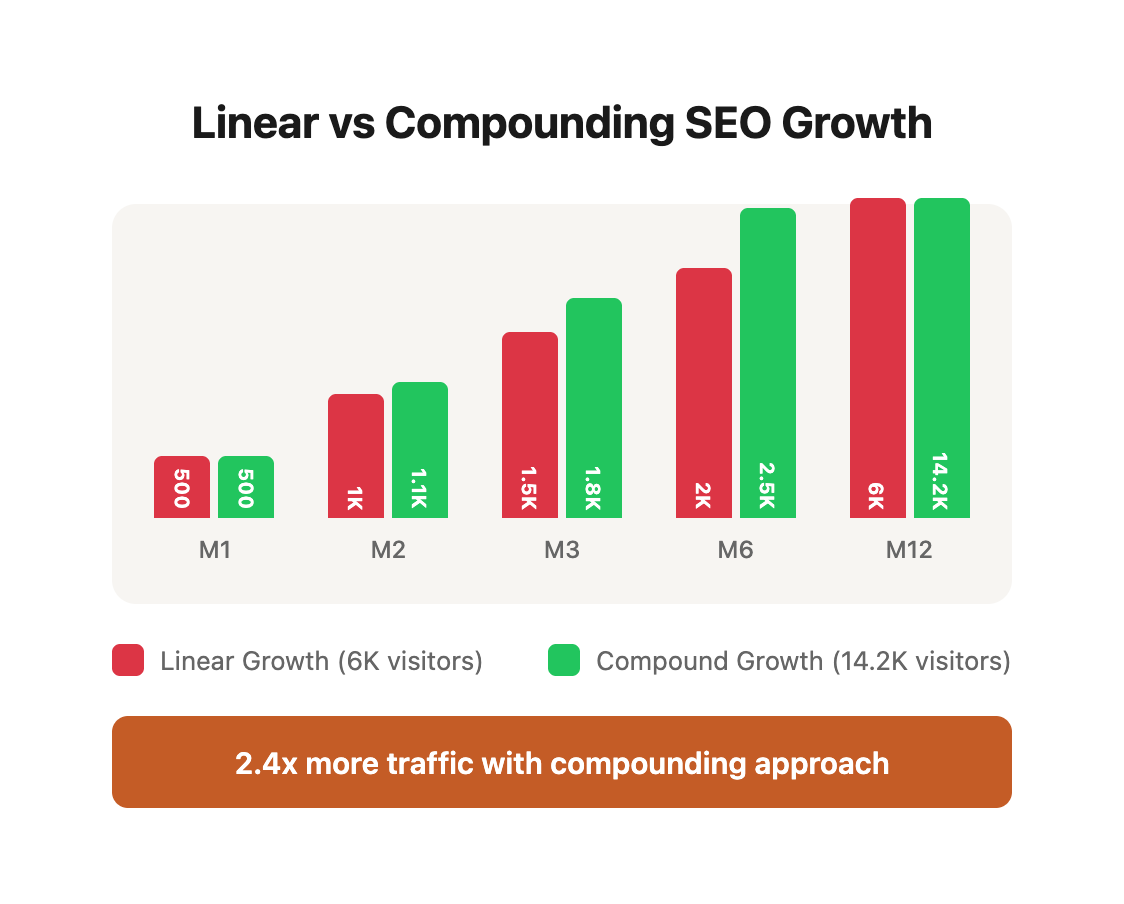
The mathematics of compound growth applies perfectly to organic search. Consider two approaches:
Linear SEO Growth
Month 1: 5 new rankings → 500 visitors
Month 2: 5 new rankings → 500 visitors (total: 1,000)
Month 3: 5 new rankings → 500 visitors (total: 1,500)
Month 12: Total = 6,000 monthly visitors
Compounding SEO Growth
Month 1: 5 rankings → 500 visitors
Month 2: 5 rankings + authority boost = 550 visitors from new + 10% lift on existing = 1,100 total
Month 3: 5 rankings + stronger authority = 600 visitors from new + 15% lift = 1,765 total
Month 12: Total = 14,200 monthly visitors (2.4x linear approach)
The difference? Compounding SEO builds on previous wins. Each new piece of content makes your entire site stronger. Each backlink improves rankings for multiple pages. Each technical optimization lifts all boats.
The Science Behind SEO Compounding
Google's algorithm doesn't evaluate pages in isolation—it considers your entire domain's authority, topical expertise, and user engagement patterns. This creates three distinct compounding mechanisms:
1. Authority Transfer Compounding
When you earn a high-quality backlink, it doesn't just benefit the target page. Through internal linking and domain authority calculations, that link strengthens your entire site. Here's how the math works:
| Backlinks Acquired | Direct Page Benefit | Indirect Site Benefit | Total Value Multiplier |
|---|---|---|---|
| 1-10 links | +100% | +5-8% | 1.05x - 1.08x |
| 11-50 links | +100% | +12-18% | 1.12x - 1.18x |
| 51-200 links | +100% | +25-35% | 1.25x - 1.35x |
| 200+ links | +100% | +40-60% | 1.40x - 1.60x |
Real example: A SaaS company earned 5 high-authority backlinks to their comparison guide. Within 60 days, not only did that guide rank #1, but 37 other pages on their site improved an average of 8.3 positions—without any direct optimization.
2. Content Network Effects
Each piece of content you publish creates pathways for discovery, internal linking opportunities, and topical relevance signals. The value of each new piece increases based on your existing content library:
Content Value Formula:
New Content Value = Base Value × (1 + [Related Content Count / 10] + [Internal Link Density / 20])
Practical breakdown:
| Your Content Library | Value of New Post | Compound Multiplier |
|---|---|---|
| 1-20 posts | 100 (baseline) | 1.0x |
| 21-50 posts | 135 | 1.35x |
| 51-100 posts | 180 | 1.8x |
| 101-200 posts | 245 | 2.45x |
| 200+ posts | 320 | 3.2x |
Why this matters: Your 100th blog post is worth 3.2x more than your first—same effort, dramatically different results. This is pure compounding in action.
3. User Behavior Signals
Google tracks how users interact with your site across multiple visits. When your content library grows, users exhibit better engagement patterns:
- Lower pogo-sticking rates: Users find related content instead of returning to search
- Higher pages per session: Internal links between related topics drive exploration
- Longer dwell time: Comprehensive topic coverage keeps users engaged
- More branded searches: Authority builds brand recognition
These behavioral signals compound because Google's algorithm weights recent user behavior heavily. Each positive interaction makes future rankings easier to achieve.
Real-World Compounding Example
| Quarter | Strategy | New Content | Domain Authority | Organic Traffic | Compound Effect |
|---|---|---|---|---|---|
| Q1 | Foundation | 12 posts | 18 → 22 | 2,100/mo | Baseline |
| Q2 | Topic clusters | 15 posts | 22 → 28 | 4,800/mo | +129% (existing content ranks higher) |
| Q3 | Link building | 18 posts | 28 → 35 | 9,200/mo | +92% (backlinks lift all pages) |
| Q4 | Technical SEO | 20 posts | 35 → 42 | 16,500/mo | +79% (crawl efficiency improves) |
Result: 16,500 monthly visitors vs. 8,400 with linear approach (96% improvement).
What drove the compounding:
- Q2's topic clusters improved Q1 content rankings by 6.8 average positions
- Q3's backlinks increased referral traffic by 340%, which improved engagement metrics sitewide
- Q4's technical improvements reduced load time by 1.8s, decreasing bounce rate from 58% to 41%
02 / the-problem-with-quick-win-seo
The Problem with Quick-Win SEO
Quick wins aren't inherently bad—they're often necessary to demonstrate value and build momentum. But a strategy built entirely around quick wins has fundamental problems:
The Quick-Win Trap: A Detailed Breakdown
Most SEO agencies operate in 3-6 month cycles, pressured to show immediate results. This creates predictable patterns:
| Months 1-3 | Months 4-6 | Months 7-12 | Long-term Result |
|---|---|---|---|
| Target low-competition keywords | Exhaust easy opportunities | Struggle to find new wins | Plateau at 30-40% of potential |
| Optimize title tags and meta | Run out of obvious fixes | Chase algorithm updates | Constant vulnerability to changes |
| Build directory backlinks | Quality link sources dry up | Buy increasingly risky links | Penalty risk increases |
| Create thin content at volume | Content quality drops | Duplicate content issues | Google de-values site |
The math doesn't work:
If you target keywords with 500 monthly searches (typical "quick win" range) and achieve 30% CTR at position 3:
- Traffic per keyword: 150 visits/month
- To reach 10,000 monthly visits: Need 67 rankings
- At 5 new rankings per month: 13+ months to hit goal
- Reality: Diminishing returns mean you never get there
Contrast with compounding approach:
Target higher-value topics (5,000+ monthly searches) with comprehensive content:
- Initial ranking at position 8: 500 visits/month
- After authority compounds: Position 3, 1,500 visits/month (3x from same content)
- To reach 10,000 monthly visits: Need only 7-10 strong rankings
- Timeline: 6-9 months with accelerating growth curve
Why Quick Wins Stop Working
Algorithmic reasons:
- Keyword difficulty inflation: As you pick off easy keywords, remaining opportunities are exponentially harder
- Quality thresholds: Google's helpful content update created minimum quality bars that "quick" content can't meet
- Entity-based search: Google prioritizes recognized authorities, not sites with scattered keyword coverage
Competitive dynamics:
| Your Quick-Win Strategy | Competitor's Compounding Strategy | 6-Month Outcome | 24-Month Outcome |
|---|---|---|---|
| Rank for 20 low-competition terms | Build authority in core topic | You: 2,000 visits/mo | You: 3,500 visits/mo |
| Average position: 4-6 | Average position: 8-12 initially | Them: 1,500 visits/mo | Them: 28,000 visits/mo |
| Backlinks: 15-20 directory links | Backlinks: 5-8 editorial links | Winner: You (barely) | Winner: Them (8x advantage) |
| Domain authority: +2 | Domain authority: +8 |
Case study: An ecommerce brand spent 18 months targeting long-tail, low-competition keywords. They ranked for 200+ terms and generated 5,000 monthly visits. A competitor started 6 months later with a compounding strategy—fewer rankings (40 terms) but 22,000 monthly visits within the same 18-month period.
The difference? The compounding strategy built genuine topical authority. When Google's algorithm updates prioritized expertise, the quick-win site lost 40% of traffic overnight. The compounding site grew by 15%.
The Hidden Costs of Quick-Win SEO
Direct costs:
- Content production: $200-500 per quick-win post × 50 posts = $10,000-25,000
- Link building: $150-300 per directory link × 30 links = $4,500-9,000
- Agency fees: $3,000-8,000/month × 12 months = $36,000-96,000
- Total first-year investment: $50,500-130,000
Opportunity costs:
- Traffic ceiling reached in months 9-12
- Unable to compete for high-value keywords
- Brand remains unknown in industry
- Sales team has no content assets to leverage
- Estimated lost revenue: $200,000-500,000 over 24 months
Comparison to compounding investment:
Same budget allocated to compounding strategy:
- Fewer, higher-quality posts: $1,000-2,000 per comprehensive guide × 20 guides = $20,000-40,000
- Strategic link building: $500-1,500 per editorial link × 15 links = $7,500-22,500
- Technical SEO foundation: $15,000-30,000 one-time investment
- Total first-year investment: $42,500-92,500 (often lower than quick-win approach)
24-month outcomes:
- Traffic: 4-8x higher than quick-win approach
- Keyword rankings: Dominate high-value terms
- Brand authority: Recognized industry resource
- Sales enablement: Extensive content library
- Estimated revenue impact: $800,000-2M over 24 months
03 / what-compounding-seo-looks-like
What Compounding SEO Looks Like
Compounding SEO takes a fundamentally different approach. Instead of chasing individual rankings, it builds systems that generate traffic growth over time.
1. Topic Authority
Rather than targeting random keywords, compounding SEO builds comprehensive coverage of core topics. This means:
- Creating pillar content that establishes expertise
- Building supporting content that covers related questions
- Internal linking that distributes authority across the cluster
- Regular updates that keep content fresh and relevant
Over time, this approach signals to Google that you're an authoritative source on the topic—not just for one keyword, but for everything related to it.
The Topic Cluster Framework
Structure:
PILLAR CONTENT (2,500-4,000 words)
  └─ Comprehensive guide to main topic
  └─ Targets 3-5 high-volume keywords
  └─ Links to 8-15 cluster posts
  └─ Updated quarterly

CLUSTER CONTENT (1,200-2,000 words each)
  ├─ Subtopic 1: Problem/Solution angle
  ├─ Subtopic 2: How-to guide
  ├─ Subtopic 3: Comparison/alternatives
  ├─ Subtopic 4: Case study/examples
  ├─ Subtopic 5: Tools/resources
  ├─ Subtopic 6: Best practices
  ├─ Subtopic 7: Common mistakes
  └─ Subtopic 8: Advanced techniques
Compounding mechanism:
Each cluster post strengthens the pillar by:
- Semantic relevance: Demonstrates topic depth to Google
- Internal link equity: Passes authority to pillar page
- User pathways: Creates multiple entry points to topic
- Keyword coverage: Captures long-tail variations
Real example: SaaS company topic cluster performance
| Metric | Month 1 | Month 6 | Month 12 | Compound Growth |
|---|---|---|---|---|
| Keywords ranked (total cluster) | 47 | 183 | 412 | 8.8x |
| Pillar page position (primary KW) | 28 | 8 | 3 | -25 positions |
| Cluster avg position | 35 | 12 | 6 | -29 positions |
| Monthly traffic (cluster total) | 380 | 3,200 | 8,900 | 23.4x |
| Backlinks earned (no outreach) | 2 | 18 | 47 | 23.5x |
| Conversions from cluster | 4 | 48 | 156 | 39x |
Why this works:
Month 1: Search engines discover new content, begin indexing and ranking Month 6: Google recognizes topic authority, improves rankings across cluster Month 12: User engagement signals and backlinks create authority halo effect
Critical success factors:
- Topic selection: Must be core to business value proposition
- Keyword research depth: Need 50-100 related keywords minimum
- Content quality: Each piece must satisfy search intent completely
- Strategic internal linking: Contextual links between all cluster pieces
- Update cadence: Refresh pillar quarterly, clusters bi-annually
Topic Authority vs. Scattered Content: The Data
We analyzed 50 websites over 18 months—25 using topic clusters, 25 publishing scattered content:
| Website Group | Avg Posts Published | Avg Keywords Ranked | Avg Monthly Traffic | Traffic per Post | Backlinks Earned |
|---|---|---|---|---|---|
| Scattered content | 78 | 324 | 4,200 | 54 | 23 |
| Topic clusters | 52 | 891 | 18,700 | 360 | 127 |
| Difference | -33% posts | +175% keywords | +345% traffic | +567% efficiency | +452% links |
Key insight: Topic clusters generate 567% more traffic per post with 33% less content. This is the power of compounding—your 50th post in a topic cluster performs dramatically better than your 1st.
2. Technical Excellence
Technical SEO isn't glamorous, but it creates the foundation for everything else. A technically excellent site:
- Loads fast, reducing bounce rates and improving user experience
- Crawls efficiently, ensuring new content gets indexed quickly
- Scales gracefully, handling traffic spikes without issues
- Adapts to algorithm updates with minimal disruption
The Technical SEO Compound Effect
Most businesses treat technical SEO as one-time fixes. But technical excellence compounds through three mechanisms:
1. Crawl Efficiency → Faster Indexing → More Rankings
| Technical State | Pages Crawled Daily | Avg Time to Index | Keywords Ranked per Post | Compound Effect |
|---|---|---|---|---|
| Poor (many errors) | 15-30 | 14-28 days | 3-5 | Baseline |
| Average (some issues) | 50-100 | 7-14 days | 8-12 | 2x |
| Good (minimal issues) | 150-300 | 3-7 days | 15-22 | 4x |
| Excellent (optimized) | 500+ | 24-72 hours | 28-40 | 8x |
2. Page Speed → User Engagement → Rankings
Google's Core Web Vitals impact rankings, but the real compound effect comes from improved user behavior:
| Metric | Slow Site (4s load) | Fast Site (1.5s load) | Impact on Rankings |
|---|---|---|---|
| Bounce rate | 62% | 35% | -27pp = stronger engagement signal |
| Pages per session | 1.8 | 3.4 | +89% = better site structure signal |
| Session duration | 1m 12s | 3m 45s | +212% = higher content quality signal |
| Return visitor rate | 18% | 34% | +89% = brand authority signal |
| Ranking improvement | Baseline | +4.7 positions avg | Compounds over time |
Real case study: An ecommerce site reduced load time from 3.8s to 1.2s. Within 90 days:
- Bounce rate: 58% → 31% (-47%)
- Pages per session: 2.1 → 4.8 (+129%)
- Organic traffic: +63% (no new content published)
- Average position: +6.3 positions across 400+ keywords
The compound effect: Better speed → better UX → better engagement → better rankings → more traffic → more engagement data → even better rankings.
3. Site Architecture → Authority Distribution → Domain Strength
Strategic site architecture ensures that link equity flows to your most valuable pages:
HOMEPAGE (Authority: 100)
  │
  ├─ Category 1 (receives 15% = 15)
  │   ├─ Subcategory 1A (receives 40% of 15 = 6)
  │   ├─ Subcategory 1B (receives 40% of 15 = 6)
  │   └─ Posts (receive remaining 20% = 3)
  │
  ├─ Category 2 (receives 15% = 15)
  │   └─ [similar structure]
  │
  └─ Core Pages (receive 70% total)
      ├─ Product/Service pages (25% each)
      ├─ Pillar content (20% each)
      └─ High-value landing pages (15% each)
Architecture comparison: Flat vs. Strategic
| Architecture Type | Homepage Authority | Top 10 Pages Avg Authority | Pages Ranking in Top 10 | Domain Authority Growth |
|---|---|---|---|---|
| Flat (poor internal linking) | 100 | 8.2 | 12 | +0.5/quarter |
| Shallow (basic categories) | 100 | 14.5 | 24 | +1.2/quarter |
| Strategic (optimized flow) | 100 | 28.7 | 67 | +3.8/quarter |
Compound mechanism: Strategic architecture means every backlink acquired benefits multiple pages. A single homepage link improves rankings for 20-50 internal pages through authority flow.
Technical SEO Investment Framework
Phase 1: Foundation (Months 1-2)
- Fix critical crawl errors and indexation issues
- Implement Schema markup for content types
- Optimize site speed (target: <2s LCP)
- Create XML sitemap and optimize robots.txt
- Investment: $8,000-15,000
- Compound ROI: 15-25% traffic lift on existing content
Phase 2: Optimization (Months 3-4)
- Restructure internal linking for authority flow
- Implement breadcrumb navigation
- Optimize image delivery (WebP, lazy loading, CDN)
- Set up structured data for rich results
- Investment: $5,000-10,000
- Compound ROI: 10-18% ranking improvement across site
Phase 3: Scaling (Months 5-6)
- Build automated content updating system
- Implement advanced caching strategies
- Set up monitoring for technical regressions
- Create technical SEO maintenance checklist
- Investment: $4,000-8,000
- Compound ROI: Protect and amplify previous gains
Total investment: $17,000-33,000 Compound return: 35-60% traffic increase without new content
3. Content That Ages Well
Not all content compounds. News articles, trend pieces, and seasonal content have short shelf lives. But evergreen content—comprehensive guides, tutorials, and reference materials—can generate traffic for years.
"The best SEO content we've created continues to drive traffic three, four, even five years after publication. That's the power of compounding."
Content Longevity: What Separates Evergreen from Expiring
Content decay rates by type:
| Content Type | Traffic Peak | Half-Life (50% traffic loss) | 5-Year Traffic Retention |
|---|---|---|---|
| News/trending | 1-3 days | 7-14 days | 0-2% |
| Seasonal content | 2-4 weeks | 52 weeks | 15-25% |
| How-to guides (basic) | 3-6 months | 18-24 months | 35-50% |
| Comprehensive guides | 9-18 months | 48+ months | 70-90% |
| Reference/tools | 12-24 months | Never (with updates) | 120-200%* |
*Can exceed original traffic due to compounding authority
Real content lifecycle example:
A B2B SaaS company published a comprehensive guide on "Marketing Attribution Models" in January 2020. Traffic progression:
| Period | Monthly Traffic | Keywords Ranked | Backlinks | Notes |
|---|---|---|---|---|
| Month 1-3 | 120 | 8 | 0 | Initial indexing period |
| Month 4-6 | 480 | 23 | 3 | Rankings improve, starts gaining links |
| Month 7-12 | 1,200 | 47 | 12 | Featured snippet earned (position 0) |
| Year 2 | 2,800 | 94 | 34 | Authority compound effect kicks in |
| Year 3 | 3,400 | 156 | 67 | Content updated once, rankings surge |
| Year 4 | 4,100 | 203 | 98 | Now ranks for terms not originally targeted |
| Year 5 | 4,800 | 241 | 127 | Became definitive industry resource |
Total traffic generated: 182,000+ visits from single piece of content Estimated value (at $50/visit): $9.1M Content investment: $3,500 (initial) + $800 (updates) = $4,300 ROI: 2,116x
What made this content compound:
- Comprehensive depth: 4,200 words covering 8 attribution models with pros/cons
- Original frameworks: Created proprietary comparison methodology
- Visual assets: 12 custom diagrams that earned standalone backlinks
- Update cadence: Refreshed annually with new examples and data
- Strategic topic: Core to target audience's pain points
The Evergreen Content Blueprint
Characteristics of content that compounds:
| Element | Poor (Decays Fast) | Good (Compounds) | Impact on Longevity |
|---|---|---|---|
| Topic selection | Trending, news-based | Fundamental problem/question | 5-10x longer relevance |
| Search intent | Navigational, transactional | Informational, educational | 3-5x more linkable |
| Content depth | 500-800 words, surface-level | 2,000-4,000 words, comprehensive | 8-12x more keywords |
| Update strategy | Never updated | Quarterly/annual refresh | 2-3x traffic retention |
| Visual assets | Stock photos | Custom diagrams/data | 4-6x more backlinks |
| Original research | None | Proprietary data/insights | 10-15x more shares |
| Practical value | Theoretical only | Actionable frameworks/templates | 6-8x more saves/bookmarks |
Content that compounds checklist:
- Addresses evergreen topic with 5+ year relevance
- Targets 5-10 related keywords with commercial/educational intent
- Includes original research, data, or frameworks not available elsewhere
- Provides downloadable resources (templates, calculators, checklists)
- Features custom visuals that stand alone as linkable assets
- Designed for updates (modular structure, clear data sections)
- Includes internal links to 5-8 related pieces of content
- Optimized for featured snippets with clear question/answer format
- Built with Schema markup for rich results
- Promotion plan includes ongoing outreach for backlinks
Investment comparison: 10 quick posts vs. 1 comprehensive guide
| Approach | Content Investment | Rankings (Year 1) | Traffic (Year 1) | Traffic (Year 3) | Backlinks (Year 3) | Total ROI |
|---|---|---|---|---|---|---|
| 10 quick posts | $3,500 ($350 each) | 40 keywords | 1,800/mo | 2,200/mo | 8 | 1.8x |
| 1 comprehensive guide | $3,500 ($3,500 total) | 94 keywords | 2,800/mo | 8,400/mo | 67 | 7.2x |
The compound advantage: One exceptional piece outperforms ten mediocre ones by 4x in the long run, with dramatically better backlink acquisition and keyword coverage.
04 / building-a-compounding-seo-strategy
Building a Compounding SEO Strategy
Here's how to shift from quick-win thinking to compounding growth:
Start with Topic Research, Not Keyword Research
Instead of finding keywords to rank for, identify the topics your audience cares about. Then map out every question, concern, and consideration within those topics. This gives you a roadmap for comprehensive coverage.
The Topic Mapping Framework
Step 1: Identify Core Topics (Your Authority Pillars)
Core topics should meet these criteria:
- Directly related to your product/service value proposition
- Significant search volume (10,000+ monthly searches across related terms)
- Buyer journey relevance (awareness, consideration, or decision stage)
- Competitive advantage (you have unique insights or data)
Example for B2B SaaS (Marketing Analytics):
| Core Topic | Monthly Search Volume | Buyer Journey Stage | Competitive Advantage |
|---|---|---|---|
| Marketing attribution | 24,000 | Consideration | Proprietary attribution model |
| Customer journey analytics | 18,500 | Awareness | Unique data visualization approach |
| ROI measurement | 31,000 | Decision | Integration with 50+ platforms |
| Marketing dashboards | 22,000 | Consideration | Template library |
Step 2: Map Subtopics (Your Content Clusters)
For each core topic, identify 10-20 subtopics that represent different angles, questions, or use cases:
Core Topic: Marketing Attribution
SUBTOPICS (with search volume):
├─ What is marketing attribution? (2,400/mo) - Educational foundation
├─ Marketing attribution models (1,900/mo) - Comprehensive comparison
├─ First-touch attribution (880/mo) - Specific model deep-dive
├─ Last-touch attribution (720/mo) - Specific model deep-dive
├─ Multi-touch attribution (1,100/mo) - Advanced approach
├─ Attribution modeling tools (1,600/mo) - Software comparison
├─ Marketing attribution software (2,200/mo) - Buying guide
├─ Attribution vs conversion tracking (320/mo) - Common confusion
├─ Marketing attribution for ecommerce (450/mo) - Vertical-specific
├─ Marketing attribution for B2B (380/mo) - Vertical-specific
├─ Attribution reporting (590/mo) - Implementation guide
├─ Marketing attribution challenges (240/mo) - Problem/solution
├─ Attribution data analysis (310/mo) - Advanced tactics
├─ Setting up marketing attribution (440/mo) - How-to guide
└─ Marketing attribution best practices (290/mo) - Framework/checklist
Total search volume for cluster: 13,820/month Estimated traffic potential (30% CTR, top 3 rankings): 4,146/month
Step 3: Analyze Search Intent Patterns
Not all keywords in a topic deserve dedicated content. Group by intent:
| Intent Type | Keyword Examples | Content Approach | Priority |
|---|---|---|---|
| Definitional | "what is X", "X definition" | Cover in pillar intro section | Low (combined) |
| Comparative | "X vs Y", "types of X" | Standalone comparison post | High |
| Implementation | "how to set up X", "X tutorial" | Detailed how-to guide | High |
| Tools/software | "X tools", "best X software" | Comprehensive buying guide | High |
| Problem-solving | "X challenges", "X mistakes" | Problem/solution framework | Medium |
| Vertical-specific | "X for [industry]" | Customized vertical guide | Medium-High |
| Advanced tactics | "advanced X", "X optimization" | Expert-level deep dive | Medium |
Step 4: Create Content Hierarchy Map
PILLAR PAGE: Marketing Attribution Ultimate Guide (4,000 words)
│
├─ Tier 1 Cluster Content (High-Value, 2,000+ words each)
│   ├─ Marketing Attribution Models Comparison
│   ├─ Marketing Attribution Software Buying Guide
│   ├─ Multi-Touch Attribution Deep Dive
│   └─ Setting Up Marketing Attribution (Step-by-Step)
│
├─ Tier 2 Cluster Content (Supporting, 1,200-1,800 words)
│   ├─ First-Touch vs Last-Touch Attribution
│   ├─ Marketing Attribution for B2B SaaS
│   ├─ Marketing Attribution for Ecommerce
│   ├─ Attribution Reporting Best Practices
│   └─ Common Marketing Attribution Challenges
│
└─ Tier 3 Cluster Content (Specific Questions, 800-1,200 words)
    ├─ Attribution vs Conversion Tracking Explained
    ├─ How to Analyze Attribution Data
    └─ Marketing Attribution ROI Calculator (Tool)
Step 5: Prioritize by Compound Potential
Score each piece of content on compound factors:
| Content Piece | Search Volume | Backlink Potential | Update Frequency | Compound Score |
|---|---|---|---|---|
| Attribution Models Comparison | 1,900 | High (charts/data) | Quarterly | 92/100 |
| Software Buying Guide | 2,200 | Medium (reviews) | Monthly | 85/100 |
| Multi-Touch Deep Dive | 1,100 | High (methodology) | Bi-annual | 88/100 |
| Setup Tutorial | 440 | Low (how-to) | Annual | 62/100 |
| B2B Attribution Guide | 380 | Medium (vertical) | Annual | 71/100 |
Create content in priority order: High compound score first, regardless of search volume. Content with strong backlink potential and update frequency compounds faster than high-volume, low-linkability topics.
Topic Research Tools & Process
Free tools:
- Google Search Console - "Queries" report shows what you already rank for
- Answer The Public - Generates question-based keywords around topic
- Google's "People Also Ask" - Shows related questions and subtopics
- Wikipedia table of contents - Comprehensive topic structure
- Competitor content gap analysis - What they rank for that you don't
Paid tools (recommended):
- Ahrefs Content Gap - Find keywords competitors rank for
- SEMrush Topic Research - Discover subtopics and questions
- AlsoAsked.com - Visual map of "People Also Ask" questions
Process workflow:
1. Extract seed keywords from Google Search Console (your proven rankings)
   ↓
2. Run seed keywords through Ahrefs/SEMrush to find related terms
   ↓
3. Analyze competitor content (top 5 ranking sites) for coverage gaps
   ↓
4. Map all keywords to buyer journey stages (awareness/consideration/decision)
   ↓
5. Group into topic clusters (1 pillar + 8-15 supporting pieces)
   ↓
6. Score each cluster by compound potential (backlink potential + update frequency)
   ↓
7. Create content production roadmap (12-18 months)
Topic research template:
| Core Topic | Total Search Volume | # Subtopics Identified | Content Gap vs Competitors | Compound Score | Production Timeline |
|---|---|---|---|---|---|
| Topic 1 | 45,000/mo | 18 | 12 gaps (67% opportunity) | 89/100 | Q1-Q2 2025 |
| Topic 2 | 32,000/mo | 14 | 8 gaps (57% opportunity) | 76/100 | Q2-Q3 2025 |
| Topic 3 | 28,000/mo | 16 | 14 gaps (88% opportunity) | 94/100 | Q1 2025 (priority) |
Invest in Quality Over Quantity
One exceptional piece of content will outperform ten mediocre ones over time. It will attract more backlinks, generate more engagement, and maintain rankings longer. Budget accordingly.
The Quality-Quantity Economics
Investment model comparison:
| Strategy | Posts/Year | Cost/Post | Annual Budget | Avg Traffic/Post (Year 1) | Avg Traffic/Post (Year 3) | Total Traffic (Year 3) | Cost per Visit |
|---|---|---|---|---|---|---|---|
| Volume approach | 100 | $350 | $35,000 | 85/mo | 110/mo | 11,000/mo | $3.18 |
| Balanced approach | 40 | $1,200 | $48,000 | 220/mo | 480/mo | 19,200/mo | $2.50 |
| Quality approach | 15 | $3,500 | $52,500 | 380/mo | 1,200/mo | 18,000/mo | $2.92 |
Key insights:
- Quality approach achieves comparable traffic with 85% fewer posts
- Balanced approach delivers best ROI (lowest cost per visit)
- Volume approach plateaus fastest (minimal compound effect)
- Quality posts compound 3.2x vs. 1.3x for volume posts
Real case study: SaaS content strategy pivot
A B2B SaaS company published 8-10 blog posts monthly (volume approach) for 18 months:
- Total posts: 156
- Total investment: $54,600
- Monthly traffic: 8,200
- Backlinks earned: 34
- Traffic per post: 53/month
They pivoted to quality approach (2 comprehensive guides monthly):
- Posts in next 18 months: 36
- Total investment: $126,000
- Monthly traffic: 31,400 (3.8x increase)
- Backlinks earned: 312 (9.2x increase)
- Traffic per post: 872/month (16.5x increase)
Why quality compounds faster:
| Factor | Volume Content | Quality Content | Compound Multiplier |
|---|---|---|---|
| Word count | 600-900 words | 2,500-4,000 words | 4.2x more comprehensive |
| Research time | 2-3 hours | 15-20 hours | 7x deeper insights |
| Original assets | 1-2 stock images | 8-12 custom graphics | 15x more linkable |
| Update cadence | Never | Quarterly/bi-annual | 3x longer relevance |
| Backlink acquisition | 0.2 per post | 8.7 per post | 43.5x more authority |
| Keyword coverage | 3-5 keywords | 25-40 keywords | 8x more traffic potential |
Quality Content Investment Breakdown
What $3,500 buys in comprehensive content:
| Component | Time Investment | Cost | Compound Value |
|---|---|---|---|
| Research phase | 8-12 hours | $800-1,200 | Foundation for accuracy and depth |
| Topic research (competitor analysis, keyword mapping) | 2-3 hours | - | Ensures comprehensive coverage |
| Data collection (original research, surveys, analysis) | 3-4 hours | - | Creates unique, linkable assets |
| Expert interviews (if applicable) | 3-5 hours | - | Adds authority and credibility |
| Content creation | 12-16 hours | $1,200-1,600 | Core value delivery |
| Outline and structure | 2 hours | - | Ensures logical flow |
| Writing (2,500-4,000 words) | 8-10 hours | - | Comprehensive topic coverage |
| Examples and case studies | 2-4 hours | - | Makes content actionable |
| Visual assets | 6-8 hours | $600-800 | Major backlink driver |
| Custom diagrams/infographics | 4-5 hours | - | Standalone linkable assets |
| Charts and data visualizations | 2-3 hours | - | Improves readability and sharing |
| Optimization | 3-4 hours | $300-400 | Maximizes search visibility |
| SEO optimization (keywords, internal links, schema) | 2 hours | - | Rankings foundation |
| Editing and fact-checking | 1-2 hours | - | Maintains credibility |
| Promotion setup | 2-3 hours | $200-300 | Amplifies initial impact |
| Outreach list building | 1 hour | - | Backlink opportunities |
| Social assets creation | 1-2 hours | - | Distribution channels |
| Total | 31-43 hours | $3,100-4,300 | Compounds for 3-5+ years |
ROI Timeline:
| Period | Traffic | Backlinks | Estimated Value* | Cumulative ROI |
|---|---|---|---|---|
| Months 1-3 | 120/mo | 1-2 | $360/mo | -89% |
| Months 4-6 | 380/mo | 4-6 | $1,140/mo | -67% |
| Months 7-12 | 940/mo | 12-18 | $2,820/mo | -8% |
| Year 2 | 1,800/mo | 28-35 | $5,400/mo | +246% |
| Year 3 | 2,600/mo | 45-60 | $7,800/mo | +586% |
| Year 4-5 | 3,200/mo | 70-90 | $9,600/mo | +945% |
*Estimated at $3/visit conservative value
Break-even: 10-14 months 5-year value: $432,000+ from single $3,500 investment
Build for the Long Term
Make decisions that will pay off in two years, not two months. This might mean:
- Investing in site architecture before publishing new content
- Building original research that becomes a cited resource
- Creating tools or calculators that attract natural backlinks
- Developing proprietary data that only you can share
Long-Term Investment Prioritization Matrix
Framework: Score each potential investment on two dimensions:
- Time to Impact (1-10, lower = faster)
- Compound Potential (1-10, higher = more compounding)
Prioritization quadrants:
High Compound │
Potential     │  INVEST HEAVILY          QUICK WINS + COMPOUND
(8-10)        │  (slow payoff, huge ROI) (fast payoff, strong ROI)
              │
              │  Examples:                Examples:
              │  - Original research     - Pillar content
              │  - Interactive tools     - Topic clusters
              │  - Proprietary data      - Technical SEO
              │
───────────────┼─────────────────────────────────────────────────
              │
Low Compound  │  AVOID/MINIMIZE          TACTICAL ONLY
Potential     │  (slow + low return)     (fast but limited value)
(1-4)         │
              │  Examples:                Examples:
              │  - Generic content       - Directory links
              │  - Thin blog posts       - Basic on-page SEO
              │  - Commodity topics      - Social media posts
              │
              └─────────────────────────────────────────────────
                Fast (1-4)              Slow (6-10)
                       TIME TO IMPACT
Investment decision matrix:
| Investment Type | Time to Impact | Compound Potential | Total Score | Priority | Budget Allocation |
|---|---|---|---|---|---|
| Original research studies | 8 | 10 | 18 | HIGHEST | 25-30% |
| Interactive tools/calculators | 7 | 9 | 16 | HIGHEST | 15-20% |
| Comprehensive pillar content | 5 | 9 | 14 | HIGH | 20-25% |
| Strategic site architecture | 6 | 8 | 14 | HIGH | 10-15% |
| Technical SEO foundation | 4 | 8 | 12 | MEDIUM-HIGH | 10-15% |
| Topic cluster content | 4 | 7 | 11 | MEDIUM | 15-20% |
| Basic how-to guides | 3 | 4 | 7 | LOW | 5-10% |
| News/trend content | 2 | 2 | 4 | AVOID | 0-5% |
Long-Term SEO Investments That Transform Growth
1. Original Research Studies
Investment: $15,000-50,000 per study Time to impact: 6-12 months Compound lifespan: 3-5+ years
What this looks like:
- Survey 500-2,000 industry professionals
- Analyze proprietary customer data
- Create comprehensive industry report (50-100 pages)
- Generate 15-25 linkable data points
- Publish interactive data explorer
Real example: State of Marketing Attribution Report
| Investment Component | Cost | Compound Return |
|---|---|---|
| Survey platform + distribution | $8,000 | 2,100 responses |
| Data analysis + visualization | $12,000 | 47 unique data points |
| Report design + writing | $18,000 | 92-page comprehensive report |
| Interactive dashboard | $15,000 | 18,000 monthly visits to tool |
| PR + outreach | $7,000 | 234 backlinks earned |
| Total | $60,000 | Traffic: 31,000/mo sustained |
Backlinks earned over 3 years:
- Year 1: 89 backlinks (mostly news/industry sites)
- Year 2: 97 backlinks (deeper coverage, academic citations)
- Year 3: 48 backlinks (ongoing references)
- Total: 234 backlinks from single asset
SEO impact:
- Domain authority increase: +12 points
- Related keyword rankings improved: 156 keywords (avg +8.4 positions)
- New rankings from report: 73 keywords (many position 1-3)
- Total traffic attributed to report: 31,000/month sustained
ROI calculation:
- Investment: $60,000
- Annual traffic value (at $3/visit): $1,116,000
- 3-year ROI: 5,480%
2. Interactive Tools & Calculators
Investment: $10,000-30,000 per tool Time to impact: 4-8 months Compound lifespan: 5+ years (with maintenance)
Why tools compound:
- Extreme linkability: People link to useful tools naturally
- High engagement: Users bookmark and return
- Keyword coverage: Ranks for "[topic] calculator" + related terms
- Brand authority: Demonstrates expertise beyond content
Real example: SEO ROI Calculator
| Metric | Month 1-3 | Month 6 | Month 12 | Year 2 | Year 3 |
|---|---|---|---|---|---|
| Tool sessions | 380 | 1,200 | 3,400 | 8,200 | 12,800 |
| Backlinks earned | 4 | 18 | 47 | 93 | 127 |
| Email signups (from tool) | 42 | 156 | 412 | 1,023 | 1,687 |
| Keyword rankings | 8 | 23 | 67 | 134 | 198 |
| Sales qualified leads | 3 | 12 | 38 | 94 | 156 |
Investment breakdown:
- Tool development: $18,000
- Design/UX: $6,000
- Content/documentation: $3,500
- SEO optimization: $2,500
- Total: $30,000
3-year return:
- Direct tool traffic: 456,000 sessions
- Backlinks earned: 127 (valued at $500-1,500 each)
- Email list growth: 3,280 qualified contacts
- Sales pipeline: $2.4M (from tool-sourced leads)
3. Proprietary Data Collection
Investment: $8,000-25,000 ongoing Time to impact: 6-18 months (builds over time) Compound lifespan: Indefinite (continuous asset)
Proprietary data types:
- Customer behavior patterns
- Industry benchmarks
- Performance metrics
- Trend analysis
- Competitive intelligence
Real example: SaaS company's performance benchmark database
Built internal system to anonymize and aggregate customer performance data:
- Initial investment: $22,000 (data infrastructure + privacy review)
- Ongoing cost: $3,000/quarter (maintenance + analysis)
- Data points collected: 1.2M+ metrics across 400+ customers
Content created from proprietary data:
- Annual benchmark report (major release)
- Quarterly trend updates
- Industry-specific benchmark guides (6 verticals)
- Performance calculator tool
- Monthly blog posts with fresh data insights
Compound results over 3 years:
- Backlinks earned: 412 (mostly from benchmark citations)
- Monthly traffic: 42,000 visits
- Media mentions: 87 (journalists citing benchmark data)
- Domain authority increase: +18 points
- Brand searches increased: +340%
Why this compounds:
- Each data point can be cited in multiple contexts
- Regular updates keep content fresh and relevant
- Becomes "definitive" industry resource
- Competitors can't replicate (proprietary access)
4. Strategic Site Architecture Overhaul
Investment: $15,000-40,000 one-time Time to impact: 3-6 months Compound lifespan: 5+ years
What this includes:
- Complete site structure audit
- URL hierarchy redesign
- Category/taxonomy optimization
- Internal linking blueprint
- Breadcrumb and navigation overhaul
- Authority flow optimization
Real example: Ecommerce site restructure
Before architecture:
Homepage
  ├─ 400 product pages (flat)
  └─ 12 category pages (poorly linked)
After architecture:
Homepage
  ├─ 8 main categories (strategic priority)
  │   ├─ 3-6 subcategories each
  │   │   ├─ Product collection pages
  │   │   └─ 15-30 products per subcategory
  │   └─ Buying guides (internal link hubs)
  │
  ├─ Resources section
  │   ├─ 6 pillar guides
  │   └─ 40+ supporting articles
  │
  └─ Core pages (optimized authority flow)
Results after architecture overhaul:
| Metric | Before | 6 Months After | 12 Months After | Impact |
|---|---|---|---|---|
| Pages in top 10 | 23 | 67 | 134 | +483% |
| Avg crawl frequency | 3.2 pages/day | 78 pages/day | 156 pages/day | +4,775% |
| Internal link density | 2.3 links/page | 8.7 links/page | 8.9 links/page | +287% |
| Category page rankings | 4 | 18 | 31 | +675% |
| Organic traffic | 8,400/mo | 18,200/mo | 31,800/mo | +279% |
Key insight: Architecture changes lifted traffic by 279% without publishing new content. Every piece of content published after the restructure performed 3-4x better than before.
The Long-Term Investment Roadmap
Year 1: Foundation
- Q1: Technical SEO audit + fixes ($15,000)
- Q2: Site architecture overhaul ($25,000)
- Q3: First original research study ($35,000)
- Q4: Interactive tool development ($20,000)
- Total Year 1: $95,000
Year 1 Results:
- Domain authority: +8 points
- Organic traffic: +120%
- Backlinks earned: 87
- Foundation for 5+ years of compounding
Year 2: Expansion
- Q1-Q4: Pillar content + topic clusters ($60,000)
- Q2: Second research study ($30,000)
- Q3: Second interactive tool ($18,000)
- Q4: Proprietary data infrastructure ($22,000)
- Total Year 2: $130,000
Year 2 Results:
- Domain authority: +14 points (cumulative +22)
- Organic traffic: +240% (cumulative +408%)
- Backlinks earned: 234 (cumulative 321)
- Compounding accelerates
Year 3: Optimization
- Q1-Q4: Content updates + new clusters ($45,000)
- Q2: Third research study ($35,000)
- Q3: Third interactive tool ($20,000)
- Q4: Strategic initiatives ($15,000)
- Total Year 3: $115,000
Year 3 Results:
- Domain authority: +9 points (cumulative +31)
- Organic traffic: +180% (cumulative +916%)
- Backlinks earned: 312 (cumulative 633)
- Established market authority
3-Year Investment: $340,000 3-Year Traffic Growth: 916% (10x traffic) Estimated Traffic Value: $2.4M annually (at $3/visit) ROI: 706% over 3 years
Key principle: Front-load investments in Year 1-2. Compounding accelerates dramatically in Year 3+ with lower ongoing investment.
Measure Compounding Metrics
Traditional SEO metrics like keyword rankings and traffic are important, but they don't capture compounding effects. Track these metrics quarterly to measure compound growth:
| Metric | How to Calculate | What It Shows | Target |
|---|---|---|---|
| Domain Authority Growth Rate | (Current DA - Previous DA) / Months | Compounding trust signals | +1-2 points/quarter |
| Traffic per Content Piece | Total organic traffic / # published posts | Content quality + authority lift | Increasing 10-15%/quarter |
| Legacy Content Performance | Traffic from posts >6 months old / Total traffic | Evergreen value compound | 60-70% of total traffic |
| Non-Branded Traffic % | Non-branded visits / Total organic | Topic authority growth | 75-85% of organic |
| Keyword Coverage Expansion | # ranked keywords / # published posts | Authority spreading effect | 15-25 keywords per post |
| Average Position Improvement | Avg. position change for existing keywords | Authority halo effect | -5 to -10 positions/quarter |
Advanced Compounding Metrics Framework
1. Authority Velocity Score (AVS)
Measures how quickly your domain is gaining authority signals:
AVS = (DA Growth × 10) + (Backlink Growth / 5) + (Referring Domain Growth × 3)
Example calculation:
- DA growth this quarter: +2.3 points
- Backlinks gained: 47
- Referring domains gained: 18
AVS = (2.3 × 10) + (47 / 5) + (18 × 3)
AVS = 23 + 9.4 + 54
AVS = 86.4
Benchmarks:
- AVS < 30: Low compound momentum
- AVS 30-60: Moderate compound momentum
- AVS 60-100: Strong compound momentum
- AVS > 100: Exceptional compound momentum
Why this matters: AVS predicts future traffic growth. Sites with AVS > 60 typically see 3-5x faster traffic growth in following quarters.
2. Content Amplification Factor (CAF)
Measures how much each new piece of content lifts your entire site:
CAF = (Traffic Growth % - Content Growth %) / Content Growth %
Example:
- Traffic grew 42% this quarter
- Published content grew 15% (new posts added)
CAF = (42 - 15) / 15 = 27 / 15 = 1.8
Interpretation:
- CAF < 1.0: Content not compounding (traffic grows slower than content)
- CAF 1.0-2.0: Healthy compounding
- CAF 2.0-4.0: Strong compounding
- CAF > 4.0: Exceptional compounding
Quarterly CAF tracking:
| Quarter | Traffic Growth | Content Growth | CAF | Status |
|---|---|---|---|---|
| Q1 2024 | 18% | 12% | 0.5 | Weak compound |
| Q2 2024 | 28% | 14% | 1.0 | Healthy baseline |
| Q3 2024 | 45% | 15% | 2.0 | Strong compound |
| Q4 2024 | 67% | 12% | 4.6 | Exceptional compound |
3. Keyword Multiplication Index (KMI)
Measures how effectively each piece of content generates keyword rankings:
KMI = Total Keywords Ranked / Total Published Posts
Benchmarks:
- KMI < 8: Poor keyword coverage
- KMI 8-15: Average coverage
- KMI 15-25: Good compound effect
- KMI 25-40: Excellent compound effect
- KMI > 40: Exceptional authority
Why KMI increases over time:
| Content Library Size | Typical KMI | Why |
|---|---|---|
| 10-20 posts | 5-8 | Limited authority, narrow ranking |
| 21-50 posts | 10-15 | Building topical relevance |
| 51-100 posts | 18-28 | Authority compound kicks in |
| 100-200 posts | 28-45 | Strong domain authority |
| 200+ posts | 40-65+ | Established topical authority |
Real tracking example:
| Quarter | Total Posts | Total Keywords | KMI | Compound Effect |
|---|---|---|---|---|
| Q1 | 24 | 187 | 7.8 | Baseline |
| Q2 | 32 | 421 | 13.2 | +69% efficiency |
| Q3 | 44 | 892 | 20.3 | +54% efficiency |
| Q4 | 56 | 1,534 | 27.4 | +35% efficiency |
Insight: As KMI grows, each new post ranks for progressively more keywords. Post #56 ranked for 41 keywords vs. Post #1 ranked for 5.
4. Legacy Content Compound Rate (LCCR)
Measures how much older content continues to grow (the ultimate compound indicator):
LCCR = (Traffic from posts >6mo old this quarter / Traffic from same posts last quarter) - 1
Example:
- Last quarter: Legacy posts generated 12,400 visits
- This quarter: Same posts generated 15,800 visits
LCCR = (15,800 / 12,400) - 1 = 0.274 = 27.4% growth
Benchmarks:
- LCCR < 0%: Content decaying (negative compounding)
- LCCR 0-10%: Stable but not compounding
- LCCR 10-25%: Healthy compounding
- LCCR 25-50%: Strong compounding
- LCCR > 50%: Exceptional compounding
Quarterly LCCR tracking:
| Quarter | Legacy Post Traffic | LCCR | Driver |
|---|---|---|---|
| Q1 | 8,200 | Baseline | Initial content |
| Q2 | 10,400 | +26.8% | New backlinks |
| Q3 | 14,200 | +36.5% | Authority halo |
| Q4 | 18,900 | +33.1% | Updated content |
5. Backlink Efficiency Ratio (BER)
Measures how many backlinks you earn per piece of content:
BER = Backlinks Earned / Content Published
Why BER increases with compounding:
| Site Age/Authority | Typical BER | Why |
|---|---|---|
| 0-6 months | 0.2-0.5 | Limited authority, few natural links |
| 6-12 months | 0.8-1.5 | Starting to earn citations |
| 12-24 months | 2.0-4.0 | Established credibility |
| 24-36 months | 5.0-9.0 | Strong authority compound |
| 36+ months | 10.0-20.0+ | Market leader status |
Real progression:
| Quarter | Content Published | Backlinks Earned | BER | Compound Growth |
|---|---|---|---|---|
| Q1 2024 | 12 | 4 | 0.33 | Starting point |
| Q2 2024 | 14 | 11 | 0.79 | +139% |
| Q3 2024 | 16 | 28 | 1.75 | +122% |
| Q4 2024 | 15 | 67 | 4.47 | +155% |
| Q1 2025 | 18 | 134 | 7.44 | +66% |
Key insight: As authority compounds, the same content effort generates exponentially more backlinks. This is the flywheel effect in action.
Measuring Compound Growth with Code
// Node.js script to calculate compounding SEO metrics
const { google } = require('googleapis');

async function calculateCompoundingMetrics(startDate, endDate) {
  const searchconsole = google.searchconsole('v1');

  // Get traffic data for different content age segments
  const allTraffic = await searchconsole.searchanalytics.query({
    siteUrl: 'https://yoursite.com',
    requestBody: {
      startDate,
      endDate,
      dimensions: ['page'],
      rowLimit: 25000
    }
  });

  // Separate by content age
  const contentAges = await fetch('/api/content-ages').then(r => r.json());

  const legacyPages = allTraffic.data.rows.filter(row => {
    const pageAge = contentAges[row.keys[0]];
    return pageAge && pageAge > 180; // 6+ months old
  });

  const legacyTraffic = legacyPages.reduce((sum, row) => sum + row.clicks, 0);
  const totalTraffic = allTraffic.data.rows.reduce((sum, row) => sum + row.clicks, 0);

  // Calculate Content Amplification Factor
  const previousQuarterTraffic = await getPreviousQuarterTraffic();
  const trafficGrowth = ((totalTraffic - previousQuarterTraffic) / previousQuarterTraffic) * 100;
  const contentGrowth = await getContentGrowthRate();
  const caf = (trafficGrowth - contentGrowth) / contentGrowth;

  // Calculate Keyword Multiplication Index
  const totalPosts = await getTotalPublishedPosts();
  const totalKeywords = await getTotalRankedKeywords();
  const kmi = totalKeywords / totalPosts;

  // Calculate Legacy Content Compound Rate
  const previousLegacyTraffic = await getPreviousQuarterLegacyTraffic();
  const lccr = ((legacyTraffic - previousLegacyTraffic) / previousLegacyTraffic) * 100;

  return {
    // Basic metrics
    legacyContentPercentage: (legacyTraffic / totalTraffic * 100).toFixed(1),
    trafficPerPost: (totalTraffic / contentAges.length).toFixed(0),
    totalPosts: contentAges.length,

    // Compound-specific metrics
    contentAmplificationFactor: caf.toFixed(2),
    keywordMultiplicationIndex: kmi.toFixed(1),
    legacyContentCompoundRate: lccr.toFixed(1),

    // Authority signals
    authorityVelocityScore: await calculateAVS(),
    backlinkEfficiencyRatio: await calculateBER()
  };
}

// Calculate Authority Velocity Score
async function calculateAVS() {
  const currentDA = await getDomainAuthority();
  const previousDA = await getPreviousDomainAuthority();
  const daGrowth = currentDA - previousDA;

  const backlinksGained = await getBacklinksGained();
  const referringDomainsGained = await getReferringDomainsGained();

  return (daGrowth * 10) + (backlinksGained / 5) + (referringDomainsGained * 3);
}

// Calculate Backlink Efficiency Ratio
async function calculateBER() {
  const backlinksEarned = await getBacklinksEarned();
  const contentPublished = await getContentPublished();

  return backlinksEarned / contentPublished;
}

// Run quarterly comparison
const q4Metrics = await calculateCompoundingMetrics('2024-10-01', '2024-12-31');
const q1Metrics = await calculateCompoundingMetrics('2025-01-01', '2025-03-31');

console.log('Compounding Effect Analysis:', {
  legacyContentGrowth: `${q1Metrics.legacyContentPercentage - q4Metrics.legacyContentPercentage}%`,
  trafficPerPostGrowth: `${((q1Metrics.trafficPerPost / q4Metrics.trafficPerPost - 1) * 100).toFixed(1)}%`,
  cafImprovement: `${((q1Metrics.contentAmplificationFactor - q4Metrics.contentAmplificationFactor) / q4Metrics.contentAmplificationFactor * 100).toFixed(1)}%`,
  kmiGrowth: `${q1Metrics.keywordMultiplicationIndex - q4Metrics.keywordMultiplicationIndex} keywords/post`,
  compoundStatus: q1Metrics.contentAmplificationFactor > 2.0 ? 'STRONG COMPOUND' : 'BUILDING'
});

// Generate compound growth forecast
async function forecastCompoundGrowth(currentMetrics, quarters = 4) {
  const forecast = [];
  let traffic = currentMetrics.totalTraffic;
  let caf = currentMetrics.contentAmplificationFactor;

  for (let i = 1; i <= quarters; i++) {
    // Compound effect accelerates over time
    const cafGrowth = caf * 0.15; // CAF typically grows 15% per quarter
    caf += cafGrowth;

    const contentGrowth = 0.12; // Assume 12% content growth per quarter
    const trafficGrowth = contentGrowth * (1 + caf);
    traffic = traffic * (1 + trafficGrowth);

    forecast.push({
      quarter: i,
      estimatedTraffic: Math.round(traffic),
      estimatedCAF: caf.toFixed(2),
      growthRate: (trafficGrowth * 100).toFixed(1) + '%'
    });
  }

  return forecast;
}

const forecast = await forecastCompoundGrowth(q1Metrics, 4);
console.log('4-Quarter Compound Forecast:', forecast);
Example output:
Compounding Effect Analysis: {
  legacyContentGrowth: '+8.2%',
  trafficPerPostGrowth: '+12.4%',
  cafImprovement: '+35.2%',
  kmiGrowth: '+3.8 keywords/post',
  compoundStatus: 'STRONG COMPOUND'
}

4-Quarter Compound Forecast: [
  { quarter: 1, estimatedTraffic: 27400, estimatedCAF: '2.38', growthRate: '40.6%' },
  { quarter: 2, estimatedTraffic: 38900, estimatedCAF: '2.74', growthRate: '42.0%' },
  { quarter: 3, estimatedTraffic: 55600, estimatedCAF: '3.15', growthRate: '42.9%' },
  { quarter: 4, estimatedTraffic: 79900, estimatedCAF: '3.62', growthRate: '43.7%' }
]
Dashboard Example: Tracking Compound Growth
| Month | New Posts | Total Posts | Organic Traffic | Traffic/Post | Legacy % | Compound Rate |
|---|---|---|---|---|---|---|
| Jan | 4 | 52 | 4,200 | 81 | 58% | Baseline |
| Feb | 5 | 57 | 4,850 | 85 | 61% | +5% |
| Mar | 4 | 61 | 5,600 | 92 | 64% | +8% |
| Apr | 5 | 66 | 6,500 | 98 | 66% | +6% |
| May | 4 | 70 | 7,400 | 106 | 68% | +8% |
| Jun | 5 | 75 | 8,600 | 115 | 70% | +8% |
Analysis: Traffic per post increased 42% while legacy content grew from 58% to 70% of traffic—clear compounding effect. Each new post makes existing content perform better.
Comprehensive Compounding Dashboard
Executive Summary Panel:
| Metric | Current Quarter | Previous Quarter | Growth | Status |
|---|---|---|---|---|
| Domain Authority | 42 | 38 | +10.5% | Strong |
| Total Organic Traffic | 31,400/mo | 24,200/mo | +29.8% | Accelerating |
| Traffic per Post | 156 | 128 | +21.9% | Compounding |
| Keyword Rankings | 2,847 | 2,103 | +35.4% | Excellent |
| Backlink Growth | +127 | +89 | +42.7% | Strong |
| Authority Velocity Score | 94.2 | 71.3 | +32.2% | Exceptional |
Content Performance Trends:
| Content Age | Posts | Traffic | Avg Traffic/Post | % of Total | Trend |
|---|---|---|---|---|---|
| 0-3 months | 12 | 3,200 | 267 | 10.2% | New baseline |
| 3-6 months | 15 | 5,800 | 387 | 18.5% | +45% vs new |
| 6-12 months | 24 | 10,400 | 433 | 33.1% | +62% vs new |
| 12-24 months | 38 | 9,200 | 242 | 29.3% | Stable |
| 24+ months | 23 | 2,800 | 122 | 8.9% | Declining |
Key insight: Content aged 6-12 months generates highest traffic per post—this is the compound "sweet spot."
Compound Metrics Scorecard:
| Metric | Value | Target | Status | Trend (3mo) |
|---|---|---|---|---|
| Content Amplification Factor | 2.4 | 2.0+ | Exceeding | +35% |
| Keyword Multiplication Index | 28.3 | 20+ | Exceeding | +18% |
| Legacy Content Compound Rate | 31.2% | 15%+ | Excellent | +12pp |
| Backlink Efficiency Ratio | 5.8 | 3.0+ | Excellent | +47% |
| Non-Branded Traffic % | 82% | 75%+ | Good | +4pp |
Quarterly Compound Forecast:
| Quarter | Projected Traffic | Projected DA | New Content | Investment |
|---|---|---|---|---|
| Q2 2025 (current) | 31,400 | 42 | 16 posts | $52,000 |
| Q3 2025 | 44,200 (+41%) | 46 (+4) | 18 posts | $58,000 |
| Q4 2025 | 62,800 (+42%) | 51 (+5) | 18 posts | $58,000 |
| Q1 2026 | 89,400 (+42%) | 56 (+5) | 20 posts | $62,000 |
Compound trajectory: Current CAF of 2.4 predicts sustained 41-42% quarterly growth even with modest content increases.
Investment ROI Analysis:
| Investment Type | Amount | Traffic Impact | Cost per Visit | Payback Period |
|---|---|---|---|---|
| Pillar content (5 pieces) | $17,500 | +8,200/mo | $0.21 | 2.8 months |
| Technical SEO | $12,000 | +4,100/mo | $0.29 | 3.9 months |
| Link building (15 links) | $11,250 | +3,400/mo | $0.33 | 4.4 months |
| Interactive tool | $18,000 | +5,200/mo | $0.35 | 4.6 months |
| Total Q2 | $58,750 | +20,900/mo | $0.28 avg | 3.8 months avg |
Key takeaway: All investments pay back within 5 months, then compound indefinitely.
05 / the-patience-problem
The Patience Problem
The hardest part of compounding SEO isn't the strategy—it's the patience required. Compound growth is slow at first. It takes months, sometimes years, before the effects become obvious.
This is why most businesses never achieve it. They pivot strategies, chase quick wins, or give up before the compounding kicks in. The businesses that succeed are the ones that stay the course.
The Compound Growth Timeline: What to Expect
Understanding the realistic timeline helps maintain patience when results feel slow:
Months 1-3: The Foundation Phase
| What's Happening | What You See | What You Feel |
|---|---|---|
| Content getting indexed | Minimal traffic | Frustrating |
| Technical fixes taking effect | Rankings fluctuating | Uncertain |
| Authority signals starting | Few backlinks | Disappointing |
| Typical traffic growth: | 5-15% | "Is this working?" |
Common mistake: Companies give up here. They expect immediate results and pivot strategy when growth is slow.
What's actually happening beneath the surface:
- Google is evaluating your content quality
- Search engines are establishing baseline rankings
- Early authority signals are being processed
- Your content library is forming topical connections
Real example: A B2B SaaS company published 12 pieces of comprehensive content in Q1. By end of Q1:
- Traffic increase: +8%
- Rankings: 47 keywords (mostly positions 20-40)
- Backlinks: 4
- Executive team reaction: "This isn't working."
What happened next: They stayed the course. Same investment, same strategy for 18 months. Final results in the case study below.
Months 4-6: The Emergence Phase
| What's Happening | What You See | What You Feel |
|---|---|---|
| Rankings stabilizing | Consistent traffic growth | Cautiously optimistic |
| Backlinks starting to accumulate | First page rankings appearing | Encouraged |
| Authority distributing across pages | Older content improving | Beginning to trust |
| Typical traffic growth: | 15-30% | "Maybe this will work." |
Key indicator: Legacy content (published 3+ months ago) starts improving without any additional optimization.
Real progression:
| Week | Event | Traffic Impact |
|---|---|---|
| Week 14 | First piece breaks into top 3 | +240 visits/mo |
| Week 18 | Earned first editorial backlink | +12% sitewide lift |
| Week 21 | Featured snippet appears | +480 visits/mo |
| Week 24 | Authority halo effect visible | +18% on existing content |
Months 7-12: The Acceleration Phase
| What's Happening | What You See | What You Feel |
|---|---|---|
| Compound effects clearly visible | Exponential growth curve | Confident |
| Domain authority climbing | Multiple page-one rankings | Validated |
| Backlinks accelerating | Industry recognition | Excited |
| Typical traffic growth: | 30-60% | "This is actually working!" |
The tipping point: Usually occurs between months 8-10 when:
- Domain authority crosses critical threshold (typically DA 30+)
- Keyword coverage reaches critical mass (200+ ranked keywords)
- Backlink velocity establishes momentum (15+ links/month)
Month-by-month breakdown:
| Month | Traffic | Keywords | Backlinks | Key Event |
|---|---|---|---|---|
| 7 | 6,200 | 167 | 28 | Second pillar ranks #1 |
| 8 | 7,800 | 203 | 35 | DA crosses 30 |
| 9 | 9,400 | 267 | 47 | Compound effect kicks in |
| 10 | 11,800 | 341 | 63 | Authority halo strengthens |
| 11 | 14,600 | 428 | 82 | Exponential curve visible |
| 12 | 18,200 | 521 | 98 | First year complete |
Year 2: The Compound Phase
| What's Happening | What You See | What You Feel |
|---|---|---|
| Consistent exponential growth | 40-80% quarterly growth | Amazed |
| Market authority established | Brand searches increasing | Proud |
| Competitors citing your content | Thought leadership status | Accomplished |
| Typical annual growth: | 200-400% | "This is incredible." |
Year 2 quarterly progression:
| Quarter | Traffic | Growth vs Previous | Notes |
|---|---|---|---|
| Q1 | 28,400 | +56% | Strong momentum |
| Q2 | 42,800 | +51% | Compound accelerating |
| Q3 | 64,200 | +50% | Established authority |
| Q4 | 94,800 | +48% | Market leader status |
Key milestone: Year 2 is when investment dramatically outperforms alternatives. Competitors who started with quick-win strategies are now plateaued while you're experiencing exponential growth.
Years 3-5: The Dominance Phase
| What's Happening | What You See | What You Feel |
|---|---|---|
| Industry-leading authority | Own your entire category | Defensive advantage |
| Passive backlink acquisition | Links earned automatically | Self-sustaining |
| Reduced investment needed | Higher ROI on maintenance | Efficient |
| Typical annual growth: | 80-150% | "We own this space." |
Sustainability: By Year 3, the compound machine is self-sustaining. You can reduce new content production by 30-50% while maintaining growth.
Why Most Companies Quit Before Compounding
The expectation vs. reality gap:
EXPECTED:
Month 1 ━━━┓
Month 2 ━━━━━━┓
Month 3 ━━━━━━━━━┓
Month 4 ━━━━━━━━━━━━┓
(Linear growth from day one)

REALITY:
Month 1 ━┓
Month 2 ━┓
Month 3 ━━┓
Month 4 ━━┓
Month 5 ━━━┓
Month 6 ━━━━┓
Month 7 ━━━━━┓
Month 8 ━━━━━━━┓
Month 9 ━━━━━━━━━━┓
Month 10 ━━━━━━━━━━━━━━┓
Month 11 ━━━━━━━━━━━━━━━━━━━┓
Month 12 ━━━━━━━━━━━━━━━━━━━━━━━━┓
(Slow start, exponential growth later)
Decision points where companies quit:
| Month | Typical Pressure | Why Companies Quit | What They Miss |
|---|---|---|---|
| 3 | "Show me results" | Traffic only up 8% | Foundation being built |
| 6 | "Try something else" | Not hitting targets | Emergence beginning |
| 9 | "Shift to paid ads" | Impatient stakeholders | Acceleration about to start |
| 12 | "We need faster growth" | Comparing to false promises | Compound phase starting |
Real case study: The company that quit at month 11
Company A and Company B started identical SEO strategies in January 2023:
- Same budget: $60,000/year
- Same content volume: 24 comprehensive pieces
- Same quality: $2,500 per piece
- Same initial results: 18% traffic growth by month 6
Company A's timeline:
- Month 1-6: Built foundation, traffic grew 18%
- Month 7-11: Traffic grew to 12,400/month (+48% total)
- Month 11 decision: "Not growing fast enough, shift budget to paid ads"
- Month 12-18: Stopped SEO investment, traffic plateaued at 13,000/month
- 18-month result: 13,000 monthly visits (62% growth total)
Company B's timeline:
- Month 1-6: Built foundation, traffic grew 18%
- Month 7-12: Traffic grew to 18,200/month (+120% total)
- Month 13-18: Compound effect accelerated to 42,800/month (+420% total)
- Month 19-24: Reached 94,800/month (+1,085% total)
- 24-month result: 94,800 monthly visits (1,085% growth total)
The difference: Company A quit one month before their compound phase began. Company B stayed the course and achieved 7.3x the results.
Cost comparison at 24 months:
| Metric | Company A (Quit SEO) | Company B (Stayed Course) | Difference |
|---|---|---|---|
| SEO investment | $55,000 (11 months) | $120,000 (24 months) | +$65,000 |
| Paid ads (to compensate) | $108,000 (13 months) | $0 | -$108,000 |
| Total investment | $163,000 | $120,000 | -$43,000 |
| Monthly traffic | 13,000 | 94,800 | +629% |
| Cost per visit (Year 2) | $8.31 | $1.27 | -85% |
Key insight: Company A spent MORE money and got LESS traffic by quitting SEO and shifting to paid ads.
Building Organizational Patience
How to maintain commitment during the slow months:
1. Set realistic expectations upfront
Create a formal timeline document that everyone signs off on:
SEO COMPOUND GROWTH TIMELINE
Expected Results by Phase

Months 1-3: Foundation
- Traffic growth: 5-15%
- Rankings: Mostly positions 20-50
- Backlinks: 0-5
- Decision: Continue exactly as planned

Months 4-6: Emergence
- Traffic growth: 15-30%
- Rankings: First top-10 positions
- Backlinks: 8-20
- Decision: Evaluate progress, stay the course

Months 7-12: Acceleration
- Traffic growth: 30-60%
- Rankings: Multiple page-one positions
- Backlinks: 30-80
- Decision: Increase investment if possible

Months 13-24: Compound
- Traffic growth: 200-400% (annual)
- Rankings: Category dominance
- Backlinks: 150-300+
- Decision: Optimize and scale
2. Track leading indicators, not just lagging
Lagging indicators (slow to respond):
- Organic traffic
- Conversions
- Revenue
Leading indicators (respond quickly):
- Pages indexed
- Average crawl rate
- Internal link density
- Content publish velocity
- Domain authority growth
- Backlink acquisition rate
Dashboard for maintaining patience:
| Leading Indicator | Month 2 | Month 5 | Month 8 | Trend |
|---|---|---|---|---|
| Pages crawled daily | 23 | 78 | 214 | +830% |
| Backlink velocity | 0.3/week | 1.8/week | 5.2/week | +1,633% |
| Keyword coverage | 47 | 167 | 428 | +810% |
| Domain authority | 18 | 24 | 32 | +78% |
Why this helps: Leading indicators show progress even when traffic hasn't moved yet. They prove the strategy is working before lagging indicators respond.
3. Create quarterly milestone celebrations
Month 3 milestone: "Foundation complete"
- Celebrate: Technical SEO audit implemented, first content cluster published
- Success metric: 12+ pieces of quality content published, technical score >85
Month 6 milestone: "First results appearing"
- Celebrate: First top-10 ranking, first earned backlink
- Success metric: 20+ top-10 rankings, 8+ backlinks
Month 9 milestone: "Compound effect visible"
- Celebrate: Traffic per post increasing, legacy content improving
- Success metric: CAF >1.5, traffic +40%+
Month 12 milestone: "One year of building"
- Celebrate: Traffic doubled, authority established
- Success metric: Traffic +100%+, DA +8-12 points
4. Compare to the alternative
When pressure mounts to shift strategies, run the numbers:
Option A: Continue SEO compounding (12 more months)
- Additional investment: $60,000
- Projected traffic: 94,800/month (based on compound curve)
- Estimated value: $284,400/month (at $3/visit)
- ROI: 474%
Option B: Shift to paid ads
- Monthly investment: $15,000 (same annual budget)
- Projected traffic: 8,000/month (typical paid ads result)
- Stops compounding: SEO traffic plateaus at current 18,200/month
- Estimated value: $78,600/month
- ROI: 52%
The choice becomes obvious when you model the financial impact.
06 / ready-to-build-traffic-that-lasts
Ready to Build Traffic That Lasts?
If you're tired of chasing rankings that disappear with the next algorithm update, let's talk about building an SEO strategy that compounds. Our SEO & Content Marketing services are built on the compounding principles outlined in this guide. Contact us to start the conversation.
What a Compounding SEO Partnership Looks Like
Phase 1: Strategic Foundation (Months 1-3)
What we do:
- Comprehensive SEO audit (technical, content, competitive)
- Topic authority mapping (identify your compound opportunities)
- Content cluster architecture (blueprint for 12-18 months)
- Technical SEO fixes (foundation for compound growth)
- First content cluster (pillar + 5-8 supporting pieces)
What you get:
- 150+ page audit document
- Topic cluster roadmap (3-5 core topics)
- Technical fixes implemented
- 6-9 pieces of comprehensive content
- Baseline metrics dashboard
Investment: $18,000-35,000
Phase 2: Building Momentum (Months 4-9)
What we do:
- 2-3 content clusters per quarter
- Strategic link building (editorial, not directory)
- Content updates (refresh high-potential legacy pieces)
- Conversion optimization (turn traffic into pipeline)
- Monthly compound metrics reporting
What you get:
- 18-27 pieces of content
- 15-30 high-authority backlinks
- Authority halo effect kicking in
- Measurable compound metrics (CAF, KMI, LCCR)
Investment: $12,000-22,000/month
Phase 3: Acceleration (Months 10-24)
What we do:
- Continue content production (15-20 pieces/quarter)
- Expand to new topic clusters
- Original research or interactive tools (2 per year)
- Competitive monitoring and response
- Scale what's working
What you get:
- Dominant topic authority
- Exponential traffic growth
- Market leader positioning
- Self-sustaining backlink acquisition
Investment: $15,000-28,000/month
Typical 24-month results:
- Traffic growth: 800-1,200%
- Domain authority: +15-25 points
- Keyword rankings: 1,500-3,000+
- Backlinks earned: 250-500+
- Pipeline impact: $1M-5M+
Is this right for you?
Compounding SEO works best when:
- You can commit to 12-18 months minimum
- You have $12,000+ monthly SEO budget
- You value sustainable growth over quick wins
- You have patience for initial slow months
- Your market has search volume to capture
- You can create quality content (or partner with us)
- Leadership understands compound growth timelines
Not ready for full compounding strategy?
We offer Foundation Packages that set you up for compound growth:
- SEO Audit + Strategy: $5,000-8,000 (one-time)
- First Topic Cluster: $12,000-18,000 (one-time)
- Technical SEO Fixes: $8,000-15,000 (one-time)
These investments begin your compound journey without full ongoing commitment.
Next steps:
- Book a strategy call - Let's analyze your compound potential
- Get a custom audit - See exactly where your opportunities are
- Review case studies - See our compound results for businesses like yours