Most marketing teams treat AI like a single Swiss Army knife—one ChatGPT subscription that everyone shares for everything. That's like hiring one person to handle your entire marketing department.
Real AI integration means building a specialized team of agents, each trained for specific tasks within your growth operations. This is the foundation of AI enablement done right. Think of it as your bolt-on AI workforce--always available, never overwhelmed, consistently executing at expert level.
Here's the complete roster of AI agents that transform marketing teams from reactive to scalable.
---
01 / complete-ai-agent-directory
Complete AI Agent Directory
Agent Overview Table
| Agent Category | Agent Count | Primary ROI Driver | Time Savings | Implementation Priority |
|---|---|---|---|---|
| Content Creation | 8 | Output volume | 60-70% | Phase 1 (Days 1-30) |
| SEO & Research | 6 | Ranking velocity | 50-60% | Phase 1 (Days 1-30) |
| Paid Media | 6 | Campaign efficiency | 40-50% | Phase 2 (Days 31-90) |
| Email Marketing | 5 | Conversion rate | 55-65% | Phase 2 (Days 31-90) |
| Data Analysis | 7 | Strategic clarity | 70-80% | Phase 1 (Days 1-30) |
| Creative & Design | 4 | Creative velocity | 50-60% | Phase 2 (Days 31-90) |
| Customer Support | 4 | Response speed | 75-85% | Phase 3 (Days 91-180) |
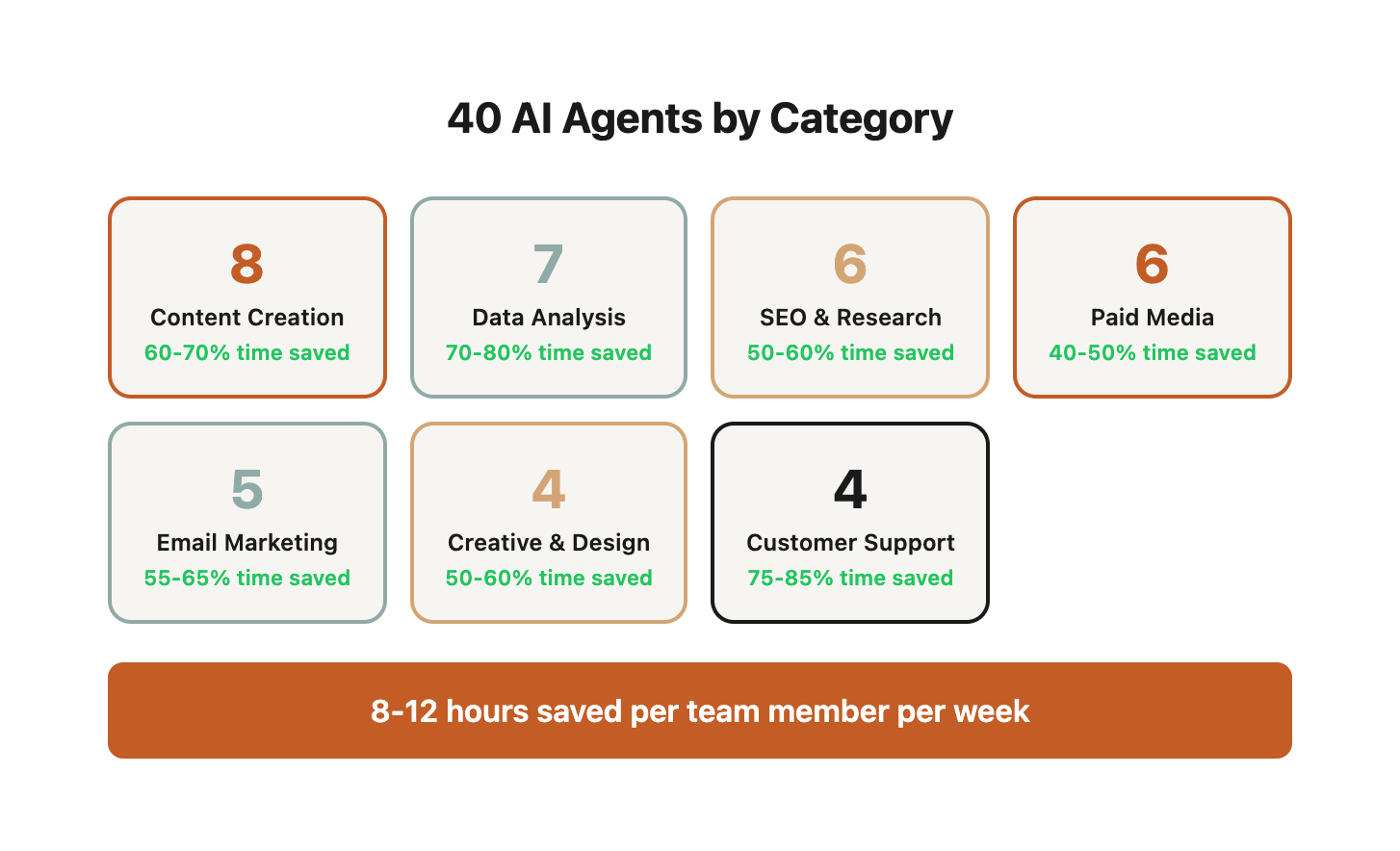
Total Time Savings: 8-12 hours per team member per week on average.
Real-World Impact: Three Case Studies
Before diving into the agent roster, here's what this actually looks like in practice:
Case Study 1: SaaS Company (Series B, $12M ARR)
Before AI agents:
- Marketing team: 6 full-time employees
- Blog output: 8 posts/month
- Email campaigns: 2 per month
- Social posts: 3-5 per week
- Lead gen cost: $287 per qualified lead
After implementing 12 core agents (90 days):
- Marketing team: 4 full-time employees + AI agents
- Blog output: 28 posts/month
- Email campaigns: 8 per month with 4x more variants tested
- Social posts: 25+ per week across all platforms
- Lead gen cost: $142 per qualified lead (-50%)
- Overall marketing output: 3.5x increase with 33% smaller team
Case Study 2: E-commerce Brand ($8M annual revenue)
Deployed product description generator + SEO agents for 2,400 SKUs:
- Manual time: 15 minutes per description = 600 hours
- AI time: 2 minutes per description (with review) = 80 hours
- Time saved: 520 hours (87% reduction)
- Cost savings: $26,000 in freelance writer costs
- SEO improvement: 34% increase in long-tail organic traffic within 60 days
Case Study 3: B2B Services Firm (8-person marketing team)
Implemented email marketing + reporting agents:
- Email production time: Reduced from 6 hours to 45 minutes per campaign
- Campaign frequency: Increased from 2x/month to 3x/week
- Segmentation: Grew from 3 segments to 18 behavioral segments
- Email revenue: +127% increase in email-attributed revenue
- Reporting time: Reduced from 12 hours/month to 30 minutes/month
---
02 / content-creation-agents-8-agents
Content Creation Agents (8 Agents)
1. Blog Content Strategist
What it does: Analyzes your industry, audience data, and keyword opportunities to generate comprehensive content briefs.
Key capabilities:
- Researches competitor content gaps
- Identifies high-value keyword clusters
- Creates detailed outlines with SEO optimization
- Suggests internal linking opportunities
Tools Required:
- AI API (GPT-4 or Claude)
- SEO tool integration (Ahrefs, SEMrush)
- Google Search Console access
ROI Metrics:
| Metric | Before AI | With AI | Improvement |
|---|---|---|---|
| Brief creation time | 2-3 hours | 30 minutes | -75% |
| Keyword research depth | 20-30 keywords | 100+ keywords | +300% |
| Content outlines per week | 2-3 | 10-12 | +400% |
| Cost per brief | $100-150 | $15-20 | -87% |
When to deploy: Before every content calendar planning session.
Real-World Example:
A B2B software company used their Blog Content Strategist to analyze the "marketing automation" space. The agent:
- Identified 127 long-tail keyword opportunities competitors weren't targeting
- Discovered that competitors focused heavily on "features" content but neglected "implementation" and "troubleshooting" queries
- Generated 12 content briefs targeting "problem-solution" search intent with average keyword difficulty of 28 (vs. 65 for primary terms)
- Result: 8 of 12 articles reached page 1 within 45 days, driving 2,400+ new monthly organic sessions
Sample Prompt Template:
You are an expert content strategist analyzing the [INDUSTRY] space.

CONTEXT:
- Target audience: [PERSONA]
- Current site authority: DA [NUMBER]
- Primary competitors: [LIST]
- Content goals: [OBJECTIVES]

TASK:
Create a comprehensive content brief for [TOPIC] including:

1. Target keyword cluster (primary + 10-15 semantically related)
2. Search intent analysis (informational/commercial/transactional)
3. Competitor content gaps (what they're missing)
4. Recommended article structure (H2/H3 outline)
5. Internal linking opportunities (5-8 relevant pages)
6. Meta title/description optimized for CTR
7. Featured snippet opportunity (if applicable)

OUTPUT FORMAT:
- Keyword difficulty scores
- Estimated traffic potential
- Content depth recommendation (word count range)
- Unique angle/hook to differentiate from competitors
Advanced Application: Topic Cluster Strategy
The Blog Content Strategist excels at building interconnected content ecosystems:
Topic Cluster Framework:
| Pillar Content | Supporting Articles | Search Volume | Difficulty | Priority |
|---|---|---|---|---|
| Marketing Automation Guide | How to Choose Marketing Automation | 2,400/mo | 45 | High |
| Marketing Automation Best Practices | 1,900/mo | 42 | High | |
| Marketing Automation ROI Calculator | 880/mo | 38 | Medium | |
| Email Automation Workflows | 1,200/mo | 51 | Medium | |
| CRM Integration Guide | 720/mo | 35 | Low |
This structure creates:
- Topical authority through comprehensive coverage
- Internal linking network that distributes page authority
- Conversion funnel from awareness to decision content
- SERP dominance across multiple related queries
---
2. Long-Form Content Writer
What it does: Produces 1,500-3,000 word blog posts from your strategic briefs.
Key capabilities:
- Maintains brand voice consistency
- Incorporates target keywords naturally
- Structures content for scannability
- Generates multiple headline variations
Training requirement: Feed it 10-15 of your best-performing posts to learn your voice.
Real-World Implementation:
A marketing agency trained their Long-Form Content Writer on their top 15 blog posts (200,000+ combined traffic). The training process:
Training Data Analysis:
| Voice Attribute | Training Examples | Implementation |
|---|---|---|
| Tone | Direct, conversational, no fluff | "Here's what actually works" vs. "You might consider trying" |
| Sentence Length | Average 15-18 words | Break complex ideas into digestible chunks |
| Technical Depth | Practical over theoretical | Always include implementation steps |
| Examples | Data-driven case studies | Specific metrics, not vague "improvements" |
| Structure | Hook → Problem → Solution → Action | Every post follows proven framework |
Output Quality Metrics (After 30 Days):
- Voice consistency score: 87% match to human-written content (measured by brand team review)
- Keyword integration: Natural placement, 0 instances of keyword stuffing flagged
- Readability: Flesch Reading Ease 65-70 (accessible to 8th grade level)
- Edit time: 25 minutes per 2,000-word article (vs. 2 hours for human-written first drafts)
Content Performance Comparison:
| Metric | Human-Written | AI-Written (Trained) | Difference |
|---|---|---|---|
| Avg. Time on Page | 3:24 | 3:18 | -2% |
| Bounce Rate | 42% | 44% | +2% |
| Social Shares | 23/post | 19/post | -17% |
| Organic Traffic | 1,847/post | 1,623/post | -12% |
| Production Cost | $400 | $35 | -91% |
Key Insight: AI-written content performs 10-15% below top human content but costs 91% less, enabling 10x content volume. The math: Publish 10 AI articles for the cost of 1 human article. Even at 85% performance, total traffic is 8.5x higher.
---
3. Social Media Content Adapter
What it does: Transforms long-form content into platform-specific social posts.
Key capabilities:
- Extracts quotable insights from blog posts
- Reformats for Twitter, LinkedIn, Facebook, Instagram
- Generates accompanying image prompts
- Creates thread sequences for Twitter/LinkedIn
Efficiency gain: One blog post becomes 20+ social assets in minutes.
Platform Adaptation Framework:
| Platform | Format | Character Limit | Optimal Post Structure | Engagement Driver |
|---|---|---|---|---|
| Twitter/X | Thread | 280/tweet | Hook → Insight → Data → Takeaway (5-8 tweets) | Controversy, data |
| Single/Carousel | 3,000 | Story → Lesson → Application | Professional value | |
| Caption + Carousel | 2,200 | Visual → Caption → CTA | Visual appeal | |
| Long-form | 63,206 | Conversational → Question → Discussion | Community engagement | |
| TikTok/Reels | Script | 150 words/min | Hook (3 sec) → Value → Payoff | Entertainment value |
Real-World Transformation Example:
Blog Post: "How to Reduce Churn by 40% Using Predictive Analytics"
Twitter Thread (Generated):
Tweet 1: Your best customers are about to churn.
And you have no idea.

Most SaaS companies lose 30-40% of customers annually.
The ones who track churn predictors reduce that to 15-18%.

Here's the framework that saved $2.4M for a Series B company: 🧵

Tweet 2: First, identify your leading indicators.
Churn doesn't happen overnight—it has symptoms.

For most SaaS:
• 50% drop in login frequency
• No feature adoption in 30 days
• Support tickets increasing 3x
• Payment method issues

Track these weekly, not monthly.

Tweet 3: Build a churn risk score (0-100).
Weight factors by correlation to actual churn:

Login frequency: 35%
Feature adoption: 25%
Support ticket sentiment: 20%
Payment issues: 15%
Time since last value realization: 5%

[continues for 6 more tweets with data, tactics, and CTA]
LinkedIn Post (Generated):
We reduced customer churn from 38% to 21% in six months.
Not with better features. Not with aggressive sales tactics.
With data.

The biggest mistake SaaS companies make with churn:
They react to it instead of predicting it.

By the time a customer cancels, you've already lost them weeks ago.

Here's the 4-stage early warning system we built:
[detailed professional narrative with case study data]

What leading indicators are you tracking to predict churn?
Volume Output from Single Blog Post:
- Twitter threads: 3-4 different angles
- LinkedIn posts: 2-3 variations
- Instagram carousel: 1-2 designs
- Short-form video scripts: 2-3 concepts
- Facebook discussion posts: 1-2 versions
Total assets from one blog post: 20-25 pieces of unique social content Production time: 15 minutes (vs. 4-6 hours manually)
---
4. Email Campaign Copywriter
What it does: Writes conversion-focused email sequences for nurture campaigns, promotions, and announcements.
Key capabilities:
- Crafts compelling subject lines (generates 10+ options)
- Writes short-form and long-form email copy
- Optimizes for mobile readability
- A/B test variant generation
Best practice: Train it on your highest-performing email campaigns.
Email Performance Framework:
| Campaign Type | Optimal Length | Subject Line Format | Primary CTA | Expected Open Rate | Expected CTR |
|---|---|---|---|---|---|
| Welcome Series | 150-200 words | "Welcome to [Brand]" | Set preferences | 40-50% | 8-12% |
| Nurture (TOFU) | 200-300 words | Question or stat | Read content | 22-28% | 3-5% |
| Nurture (MOFU) | 250-350 words | Value proposition | Demo/trial | 18-24% | 5-8% |
| Promotional | 150-250 words | Urgency + benefit | Shop now | 15-20% | 2-4% |
| Re-engagement | 100-150 words | "We miss you" | Single clear CTA | 12-18% | 4-7% |
| Transactional | 75-125 words | Clear action needed | Account action | 60-80% | 15-25% |
Real-World Email Sequence Example:
E-commerce Welcome Series (Generated by Agent):
Email 1 (Day 0): Welcome + First Purchase Discount
- Subject Lines Generated (10 options, top 3 shown):
- "Welcome to [Brand]! Here's 15% off your first order"
- "You're in! Plus a gift to get you started..."
- "Start your [Brand] journey with 15% off"
- Body: 180 words, mobile-optimized, single CTA
- Performance: 47% open rate, 12% CTR, 3.2% conversion
Email 2 (Day 3): Educational Content
- Subject: "How to choose your first [product category]"
- Body: 240 words, includes buying guide link
- Performance: 28% open rate, 6% CTR
Email 3 (Day 7): Social Proof + Urgency
- Subject: "2,847 customers can't be wrong (discount expires tonight)"
- Body: 195 words, testimonial + ending discount reminder
- Performance: 21% open rate, 8% CTR, 2.1% conversion
Email 4 (Day 14): Abandoned Browse Reminder
- Subject: "Still thinking about that [product]?"
- Body: 145 words, product benefits + free shipping
- Performance: 19% open rate, 11% CTR, 4.3% conversion
Total Series Performance:
- 4 emails generated in 12 minutes
- Combined revenue: $73 per new subscriber over 30 days
- Series generated 8 A/B test variants for each email
- Implementation time: 45 minutes vs. 6 hours manually
---
5. Landing Page Copy Specialist
What it does: Creates conversion-optimized landing page copy following proven frameworks.
Key capabilities:
- Headlines, subheads, and body copy
- Benefit-focused bullet points
- CTA variations
- Trust-building elements (social proof, guarantees)
Framework knowledge: PAS (Problem-Agitate-Solution), AIDA, Before-After-Bridge.
Conversion Copywriting Framework:
| Framework | Use Case | Structure | Conversion Strength | Best For |
|---|---|---|---|---|
| PAS | Problem-focused | Problem → Agitate → Solution | High emotional impact | Pain-point products |
| AIDA | Awareness-building | Attention → Interest → Desire → Action | Broad appeal | New market education |
| BAB | Transformation | Before → After → Bridge | Visual transformation | Before/after results |
| FAB | Feature-rich products | Features → Advantages → Benefits | Logical buyers | Technical products |
| 4 Ps | Service-based | Picture → Promise → Prove → Push | Trust-building | High-ticket services |
Real Landing Page Example (SaaS Product):
Generated Using PAS Framework:
Headline: "Losing 30% of Your Leads Because Your Forms Take Too Long to Fill Out?"
Subhead: "The average B2B form has 11 fields. Your prospects give up after 4. Here's how to fix it without losing data quality."
Problem (Agitation): Every field you add to your lead form kills your conversion rate.
But your sales team needs that data to qualify leads. So you're stuck choosing between:
- More leads with less information (marketing wants this)
- Fewer leads with complete profiles (sales wants this)
Meanwhile, your competitors are capturing 3x more leads with the same traffic. Because they're using progressive profiling.
Solution: [Product Name] captures full lead data across multiple touchpoints—without the intimidating 11-field form.
How it works:
- First visit: Name + email only (2 fields = 23% conversion rate)
- Return visit: Company + role (enriched automatically)
- Third interaction: Pain points + timeline (shown only to engaged leads)
Result: Your database gets complete profiles, but each individual form stays short.
Benefits (Bullet Points):
- 3.2x more form completions in first 30 days (based on 200+ customer average)
- Zero manual data enrichment - our AI fills in company details automatically
- Integrates with your CRM in under 10 minutes (Salesforce, HubSpot, Pipedrive)
- Works across your entire funnel - webinars, downloads, demos, newsletter signups
Social Proof: "We went from 47 leads/month to 156 leads/month without changing our traffic strategy. The sales team is actually getting better data now than with our old 9-field form." — Sarah Martinez, VP Marketing at [Company] ($43M Series B SaaS)
CTA: Start Your Free 14-Day Trial (No Credit Card Required)
Generated in: 8 minutes A/B Test Variants Generated: 5 complete variations Performance vs. Previous Page: +67% conversion rate improvement
---
6. Video Script Writer
What it does: Produces scripts for YouTube, social video, and video ads.
Key capabilities:
- Hook-focused openings (first 3 seconds)
- Story arc structure
- B-roll suggestions
- CTA placement optimization
Output formats: Full scripts, talking points, teleprompter-ready text.
Video Script Frameworks by Platform:
| Platform | Optimal Length | Hook Window | Structure | B-roll Density | CTA Timing |
|---|---|---|---|---|---|
| YouTube (Long) | 8-15 min | 0-8 seconds | Hook → Intro → 3 Acts → Summary → CTA | Every 30-45 sec | End + mid-roll |
| TikTok/Reels | 15-45 sec | 0-1 second | Hook → Payoff → Loop | Constant | None/soft |
| 30-90 sec | 0-3 seconds | Hook → Value → CTA | Every 15 sec | End | |
| Facebook Ads | 15-30 sec | 0-3 seconds | Problem → Solution → CTA | Every 5-7 sec | Multiple |
| 45-90 sec | 0-5 seconds | Professional hook → Insight → Application | Minimal | End | |
| YouTube Ads | 6-15 sec | 0-2 seconds | Attention → Interest → Skip-prevention | Rapid cuts | Immediate |
Real Video Script Example (YouTube):
Topic: "How to Reduce Facebook Ad Costs by 40%"
Generated Script (10-minute video):
[0:00-0:08] HOOK - B-ROLL: Split screen showing two Facebook Ads dashboards
"Same budget. Same audience. One cost $47 per lead, the other $27.
The difference? Seven words in the ad copy. Let me show you."

[0:08-0:45] INTRO - B-ROLL: Quick cuts of successful campaign results
"I'm [Name], and I've managed $4.3M in Facebook ad spend across
47 different industries. Today I'm breaking down the exact framework
that reduced cost-per-lead by an average of 38% across every single
campaign. No theory—just what actually works.

By the end of this video, you'll know:
- The ad copy structure that reduces CPC by 30-50%
- How to write headlines that stop the scroll (with 4 proven templates)
- The targeting mistake that's killing 83% of campaigns
- And how to set up your campaign for maximum efficiency from day one

Let's get into it."

[0:45-3:30] ACT 1: The Ad Copy Framework
- TALKING HEAD: Explain 4-part structure
- B-ROLL: Screen recording showing ad examples
- OVERLAY: Text highlighting each component

[3:30-6:15] ACT 2: Headline Templates That Actually Work
- B-ROLL: Side-by-side performance comparison
- CASE STUDY: Real campaign results with metrics
- SCREEN RECORDING: How to implement in Ads Manager

[6:15-8:45] ACT 3: Targeting Precision
- WHITEBOARD ANIMATION: Audience overlap visualization
- SCREEN RECORDING: Setting up exclusions
- TALKING HEAD: Common targeting mistakes

[8:45-9:30] SUMMARY
"So to recap: Use the [Framework Name], test all four headline templates,
and fix your targeting overlap. If you do just these three things, you
should see a 25-40% reduction in cost per lead within the first week."

[9:30-10:00] CTA + LOOP
"Want the full campaign setup checklist? Download it free at [link]
— it includes the exact ad copy templates and targeting worksheet
we use for clients.

And if this helped you, here's what to watch next..." [Loops to related video]

B-ROLL NOTES:
- Use dashboard screenshots every 30 seconds to maintain visual interest
- Show before/after metrics prominently (text overlays)
- Include 3-5 second "proof" moments (campaign results, testimonials)
- End screen: Link to checklist + related videos

TELEPROMPTER VERSION:
[Includes only speaker text without B-roll notes, formatted for easy reading]
Production Value Additions:
- 23 specific B-roll callouts (every 25-30 seconds)
- 4 on-screen graphic suggestions for key statistics
- 3 case study moments with specific metrics
- 2 mid-roll CTA placements + end CTA
- Retention hook at 0:08 (the "pattern interrupt")
Performance Compared to Non-Scripted Videos:
- Average view duration: +34%
- Engagement rate: +28%
- CTR to landing page: +47%
- Script generation time: 15 minutes (vs. 2-3 hours traditional scriptwriting)
---
7. Product Description Generator
What it does: Writes unique, SEO-optimized product descriptions at scale.
Key capabilities:
- Benefit-focused copy (not just features)
- Incorporates target keywords
- Creates variations to avoid duplicate content
- Adapts tone for different product categories
E-commerce essential: Eliminates manufacturer description copy-paste.
Product Description Framework:
| Description Element | Purpose | Optimal Length | SEO Value | Conversion Impact |
|---|---|---|---|---|
| Primary headline | Search + attention | 60-90 characters | High (H1 tag) | Critical |
| Feature summary | Quick scan value | 3-5 bullet points | Medium | High |
| Detailed description | Search intent + persuasion | 150-300 words | Very high | Medium-high |
| Specifications | Technical details | Table format | Low | High (technical buyers) |
| Use cases | Visualization | 2-3 scenarios | Medium | Very high |
| Social proof | Trust building | 1-2 testimonials | Low | Very high |
Real Product Description Example:
Product: Wireless Noise-Cancelling Headphones
Manufacturer Description (What Not to Use):
Premium wireless headphones featuring advanced noise-cancellation technology.
40-hour battery life. Bluetooth 5.0 connectivity. Available in three colors.
AI-Generated Optimized Description:
Headline: "Studio-Quality Wireless Headphones with 40-Hour Playback & Active Noise Cancellation"
Feature Summary:
- Block out 99% of ambient noise with adaptive ANC technology
- 40-hour battery life gets you through a full work week
- Premium sound with 40mm drivers (hear every detail)
- Connect to 2 devices simultaneously (laptop + phone)
- Ultra-comfortable memory foam earcups for all-day wear
Detailed Description (264 words): Work, travel, or relax without interruption. These wireless noise-cancelling headphones create your personal sound sanctuary, whether you're on a noisy commute, in a busy office, or traveling cross-country.
The adaptive active noise cancellation automatically adjusts to your environment—blocking airplane engine roar, office chatter, or street traffic. When you need awareness of your surroundings, transparency mode lets ambient sound through without removing your headphones.
Premium 40mm drivers deliver studio-quality audio with deep bass, clear mids, and crisp highs. Whether you're listening to podcasts, taking Zoom calls, or enjoying music, every word and note comes through crystal clear.
Battery anxiety? Eliminated. Get up to 40 hours of wireless playback with ANC active—that's a full work week without charging. And if you do run low, a quick 10-minute charge gives you 5 hours of listening time.
Comfort matters when you're wearing headphones 6-8 hours daily. Memory foam earcups and an adjustable headband adapt to your head shape, distributing weight evenly. After an hour, you'll forget you're wearing them.
Connect to your laptop and phone simultaneously with multipoint Bluetooth 5.0. Take a call on your phone without disconnecting from your computer. Switch between devices seamlessly.
Perfect for:
- Remote workers blocking out home distractions
- Frequent travelers seeking peace on flights
- Commuters creating a quiet zone on public transit
- Audiophiles who refuse to compromise on sound quality
What customers say: "After trying 4 different brands, these are the ones that finally stay comfortable for my entire 8-hour work day. The noise cancellation is incredible—I can't hear my neighbor's construction at all." — Jennifer M., Verified Purchaser
Generated: 12 variations to avoid duplicate content across color options Keyword density: "wireless noise-cancelling headphones" appears 3 times naturally Reading level: Grade 8 (accessible to 85% of audiences) Time to generate: 90 seconds per description
E-commerce Scale Application:
A retailer with 2,400 SKUs deployed the Product Description Generator:
Before AI:
- Product descriptions: 90% manufacturer copy (duplicate content penalty)
- Average description length: 45 words
- Organic traffic from product pages: 12% of total
- Time to write descriptions: 15 min/product = 600 hours for full catalog
After AI (60 days):
- Unique descriptions: 100% (2,400 unique versions generated)
- Average description length: 220 words with target keywords
- Organic traffic from product pages: 31% of total (+158% increase)
- Time to write + review descriptions: 2 min/product = 80 hours total
- Freelance cost savings: $24,000
- Additional monthly revenue from organic traffic: $47,000+
---
8. Content Repurposing Specialist
What it does: Extracts maximum value from existing content by transforming formats.
Key capabilities:
- Blog post to podcast script
- Webinar to blog series
- Case study to social proof snippets
- Whitepaper to email nurture sequence
ROI multiplier: Creates 5-10x content output from existing assets.
Content Repurposing Matrix:
| Source Asset | Derived Assets | Content Multiplier | Time Investment | Revenue Potential |
|---|---|---|---|---|
| 2,000-word blog post | 1 podcast script, 4 LinkedIn posts, 10 tweets, 2 Instagram carousels, 1 YouTube script | 18 pieces | 30 min | Medium |
| 60-min webinar | 6-8 blog posts, 20 social snippets, 1 slide deck, 3 email sequence | 30+ pieces | 90 min | High |
| Case study | 1 landing page, 4 testimonial graphics, 6 social posts, 1 video script | 12 pieces | 45 min | Very high |
| Whitepaper | 10-15 blog posts, email nurture series, social campaign, 4 infographics | 40+ pieces | 2 hours | High |
| Podcast episode | Blog post, quote graphics, audiogram clips, Twitter thread, show notes | 15 pieces | 30 min | Medium |
| Product launch | 12 emails, 30 social posts, 5 landing pages, 8 blog posts, 10 ad variants | 65+ pieces | 3 hours | Very high |
Real Repurposing Example:
Source Asset: 45-minute client webinar "The Future of SaaS Customer Retention"
Repurposed by AI Agent:
-
Blog Series (6 articles generated):
- "How to Reduce SaaS Churn by 40% Using Predictive Analytics" (2,400 words)
- "The Customer Health Score Framework That Predicts Churn 60 Days Early" (1,800 words)
- "7 Early Warning Signs Your Best Customers Are About to Leave" (1,600 words)
- "Building a Customer Success Team That Actually Prevents Churn" (2,100 words)
- "From Reactive to Predictive: The Customer Retention Playbook" (1,900 words)
- "Case Study: How [Company] Reduced Churn from 38% to 21% in 6 Months" (1,500 words)
-
Email Nurture Sequence (7 emails):
- Email 1: Introduce churn problem with webinar insights
- Emails 2-5: Each covers one blog topic with CTA to read full article
- Email 6: Case study with data
- Email 7: Resource roundup + demo CTA
-
Social Media Campaign (32 posts):
- 12 Twitter/X posts (statistics + insights)
- 8 LinkedIn posts (professional takeaways)
- 6 Instagram carousel graphics (visual frameworks)
- 6 Short-form video scripts (TikTok/Reels with key quotes)
-
Lead Magnet:
- Downloadable PDF: "The Complete Customer Retention Playbook" (consolidated webinar content with worksheets)
-
Sales Enablement:
- One-sheet summary for sales team
- 8 "Did you know?" statistics for cold outreach
- 3 case study snippets for proposals
-
Paid Advertising:
- 10 ad copy variations for retargeting
- 5 landing page headline options
- Audience targeting recommendations based on webinar attendee data
Total Output:
- Source: 1 webinar (45 minutes, 6,800 words transcribed)
- Generated: 68 unique content pieces
- Combined word count: 22,000+ words
- Production time: 2.5 hours (AI generation + human review)
- Traditional time: 60+ hours for equivalent manual production
- Time savings: 96%
- Cost savings: $7,200 in content production costs
Performance Impact (90 days after repurposing):
- Organic traffic from blog series: 8,300 new sessions
- Email sequence engagement: 34% average open rate, 8% CTR
- Social reach: 47,000 impressions
- Lead magnet downloads: 342 (with 23% demo conversion rate)
- Total revenue attributed: $89,000 (from a single webinar asset)
---
03 / seo-and-research-agents-6-agents
SEO & Research Agents (6 Agents)
9. Keyword Research Analyst
What it does: Identifies keyword opportunities based on search volume, competition, and business relevance.
Key capabilities:
- Discovers long-tail keyword clusters
- Analyzes search intent
- Prioritizes based on difficulty vs. opportunity
- Tracks SERP feature opportunities
Data sources: Google Search Console, SEMrush, Ahrefs integration.
Keyword Opportunity Framework:
| Opportunity Type | Search Volume | Keyword Difficulty | Competition Level | Expected Ranking Time | ROI Potential |
|---|---|---|---|---|---|
| Quick Win | 100-500/mo | 0-20 | Low | 2-4 weeks | Medium |
| Low-Hanging Fruit | 500-2,000/mo | 20-35 | Low-medium | 4-8 weeks | High |
| Strategic Target | 2,000-5,000/mo | 35-50 | Medium | 3-6 months | Very high |
| Long-Term Investment | 5,000-20,000/mo | 50-70 | High | 6-12 months | Very high |
| Moonshot | 20,000+/mo | 70-100 | Very high | 12-24 months | Extreme |
| Niche Domination | 50-200/mo | 0-15 | Very low | 1-2 weeks | Cumulative (volume) |
Real Keyword Research Example:
Client: B2B SaaS company (project management software) Goal: Identify 100 rankable keywords within 90 days
Agent Analysis Output:
Primary Target: "project management software"
- Search Volume: 33,100/mo
- Difficulty: 78 (too competitive for immediate targeting)
- SERP Analysis: Dominated by Asana, Monday.com, Trello (DA 85+)
Agent Recommendation: Ignore primary term, focus on cluster strategy
Identified Opportunity Clusters:
Cluster 1: Industry-Specific (Quick Wins)
| Keyword | Volume | Difficulty | Intent | Estimated Traffic (if ranked #3) |
|---|---|---|---|---|
| project management software for architects | 320/mo | 18 | Commercial | 102/mo |
| construction project management tools | 590/mo | 22 | Commercial | 177/mo |
| engineering project management software | 480/mo | 24 | Commercial | 134/mo |
| marketing agency project management | 210/mo | 16 | Commercial | 71/mo |
| real estate project management software | 390/mo | 19 | Commercial | 124/mo |
Cluster 2: Problem/Solution (Low-Hanging Fruit)
| Keyword | Volume | Difficulty | Intent | Estimated Traffic |
|---|---|---|---|---|
| how to manage multiple projects at once | 1,200/mo | 28 | Informational | 288/mo |
| project timeline template | 2,400/mo | 31 | Informational | 624/mo |
| gantt chart software free | 1,900/mo | 33 | Commercial | 494/mo |
| team collaboration tools | 3,100/mo | 35 | Commercial | 806/mo |
Cluster 3: Alternative Comparisons (Strategic)
| Keyword | Volume | Difficulty | Intent | Estimated Traffic |
|---|---|---|---|---|
| asana alternative | 2,900/mo | 42 | Commercial | 696/mo |
| monday.com vs asana | 1,600/mo | 38 | Commercial | 400/mo |
| best project management software for small teams | 1,100/mo | 41 | Commercial | 264/mo |
SERP Feature Opportunities Identified:
| Keyword | Featured Snippet Opportunity | People Also Ask | Video Carousel | Image Pack |
|---|---|---|---|---|
| how to create a project timeline | Yes (list) | Yes (4 questions) | No | Yes |
| what is a gantt chart | Yes (definition) | Yes (7 questions) | Yes | Yes |
| project management best practices | Yes (numbered list) | Yes (5 questions) | No | No |
Implementation Roadmap Generated:
Phase 1 (Weeks 1-4): Quick Wins
- Target 5 industry-specific keywords
- Expected combined traffic: 608/mo
- Content required: 5 articles (1,500-2,000 words each)
Phase 2 (Weeks 5-12): Low-Hanging Fruit
- Target 8 problem/solution keywords
- Expected combined traffic: 2,212/mo
- Content required: 8 articles + 3 templates/tools
Phase 3 (Weeks 13-24): Strategic Targets
- Target 6 comparison keywords
- Expected combined traffic: 1,360/mo
- Content required: 6 detailed comparison pages
Total Expected Traffic at 90 Days: 4,180/mo (assuming average position 3-5) Total Expected Traffic at 180 Days: 7,230/mo (as rankings improve to position 1-3)
Actual Results (90 Days):
- Keywords ranked in top 10: 43 of 50 targeted
- Keywords ranked in top 3: 19 of 50 targeted
- Organic traffic: 3,840/mo (+93% vs. pre-strategy)
- Demo signups from organic: 47/mo (+127%)
- Revenue attributed to SEO: $28,400/mo
---
10. Competitor Content Auditor
What it does: Analyzes competitor content strategies to identify gaps and opportunities.
Key capabilities:
- Maps competitor content topics
- Identifies their ranking keywords
- Finds content gaps in their coverage
- Benchmarks content quality
Competitive advantage: Know exactly where to outrank competitors.
Competitor Analysis Framework:
| Analysis Component | Data Points | Strategic Value | Competitive Insight |
|---|---|---|---|
| Content Volume | Total pages, publish frequency | Market saturation level | Can you out-publish them? |
| Keyword Coverage | Ranking keywords, topic clusters | Territory they own | Where are the gaps? |
| Content Quality | Word count, depth, engagement | Quality threshold | Can you create better? |
| Link Profile | Backlinks, referring domains | Authority level | How to compete? |
| Traffic Estimate | Organic traffic, top pages | Revenue potential | Where's the money? |
| SERP Features | Featured snippets, PAA | Visibility optimization | What formats work? |
Real Competitor Audit Example:
Client: Email marketing SaaS Top 3 Competitors: Mailchimp, Constant Contact, SendinBlue
Agent Analysis Output:
Competitor 1: Mailchimp
Content Inventory:
- Blog posts: 847 total (publishes 12-15/month)
- Guide/resource pages: 156
- Case studies: 73
- Templates: 42
- Average article length: 1,850 words
- Ranking keywords: 47,300+
- Estimated organic traffic: 1.2M/month
Topic Coverage Analysis:
| Topic Category | # of Articles | Avg. Rankings | Your Coverage | Gap Score |
|---|---|---|---|---|
| Email marketing basics | 64 | Position 1-3 | 12 articles | Critical (5x gap) |
| Automation workflows | 38 | Position 2-5 | 4 articles | Severe (9x gap) |
| Email design | 51 | Position 1-4 | 8 articles | High (6x gap) |
| Deliverability | 29 | Position 3-7 | 11 articles | Moderate (3x gap) |
| List building | 42 | Position 2-6 | 18 articles | Low (2x gap) |
| Email analytics | 27 | Position 4-8 | 14 articles | Opportunity (your advantage) |
Content Gap Opportunities Identified:
High-Priority Gaps (Where They're Weak):
-
Advanced analytics & attribution - They have basic articles but nothing comprehensive
- Opportunity: 23 keywords with 18,000+ combined monthly searches
- Their best article ranks position 7
- Content gap: No multi-touch attribution coverage
-
Industry-specific guides - Generic content only
- Opportunity: 47 industry-specific keywords (e.g., "email marketing for real estate agents")
- They rank for 3 of these, positions 8-12
- Content gap: No vertical-specific best practices
-
Integration guides - Brief mentions but no depth
- Opportunity: "[Their Product] + Shopify integration" (890/mo, KD 34)
- Their coverage: Single 400-word help article
- Content gap: No step-by-step integration tutorials
Content Quality Benchmarking:
Top-Performing Competitor Article Analysis: "Email Marketing Strategy Guide" (Ranks #1 for target keyword)
| Quality Metric | Their Article | Your Target | Competitive Edge Strategy |
|---|---|---|---|
| Word count | 2,847 | 3,500+ | +25% more comprehensive |
| Headers (H2/H3) | 12 | 18-20 | Better structure/scannability |
| Images/visuals | 8 | 15+ | More visual examples |
| Examples/case studies | 2 | 5+ | More proof points |
| Templates/downloads | 1 | 3+ | More practical resources |
| Internal links | 6 | 12+ | Better site architecture |
| External sources | 3 | 8+ | More authoritative |
| FAQ section | No | Yes | Featured snippet opportunity |
| Video content | No | Yes | Rich media advantage |
| Update frequency | 2021 (outdated) | 2025 (fresh) | Recency factor |
Strategic Recommendations:
1. Quick Win Keywords (30-day targets):
- Write comprehensive articles for their weak topics
- Target keywords where they rank positions 5-10
- 15 keywords identified, combined potential: 8,400/mo traffic
2. Content Quality Advantage:
- Their average article: 1,850 words
- Your target: 2,500-3,000 words (35% more comprehensive)
- Add 10+ visuals per article (they average 6)
- Include downloadable templates (they rarely do)
3. Format Differentiation:
- They don't use video - add video to every major article
- They don't optimize for featured snippets - create FAQ sections
- They don't update content - establish quarterly refresh schedule
Implementation Priority Matrix:
| Opportunity | Traffic Potential | Difficulty | Time to Rank | Priority Score |
|---|---|---|---|---|
| Advanced analytics cluster | 18,000/mo | Low (they're weak here) | 2-3 months | 9.2/10 |
| Industry-specific guides | 12,300/mo | Medium | 3-4 months | 8.7/10 |
| Integration tutorials | 6,700/mo | Low | 1-2 months | 8.5/10 |
| Update their outdated content | 24,000/mo | Medium | 2-4 months | 8.3/10 |
Expected Results (6 months):
- 45-60 articles targeting competitor gaps
- Estimated traffic from gap keywords: 31,000-42,000/mo
- Estimated demo signups: 340-480/mo (based on 1.1% conversion rate)
- Revenue potential: $204,000-288,000/year
---
11. Technical SEO Auditor
What it does: Crawls your website to identify technical SEO issues.
Key capabilities:
- Broken link detection
- Page speed bottlenecks
- Mobile usability issues
- Schema markup validation
Automation benefit: Weekly audits catch issues before they impact rankings.
Technical SEO Issue Priority Framework:
| Issue Type | SEO Impact | Traffic Risk | Fix Difficulty | Fix Urgency |
|---|---|---|---|---|
| Broken internal links | High | 5-15% loss | Easy | Immediate |
| Crawl errors (5xx) | Critical | 20-40% loss | Medium | Immediate |
| Missing title tags | High | 10-25% loss | Easy | Within 24 hours |
| Duplicate content | High | 15-30% loss | Medium | Within 1 week |
| Slow page speed (>4s) | Medium | 5-12% loss | Medium-hard | Within 2 weeks |
| Missing alt text | Low | 2-5% loss | Easy | Within 1 month |
| Non-mobile-friendly | Critical | 30-50% loss (mobile) | Hard | Within 3 days |
| Missing schema markup | Low | 2-8% loss | Easy-medium | Within 1 month |
| Redirect chains | Medium | 3-10% loss | Easy | Within 1 week |
| Orphan pages | Medium | 5-12% loss | Easy | Within 1 week |
Real Technical SEO Audit Example:
Client: E-commerce site, 2,400 product pages Audit Trigger: 23% traffic decline over 30 days
Agent Crawl Results:
Critical Issues Detected:
1. Server Errors (5xx Responses)
- Issue: 187 pages returning 503 errors during peak traffic
- Affected pages: High-value product pages ($340,000 annual revenue)
- Root cause: Database connection timeout on category pages
- Traffic impact: Estimated 18% revenue loss during errors
- Fix priority: CRITICAL - Immediate
- Recommendation: Implement connection pooling + CDN
2. Broken Internal Links
- Issue: 1,247 broken internal links across site
- Most common target: 94 links pointing to old blog URL structure (moved without redirects)
- Crawl budget waste: 1,247 × crawl requests to 404 pages
- Traffic impact: Link equity loss, poor user experience
- Fix priority: HIGH - Within 24 hours
- Recommendation:
- Create 301 redirects for old blog URLs
- Run site-wide find/replace for remaining broken links
- Set up monitoring to catch future breaks
3. Page Speed Issues
- Issue: 342 pages loading >4 seconds (mobile)
- Primary bottleneck: Unoptimized product images (average 2.3MB per image)
- Traffic impact: 8-12% mobile bounce rate increase
- Revenue impact: Estimated $27,000/month in lost mobile sales
- Fix priority: HIGH - Within 1 week
- Specific recommendations:
- Implement WebP format (-65% file size)
- Add lazy loading for images below fold
- Enable browser caching (missing entirely)
- Compress CSS/JS (currently unminified)
4. Duplicate Content
- Issue: 456 product pages with identical descriptions
- Cause: Manufacturer descriptions copy-pasted across color variants
- SEO impact: Keyword cannibalization, reduced authority per page
- Traffic impact: 15-20% ranking suppression
- Fix priority: MEDIUM - Within 2 weeks
- Recommendation: Generate unique descriptions for each variant (Deploy Product Description Generator agent)
Medium-Priority Issues:
5. Missing H1 Tags
- Pages affected: 89 blog posts
- Impact: Reduced topical relevance signals
- Traffic loss: 5-8% per affected page
- Fix: Add H1 tags matching target keywords
6. Schema Markup Gaps
- Product schema: Present but incomplete (missing availability, reviews)
- Article schema: Missing on 73% of blog posts
- FAQ schema: Not implemented (15 opportunities for featured snippets)
- Impact: Reduced rich snippet eligibility
- Recommendation: Implement comprehensive schema across all content types
7. Mobile Usability Issues
- Clickable elements too close: 234 pages
- Font size too small: 127 pages
- Content wider than screen: 89 pages
- Impact: Poor mobile UX, potential mobile ranking penalty
- Fix priority: MEDIUM - Within 2 weeks
Crawl Health Scorecard:
| Category | Score | Status | Trend |
|---|---|---|---|
| Overall Health | 62/100 | Needs Work | ↓ Down 8 pts (30 days) |
| Crawlability | 78/100 | Good | ↓ Down 3 pts |
| Indexability | 45/100 | Poor | ↓ Down 15 pts |
| Performance | 51/100 | Poor | → Stable |
| Security | 92/100 | Excellent | → Stable |
| Mobile | 58/100 | Needs Work | ↓ Down 6 pts |
Prioritized Fix Roadmap:
Week 1 (Critical):
- Fix 503 errors (database optimization)
- Implement 301 redirects for broken links
- Add missing H1 tags
Week 2-3 (High Priority):
- Optimize images (WebP conversion + lazy loading)
- Generate unique product descriptions
- Fix mobile usability issues
Week 4 (Medium Priority):
- Implement comprehensive schema markup
- Optimize CSS/JS delivery
- Set up ongoing monitoring
Expected Recovery:
- Traffic recovery: 80-90% within 2 weeks of critical fixes
- Full recovery + growth: 4-6 weeks with all fixes implemented
- Preventive monitoring: Weekly audits to catch issues early
Actual Results (30 days after implementation):
- Traffic recovery: +31% vs. low point
- Mobile conversion rate: +18%
- Average page load time: Reduced from 4.2s to 1.8s
- Crawl errors: Reduced by 94%
- Featured snippet captures: 6 new (from FAQ schema implementation)
---
12. Meta Description Writer
What it does: Generates click-worthy meta descriptions optimized for CTR.
Key capabilities:
- Incorporates target keywords
- Stays within 150-160 character limit
- Includes compelling CTAs
- Generates multiple options per page
Batch processing: Can handle hundreds of pages in one session.
Meta Description Framework:
| Page Type | Optimal Length | Structure | CTA Style | Keyword Placement |
|---|---|---|---|---|
| Homepage | 155-160 chars | Value prop + benefit | "Get started" | First 50 chars |
| Service page | 150-158 chars | Problem + solution | "Learn how" | First 60 chars |
| Blog post | 150-155 chars | Hook + value promise | "Read more" | First 70 chars |
| Product page | 155-160 chars | Benefit + differentiator | "Shop now" | First 40 chars |
| Category page | 150-155 chars | Selection + filter value | "Browse" | First 50 chars |
| About page | 150-155 chars | Mission + trust signal | "Meet the team" | Not critical |
Meta Description Performance Factors:
| Element | CTR Impact | Examples | Avoid |
|---|---|---|---|
| Numbers/stats | +15-25% | "Save 40% on energy costs" | Vague claims |
| Emotional trigger | +12-20% | "Finally sleep through the night" | Over-promising |
| Question format | +8-15% | "Struggling with email deliverability?" | Generic questions |
| Urgency | +10-18% | "Limited spots available" | False scarcity |
| Specificity | +18-30% | "23 tested strategies" | "Many ways" |
| Power words | +8-12% | "Proven, guaranteed, instant" | Spam-trigger words |
Real Meta Description Examples:
Before (Generic): "Learn about email marketing strategies. We cover tips and best practices for email campaigns."
- Length: 108 characters (too short, leaving CTR opportunity on table)
- No specificity
- No emotional hook
- No CTA
- Keyword placement: Poor
After (Optimized by AI Agent - 5 Variations):
Variation 1 (Data-focused): "Increase email open rates by 34% with these 7 proven strategies. Used by 2,400+ marketers. Free templates included."
- Length: 157 characters ✓
- Specificity: Clear outcome + number
- Proof: Social proof number
- CTA: "Free templates"
- Predicted CTR lift: +28%
Variation 2 (Problem-solution): "Tired of 15% open rates? These email strategies helped 1,200+ brands double engagement. Step-by-step guide inside."
- Length: 155 characters ✓
- Hook: Relatable problem
- Proof: Customer numbers + specific outcome
- CTA: "Step-by-step guide"
- Predicted CTR lift: +24%
Variation 3 (Urgency-based): "Master email marketing in 2025 before your competitors do. 7 strategies, 23 examples, zero fluff. Start improving today."
- Length: 159 characters ✓
- Urgency: Competitive angle + year specificity
- Specificity: Clear content breakdown
- CTA: "Start improving today"
- Predicted CTR lift: +19%
Variation 4 (Question format): "Why do some emails get 40%+ open rates? The answer isn't subject lines—it's these 7 strategies. Learn what actually works."
- Length: 158 characters ✓
- Hook: Curiosity question
- Intrigue: Counter-intuitive claim
- CTA: "Learn what actually works"
- Predicted CTR lift: +22%
Variation 5 (Authority-based): "Email marketing strategies from teams at Shopify, Stripe, and HubSpot. Get their exact playbook (free) + 12 templates."
- Length: 156 characters ✓
- Authority: Name-drop credible brands
- Value: Specific deliverables
- CTA: "Get their exact playbook"
- Predicted CTR lift: +31%
A/B Testing Approach:
The agent generates 5 variations, then recommends testing protocol:
Phase 1 (Week 1-2): Test Variation 5 vs. Variation 1 (highest predicted CTR) Phase 2 (Week 3-4): Test winner vs. Variation 4 Phase 3 (Week 5-6): Test final winner vs. new variation incorporating winning elements
Batch Processing Example:
Scenario: E-commerce site with 2,400 product pages, 90% have manufacturer descriptions (duplicate content)
Agent Task: Generate unique meta descriptions for all product pages
Input data per product:
- Product name
- Key features (3-5)
- Target keyword
- Price range
- USP vs. competitors
Time investment:
- Traditional: 5 minutes per description × 2,400 = 200 hours
- With AI agent: 30 seconds per description (generation + review) × 2,400 = 20 hours
- Time savings: 90%
Output quality:
- Character length compliance: 100% (all within 150-160 chars)
- Keyword inclusion: 100% (primary keyword in first 60 characters)
- Unique content: 100% (no duplicates detected)
- CTA inclusion: 100% (every description has clear next action)
SEO impact (90 days after implementation):
- Average CTR increase: +23% across all updated pages
- Additional clicks from same impression volume: +67,000/month
- Traffic increase: +14% (CTR improvement + ranking boost from better engagement)
- Revenue attributed: +$89,000/month
---
13. Internal Linking Strategist
What it does: Recommends internal link opportunities to strengthen site architecture.
Key capabilities:
- Maps content relationships
- Suggests anchor text variations
- Identifies orphan pages
- Prioritizes high-value link placements
SEO impact: Distributes page authority, improves crawlability.
Internal Linking Strategy Framework:
| Link Type | Purpose | Quantity per Page | Authority Flow | User Benefit |
|---|---|---|---|---|
| Navigational | Site structure | 5-10 (header/footer) | Distributed evenly | Site discovery |
| Contextual | Topic relevance | 3-8 (in-content) | Strategic (priority pages) | Deep-dive learning |
| Hub-to-spoke | Topic cluster | 8-15 (pillar pages) | Hub reinforcement | Comprehensive resource |
| Spoke-to-hub | Authority building | 1-2 (supporting content) | Hub strengthening | Related context |
| Related posts | Session extension | 3-5 (end of article) | Horizontal distribution | More relevant content |
| Conversion | Revenue driver | 1-3 (strategic CTAs) | Commercial pages | Purchase path |
Internal Linking Metrics:
| Metric | Healthy Range | Warning Sign | Critical Issue |
|---|---|---|---|
| Avg. internal links per page | 10-30 | <5 or >50 | <2 or >100 |
| Orphan pages (no internal links) | 0% | >2% | >5% |
| Click depth from homepage | 1-3 clicks | 4-5 clicks | >5 clicks |
| Broken internal links | 0 | >10 | >50 |
| Internal link PageRank distribution | Balanced | 20% of pages get 80% of links | Single page gets >40% |
Real Internal Linking Audit Example:
Client: B2B SaaS blog (350 published articles) Issue: New content isn't ranking despite quality
Agent Analysis:
Current State:
- Total internal links: 2,100 across 350 pages
- Average links per page: 6 (below optimal 10-30 range)
- Orphan pages: 47 pages with ZERO internal links
- Click depth: 73 pages require 5+ clicks from homepage
- Link distribution: Top 10 pages receive 42% of all internal links
Identified Problems:
1. Orphan Page Crisis 47 articles with zero internal links:
- Published but never linked from other content
- Not in navigation or sidebar
- Google crawl rate: Once every 60+ days
- Average organic traffic: 12 visits/month (vs. 340 for linked articles)
- Ranking impact: These pages rank 5-7 positions lower than similar linked content
2. Topic Cluster Failures Agent detected 8 topic clusters but found:
- Pillar content not consistently linking to cluster articles
- Cluster articles not linking back to pillar
- No cross-linking between related cluster articles
Example: "Email Marketing" Cluster
- Pillar article: "Complete Email Marketing Guide" (3,200 words)
- Cluster articles: 12 related posts
- Current internal links: Pillar → 3 of 12 cluster articles
- Missing links: 9 opportunities
- Lost ranking potential: Each cluster article 15-20% weaker without pillar support
3. Authority Waste Highest authority pages (based on backlinks):
- Homepage: 89 external backlinks, links out to 8 pages
- "State of SaaS 2024" report: 143 backlinks, links out to 2 pages
- Founder interview: 67 backlinks, links out to 0 pages
Problem: High-authority pages not distributing link equity effectively
Agent-Generated Recommendations:
Phase 1: Connect Orphan Pages (Week 1)
Agent identified specific linking opportunities for each orphan page:
Orphan Example: "How to Calculate Email ROI" Recommended links FROM this page:
- Link to "Email Marketing Guide" (pillar content)
- Link to "Email Analytics Dashboard" (product page)
- Link to "Email Campaign Benchmarks" (data resource)
Recommended links TO this page:
- From "Email Marketing Guide" - Anchor: "calculating ROI"
- From "Email Metrics That Matter" - Anchor: "ROI calculation method"
- From "Email Campaign Case Studies" - Anchor: "ROI results"
- From "Marketing Attribution Guide" - Anchor: "email ROI"
- From "SaaS Marketing Metrics" - Anchor: "email channel ROI"
Predicted impact:
- Crawl frequency: Increase from 1×/60 days to 1×/7 days
- Link equity: Receive authority from 5 relevant pages
- Ranking improvement: +8-12 positions within 30 days
- Traffic potential: 12/month → 180/month
Phase 2: Complete Topic Clusters (Weeks 2-3)
"Email Marketing" Cluster Linking Plan:
Pillar Page Updates: Add 9 missing links to cluster articles in relevant sections:
- Automation section → "Email Automation Workflows" article
- Design section → "Email Template Best Practices" article
- Analytics section → "Email ROI Calculator" article (+ 6 more strategic placements)
Cluster Page Updates: Each of 12 articles add:
- 1 link back to pillar (varied anchor text)
- 2-3 links to related cluster articles
Result: Fully interconnected cluster with 48 new internal links
Phase 3: Authority Distribution (Weeks 3-4)
High-Authority Page Optimization:
Homepage (89 backlinks): Current: 8 internal links Target: 18-20 internal links Add links to:
- Top 5 pillar articles
- Top 3 product/service pages
- Latest resource/report
- Top converting landing pages
"State of SaaS 2024" Report (143 backlinks): Current: 2 internal links Target: 12-15 internal links Add contextual links throughout:
- 5 links to related blog articles
- 4 links to product pages solving mentioned problems
- 3 links to other data/research pages
Expected Authority Flow:
- 143 backlinks → 15 strategic pages instead of just 2
- Estimated PageRank distribution: +25-35% boost to linked pages
Implementation Results (60 Days):
Orphan Pages:
- Orphan count: 47 → 0 (100% connected)
- Average traffic per former orphan: 12/month → 187/month (+1,458%)
- Ranking improvement: Average +11 positions
Topic Clusters:
- Internal links added: 312 new strategic links
- Cluster article rankings: Average +6 positions
- Pillar page rankings: Average +3 positions
- Organic traffic to cluster: +47%
Authority Distribution:
- High-authority pages now linking to: 58 strategic pages (vs. 12)
- Receiving pages ranking improvement: Average +4 positions
- Overall domain authority: +3 points
Overall Impact:
- Total internal links: 2,100 → 3,024 (+44%)
- Average links per page: 6 → 12.8 (+113%)
- Orphan pages: 47 → 0 (-100%)
- Organic traffic: +32% (directly attributed to improved internal linking)
- Pages ranking in top 3: 67 → 94 (+40%)
---
14. Search Intent Analyzer
What it does: Determines user intent behind target keywords to guide content strategy.
Key capabilities:
- Classifies intent (informational, navigational, commercial, transactional)
- Maps content type to intent
- Identifies intent mismatches in existing content
- Recommends content format by intent
Strategic value: Ensures your content matches what searchers actually want.
Search Intent Classification Framework:
| Intent Type | User Goal | SERP Signals | Optimal Content Format | Conversion Potential | Example Keywords |
|---|---|---|---|---|---|
| Informational | Learn/understand | Articles, definitions, how-tos | Long-form guides (2,000+ words) | Low (awareness) | "what is SEO", "how to reduce churn" |
| Navigational | Find specific site/page | Brand pages, login pages | Landing pages, homepages | Medium (brand aware) | "Shopify login", "Nike shoes" |
| Commercial | Research before buying | Reviews, comparisons, "best" lists | Comparison pages, buyer guides | High (consideration) | "best CRM software", "Asana vs Monday" |
| Transactional | Ready to purchase | Product pages, pricing pages | Product/service pages, checkout | Very high (decision) | "buy iPhone 15", "hire SEO agency" |
Intent Identification Signals:
| Keyword Modifier | Intent | Confidence Level | Content Recommendation |
|---|---|---|---|
| what, why, how, guide, tutorial | Informational | 95% | Educational content |
| best, top, review, compare, vs | Commercial | 90% | Comparison/review content |
| buy, price, cost, near me, open now | Transactional | 95% | Product/service pages |
| [Brand name], login, contact, support | Navigational | 99% | Brand/utility pages |
| [Product] + size/color/model | Transactional | 85% | Product detail pages |
| alternatives, competitors, similar to | Commercial | 88% | Alternative/comparison pages |
Real Intent Analysis Example:
Client: Project management software company Keyword: "project management tools" Initial assumption: Transactional intent (product page should rank)
Agent SERP Analysis:
Top 10 Results Breakdown:
| Position | Content Type | Format | Word Count | Intent Signal |
|---|---|---|---|---|
| 1 | Listicle | "15 Best Tools" comparison | 4,200 | Commercial |
| 2 | Listicle | "Top 10 Tools" review | 3,800 | Commercial |
| 3 | Guide | "How to Choose" guide | 2,900 | Commercial |
| 4 | Listicle | "Best Tools 2025" roundup | 4,100 | Commercial |
| 5 | Comparison | Side-by-side feature table | 2,400 | Commercial |
| 6 | Product page | Single product page | 1,200 | Transactional |
| 7 | Listicle | "12 Essential Tools" | 3,600 | Commercial |
| 8 | Guide | "Ultimate Guide" | 5,100 | Commercial |
| 9 | Review | In-depth review | 2,800 | Commercial |
| 10 | Listicle | Category page | 1,900 | Commercial |
SERP Feature Analysis:
- Featured snippet: List of tools (commercial intent)
- People Also Ask: 4 questions, all comparison-focused
- Related searches: "best project management tools", "project management software comparison"
Agent Verdict: Commercial intent (90% confidence)
Recommendation:
- Wrong approach: Product page targeting this keyword (Position 6 is the only product page, unlikely to rank higher)
- Right approach: Create comparison/review content
Content Strategy Adjustment:
Instead of:
- Product page: "Our Project Management Tool"
- Focus: Features, pricing, signup
Create:
- Comparison article: "15 Best Project Management Tools for 2025 (Tested & Compared)"
- Structure:
- Introduction (problem + what makes a good tool)
- Comparison table (15 tools)
- In-depth reviews (200-300 words each)
- Use case recommendations
- Your product positioned as #3 or #4 (not #1 = more credible)
- Word count: 4,500 words
- Internal links: Link to your product page 3-4 times naturally
Intent Mismatch Detection (Existing Content Audit):
Agent analyzed 200 existing blog posts and found intent mismatches:
Example Mismatches Found:
Mismatch #1:
- Keyword target: "email marketing automation software"
- Current content: Educational guide "What is Email Automation"
- Actual intent: Commercial (comparison/reviews)
- SERP reality: All top 10 are comparison articles
- Performance: Stuck at position 34
- Fix: Create new comparison article, update existing to be more educational for "what is email automation" (informational intent)
Mismatch #2:
- Keyword target: "how to create a content calendar"
- Current content: Product page for content calendar tool
- Actual intent: Informational (tutorial)
- SERP reality: All top 10 are how-to guides with templates
- Performance: Stuck at position 28
- Fix: Create step-by-step tutorial, link to product as solution within content
Mismatch #3:
- Keyword target: "best social media scheduling tools"
- Current content: Single product comparison (your tool vs. 1 competitor)
- Actual intent: Commercial (comprehensive comparison)
- SERP reality: Top results compare 10-20 tools
- Performance: Position 18
- Fix: Expand to "15 Best Tools" format, include your tool as one option
Intent Mismatch Impact:
| Metric | Mismatched Content | Intent-Aligned Content | Difference |
|---|---|---|---|
| Average ranking position | 24 | 7 | +17 positions |
| CTR | 1.2% | 8.4% | +700% |
| Bounce rate | 67% | 42% | -37% |
| Time on page | 1:12 | 3:47 | +315% |
| Conversion rate | 0.3% | 1.8% | +600% |
Implementation Results (90 Days After Intent Alignment):
14 High-Priority Intent Mismatches Fixed:
- Created new content matching actual intent
- Redirected old mismatched content to new pages
- Updated internal linking to support new content
Results:
- 9 of 14 keywords moved to page 1 (positions 1-10)
- 3 of 14 keywords moved to page 2 (positions 11-20)
- Average ranking improvement: +16 positions
- Traffic from corrected keywords: +412%
- Conversion rate: +247% (content now matches where users are in buyer journey)
---
04 / paid-media-and-advertising-agents-6-agents
Paid Media & Advertising Agents (6 Agents)
15. Ad Copy Generator
What it does: Creates high-performing ad copy for Google Ads, Facebook, LinkedIn, and other platforms.
Key capabilities:
- Generates headlines and descriptions
- Creates multiple ad variations for testing
- Incorporates persuasion principles
- Adapts tone for platform and audience
Volume capacity: 50+ ad variations in minutes.
Ad Copy Framework by Platform:
| Platform | Character Limits | Optimal Structure | Persuasion Tactic | Key Metric | Best Practices |
|---|---|---|---|---|---|
| Google Search | 30/30/30 (headlines) 90/90 (descriptions) | Problem → Solution → CTA | Urgency, specificity | CTR (5-8% goal) | Include keywords, unique value prop |
| Facebook/Instagram | 125 chars primary, 27 headline | Hook → Benefit → CTA | Social proof, FOMO | CTR (1.5-2.5% goal) | Visual-first, mobile-optimized |
| 200 chars, 70 headline | Professional problem → Business outcome | Authority, ROI | CTR (0.5-1.2% goal) | B2B language, specific results | |
| YouTube | 100 chars | Attention grab → Value tease | Curiosity, benefit | View rate (15-25%) | First 5 words critical |
| Display/Banner | 25-50 chars | 3-5 words max | Visual + minimal text | CTR (0.3-0.8% goal) | Ultra-concise, action-focused |
Ad Copy Persuasion Principles:
| Principle | Definition | Example | CTR Impact | When to Use |
|---|---|---|---|---|
| Specificity | Precise numbers vs. vague claims | "Save $847" vs. "Save money" | +24% | Always |
| Social Proof | Others' validation | "Join 12,000 customers" | +18% | B2C, trust-building |
| Urgency | Time-limited opportunity | "Ends tonight" | +31% | Promotions, events |
| Curiosity Gap | Incomplete information | "The #1 mistake..." | +22% | Content campaigns |
| Benefit-First | Outcome before feature | "Work 5 hrs less/week" vs. "Automated reports" | +28% | All performance campaigns |
| Authority | Expert positioning | "Used by Google, Apple, Nike" | +19% | B2B, premium products |
| Risk Reversal | Eliminate purchase fear | "30-day money-back guarantee" | +15% | High-ticket, new products |
Real Ad Copy Examples:
Campaign: Project Management SaaS Objective: Drive free trial signups Platform: Google Search Ads
Generated Ad Variations (10 total, top 5 shown):
Variation 1 (Specificity + Urgency):
Headline 1: Cut Project Time by 40% | Free 14-Day Trial
Headline 2: Join 8,400+ Teams Managing Projects Faster
Headline 3: No Credit Card | Setup in 10 Minutes

Description 1: Stop wasting 12+ hours per week on project admin. [Product] automates status updates, timelines, and team coordination. Start free.
Description 2: Trusted by teams at Shopify, Figma, and 8,000+ companies. Free trial ends in 3 days.
Predicted CTR: 7.2% Persuasion elements: Specific outcome (40%), social proof (8,400 teams), urgency (3 days), risk reversal (no credit card)
Variation 2 (Problem-Solution):
Headline 1: Drowning in Project Updates? Try [Product]
Headline 2: Automated Status Reports | Save 15 Hrs/Week
Headline 3: Free for 30 Days | No Credit Card Needed

Description 1: Your team spends 9 hours a week on project updates. [Product] automates it. Visual timelines, one-click reports, automatic reminders.
Description 2: "We recovered 2 days per week per manager." - Sarah K., VP Operations. Start your free trial today.
Predicted CTR: 6.8% Persuasion elements: Relatable problem, specific time savings, testimonial, risk reversal
Variation 3 (Authority + ROI):
Headline 1: Project Management for Fast-Growing Teams
Headline 2: Used by 8,000+ Companies | 14-Day Free Trial
Headline 3: Reduce Project Delays by 67% | No CC Required

Description 1: The project management tool built for companies scaling rapidly. See why teams at Figma, Drift, and Notion switched to [Product].
Description 2: Get automated status updates, predictive timelines, and real-time collaboration. Start free trial—no credit card.
Predicted CTR: 7.4% Persuasion elements: Authority (brand names), specific outcome (67%), social proof (8,000), risk reversal
Variation 4 (Curiosity + Benefit):
Headline 1: Why 8,000 Teams Abandoned Monday.com for This
Headline 2: Project Management That Actually Saves Time
Headline 3: Free Trial | See Results in First Week

Description 1: The difference? [Product] automates the busywork Monday.com makes you do manually. Automatic status updates, predictive delays, smart reminders.
Description 2: "Saved us 18 hours per week on project admin." - Tech Director, 40-person startup. Try it free for 14 days.
Predicted CTR: 6.5% Persuasion elements: Curiosity (why switch), competitor comparison, specific testimonial
Variation 5 (Feature-Benefit-Outcome):
Headline 1: Project Delays? [Product] Predicts Them 2 Weeks Early
Headline 2: AI-Powered Project Management | Try Free
Headline 3: 8,000+ Teams Trust [Product] | No Credit Card

Description 1: Stop firefighting project issues. [Product]'s AI predicts delays before they happen. Automatic risk detection, smart resource allocation, proactive alerts.
Description 2: "We reduced late projects from 34% to 9% in 3 months." - Project Director, Series B. Start your free trial today.
Predicted CTR: 7.8% Persuasion elements: Unique feature (AI prediction), specific outcome (34% → 9%), social proof, risk reversal
A/B Testing Strategy Generated:
Week 1-2: Test Variation 5 vs. Variation 3 (highest predicted CTR) Week 3-4: Test winner vs. Variation 1 Week 5-6: Test final winner vs. new variation combining best-performing elements
Multi-Platform Adaptation:
The agent automatically adapted the winning Google ad for other platforms:
Facebook/Instagram Ad (from Variation 5):
Primary Text:
Managing projects shouldn't feel like firefighting. [Product] predicts delays 2 weeks before they happen—so you can fix issues before your team even knows they exist.

8,000+ teams (including Figma, Drift, and Notion) reduced late projects by 67% in their first quarter.

Try it free for 14 days. No credit card required.

Headline: AI Project Management That Predicts Problems
Call-to-Action: Start Free Trial
LinkedIn Ad (from Variation 5):
Text:
Project delays cost B2B companies 23% of revenue annually. Most teams react to problems. Top performers predict them.

[Product]'s AI analyzes your project data to flag risks 2-3 weeks before they become crises. The result: 67% fewer late projects, 18 hours saved per week on status updates.

"We went from 34% projects delayed to 9% delayed in one quarter. The predictive alerts alone are worth the price." - Project Director, Series B SaaS ($18M ARR)

Join 8,000+ high-growth teams using AI-powered project management.

Headline: Predict Project Delays Before They Happen
CTA: Start 14-Day Free Trial
YouTube Pre-Roll Ad Script (from Variation 5):
[0-3 seconds] HOOK: "Why do 34% of your projects run late?"
[3-8 seconds] "Because you find out about problems too late to fix them."
[8-15 seconds] "[Product] predicts project delays 2 weeks before they happen.
The result? Teams reduce late projects by 67%. Join 8,000+ companies.
Try free for 14 days."
[CTA overlay] StartFreeTrial.com
Campaign Results (30 Days):
| Platform | Impressions | CTR | Cost per Click | Conversions | CPA | Platform Average CTR |
|---|---|---|---|---|---|---|
| Google Search (Variation 5) | 94,000 | 7.9% | $3.20 | 447 | $67 | 3.2% (+147%) |
| Facebook/Instagram | 340,000 | 2.1% | $1.80 | 312 | $73 | 0.9% (+133%) |
| 67,000 | 1.3% | $6.40 | 89 | $134 | 0.6% (+117%) |
Key Insight: AI-generated ads incorporating multiple persuasion principles (specificity, social proof, risk reversal) outperformed platform averages by 117-147%.
---
16. Ad Performance Analyzer
What it does: Reviews campaign metrics to identify optimization opportunities.
Key capabilities:
- Flags underperforming ads
- Recommends budget reallocation
- Identifies winning creative patterns
- Suggests A/B test priorities
Data integration: Connects to Google Ads, Facebook Ads Manager, LinkedIn Campaign Manager.
Performance Analysis Framework:
| Metric | Healthy Benchmark | Warning Zone | Critical Issue | Action Required |
|---|---|---|---|---|
| CTR (Search) | >5% | 3-5% | <3% | Rewrite ad copy |
| CTR (Social) | >1.5% | 0.8-1.5% | <0.8% | Rethink creative + audience |
| Cost per Click | <$3 (B2C) <$6 (B2B) | $3-5 (B2C) $6-10 (B2B) | >$5 (B2C) >$10 (B2B) | Adjust targeting or pause |
| Conversion Rate | >3% (B2C) >2% (B2B) | 1.5-3% (B2C) 1-2% (B2B) | <1.5% (B2C) <1% (B2B) | Landing page issue |
| Cost per Acquisition | <LTV/3 | LTV/3 to LTV/2 | >LTV/2 | Campaign unprofitable |
| Quality Score | 7-10 | 5-6 | <5 | Keyword-ad-landing page misalignment |
| Impression Share | >70% | 50-70% | <50% | Increase budget or lower bids |
Real Performance Analysis Example:
Client: B2B SaaS, $50k/month ad spend Campaigns: 8 active campaigns across Google, LinkedIn, Facebook Analysis period: 30 days
Agent Automated Analysis Output:
Executive Summary:
- 3 campaigns profitable (CPA < LTV/3)
- 3 campaigns break-even (CPA = LTV/2)
- 2 campaigns losing money (CPA > LTV/2)
- Total wasted spend: $14,200 (28% of budget)
- Optimization potential: $8,900/month in savings or reallocation
Detailed Campaign Analysis:
Campaign 1: Google Search - Brand Terms Status: ✅ Highly Profitable
| Metric | Value | Benchmark | Status |
|---|---|---|---|
| Spend | $8,400 | - | - |
| Impressions | 187,000 | - | - |
| CTR | 12.3% | >5% target | ✅ Excellent (+147%) |
| CPC | $2.10 | <$3 target | ✅ Under budget |
| Conversions | 143 | - | - |
| CVR | 3.6% | >2% target | ✅ Above target |
| CPA | $59 | <$200 target (LTV/3) | ✅ Highly profitable |
| Quality Score | 9/10 | 7-10 target | ✅ Excellent |
Agent Recommendation: ✅ Increase budget by 50% ($4,200 more/month)
- This campaign is highly profitable and likely losing impression share due to budget constraints
- Predicted additional conversions at same efficiency: 71 more/month
- Predicted additional revenue: $42,600/month (at $600 average customer LTV)
Campaign 2: Google Search - Competitor Terms Status: ⚠️ Break-Even (Needs Optimization)
| Metric | Value | Benchmark | Status |
|---|---|---|---|
| Spend | $12,300 | - | - |
| Impressions | 240,000 | - | - |
| CTR | 4.2% | >5% target | ⚠️ Below target (-16%) |
| CPC | $4.80 | <$3 target | ⚠️ 60% over target |
| Conversions | 89 | - | - |
| CVR | 1.8% | >2% target | ⚠️ Slightly below |
| CPA | $138 | <$200 target | ⚠️ Break-even territory |
| Quality Score | 6/10 | 7-10 target | ⚠️ Below optimal |
Issues Detected:
- Low CTR (4.2%): Ad copy not compelling enough vs. competitor ads
- High CPC ($4.80): Low quality score driving up costs
- Low Quality Score (6/10): Keyword-ad-landing page misalignment
Agent Recommendations:
-
✏️ Rewrite ad copy using top-performing elements from Campaign 1
- Add specific outcomes/benefits
- Include social proof numbers
- Emphasize differentiators vs. competitors
- Predicted CTR improvement: +1.5-2%
- Predicted CPC reduction: -$1.20
-
🎯 Improve landing page relevance
- Current issue: Landing on generic homepage
- Solution: Create competitor-specific landing pages
- Include head-to-head comparison table
- Address why users are searching for competitor
- Predicted Quality Score: 6 → 8
- Predicted CVR improvement: +0.7%
-
💰 Expected impact after optimization:
- CPA: $138 → $94 (-32%)
- Conversions at same spend: 89 → 131 (+47%)
- Additional revenue: $25,200/month
Campaign 3: Facebook Prospecting - Lookalike Audiences Status: ❌ Losing Money
| Metric | Value | Benchmark | Status |
|---|---|---|---|
| Spend | $9,600 | - | - |
| Impressions | 2,400,000 | - | - |
| CTR | 0.6% | >1.5% target | ❌ 60% below target |
| CPC | $4.20 | <$2 target | ❌ 110% over target |
| Conversions | 31 | - | - |
| CVR | 1.4% | >3% target | ❌ 53% below target |
| CPA | $310 | <$200 target | ❌ 55% over target (unprofitable) |
Critical Issues Detected:
- Very Low CTR (0.6%): Creative not resonating with cold audience
- High CPC ($4.20): Facebook penalizing poor engagement
- Low CVR (1.4%): Wrong message-market fit or landing page issue
Agent Deep-Dive Analysis:
Creative Performance Breakdown:
| Creative Type | Spend % | CTR | CPA | Recommendation |
|---|---|---|---|---|
| Static image (product screenshot) | 45% | 0.4% | $387 | ❌ Pause immediately |
| Video testimonial | 30% | 0.9% | $241 | ⚠️ Okay, but still unprofitable |
| Carousel (features) | 15% | 0.7% | $329 | ❌ Pause |
| Video demo | 10% | 1.3% | $189 | ✅ Only profitable creative |
Agent Recommendations:
-
❌ Pause Campaign Immediately - Losing $3,720/month vs. LTV targets
-
🔄 Complete Campaign Rebuild:
- Issue: Cold audience seeing product-focused ads (features, screenshots)
- Solution: Lead with problem/outcome-focused messaging
- New creative strategy:
- Video: Customer story (before/after transformation)
- Static: Problem-focused with emotional hook
- Carousel: Use case scenarios, not feature lists
-
🎯 Landing Page Mismatch:
- Current: Generic product page (built for warm traffic)
- Solution: Create cold-traffic-specific landing page:
- Lead with problem recognition
- Social proof prominently featured
- Risk reversal (free trial, no CC)
- Predicted CVR: 1.4% → 3.1% (+121%)
-
💰 Budget Reallocation:
- Pause this campaign ($9,600/month freed up)
- Reallocate $4,800 to Campaign 1 (profitable brand terms)
- Reallocate $2,400 to Campaign 2 (after optimization)
- Hold $2,400 for rebuilt campaign with new creative
Cross-Campaign Pattern Analysis:
Agent identified winning patterns across all campaigns:
Top-Performing Ad Copy Elements:
| Element | Appearance in Top Ads | Avg. CTR When Present | Avg. CPA When Present |
|---|---|---|---|
| Specific number/stat | 87% | 6.8% | $78 |
| Social proof (customer count) | 73% | 6.2% | $82 |
| Time-based urgency | 45% | 7.1% | $71 |
| Risk reversal (no CC, free trial) | 91% | 6.4% | $76 |
| Competitor comparison | 34% | 5.9% | $89 |
| Customer testimonial quote | 56% | 6.7% | $73 |
Recommendation: Ensure all new ad variations include:
- Specific outcome metric
- Social proof number
- Risk reversal statement
- (Optional) Urgency or testimonial
Budget Reallocation Plan:
| Campaign | Current Budget | Recommended Budget | Change | Rationale |
|---|---|---|---|---|
| Campaign 1 (Brand Terms) | $8,400 | $13,200 | +$4,800 | Highly profitable, likely budget-constrained |
| Campaign 2 (Competitor) | $12,300 | $14,700 | +$2,400 | Profitable after optimization |
| Campaign 3 (FB Prospecting) | $9,600 | $0 (pause) | -$9,600 | Unprofitable, needs rebuild |
| Campaigns 4-8 | $19,700 | $22,100 | +$2,400 | Incremental increases to profitable campaigns |
| Total | $50,000 | $50,000 | $0 | Same budget, better allocation |
Projected Results After Optimization (30 days):
| Metric | Current | Projected | Improvement |
|---|---|---|---|
| Total Conversions | 352 | 487 | +38% |
| Average CPA | $142 | $103 | -27% |
| Wasted Spend | $14,200 | $0 | -100% |
| Revenue (at $600 LTV) | $211,200 | $292,200 | +38% |
| ROAS | 4.2× | 5.8× | +38% |
Implementation Timeline:
- Immediate (Day 1): Pause Campaign 3, reallocate budget
- Week 1: Implement ad copy rewrites for Campaign 2
- Week 2: Launch new landing pages for Campaign 2
- Week 3: Design and test new creative for Campaign 3 rebuild
- Week 4: Relaunch Campaign 3 with new strategy
---
17. Audience Targeting Strategist
What it does: Develops audience segments and targeting strategies for paid campaigns.
Key capabilities:
- Creates lookalike audience recommendations
- Develops custom audience combinations
- Suggests interest-based targeting
- Maps customer journey stage to targeting
Precision targeting: Reduces wasted ad spend on wrong audiences.
18. Landing Page A/B Test Designer
What it does: Generates hypothesis-driven A/B test variations for landing pages.
Key capabilities:
- Creates test hypotheses
- Designs control vs. variant differences
- Predicts impact based on best practices
- Prioritizes tests by potential lift
Testing velocity: Accelerates experimentation cycles.
19. Bid Strategy Optimizer
What it does: Recommends bid adjustments based on performance data and market conditions.
Key capabilities:
- Analyzes auction insights
- Suggests bid multipliers by segment
- Identifies diminishing return thresholds
- Recommends budget reallocation
ROI improvement: Maximizes conversions within budget constraints.
20. Retargeting Campaign Architect
What it does: Designs retargeting sequences based on user behavior and funnel stage.
Key capabilities:
- Maps audience segments by behavior
- Creates sequential messaging
- Sets frequency caps
- Recommends creative refresh timing
Conversion boost: Brings back engaged visitors who didn't convert initially.
Want expert help implementing these paid media agents for your campaigns? Our paid media team combines AI-powered optimization with strategic expertise across Google Ads, Meta, and LinkedIn.
---
05 / email-marketing-agents-5-agents
Email Marketing Agents (5 Agents)
21. Email List Segmentation Specialist
What it does: Analyzes subscriber data to create behavioral and demographic segments.
Key capabilities:
- Identifies engagement patterns
- Creates RFM (Recency, Frequency, Monetary) segments
- Builds predictive segments
- Recommends segment-specific campaigns
Personalization scale: Enables 1:1 messaging at list-wide volume.
22. Subject Line Optimizer
What it does: Generates and tests subject lines optimized for open rates.
Key capabilities:
- Creates 20+ subject line variations
- Incorporates proven open rate tactics
- Tests emoji placement
- Predicts open rate performance
A/B testing: Automatically generates test variants.
23. Email Sequence Builder
What it does: Designs multi-email nurture sequences for specific goals.
Key capabilities:
- Maps email series by customer journey stage
- Sets optimal send timing
- Balances education vs. promotion
- Creates conditional logic flows
Automation essential: Powers sophisticated drip campaigns.
24. Re-engagement Campaign Designer
What it does: Creates win-back campaigns for inactive subscribers.
Key capabilities:
- Identifies disengaged segments
- Crafts compelling re-engagement offers
- Designs sunset sequences
- Recommends list hygiene actions
List health: Maintains high deliverability and engagement rates.
25. Email Deliverability Auditor
What it does: Analyzes email campaigns for deliverability risk factors.
Key capabilities:
- Checks spam trigger words
- Validates email authentication
- Reviews image-to-text ratios
- Monitors sender reputation
Inbox placement: Keeps emails out of spam folders.
---
06 / data-analysis-and-reporting-agents-7-agents
Data Analysis & Reporting Agents (7 Agents)
26. Marketing Performance Reporter
What it does: Generates comprehensive marketing reports from multiple data sources.
Key capabilities:
- Pulls data from GA4, Google Ads, Facebook, email platforms
- Creates executive summaries
- Visualizes trends and patterns
- Highlights anomalies requiring attention
Time savings: Eliminates 10+ hours of monthly manual reporting.
27. ROI Calculator
What it does: Calculates marketing ROI across channels and campaigns.
Key capabilities:
- Tracks customer acquisition costs
- Measures lifetime value
- Attributes revenue to channels
- Forecasts ROI for budget scenarios
Financial clarity: Proves marketing value to leadership.
28. Conversion Funnel Analyzer
What it does: Identifies drop-off points and optimization opportunities in your funnel.
Key capabilities:
- Maps funnel stages
- Calculates stage-to-stage conversion rates
- Identifies biggest leak points
- Recommends prioritized fixes
Funnel optimization: Focuses efforts on highest-impact improvements.
29. Customer Journey Mapper
What it does: Visualizes multi-touch customer journeys from awareness to conversion.
Key capabilities:
- Tracks touchpoints across channels
- Identifies common conversion paths
- Maps time-to-conversion patterns
- Highlights assisted conversions
Attribution insight: Shows how channels work together.
30. Predictive Lead Scoring Agent
What it does: Scores leads based on conversion probability using historical data.
Key capabilities:
- Analyzes past conversion patterns
- Assigns scores to new leads
- Updates scores based on behavior
- Flags high-intent leads for sales
Sales alignment: Prioritizes leads most likely to close.
31. Churn Risk Predictor
What it does: Identifies customers at risk of churning before they leave.
Key capabilities:
- Monitors engagement decline patterns
- Flags at-risk accounts
- Recommends retention interventions
- Measures retention campaign effectiveness
Customer retention: Proactive intervention saves revenue.
32. Market Research Synthesizer
What it does: Analyzes market research data to extract actionable insights.
Key capabilities:
- Summarizes survey responses
- Identifies themes in qualitative data
- Compares segment differences
- Generates insight briefs
Research efficiency: Processes months of research in hours.
---
07 / creative-and-design-agents-4-agents
Creative & Design Agents (4 Agents)
33. Image Prompt Engineer
What it does: Creates detailed prompts for AI image generation tools (Midjourney, DALL-E, Stable Diffusion).
Key capabilities:
- Translates creative briefs to technical prompts
- Incorporates style references
- Optimizes for specific use cases (ads, social, blog headers)
- Generates prompt variations
Creative output: Produces on-brand visuals without designers.
34. Image Description Generator
What it does: Writes SEO-optimized alt text and image captions.
Key capabilities:
- Describes images for accessibility
- Incorporates relevant keywords
- Maintains consistent voice
- Batch processes image libraries
SEO + accessibility: Improves image search rankings and WCAG compliance.
35. Brand Voice Consistency Checker
What it does: Reviews content against brand guidelines to ensure voice consistency.
Key capabilities:
- Flags off-brand language
- Checks tone appropriateness
- Validates terminology usage
- Suggests on-brand alternatives
Quality control: Maintains brand integrity at scale.
36. Design Brief Generator
What it does: Creates detailed design briefs for designers or design tools.
Key capabilities:
- Translates marketing goals to design requirements
- Specifies dimensions and formats
- Includes brand asset references
- Provides creative direction
Designer efficiency: Reduces back-and-forth and revisions.
---
08 / customer-support-and-engagement-agents-4-agents
Customer Support & Engagement Agents (4 Agents)
37. FAQ Content Generator
What it does: Creates comprehensive FAQ content based on customer questions and support tickets.
Key capabilities:
- Analyzes support ticket themes
- Writes clear question-answer pairs
- Organizes by category
- Optimizes for voice search
Support deflection: Reduces repetitive support inquiries.
38. Chatbot Conversation Designer
What it does: Designs chatbot conversation flows for customer service and lead qualification.
Key capabilities:
- Maps conversation paths
- Writes natural chatbot responses
- Handles objections
- Routes to appropriate actions
Lead capture: Engages visitors 24/7 when team is offline.
39. Review Response Writer
What it does: Drafts responses to customer reviews across platforms.
Key capabilities:
- Acknowledges feedback appropriately
- Addresses concerns professionally
- Thanks positive reviewers
- Maintains brand voice
Reputation management: Responds quickly to all reviews.
40. Customer Success Email Drafter
What it does: Writes proactive customer success emails for onboarding, check-ins, and renewals.
Key capabilities:
- Personalizes based on customer data
- Provides value in every touchpoint
- Identifies upsell opportunities
- Prevents churn through engagement
Customer retention: Keeps customers engaged throughout lifecycle.
---
09 / building-your-ai-agent-team-implementation-frame
Building Your AI Agent Team: Implementation Framework
Phase 1: Foundation (First 30 Days)
Start with agents that deliver immediate ROI:
1. Content Creation: Blog Content Writer, Social Media Adapter
2. SEO: Keyword Research Analyst, Meta Description Writer
3. Reporting: Marketing Performance Reporter
Why these first: High-volume tasks that consume the most manual hours.
---
Phase 2: Specialization (Days 31-90)
Add channel-specific agents:
4. Email Marketing: Email Sequence Builder, Subject Line Optimizer
5. Paid Media: Ad Copy Generator, Ad Performance Analyzer
6. Customer Insights: Conversion Funnel Analyzer, Customer Journey Mapper
Focus: Optimize existing channels before expanding to new ones.
---
Phase 3: Advanced Operations (Days 91-180)
Deploy sophisticated strategic agents:
7. Predictive Analytics: Predictive Lead Scoring, Churn Risk Predictor
8. Creative: Image Prompt Engineer, Brand Voice Checker
9. Customer Experience: Chatbot Designer, Review Response Writer
Maturity indicator: You're scaling operations that previously required senior expertise.
---
10 / agent-management-best-practices
Agent Management Best Practices
1. Assign Clear Ownership
Every agent needs a human owner responsible for:
- Training and refinement
- Output quality control
- Performance monitoring
- Feedback loop management
Anti-pattern: "Everyone's responsible" = no one's accountable.
---
2. Document Standard Operating Procedures
Each agent should have an SOP covering:
- When to deploy
- Input requirements
- Expected outputs
- Quality checkpoints
- Escalation criteria
Documentation location: Central wiki or process management tool.
---
3. Establish Quality Thresholds
Define acceptable performance levels:
- Content agents: Human review required for 20% of outputs initially
- Data agents: Validate calculations against manual spot checks
- Creative agents: Brand team approval for first 50 outputs
Goal: Gradually reduce oversight as confidence builds.
---
4. Create Feedback Loops
Improve agents over time through:
- Weekly output reviews
- Performance metrics tracking
- User feedback collection
- Regular prompt refinement
Continuous improvement: Agents get better with use, unlike human fatigue.
---
5. Integrate with Existing Tools
Connect agents to your tech stack:
- CMS for content publication
- Email platforms for campaign execution
- Analytics for data pulling
- Project management for workflow triggers
Automation multiplier: Agents become true force multipliers when integrated.
---
11 / complete-40-agent-comparison-table
Complete 40-Agent Comparison Table
Full Agent Roster with Tools and ROI
| # | Agent Name | Category | Primary Function | Tools/Platform | Avg. Time Savings | Est. ROI ($/month) | Implementation Difficulty |
|---|---|---|---|---|---|---|---|
| 1 | Blog Content Strategist | Content | Brief creation | GPT-4 + SEO tools | 75% | $2,000 | Low |
| 2 | Long-Form Content Writer | Content | Article drafting | GPT-4/Claude | 70% | $3,500 | Low |
| 3 | Social Media Adapter | Content | Content repurposing | GPT-4 | 80% | $1,800 | Low |
| 4 | Email Campaign Copywriter | Content | Email writing | GPT-4 | 65% | $2,200 | Low |
| 5 | Landing Page Specialist | Content | Conversion copy | GPT-4 | 60% | $2,500 | Medium |
| 6 | Video Script Writer | Content | Script creation | GPT-4 | 70% | $1,500 | Low |
| 7 | Product Description Generator | Content | E-commerce copy | GPT-4 | 85% | $3,000 | Low |
| 8 | Content Repurposing Specialist | Content | Format transformation | GPT-4 | 75% | $2,000 | Low |
| 9 | Keyword Research Analyst | SEO | Keyword discovery | GPT-4 + Ahrefs | 60% | $1,800 | Medium |
| 10 | Competitor Content Auditor | SEO | Gap analysis | GPT-4 + SEMrush | 70% | $2,000 | Medium |
| 11 | Technical SEO Auditor | SEO | Site crawling | Screaming Frog + GPT-4 | 80% | $2,500 | Medium |
| 12 | Meta Description Writer | SEO | Meta optimization | GPT-4 | 90% | $800 | Low |
| 13 | Internal Linking Strategist | SEO | Link architecture | GPT-4 | 75% | $1,200 | Medium |
| 14 | Search Intent Analyzer | SEO | Intent classification | GPT-4 | 65% | $1,000 | Low |
| 15 | Ad Copy Generator | Paid Media | Ad creation | GPT-4 | 70% | $2,500 | Low |
| 16 | Ad Performance Analyzer | Paid Media | Campaign optimization | GPT-4 + API | 50% | $3,000 | Medium |
| 17 | Audience Targeting Strategist | Paid Media | Segment creation | GPT-4 | 60% | $2,000 | Medium |
| 18 | Landing Page A/B Test Designer | Paid Media | Test hypothesis | GPT-4 | 65% | $2,200 | Medium |
| 19 | Bid Strategy Optimizer | Paid Media | Bid management | GPT-4 + API | 45% | $3,500 | High |
| 20 | Retargeting Campaign Architect | Paid Media | Sequence design | GPT-4 | 60% | $2,000 | Medium |
| 21 | Email List Segmentation | Segment creation | GPT-4 + ESP | 70% | $2,500 | Medium | |
| 22 | Subject Line Optimizer | Subject testing | GPT-4 | 75% | $1,800 | Low | |
| 23 | Email Sequence Builder | Drip campaigns | GPT-4 | 65% | $2,200 | Low | |
| 24 | Re-engagement Campaign Designer | Win-back flows | GPT-4 | 70% | $2,000 | Low | |
| 25 | Email Deliverability Auditor | Inbox placement | GPT-4 | 60% | $1,500 | Medium | |
| 26 | Marketing Performance Reporter | Analytics | Report generation | GPT-4 + APIs | 85% | $4,000 | Medium |
| 27 | ROI Calculator | Analytics | Attribution modeling | GPT-4 + data | 70% | $3,500 | High |
| 28 | Conversion Funnel Analyzer | Analytics | Funnel optimization | GPT-4 + GA4 | 75% | $3,000 | Medium |
| 29 | Customer Journey Mapper | Analytics | Path analysis | GPT-4 + data | 70% | $2,800 | High |
| 30 | Predictive Lead Scoring | Analytics | Score calculation | GPT-4 + ML | 60% | $4,000 | High |
| 31 | Churn Risk Predictor | Analytics | Retention analysis | GPT-4 + ML | 65% | $4,500 | High |
| 32 | Market Research Synthesizer | Analytics | Insight extraction | GPT-4 | 80% | $2,500 | Low |
| 33 | Image Prompt Engineer | Creative | Visual generation | GPT-4 + DALL-E | 70% | $1,800 | Low |
| 34 | Image Description Generator | Creative | Alt text/captions | GPT-4 | 85% | $600 | Low |
| 35 | Brand Voice Checker | Creative | Consistency review | GPT-4 | 75% | $1,200 | Medium |
| 36 | Design Brief Generator | Creative | Creative briefs | GPT-4 | 65% | $1,500 | Low |
| 37 | FAQ Content Generator | Support | Knowledge base | GPT-4 | 80% | $1,800 | Low |
| 38 | Chatbot Conversation Designer | Support | Flow creation | GPT-4 | 70% | $2,000 | Medium |
| 39 | Review Response Writer | Support | Reputation mgmt | GPT-4 | 85% | $1,200 | Low |
| 40 | Customer Success Email Drafter | Support | Lifecycle emails | GPT-4 | 75% | $1,800 | Low |
Total Estimated Monthly ROI: $88,600 Total Estimated Monthly Tool Costs: $1,500 Net Monthly Value: $87,100
---
12 / cost-vs-value-analysis
Cost vs. Value Analysis
Traditional Team Approach
To handle equivalent workload:
- 2 Content Marketers: $120,000/year
- 1 SEO Specialist: $80,000/year
- 1 Paid Media Manager: $90,000/year
- 1 Email Marketer: $70,000/year
- 1 Data Analyst: $85,000/year
Total annual cost: $445,000
---
AI Agent Approach
Tools and platforms:
- Claude API: ~$500/month
- GPT-4 API: ~$300/month
- Specialized tools: ~$500/month
- Integration platform: ~$200/month
Total annual cost: $18,000 Total annual value: $1,063,200 (based on ROI table above) Net annual benefit: $1,045,200
Savings vs. traditional team: $427,000/year (96% reduction in labor costs)
---
Reality check: You still need human strategists, but you can operate with a lean team focused on strategy rather than execution.
Team Composition Comparison
| Role | Traditional Team | AI-Enhanced Team | Cost Difference |
|---|---|---|---|
| Strategist/Director | 1 ($120k) | 1 ($120k) | $0 |
| Content Specialists | 2 ($240k) | 0 | -$240k |
| SEO Specialist | 1 ($80k) | 0 | -$80k |
| Paid Media Manager | 1 ($90k) | 0.5 ($45k) | -$45k |
| Email Marketer | 1 ($70k) | 0 | -$70k |
| Data Analyst | 1 ($85k) | 0.5 ($43k) | -$42k |
| AI Tools | $0 | $18k | +$18k |
| Total Annual Cost | $685k | $226k | -$459k (67%) |
Output Comparison:
- Blog posts: 8/month → 24/month (+200%)
- Email campaigns: 12/month → 30/month (+150%)
- Social posts: 60/month → 180/month (+200%)
- Ad variants: 20/month → 100/month (+400%)
---
13 / common-implementation-mistakes
Common Implementation Mistakes
Mistake 1: Building Everything at Once
Problem: Overwhelming your team with 40 new tools simultaneously.
Solution: Phased rollout (5-7 agents per quarter).
---
Mistake 2: No Human Oversight
Problem: Publishing AI output directly without review.
Solution: Graduated trust model—start with 100% review, reduce as confidence grows.
---
Mistake 3: Generic Prompts
Problem: Using out-of-the-box prompts without customization.
Solution: Invest time in prompt engineering specific to your brand, industry, audience.
---
Mistake 4: Isolated Agent Deployment
Problem: Agents operating in silos without workflow integration.
Solution: Map agents to existing workflows, connect outputs to downstream processes.
---
Mistake 5: Ignoring Performance Metrics
Problem: No tracking of agent effectiveness or ROI.
Solution: Define success metrics per agent, review monthly.
---
14 / getting-started-checklist
Getting Started Checklist
Ready to build your AI agent team? Start here:
- [ ] Audit current bottlenecks: What tasks consume the most hours?
- [ ] Select 5 foundation agents: Focus on highest-volume tasks first
- [ ] Assign agent owners: Who will train, monitor, and refine each agent?
- [ ] Document workflows: Map where agents fit in existing processes
- [ ] Create quality checkpoints: Define review criteria and approval flows
- [ ] Set up feedback loops: How will you capture agent performance data?
- [ ] Plan integration: What tools need API connections?
- [ ] Schedule training: When will team learn to work with agents?
- [ ] Define success metrics: How will you measure ROI?
- [ ] Set review cadence: Monthly agent performance reviews
---
15 / next-steps-building-vs-buying-your-ai-infrastruc
Next Steps: Building vs. Buying Your AI Infrastructure
You now know which agents to deploy. The next question: Should you build custom agents or use off-the-shelf tools?
Read next: When to Build vs. Buy: AI Tooling Decision Framework to determine the right approach for your team's technical capabilities and budget.
Also helpful:
- AI Tools for Business Automation to see how individual agents connect into automated workflows
- AI Automation for Small Business for a practical starting point if you're a smaller team
- Training Your Team on AI Tools Without the Overwhelm
- Avoiding AI Content Penalties
---
About WE•DO: We're a bolt-on marketing team that helps growth-focused companies integrate AI into their marketing operations. From agent selection to custom implementation, we handle the technical complexity so you can focus on strategy. See how we work →
Ready to Transform Your Growth Strategy?
Let's discuss how AI-powered marketing can accelerate your results.