You spend six hours writing a blog post. Research, outline, draft, edit, polish. It's good. Maybe great.
Then you share it once on LinkedIn, once on Twitter, add it to your newsletter, and move on.
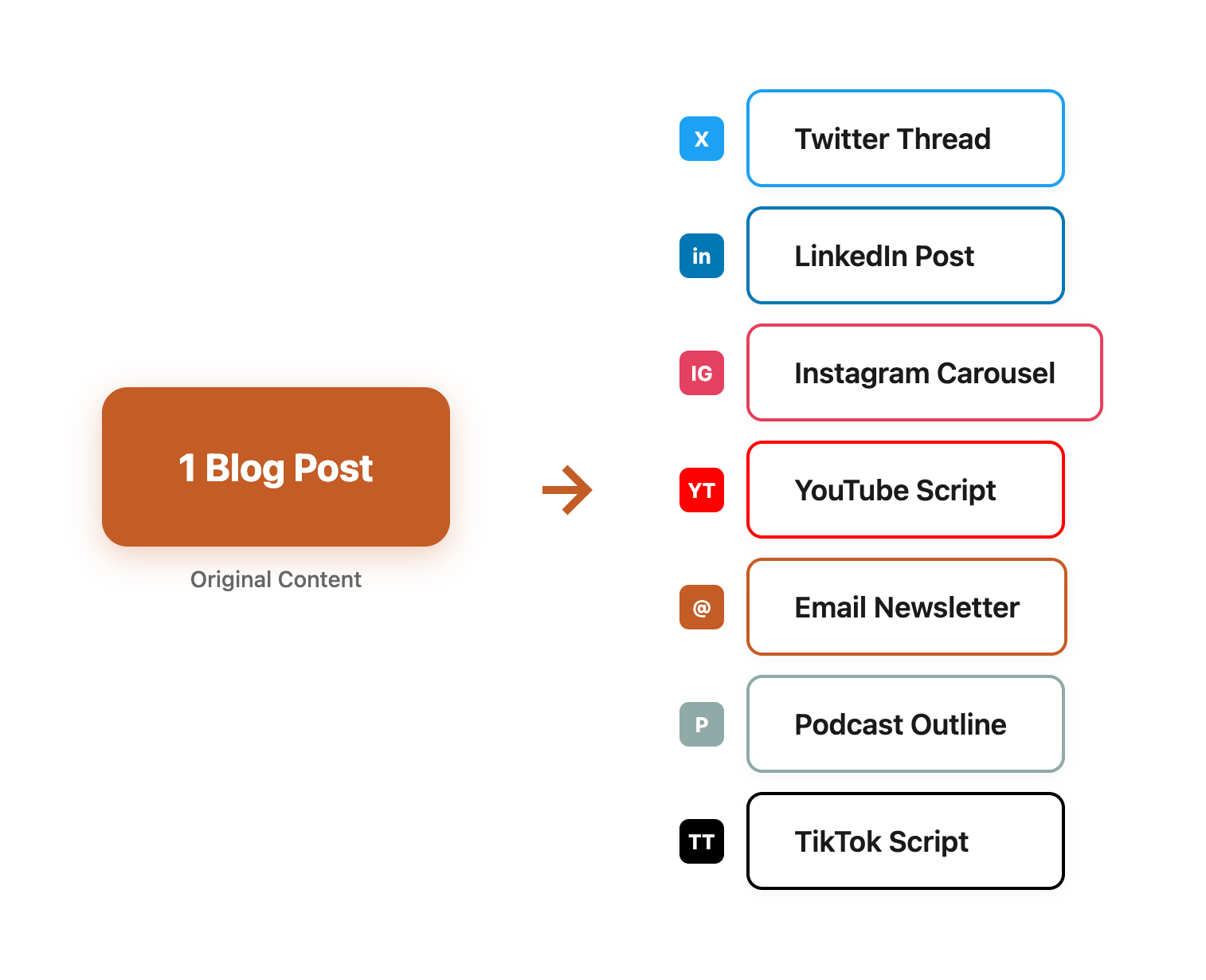
That blog post could have become:
- A Twitter/X thread pulling 50,000 impressions
- A LinkedIn post driving 200 profile visits
- An Instagram carousel generating 500 saves
- A TikTok script getting 100,000 views
- A YouTube video description boosting SEO
- A newsletter section nurturing 10,000 subscribers
- An email sequence converting leads
Instead, it sits on your blog collecting dust, occasionally surfacing in organic search.
This is the content leverage problem. Creating content takes enormous effort. Distributing content takes additional effort. Most teams have capacity for one or the other—not both.
We solved this with AI-powered content repurposing that transforms one piece into seven+ platform-native assets without adding hours to the workload.
Here's how it works.
01 / the-platform-reality
The Platform Reality
Each platform has different rules. What works on LinkedIn bombs on Twitter. What works on Instagram confuses your newsletter readers.
| Platform | Format | Length | Tone | Key Element |
|---|---|---|---|---|
| Twitter/X | Thread | 280 chars/tweet | Punchy, provocative | Strong hook, numbered points |
| Long post | 1,300-3,000 chars | Professional, story-driven | Personal angle, business lesson | |
| Carousel | 10 slides, 2,200 char caption | Visual, scannable | Cover slide hook, swipe value | |
| TikTok | Script | 60-90 seconds | Conversational, direct | Pattern interrupt opener |
| Newsletter | Section | 200-400 words | Intimate, valuable | One clear takeaway |
| Sequence | 3-5 emails | Persuasive, personal | Problem-agitation-solution | |
| YouTube | Description | 500-1,000 words | SEO-focused, detailed | Timestamps, keywords, CTAs |
Creating content natively for each platform would multiply your content workload 7x. Nobody has that capacity.
But adapting existing content for each platform? That's a different problem. And it's one AI solves beautifully.
02 / the-repurposing-framework
The Repurposing Framework
Our system uses a consistent framework for transforming any long-form content into platform-native assets.
Step 1: Extract Core Insights
Every piece of content has a limited number of core insights. A 2,500-word blog post might have:
- One central thesis
- Three to five supporting points
- Two to three stories/examples
- One clear call to action
The repurposing process starts by extracting these elements into a structured format:
Thesis: "AI-amplified marketing enables 10x output without 10x headcount."
Supporting points:
- Time compression: Tasks that took hours now take minutes
- Quality improvement: Consistency and depth increase when AI handles mechanical work
- Scale: Same team serves more clients without proportional effort increase
Stories/Examples:
- SEO audit: 40 hours → 4 hours while finding insights manual analysis missed
- Content brief: 3-4 hours → 15 minutes with better structure
- Client reporting: 5 hours → 30 minutes per report
CTA: Schedule a consultation to discuss AI amplification for your marketing.
This extraction takes 5-10 minutes and creates the foundation for all platform adaptations.
Step 2: Hook Generation
The hook is everything. On crowded platforms, you have 2 seconds to earn continued attention.
For each piece of content, we generate 5+ hook options using different psychological triggers:
Curiosity hook: "We deliver 100 client reports per month. We don't have a reporting team. Here's how..."
Contrarian hook: "Your content strategy is backwards. You're spending 90% of effort on creation, 10% on distribution. Flip it."
Quantified hook: "One blog post became 47 social assets, 12,000 impressions, and 340 newsletter signups. Time spent: 45 minutes."
Problem hook: "You write great content that nobody sees. The problem isn't your writing—it's your distribution."
Story hook: "Last month I watched a client's blog post get 47 organic visits. Then we repurposed it. 12,000 impressions in 72 hours."
Different hooks work for different platforms. Twitter rewards provocation. LinkedIn rewards professional insight. Instagram rewards curiosity. The hook library gives options for each context.
Step 3: Platform Adaptation
With core insights extracted and hooks generated, AI adapts content for each platform.
Twitter/X Thread:
[Hook tweet]
We deliver 100 client reports per month.

We don't have a reporting team.

Here's the exact system (that you can steal):

🧵 A thread on AI-amplified reporting:

[Tweet 2]
1/ The traditional approach is broken.

5 hours per report
× 100 clients
= 500 hours/month

That's 3 full-time employees doing nothing but reporting.

We reduced it to 50 hours total.

[Tweet 3]
2/ Three components make this work:

• Standardized templates (structure decisions eliminated)
• Automated data aggregation (no manual exports)
• AI-generated analysis (first drafts in seconds)

Each one cuts hours from the process.

[Continue for 8-12 tweets...]

[Final tweet]
Want the full breakdown?

I wrote 2,500 words on exactly how to build this system:

[Link to blog]

Follow @wedoworldwide for more AI marketing systems.
LinkedIn Post:
We deliver 100 client reports per month without a reporting team.

I know that sounds impossible. Three years ago, I would have said the same thing.

Here's what changed:

We stopped treating reporting as a creative task and started treating it as a systems problem.

The insight: 80% of reporting is mechanical work.

Logging into platforms. Exporting data. Building charts. Formatting templates.

None of that requires human judgment. It requires human hands because we never built systems to eliminate the need.

So we built the systems.

→ Templates that standardize structure (decisions eliminated)
→ API integrations that pull data automatically (exports eliminated)
→ AI that generates first-draft analysis (writing time reduced 80%)

The result: 30 minutes per report instead of 5 hours.

Same team. 10x the capacity.

The question for your team: What percentage of your work is mechanical?

That's the percentage AI can amplify.

---

Full breakdown of our reporting system in the comments.

#AIMarketing #AgencyLife #MarketingOps
Instagram Carousel:
[Slide 1 - Cover]
100 Client Reports
Zero Reporting Team
(How we actually do it)

[Slide 2]
The math doesn't work.

Traditional reporting:
5 hours × 100 clients = 500 hours/month

That's 3 full-time employees doing nothing but reports.

[Slide 3]
We do it in 50 hours total.

Same quality. Same depth.
No dedicated reporting headcount.

Here's the system:

[Slide 4]
COMPONENT 1
Standardized Templates

Every report follows the same structure.
Decisions eliminated = time saved.

[Slide 5]
COMPONENT 2
Automated Data Pulls

APIs connect to GA4, GSC, Ads, email.
No manual exports. No copy-paste.

[Slide 6]
COMPONENT 3
AI-Generated Analysis

AI writes the first draft.
Humans refine and add strategic context.

(See: [AI-powered client reporting](/blog/ai-client-reporting-at-scale))

[Slide 7]
The time breakdown:

Request → 2 min
Data aggregation → 5 min
AI analysis → 3 min
Human review → 20 min
Delivery → 2 min

Total: 30 minutes

[Slide 8]
This changed everything.

Account managers who spent 40% of time on reports now spend it on strategy.

Clients get better insights, faster.

The team handles 3x more clients.

[Slide 9]
What's the 80% of YOUR work that's mechanical?

That's where AI creates leverage.

[Slide 10 - CTA]
Full system breakdown in bio link.

Save this for later.
Follow for more AI marketing systems.
Newsletter Section:
📊 How We Deliver 100 Client Reports Without a Reporting Team

Here's a number that would have terrified me three years ago: we produce 100+ client reports per month.

We don't have a reporting department. We don't even have a dedicated analyst.

What we have is a system.

The core insight: reporting is 80% mechanical work (data exports, chart building, template formatting) and 20% strategic thinking (analysis, recommendations, context).

Traditional reporting makes humans do both. Smart reporting makes AI do the 80% so humans can focus on the 20% that actually matters.

Our three-component system:

1. Standardized templates eliminate structure decisions
2. API integrations eliminate manual data exports
3. AI generates first-draft analysis in seconds

The result: 30 minutes per report instead of 5 hours.

If you're spending more than an hour per client report, you're doing it the old way. Reply to this email and I'll share the specific tools we use.
Step 4: Quality Control
AI output isn't publish-ready. It requires human review for:
Voice consistency: Does this sound like our brand? Accuracy: Are statistics and claims correct? Platform appropriateness: Does the format match platform norms? CTA alignment: Does the call-to-action serve current business goals?
This review takes 5-10 minutes per platform. But that's 5-10 minutes of refinement, not 60 minutes of creation.
03 / the-pas-framework
The PAS Framework
For platforms that require persuasive copy (LinkedIn, email, landing pages), we use the Problem-Agitation-Solution framework:
Problem: Identify the pain point your audience experiences. "You spend 6 hours creating content that gets 47 views."
Agitation: Amplify the pain by exploring consequences. "That's $300+ of your time for exposure you could buy with a $5 ad. Meanwhile, your competitors repurpose everything and dominate every platform."
Solution: Present your approach as the answer. "AI-powered repurposing transforms one blog post into 7 platform-native assets in 45 minutes. Same content investment, 7x the distribution."
PAS works because it follows the emotional journey of your audience. They need to feel the problem before they're open to the solution.
04 / real-platform-results
Real Platform Results
Let me share what this looks like in practice.
Case: B2B SaaS Company
Original content: 2,800-word blog post on "Building a Customer Success Motion"
Repurposed into:
- Twitter thread (12 tweets)
- LinkedIn post (1,800 characters)
- Instagram carousel (10 slides)
- Newsletter feature (400 words)
- YouTube video description (650 words)
- 3-email nurture sequence
Results:
| Platform | Original Blog | Repurposed | Multiplier |
|---|---|---|---|
| Organic views | 234 | — | — |
| — | 23,400 impressions | 100x | |
| — | 12,800 impressions | 54x | |
| — | 3,200 impressions, 180 saves | 14x | |
| Newsletter | — | 34% open rate (vs 28% avg) | — |
Time investment:
- Original blog: 6 hours
- Repurposing: 45 minutes
- Total distribution: 7 platforms
The blog alone would have taken 6 hours for 234 views. Adding 45 minutes of repurposing created 39,000+ additional impressions.
Case: E-commerce Brand
Original content: Product launch announcement (1,200 words)
Repurposed into:
- Twitter announcement thread
- Instagram carousel showcasing features
- TikTok script for product demo
- Email launch sequence (5 emails)
- YouTube description optimized for product keywords
Results:
- Twitter: 8,400 impressions, 340 link clicks
- Instagram: 4,200 impressions, 890 saves, 124 shares
- TikTok: 47,000 views, 2,300 likes
- Email: 41% open rate, 12% click rate, 4.2% conversion
The product launch succeeded across platforms because each version was native to its platform—not a copy-paste of the original announcement.
05 / building-your-own-repurposing-system
Building Your Own Repurposing System
You don't need custom AI tools to start repurposing. Here's how to build a system with available technology.
Step 1: Create Extraction Templates
Before you can repurpose, you need to extract the core elements. Create a template:
CONTENT EXTRACTION

Title: _______________

Central thesis (1 sentence):
_______________

Supporting points (3-5):
1. _______________
2. _______________
3. _______________

Stories/examples (2-3):
1. _______________
2. _______________

Key statistics:
1. _______________
2. _______________

Call to action:
_______________
Fill this out for every piece of content before repurposing. It takes 5 minutes and makes everything else faster.
Step 2: Develop Platform Templates
For each platform you target, create a template showing structure:
Twitter Thread Template:
[Hook - controversial or curiosity-driving]
[Setup - context for what follows]
[Point 1 - clear, standalone value]
[Point 2 - builds on previous]
[Point 3 - continues building]
[Story/example - makes it concrete]
[Insight - the "so what"]
[CTA - link or follow request]
LinkedIn Template:
[Hook - strong opening line, often standalone paragraph]
[Context - 2-3 sentences setting up the story]
[Story/insight - the meat of the post]
[Lesson - what readers should take away]
[Question - engagement prompt]
[CTA - link in comments or direct ask]
Templates ensure consistency and reduce decision fatigue.
Step 3: Use AI for First Drafts
Feed Claude, GPT-4, or similar the extraction plus template:
Here's the core content:
[Paste extraction]

Transform this into a LinkedIn post following this structure:
[Paste template]

Requirements:
- Use contractions throughout
- Vary sentence length (short punchy sentences mixed with longer explanatory ones)
- Open with a hook that stops scrolling
- Include specific numbers where available
- End with an engagement question
The AI produces a draft. You refine voice, accuracy, and platform fit.
Step 4: Batch Production
Efficiency comes from batching. Don't repurpose one piece at a time.
Weekly batch process:
- Monday: Extract core elements from 2-3 new content pieces
- Tuesday: Generate all Twitter threads
- Wednesday: Generate all LinkedIn posts
- Thursday: Generate all Instagram carousels
- Friday: Generate email and newsletter content
Batching similar tasks reduces context-switching and increases throughput.
Step 5: Schedule Distribution
Don't publish everything at once. Spread distribution over time:
Week 1: Twitter thread + LinkedIn post Week 2: Instagram carousel + Newsletter feature Week 3: Email sequence + YouTube description Week 4: Repurpose again for different angle
This extends content lifespan and maintains consistent presence without constant creation.
06 / common-mistakes-to-avoid
Common Mistakes to Avoid
Mistake 1: Copy-Paste Repurposing
Posting the same content across platforms isn't repurposing—it's spam.
Each platform has different norms. LinkedIn allows 3,000 characters; Twitter allows 280. Instagram is visual-first; Twitter is text-first. LinkedIn rewards professional insight; TikTok rewards entertainment.
True repurposing adapts the core insight to each platform's native format.
Mistake 2: Ignoring Platform Context
A Twitter thread that starts with "Happy to share that..." will fail. That's LinkedIn energy.
A LinkedIn post that opens with "Hot take:" might underperform. That's Twitter energy.
Study what works on each platform. Adapt your content to match.
Mistake 3: Over-Automating
AI generates drafts. Humans ensure quality.
Fully automated posting leads to:
- Brand voice inconsistency
- Factual errors
- Tone-deaf content in sensitive moments
- Platform ban risk
Always review before publishing. The 5-10 minutes of review prevents hours of damage control.
Mistake 4: Quantity Over Quality
Seven mediocre platform posts are worse than three excellent ones.
Start with your highest-performing platforms. Master those before expanding. Better to dominate two platforms than be mediocre on seven.
07 / the-compound-effect
The Compound Effect
Here's why content repurposing changes everything: it creates compound returns.
Single-use content:
- 1 blog post = ~200-500 organic visits/month (maybe)
- Value captured once, then declines
Repurposed content:
- 1 blog post = ~200-500 organic visits
-
- Twitter thread = 5,000-50,000 impressions
-
- LinkedIn post = 2,000-20,000 impressions
-
- Instagram carousel = 1,000-10,000 impressions
-
- Newsletter section = list nurturing
-
- Email sequence = lead conversion
Same creation investment. 10-100x distribution value.
Over time, this compounds. Build an audience on Twitter, and future threads perform better. Grow your LinkedIn following, and future posts reach more people. Each repurposed piece contributes to platform growth that amplifies future content.
The agencies crushing it on social media aren't creating 10x more content. They're repurposing 10x more effectively. This is part of our broader AI-amplified marketing approach.
08 / start-here
Start Here
If you're creating content that doesn't get repurposed, you're leaving 90% of its value on the table.
Here's your action plan:
This week:
- Pick your best-performing blog post from last month
- Extract core elements using the template above
- Create one Twitter thread and one LinkedIn post
This month:
- Establish extraction as part of your content process
- Add two more platforms (Instagram, newsletter)
- Batch your repurposing into dedicated time blocks
This quarter:
- Repurpose every new piece of content across all relevant platforms
- Measure performance to identify which platforms drive results
- Double down on winners, deprioritize losers
The goal isn't to be everywhere. It's to maximize the value of content you're already creating.
09 / let-us-handle-it
Let Us Handle It
Want the repurposing pipeline built for you instead? See our AI Operations service, where marketing ops automation includes repurposing across all your channels.
Don't want to build the system yourself? We offer content repurposing as a service.
What you provide:
- Your blog posts, case studies, or long-form content
What we deliver:
- Platform-native versions for Twitter, LinkedIn, Instagram, newsletter, and email
- Scheduled distribution across your channels
- Performance reporting and optimization
Investment: Starting at $500/month for 4 pieces repurposed across 5 platforms.
Contact us:
- Email: hello@wedoworldwide.com
- Website: wedoworldwide.com
Or just reply with your biggest content challenge. We'll respond with ideas.
About the Author: Mike McKearin is the founder of WE•DO Growth Agency. His team repurposes 50+ pieces of content per month across 100+ client channels. He's slightly obsessed with extracting maximum value from every piece of content created.