Every marketing agency faces the same constraint: time. There are only so many hours in the day, only so many people on the team, only so many clients you can serve well.
The traditional response is to hire more people. But headcount scales linearly while costs scale exponentially. Double your team, and you double your payroll, benefits, management overhead, and office space. You might double output, but you definitely more than double expenses.
What if you could multiply output without multiplying headcount?
That's the promise of AI-amplified marketing. Not AI that replaces human expertise, but AI that amplifies it. Systems that handle the 80% of repetitive work so your team can focus on the 20% that requires human judgment, creativity, and strategic thinking.
This guide explains exactly how it works.
01 / what-ai-amplified-marketing-actually-means
What AI-Amplified Marketing Actually Means
Let's start by distinguishing AI-amplified marketing from its inferior cousins.
Manual marketing is what most agencies still do. Analysts export data from GA4, copy it into spreadsheets, format charts, write analysis, and compile reports. Writers research topics, outline content, draft, edit, and optimize for SEO. Designers create mockups, developers build pages, QA tests, and campaigns launch weeks after ideation.
Every step requires human hands. Every deliverable takes hours of labor. Scale means hiring.
Tool-assisted marketing improves on manual with software. SEMrush for keyword research. HubSpot for email automation. Figma for design collaboration. These tools accelerate individual tasks but don't fundamentally change the workflow. A human still drives every action.
AI-augmented marketing adds language models to the toolkit. ChatGPT drafts content. Midjourney generates images. AI assistants answer questions. But each interaction starts fresh. There's no memory, no learning, no compounding improvement. You prompt, you get output, you prompt again.
AI-amplified marketing is different. It's a system where AI capabilities compound over time. Where every project teaches the system something that makes the next project faster. Where specialized "skills" handle entire workflows, not just individual prompts. Where human expertise directs strategy while AI handles execution at scale. For a deeper exploration of how businesses are using AI for marketing across every channel, see our dedicated guide.
The difference isn't just degree—it's kind. AI-amplified marketing changes what's possible.
02 / the-10x-multiplier-effect
The 10x Multiplier Effect
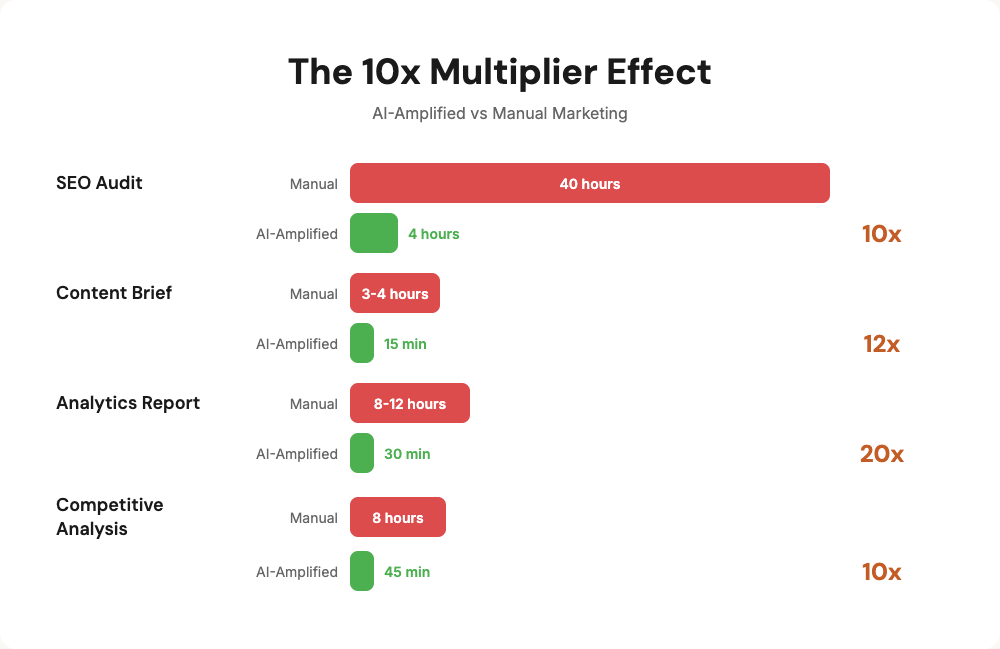
Here's what "10x" actually looks like in practice.
Time Compression
Tasks that took hours now take minutes:
| Task | Manual Time | AI-Amplified Time | Multiplier |
|---|---|---|---|
| Comprehensive SEO audit | 40 hours | 4 hours | 10x |
| Content brief creation | 3-4 hours | 15 minutes | 12-16x |
| Monthly analytics report | 8-12 hours | 30 minutes | 16-24x |
| CRO experiment setup | 2-3 weeks | 60 minutes | 80-120x |
| Competitive analysis | 8 hours | 45 minutes | 10x |
These aren't theoretical projections. They're actual time savings from our production workflows.
Quality Improvements
Speed without quality is worthless. Here's the quality differential:
Consistency: Every SEO audit follows the same rigorous methodology. Every content brief includes the same comprehensive sections. Every report uses the same branded templates. Human inconsistency disappears when AI enforces standards.
Depth: When you're not spending 8 hours on data collection, you can spend 4 hours on strategic analysis. AI handles the mechanical work; humans do the thinking work. The output is deeper because humans focus on what they're actually good at.
Coverage: Manual processes create blind spots. Who has time to check all 500 pages for broken links? Who can analyze every search term in a 50,000-row export? AI can. Coverage becomes comprehensive because AI doesn't get tired.
Scale Without Proportional Headcount
The math changes completely:
Traditional agency: 10 clients per account manager, 20 hours per client per month = 200 hours of account work. Add 5 clients, add 100 hours, add half a person.
AI-amplified agency: 10 clients per account manager, but AI handles 16 hours of mechanical work per client. Human time drops to 4 hours per client = 40 hours of strategic work. Add 5 clients, add 20 human hours. Same team handles 50% more clients.
The constraint shifts from labor hours to strategic capacity. And strategic capacity is what agencies should be selling anyway.
03 / core-ai-amplified-capabilities
Core AI-Amplified Capabilities
Let me walk you through the specific capabilities that enable this transformation.
SEO Audits and Optimization
Traditional SEO audits require pulling data from multiple tools: Screaming Frog for technical crawls, Google Search Console for search performance, Google Analytics for traffic patterns, Ahrefs or SEMrush for competitive data. Then cross-referencing, analyzing, prioritizing, and documenting.
AI-amplified SEO audits aggregate all data sources simultaneously. The system ingests crawl data, search metrics, traffic patterns, and competitive benchmarks in parallel. AI identifies patterns humans miss—correlations between technical issues and traffic drops, content gaps revealed by competitor analysis, opportunities hidden in long-tail search terms.
The output isn't a raw data dump. It's prioritized recommendations scored by impact and implementation effort. "Fix these 12 broken links first (high impact, low effort). Then address these page speed issues (high impact, medium effort). Consider these content expansions (medium impact, medium effort)."
A comprehensive audit that took 40+ hours now takes 4 hours—and surfaces insights that manual analysis would have missed entirely. For a deep dive into this process, see our guide on how AI transforms 40-hour SEO audits into 4-hour reports.
Content Creation at Scale
Content is where most agencies hit the wall. Writing takes time. Good writing takes more time. Great writing optimized for both humans and search engines takes even more time.
AI-amplified content creation accelerates every phase:
Briefs: Input a target keyword. The system analyzes SERP competitors, extracts topic structures, identifies content gaps, determines search intent, and generates a comprehensive brief with meta tags, outline, word counts per section, and internal linking strategy. What took 3-4 hours takes 15 minutes. Learn more about AI-powered content brief generation.
Drafts: The brief feeds directly into content generation. AI produces first drafts that follow the structure, hit word counts, and incorporate required elements. Human writers refine, add expertise, inject voice, and ensure quality. The 80% mechanical work is automated; humans focus on the 20% that requires judgment.
Optimization: Before publishing, AI analyzes content against 50+ ranking factors. Keyword density, heading structure, E-E-A-T signals, featured snippet formatting, AI citation optimization. Issues surface automatically; fixes apply in minutes. See our approach to optimizing content for both search engines and AI answer engines.
Repurposing: One blog post becomes a Twitter thread, LinkedIn article, Instagram carousel, newsletter section, and YouTube script. Each platform-native, properly formatted, maintaining brand voice. Seven assets from one piece of content, with minimal additional effort. Explore our full content repurposing strategy.
Conversion Rate Optimization
CRO traditionally moves at development speed. Designer creates mockup (one week). Developer builds variant (two weeks). QA tests (three days). Deploy to A/B platform (two days). Total: 3-4 weeks to test one hypothesis.
AI-amplified CRO moves at marketing speed.
The workflow starts with single-file HTML capture—a complete snapshot of any live page with all CSS, JavaScript, and assets embedded. AI extracts brand patterns into organized CSS variables. Modifications apply as targeted changes to the captured file. Deployment happens via page builder modules, no development required.
Result: 60 minutes from capture to live variant. Not 3 weeks. 60 minutes.
This changes the economics of testing. When each experiment takes 60 minutes instead of 3 weeks, you run 40 experiments per year instead of 4. Learning compounds. Conversion rates climb. Revenue grows. See our detailed guide on running 10x more CRO experiments.
Analytics and Reporting
GA4's complexity creates a knowledge gap most marketers can't bridge. The interface is confusing. The data model is different from Universal Analytics. Custom reports require expertise most teams don't have.
AI-amplified analytics translate raw metrics into business language:
"Traffic from organic search increased 23% month-over-month, driven primarily by three blog posts published in December. However, conversion rate from organic traffic decreased 8%, suggesting the new content attracts a different (less purchase-intent) audience. Recommend adding stronger CTAs to new content and creating dedicated landing pages for high-intent keywords."
That's not raw numbers. That's actionable insight. The kind of analysis that used to require a senior analyst with GA4 certification now generates automatically. Discover how we turn GA4 data overload into actionable insights.
Reporting follows the same pattern. Data pulls happen via API. Charts populate automatically. Narrative sections highlight anomalies and recommendations. A monthly report that took 8-12 hours now takes 30 minutes—mostly for human review and strategic additions. Learn how we deliver 100 client reports per month without a reporting team.
Meeting Intelligence
Here's a capability most agencies don't even consider: turning meeting conversations into executed tasks.
The typical post-meeting workflow: Account manager scribbles notes, transfers to task manager (maybe), follows up (sometimes), tracks completion (rarely). Critical action items slip through cracks. Clients lose trust.
AI-amplified meeting intelligence captures everything:
Meetings record and transcribe automatically. AI extracts action items with context, assignees, and timestamps. Notes route to appropriate client folders. Tasks populate in project management systems. Nothing slips through.
For an agency managing 100+ client relationships, this isn't nice-to-have. It's the difference between consistent follow-through and chaos. See how we transform client meetings into executed tasks.
Competitive Intelligence
Knowing what competitors are doing shouldn't require an analyst spending 8 hours per month on research. It should happen continuously, surfacing insights when they matter.
AI-amplified competitive intelligence monitors continuously:
Keywords: What terms are competitors ranking for that you're not? What new content are they publishing? What gaps exist in their coverage?
Backlinks: Who's linking to competitors? What content earns links in your space? What outreach opportunities exist?
Traffic: How does competitor traffic trend over time? What drives their peaks? What correlates with their valleys?
Content: What topics perform best for competitors? What formats work? What angles resonate?
This intelligence isn't buried in a quarterly report. It surfaces in real-time, informing strategy decisions as opportunities emerge. Explore our approach to continuous competitive intelligence.
04 / the-skill-based-architecture
The Skill-Based Architecture
Here's what separates AI-amplified marketing from prompt engineering: the skill-based architecture.
What Are Skills?
A "skill" is a modular capability that handles a complete workflow, not just a single prompt. It includes:
Instructions: Detailed guidance on what the skill does, when to use it, and how it works.
Context: Domain knowledge specific to the capability—brand guidelines, process documentation, reference materials.
Tools: Integrations with external systems—APIs, databases, file systems, web services.
Examples: Sample inputs and outputs that demonstrate proper usage.
When you invoke a skill, all of this context loads together. The AI doesn't start fresh—it starts with everything needed to execute the workflow competently.
Why Skills Beat Prompts
Consider the difference:
Prompt approach: Every time you need an SEO audit, you write a detailed prompt explaining what data to pull, how to analyze it, what to prioritize, and how to format the output. You refine the prompt through trial and error. You copy-paste it into each new conversation. Context is limited; consistency varies.
Skill approach: You invoke the SEO audit skill. It knows what data sources to integrate, what analysis methodology to apply, how to prioritize findings, and how to format deliverables. It's been refined over dozens of audits. It improves with each use. Consistency is guaranteed because the system—not the human—enforces standards.
The prompt approach treats AI as a tool. The skill approach treats AI as a system. Learn more about why we build skills instead of prompts.
Compounding Improvement
Here's the crucial insight: skills improve over time.
Every SEO audit reveals edge cases the system handles better next time. Every content brief exposes patterns that inform future briefs. Every client interaction teaches the system something that benefits all clients.
This is the opposite of manual processes, where knowledge lives in people's heads and leaves when they leave. Skills create institutional memory that compounds. See how our continuous improvement system captures learnings from every project.
After running 100 SEO audits, the audit skill is dramatically better than after running 10. After generating 500 content briefs, the brief skill handles edge cases that would have stumped it initially. The system gets smarter with use.
05 / real-world-applications
Real-World Applications
Theory is nice. Results matter. Here's what AI-amplified marketing looks like in practice.
Case Study: Outdoor Education Nonprofit
Challenge: Large outdoor education organization with complex website (50,000+ pages), multiple program areas, and limited marketing resources.
AI-Amplified Approach:
- Comprehensive SEO audit aggregating crawl data, GSC metrics, and GA4 traffic in 4 hours (vs. 40+ hours traditional)
- Content brief generation for new program pages in 15 minutes each (vs. 3-4 hours)
- Monthly reporting combining organic, paid, and email metrics in 30 minutes (vs. 8-12 hours)
Results:
- 3x more optimization projects completed in same time budget
- Content production increased 400% with same writing team
- Client satisfaction improved due to faster turnaround and deeper insights
Case Study: Vision Services Organization
Challenge: Specialty e-commerce retailer serving customers with visual impairments. High-value products ($100-$2,000) requiring significant trust-building.
AI-Amplified Approach:
- Rapid CRO experimentation: capture page, extract brand patterns, deploy variant in 60 minutes
- A/B test trust-focused category page redesign vs. standard WooCommerce template
- Iterate through 3 variant versions in 40 minutes (vs. 6-8 weeks traditional development)
Results:
- CRO experiment cycle reduced from 3 weeks to 60 minutes
- Testing capacity increased from 4 experiments/year to 40+
- Conversion rate improvements compound through rapid iteration
Case Study: Fishing Gear E-commerce Brand
Challenge: Growing direct-to-consumer brand competing against Amazon and established retailers. Limited budget for content and advertising.
AI-Amplified Approach:
- Content repurposing: every blog post becomes 7+ platform-native assets
- Search term mining: weekly analysis of Google Ads queries for keyword opportunities using AI-powered search term analysis
- Competitive intelligence: continuous monitoring of competitor rankings and content
Results:
- Content reach multiplied 7x without additional creation time
- Google Ads wasted spend reduced 23% through systematic negative keyword addition
- SEO opportunities identified months before competitors noticed
06 / implementing-ai-amplified-marketing
Implementing AI-Amplified Marketing
Ready to make the shift? Here's how to approach implementation.
Assessment: Where to Start
Not every marketing function benefits equally from AI amplification. Start where the leverage is highest:
High-leverage areas (start here):
- Reporting and analytics (high volume, high repetition, low creativity required)
- SEO audits and technical analysis (data-heavy, pattern-matching intensive)
- Content briefs and outlines (structured, template-driven)
- Competitive monitoring (continuous, data-aggregation focused)
Medium-leverage areas (phase two):
- Content creation (requires human refinement but benefits from AI drafting)
- CRO experimentation (requires strategic thinking but benefits from rapid execution)
- Client communication (requires relationship awareness but benefits from consistency)
Lower-leverage areas (human-led):
- Strategy development (requires experience and judgment)
- Creative direction (requires taste and vision)
- Client relationships (requires empathy and trust)
Start with the high-leverage areas. Build confidence. Expand from there.
Building vs. Buying
You have three options:
Build custom systems: Highest control, highest investment. Makes sense if you have technical resources and differentiation is strategic.
Buy SaaS platforms: Fastest to deploy, least differentiated. Makes sense for commodity capabilities where you don't need competitive advantage.
Hybrid approach: Build custom for core differentiators, buy for everything else. This is what most agencies should do.
The skills that define your agency's value proposition—your methodology, your processes, your secret sauce—those you build custom. Generic capabilities like email sending or project management—those you buy.
Integration with Existing Workflows
AI amplification doesn't require ripping out your existing systems. It integrates with them:
- CRM: AI surfaces insights; humans maintain relationships
- Project management: AI populates tasks; humans prioritize and assign
- Content management: AI drafts and optimizes; humans review and publish
- Analytics: AI aggregates and analyzes; humans interpret and strategize
The goal isn't replacement. It's enhancement. Your existing workflows get faster, not obsolete.
Measuring ROI
Track these metrics to quantify the value:
Time savings:
- Hours per deliverable (before vs. after)
- Deliverables per team member per month
- Time from request to delivery
Quality improvements:
- Error rates (broken links in audits, formatting issues in reports)
- Client revision requests per deliverable
- NPS or satisfaction scores
Scale metrics:
- Clients per account manager
- Revenue per employee
- Gross margin by service line
Outcome metrics:
- Client results (rankings, traffic, conversions)
- Client retention
- Referral rates
The ROI case builds itself when you can demonstrate that the same team delivers 3x more work at higher quality with better client outcomes.
07 / the-future-of-marketing-agencies
The Future of Marketing Agencies
Let me be direct: agencies that don't adopt AI-amplified approaches will struggle.
The competitive dynamics are already shifting. Clients increasingly expect faster turnaround, deeper analysis, and better results—at the same or lower prices. Agencies that rely on manual processes can't deliver. They'll lose clients to competitors who can.
This isn't speculation. It's already happening. The agencies growing fastest right now are the ones that figured out how to multiply output without multiplying headcount.
Why Traditional Agencies Struggle
Traditional agencies face a structural problem: their business model depends on selling hours, but their value isn't measured in hours. Clients don't care how long an SEO audit takes; they care whether it surfaces actionable insights. Clients don't care how many hours went into a report; they care whether it helps them make better decisions.
When AI-amplified agencies can deliver better insights in less time at lower cost, hour-based agencies have no answer. They can't compete on speed (AI is faster). They can't compete on cost (AI is cheaper). They can only compete on quality—and AI-amplified agencies often win there too, because AI handles the mechanical work flawlessly while humans focus on the strategic work.
The New Competitive Landscape
The agencies that thrive will be the ones that figure out how to combine human expertise with AI capabilities:
Strategic thinking remains human. Understanding client business models, identifying growth opportunities, developing differentiated positioning—these require experience, judgment, and creativity that AI can't replicate.
Relationship building remains human. Trust, empathy, communication—the soft skills that turn vendors into partners. AI can help (better follow-through, faster responses), but the relationship itself is human.
Execution at scale becomes AI. Data aggregation, pattern recognition, content generation, report compilation, competitive monitoring—the mechanical work that scales linearly with clients. AI handles this so humans don't have to.
The winning formula: human strategy + AI execution + human relationship management.
Skills as Competitive Moats
Here's the strategic insight most agencies miss: skills are defensible competitive advantages.
Generic AI tools are available to everyone. ChatGPT, Claude, Midjourney—your competitors have the same access you do. Using them doesn't differentiate you.
But custom skills built from your methodology, refined through your client work, encoding your institutional knowledge? Those are yours. Competitors can't buy them. They can't copy them (easily). They have to build their own—which takes time and experience.
The agencies that invest in building proprietary skill systems today will have advantages that compound for years. The agencies that wait will have to catch up—from further behind.
08 / getting-started
Getting Started
If you've read this far, you're ready to act. Here's the path forward.
Self-Assessment Checklist
Rate your current state (1-5) on each dimension:
- Time efficiency: How many hours does each deliverable take?
- Consistency: How similar are deliverables across team members?
- Scale: How many clients can each team member effectively serve?
- Quality: How often do clients request revisions or express dissatisfaction?
- Speed: How long from request to delivery?
If you scored below 3 on any dimension, AI amplification can help.
Priority Actions
This week:
- Identify your highest-volume, most repetitive deliverable
- Document the current process step-by-step
- Calculate time spent per deliverable
This month:
- Research AI tools for that specific workflow
- Run a pilot with 3-5 deliverables
- Measure time savings and quality impact
This quarter:
- Expand successful pilots to standard practice
- Document learnings and refine processes
- Identify next workflow to amplify
Next Step: Talk to Us
WE•DO has spent three years building AI-amplified marketing capabilities. We've learned what works, what doesn't, and how to implement successfully.
If you're a marketing leader exploring AI amplification—whether you want to implement it internally or work with an agency that's already done it—we'd like to talk.
Schedule a consultation: We'll assess your current workflows, identify high-leverage opportunities, and outline a practical implementation path. Explore our AI Operations services to see how we can help transform your marketing operations. You can also learn more about what makes a great AI marketing agency and how AI enablement creates the foundation for sustained competitive advantage.
Email: hello@wedoworldwide.com
Website: wedoworldwide.com
No pitch. No pressure. Just a conversation about what's possible when AI amplifies human expertise instead of replacing it.
About the Author: Mike McKearin is the founder of WE•DO Growth Agency. Over three years, he's built a skill-based AI system that enables a small team to serve 100+ clients with the depth and quality that traditionally required 10x the headcount. He writes about the intersection of AI, marketing, and agency operations.