Google is no longer the only search engine that matters.
ChatGPT answers 100 million queries per day. Perplexity processes millions more. Claude, Gemini, and a dozen other AI assistants field questions that used to go to Google.
When someone asks an AI "What's the best project management tool for small teams?", your content either gets cited or it doesn't. There's no page 2. There's no snippet to compete for. The AI either references you or ignores you entirely.
This is the new SEO reality: optimizing for traditional search engines AND AI answer engines simultaneously.
We call it AEO (Answer Engine Optimization) and GEO (Generative Engine Optimization). And if you're not doing it, you're already falling behind.
01 / the-shift-in-search-behavior
The Shift in Search Behavior
Traditional SEO optimized for one thing: Google's ranking algorithm. Keywords, backlinks, technical factors, user signals. Master those, rank well, get traffic.
The new landscape splits into three channels:
Traditional Search (Still Matters)
Google processes 8.5 billion searches per day. It's not going anywhere.
But Google itself is changing. AI Overviews (formerly SGE) now appear on many queries, synthesizing answers at the top of results. Your content needs to be cited in those overviews—not just ranked below them.
AI Chatbots (Growing Fast)
ChatGPT, Claude, Perplexity—these tools answer questions directly. They don't show ten blue links; they provide answers.
When they cite sources (and they increasingly do), they pull from a training corpus plus real-time retrieval. Your content needs to be authoritative enough to be cited.
Voice and Assistant Queries
Siri, Alexa, Google Assistant—voice queries demand direct answers. "What's the best CRM for small businesses?" needs a single recommendation, not a list of options.
Optimizing for one channel isn't enough anymore. Content needs to perform across all three.
02 / traditional-seo-vs-aeo-vs-geo
Traditional SEO vs AEO vs GEO
Let me clarify what's different.
| Factor | Traditional SEO | AEO | GEO |
|---|---|---|---|
| Goal | Rank in top 10 | Get cited as source | Be selected for AI response |
| Format | Varies | Direct answers | Structured, quotable |
| Keywords | Exact match helpful | Question formats | Natural language |
| Authority | Backlinks, domain | E-E-A-T signals | Expertise signals |
| Structure | Headers, meta tags | FAQ schema, clear answers | Extractable claims |
| Success metric | Rankings, traffic | Citation rate | AI inclusion |
Traditional SEO optimizes for algorithm signals. AEO optimizes for direct answers. GEO optimizes for AI extraction.
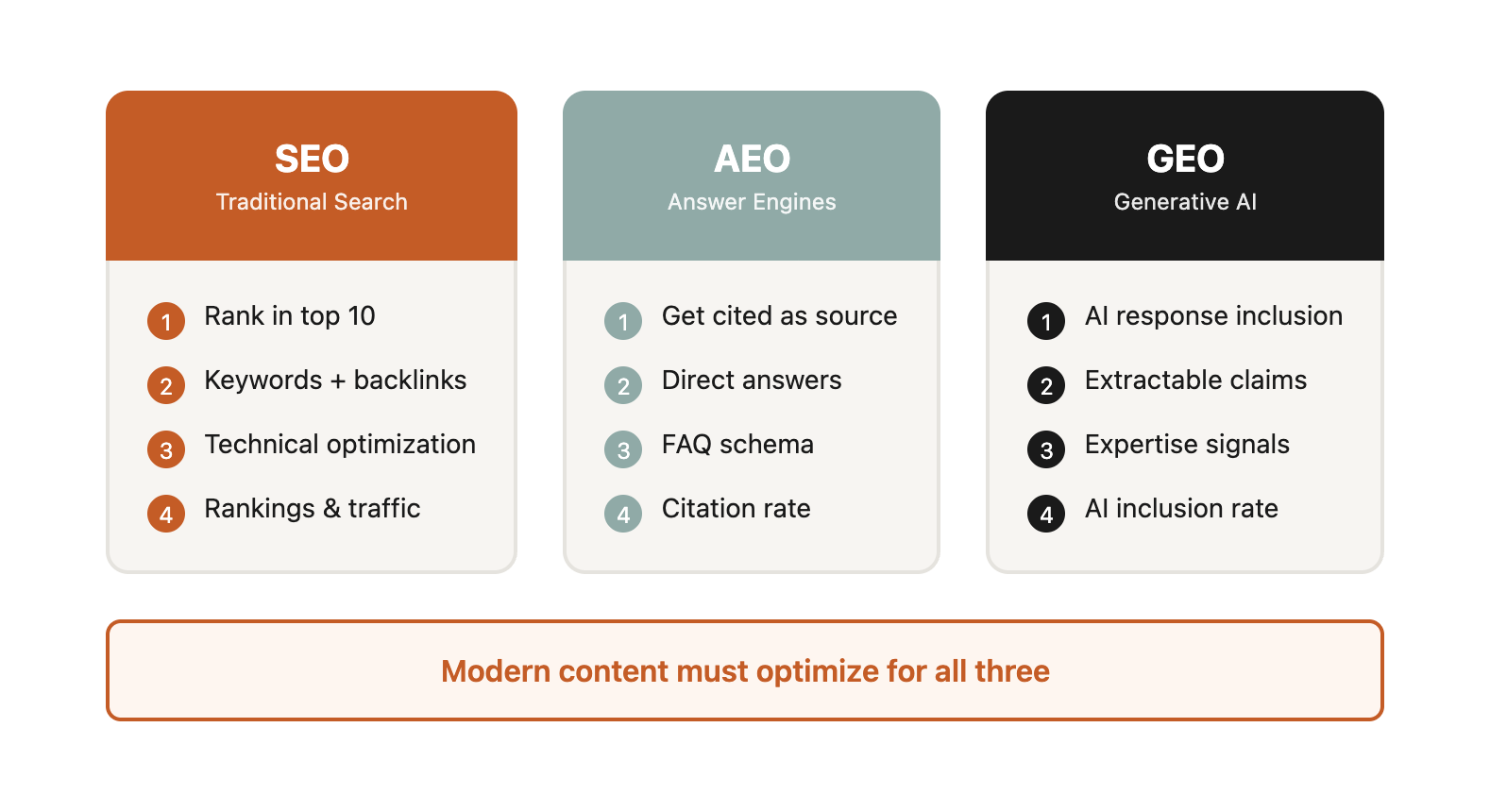
You need all three.
03 / the-ai-content-optimization-framework
The AI Content Optimization Framework
Here's how we optimize content for the multi-engine landscape.
Layer 1: Traditional SEO Foundation
The basics still matter. You can't rank in AI citations if Google doesn't trust your domain.
Technical foundation:
- Fast load times (Core Web Vitals passing)
- Mobile-friendly design
- Secure (HTTPS)
- Crawlable structure
- Clean URL architecture
On-page fundamentals:
- Keyword-optimized titles and headers
- Meta descriptions that drive clicks
- Internal linking structure
- Image optimization
Authority signals:
- Quality backlinks from relevant sites
- E-E-A-T indicators (author bios, credentials, citations)
- Fresh, updated content
- Topical depth and breadth
Skip these fundamentals and nothing else matters. They're the foundation. For a comprehensive look at your SEO baseline, see our guide on AI-powered SEO audits.
Layer 2: Answer Engine Optimization (AEO)
AEO focuses on making your content the obvious answer to specific questions.
Question-based structure: Format content around the questions people ask. Use the actual questions as headers.
Bad: "Project Management Benefits" Good: "What Are the Benefits of Project Management Software?"
Direct answers first: Don't bury the answer. Start sections with the answer, then elaborate.
Bad: "There are many factors to consider when choosing project management software. First, you should think about your team size. Then consider your budget..."
Good: "The best project management software for small teams under 10 people is [Tool]. Here's why: it offers unlimited users on free tier, requires zero setup, and integrates with tools small teams already use. Let me break down the decision factors..."
FAQ schema markup: Implement FAQ structured data so search engines can extract Q&A pairs directly:
{
  "@type": "FAQPage",
  "mainEntity": [{
    "@type": "Question",
    "name": "What is the best project management software for small teams?",
    "acceptedAnswer": {
      "@type": "Answer",
      "text": "For teams under 10 people, [Tool] offers the best combination of..."
    }
  }]
}
Clear, quotable statements: AI systems extract claims. Make your claims clear and attributable.
Weak: "Project management software can help teams in various ways." Strong: "Project management software reduces project delivery time by 28% on average, according to PMI research."
Layer 3: Generative Engine Optimization (GEO)
GEO optimizes specifically for AI extraction and citation.
Authoritative voice: AI systems assess expertise signals. Write like an authority, not an aggregator.
Aggregator voice: "Many experts say that..." Authority voice: "In our experience working with 100+ teams, we've found that..."
Cite your sources: AI systems trust content that references credible sources. Link to research, cite statistics, reference authoritative publications.
Structured data for extraction: Tables, lists, and clearly formatted information extract better than prose:
Instead of: "The three main benefits are improved communication, better visibility, and increased accountability."
Use:
| Benefit | Impact | How It Works |
|---|---|---|
| Improved communication | 34% fewer meetings | Centralized updates |
| Better visibility | 45% faster decisions | Real-time dashboards |
| Increased accountability | 28% more on-time delivery | Clear ownership |
Definitive statements: AI systems prefer confidence. Hedging weakens extraction likelihood.
Hedging: "This might be a good option for some teams." Definitive: "This is the best option for remote teams under 15 people."
Update signals: AI systems weight recency. Include publication and update dates. Reference current year. Update content regularly.
04 / the-multi-engine-optimization-process
The Multi-Engine Optimization Process
Here's the practical workflow we use.
Step 1: Audit Existing Content
Before optimizing, assess current state:
Traditional SEO check:
- Current rankings for target keywords
- Technical issues (crawl errors, speed, mobile)
- Backlink profile health
- Content gaps vs competitors
AEO check:
- Does content answer questions directly?
- Is FAQ schema implemented?
- Are answers easy to extract?
- Do you appear in "People Also Ask"?
GEO check:
- Is the content cited by AI tools? (Test by asking ChatGPT/Perplexity about your topic)
- Does content include authoritative signals?
- Are claims clear, sourced, and extractable?
- Is structured data present?
Step 2: Keyword + Question Research
Traditional keyword research plus:
Question mining:
- Google's "People Also Ask" for your keywords
- AnswerThePublic for question variations
- Reddit/Quora for how real people phrase questions
- ChatGPT: "What questions do people ask about [topic]?"
Intent mapping: For each keyword/question, identify:
- Is this informational, commercial, or transactional?
- What format best serves this intent?
- What does a complete answer require?
Step 3: Content Structure for Multi-Engine
Build content that serves all three engines:
Opening: Direct answer to primary question (AEO/GEO) Body: Detailed exploration with headers as questions (AEO) Tables/lists: Extractable comparisons and data (GEO) Expert perspective: Authoritative insights from experience (GEO) FAQ section: Additional questions with direct answers (AEO) Schema markup: Structured data for extraction (all)
Step 4: Optimization Pass
AI-assisted review against checklist:
Traditional SEO:
- Primary keyword in title, H1, first paragraph
- Secondary keywords distributed naturally
- Meta description optimized for CTR
- Internal links to/from relevant content
- Images optimized with alt text
AEO:
- Questions used as headers
- Direct answers at start of sections
- FAQ section with 5-10 questions
- FAQ schema implemented
- Clear, extractable claims throughout
GEO:
- Authoritative voice (first-person expertise)
- Statistics cited with sources
- Tables and structured data present
- Definitive recommendations made
- Publication/update dates visible
- No AI detection flags (genuine human expertise)
Step 5: Monitor Multi-Channel Performance
Track success across all engines:
Traditional metrics:
- Keyword rankings
- Organic traffic
- Click-through rate
AEO metrics:
- Featured snippet captures
- "People Also Ask" inclusions
- Direct answer appearances
GEO metrics:
- AI citation rate (manual testing)
- Brand mentions in AI responses
- Traffic from AI-referred sources
05 / ai-detection-and-the-authenticity-imperative
AI Detection and the Authenticity Imperative
One critical consideration: AI-generated content optimized for AI engines creates a paradox.
Search engines and AI systems increasingly detect AI-generated content. Content that reads as AI-written may be downgraded or filtered.
The solution isn't avoiding AI assistance—it's ensuring authenticity.
What AI can do:
- Research and data aggregation
- Structure recommendations
- First draft generation
- Optimization suggestions
What humans must add:
- Original insights from actual experience
- Proprietary data and case studies
- Expert opinions and recommendations
- Unique perspectives and voice
The content that performs best in the AI era combines AI efficiency with human authenticity. AI handles research and structure; humans add expertise and voice. This is our philosophy across all AI-amplified marketing workflows.
06 / real-world-results
Real-World Results
Let me share what this optimization produces.
Case: B2B Software Company
Before optimization:
- Ranking positions 8-15 for target keywords
- Zero featured snippets
- Not cited in AI responses when tested
Optimization applied:
- Restructured content around questions
- Added FAQ schema to all blog posts
- Included comparison tables with structured data
- Strengthened authoritative voice with case study data
- Updated all content with current statistics
After 90 days:
- Ranking positions improved to 3-7 average
- Captured 4 featured snippets
- Cited in ChatGPT responses for 3 of 5 tested queries
- Organic traffic increased 67%
Case: E-commerce Brand
Before optimization:
- Strong product page rankings
- Blog content underperforming
- Zero AI visibility
Optimization applied:
- Rebuilt blog content with AEO structure
- Added expert buying guides with definitive recommendations
- Implemented FAQ schema on all category pages
- Created comparison tables for product categories
After 60 days:
- Blog traffic increased 124%
- Captured 7 new featured snippets
- Product recommendations appearing in Perplexity results
- "People Also Ask" appearances increased 340%
07 / your-optimization-checklist
Your Optimization Checklist
Start optimizing today with this checklist.
Quick Wins (This Week)
- Add FAQ schema to your top 5 performing pages
- Rewrite openings to lead with direct answers
- Test 5 queries in ChatGPT—are you cited?
- Add comparison tables to relevant content
Medium-Term (This Month)
- Audit all content against AEO/GEO criteria
- Restructure underperforming content with question headers
- Add authoritative signals (author bios, credentials, sources)
- Update dated content with current statistics
Ongoing (Every Quarter)
- Monitor AI citation rates for key topics
- Update content with fresh data and examples
- Expand coverage of question variations
- Test new content formats for AI extraction
08 / let-us-optimize-your-content
Let Us Optimize Your Content
Don't want to build the expertise internally? Our SEO & Content Marketing team handles this for you.
What we do:
- Full content audit (traditional + AEO + GEO)
- Optimization roadmap prioritized by impact (using our competitive intelligence to identify gaps)
- Content updates with multi-engine optimization
- Schema implementation and technical SEO
- Ongoing monitoring and iteration
Investment: Starting at $3,000 for comprehensive audit + optimization plan.
Contact us:
- Email: hello@wedoworldwide.com
- Website: wedoworldwide.com
Send us your top 3 performing URLs. We'll analyze their AI-readiness and send recommendations within 48 hours.
About the Author: Mike McKearin is the founder of WE•DO Growth Agency. His team optimizes content for the multi-engine era, helping clients appear in traditional search, AI overviews, and chatbot citations simultaneously.