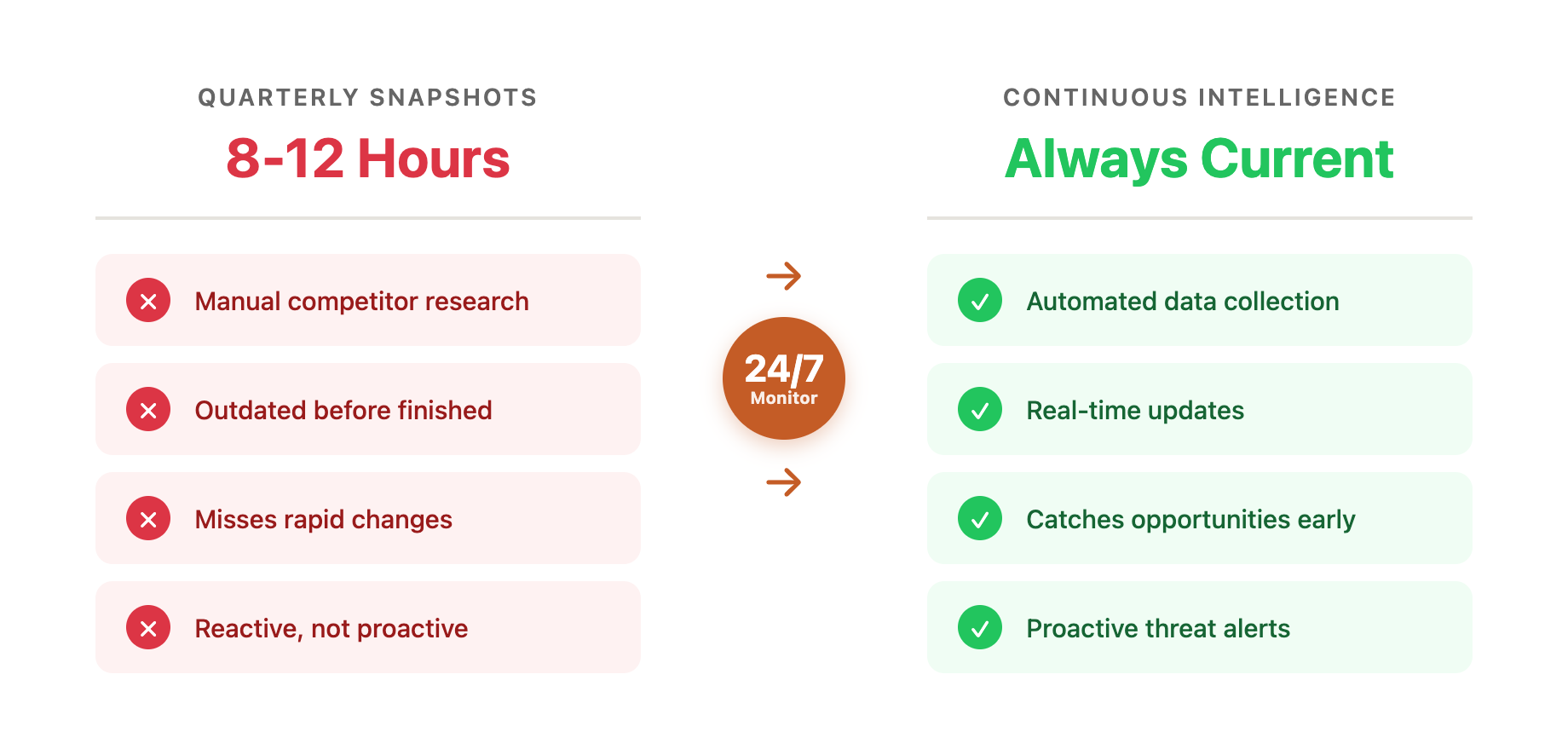
Traditional competitive analysis is a quarterly project. Someone spends 8 hours researching competitors, compiles a deck, presents findings, and everyone moves on. By the time you act on insights, the landscape has shifted.
The problem isn't lack of data. It's the cadence. Quarterly snapshots can't track weekly changes. By the time you notice a competitor's new content strategy, they've already captured the keywords. By the time you see their pricing change, they've won the customers.
AI-powered competitive intelligence changes the cadence from quarterly to continuous. Real-time monitoring surfaces opportunities and threats as they emerge, not months later.
Here's how to know your competitors better than they know themselves.
01 / the-traditional-approach-and-why-it-fails
The Traditional Approach (And Why It Fails)
Manual competitive analysis typically includes:
Website review: Browse competitors' sites, note changes, document offerings Content audit: Catalog their blog posts, resources, and media Keyword research: See what they rank for using SEO tools Social monitoring: Check their social presence and engagement Pricing research: Document pricing and positioning
Time required: 8-12 hours per competitor Frequency: Quarterly (at best) Result: A snapshot that's outdated before the deck is finished
The failure isn't effort—it's timing. Competitive advantages emerge and disappear in weeks, not quarters.
02 / the-ai-amplified-approach
The AI-Amplified Approach
Continuous competitive intelligence requires three layers: automated data collection, AI-powered analysis, and actionable alerting.
Layer 1: Automated Data Collection
Instead of manual research, APIs continuously collect:
Keyword rankings:
- What keywords do competitors rank for?
- What's their position trajectory? (improving, declining, stable)
- What new keywords appeared this week?
- What keywords did they lose?
Content changes:
- What new pages were published?
- What existing pages were updated?
- What topics are they expanding into?
- What content format do they favor?
Backlink profile:
- Who's linking to them?
- What new backlinks did they acquire?
- What link-building tactics are working?
- Who links to them but not you?
Technical performance:
- How fast is their site?
- What technologies do they use?
- How does their mobile experience compare?
Traffic estimates:
- How much traffic do they get?
- What's the source distribution?
- How is traffic trending?
This data refreshes weekly or daily, depending on competitive intensity. No manual pulling required.
Layer 2: AI-Powered Analysis
Raw data overwhelms. AI transforms data into insight.
Pattern recognition: "Competitor X published 12 blog posts in the past 30 days, all targeting [keyword cluster]. This represents a 4x increase from their previous content velocity. They appear to be building topical authority in [topic area]. Currently they rank position 8-15 for these terms. Expected timeline to page 1: 60-90 days without intervention."
Opportunity identification: "Competitor Y ranks position 3 for [keyword] with content from 2022. Your recent content on this topic is more comprehensive and current. Opportunity: Build 3-5 backlinks to your article and update with 2026 data to capture this position."
Threat detection: "Competitor Z launched a new product page targeting [your primary service keyword]. Early indicators suggest aggressive paid promotion. Monitor for organic ranking movement over next 30 days. Consider defensive content strategy for related long-tail terms."
Gap analysis: "Analysis of top 3 competitors reveals consistent coverage of [topic]. You have no content addressing this topic. Search volume: 2,400/month. Difficulty: 38/100. Recommendation: Prioritize content creation to close competitive gap."
Layer 3: Actionable Alerting
Intelligence is worthless without action. The system alerts on:
High-priority triggers:
- Competitor publishes content targeting your primary keywords
- Competitor acquires significant backlinks to competing pages
- Competitor content outranks you for tracked keywords
- Competitor launches new product/service in your space
Medium-priority triggers:
- Competitor increases content velocity significantly
- Competitor expands into adjacent topic areas
- Competitor updates pricing or positioning
- Competitor site performance improves notably
Opportunity triggers:
- Competitor content becomes outdated
- Competitor loses rankings for target keywords
- Gap emerges in competitor coverage
- New backlink opportunity from competitor's linking site
Alerts route to the right person with context and recommended action. No information overload—just what matters, when it matters.
03 / what-continuous-intelligence-reveals
What Continuous Intelligence Reveals
Let me show you what you learn when monitoring shifts from quarterly to continuous.
Content Strategy Patterns
Quarterly snapshot view: "Competitor has 47 blog posts"
Continuous intelligence view: "Competitor publishes every Tuesday and Thursday at 9am. Content length averages 2,100 words. Topics cluster around [themes]. Posts with data/statistics generate 3x more backlinks. Their highest-performing content format is comparison guides. They're systematically building topic clusters around [keyword group], with 8 posts published in the past 6 weeks."
The continuous view reveals strategy, not just state.
Ranking Trajectory
Quarterly snapshot view: "Competitor ranks position 5 for [keyword]"
Continuous intelligence view: "Competitor improved from position 12 to position 5 over 8 weeks. Key factors: Added 2,400 words to existing content, acquired 7 backlinks from industry publications, implemented FAQ schema. Current trajectory suggests position 1-3 within 30 days. Action window: 2-3 weeks to respond."
The continuous view reveals trajectory and timeline.
Link Building Tactics
Quarterly snapshot view: "Competitor has 340 referring domains"
Continuous intelligence view: "Competitor acquires 8-12 new referring domains monthly. Primary sources: guest posts on [publications], citations in industry roundups, and broken link building. Recent spike: 15 new domains in past 2 weeks, all from HARO responses. Tactic to replicate: Target same HARO queries in your category."
The continuous view reveals tactics to replicate.
Market Positioning Changes
Quarterly snapshot view: "Competitor offers similar services to us"
Continuous intelligence view: "Competitor repositioned messaging last month. Previous focus: cost savings. Current focus: time savings for executives. New landing page created targeting [persona]. Pricing page updated: enterprise tier added, starting price increased 20%. This suggests upmarket movement. Consider if their old positioning creates opportunity at lower market segment."
The continuous view reveals strategic shifts.
04 / building-your-intelligence-system
Building Your Intelligence System
You can implement continuous competitive intelligence without massive investment.
Step 1: Define Competitors and Keywords
Direct competitors: Who competes for the same customers? Content competitors: Who competes for the same keywords? Aspirational competitors: Who do you want to eventually compete with?
For each, define:
- Primary keywords to track (10-20 per competitor)
- Content categories to monitor
- Specific pages to watch (pricing, features, high-value content)
Step 2: Implement Data Collection
Tools for keyword tracking:
- Ahrefs or SEMrush (manual checks or API)
- DataForSEO (API for automated collection)
- Similarweb (traffic estimates)
Tools for content monitoring:
- RSS feeds for competitor blogs
- Visualping for page change detection
- Wayback Machine for historical comparison
Tools for backlink monitoring:
- Ahrefs Alerts (new backlinks)
- Majestic (link profile analysis)
Budget-conscious approach: Start with free tier tools and manual weekly checks. Graduate to API automation as ROI proves out.
Step 3: Add AI Analysis
Feed collected data to AI for analysis:
Weekly analysis prompt:
Here is this week's competitive data:

Competitor A:
- New keywords ranking: [list]
- New content published: [list]
- New backlinks: [list]

Competitor B:
- New keywords ranking: [list]
- New content published: [list]
- New backlinks: [list]

Our current position:
- Rankings for tracked keywords: [list]
- Recent content published: [list]
- Recent backlinks: [list]

Analyze this data and provide:
1. Three most significant competitive movements this week
2. Immediate threats requiring response
3. Opportunities to exploit competitor weaknesses
4. Recommended actions prioritized by impact

Format as an executive briefing I can act on.
Step 4: Establish Action Triggers
Define what triggers action:
| Trigger | Action | Owner | Timeline |
|---|---|---|---|
| Competitor publishes content for our primary keyword | Audit our content, update if needed (use content briefs for rapid response) | Content lead | 7 days |
| Competitor outranks us for tracked keyword | Analyze why with SEO audit, develop response plan | SEO lead | 14 days |
| Competitor gets backlink from site we've targeted | Reach out to same site | Link builder | 7 days |
| Competitor launches new product | Feature comparison analysis | Product marketing | 3 days |
Documented triggers create accountability. Intelligence without action is trivia.
Step 5: Establish Cadence
Daily: Automated alerts for high-priority triggers Weekly: AI-generated competitive briefing Monthly: Deeper analysis with trend identification Quarterly: Strategic review and plan adjustment
05 / the-intelligence-compound-effect
The Intelligence Compound Effect
Continuous competitive intelligence creates compounding advantage:
Week 1: You notice competitor starting content series on topic X Week 3: You launch your content series on topic X (faster execution) Week 6: Both series gaining traction Week 10: Your head start means more backlinks, better rankings Week 14: You've established position; competitor struggles to catch up
The early warning creates time advantage. Time advantage creates execution advantage. Execution advantage creates market position.
Multiply this across dozens of competitive moves per year, and the compound effect becomes substantial. This compounding intelligence is core to our AI-amplified marketing approach.
06 / common-mistakes-to-avoid
Common Mistakes to Avoid
Mistake 1: Monitoring Too Many Competitors
Focus on 3-5 direct competitors. More creates noise without insight. Quality of intelligence beats quantity of data.
Mistake 2: Collecting Without Acting
Intelligence requires action to create value. If you're not acting on insights, you're not getting ROI. Establish clear action triggers.
Mistake 3: Copying Instead of Learning
The goal isn't to copy competitors—it's to understand patterns that work and adapt them to your context. Blind copying creates sameness.
Mistake 4: Ignoring Your Own Position
Competitive intelligence must contextualize against your own data. "Competitor ranks #3" is meaningless without "and we rank #7." Always compare.
07 / start-today
Start Today
If you're doing competitive analysis quarterly, here's how to shift to continuous:
This week:
- List your top 3 competitors
- Set up Google Alerts for competitor brand names
- Subscribe to competitor blog RSS feeds
- Check competitor rankings for 5 key keywords
This month:
- Implement keyword tracking tool for competitor positions
- Set up backlink alerts for competitors
- Create your first AI-generated competitive briefing
- Document action triggers and owners
This quarter:
- Automate data collection via APIs
- Establish weekly intelligence cadence
- Track action-to-insight ratio (are you acting on intelligence?)
- Refine triggers based on what drives results
08 / let-us-monitor-your-competition
Let Us Monitor Your Competition
Want competitive intelligence integrated into a comprehensive growth strategy? Explore our Growth Strategy services for strategic oversight that keeps you ahead of the competition.
Don't want to build the system yourself? We offer competitive intelligence as a service.
What you get:
- Continuous monitoring of up to 5 competitors
- Weekly AI-generated competitive briefings
- Real-time alerts for significant movements
- Monthly strategic analysis with recommendations
- Quarterly competitive landscape reports
Investment: Starting at $1,500/month for comprehensive competitive intelligence.
Contact us:
- Email: hello@wedoworldwide.com
- Website: wedoworldwide.com
Tell us your top 3 competitors. We'll send a free initial analysis within 48 hours showing what you're missing.
About the Author: Mike McKearin is the founder of WE•DO Growth Agency. His team monitors competitive landscapes for 100+ clients, surfacing opportunities and threats that quarterly analysis would miss entirely.