The content brief is where most content fails before it starts.
A writer receives a keyword and a word count. "Write 2,000 words about project management software." They research for an hour, struggle to find an angle, produce something generic, and send it for review. Revisions follow. The final piece ranks on page 3 and generates 47 sessions per month.
Contrast with a comprehensive brief: target keyword with search intent analysis, competitive gap identification, required sections with word counts, internal linking opportunities, meta title and description, featured snippet formatting opportunities. The writer knows exactly what to produce. The piece ranks on page 1 and generates 4,700 sessions per month.
The difference is the brief. And briefs take time most teams don't have.
A thorough content brief requires 3-4 hours of research and documentation. At scale—producing 20 pieces per month—that's 60-80 hours just on briefs. More time planning than writing.
We reduced that to 15 minutes per brief without sacrificing quality.
01 / what-a-real-content-brief-contains
What a Real Content Brief Contains
Let's define what "comprehensive" actually means.
Keyword Intelligence
Primary keyword: The main term you're targeting Secondary keywords: Related terms to include naturally Long-tail variations: Specific queries that signal high intent Search volume and difficulty: Is this worth pursuing? Search intent: Informational, navigational, commercial, or transactional
SERP Analysis
Current top 10: Who ranks and why? Content format patterns: Are listicles winning? How-to guides? Comparisons? Word count benchmarks: What length performs in this SERP? Featured snippet opportunities: What format could capture position zero? People Also Ask: What questions does Google associate with this topic?
Content Structure
Recommended sections: Based on what top content covers Unique angle: What can you add that competitors don't have? Required elements: Statistics, examples, images, tables Word count per section: Proportional depth guidance
On-Page SEO
Meta title: Under 60 characters, includes primary keyword Meta description: Under 155 characters, includes CTA URL slug: Short, keyword-rich Header structure: H1, H2s, H3s with keyword placement
Internal Linking
Pages to link from: Existing content that should point to new piece Pages to link to: Existing content the new piece should reference Anchor text suggestions: Natural variations of target keywords
That's the brief that produces ranking content. And creating it manually takes 3-4 hours.
02 / the-15-minute-brief
The 15-Minute Brief
Here's how we compress 3-4 hours into 15 minutes.
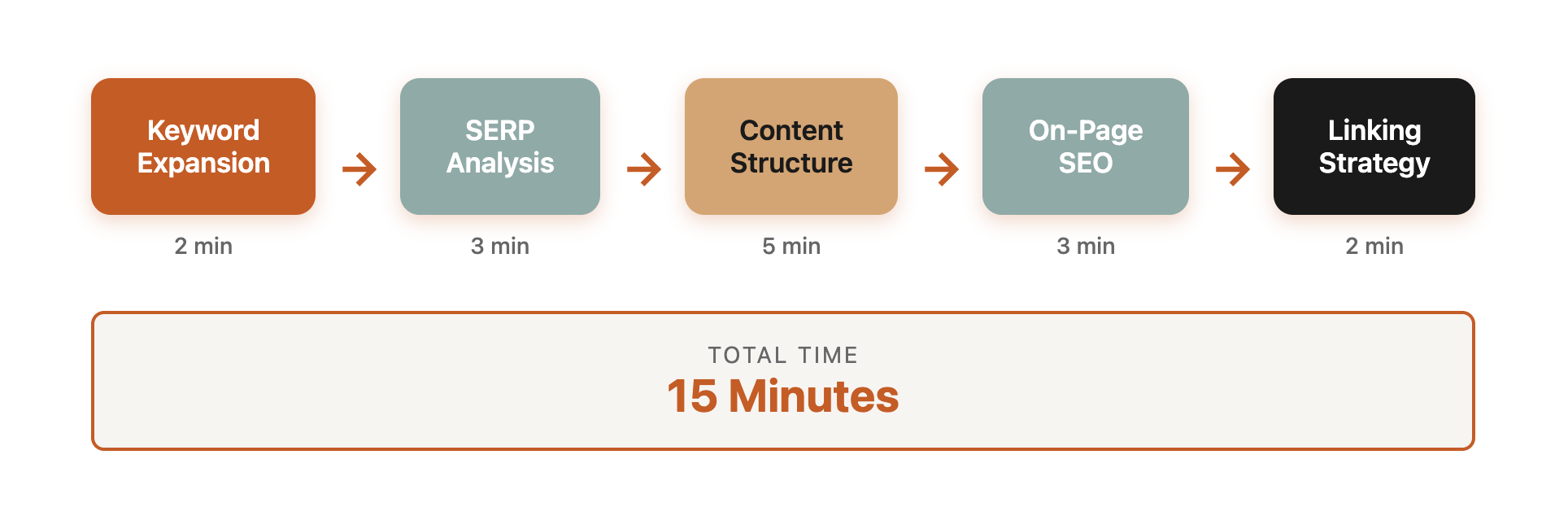
Step 1: Keyword Expansion (2 minutes)
Input: Primary keyword Output: Keyword cluster with volumes and difficulties
The system queries keyword databases to expand a seed keyword into:
- Primary keyword with metrics
- 10-15 secondary keywords
- 20-30 long-tail variations
- Search intent classification
What took 45 minutes of manual Ahrefs/SEMrush work happens in seconds via API.
Step 2: SERP Analysis (3 minutes)
Input: Primary keyword Output: Competitive landscape analysis
The system analyzes current top 10 results:
- Extracts titles, meta descriptions, word counts
- Identifies common sections and topics
- Notes content formats (listicle, guide, comparison)
- Captures featured snippet format
- Pulls People Also Ask questions
Manual SERP analysis requires opening 10 tabs, reading 10 articles, and noting patterns. Automated analysis extracts this in seconds.
Step 3: Content Gap Identification (3 minutes)
Input: SERP data Output: Unique angle opportunities
AI compares what competitors cover versus what searchers need:
- Topics mentioned by some but not all competitors
- Questions in "People Also Ask" not thoroughly answered
- Angles absent from current results (case studies, data, comparisons)
- Recency gaps (outdated competitor content)
This is where AI adds real value—pattern recognition across multiple sources that would take humans an hour of reading.
Step 4: Structure Generation (4 minutes)
Input: Keyword cluster + SERP analysis + content gaps Output: Complete content outline
AI generates:
- Recommended title (with alternatives)
- H2 sections with H3 subsections
- Word count per section
- Required elements per section (examples, stats, images)
- Featured snippet optimization recommendations
The structure synthesizes competitive intelligence with unique angle opportunities—something that requires human judgment when done manually but AI handles through pattern recognition.
Step 5: SEO Elements (2 minutes)
Input: Complete outline Output: On-page SEO specifications
Generated elements:
- Meta title (under 60 characters, keyword-front-loaded)
- Meta description (under 155 characters, includes CTA)
- URL slug
- Internal linking opportunities (both to and from)
- Image alt text recommendations
Step 6: Human Review (1 minute)
The brief isn't auto-approved. A human reviews for:
- Business alignment (does this topic serve our goals?)
- Brand voice fit (can we write this authentically?)
- Technical accuracy (do the recommendations make sense?)
- Strategic adjustments (should we emphasize certain angles?)
Review rarely requires changes—maybe 10-20% of briefs get minor adjustments. But the human checkpoint ensures quality control.
03 / sample-brief-output
Sample Brief Output
Here's what a 15-minute brief actually looks like.
Content Brief: Project Management Software for Small Teams
Target Keyword: project management software for small teams Search Volume: 2,400/month | Difficulty: 42/100
Search Intent: Commercial investigation (users comparing options before purchase)
Secondary Keywords:
- Best project management tools for small business (1,200/mo)
- Simple project management software (890/mo)
- Team collaboration tools for small teams (720/mo)
- Affordable project management apps (340/mo)
SERP Analysis:
- Top results are listicles (7/10 are "Best X" format)
- Average word count: 3,200 words
- Average tools covered: 12-15 per article
- Featured snippet: Comparison table format
- Common weakness: Generic descriptions, lack of specific use cases
Content Gap Opportunity: Competitors list features but don't explain which tool fits which team type. Create decision framework based on team size, budget, and workflow complexity.
Recommended Structure:
| Section | Word Count | Key Elements |
|---|---|---|
| Introduction | 200 | Hook: "The wrong tool costs more than money" |
| How to Choose (Framework) | 400 | Decision matrix by team size/budget/complexity |
| Best for Tiny Teams (1-5) | 500 | 3 tools with specific use cases |
| Best for Small Teams (6-15) | 600 | 4 tools with comparison table |
| Best for Growing Teams (16-30) | 500 | 3 tools with scaling considerations |
| Best Free Options | 400 | 3 tools with limitation clarity |
| Best for Specific Needs | 400 | Remote teams, creative teams, dev teams |
| How We Evaluated | 200 | Methodology transparency |
| FAQ | 300 | Top "People Also Ask" questions |
| Conclusion | 100 | Summary + CTA |
| Total | 3,600 |
Featured Snippet Target: Comparison table in "Best for Small Teams" section. Format: Tool | Best For | Price | Key Feature
Meta Title: 12 Best Project Management Tools for Small Teams (2026 Comparison)
Meta Description: Compare the top project management software for teams of 1-30. Honest reviews with pricing, pros/cons, and specific recommendations by team size.
URL: /blog/project-management-software-small-teams
Internal Links:
- Link FROM: /blog/team-collaboration-tips, /blog/remote-work-tools
- Link TO: /services/consulting, /blog/productivity-frameworks
That brief took 15 minutes to generate. A writer can produce a ranking article from it. The strategic decisions are made; execution remains.
04 / why-this-beats-manual-briefs
Why This Beats Manual Briefs
Three advantages compound:
Speed Enables Scale
At 3-4 hours per brief, a content strategist produces 10-12 briefs per month. At 15 minutes per brief, the same strategist produces 80+.
More briefs means more content. More content means more ranking opportunities. More ranking opportunities means more traffic.
The math is simple: 15-minute briefs enable 6-8x content velocity.
Consistency Beats Talent
Manual briefs vary by who creates them. Senior strategists produce thorough briefs; junior team members miss elements. Monday briefs differ from Friday briefs.
AI-generated briefs are consistent. Every brief includes the same elements in the same depth. Quality doesn't depend on who created it or when.
Consistency enables delegation. Any writer can execute a comprehensive brief, not just writers who know SEO.
Data Beats Intuition
Manual briefs rely on experience. "I think this section should come first." "This keyword feels right." "Competitors seem to be doing X."
AI briefs rely on data. "This section ranks in featured snippets 73% of the time." "This keyword has 2.3x the conversion rate of alternatives." "Competitors average 3,200 words with this structure."
Data-driven briefs produce data-driven content that ranks. We then optimize that content for both traditional SEO and AI answer engines.
05 / building-your-brief-system
Building Your Brief System
You can implement this without custom development.
Option 1: AI + Existing Tools
Use existing keyword tools (Ahrefs, SEMrush, Moz) for data, then feed to Claude or GPT-4:
Prompt template:
I'm creating a content brief for [KEYWORD].

Here's the data I've gathered:
- Search volume: [X]
- Top 10 results: [paste titles and word counts]
- People Also Ask: [paste questions]
- Related keywords: [paste list]

Generate a comprehensive content brief including:
1. Search intent analysis
2. Content gap opportunities
3. Recommended structure with sections and word counts
4. Featured snippet optimization approach
5. Meta title and description
6. Internal linking suggestions

Format as a ready-to-use brief a writer can execute.
Option 2: API Integration
Connect keyword and SERP APIs directly to AI processing:
Data sources:
- DataForSEO for keyword and SERP data
- OpenAI or Anthropic API for analysis and generation
- Your CMS for internal linking opportunities
Workflow:
- Input keyword to system
- System pulls keyword cluster from API
- System pulls SERP data from API
- System analyzes and generates brief
- Human reviews and approves
- Brief routes to writer
Option 3: Use Our System
We've built this. It works. You can use it.
06 / common-objections-addressed
Common Objections Addressed
"AI can't understand our brand voice"
The brief doesn't write the content—it structures it. Your writers still write in your voice. The brief ensures they write about the right things in the right structure.
"Every piece of content is unique"
Unique execution, yes. Unique structure? Often not. Most content follows patterns that work for specific search intents. The brief codifies those patterns; writers add uniqueness.
"We need human strategy"
You have human strategy—in the brief review step. The human decides which keywords to pursue, which angles to emphasize, which briefs to approve. AI handles research and structure; humans handle strategy.
"What about quality?"
Brief quality and content quality correlate. A comprehensive brief leads to comprehensive content. AI briefs are more thorough than most manual briefs because they don't skip steps. Once content is created, we repurpose it across multiple platforms to maximize reach.
07 / the-content-flywheel
The Content Flywheel
Here's what happens when you can produce 80 briefs per month instead of 12:
Month 1: 20 pieces published (up from 3) Month 3: 60 pieces live, first pieces gaining traction Month 6: 120 pieces, compound traffic growth begins Month 12: 240 pieces, organic traffic dominates acquisition
The brief bottleneck is usually what limits content velocity. Remove the bottleneck, and production scales.
And scale matters in SEO. More content covering more keywords with more internal links creates topical authority that single pieces can't achieve. This is a key component of our AI-amplified marketing approach.
08 / start-today
Start Today
If your content process bottlenecks at brief creation, here's your path:
This week:
- Document your current brief template (what does a good brief include?)
- Time yourself creating one brief manually (establish baseline)
- Try the AI prompt template above with one keyword
This month:
- Refine your prompt based on what works for your content
- Process 10 briefs using AI assistance
- Compare output quality to manual briefs
This quarter:
- Systematize the process (tools, templates, workflow)
- Train team on brief review and approval
- Scale content production with new capacity
09 / let-us-brief-your-content
Let Us Brief Your Content
Want 15-minute briefs without building the system? We offer content brief generation as part of our SEO & Content Marketing services.
What you get:
- Comprehensive briefs for your target keywords
- Keyword research and opportunity identification
- Competitive analysis and content gaps
- Ready-to-execute outlines for your writers
Investment: $150 per brief, or $2,500/month for 20 briefs.
Contact us:
- Email: hello@wedoworldwide.com
- Website: wedoworldwide.com
Send us 5 keywords. We'll send back 5 briefs within 48 hours. See the difference.
About the Author: Mike McKearin is the founder of WE•DO Growth Agency. His team generates 200+ content briefs per month, enabling content production at scale that would be impossible with manual processes.