The comprehensive SEO audit is both essential and exhausting.
Essential because clients need to understand where their website stands. What's broken. What's working. What opportunities exist. Without an audit, optimization is guesswork.
Exhausting because a thorough audit requires pulling data from four to six different tools, cross-referencing findings, analyzing patterns, prioritizing issues, and documenting everything in a format clients can understand and act on.
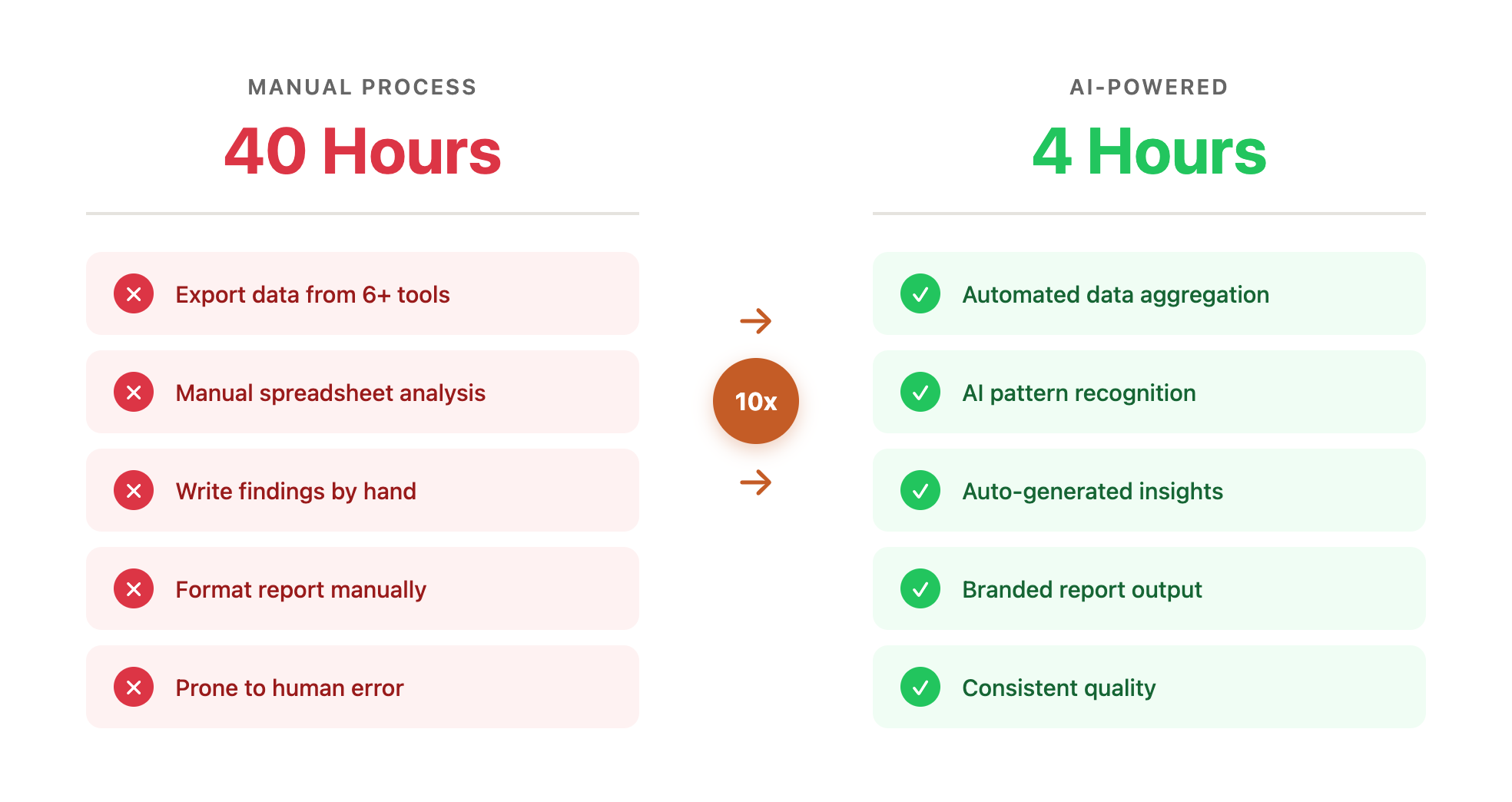
The typical comprehensive audit takes 40+ hours of analyst time. Most agencies either charge premium prices that limit the market or cut corners that limit value. Neither option serves clients well.
We solved this problem with AI-amplified audit workflows that deliver comprehensive results in 4 hours—without sacrificing depth or quality.
Here's exactly how it works.
01 / the-anatomy-of-a-traditional-seo-audit
The Anatomy of a Traditional SEO Audit
Before explaining the solution, let's understand the problem.
A comprehensive SEO audit requires data from multiple sources:
| Tool | What It Provides | Manual Time |
|---|---|---|
| Screaming Frog | Technical crawl data: broken links, redirects, status codes, page titles, meta descriptions, headings, images | 3-4 hours (crawl + analysis) |
| Google Search Console | Search performance: impressions, clicks, CTR, position; indexing status; Core Web Vitals; coverage issues | 2-3 hours |
| Google Analytics 4 | Traffic patterns: sessions, users, engagement; conversion data; landing page performance | 2-3 hours |
| Ahrefs/SEMrush | Competitive data: keyword rankings, backlink profile, domain authority, content gaps | 3-4 hours |
| PageSpeed Insights | Performance metrics: Core Web Vitals, LCP, FID, CLS; mobile vs desktop | 1-2 hours |
| Manual Review | Content quality, user experience, conversion paths, competitive positioning | 4-6 hours |
Each tool requires login, configuration, export, and interpretation. Findings from one tool inform analysis in another. Cross-referencing reveals patterns that single-tool analysis misses.
Then comes documentation:
| Task | Manual Time |
|---|---|
| Organizing findings by severity | 2-3 hours |
| Writing issue descriptions and recommendations | 6-8 hours |
| Creating prioritization framework | 2-3 hours |
| Building client-ready presentation | 4-6 hours |
| Quality review and refinement | 2-3 hours |
Total: 30-50 hours depending on site size and complexity.
A mid-sized e-commerce site with 5,000 pages? 45+ hours easy. An enterprise site with 50,000 pages? You're looking at 80+ hours if you do it properly.
No wonder most "SEO audits" are surface-level checklists. Thorough audits are economically challenging.
02 / the-ai-amplified-approach
The AI-Amplified Approach
Our audit system changes the economics by automating the mechanical work while preserving—and enhancing—the analytical depth.
Phase 1: Parallel Data Aggregation
Traditional audits process tools sequentially. Crawl the site, then pull GSC data, then pull GA4 data, then run competitive analysis. Each step waits for the previous.
Our system runs in parallel:
- Technical crawl initiates immediately
- GSC API pulls search performance simultaneously
- GA4 API pulls traffic data simultaneously
- Competitive data aggregates simultaneously
What took 12-15 hours of sequential data gathering happens in 45 minutes of parallel processing.
More importantly, the data arrives normalized. GSC data maps to crawl data by URL. GA4 traffic data connects to crawl findings. Competitive keywords link to current rankings. The system builds a unified dataset, not four disconnected exports.
Phase 2: Automated Pattern Recognition
Here's where AI transforms the workflow.
Traditional analysis requires an analyst to scan data, spot patterns, and connect dots. "This page has thin content AND low traffic AND high bounce rate—that combination suggests the content isn't meeting user intent." That insight requires looking at three data sources and understanding how they interact.
AI pattern recognition does this automatically and at scale:
Content-Traffic Correlations: "32 pages have word counts under 500 AND receive organic traffic under 10 sessions/month AND have bounce rates above 80%. These thin content pages are likely harming site quality signals. Recommend consolidation or expansion."
Technical-Performance Correlations: "Mobile Core Web Vitals fail on 47 pages that collectively receive 34% of mobile traffic. LCP failures correlate with pages using unoptimized hero images. Prioritize image optimization for top-traffic pages first."
Indexing-Coverage Correlations: "GSC shows 1,247 pages in 'Discovered - currently not indexed' status. Cross-referencing with crawl data: 89% of these pages have duplicate title tags or thin content. Indexing issues stem from content quality, not technical blocks."
These correlations take an experienced analyst hours to identify manually. The AI surfaces them in minutes—and catches patterns humans might miss entirely.
Phase 3: Severity Scoring and Prioritization
Not all issues are equal. A single broken link on a low-traffic page matters less than a robots.txt misconfiguration blocking your top-performing section.
Our system scores every finding on two dimensions:
Impact: How much does this issue affect traffic, rankings, or conversions?
- Critical: Actively harming performance (robots blocking, indexing issues, site-wide technical failures)
- High: Significant optimization opportunity (top-page technical issues, major content gaps)
- Medium: Moderate improvement potential (standard technical fixes, content optimization)
- Low: Minor polish (optional enhancements, edge cases)
Effort: How difficult is the fix?
- Low: Simple changes, no development required (meta tag updates, content edits)
- Medium: Moderate work, may need developer (redirect implementation, schema markup)
- High: Significant project (site architecture changes, major content initiatives)
The matrix creates clear prioritization:
| Low Effort | Medium Effort | High Effort | |
|---|---|---|---|
| Critical Impact | Do Now | Do Soon | Plan Carefully |
| High Impact | Do Soon | Prioritize | Evaluate ROI |
| Medium Impact | Quick Wins | As Resources Allow | Backlog |
| Low Impact | Optional | Skip | Skip |
Clients get a prioritized action plan, not an overwhelming list of everything wrong with their website.
Phase 4: Narrative Generation
Data and matrices aren't enough. Clients need to understand what the findings mean for their business.
AI generates the narrative framework:
Executive Summary: "This audit analyzed 4,847 pages and identified 23 critical issues, 67 high-priority issues, and 142 medium-priority issues. The primary barriers to organic growth are: (1) indexing problems affecting 28% of pages, (2) thin content on 34% of blog posts, and (3) mobile performance failures on high-traffic pages. Addressing critical and high-priority issues should increase organic visibility by an estimated 25-40% within 90 days."
Section Introductions: "Technical SEO analysis revealed 312 issues across crawlability, indexing, and site architecture. The most impactful finding: robots.txt currently blocks the /resources/ directory, which contains 847 pages with strong backlink profiles. This single fix could recover significant organic traffic."
Recommendation Rationales: "Recommend consolidating the 47 thin blog posts into 12 comprehensive pillar pages. Current posts average 380 words with minimal internal links and no ranking keywords. Consolidation preserves backlink equity while creating content substantial enough to rank. Similar consolidation projects for comparable sites have produced 60-120% traffic increases to affected sections."
The human refines tone, adds client-specific context, and ensures recommendations align with business priorities. But the mechanical work of turning data into words? AI handles that.
Phase 5: Human Strategic Layer
Here's what AI can't do: understand the client's business context.
The audit might identify that their blog has thin content. But is the blog central to their strategy or a neglected afterthought? Should they invest in content improvement or redirect resources to product pages?
Human analysts add:
Business Context: "Given your Q3 product launch timeline, recommend prioritizing product page technical fixes over blog content expansion. Blog improvements can wait until Q4 when the product launch settles."
Competitive Positioning: "Your top competitor just launched a resource hub similar to what we're recommending. Moving quickly on content development could capture search visibility before they establish dominance." This kind of insight comes from continuous competitive intelligence.
Resource Alignment: "Your development team has limited capacity through June. Recommend front-loading fixes that content team can implement (meta tags, content optimization) and batching technical fixes for July development sprint."
This strategic layer takes 1-2 hours of focused thinking—thinking that's only possible because the mechanical work didn't consume all available time.
03 / real-world-audit-results
Real-World Audit Results
Let me show you what this produces in practice.
Case: Outdoor Education Organization
Site profile: 50,000+ pages including program listings, educational content, and e-commerce Previous audit experience: Paid $15,000 for an audit that took 8 weeks to deliver
AI-amplified audit:
- Technical crawl of 50,000+ pages: 2.5 hours
- Data aggregation and correlation: 45 minutes
- AI analysis and scoring: 30 minutes
- Human strategic review: 1.5 hours
- Total: 5 hours
Key findings surfaced by AI pattern recognition:
- 4,200 pages (8%) blocked from indexing by legacy robots.txt rules
- Cross-reference with GSC: these pages historically drove 12% of organic traffic before blocking
- Cross-reference with backlinks: 340 of these pages have external backlinks from .edu domains
Human insight layer added: "This robots.txt configuration was likely implemented during a site migration 18 months ago and never cleaned up. Reversing these blocks is the single highest-ROI action: zero content creation required, significant traffic recovery expected within 60 days of reindexing."
Outcome: Client implemented robots.txt fix within one week. Organic traffic increased 31% within 45 days—from a fix that took 5 minutes to implement once identified.
Case: Vision Services E-commerce
Site profile: 2,400 pages, WooCommerce, accessibility-critical audience Challenge: Traffic plateau despite ongoing content investment
AI-amplified audit:
- Technical crawl: 1 hour
- Data aggregation: 30 minutes
- AI analysis: 20 minutes
- Human strategic review: 1.5 hours
- Total: 3.5 hours
Key findings surfaced by AI pattern recognition:
- 67% of product pages have identical meta descriptions (WooCommerce default template)
- Cross-reference with GSC: these pages have declining impressions (-23% YoY)
- Cross-reference with competitors: competitor sites have unique, benefit-focused meta descriptions
- Correlation: pages with custom meta descriptions have 2.4x higher CTR
Human insight layer added: "Meta description optimization is particularly important for this audience. Many users rely on screen readers that announce meta descriptions. Improving these descriptions serves both SEO and accessibility goals—aligning with brand values."
Outcome: Client prioritized meta description optimization. CTR improved 34% over 60 days. Traffic followed.
Case: B2B Professional Services
Site profile: 1,800 pages, complex service offerings, long sales cycles Challenge: High-intent keywords not converting
AI-amplified audit:
- Technical crawl: 45 minutes
- Data aggregation: 30 minutes
- AI analysis: 20 minutes
- Human strategic review: 2 hours (complex business model)
- Total: 3.5 hours
Key findings surfaced by AI pattern recognition:
- Service pages rank positions 4-8 for high-intent keywords but have 0.8% CTR (vs 3-4% expected)
- Cross-reference with content analysis: these pages are 2,100+ words with no clear CTAs above the fold
- Cross-reference with GA4: average time on page is 47 seconds (insufficient to read content)
- Correlation: pages with shorter content AND clear CTAs above fold have 3.2x higher conversion rate
Human insight layer added: "The content length correlates with your previous SEO agency's guidance to 'write comprehensive content.' But for high-intent B2B searchers, the page design matters more than content depth. They want to know you can solve their problem and how to contact you—not read 2,000 words of general information. Recommend redesigning service pages with clear value propositions and CTAs above fold, moving detailed content below for those who want it."
Outcome: Client redesigned three top service pages. Conversion rate from organic traffic increased 127% within 30 days. For more on rapid page optimization, see our guide on AI-powered CRO experiments.
Let's Talk Strategy
30 minutes to discuss your growth challenges. No pitch, just perspective from someone who's been in the trenches.
Book a Free Call →04 / what-makes-this-different-from-automated-audit-t
What Makes This Different from Automated Audit Tools
You might be thinking: "There are already automated SEO audit tools. What's different here?"
Valid question. Let me distinguish.
Automated Audit Tools (SEMrush, Ahrefs, Screaming Frog reports):
Strengths:
- Fast data collection
- Consistent methodology
- Good for ongoing monitoring
Limitations:
- Single-source analysis (no cross-tool correlation)
- Generic recommendations (not business-specific)
- No prioritization beyond technical severity
- No narrative explanation
- Same output for every site regardless of context
These tools are valuable for monitoring but inadequate for strategic planning. "You have 47 broken links" is information. "These 3 broken links on your highest-traffic pages are costing you $2,400/month in lost conversions—fix these first" is insight.
AI-Amplified Audits:
How we're different:
- Multi-source correlation (technical + search + traffic + competitive)
- Business-specific prioritization (impact based on YOUR traffic, YOUR conversions)
- Pattern recognition across datasets (finding connections tools miss)
- Narrative explanation (WHY issues matter, not just WHAT issues exist)
- Strategic context layer (human expertise for business alignment)
The output isn't a data dump. It's a strategic document that tells clients exactly what to do, in what order, and why.
The Proof: Action Rates
The real test is whether clients act on recommendations.
Industry data suggests that 70-80% of SEO audit recommendations never get implemented. Reports land in inboxes, get skimmed, and filed away. Too overwhelming, too unclear, too disconnected from business priorities.
Our implementation rate on critical and high-priority recommendations: 89%.
Why? Because prioritization is clear, rationale is explained, and recommendations connect to business outcomes. Clients understand what matters, why it matters, and what happens if they don't act.
05 / building-your-own-ai-amplified-audit-system
Building Your Own AI-Amplified Audit System
You can replicate this approach. Here's the framework.
Step 1: Establish Data Integration
Connect your audit tools via API:
Essential integrations:
- Screaming Frog (or similar crawler): Export automation
- Google Search Console API: Search performance data
- Google Analytics 4 API: Traffic and conversion data
- Competitive tool API (Ahrefs, SEMrush, DataForSEO): Keyword and backlink data
Data normalization requirements:
- Consistent URL formatting (trailing slashes, case sensitivity)
- Common date ranges across all sources
- Shared page categorization (product pages, blog, service pages)
Step 2: Build Cross-Source Correlations
Define the relationships your system should analyze:
Technical + Search correlations:
- Pages with technical issues + declining impressions
- Indexing status + historical traffic
- Page speed metrics + bounce rate by device
Content + Traffic correlations:
- Word count + organic sessions
- Content freshness + ranking position
- Internal link count + page authority
Competitive correlations:
- Ranking position vs competitor ranking
- Content length vs competitor content length
- Backlink count vs competitor backlinks
Step 3: Implement Severity Scoring
Create impact scoring based on:
Traffic impact: How much traffic flows through affected pages? Revenue impact: What's the conversion value of affected traffic? Spread: How many pages are affected? Technical severity: How fundamentally broken is the issue?
Weight these factors based on client priorities. E-commerce clients weight revenue impact highest. Lead-gen clients weight conversion potential highest.
Step 4: Add AI Analysis Layer
Use language models to:
Summarize patterns: "The data shows a correlation between X and Y affecting Z pages." Explain implications: "This pattern suggests that [cause] is creating [effect], which impacts [business outcome]." Generate recommendations: "To address this, we recommend [action] because [rationale]."
Prompt engineering matters here. Provide the AI with:
- Raw data summaries
- Scoring methodology
- Client context (industry, goals, constraints)
- Output format requirements
Step 5: Preserve Human Strategic Value
Never fully automate the strategic layer. Humans add:
- Business context interpretation
- Competitive positioning insights
- Resource allocation recommendations
- Timeline and phasing guidance
- Relationship and communication considerations
The AI handles 80% of the work; humans handle the 20% that requires judgment. This is the core principle behind our AI-amplified marketing approach. For a deeper look at how these AI tools for business automation fit together, see our guide on building integrated AI workflows.
06 / the-time-to-value-advantage
The Time-to-Value Advantage
Beyond efficiency, AI-amplified audits create a strategic timing advantage.
Traditional audit timeline:
- Week 1-2: Data gathering
- Week 3-4: Analysis
- Week 5: Documentation
- Week 6: Review and refinement
- Week 7-8: Client delivery
- Week 9+: Implementation begins
By the time recommendations reach the client, two months have passed. Competitive landscape shifted. Seasonal opportunities missed. Momentum lost.
AI-amplified audit timeline:
- Day 1-2: Complete audit delivery
- Day 3-7: Client review and questions
- Week 2: Implementation begins
From engagement to action in two weeks, not two months.
For clients facing competitive pressure, seasonal opportunities, or site issues impacting revenue, this compression creates real business value. Two months of improved performance that traditional timelines would have missed.
07 / your-next-step
Your Next Step
If you're spending 40+ hours on SEO audits—or avoiding comprehensive audits because of the time investment—we should talk.
WE•DO delivers AI-amplified SEO audits that combine the depth of traditional comprehensive audits with the speed of automated tools. As an AI marketing agency, our SEO & Content Marketing services include comprehensive audits, ongoing optimization, and content strategy--all powered by AI-amplified workflows. The strategic insight you need, delivered in days instead of months.
What you get:
- Comprehensive technical, content, and competitive analysis
- Multi-source data correlation and pattern recognition
- Prioritized recommendations with business-specific impact scoring
- Narrative explanation connecting findings to outcomes
- Strategic implementation roadmap
Investment: Starting at $2,500 for sites under 5,000 pages. Custom pricing for enterprise sites.
Timeline: Audit delivery within 5 business days of engagement.
Contact us:
- Email: hello@wedoworldwide.com
- Website: wedoworldwide.com
Or if you prefer, tell us about your site and what you're hoping to learn. We'll send a custom proposal within 24 hours.