Your Google Ads search term report contains hidden treasure. And hidden waste.
Every query that triggered your ads tells you something: what people actually search for when looking for your product, what terms you're paying for that will never convert, what keywords you're missing that your competitors capture.
Most advertisers export the report, sort by spend, skim the top 20 terms, add a few negatives, and move on. They're leaving money on the table.
AI-powered search term analysis goes deeper—finding patterns humans miss, opportunities buried in long-tail data, and systematic waste that compounds monthly.
Here's how to extract every dollar of value from your search term data.
Your search term report isn't just a list. It's a map of customer intent.
What search terms reveal:
| Data Point | What It Tells You |
|---|---|
| New converting terms | Keywords to add to campaigns |
| High-spend non-converters | Negatives to eliminate waste |
| Question-format queries | Content opportunities |
| Competitor mentions | Competitive positioning needs |
| Misspellings that convert | Broad match opportunities |
| Long-tail variations | Exact match expansion candidates |
| Intent signals | Landing page optimization targets |
The average account has 10,000+ unique search terms per quarter. Manual analysis catches the obvious ones. AI analysis catches everything.
02 / the-manual-approach-and-its-limits
The Manual Approach (And Its Limits)
Typical search term management:
- Export last 30 days
- Sort by cost
- Review top 50-100 terms
- Add obvious negatives ("free," "jobs," competitor names)
- Maybe add a few high-performers as keywords
- Done until next month
Time invested: 30-60 minutes Terms reviewed: 0.5-1% of total Waste eliminated: Obvious offenders only Opportunities captured: Whatever stood out
This approach misses:
- Low-volume terms that collectively represent 40%+ of spend
- Patterns across related terms (not just individual queries)
- Emerging trends before they become obvious
- Negative keyword themes (not just individual terms)
- Keyword opportunities in the long tail
03 / the-ai-powered-approach
The AI-Powered Approach
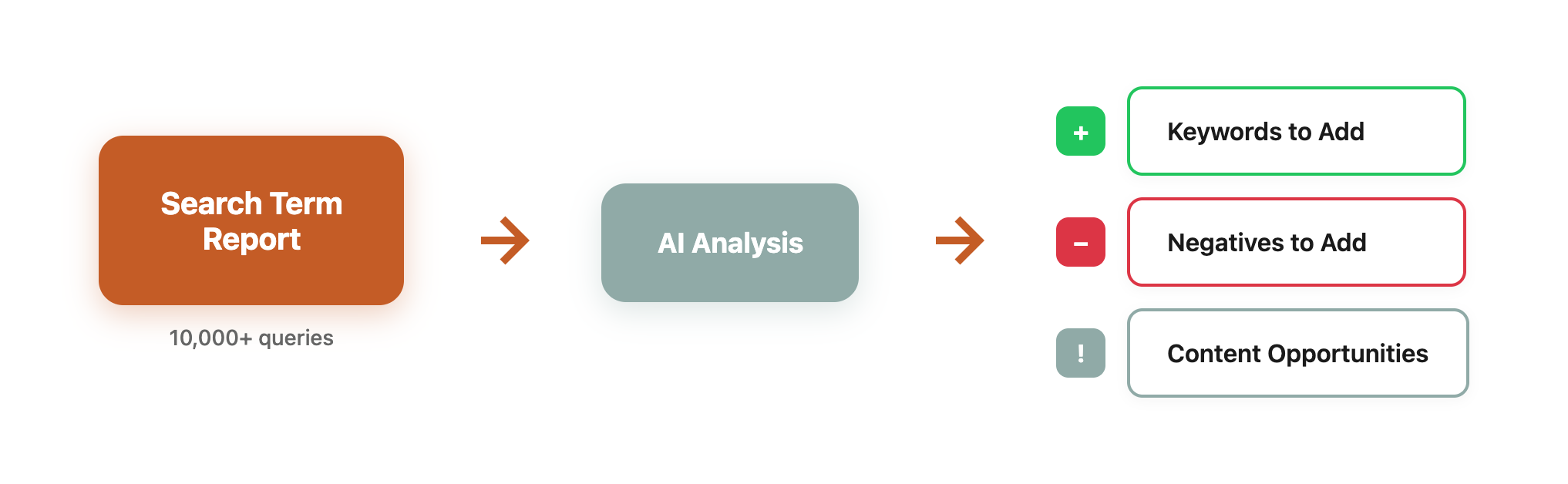
Our system analyzes every term, identifies patterns, and generates prioritized actions.
Phase 1: Data Preparation
Export search terms with all available metrics:
- Search term
- Match type triggered
- Impressions, clicks, cost
- Conversions, conversion value
- Campaign and ad group
For meaningful analysis, pull at least 90 days of data. Short timeframes miss patterns.
Phase 2: Pattern Recognition
AI analyzes the data looking for:
Negative keyword candidates:
- Terms with spend > $X and zero conversions
- Terms with high impressions but CTR < 0.5% (low relevance)
- Terms containing irrelevant modifiers ("free," "diy," "cheap" if you're premium)
- Terms indicating wrong intent (informational when you want transactional)
- Terms mentioning competitors (if you don't want to bid on them)
Keyword opportunities:
- Converting terms not yet added as keywords
- Terms with CTR > campaign average (high relevance)
- Long-tail variations of your best performers
- Question-format queries (potential featured snippet targets)
- Terms with high conversion rate but low impression share
Match type optimization:
- Exact match candidates (proven converters to protect)
- Phrase match candidates (proven themes to expand)
- Broad match risks (high spend from irrelevant queries)
Phase 3: Prioritized Recommendations
AI doesn't just flag issues—it prioritizes by impact:
Example output:
NEGATIVE KEYWORD RECOMMENDATIONS (Priority: High)

1. Add "jobs" as campaign negative
   - 47 matching terms, $1,234 spend, 0 conversions
   - Pattern: Users searching for employment, not product
   - Impact: Est. $400/month waste elimination

2. Add "free" as campaign negative
   - 23 matching terms, $890 spend, 0 conversions
   - Pattern: Users seeking free alternatives
   - Impact: Est. $290/month waste elimination

3. Add "how to" as ad group negative (Brand campaign only)
   - 12 matching terms, $456 spend, 1 conversion at $456 CPA
   - Pattern: Informational intent, poor conversion
   - Impact: Est. $400/month CPA improvement

KEYWORD OPPORTUNITIES (Priority: Medium)

1. Add "[product] for small business" as exact match
   - Current: Triggered via broad match
   - Performance: 34 conversions, $12 CPA (vs $28 account avg)
   - Recommendation: Protect with exact match, increase bids

2. Add "[product] vs [competitor]" as phrase match
   - Current: Triggered via broad match
   - Performance: 12 conversions, $18 CPA
   - Recommendation: Create dedicated ad group with comparison ads

MATCH TYPE ALERTS (Priority: Low)

1. Broad match "[product]" generating irrelevant traffic
   - 23% of queries are off-topic
   - Consider tightening to phrase match or adding negatives
Phase 4: Implementation
Recommendations export directly to Google Ads Editor format:
Campaign,Ad Group,Keyword,Match Type,Action
All Campaigns,-,jobs,Negative Broad,Add
All Campaigns,-,free,Negative Broad,Add
Brand Campaign,-,how to,Negative Phrase,Add
Product Campaign,Core Terms,[product] for small business,Exact,Add
Product Campaign,Competitor,[product] vs [competitor],Phrase,Add
Import to Editor, review, apply. What took hours of manual work happens in minutes.
04 / real-impact-examples
Real Impact Examples
Let me show you what this analysis uncovers.
Example 1: The Compound Waste Pattern
Manual analysis found: "Free trial download" - added as negative
AI analysis found:
Pattern: "Free" modifier queries
- 47 unique terms containing "free"
- Combined: 2,340 clicks, $4,680 spend, 0 conversions
- Terms include: free alternative, free version, free trial,
  free download, free software, open source free, etc.

Recommendation: Add "free" as campaign-level negative
Annual savings: $56,160
The manual approach found one term. AI found the pattern across 47 terms.
Example 2: The Hidden Gem
Manual analysis found: Nothing notable in position 73 of cost-sorted list
AI analysis found:
High-efficiency opportunity:
- Term: "[product] for accountants"
- 12 conversions, $96 total spend ($8 CPA vs $32 account avg)
- Currently: Triggered via broad match, no dedicated targeting
- Impression share: 23% (missing 77% of searches)

Recommendation:
1. Add as exact match keyword
2. Create dedicated ad with accountant-specific messaging
3. Create landing page for accountants
Projected impact: 4x conversions at same CPA
This converting term was buried in the long tail. AI surfaced it because of anomalous efficiency.
Example 3: The Competitor Intelligence
Manual analysis found: A few competitor brand terms to negative out
AI analysis found:
Competitor mention analysis:
- [Competitor A]: 234 queries, 12 conversions, $18 CPA
- [Competitor B]: 156 queries, 8 conversions, $22 CPA
- [Competitor C]: 89 queries, 2 conversions, $67 CPA

Insight: Users comparing you to Competitor A convert well.
Users searching Competitor C have different needs (poor fit).

Recommendations:
1. Create Competitor A comparison campaign (opportunity)
2. Add Competitor C as negative (poor fit)
3. Research why Competitor B traffic underperforms
Not all competitor traffic is equal. AI identifies which competitors to embrace and which to avoid. This analysis feeds into our broader competitive intelligence system.
05 / building-your-search-term-analysis-system
Building Your Search Term Analysis System
You can implement this approach with available tools.
Step 1: Export Comprehensive Data
From Google Ads:
- Reports > Predefined reports > Search terms
- Date range: Last 90 days (minimum)
- Columns: Search term, match type, campaign, ad group, impressions, clicks, cost, conversions, conv. value
Export as CSV.
Step 2: Prepare Analysis Prompt
Feed the data to Claude or GPT-4 with this prompt:
Analyze this Google Ads search term data and provide:

1. NEGATIVE KEYWORD RECOMMENDATIONS
Identify terms to add as negatives based on:
- High spend with zero conversions
- Patterns indicating wrong intent
- Irrelevant modifiers appearing across multiple terms
Format: Term, reason, total spend, recommended match type

2. KEYWORD OPPORTUNITIES
Identify terms to add as keywords based on:
- Conversions at better-than-average CPA
- High CTR indicating strong relevance
- Volume potential if given dedicated targeting
Format: Term, current performance, recommended match type, projected impact

3. MATCH TYPE RECOMMENDATIONS
Identify keywords where match type should change based on:
- Broad match generating excessive irrelevant queries
- High-performing terms that need protection with exact match
Format: Current keyword, current match type, recommended change, reason

4. PATTERNS AND INSIGHTS
What themes or patterns exist in:
- Converting terms (what do winners have in common?)
- Non-converting terms (what do losers have in common?)
- Emerging trends (new query patterns worth watching?)

Prioritize all recommendations by estimated monthly impact.

Here is the data:
[paste CSV]
Step 3: Review and Implement
AI recommendations need human review:
- Does the negative make sense for our business?
- Is the keyword opportunity actually relevant?
- Do we have capacity to create dedicated campaigns/landing pages?
Review takes 15-20 minutes. Then export to Google Ads Editor and apply.
Step 4: Establish Cadence
Weekly: Quick review of high-spend non-converters (15 min) Monthly: Full AI analysis and implementation (60 min) Quarterly: Deep dive on patterns and strategic opportunities (2 hours)
Consistent attention compounds. Monthly analysis catches waste before it accumulates.
06 / the-math-of-systematic-analysis
The Math of Systematic Analysis
Let's quantify the impact:
Typical account inefficiency:
- 15-25% of spend goes to irrelevant queries
- On $10,000/month spend, that's $1,500-2,500 waste
Manual analysis catches:
- Obvious negatives (the "jobs" and "free" queries)
- Maybe 30-40% of waste
- Savings: $450-1,000/month
AI analysis catches:
- Pattern-based negatives
- Long-tail waste
- 70-85% of waste identified
- Savings: $1,050-2,125/month
Additional value from opportunities:
- Converting terms promoted to keywords
- Dedicated campaigns for high performers
- Typical improvement: 10-20% more conversions at same spend
Annual impact of AI-powered analysis: $15,000-35,000 on a $10,000/month account. This is one of many ways our AI-amplified marketing approach drives measurable ROI.
07 / start-today
Start Today
If you're running Google Ads, here's your immediate action:
Today:
- Export last 90 days of search terms
- Run AI analysis using the prompt above
- Identify top 10 negative keyword candidates
This week:
- Implement negative keywords
- Identify top 3 keyword opportunities
- Create new keywords or campaigns for opportunities
This month:
- Establish weekly review cadence
- Track impact of changes (before/after spend efficiency)
- Refine analysis prompts based on what's useful
08 / let-us-analyze-your-campaigns
Let Us Analyze Your Campaigns
Want professional search term analysis? Our paid media team offers it as a service.
What you get:
- Comprehensive analysis of all search terms
- Prioritized negative keyword recommendations
- Keyword opportunity identification
- Match type optimization recommendations
- Implementation support
Investment: Starting at $500 for one-time analysis, or $300/month for ongoing optimization.
Contact us:
- Email: hello@wedoworldwide.com
- Website: wedoworldwide.com
Share your search term export (anonymized if preferred). We'll send back a sample analysis showing what you're missing.
About the Author: Mike McKearin is the founder of WE•DO Growth Agency. His team manages $2M+ in annual Google Ads spend, using AI-powered search term analysis to reduce waste by an average of 23% while improving conversion volume.