Most AI marketing advice doesn't apply to home service businesses.
Generic content strategies assume you want national traffic. You don't—you serve a 30-mile radius. Sophisticated automation frameworks assume you have a marketing department. You have three trucks and a dispatcher.
This guide covers what actually works for plumbers, HVAC technicians, electricians, roofers, and contractors. Practical applications that fit how your business operates, not theoretical frameworks that don't.
01 / why-home-services-is-different
Why Home Services Is Different
Before diving into solutions, let's acknowledge why generic AI marketing advice fails here:
You're local-only. National traffic is worthless. Someone in Seattle can't hire your Asheville plumbing company. Every marketing dollar must target your service area specifically.
Reviews make or break you. One bad Google review impacts next month's phone calls. One great review generates referrals for years. Reputation management isn't optional—it's survival.
Seasonality is real. HVAC companies are slammed in summer and winter, slow in spring and fall. Roofers peak after storms. Landscapers disappear in January. Your marketing needs to flex with demand.
Emergency vs. planned work are different businesses. "AC broken need help NOW" is different from "thinking about AC maintenance this spring." Same company, different marketing.
Trust is everything. Customers let you into their homes. They're often making expensive decisions quickly without ability to evaluate quality. Marketing must build trust before the phone rings.
02 / ai-applications-that-actually-work
AI Applications That Actually Work
Here's what's worth implementing, in order of impact:
1. Review Response Automation
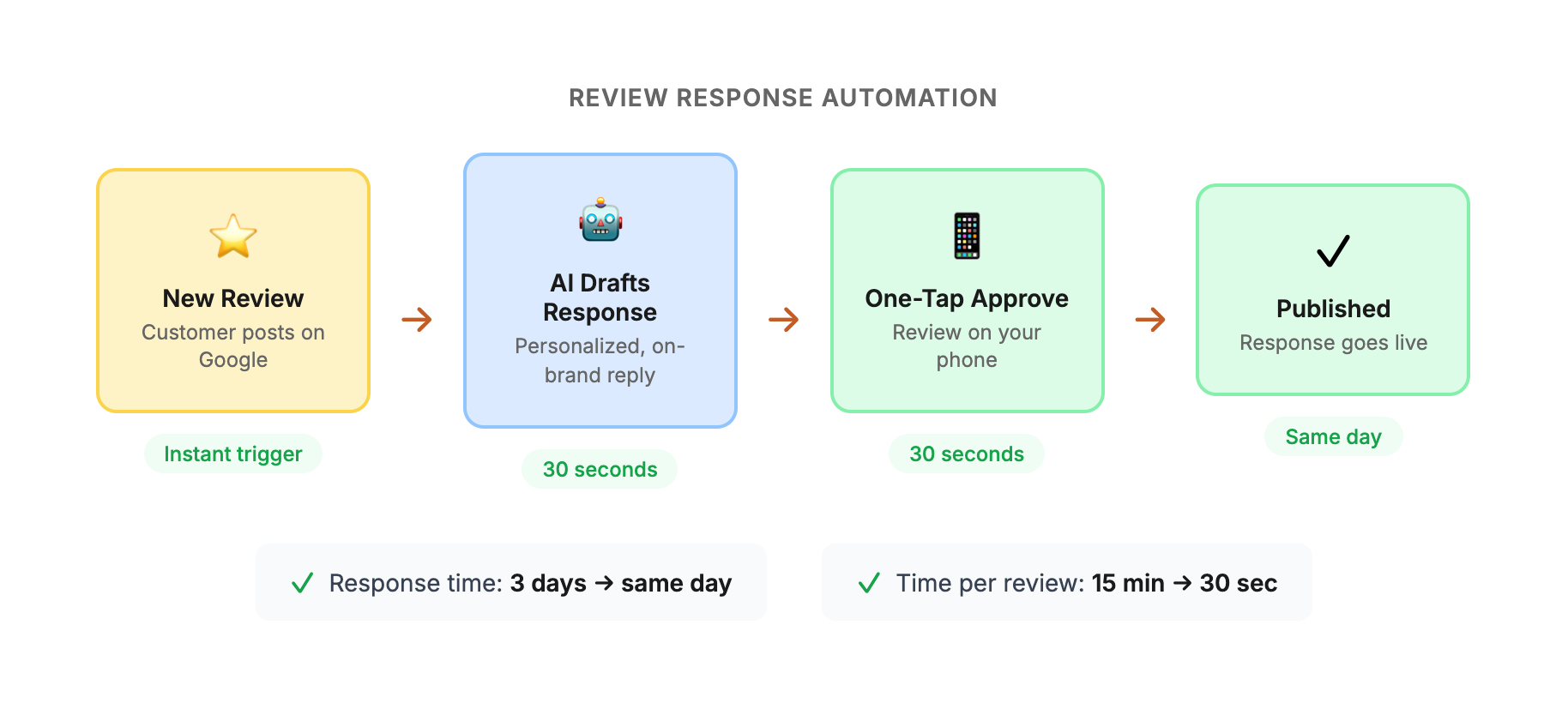
The problem: Reviews need quick, personalized responses. But you're on job sites. By the time you think about responding, it's been three days—which looks like you don't care.
The solution: AI drafts review responses immediately. You approve from your phone with one click. Positive reviews get thoughtful thanks. Negative reviews get professional acknowledgment and invitation to resolve offline.
What this looks like:
New 5-star review appears → AI drafts response:
"Thank you for the kind words about the water heater installation! We're glad the crew was able to get everything up and running on your timeline. Please don't hesitate to reach out if you have any questions as you get used to the new system."
New 3-star review appears → AI drafts response:
"Thank you for your feedback. We're sorry to hear the scheduling didn't work as smoothly as we'd like. [Name] would like to discuss this directly—could you call us at [number] or email [address]? We want to make this right."
You review, edit if needed, tap approve. 30 seconds instead of 15 minutes. Every review gets a response within hours, not days.
Expected impact:
- Response time: 3 days → same day
- Time per review: 15 minutes → 30 seconds
- Response rate: sporadic → 100%
- Review score impact: positive responses encourage more reviews
2. Quote Follow-Up Sequences
The problem: You give quotes. You mean to follow up. You forget. By the time you remember, they've hired someone else. Studies show 44% of salespeople give up after one follow-up, but 80% of sales require five follow-ups.
The solution: Automated sequences that follow up systematically. Quote given triggers a sequence: Day 1 check-in, Day 3 value-add, Day 7 final touch. No quotes fall through cracks.
What this looks like:
Quote sent → System schedules:
Day 1 (email):
"Hi [Name], just following up on the quote for [service]. Let me know if you have any questions—happy to walk through the details or adjust anything to fit your needs."
Day 3 (text):
"Hi [Name], checking in on the [service] quote. Any questions I can answer?"
Day 7 (email):
"Hi [Name], wanted to check one more time on the [service] quote. If timing isn't right, no pressure—just let me know if circumstances change and I'll be here. Otherwise, I'll assume you went a different direction and won't keep bothering you."
Sequences stop if they respond. No manual tracking required.
Expected impact:
- Quotes that convert: typically 15-25% → 25-40%
- Follow-up consistency: sporadic → 100%
- Time on follow-up: hours/week → nearly zero
- Revenue recovery: 20-30% more jobs from existing leads
3. Seasonal Content Scheduling
The problem: You know you should blog and post on social media. But "write AC maintenance tips" in January feels wrong, and you never remember in June because you're too busy.
The solution: AI builds a full seasonal content calendar once. Creates all content in batches. Schedules to publish automatically. Your content matches the season without you thinking about it.
What this looks like:
One planning session creates 12 months of content:
January content: Frozen pipe prevention, furnace efficiency tips, winter thermostat settings, holiday lighting safety April content: AC tune-up reminders, spring HVAC checklist, allergy season air quality, storm prep July content: Energy saving during heat waves, signs your AC needs service, humidity control tips October content: Heating system preparation, fall maintenance checklist, holiday booking reminders
AI writes all posts based on your services and voice. You review in batches (2-3 hours quarterly). Content publishes automatically, never missing a relevant season.
Expected impact:
- Content consistency: sporadic → continuous
- Time on content: ongoing struggle → quarterly batch
- Seasonal relevance: usually missed → always timely
- SEO benefit: fresh content signals, local keyword coverage
4. Emergency vs. Planned Targeting
The problem: "AC repair" and "AC maintenance" are different searches from different customers with different urgency. Treating them the same wastes money.
The solution: AI segments campaigns, ads, landing pages, and follow-up by intent. Emergency gets immediate response focus. Planned gets education and scheduling focus.
What this looks like:
Emergency searches ("AC not cooling," "broken air conditioner," "HVAC emergency"):
- Ads emphasize: Same-day service, 24/7 availability, fast response
- Landing page: Phone number prominent, immediate booking, minimal content
- Follow-up: Immediate confirmation, tech ETA, post-service review request
Planned searches ("AC maintenance," "HVAC tune up," "AC service near me"):
- Ads emphasize: Expertise, preventive benefits, seasonal specials
- Landing page: Education content, scheduling options, service packages
- Follow-up: Maintenance reminders, seasonal tips, loyalty discounts
Same business, different marketing systems for different customer needs.
Expected impact:
- Cost per lead: typically 20-30% reduction
- Conversion rate: better match = higher conversion
- Customer satisfaction: expectations set correctly
- Revenue per customer: maintenance customers become long-term relationships
5. Local SEO Monitoring
The problem: Local pack rankings change constantly. You find out something's wrong when the phone stops ringing—which is too late to fix.
The solution: AI monitors your rankings daily across service areas. Alerts you to drops before they become crises. Tracks competitor movements. Identifies opportunities.
What this looks like:
Weekly report shows:
- Your position for "plumber [city]" across all service area cities
- Week-over-week changes (up, down, stable)
- Competitor movements (new competitor? Existing one declining?)
- Review velocity (are you getting more or fewer reviews than last month?)
- Opportunities (cities where you're close to top 3 but not there yet)
When something changes significantly, you get an alert:
"Your ranking for 'plumber Asheville' dropped from #2 to #5 this week. Competitor [Name] now #1 with 47 new reviews this month vs. your 8. Recommend review generation focus."
No surprises. Problems caught early when they're easier to fix.
Expected impact:
- Ranking issue detection: weeks/months → same day
- Proactive vs. reactive: reactive → proactive
- Competitive awareness: blind → informed
- Revenue protection: catch problems before they cost jobs
03 / what-doesnt-work-for-home-services
What Doesn't Work for Home Services
Knowing what not to do is as valuable as knowing what to do:
Generic content marketing. You don't need 50 blog posts for national SEO. You need 5-10 strong local pages that rank in your service area. Quality over quantity.
Sophisticated marketing automation. Enterprise platforms with 47 features are overkill. You need the 4-5 features that matter, implemented well.
Social media heavy strategies. Your customers aren't scrolling Instagram looking for plumbers. Social presence helps legitimacy, but it's not a lead generation channel for emergency services.
National SEO tactics. Backlink building, guest posting, content syndication—these are for national brands. Local service businesses grow through local citations, reviews, and Google Business Profile optimization.
Overly complex CRM systems. You need to track leads and follow up. You don't need a CRM that requires a full-time administrator.
04 / getting-started-the-home-services-ai-stack
Getting Started: The Home Services AI Stack
Tier 1: DIY Foundation ($100-200/month)
For businesses doing marketing themselves:
| Tool | Purpose | Cost |
|---|---|---|
| Google Business Profile | Free local presence | $0 |
| Review management (Birdeye, Podium basic) | Review response | $100-150/mo |
| Email platform (Mailchimp, basic HubSpot) | Follow-up sequences | $0-50/mo |
Time required: 3-5 hours/week Best for: Businesses with an owner/admin who has time for marketing basics
Tier 2: Assisted Operations ($400-800/month)
Adding automation without full agency:
| Tool | Purpose | Cost |
|---|---|---|
| Tier 1 tools | Foundation | $100-200/mo |
| Local SEO tool (BrightLocal, Whitespark) | Ranking monitoring | $50-100/mo |
| Content scheduling (Buffer, Hootsuite) | Social automation | $50-100/mo |
| AI writing assistant (Claude Pro, Jasper) | Content creation | $20-100/mo |
| Automation (Zapier, Make) | Connecting tools | $50-200/mo |
Time required: 2-3 hours/week Best for: Businesses with some marketing attention but limited time
Tier 3: Done-For-You ($2,000-5,000/month)
Full service from an agency:
| Service | What You Get |
|---|---|
| Local SEO management | GBP optimization, local citations, ranking monitoring |
| Review automation | Response drafting, review generation campaigns |
| Content production | Blog posts, social content, seasonal campaigns |
| Paid local ads | Google Local Service Ads, targeted PPC |
| Reporting | Monthly performance analysis, recommendations |
Time required: 2-4 hours/month for communication Best for: Businesses where owner time is better spent on operations
05 / implementation-example-hvac-company
Implementation Example: HVAC Company
Here's what this looks like in practice for a mid-sized HVAC company:
Before AI implementation:
- Owner spending 10+ hours/week on marketing tasks
- Reviews responded to sporadically (if at all)
- Content published occasionally when someone remembered
- Quotes followed up inconsistently
- Ranking changes discovered when phone slowed down
After implementing AI systems:
- Review responses: Automated drafts, owner approves in under 5 minutes/day
- Quote follow-up: 100% of quotes get 3-touch sequence automatically
- Content: Seasonal calendar created annually, publishes automatically
- Local SEO: Weekly monitoring report, alerts for significant changes
- Total owner time: 2-3 hours/week reviewing and approving
Results after 6 months:
- Review response rate: 100% within 24 hours (was ~30% within a week)
- Quote conversion: 34% (was 22%)—representing ~$15,000/month additional revenue
- Organic calls: Up 23% from improved local rankings and review velocity
- Owner time: Reduced from 10+ hours to under 3 hours weekly
The numbers vary by business, but the pattern is consistent: systematized AI marketing produces better results with less owner time than sporadic manual effort.
06 / common-questions
Common Questions
"I'm not technical—can I implement this?"
Tier 1 tools are designed for non-technical users. Tier 2 requires some comfort with connecting software. Tier 3 (agency) requires no technical skill from you.
"What if I have multiple locations?"
AI systems scale well to multiple locations. The same review response templates, content calendars, and monitoring dashboards work across locations with location-specific customization.
"How long until I see results?"
Review automation: Immediate impact on response consistency Quote follow-up: 30-60 days to see conversion improvement Content/SEO: 3-6 months for ranking and traffic impact Overall: Most businesses see measurable improvement within 90 days
"What about AI-generated content quality?"
AI drafts need human review. The goal isn't "AI writes everything automatically"—it's "AI does 80% of the work, human reviews and approves." Quality stays high; time drops dramatically.
07 / getting-started-this-week
Getting Started This Week
If this resonates, here's how to start:
This week: Set up or claim your Google Business Profile if you haven't. This is free and foundational to everything else.
This month: Implement review response automation. This has the fastest impact and lowest complexity. Even basic email templates that you copy-paste are better than nothing.
This quarter: Add quote follow-up sequences. This is where revenue recovery happens. Even simple three-email sequences dramatically improve conversion.
This year: Build out content systems and local SEO monitoring. These have longer payback periods but compound over time.
Start with what's easiest to implement and has the fastest impact. Build from there. Perfect is the enemy of progress.
Want to explore what AI-amplified marketing looks like beyond home services? See our complete guide to AI-amplified marketing or learn about building AI marketing systems from the ground up.