Three ways to get AI marketing done: build internal capability, hire an agency, or engage freelancers.
Each has trade-offs. The right choice depends on your budget, timeline, team, and goals. This guide helps you decide based on your actual situation—not a sales pitch for any particular option.
Sometimes the answer isn't "hire an agency." Sometimes it is. Let's figure out which applies to you.
01 / option-1-build-in-house-ai-marketing-capability
Option 1: Build In-House AI Marketing Capability
Building internally means hiring or training staff to implement AI marketing systems. You own everything—strategy, execution, tools, data.
What This Actually Requires
People: At minimum, someone who can:
- Evaluate and implement AI tools
- Write prompts and build workflows
- Connect data sources and APIs
- Monitor outputs and fix problems
- Stay current with rapidly changing technology
This person either exists on your team (rare) or needs to be hired ($60,000-120,000 salary depending on experience and location) or developed (6-12 months of learning curve).
Tools: A typical in-house AI marketing stack runs $500-2,500/month:
| Category | Examples | Cost Range |
|---|---|---|
| AI platform | ChatGPT Team, Claude, Anthropic API | $25-500/mo |
| SEO tools | Ahrefs, SEMrush, Screaming Frog | $100-400/mo |
| Email platform | Klaviyo, HubSpot, ActiveCampaign | $50-500/mo |
| Analytics | GA4 (free), Amplitude, Mixpanel | $0-500/mo |
| Automation | Zapier, Make, custom scripts | $50-200/mo |
| Content tools | Jasper, Writer, Grammarly | $50-200/mo |
Time: Beyond salary, factor in management time. Someone needs to set direction, review work, and maintain accountability—typically 5-10 hours/week from a senior person.
When In-House Makes Sense
Marketing is core to your business model. If marketing excellence is your competitive advantage—you're a media company, e-commerce brand, or growth-stage startup where marketing drives everything—owning the capability makes sense.
You already have a marketing team. Adding AI capability to an existing 3+ person marketing team is easier than building from scratch. They have context, relationships, and processes to build on.
You want proprietary systems. If competitive advantage comes from unique marketing approaches you don't want shared, building internally protects that IP.
You have a long time horizon. In-house capability takes 6-12 months to reach full productivity. If you need results in 90 days, this isn't the path.
Watch Out For
Single point of failure. One AI marketing person means when they're sick, on vacation, or job hunting—your capability disappears. This risk is real and often underestimated.
Technology changes fast. The AI landscape shifts monthly. Keeping an internal person current requires ongoing investment in training and experimentation. Without it, your "AI marketing capability" becomes outdated quickly.
"We'll figure it out" often means "we won't do it." Good intentions don't become capabilities without dedicated focus. If AI marketing is one of many things someone is supposed to do, it typically receives inconsistent attention.
True Cost Calculation
| Item | Annual Cost |
|---|---|
| Salary (mid-level) | $70,000-90,000 |
| Benefits (25%) | $17,500-22,500 |
| Tools | $6,000-30,000 |
| Training/development | $2,000-5,000 |
| Management overhead | $10,000-20,000 |
| Total | $105,500-167,500/year |
That's $8,800-14,000/month before the person reaches full productivity.
02 / option-2-hire-an-ai-marketing-agency
Option 2: Hire an AI Marketing Agency
Agencies bring pre-built systems, proven processes, and experienced teams. You buy capability instead of building it.
What This Actually Requires
Monthly retainer: Typically $2,500-15,000/month depending on scope. What's included varies significantly:
| Price Range | Typical Scope |
|---|---|
| $2,500-4,000 | Single channel (SEO or content or email) |
| $4,000-7,500 | Multi-channel execution with reporting |
| $7,500-15,000+ | Comprehensive strategy, execution, optimization |
Your time: 2-5 hours/week for communication, approvals, and direction. More during onboarding (first 30-60 days), less once systems are running.
Access and information: Agencies need admin access to analytics, ads accounts, and relevant platforms. They need someone who can answer questions about your business, approve content, and provide feedback promptly.
When Agency Makes Sense
You need results faster than you can build capability. Agencies have working systems today. If waiting 6-12 months for internal capability costs you competitive position, buying speed makes sense.
Marketing isn't your core competency. If you're great at product, operations, or sales—but marketing feels like foreign territory—renting expertise beats learning from scratch.
You want access to tools and expertise without building it. Agencies amortize expensive tools across multiple clients. You get enterprise-grade capabilities without enterprise-grade costs.
You have budget but not time. The constraint on many businesses isn't money—it's executive attention. If you'd rather write checks than manage marketing, agencies fit that preference.
Watch Out For
Quality varies wildly. Some agencies have genuinely built AI capabilities. Many have added "AI" to their website without changing how they work. Due diligence matters—see our guide on how to evaluate and hire an AI marketing agency.
Dependency without learning. If the agency does everything and you learn nothing, you're trapped. Good agencies teach while they work. Bad ones create perpetual dependency.
Not all agencies use AI meaningfully. "AI-powered" is unregulated marketing language. Ask specifically: what AI tools, what workflows, what changes from traditional approaches? Vague answers mean vague capability.
True Cost Calculation
| Item | Annual Cost |
|---|---|
| Monthly retainer ($5,000 mid-range) | $60,000 |
| Onboarding/setup (typical) | $2,500-5,000 |
| Additional projects/requests | $5,000-15,000 |
| Internal time (3 hrs/week @ $100/hr) | $15,600 |
| Total | $83,100-95,600/year |
Potentially less than in-house, with faster results and no single-person risk.
03 / option-3-engage-freelancers
Option 3: Engage Freelancers
Freelancers provide specific skills on demand. You coordinate; they execute.
What This Actually Requires
Finding and vetting freelancers: Platforms like Upwork, Toptal, and specialized communities have AI marketing talent. Quality ranges from excellent to useless. Budget 10-20 hours to find, vet, and onboard your first good freelancer.
Hourly or project rates: AI marketing freelancers typically charge:
| Experience Level | Hourly Rate | Project Examples |
|---|---|---|
| Junior (1-2 yrs) | $50-75/hr | Basic automation, content assistance |
| Mid-level (3-5 yrs) | $75-150/hr | Workflow building, strategy assistance |
| Senior (5+ yrs) | $150-300/hr | Architecture, complex systems, consulting |
Coordination time: You become project manager. Defining scope, providing context, reviewing work, giving feedback, handling revisions. Budget 5-15 hours/week depending on project complexity.
When Freelancers Make Sense
You have specific, defined projects. "Build an automated email sequence for new leads" is a good freelancer project. "Improve our marketing" is not.
You can manage multiple relationships. Freelancer model works when someone internally has time and skill to coordinate. Without that, the wheels fall off.
Budget is limited but you have time. Freelancers cost less per hour than agencies charge per project. But you provide the management layer, which has value.
You only need help in one area. Need AI-powered content but have email handled? One freelancer makes more sense than full agency.
Watch Out For
You become the project manager. No one coordinates the pieces except you. Content freelancer doesn't talk to SEO freelancer unless you make it happen. Strategy coherence is your job.
Availability issues. Good freelancers are busy. When you need something urgently, they might be deep in another client's project. Agencies staff for this; freelancers don't.
No strategic oversight. Freelancers execute tasks. They typically don't tell you which tasks you should be doing. That strategic layer remains your responsibility.
Quality inconsistency. Without organizational standards, each freelancer works differently. Outputs can feel disjointed; quality depends on individual rather than process.
True Cost Calculation
| Item | Annual Cost |
|---|---|
| Freelancer hours (20 hrs/mo @ $100/hr avg) | $24,000 |
| Tools you provide | $3,000-6,000 |
| Your coordination time (8 hrs/week @ $100/hr) | $41,600 |
| Onboarding/replacement costs | $2,000-5,000 |
| Total | $70,600-76,600/year |
Lowest direct cost, but highest time cost. Only makes sense if your time is actually available.
04 / decision-framework
Decision Framework
Use this framework to clarify your situation:
Question 1: How urgent are results?
| Timeline | Best Fit |
|---|---|
| Need results in 30-90 days | Agency (they have working systems) |
| Can wait 4-6 months | Freelancers (if you can manage) |
| Building for 1+ year horizon | In-house (with patience to develop) |
Question 2: What's your realistic budget?
| Budget | Best Fit |
|---|---|
| Under $3,000/month | DIY with freelancer support |
| $3,000-8,000/month | Agency (standard scope) |
| $8,000-15,000+/month | Agency (comprehensive) or in-house |
Question 3: How much management capacity exists?
| Capacity | Best Fit |
|---|---|
| No time to manage marketing | Agency (they manage themselves) |
| 5-10 hours/week available | Freelancers (you coordinate) |
| Can hire dedicated person | In-house (with proper role) |
Question 4: Is marketing a core competency?
| Role of Marketing | Best Fit |
|---|---|
| Core competitive advantage | In-house (own the capability) |
| Important but not differentiating | Agency (buy vs. build) |
| Necessary but not strategic focus | Freelancers (minimize investment) |
Question 5: How technical is your team?
| Technical Comfort | Best Fit |
|---|---|
| Can implement tools, build integrations | In-house or freelancers |
| Moderate—can use tools, not build them | Agency or hybrid |
| Limited—need turnkey solutions | Agency |
05 / comparison-matrix
Comparison Matrix
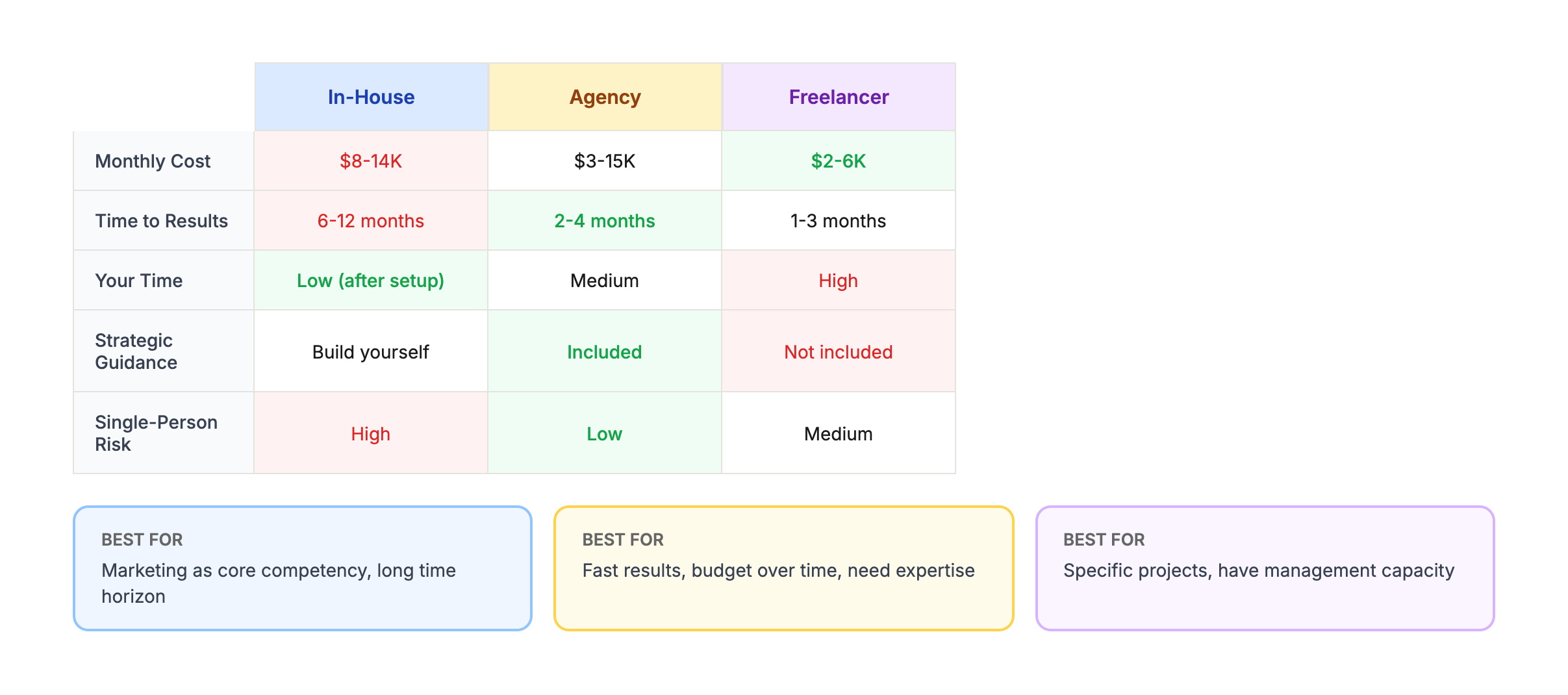
| Factor | In-House | Agency | Freelancer |
|---|---|---|---|
| Monthly cost | $8,000-14,000 | $3,000-15,000 | $2,000-6,000 |
| Time to results | 6-12 months | 2-4 months | 1-3 months |
| Your time required | Low (after setup) | Medium | High |
| Strategic guidance | Build yourself | Included | Not included |
| Scalability | Limited by headcount | Flexible | Limited |
| Single-person risk | High | Low | Medium |
| Learning/capability building | High | Medium | Low |
| Best for | Core competency | Acceleration | Specific projects |
06 / hybrid-approaches-that-work
Hybrid Approaches That Work
Pure options aren't always optimal. Consider combinations:
Agency for Strategy + Freelancers for Execution
Agency provides direction, planning, and quality control. Freelancers execute at lower cost. You get strategic guidance without full agency pricing for everything.
Works when: You need strategy help but have management capacity for tactical execution.
In-House Coordinator + Agency for Specialized Work
Junior/mid-level marketing hire manages day-to-day. Agency handles complex work—SEO technical audits, sophisticated automation, strategic planning.
Works when: You want internal capability for routine work but need agency expertise for hard problems.
Start With Agency, Transition to In-House
Agency builds systems and proves what works. You hire and train internal person who takes over. Agency transitions to advisory role.
Works when: You want to own long-term but can't wait to build from scratch. The most common path for growing companies.
Freelancer for Pilot, Agency for Scale
Test AI marketing with freelancer projects before committing to larger investment. If results prove the model, move to agency for systematic implementation.
Works when: You're uncertain about AI marketing ROI and want proof before bigger commitment.
07 / making-the-decision
Making the Decision
Answer these questions before choosing:
-
Is marketing a core competency we need to own long-term?
- Yes → Lean toward in-house (eventually)
- No → Lean toward agency or freelancers
-
How fast do we need results?
- Fast (90 days) → Agency
- Moderate (6 months) → Any option could work
- Slow (12+ months) → In-house if strategic
-
Do we have someone to manage this internally?
- Yes, dedicated person → Freelancers or hybrid
- Yes, partial attention → Agency (less management needed)
- No → Agency (they manage themselves)
-
What's our realistic monthly budget?
- Under $3K → Freelancers or DIY
- $3K-10K → Agency (scaled scope)
- $10K+ → In-house or comprehensive agency
-
How long can we commit to making this work?
- 3-6 months → Agency pilot
- 12+ months → In-house or agency retainer
08 / the-right-answer-for-you
The Right Answer for You
There's no universally correct choice. The right answer depends on your specific constraints and goals.
Choose in-house if: Marketing is core to your business, you have patience for a learning curve, you want to build proprietary capability, and you can afford the full cost (including risk of that person leaving).
Choose agency if: You need results faster than you can build internally, you have budget but limited time, you want expertise without building it, and you've done due diligence on agency quality.
Choose freelancers if: You have specific projects (not ongoing needs), you have management capacity, your budget is limited but your time is available, and you need flexibility over consistency.
Choose hybrid if: Your needs don't fit neatly into one category, you want to build capability while getting results, or you need different levels of support for different functions.
The worst choice is analysis paralysis. Pick the approach that fits your current situation, commit to it for 90-180 days, measure results, and adjust. You can always change approaches—what you can't do is get back time spent deciding.
Ready to dive deeper? If you're leaning toward agency, see our guide on what to ask before hiring and our comprehensive AI marketing agency pillar page. If you want to understand what AI-amplified marketing actually involves, start with our complete guide to AI-amplified marketing. For smaller teams weighing their options, small business AI consulting explains how targeted expert guidance can bridge the gap between DIY and full agency engagement.