AI marketing agencies are everywhere now. Quality varies wildly.
The difference between an agency that transforms your marketing and one that wastes your budget often isn't obvious until you've spent months and money discovering it. By then, you've lost time you can't get back.
I've been on both sides of this conversation—as someone hiring agencies and as the agency being evaluated. Here are the 15 questions that separate agencies that deliver from those that just talk. These aren't gotcha questions. They're diagnostic tools that reveal whether an agency has built real AI capabilities or just added "AI" to their marketing materials.
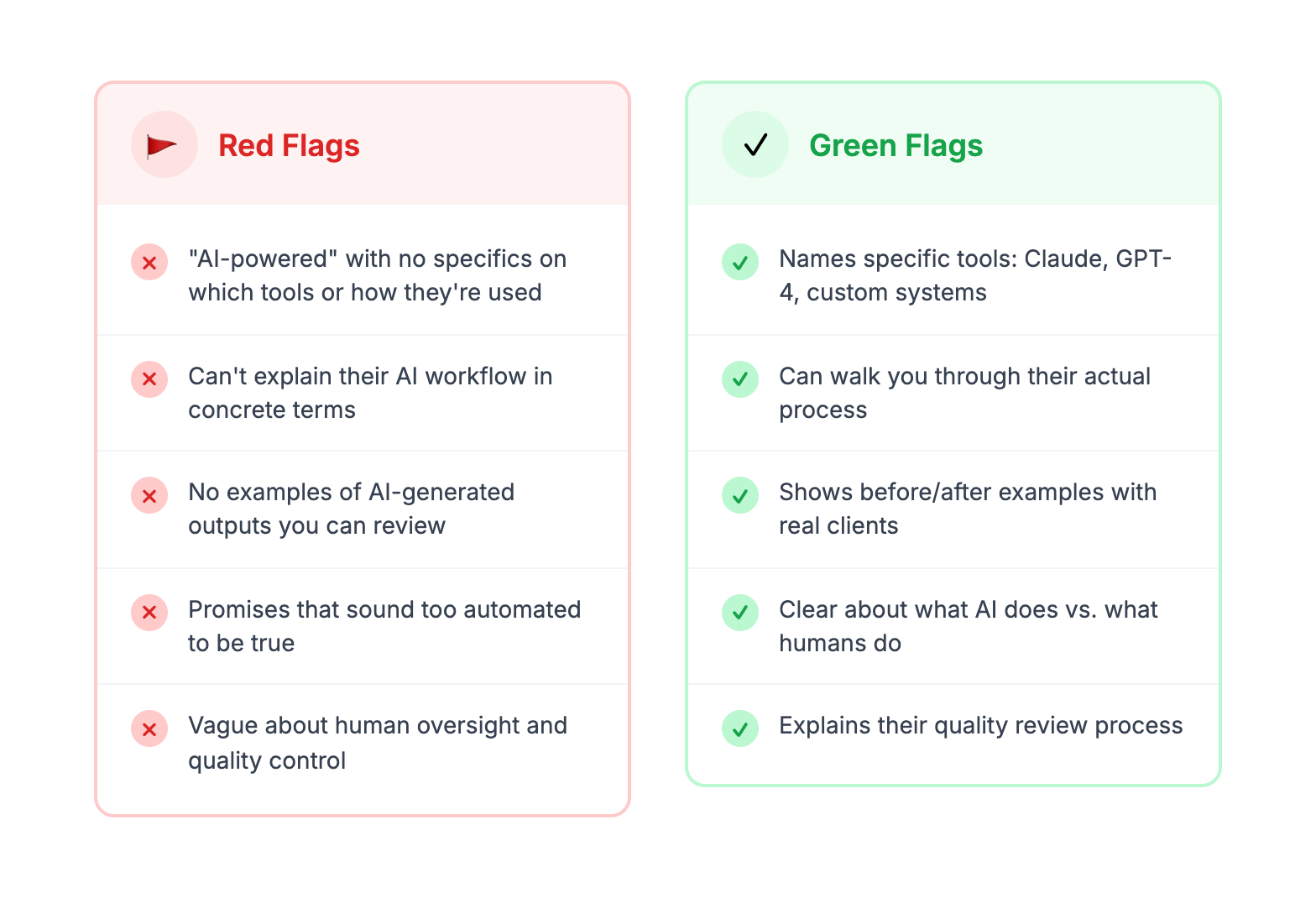
01 / quick-reference-red-flags-vs-green-flags
Quick Reference: Red Flags vs. Green Flags
02 / questions-about-results-and-measurement
Questions About Results and Measurement
Question 5: "What specific metrics will you report on?"
Good answer: Metrics tied to your business goals. For e-commerce: "Revenue, conversion rate, ROAS, customer acquisition cost." For lead-gen: "Qualified leads, cost per lead, lead-to-opportunity rate." They should ask about your goals before answering.
Red flag: Leading with vanity metrics—impressions, followers, "engagement." These can improve while your business results stay flat.
Why it matters: Activity isn't results. An agency focused on metrics that don't connect to revenue is optimizing for looking busy, not making you money.
Question 6: "Can I see a sample report from a current client?"
Good answer: They produce a redacted but real report with actual data, analysis, and recommendations. The format is professional, the insights are specific, and you can imagine receiving it monthly.
Red flag: "That's confidential" with no alternative, or they show a generic template without real data. Every agency should have at least one client willing to have their (anonymized) report shared.
Why it matters: Report quality predicts communication quality. If their sample report is thin, confusing, or generic, that's what you'll receive. See what comprehensive AI-generated reporting looks like in our client reporting deep dive.
Question 7: "What results have you achieved for businesses like mine?"
Good answer: Specific case study with context. "We worked with a B2B SaaS company at similar revenue and growth stage. Over 6 months, we increased organic traffic 145%, which contributed to a 34% increase in demo requests. They had similar challenges with [specific issue]."
Red flag: Generic claims like "we increased traffic 300%" without context about the starting point, timeframe, industry, or business impact.
Why it matters: Results without context are meaningless. A 300% traffic increase sounds great until you learn they went from 100 to 400 monthly visitors. Specific, contextualized results demonstrate actual capability.
Question 8: "How long until I see results?"
Good answer: Honest timeline with milestones. "For SEO, expect to see ranking movements in 8-12 weeks, with meaningful traffic impact in 4-6 months. For paid media, we can show initial results in 2-4 weeks but need 60-90 days to fully optimize. We'll set 30/60/90 day milestones so you can track progress."
Red flag: Promises of immediate results or guaranteed rankings. Anyone guaranteeing page 1 rankings or promising results in 2 weeks either doesn't understand marketing or is willing to lie to close the deal.
Why it matters: Real marketing takes time. Overpromising is the first red flag of an agency that will underdeliver. The best agencies set realistic expectations because they've done this enough to know what's actually possible.
03 / questions-about-working-together
Questions About Working Together
Question 9: "Who will I actually work with?"
Good answer: Named person with their background. "You'll work primarily with [Name], who has 8 years of experience in B2B marketing and manages our accounts in your industry. [Name] will be your day-to-day contact, and you'll have quarterly reviews with our strategy director."
Red flag: "Our team" without specifics, or the salesperson who's been impressive suddenly disappears after signing.
Why it matters: You're hiring people, not a logo. The person managing your account matters more than the agency's overall reputation. If they won't tell you who you'll work with, they're probably planning to hand you to their most junior person.
Question 10: "How often will we communicate?"
Good answer: Defined cadence. "Weekly 30-minute calls to review progress and priorities, monthly reports with written analysis, quarterly strategy reviews. You'll also have async access via Slack for questions that don't need a meeting."
Red flag: "Whenever you want" or "as needed." No structure usually means you'll be forgotten between urgent requests.
Why it matters: Communication cadence is the difference between feeling informed and feeling ignored. Agencies that haven't defined their communication process will default to reactive—you only hear from them when something's wrong or when they need something.
Question 11: "What do you need from me to be successful?"
Good answer: Specific list. "We'll need admin access to GA4, Search Console, and Google Ads. We'll need a primary point of contact who can approve content within 48 hours. Monthly, we'll need 60-90 minutes for our review calls. For content, we'll need access to a subject matter expert for interviews."
Red flag: "Nothing, we handle everything." That's either a lie or a sign they'll produce generic work that doesn't require your input.
Why it matters: Good agencies know marketing is a partnership. They need access, information, and timely feedback. An agency that claims to need nothing from you is planning to produce work that doesn't require understanding your business.
Question 12: "What's your onboarding process?"
Good answer: Defined steps with timeline. "Week 1: kickoff call, access setup, initial audit. Week 2-3: strategy development and baseline documentation. Week 4: first deliverables and feedback loop. You'll be fully operational by day 30."
Red flag: "We'll figure it out as we go" or no clear onboarding at all.
Why it matters: Chaotic onboarding predicts chaotic service. Agencies that have served many clients have refined their onboarding process. Those that haven't will waste your first month sorting out basics.
04 / questions-about-money-and-commitment
Questions About Money and Commitment
Question 13: "What exactly is included in this price?"
Good answer: Itemized deliverables and scope. "For $X/month, you receive: 4 blog posts optimized for SEO, monthly performance report, bi-weekly strategy calls, ongoing technical SEO monitoring, and quarterly competitive analysis. Content revision rounds: 2 per piece. Additional blog posts: $Y each."
Red flag: Vague "full-service" packaging without specifics. "Everything you need" isn't a scope.
Why it matters: Undefined scope leads to scope creep arguments. You'll either pay more than expected or receive less than expected. Neither feels good. Get the specifics in writing before signing.
Question 14: "What's NOT included that I might expect?"
Good answer: Transparent about limitations. "Design work beyond basic graphics, video production, and paid media management are separate. If you need landing page development, that's a separate project scope. Our retainer covers strategy and content, not implementation of technical recommendations."
Red flag: "Everything's included" or unwillingness to discuss limitations.
Why it matters: Every agency has boundaries. The honest ones tell you upfront. The ones who claim everything's included will either surprise you with add-on costs or quietly not do the things you assumed were included.
Question 15: "What happens if I want to leave?"
Good answer: Clear exit terms and data ownership. "30-day notice to cancel, no long-term lock-in after the initial 90-day period. You own all content we create. We'll provide a complete handoff document including access credentials, strategy documentation, and recommendations for continuity."
Red flag: Long lock-in periods (12+ months), vague about who owns the work, or unwillingness to discuss exit terms.
Why it matters: Agencies confident in their value don't need to trap you. Flexible terms signal they believe you'll stay because you want to, not because you're contractually obligated. And data/content ownership matters—you don't want to lose everything if the relationship ends.
05 / what-good-answers-sound-like
What Good Answers Sound Like
Beyond these specific questions, pay attention to patterns in how the agency responds:
Good signs:
- They ask clarifying questions before answering
- They give specific examples from their experience
- They're honest about limitations and tradeoffs
- They push back on assumptions that don't fit your situation
- They can explain technical concepts in plain language
Warning signs:
- They have a polished answer ready before you finish the question
- Every answer is about how great they are
- They promise everything, qualify nothing
- They use buzzwords without substance
- They get defensive when pressed for specifics
06 / a-practical-evaluation-framework
A Practical Evaluation Framework
After your conversations, score each agency on a simple framework:
| Criteria | Weight | Score (1-5) | Weighted |
|---|---|---|---|
| AI capability depth | 20% | ||
| Results with similar businesses | 20% | ||
| Communication clarity | 15% | ||
| Realistic expectations | 15% | ||
| Team quality | 15% | ||
| Commercial transparency | 15% | ||
| Total | 100% |
A score below 3.5 overall should give you pause. A score below 3 on any single criterion is a red flag worth investigating.
07 / the-conversation-after-the-questions
The Conversation After the Questions
Good questions get you information. But trust your gut on chemistry and communication style too.
Ask yourself:
- Did I feel heard, or talked at?
- Did they understand my business, or pitch their services?
- Were they curious about my situation, or just eager to close?
- Can I imagine working with these people for 12 months?
The best agency relationship is a partnership. If the sales process feels adversarial or one-sided, the working relationship probably will too.
08 / start-with-lower-risk
Start With Lower Risk
If you're unsure, don't sign a massive retainer immediately. Ask about:
- Audit or assessment: One-time project to evaluate your current state and opportunities. Lets you see their thinking and work quality before committing.
- Pilot project: Limited scope engagement (3 months, single channel) before expanding.
- Phased rollout: Start with one service, add others as trust builds.
Good agencies will accommodate these requests. They know that proving value upfront leads to longer, larger relationships.
09 / next-step
Next Step
Hiring an AI marketing agency is a significant decision. The right partner accelerates your growth. The wrong one wastes time and money while your competitors pull ahead.
These questions won't guarantee you'll find the right agency. But they'll help you avoid the wrong ones—and that's often more valuable.
If you're evaluating agencies and want to include WE•DO in your consideration, we welcome these questions. Schedule a conversation and ask us anything on this list. We'd rather you find the right fit—whether that's us or not—than sign up unprepared.
Ready to learn more about what AI-amplified marketing actually looks like in practice? Explore our complete guide to AI-amplified marketing or see how we approach specific capabilities like SEO audits, content creation, and client reporting. For a comprehensive look at what separates real AI agencies from pretenders, read our AI marketing agency pillar guide.