You've heard "AI marketing" everywhere. LinkedIn posts. Vendor pitches. That competitor who suddenly seems to be everywhere online. The phrase gets thrown around constantly, usually followed by promises that sound too good to be true.
Most explanations fall into two categories: too technical (prompts, models, integrations) or too vague (transform your business with AI). Neither helps you make a decision.
This guide cuts through both. We'll cover what AI marketing actually is, whether it makes sense for your business, and what it really costs. Written for business owners, not marketers.
01 / what-ai-marketing-actually-means-plain-english
What AI Marketing Actually Means (Plain English)
AI marketing means using software that learns patterns to help with marketing tasks. Instead of someone manually writing every email, analyzing every spreadsheet, or monitoring every competitor—software handles parts of that work.
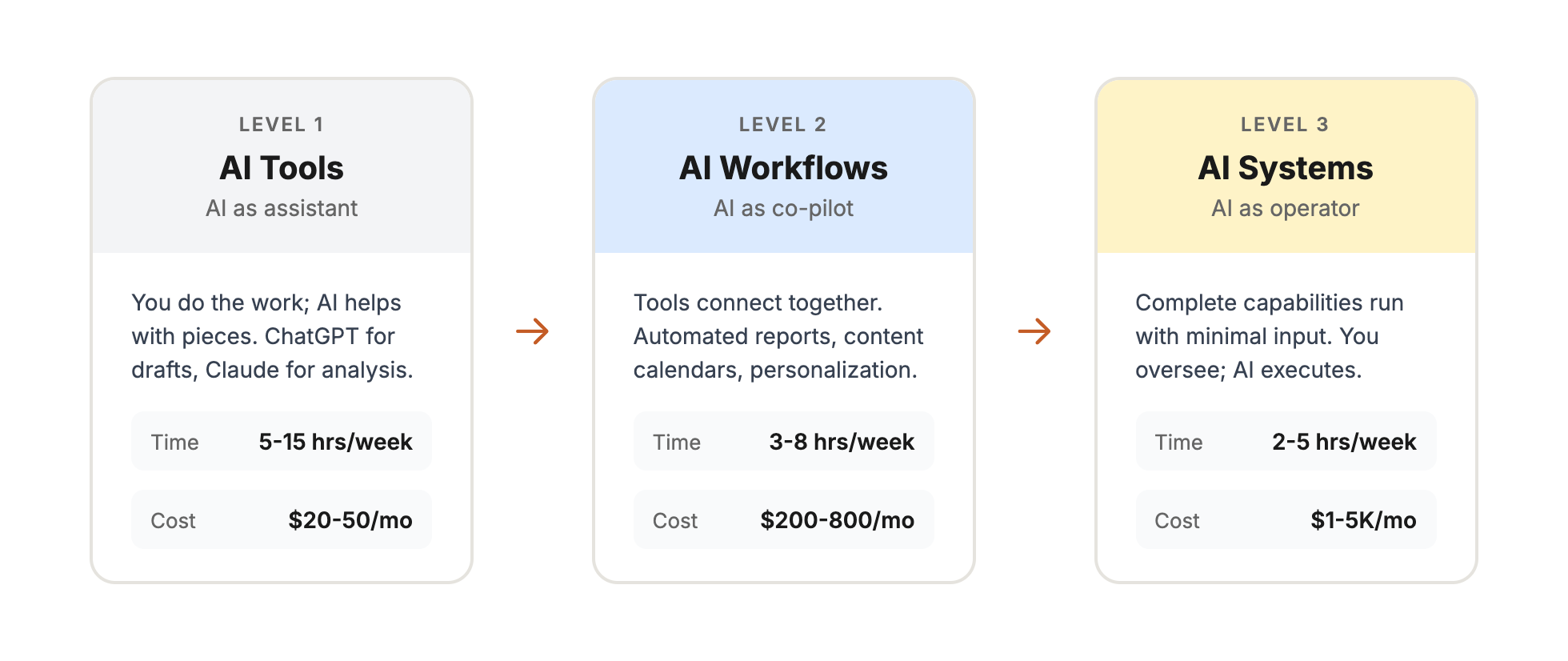
But "AI marketing" isn't one thing. It's a spectrum, and most confusion comes from people conflating different levels:
Level 1: Using AI Tools
You open ChatGPT, describe what you need, and use the output. Writing a blog post draft. Getting email subject line ideas. Summarizing customer feedback.
This is AI as assistant. You do the work; AI helps with pieces. You're still driving every action, making every decision, managing every task.
Time investment: 5-15 hours/week learning and using tools Cost: $20-50/month in subscriptions Results: Modest time savings on individual tasks
Level 2: AI-Assisted Workflows
Tools connect together. Your customer data feeds into email personalization. Your website analytics trigger automated reports. Your content calendar populates with AI-generated briefs.
This is AI as co-pilot. You set up systems; AI executes parts of them. You're still reviewing, approving, and directing—but not doing everything manually.
Time investment: 3-8 hours/week managing workflows Cost: $200-800/month in tools and integrations Results: Meaningful time savings, improved consistency
Level 3: AI-Powered Systems
Complete capabilities run with minimal input. Weekly reports generate automatically. Content pipelines produce drafts on schedule. Competitive monitoring alerts you to changes. Lead nurturing sequences adapt based on behavior.
This is AI as system. You define strategy and review outputs; AI handles execution. Your involvement becomes oversight rather than labor.
Time investment: 2-5 hours/week for review and direction Cost: $1,000-5,000/month (or agency fees) Results: Significant capacity expansion, consistent quality
Most small businesses using AI are somewhere between Level 1 and Level 2. Level 3 typically requires either significant technical investment or working with an agency that's already built the infrastructure.
02 / what-ai-can-and-cant-do-for-your-marketing
What AI Can and Can't Do for Your Marketing
Let's be specific about capabilities and limitations:
What AI Does Well
Analyzing data: AI processes spreadsheets, identifies patterns, and surfaces insights faster than humans. Give it your Google Analytics export, and it can tell you which traffic sources convert best, which pages underperform, and what patterns appear in your data.
Writing first drafts: AI generates serviceable first drafts of blog posts, emails, social captions, and product descriptions. Not perfect—often generic or missing nuance—but a starting point that's faster than blank page.
Personalizing at scale: AI tailors messages based on customer data. Different email content for different segments. Product recommendations based on browsing history. Follow-up sequences adapted to behavior.
Repetitive tasks: Anything that follows a pattern—formatting reports, generating meta descriptions, creating social post variations—AI handles quickly without getting bored or making fatigue errors.
Monitoring and alerting: AI watches for changes—competitor pricing updates, ranking drops, unusual traffic patterns—and notifies you when something needs attention.
What AI Can't Do
Understand your business: AI doesn't know why your customers choose you, what makes your offering different, or what matters in your market. It can process information you provide, but it can't replace institutional knowledge.
Make strategic decisions: Which market should you expand into? Should you raise prices? Is this partnership worth pursuing? AI can provide information to inform decisions, but judgment calls remain human.
Replace relationships: Your customers trust you, not your AI. The personal touch that turns customers into advocates comes from human connection—AI can support those relationships but can't replace them.
Generate truly original ideas: AI recombines existing patterns. It can help you brainstorm, suggest variations, and explore options—but breakthrough creative ideas still come from human insight.
Stay current automatically: AI training data has cutoff dates. It doesn't know about your industry's developments last month unless you tell it. Keeping AI outputs relevant requires ongoing human input.
03 / signs-ai-marketing-might-help-your-business
Signs AI Marketing Might Help Your Business
AI marketing makes sense when you have specific problems it can solve:
You spend 10+ hours/week on repetitive marketing tasks. If you're manually exporting data, reformatting reports, writing similar emails over and over—AI can reclaim those hours. Calculate your time: hours/week × your hourly rate × 52 weeks = the value of automation.
Your marketing is inconsistent. Some months you publish four blog posts; other months, zero. Some customers get great follow-up; others fall through cracks. AI-powered systems create consistency that human-only processes struggle to maintain.
You know you should be doing more but can't. You should be blogging, but who has time? You should analyze your analytics, but the spreadsheets sit unopened. AI can help you do the "should" activities that get pushed aside.
Your competitors seem to be everywhere. If competitors with similar resources appear more active—more content, faster responses, broader reach—they may have systematized what you're doing manually.
You're paying for tools you barely use. Many businesses pay for marketing software they've never fully implemented. AI can help extract value from existing investments by automating what you bought but never had time to use.
04 / signs-ai-marketing-isnt-right-for-you-yet
Signs AI Marketing Isn't Right for You (Yet)
AI marketing isn't universally beneficial. It's the wrong move if:
You don't have basic marketing in place. AI amplifies what exists. If you don't have a functional website, email list, or social presence, adding AI creates nothing. Get fundamentals working before automating them.
Your business model is still evolving. If you're pivoting frequently, still finding product-market fit, or uncertain about your target customer—AI systems will encode assumptions that might be wrong. Stabilize first.
You have fewer than 100 customers. Below a certain scale, personalization at scale doesn't matter because you don't have scale. The ROI calculation doesn't work when volume is too low for automation to beat manual effort.
You're not sure who your ideal customer is. AI needs direction. If you can't describe your target customer clearly, AI will produce generic content for generic audiences—which helps no one.
You don't have 2-3 hours/week to review outputs. AI isn't autopilot. Outputs need review. Errors need catching. Strategy needs adjusting. If you genuinely have zero time available, AI creates more problems than it solves.
05 / the-real-cost-breakdown
The Real Cost Breakdown
Let's talk actual numbers for each approach:
DIY Approach
Build AI marketing capabilities yourself using available tools.
| Item | Monthly Cost |
|---|---|
| ChatGPT Plus or Claude Pro | $20-25 |
| Email platform with AI features | $30-100 |
| Social scheduling tool | $20-50 |
| SEO tool (basic plan) | $100-150 |
| Total Tools | $170-325/month |
Plus your time: 10-15 hours/week learning and implementing (especially in months 1-6). If your time is worth $100/hour, that's $4,000-6,000/month in opportunity cost during the learning phase.
Best for: Tech-comfortable owners with more time than money, simple marketing needs, willingness to learn.
Hybrid Approach
Use tools plus consultant or fractional help for setup and strategy.
| Item | Monthly Cost |
|---|---|
| Tools (same as above) | $170-325 |
| Consultant/setup help | $500-1,500 |
| Total | $670-1,825/month |
Your time: 5-8 hours/week for implementation and review. Reduced learning curve because someone guides you.
Best for: Owners who want to own the capability long-term but need help getting started. Good balance of cost and learning.
Done-For-You Approach
Hire an agency to implement and manage AI-powered marketing.
| Service Level | Monthly Cost |
|---|---|
| Basic (one channel focus) | $2,000-3,500 |
| Standard (multi-channel) | $3,500-7,500 |
| Comprehensive (full-service) | $7,500-15,000+ |
Your time: 2-5 hours/week for communication and approvals. No learning curve—you're buying capability, not building it.
Best for: Owners who need results without learning curve, have budget but not time, prefer to focus on business operations.
The Hidden Cost of "Free"
Free AI tools exist. Many are genuinely useful. But free comes with tradeoffs:
- Your time learning, troubleshooting, maintaining
- Quality gaps compared to paid alternatives
- Privacy concerns with how your data is used
- Missing features that save time at scale
The cheapest option often isn't free tools—it's the approach that generates the best ROI on your total investment (money + time).
06 / what-to-do-next
What to Do Next
Based on where you are:
If You're Just Curious
Try one specific task. Pick something repetitive—writing email subject lines, summarizing customer calls, creating social post variations. Use ChatGPT or Claude for a week and see if it helps.
Time commitment: 30 minutes to try, 2-3 hours over a week to evaluate Risk: Near zero—worst case, you've learned what doesn't work
If You're Serious but Budget-Conscious
Start with email automation. It's the highest-ROI AI application for most small businesses. Set up automated sequences for new leads, post-purchase follow-up, and re-engagement. Most email platforms now include AI features.
Time commitment: 8-12 hours to set up, 2-3 hours/week to maintain Investment: $50-200/month for email platform Expected result: Consistent follow-up that was previously sporadic
If You Want Results Without Learning Curve
Talk to 3 agencies. Get proposals, ask the hard questions (see our guide on hiring an AI marketing agency), and find one that fits your business. If you're not sure where to start, small business AI consulting can help you identify the right priorities before committing to a full retainer.
Time commitment: 3-5 hours for evaluation, 2-4 hours/week ongoing Investment: $2,000-5,000/month depending on scope Expected result: Functional AI marketing system in 60-90 days
07 / the-bottom-line
The Bottom Line
AI marketing isn't magic. It's tools and systems that help marketing happen faster and more consistently. Whether that's valuable depends on your specific situation.
For some businesses—particularly those with repetitive tasks, inconsistent execution, and capacity constraints—AI marketing creates genuine competitive advantage. For others—those still figuring out fundamentals or lacking time for any marketing investment—it's premature.
The best approach: start small, measure results, expand what works. AI marketing compounds over time, but only if you stay involved enough to guide it.
Not sure where you stand? The questions in this article should help you decide. And if you conclude that professional help makes sense, we're happy to have a conversation about what AI-amplified marketing could look like for your business.
Want to go deeper? Explore our complete guide to AI-amplified marketing for the full picture of how modern agencies use AI to deliver better results, learn about the architecture behind AI marketing systems, or see practical examples of AI automation for small business. If you're ready for outside help, our guide on choosing an AI marketing agency walks through what to look for.