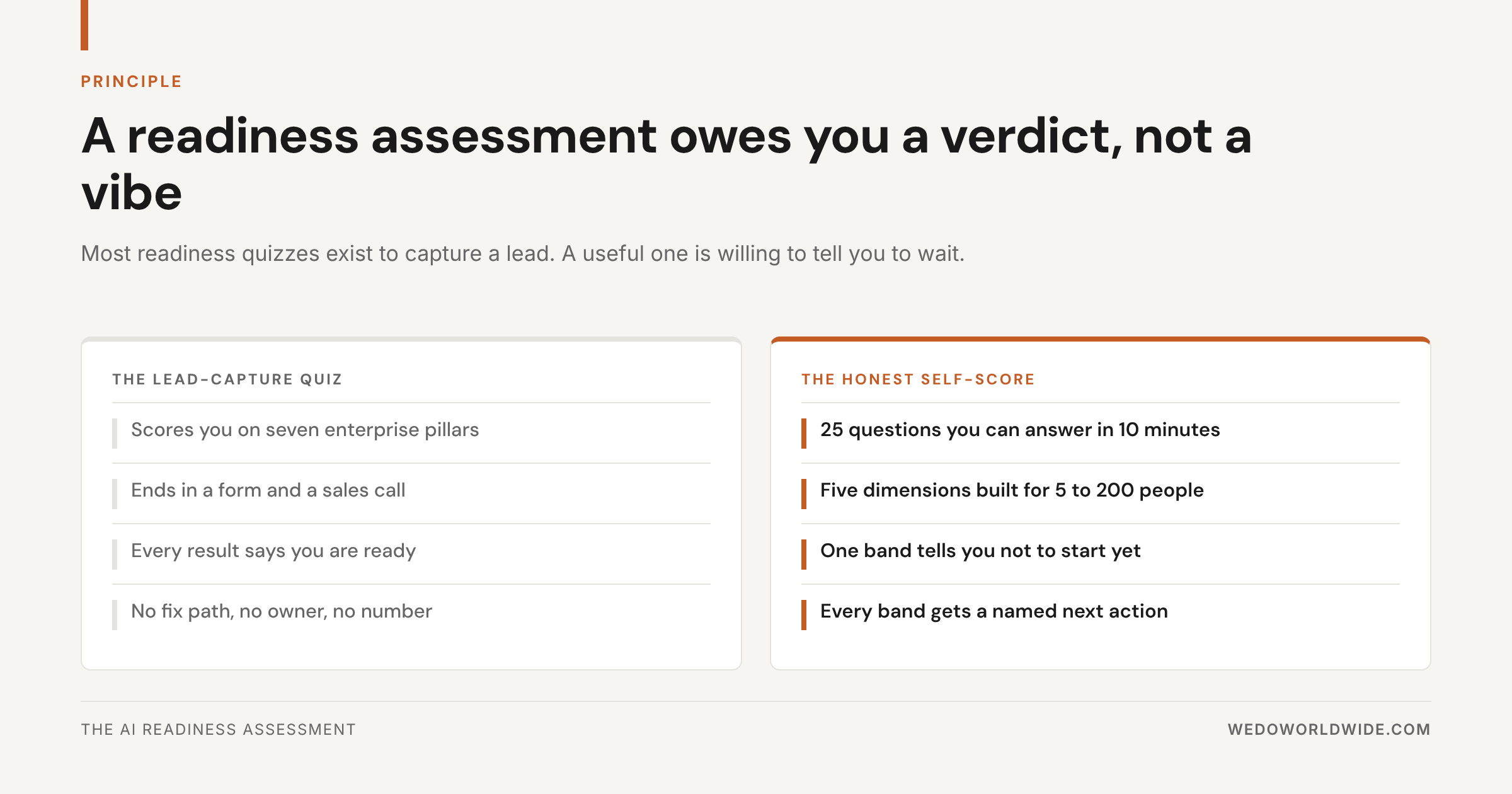
Every AI readiness assessment on page one of Google is a form. Microsoft's runs 45 questions across seven pillars, including model management and infrastructure for AI. Cisco, Avanade, RSM, and PwC each publish their own. They all end the same way: you answer, they score, someone calls you.
Part of our guide to AI enablement for small business.
None of them will tell you the most useful thing, which is that you are not ready, and you should fix your data before you spend a dollar on AI.
This one will. Twenty-five questions, five dimensions, one point each. Ten minutes, no form. Then read the verdict for your band, including the band where the right move is to wait.
01 / what-an-ai-readiness-assessment-actually-measure
What an AI Readiness Assessment Actually Measures
The short answer
An AI readiness assessment measures whether your business can support AI, not whether AI could theoretically help you.
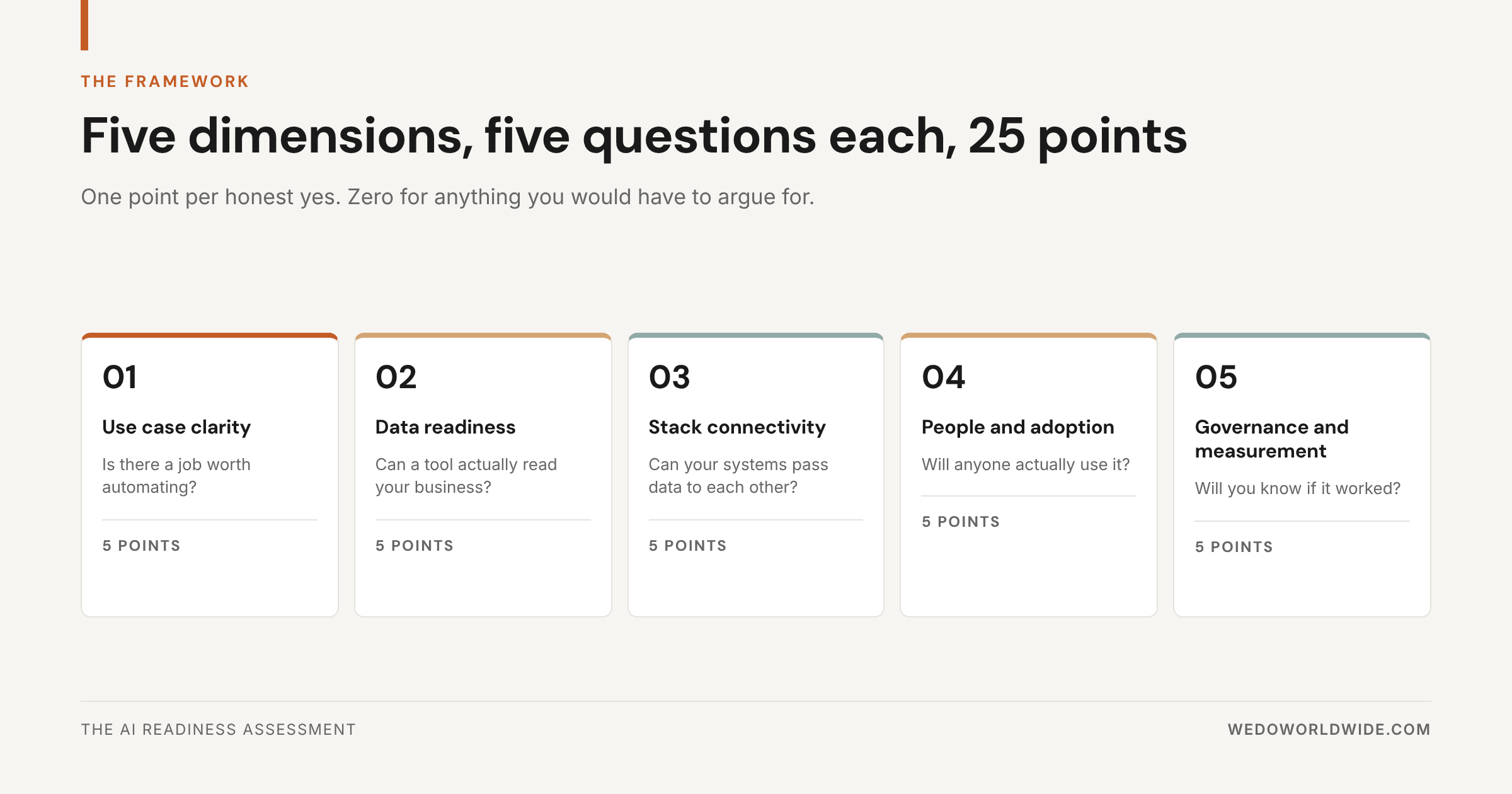
It scores five things: whether you have a job worth automating, whether your data is organized enough for a tool to read, whether your systems can pass data to each other, whether your team will adopt it, and whether you can prove it worked.
Enterprise frameworks stretch that across six or seven pillars. Gartner's maturity model runs five levels, from Awareness to Transformational. Microsoft's assessment adds model management and compute capacity. That vocabulary was built for companies with data engineers and an AI steering committee.
If you run a business with 5 to 200 people, you do not need model management. You need to know whether your customer list exports cleanly, and whether the person who will own this has time on their calendar. Same discipline, lower altitude.
For the long version of the foundation this checklist tests, read our guide to AI enablement. This post is the diagnostic that comes before it.
02 / the-five-dimensions-of-ai-readiness
The Five Dimensions of AI Readiness
Score one point per yes. Zero for "sort of," "we are working on it," or anything you would have to argue for. Twenty-five points available.
1. Use case clarity (5 points)
- You can name the single task that eats the most staff hours each week.
- You know roughly what it costs, in hours, per person, per week.
- It happens at least weekly, not once a quarter.
- It has a checkable right answer, so you can judge output quality.
- You can state success as a number, like "from 6 hours to 2."
2. Data readiness (5 points)
- You can export your customer list as a clean CSV in under 10 minutes.
- One system is the agreed source of truth when two records disagree.
- Records stay current instead of getting batched the night before a meeting.
- Work files live in a shared system, not on personal drives.
- The inputs AI would need are typed, not trapped in PDFs, screenshots, or one person's memory.
3. Stack connectivity (5 points)
- Your five most-used tools are cloud based.
- At least three of them have an API or a native integration with each other.
- You can name every place the same data gets entered twice.
- You have two-factor authentication and role-based permissions.
- Adding a new tool does not require a developer.
4. People and adoption (5 points)
- You can name the person who will own the first pilot.
- That person has time for it on their calendar, not in theory.
- Everyone involved can spare 2 to 4 hours for initial training.
- At least one person already uses AI tools voluntarily.
- Leadership can explain why this matters without using the word AI.
5. Governance and measurement (5 points)
- You know what AI is allowed to do without human review.
- You know what is off limits entirely.
- You have a baseline number for the task you want to improve.
- You can pull that number again in 30 days without building a report from scratch.
- Someone owns the monthly review.
03 / your-score-and-the-honest-verdict
Your Score, and the Honest Verdict
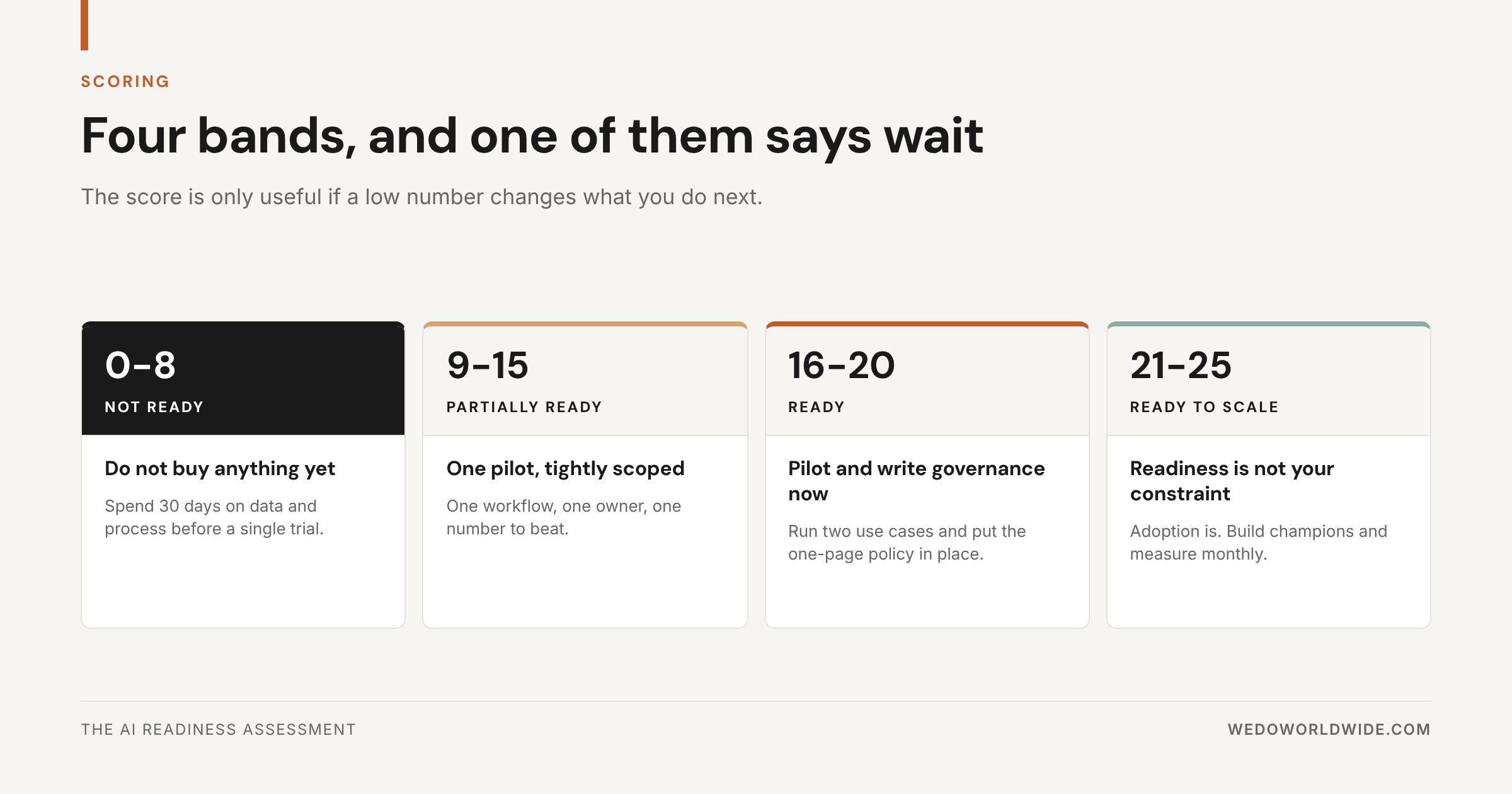
0 to 8: Not ready. Do not buy anything yet.
Buying a tool at this score is how AI subscriptions become shelfware. Take 30 days instead. Pick one system to be the source of truth, get files off personal drives, and write down how one important process actually works. Then score again. Almost nobody stays under 9 after a month of that, and you will have spent nothing.
9 to 15: Partially ready. One pilot, tightly scoped.
You have enough to run a controlled test and not enough to run three. Pick the workflow that scored highest on use case clarity, give it one owner, set one baseline number, and cap it at 30 days. Do not let it grow mid-flight. The point of a pilot is evidence, not coverage.
16 to 20: Ready. Pilot and write governance now.
Run two use cases in parallel, and write the one-page policy this week rather than after something goes out wrong. Three answers on one page is enough: what AI can do unreviewed, what needs a human check, what is banned outright.
21 to 25: Ready to scale. Readiness is not your constraint.
Adoption is. At this score the failure mode is a tool that works beautifully for the two people who championed it and gets ignored by everyone else. Name a champion per team, document the workflow well enough that someone else can run it, and review the numbers monthly. Our four-phase enablement framework covers what Scale and Optimize look like from here.
04 / where-most-businesses-lose-points
Where Most Businesses Lose Points
Data. Every time.
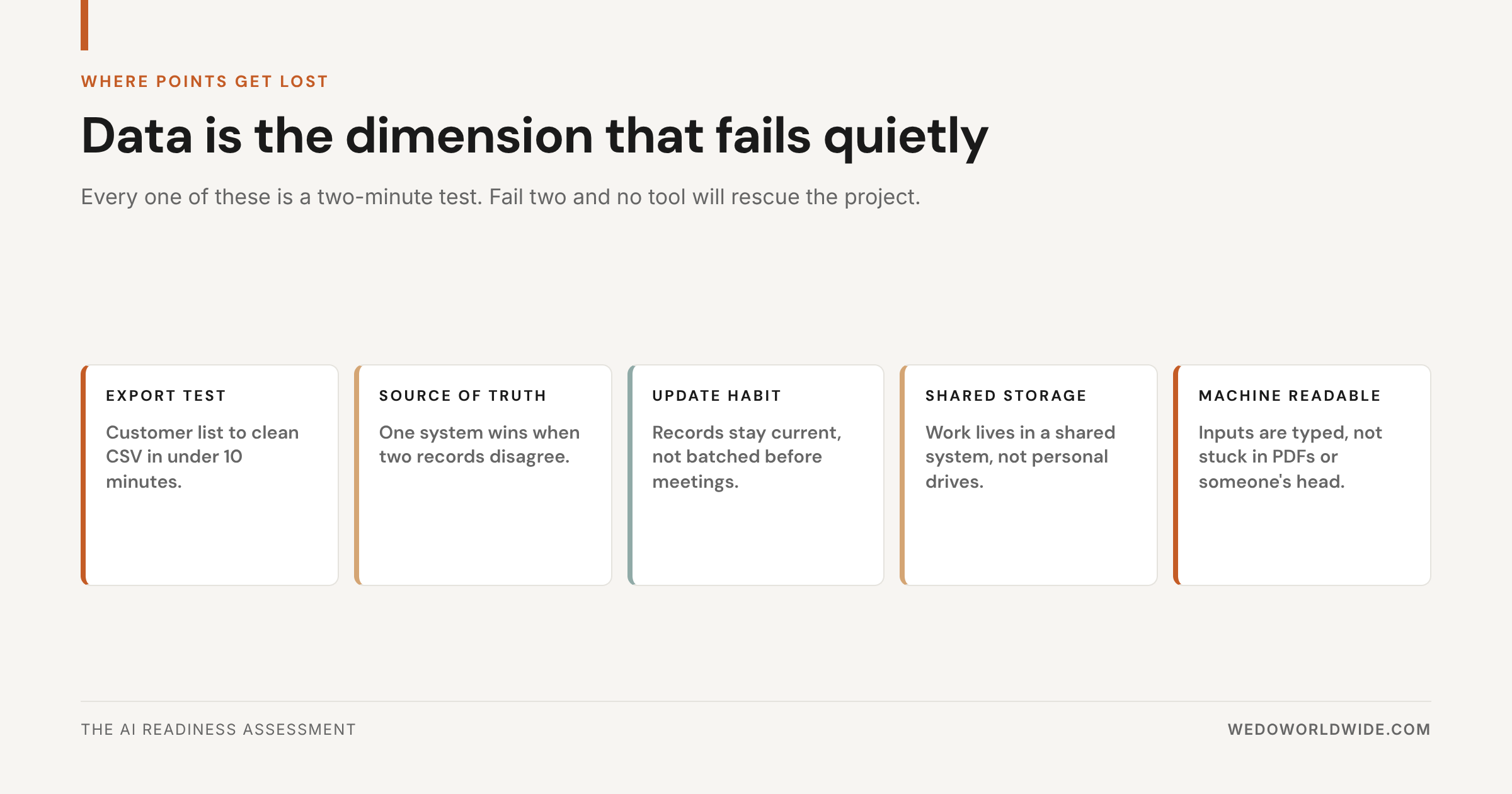
Use case clarity is easy to score well on, because every owner already knows what hurts. Governance is easy to fix, because it is one page. Data is the dimension that fails quietly: the CRM that is 60% current, the four spreadsheets that each claim to be the master list, the pricing rules that live in one salesperson's head.
The tell is the export test. If you cannot get your customer list out as a clean CSV in ten minutes, an AI tool cannot see your business, and every output it gives you will be confidently wrong in ways that are expensive to catch.
Fixing it is boring and fast. Pick the winner between competing systems, mark the losers read-only, and set one rule for who updates what. Two weeks of unglamorous cleanup buys back months of failed pilots.
05 / the-30-day-fix-path
The 30-Day Fix Path
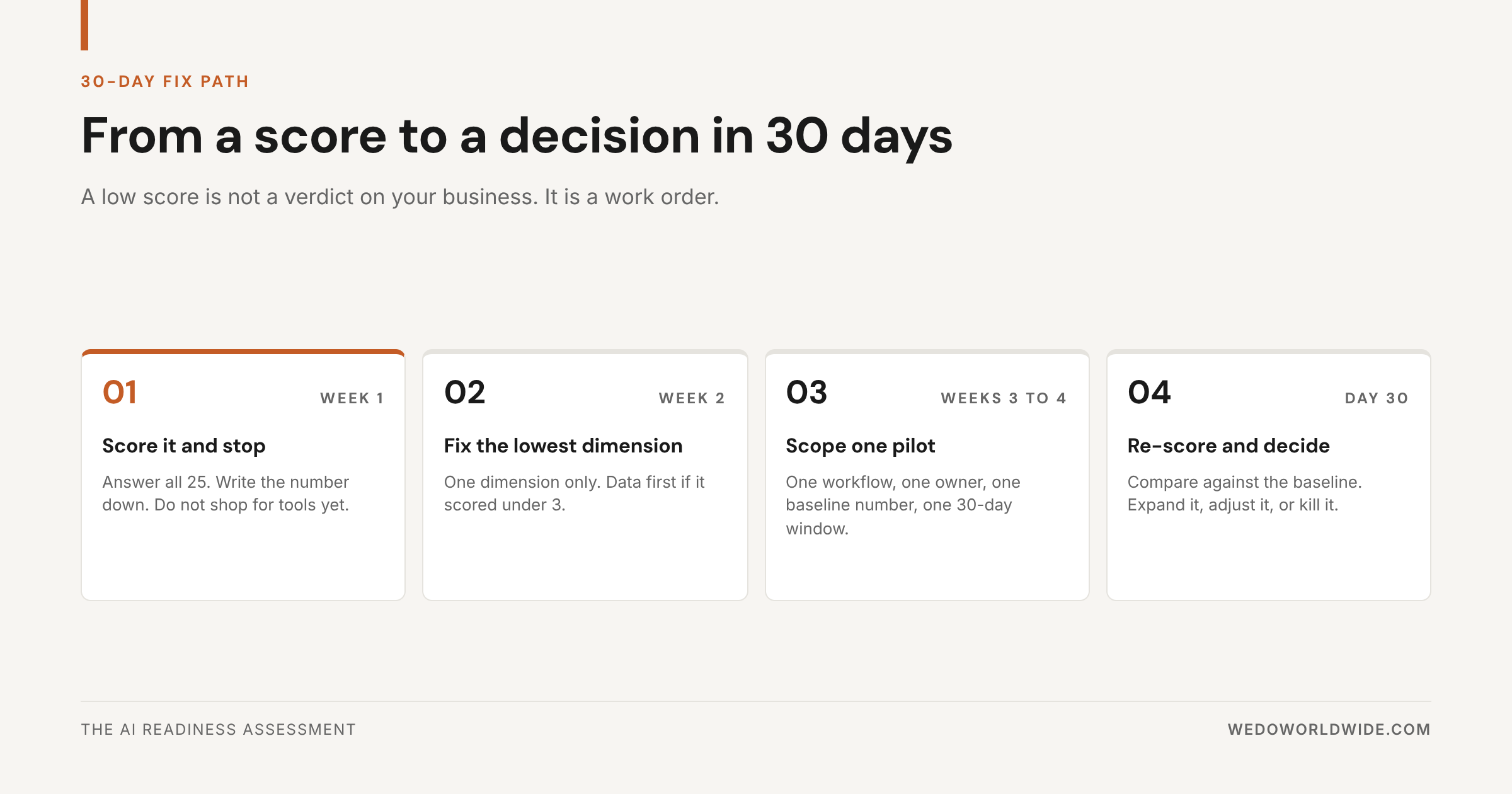
Score it, fix your weakest dimension, scope one pilot, then re-score. The discipline that matters is the second score. Most companies run a pilot and never check whether the conditions that made it work were real, which is why the third and fourth use cases stall for reasons nobody can name.
If data scored under 3, that is your entire week two. Nothing else in the checklist compensates for inputs a tool cannot read.
06 / what-getting-this-wrong-costs
What Getting This Wrong Costs
The visible cost is small: a few hundred dollars a month in subscriptions nobody opens. The real cost is the second attempt. A failed pilot teaches your team that AI is a distraction, and the next initiative starts from negative trust. That is the line item nobody budgets for.
The upside is worth the discipline. We run our own agency on more than 40 AI agents. Content production moves roughly 10 times faster, reporting takes about 60% less time, and adoption across the team sits near 85%. None of that came from picking better tools. It came from readiness work that looked like housekeeping. The full agent roster is here if you want to see what it produced.
07 / what-to-do-with-your-score
What to Do With Your Score
Write your number down with today's date. Fix the lowest dimension first. Scope one pilot with one owner and one number. Re-score in 30 days.
Want the outside version of this? Our AI workflow audit maps your stack and workflows, scores the opportunities by impact and effort, and hands you a prioritized implementation roadmap. Same five dimensions, run against your actual systems.