You pay for AI. Monday still looks the same.
I've sat with a lot of owners who already pay for Claude or ChatGPT. Some pay for both. Plus an agent platform someone was excited about in March.
That's usually not the model's fault. Nobody hooked the work up.
By the end, you'll know:
- How to tell if AI is working in your business (one test)
- How to name the first job to hand off
- What a first job looks like, and what it saves
- How to start without a transformation program
It's a 7-minute read. If you only want the test, stop after the first section.
01 / is-ai-working-in-your-business-run-the-monday-te
Is AI working in your business? Run the Monday test.
Look at Monday morning. That's the whole test.
Same reports assembled by hand? Same meeting notes copied into your project tool? Same person pasting the same thing into the same chat window as last Monday?
Then you have AI adoption, not AI enablement. Adoption is buying seats. Enablement is hooking the work up.
02 / why-do-four-out-of-five-pilots-never-leave-the-l
Why do four out of five pilots never leave the lab?
Because nobody hands the AI a job. Research covered by Harvard Business Review puts the failure rate at roughly 80 percent. Most corporate AI projects never make it out of the pilot phase.
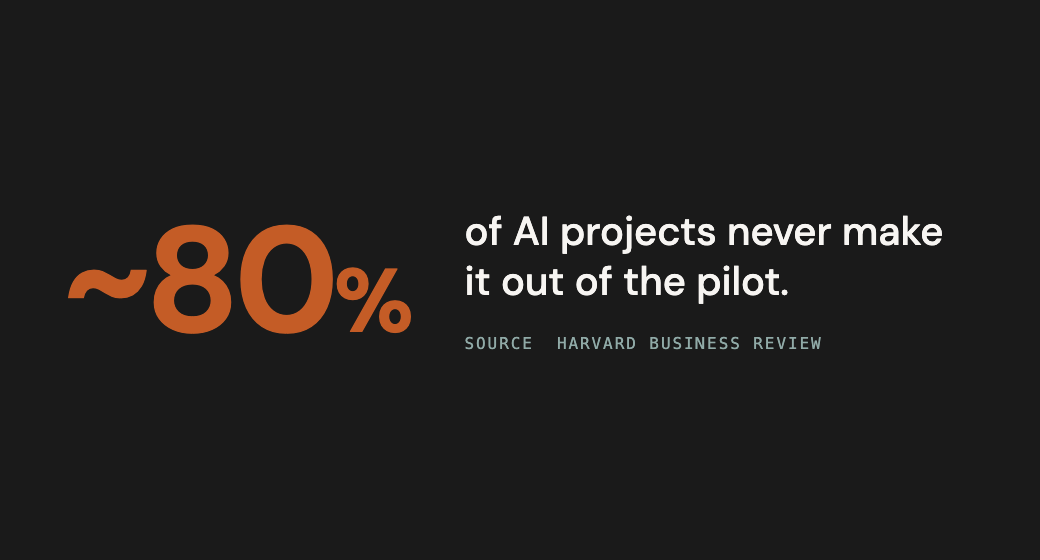
The pattern behind that number is almost always the same. The pilot is framed as a technology evaluation, not a job transfer. Teams evaluate models, compare vendors, and run demos. Nobody names a specific piece of work the AI now owns.
So the pilot ends. Everyone agrees it was interesting. And the work goes back to the people already doing it.
03 / step-1-read-your-ai-receipt-first
Step 1: Read your AI receipt first
Audit what you already pay for before you buy anything new. In our client conversations, $300 to $500 a month in underused AI seats is common. Claude here, ChatGPT there. A platform trial someone forgot to cancel.
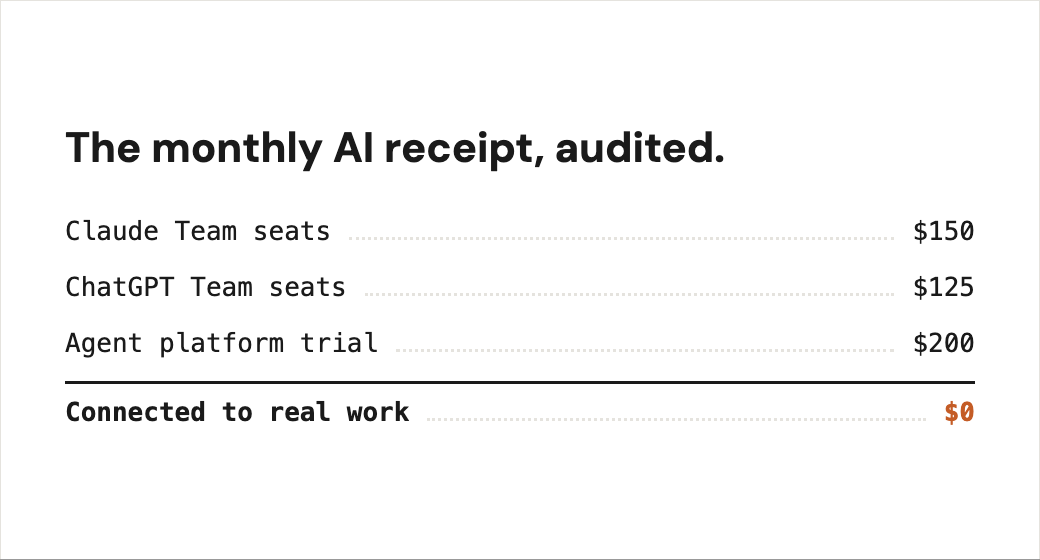
You didn't waste the money by picking the wrong tool. You wasted it because there's no harness (the setup that connects AI to real work).
None of those seats connect to a recurring job. No defined input. No defined output. No place in your systems where the result lands.
04 / step-2-write-one-strong-sentence
Step 2: Write one strong sentence
The fastest diagnostic I know is one sentence long.
A weak use of AI sounds like this: "We should use ChatGPT more."
A strong use sounds like this: "This Monday report writes itself from GA4."
The difference is specificity. The strong version names the workflow, the data source, and the outcome.
If nobody on your team can write the second kind of sentence, don't buy more tools yet. You don't have a tooling gap. You have a naming gap.
05 / what-does-a-first-job-look-like
What does a first job look like?
It's recurring, defined, and boring. Here's a real example we use constantly.
A client meeting ends. Somewhere in that transcript are commitments: send the revised scope, update the launch date, draft the follow-up. In most companies, a person reads the transcript and types those into ClickUp by hand. Or worse, from memory.
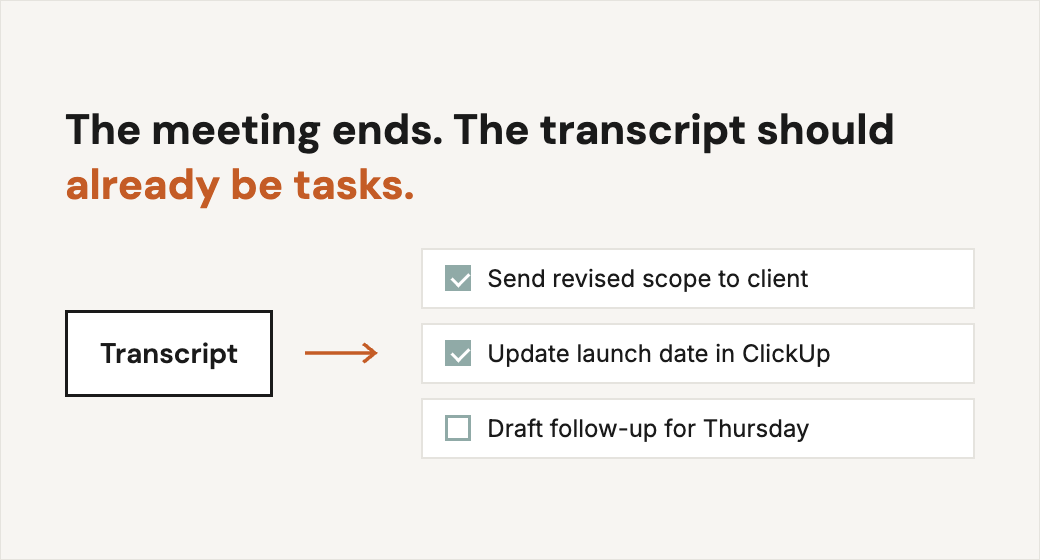
That's a perfect first job to hand off. The input is defined (the transcript). The output is defined (tasks in your project tool).
The judgment stays human. You still decide what matters and what ships. The agent (AI software that runs a task on its own) takes the copy and paste.
Good first jobs share one shape: recurring, rule-bound in the middle, judgment at the edges.
- Meeting notes to tasks
- GA4 data to a Monday report
- Inbound leads to a qualified summary
- Invoice data to a weekly cash view
06 / what-does-the-proof-look-like-boring-on-purpose
What does the proof look like? Boring, on purpose.
A job that took six hours now takes two. That's what a well-picked first job looks like. Not a moonshot.
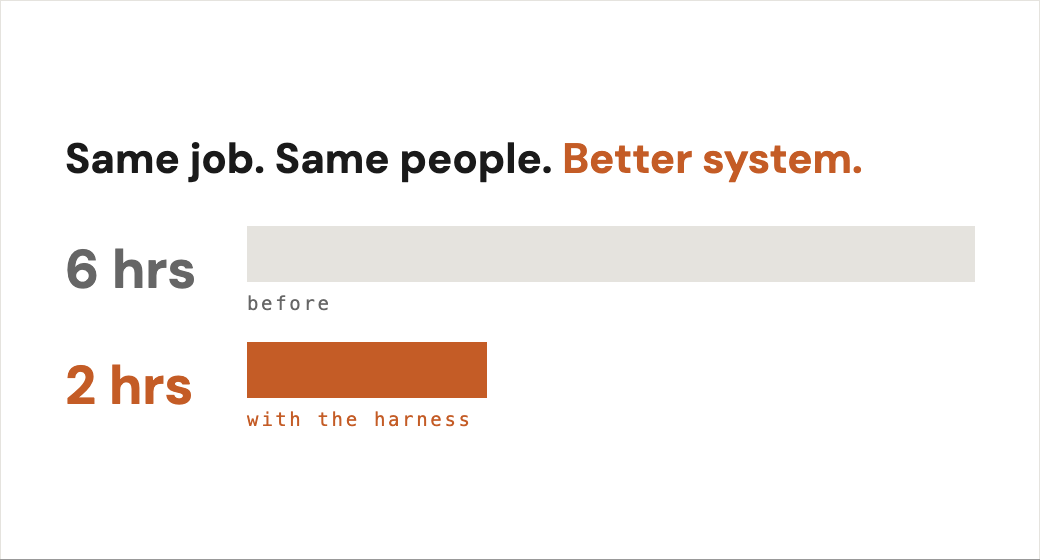
Same job. Same people. Better system.
Nobody was replaced. Nobody sat through a transformation program. One workflow moved from hands to harness, and the hours came back.
07 / we-ran-this-on-ourselves-first
We ran this on ourselves first
We didn't build this offer from a whiteboard. We built it because we got tired of our own grind.
Today, more than 40 agents run inside WE•DO: reporting, meeting follow-up, time tracking, content QA, deliverable assembly. Our agent team structure is public. The framework behind it is the same one we install for clients.
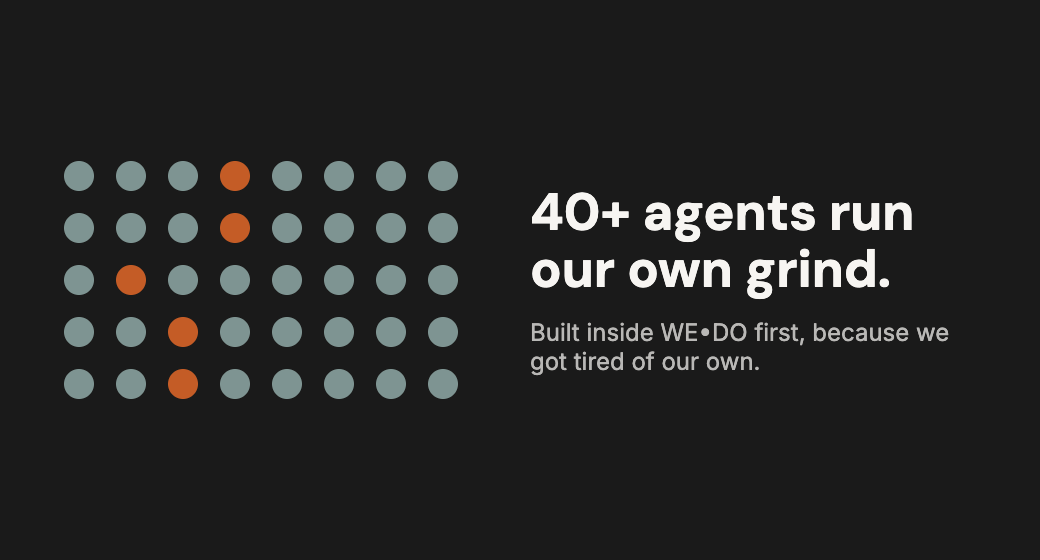
That matters for one reason. When we say a workflow can move in weeks, we've done it on our own operations first. Where the failures are ours to eat.
08 / why-the-model-matters-less-than-the-harness
Why the model matters less than the harness
I repeat one sentence to clients more than any other. It's less about the LLM (the AI model, like Claude or GPT). It's more about the harness.
The models are good. They've been good for a while. Every vendor's model will be good next quarter too.
The harness is what separates companies where AI works from companies where AI is a line item. It has four parts:
- The connections into the tools you already use
- The standard operating procedure the agent follows
- The review step where a human applies judgment
- The place the output lands, so nobody moves it by hand
09 / how-do-you-start-without-a-transformation
How do you start without a transformation?
Start with one conversation, not a program. This is deliberately not enterprise consulting. No $200k engagement. No 18-month roadmap.
Here's how the progression works, step by step.
Working session. One conversation, on day one. We look at where your team loses time. We name the first job to hand off. You leave with one named workflow either way.
Opportunity audit. Over a week or two, we map every hand-off candidate in your operation. What's recurring? What's rule-bound in the middle? What needs human judgment at the edges? You leave with the map, and it's yours to keep.
Pilot. One workflow, built and live in the tools you already use, over four to eight weeks. Not a demo. Not a deck. The job moves off someone's plate. You leave with hours back, every week.
Enablement. This is for teams that want the full map installed. Over 90 days, we stand up the remaining workflows and train your team to run them. You leave with a system, not a vendor dependency.
Retainer, only after a win. Ongoing agent operations for teams that want us to keep building. That step exists because the earlier ones worked. Not because a contract says so.
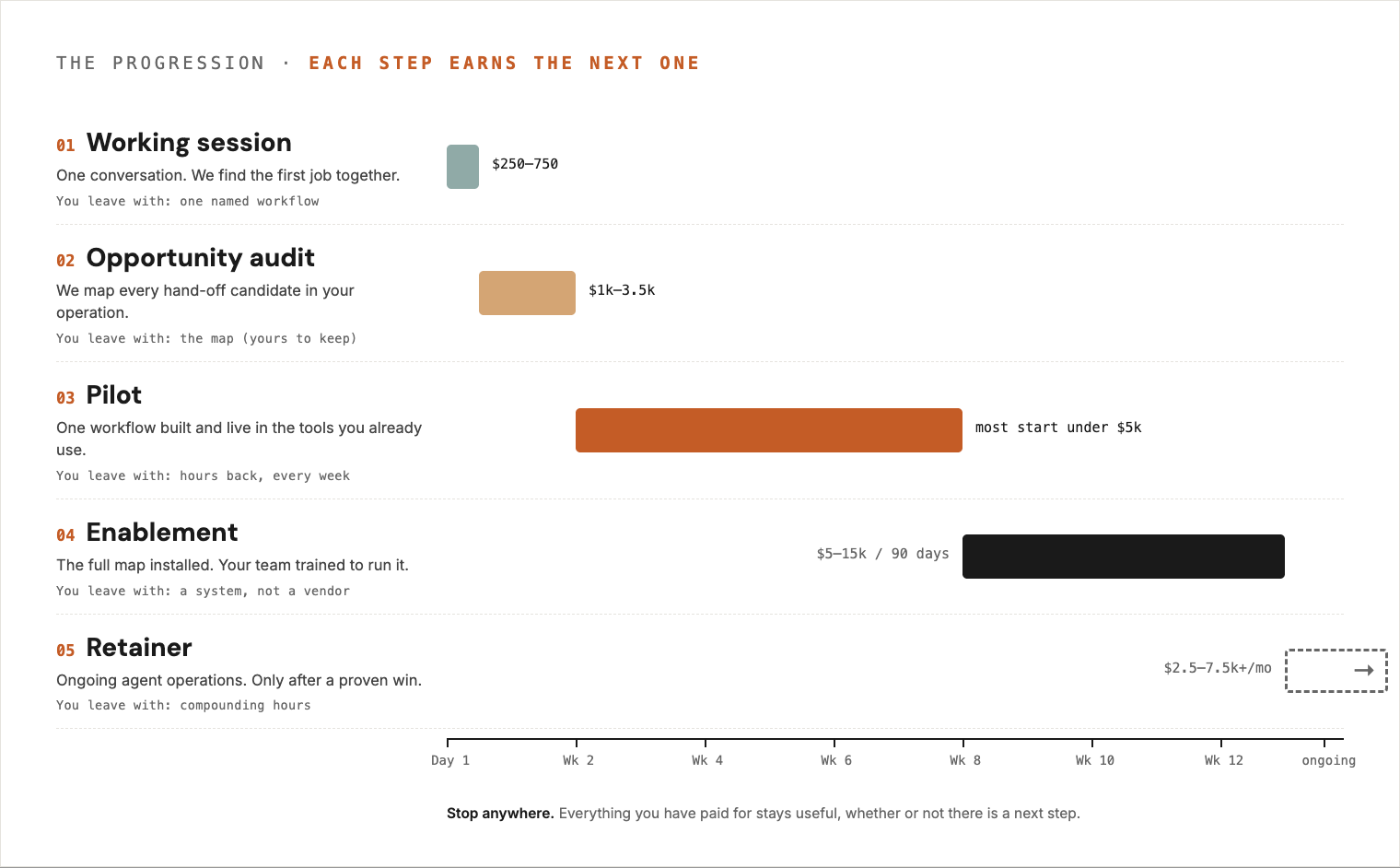
| Step | What it is | Range |
|---|---|---|
| Working session | Find the first job together | $250 to $750 |
| Opportunity audit | Map every hand-off candidate | $1k to $3.5k |
| Pilot | One workflow, built and live in 4 to 8 weeks | $3k to $12k, most start under $5k |
| Enablement | The full map over 90 days | $5k to $15k |
| Retainer | Only after a win | $2.5k to $7.5k+ per month |
Each step earns the next one. Stop after the audit and you keep the map. The work stays useful whether you hire us again or not.
10 / want-help-finding-the-first-job-take-the-15-minu
Want help finding the first job? Take the 15-minute intake.
The intake takes 15 minutes. Be specific. There are no wrong answers. We use it to pick one workflow, not to sell you a stack.
Start the AI Enablement intake
You keep judgment and the brand. We take the copy and paste.