You can compare website proposals before you understand every technical detail.
Start with the job your website needs to do. Then ask each agency to show where that job appears in its scope.
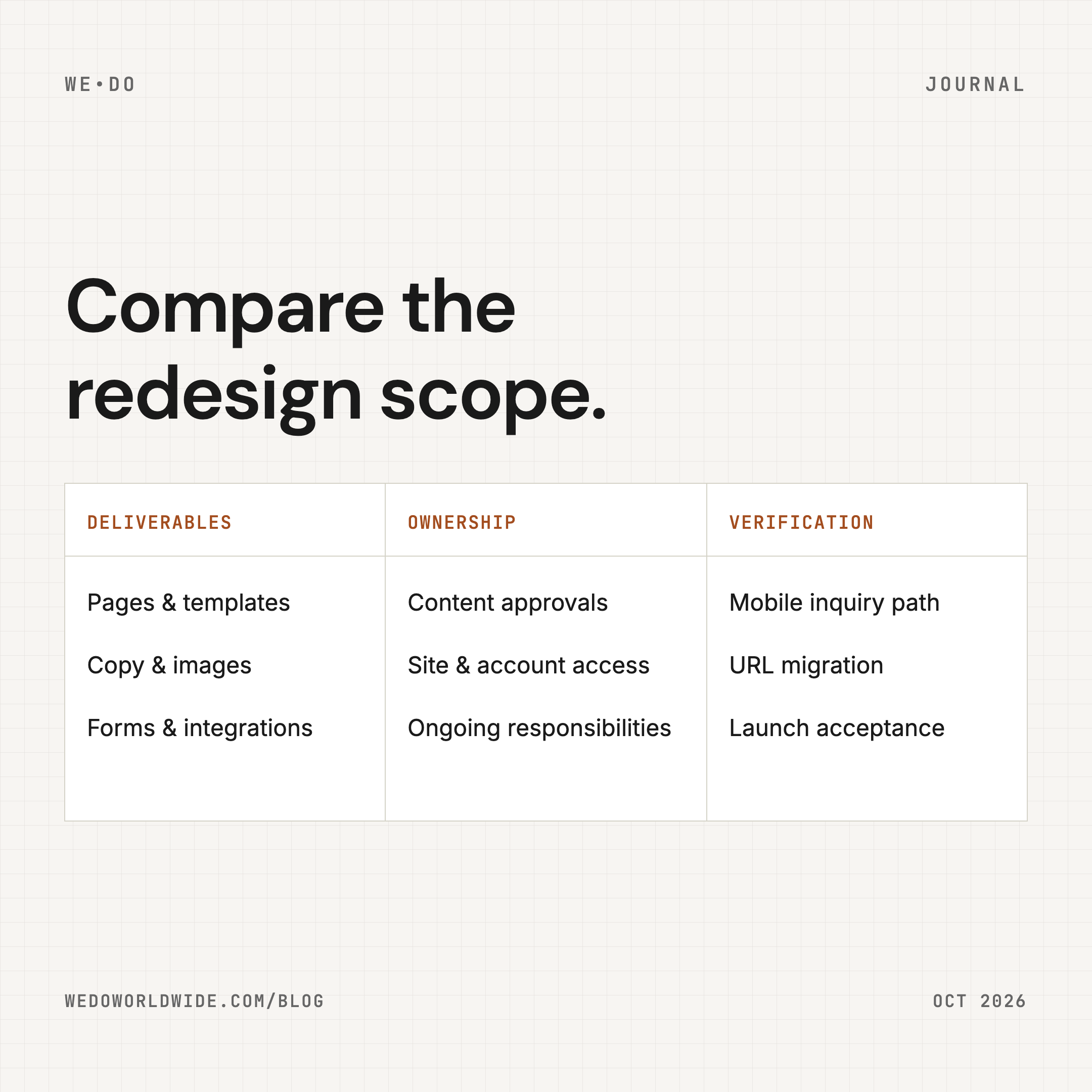
“Website redesign” can cover very different work. One proposal includes new copy and content migration. Another expects your team to supply everything. Both may promise the same number of pages.
Use the questions below to compare what you’ll actually receive.
01 / start-with-one-customer-action
Start with one customer action
Write down the most important action a qualified visitor should take.
For a service business, that might be requesting a project conversation. For a property business, it might be sending an inquiry about a particular home.
Be specific about what happens next. Who receives it? What information do they need to respond?
Here’s a simple test you can adapt:
“A visitor can understand the service, find relevant proof and send a project inquiry from their phone. The right person receives the inquiry with enough context to follow up.”
Ask each agency which parts of the proposal make that possible.
If you’re still deciding whether the whole site needs replacing, first work through the rebuild decision. A defined problem may have a smaller fix.
02 / count-templates-and-finished-pages-separately
Count templates and finished pages separately
Ask what the page count means.
A template is a reusable layout. A finished page has its actual content in place. Building one service-page template and filling twenty service pages are separate tasks.
Get both quantities in writing. Also ask who enters the content.
That distinction matters when your site includes products or properties. The layout may repeat, while each page needs its own images and details.
For each page type, write down what the visitor needs to decide. Then check whether the design includes space for it.
03 / name-who-supplies-the-words-and-images
Name who supplies the words and images
A design can be approved while most of the content remains unfinished.
Your scope should say who writes each page and who checks it. It should also cover photography, image selection and any licensed assets.
Ask what happens to existing content. Which pages stay? Which get rewritten? Which can be retired?
If your team supplies the copy, ask when it’s needed and what format to use. Put those dependencies beside the project milestones.
A proposal with copywriting included covers different work from one that assumes approved copy arrives on day one.
04 / test-the-whole-inquiry-path
Test the whole inquiry path
“Contact form included” leaves several questions open.
What fields will it collect? Where does the submission go? What confirms to the visitor that it worked?
If your team uses a customer-management system, ask whether connecting it is included. Name the actual system.
Before launch, submit a test inquiry from a phone. Check the confirmation, then find the inquiry where your team expects to receive it. Verify that the useful details survived the trip.
Also test what happens when a required field is missing. Agree on who handles delivery failures and spam.
An inquiry button alone doesn’t tell you whether the handoff works.
05 / make-search-migration-a-named-deliverable
Make search migration a named deliverable
If a redesign changes page addresses, ask for a list connecting each old address to its new destination. That’s a URL map.
The scope should name who creates the map, sets up redirects and checks them after launch.
Google’s site-move guidance recommends preparing and testing the new site, mapping URLs, implementing redirects and monitoring traffic. It also warns that rankings can fluctuate during significant changes.
Ask what happens to pages already bringing useful visitors. Record which content remains and which pages will be merged or removed.
“SEO included” needs a defined list of work. Nobody can promise that a redesign will preserve every ranking or increase inquiries.
06 / ask-your-team-to-demonstrate-an-update
Ask your team to demonstrate an update
Before choosing a platform, list the updates your team makes.
That may mean changing a service description, adding a property or publishing a case study.
Ask the agency to show how those updates will work. Include training and access in the scope where needed.
Clarify ownership of the domain and hosting account. Ask about access to the site’s code, design files and analytics.
You should also know which licenses need renewing and which changes still require a developer.
These questions belong in the buying conversation. They affect the work after launch.
07 / agree-on-what-ready-to-launch-means
Agree on what ready to launch means
Ask for a written acceptance checklist.
Include the customer action you started with. Add the agreed checks for mobile layouts, accessibility and performance. Name the pages and conditions being tested.
For example, “mobile tested” becomes more useful when it names the inquiry journey and the devices checked.
Ask who approves launch, who takes a backup and what the recovery plan is if a critical problem appears.
Then separate launch support from ongoing maintenance. Confirm what each covers and when responsibility transfers.
08 / send-the-same-brief-to-each-agency
Send the same brief to each agency
Copy these questions into a document. Answer what you can, then ask each agency to respond to the same scope.
-
Who is the customer we want this site to attract?
-
What should that person understand and do?
-
What currently gets in their way?
-
Which existing pages or features must stay?
-
Which templates and finished pages are included?
-
Who supplies and approves the copy and images?
-
Where should inquiries go, and what must travel with them?
-
Which systems need connecting?
-
Who handles content migration and changed page addresses?
-
Which updates must our team make independently?
-
What will we test before approving launch?
-
What is excluded, and what ongoing costs or responsibilities remain?
Compare the answers alongside the price. If a line is unclear, ask before choosing.
For a sense of the work WE•DO takes on, see our web development services.
If you’re considering a redesign, tell us what your current site prevents a good customer from doing.