Most small businesses I talk to are using AI. Almost none of them are getting paid for it.
They have a ChatGPT tab open. Someone on the team writes social posts with it. Maybe there's a chatbot on the website. And yet the business runs exactly the way it did two years ago, just with more tabs.
Turns out the biggest companies in the world have the same problem. And McKinsey just put a name on the fix.
01 / what-mckinsey-actually-said
What McKinsey actually said
On October 13, McKinsey published "The AI operating system: A new way for CEOs to run the enterprise." The headline number is the gap:
- 40% of respondents at large companies (over $1B in revenue) say they've scaled AI agents.
- Only 6% say AI generates at least 5% of their EBIT, about the same as the year before.
Their own State of AI survey adds a detail I found more interesting: among smaller organizations, the share scaling AI agents stayed flat at 22%, while large companies jumped from 27% to 40%.
So the big guys are pulling ahead on adoption, and still not seeing it in the bottom line. McKinsey's conclusion: "the challenge is no longer simply getting people to use AI; it is changing how the enterprise itself works."
Their answer is an AI operating system, which they describe as a "second brain" for the company. In their words, it's "a continuously operating layer that maintains enterprise context..., reasons across functions, recommends or executes decisions, and learns from outcomes."
And they're clear about what it is not: "An AI OS is not an executive dashboard, which reports on what has happened."
02 / the-one-rule-worth-stealing
The one rule worth stealing
McKinsey lists a handful of priorities. One of them is the whole game:
"Own the context; rent or replace the technology."
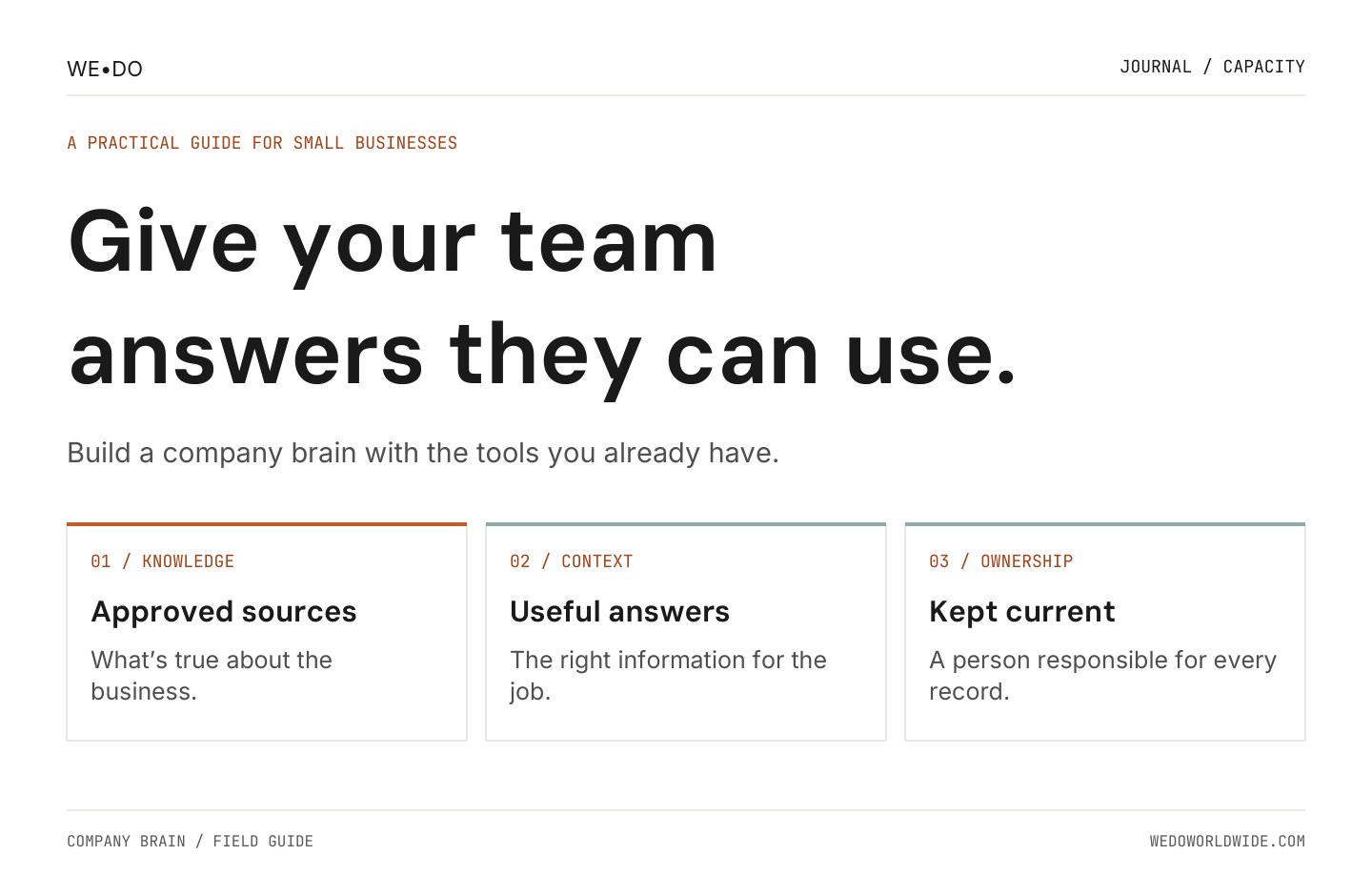
Your knowledge (how you price, how you talk to customers, what you've learned the hard way) is the asset. The AI model is a utility. Models change every few months. If your business knowledge is trapped inside one vendor's chat history, you start over every time you switch.
They also warn against "operating system sprawl," meaning every team or tool running its own separate AI setup so nothing connects. That one hits small businesses hard, because sprawl is usually how we start: one tool for email, another for notes, another for social, none of them talking.
03 / why-this-matters-more-for-a-10-person-business-t
Why this matters more for a 10-person business than a Fortune 500
McKinsey is writing for CEOs of huge companies. Nate Herk, who shared the article on LinkedIn, made the point I agree with: you don't need an enterprise budget to build a version of this. In his view, a first version can start with a folder of plain text files and an AI agent.
Here's why I think small businesses actually have the edge:
- Your context is small enough to write down. A big company needs ontologies and knowledge graphs. You need a few honest documents: who you serve, what you sell, how you price, what you never do.
- You can decide in a day. McKinsey talks about redesigning "decision rights." At a small company, that's a conversation over lunch.
- The owner is the bottleneck. If every decision runs through you, a system that prepares decisions for you is worth more to you than to a CEO with five layers of managers.
04 / where-most-small-businesses-get-it-wrong
Where most small businesses get it wrong
When I look at how owners are rolling out AI, I see the same four mistakes.
1. They start with automation. The first thing everyone wants is "make it run on its own." Nate Herk's advice here is right: start with context and save automation for last, because "automating something that doesn't work by hand just breaks faster."
2. They give one agent every job. A single assistant with access to everything sounds efficient. In practice nobody knows what it did, why, or what it touched.
3. There's no approval step. AI sends the email, posts the update, changes the website. Then someone finds out from a customer.
4. Nothing is written down. The AI gets re-explained the business in every chat. That isn't a second brain. It's amnesia with good grammar.
05 / how-we-actually-do-it-at-wedo
How we actually do it at WE•DO
We run our own agency on this model, and we build it for clients. It's not fancy. It's five rules.
1. A shared company brain, with rules
We keep one folder that every agent reads first: what the company is, who our clients are, how we work. Inside it is a rules sheet. A rule only counts if it's marked active, and the sheet wins if anything else disagrees with it. When a rule changes, it changes once, and every agent picks it up.
That's McKinsey's "own the context" in a form a small team can actually maintain. The longer version, using tools you already have, is How to Build a Company Brain With Tools You Already Have.
2. One job per agent
Each agent does one thing: watch for client tasks that are stuck, prepare a meeting brief, scan research, draft a report. Small scope means small access, and when something goes wrong you know exactly where to look.
3. Humans approve anything that leaves the building
Agents draft. People send. Every outgoing email shows up as a draft for approval before it goes anywhere. Same for publishing and anything touching money. McKinsey's version is "coordinated human and agent execution within defined guardrails." Ours is simpler: if a customer will see it, a person said yes.
4. Recurring automations are the system of record
Once a job works by hand, we put it on a schedule, and that routine becomes how the work gets done, not a side project. Tasks land in our project tool with a link. Files land in the right folder, never "somewhere." If it isn't in the system, it didn't happen.
5. Rent the tools, keep the knowledge
Our brain lives in plain documents and spreadsheets we own. The models and apps around it can change. When a better model shows up next quarter, we swap it in and nothing is lost.
06 / what-you-can-do-this-week
What you can do this week
You don't need a 12-week project. Try this:
- Write your one-page company brain. Who you serve, what you sell, how you price, your tone, and three things you never do.
- Pick one painful, repeatable job. Following up on quotes. Weekly reporting. Chasing invoices. One.
- Do it by hand with AI for two weeks, using that brain document every time.
- Add an approval step before anything goes to a customer.
- Only then put it on a schedule.
Then pick the next job. That's how a second brain gets built: one job at a time, on top of knowledge you own.
07 / the-real-takeaway
The real takeaway
McKinsey's research says the gap between using AI and profiting from it comes down to whether you change how the business runs. For a small business, that change is smaller than it sounds. Write down what you know. Give each agent one job. Keep a human on the send button. Let the routines become the system.
If you want help building yours, that's what we do at WE•DO. Reach out and we'll start with your company brain.
08 / sources
Sources
- McKinsey & Company, "The AI operating system: A new way for CEOs to run the enterprise," October 13, 2026.
- McKinsey & Company, "The state of AI in 2026: On the road to ROI," August 25, 2026.
- Nate Herk, "McKinsey & Company Just Told CEOs to Build an AI Operating System," LinkedIn, October 15, 2026.