Twenty-four working agents. Named, triggered and owned. Nine are ours. Six come from companies you know. Three failed.
Part of our guide to AI agents for small business.
Search AI agents examples and Google hands you a thermostat, a Roomba and a self-driving car.
Those are exam answers to a question nobody asked.
The top organic result tells you what people want. It's a Reddit thread with 230+ comments, titled "Do you guys know some REAL world examples of using AI Agents?" People want a working agent inside a business. Running on a Tuesday. Owned by a person with a name.
We run 40+ AI agents at WE•DO. They write briefs and pull GA4 and Search Console. They draft client reports and prep meeting agendas. They catch unlogged billable hours and built the graphics in this post. Some paid for themselves in a week. We killed three.
By the end, you'll know:
- The five things that make an example worth copying
- Nine agents from our fleet, with triggers and owners
- Six agents big companies documented, and the part to steal
- The numbers they moved, including one that embarrassed us
- How to pick your first one
It's an 11-minute read. Want a starting point and nothing else? Skip to the last section.
First, the part every example list skips: how to tell which examples are worth anything.
01 / what-makes-an-ai-agent-example-worth-copying
What Makes an AI Agent Example Worth Copying?
A real example names five things. A category doesn't.
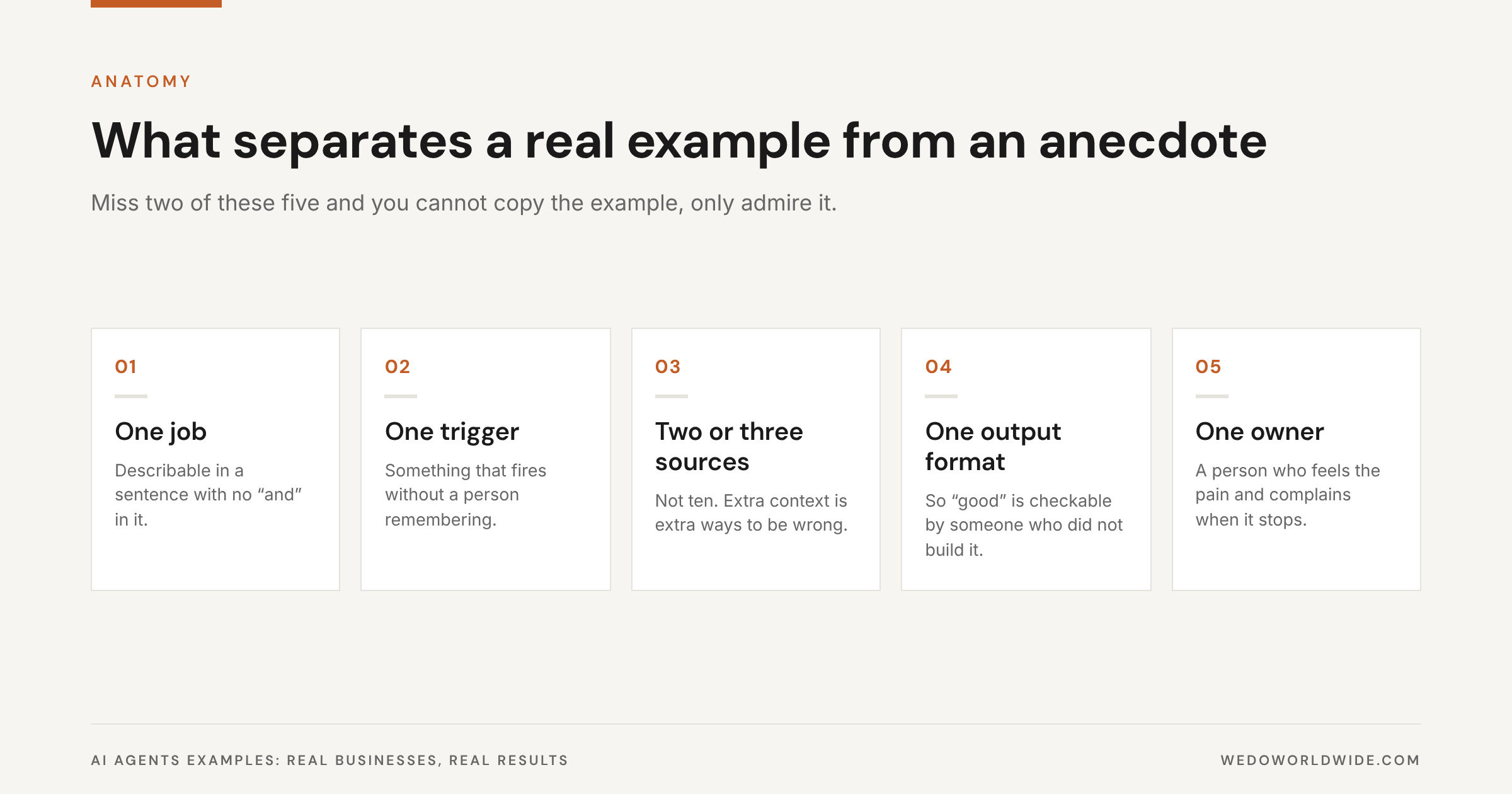
"Customer support agent" is a category, not an example. You can't build from it. You can't build from "utility-based agent" either. That's a textbook taxonomy label. It's why half of page one reads like a lecture.
Here are the five:
- One job. Describable in a sentence with no "and" in it.
- One trigger. Something that fires without a person remembering. A status change, a due date, a schedule, an inbound form.
- Two or three sources. Not ten. Extra context means extra chances to reason from something irrelevant.
- One output format. So someone who didn't build it can check "good."
- One owner. A person who feels the pain and complains when it stops.
Miss two of the five and you have an anecdote, not an example. Every agent we've killed was missing at least two.
Chatbot, automation, agent
The search results muddle these three. The difference decides your budget.
- A chatbot answers. You ask, it replies, you paste the reply somewhere useful. You did the work.
- An automation runs a fixed rule. It's reliable until reality shows up in a shape the rule didn't expect.
- An agent takes a goal and plans the steps. It uses your tools and checks its own output. Then it finishes or escalates.
The practical test: switch it off. If the job stops happening, it was an agent. If the job takes longer, it was an assistant. We drew the same line in more detail in AI tools for business automation.
02 / nine-ai-agent-examples-from-our-own-fleet
Nine AI Agent Examples From Our Own Fleet
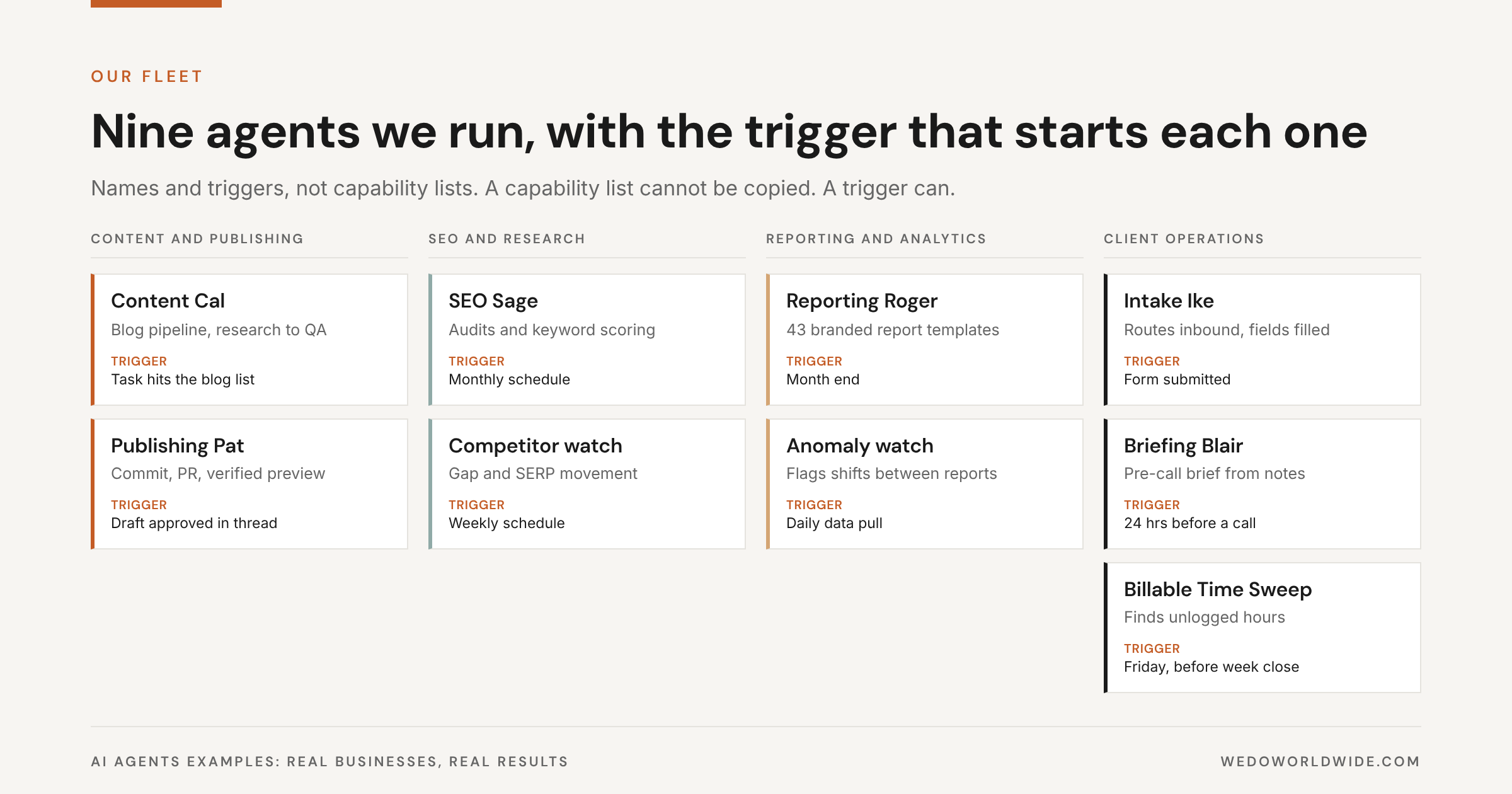
Here are nine of our 40+. That's enough to show the pattern without writing a directory. Each one has a name. Naming an agent forces you to give it one job.
| Agent | The one job | Trigger | Owner |
|---|---|---|---|
| Content Cal | Runs the blog pipeline from keyword research to QA handoff | A content task lands in the blog list | Content lead |
| Publishing Pat | Commits the post and graphics, opens the PR, returns a verified preview | A draft is approved in the task thread | Content lead |
| SEO Sage | Scores keyword and audit opportunities, writes the survivors into tasks | Monthly schedule | SEO lead |
| Competitor watch | Tracks gap and SERP movement across the account list | Weekly schedule | SEO lead |
| Reporting Roger | Drafts the monthly client report into one of 43 branded templates | Month end | Account lead |
| Anomaly watch | Flags metric shifts between reports before a client sees them | Daily data pull | Account lead |
| Intake Ike | Routes inbound work into the right list with the fields filled in | Form submitted | Ops |
| Briefing Blair | Posts a pre-call brief from the last three meetings, open tasks and analytics | 24 hours before any client call | Account lead |
| Billable Time Sweep | Finds unlogged hours before the week closes | Friday, before week close | Ops |
Three of these get the most questions. Here's how they work.
Reporting Roger, the most boring agent we own
It pulls GA4, Search Console and Ads. It calculates period-over-period change, drafts the analysis and renders it into a branded template. A person reviews it, adds the context only they have, and ships it.
Monthly reporting went from five hours a report to about thirty minutes. That's how a team our size sends 100+ client reports a month with no reporting department.
It's the highest-return agent in the fleet. It's also the least interesting. That's the pattern, not the exception.
Briefing Blair, the job that never happened before
Nobody skipped pre-call prep out of laziness. It was always last in line. This agent fires on the calendar, not on somebody remembering. "We should really do that" becomes a thing that happens every time.
The best first agent in most businesses isn't a job you do badly. It's a valuable job you never get to.
Billable Time Sweep, the one that returns money instead of hours
Every other agent on the list gives back time. This one finds revenue you already earned and never logged. Do you bill by the hour? Then this is the shortest argument for your first agent. Start here.
03 / which-ai-agents-fit-each-business-function
Which AI Agents Fit Each Business Function?
Every function has one job worth handing over, plus a trigger and a human gate (the person who checks the output before it goes anywhere).
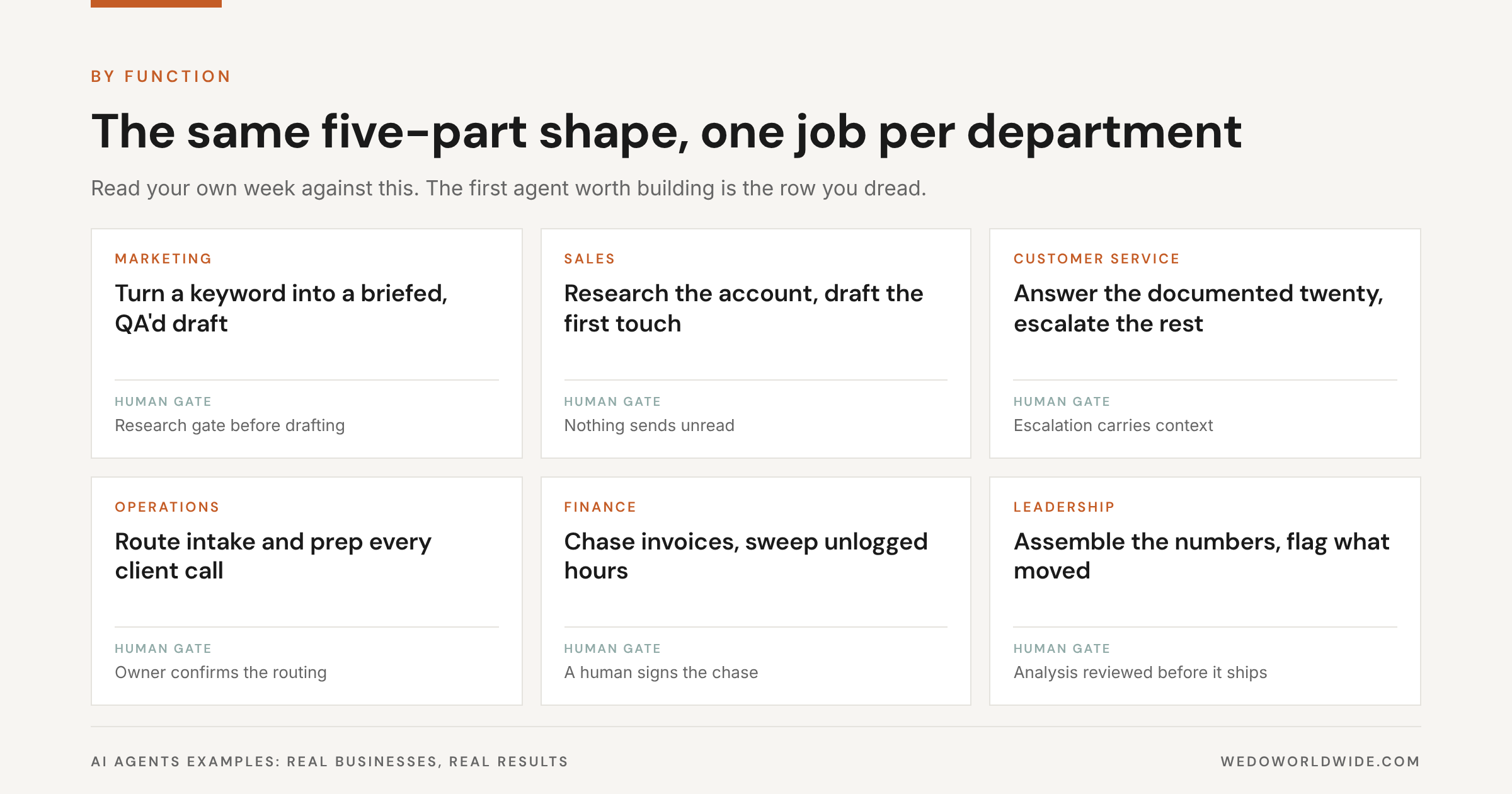
We're a marketing business, so read our fleet as a shape, not a shopping list. The shape transfers.
| Function | The job to hand over | Trigger that fires it | The human gate |
|---|---|---|---|
| Marketing | Keyword research to briefed, QA'd draft | A task enters the content list | Research is a gate before drafting |
| Sales | Research the account, draft the first touch | A lead clears the qualifying rule | Nothing sends unread |
| Customer service | Answer the documented twenty questions, escalate the rest | Inbound message | Escalations arrive with context attached |
| Operations | Route intake, prep every client call | Form submitted, or 24 hours pre-call | The owner confirms the routing |
| Finance | Chase invoices, sweep unlogged hours | Invoice age, or Friday close | A human signs the chase |
| Leadership | Assemble the weekly numbers, flag what moved | Friday morning schedule | Analysis reviewed before it ships |
Look at what's in every row. Not a tool name. A trigger and a gate.
Pick the row you dread most in your own week. That's your first candidate. The four-question filter for choosing is at the end of this post. The fuller version is in the delegation framework we run on: agents are employees, skills are SOPs (standard operating procedures).
04 / what-can-you-steal-from-companies-you-already-kn
What Can You Steal From Companies You Already Know?
Their checking step. Each of these six bolts one onto a narrow job.
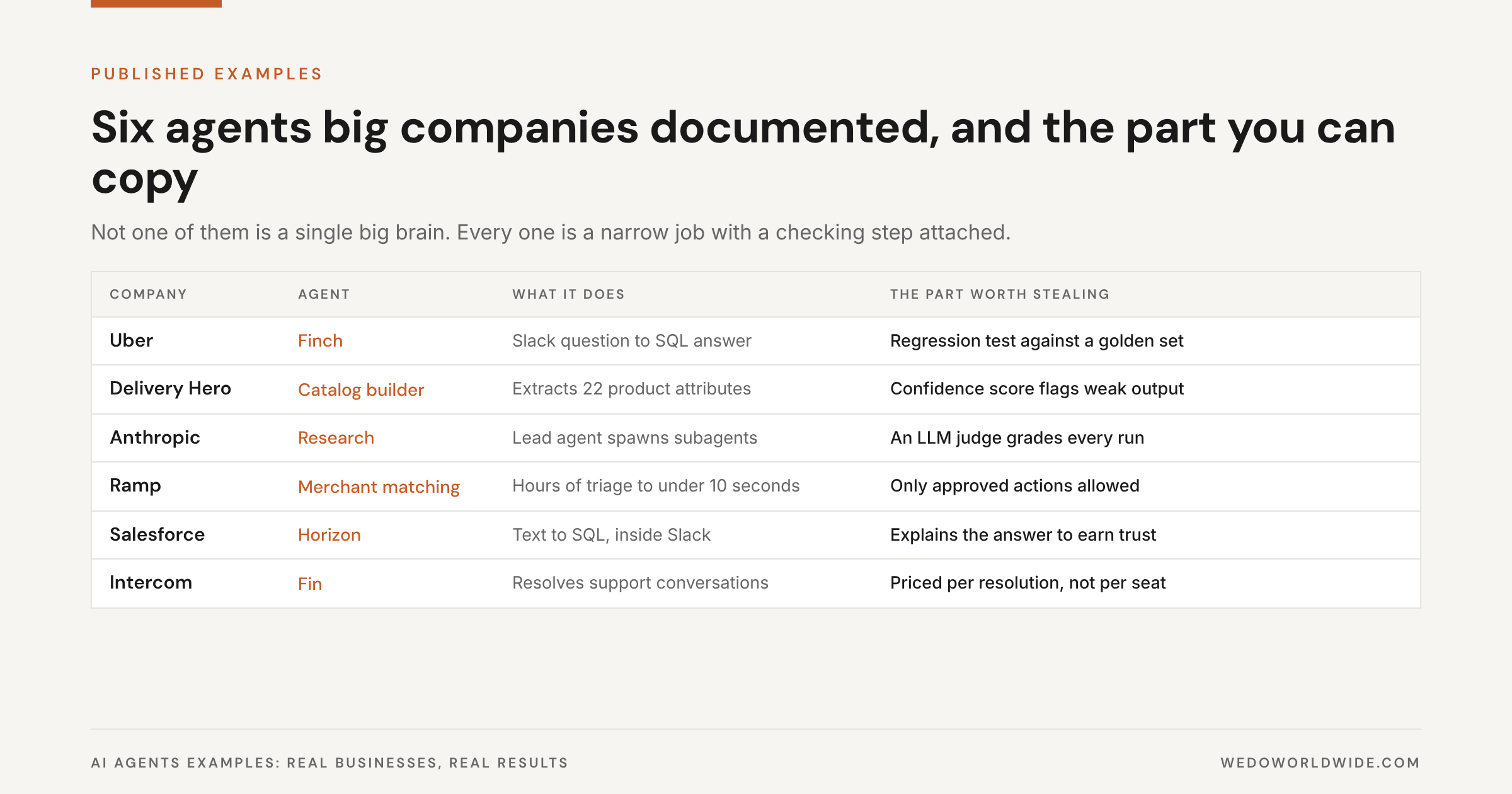
Each company documented its agent on its own engineering blog. That makes them the most reliable examples online. It also makes them the least applicable at small-business scale. Read them for the pattern, not the budget.
| Company | Agent | What it does | The part worth stealing |
|---|---|---|---|
| Uber | Finch | Turns a Slack question into a SQL answer, with a supervisor agent routing to sub-agents | It is regression tested against a "golden" set of expected answers before every deploy |
| Delivery Hero | Catalog builder | Extracts 22 product attributes from vendor titles and images, then standardises the title | A confidence score sends weak output to a human instead of shipping it |
| Anthropic | Research | A lead agent plans, then spawns parallel subagents that search and report back | An LLM judge grades factual accuracy, citations and completeness on every run |
| Ramp | Merchant matching | Fixes incorrect merchant classifications in under 10 seconds instead of hours | The model can only take pre-approved actions, with guardrails after the fact |
| Salesforce | Horizon | Text-to-SQL inside Slack for anyone who needs a number | It explains its answer, which is how it earned internal trust |
| Intercom | Fin | Resolves support conversations end to end, with voice as well as chat | Priced per resolution rather than per seat, so the vendor carries some of the risk |
One thing runs through all six. None of them is a single big brain. Each is a narrow job with a checking step bolted on:
- a golden-set test (a fixed list of known right answers)
- a confidence threshold
- a judge
- an allow-list
- an explanation
- a resolution definition
That checking step is the difference between a demo and a system. It's also the cheapest part to copy. So put it in your first agent, not your fifth.
05 / what-did-these-examples-return
What Did These Examples Return?
Hours, mostly. Here are numbers from our own fleet, measured on repeated work. None of it came from anything clever.
| Job | By hand | With the agent | What changed |
|---|---|---|---|
| Monthly client report | 5 hours | 30 minutes | Data pulls and first-draft analysis |
| Full SEO audit | 1 day | 30 minutes | Five sources arriving together |
| 12-site WordPress audit | 2 hours | 15 minutes | One command across every site |
| Content brief | 90 minutes | 10 minutes | Research and structure pre-assembled |
One usage snapshot from a heavy stretch: roughly 12,000 platform AI credits. Same period: 63 hours of work returned. The four-line cost breakdown is in what running 40+ agents costs and saves. So are the cases where the math goes negative.
The condition on every number
Recovered hours only count if they move to work that earns.
63 hours returned that turn into 63 hours of cleanup is not a saving.
The number that does not flatter us
Our 40 AI marketing agents pillar page is the proof. Over the last 180 days it pulled 29,085 impressions and 8 clicks in Search Console. That's a 0.03% click-through rate at an average position of 10.6. Our top 25 blog pages in the same window: 78,813 impressions, 77 clicks.
The fleet did what we asked. It published more, faster, more consistently. It couldn't fix our aim. We pointed it at broad topics with no commercial intent (nobody searching them was ready to buy).
Agents multiply whatever strategy you aim them at. Aim them at the wrong thing and you get a bigger wrong thing, on schedule.
06 / what-didnt-work-in-our-own-fleet
What Didn't Work in Our Own Fleet?
Three agents failed. Each failure left us a written rule.
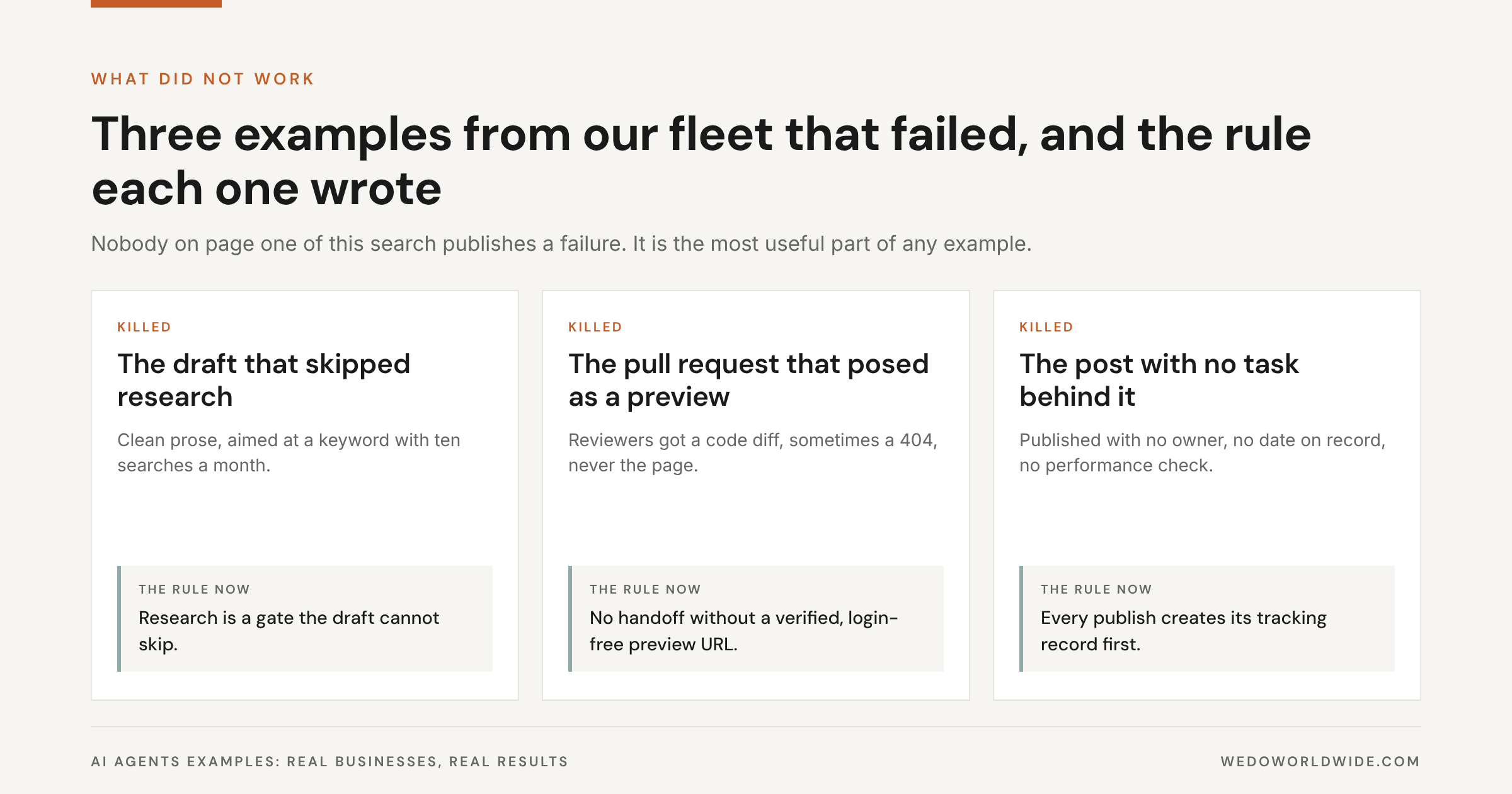
The draft that skipped the research
One agent wrote a full draft before the keyword and SERP (search results page) work was done. The prose was fine. The angle targeted a keyword with ten searches a month.
We killed that version and labelled it so nobody would reuse it. Research is now a gate the draft can't skip.
The pull request that pretended to be a preview
Our publishing agent returned a GitHub pull request link. It reported the post as ready for review. A pull request isn't a preview. The reviewer got a code diff, and sometimes a 404.
The rule now: no handoff ships without a verified, login-free preview URL. And nobody calls a pull request link a preview.
The post that shipped with no task behind it
A post went live with no task in the pipeline. No owner, no publish date on record, no performance check scheduled. We caught it days later. Now every publish creates its own tracking record before anyone can mark it done.
Three failures, three written rules. That's the real return on a failed agent. It's why I'd rather read one honest failure than thirty polished use cases. The longer diagnosis is in why most AI agent pilots fail.
07 / how-do-you-pick-the-first-example-to-copy
How Do You Pick the First Example to Copy?
Pick one job that already happens every week. You don't need forty. Forty is what three years of a team compounding on its own standards looks like.
Run your candidate through four questions:
- Does this job happen at least weekly? Frequency is what pays back the build.
- Is it context-heavy? Docs, tasks, transcripts, analytics. Context is where agents beat tools.
- Is "good" easy to define? A structured output can be checked. A vague one can't.
- Does a missed step cost something? That's where reliability turns into money.
Three yes answers? Build a narrow first version:
- Give it a trigger.
- Connect only the sources it can't work without.
- Name the number it should move.
- Hand it to whoever feels the pain today.
Weighing a product against something custom? Make the build-versus-buy call after that decision, not before. For the wider view of what to automate first, start with AI automation for small business.
Next step
Find the first job worth handing off.
We will map your recurring workflows, price the two or three worth automating first, and tell you plainly which ones to leave alone.
08 / the-takeaway
The Takeaway
The best example isn't the most impressive one. It's the one closest to a job you already do every week. It has a trigger you can name and an output someone can check.
Copy the checking step from Uber and Ramp. Copy the trigger discipline from our fleet. Skip the thermostat.
Source notes. Enterprise examples read Sat Sep 5, 2026 from Evidently AI, Automation Anywhere and IBM. Intercom's resolution claim is Intercom's own published figure and is not independently verified. First-party numbers come from AI Agent ROI, AI Client Reporting at Scale, How We Use Claude Code, and Search Console and GA4 data pulled Sat Sep 5, 2026.