We run more than 40 AI agents in a working marketing business.
Some earn their keep in week one. Some we killed. A few cost more than the work they replaced.
Here's the honest shortlist by job: what each costs, and where each still needs a human.
Part of our guide to AI agents for small business.
By the end, you'll know:
- Which agent to buy for each of six jobs, with real 2026 pricing
- The five tests an agent must pass before you pay
- What an agent stack costs to run each month
- How to roll out your first agent in 30 days
It's a 12-minute read. If you're ready to buy, jump to the shortlist and stop there.
Most "best AI agents for small business" lists come from companies selling one of the agents. That's why they read the same. Ten tools, ten feature bullets. No mention of what breaks in week three.
Our agents work inside WE•DO every day. They write briefs. They pull GA4 and Search Console data. They draft client reports, prep meeting agendas, triage our inbox, and build the graphics in this post.
So this is the operator version. The agents worth your money in 2026, sorted by the job you want to hand off. Real pricing. The failure mode of each category. And the one rule that decides whether any of it works.
That rule comes first. Get it wrong and the rest of this article won't save you.
01 / what-counts-as-an-ai-agent-and-what-doesnt
What Counts as an AI Agent (and What Doesn't)?
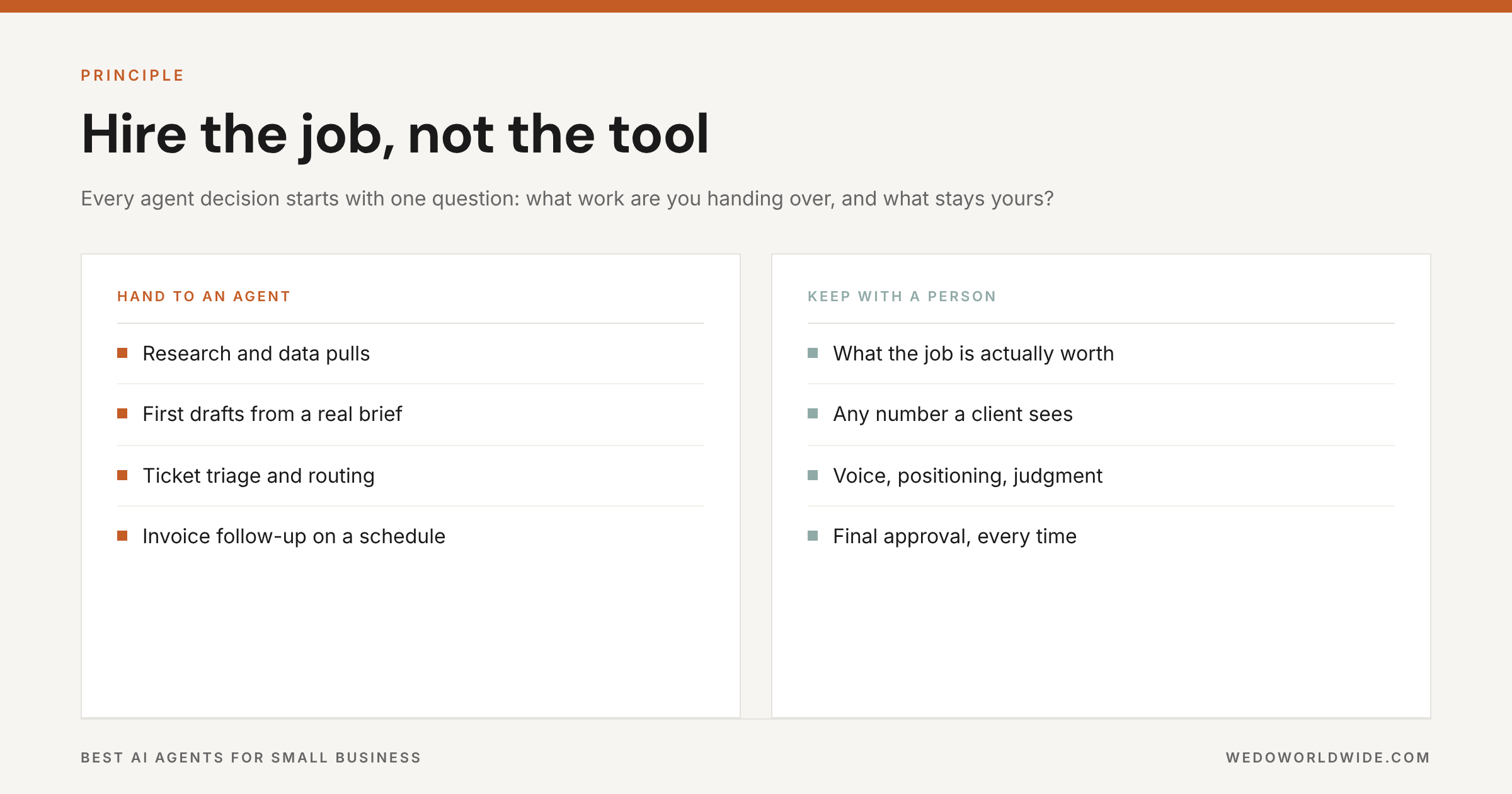
An AI agent decides and acts on its own. A chatbot or an automation doesn't.
The word "agent" does a lot of unpaid labor in marketing copy right now. Here's the line that matters for a small business budget.
A chatbot answers. You ask, it replies, you copy the reply somewhere useful. You did the work.
An automation executes. A fixed rule fires: form submitted, add row, send template. It's reliable until reality shows up in a format your rule didn't expect.
An agent decides and acts. It takes a goal and breaks it into steps. It uses your connected tools and checks its own result. Then it finishes the job or escalates. Wix puts the distinction well. An automation sends a standard follow-up three days later. An agent reads the response, decides whether the lead is a priority, and adjusts the timing.
Here's the practical test. Remove the tool. If the task stops getting done at all, you bought an agent. If the task only takes longer, you bought an assistant.
Both are fine. Only one justifies agent pricing.
02 / how-did-we-score-these
How Did We Score These?
Every agent below had to pass the same five tests we use on our own stack. It's also the buying checklist we hand clients, so steal it.
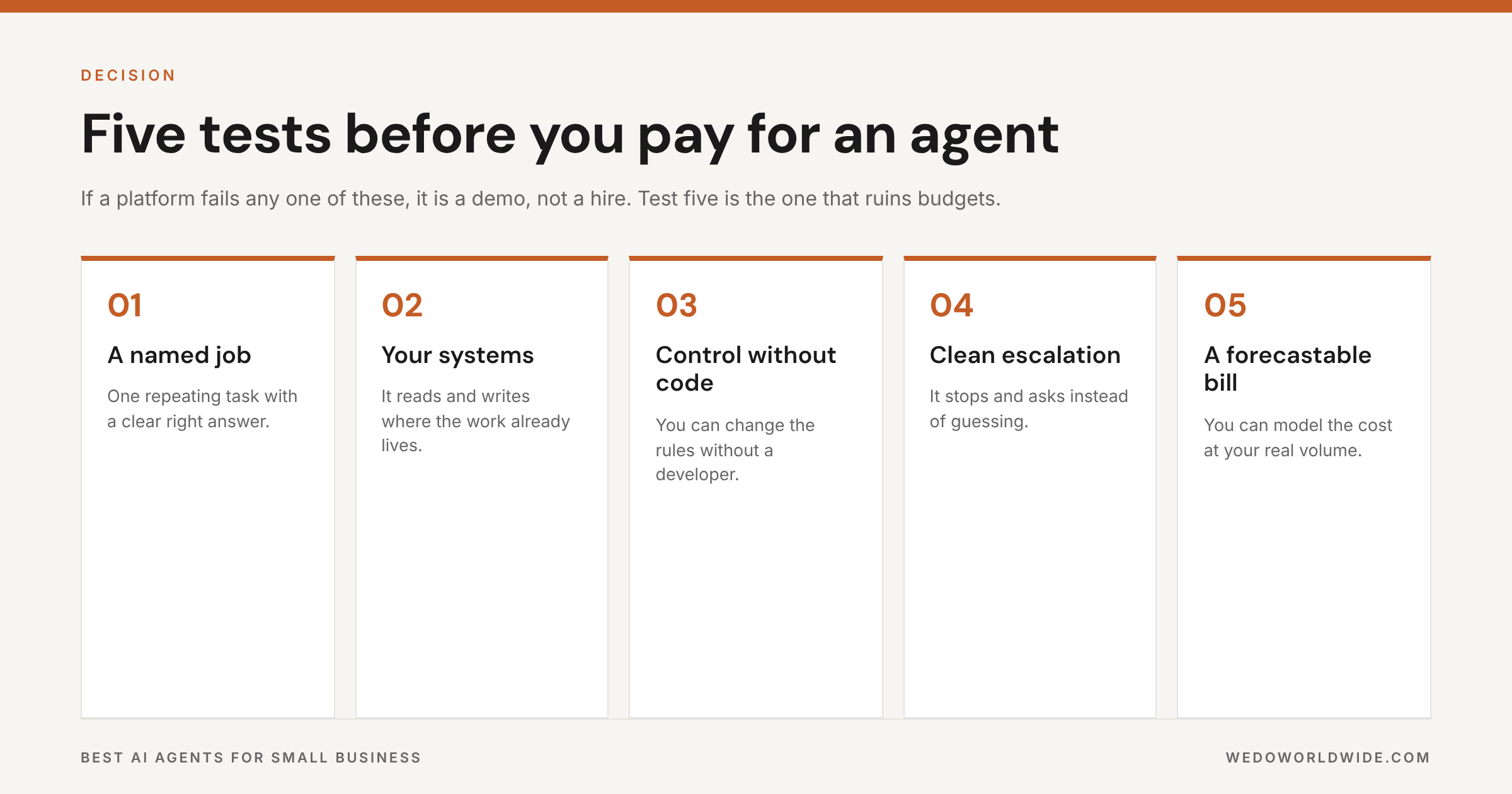
People skip test five. It's the one that ruins budgets in 2026.
Agent pricing has mostly moved off seats:
- HubSpot bills its customer agent per resolved conversation and its prospecting agent per lead.
- Intercom pioneered charging for Fin only when it resolves a conversation.
- Clay and Make meter actions and credits.
- n8n charges per full workflow run.
None of that is a scam. It's often cheaper than a seat. But your bill scales with your volume. Volume is the one number founders keep underestimating. Model it before you commit.
03 / what-are-the-best-ai-agents-for-small-business-b
What Are the Best AI Agents for Small Business by Use Case?
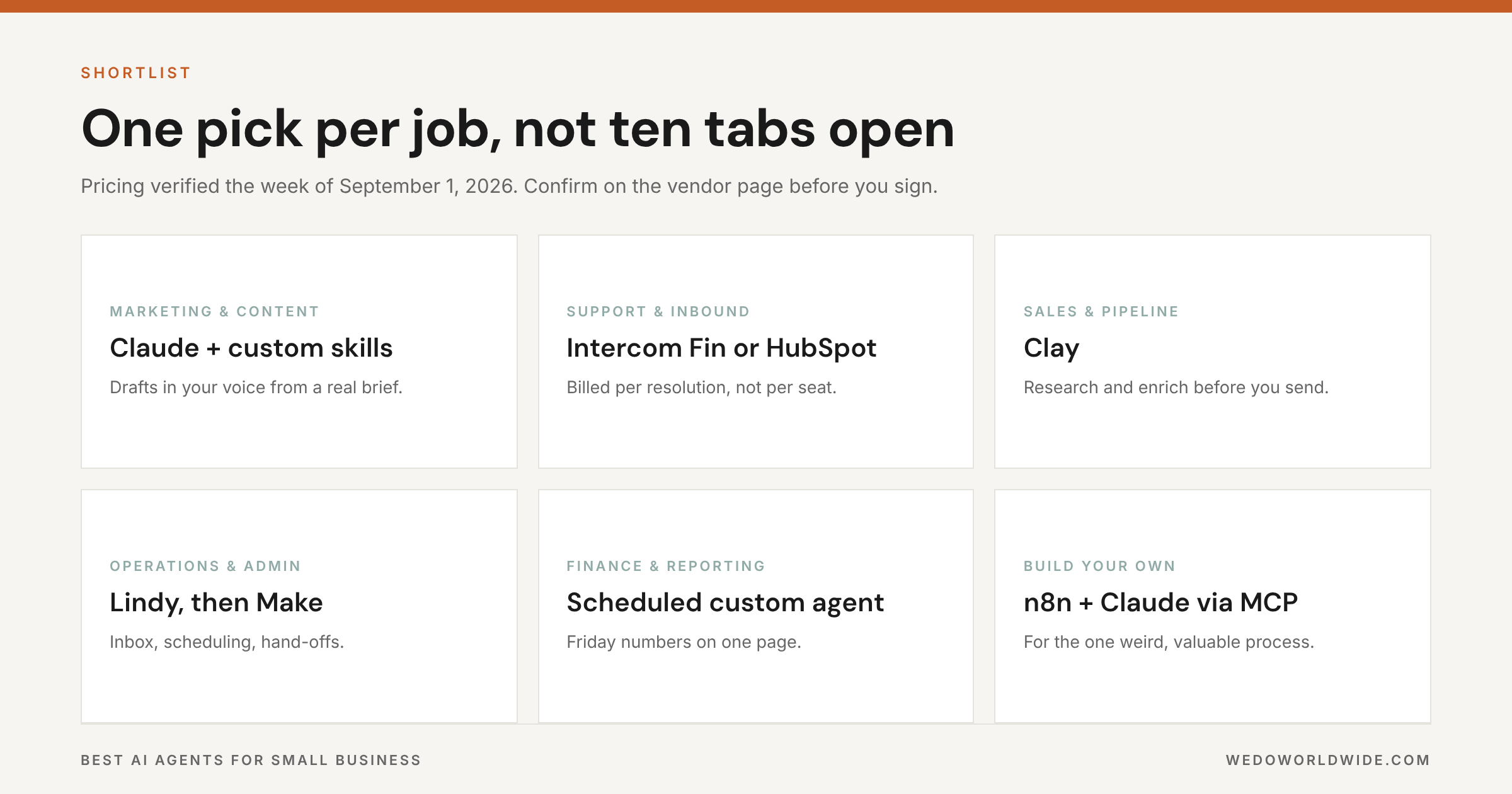
The best agent depends on the job you're handing off. That's how you buy, so that's how we sorted them.
We checked pricing on vendor pages the week of September 1, 2026. These pages change often. Confirm before you sign.
1. Marketing and content
The job: research, briefs, first drafts, repurposing, metadata. Plus the twelve small formatting chores that make content feel heavier than it is.
What to use:
- Claude (Cowork and Code) with custom skills is the strongest general-purpose pick for non-technical owners. It reads a brand context file first, then drafts in your voice. It runs most of our own content pipeline.
- Lindy if the marketing work you want gone is mostly email, scheduling, and meeting follow-up. Plus is $49.99/mo, Pro $99.99/mo, Max $199.99/mo. There's a 7-day trial and no free tier.
- Purpose-built content agents inside your work platform (ClickUp, HubSpot, Notion) if your team already lives there. The integration is worth more than a slightly better model.
Best for: owner-operators and marketing teams of 2 to 10 people. Watch out for: volume without a quality gate. A content agent with no brief and no reviewer produces twenty pages nobody asked for. That's how you land on the wrong side of Google's scaled content abuse policy.
2. Customer service and inbound
The job: answer the same twenty questions, 24 hours a day. Escalate the rest with context attached.
Agents pay back fastest here. The volume is high, the answers are documented, and success is measurable.
- Intercom Fin is the most proven option. Intercom reports a 76% average resolution rate across more than 12,000 customers. It works with Salesforce, HubSpot, Freshdesk and other helpdesks. It charges on resolutions, not seats.
- HubSpot Customer Agent at $0.50 per resolution, if your business already runs on HubSpot. The CRM context is the edge: it answers using real contact and contract history.
Best for: any business where the founder is still the default support rep. Watch out for: your own documentation. A support agent trained on a thin, out-of-date help center will be confidently wrong. Clean the docs first. That work pays off whether or not you buy an agent.
3. Sales and pipeline
The job: research prospects and score them against your ideal customer. Personalize the first touch, follow up on schedule, and keep the CRM honest.
- Clay for research and enrichment. The free tier gives 500 actions and 100 data credits a month. Launch starts at $167/mo, Growth at $446/mo. Actions and credits are the meter. Pilot on the free tier with a real list before you pick a plan.
- HubSpot Prospecting Agent at $1.00 per lead when it drafts outreach. That makes the math easy to check against your close rate.
Best for: founder-led sales and sales teams of one to three people. You're competing on outreach volume against much bigger companies. Watch out for: sending on autopilot. Outbound is the riskiest place to remove human review. A bad message costs you your reputation with the exact people you want to sell to.
4. Operations and admin
The job: work that's never urgent enough to prioritize and always painful when it piles up. Client onboarding, invoice follow-up, meeting prep, contract reminders, status updates.
- Lindy for the assistant layer: inbox triage, scheduling, meeting notes, and follow-up drafts. Max covers up to five inboxes.
- Make for visual, credit-metered orchestration. The free plan includes 1,000 credits a month and 3,000+ app connections. That's enough to prove one real workflow.
- Zapier when breadth of integrations matters more than control. Its tiers are metered on task and usage volume. Estimate your monthly runs before choosing.
Best for: solo operators and small teams where one person holds all the process context. Watch out for: automating a process you never documented. AI can't fix an unclear process. It makes the inconsistency faster.
5. Finance and reporting
The job: chase invoices and assemble the weekly numbers. Answer "how did we do" without a Sunday night in spreadsheets.
- Reporting and data agents inside your existing stack are the cheapest entry point. HubSpot's data agent, for example, charges $0.10 per answered question about your CRM data.
- A scheduled custom agent that pulls analytics, ad, and CRM data on Friday morning. It drafts a one-page summary. Ours cut reporting time roughly 60%.
- Invoice follow-up agents. They're unglamorous and often the fastest payback on this list. Late payment is a cash flow problem with a fixed script.
Best for: any business with more than a handful of monthly invoices. Watch out for: an agent stating numbers it didn't look up. Require the source on every figure.
6. Build your own
This is the category vendor lists leave out. It's the one that changed our business.
When the job is specific to how you work, no product will fit. You don't need a $40,000 development project either.
- n8n is the best value in the category. Community edition is free to self-host. Cloud starts at €20/mo (Starter) and €50/mo (Pro). It bills on full workflow executions, not per step. So one execution can do what costs thousands of operations elsewhere. Business is €667/mo when you need SSO and environments.
- Claude plus MCP (Model Context Protocol, a standard way to plug an AI model into your tools). It gives an agent real access to your systems. The model stays a setting, not a dependency you build your business around.
- Your work platform's agent builder (ClickUp, HubSpot Agent Builder) when the data the agent needs already lives there.
Best for: businesses with one weird, valuable, repeating process. Watch out for: the maintenance bill. A custom agent nobody owns is a fragile pipeline. It breaks the day a vendor changes an endpoint.
04 / what-does-this-cost-to-run
What Does This Cost to Run?
Most small businesses can run a serious agent stack for $50 to $300 a month in tool cost. The listicles skip this part.
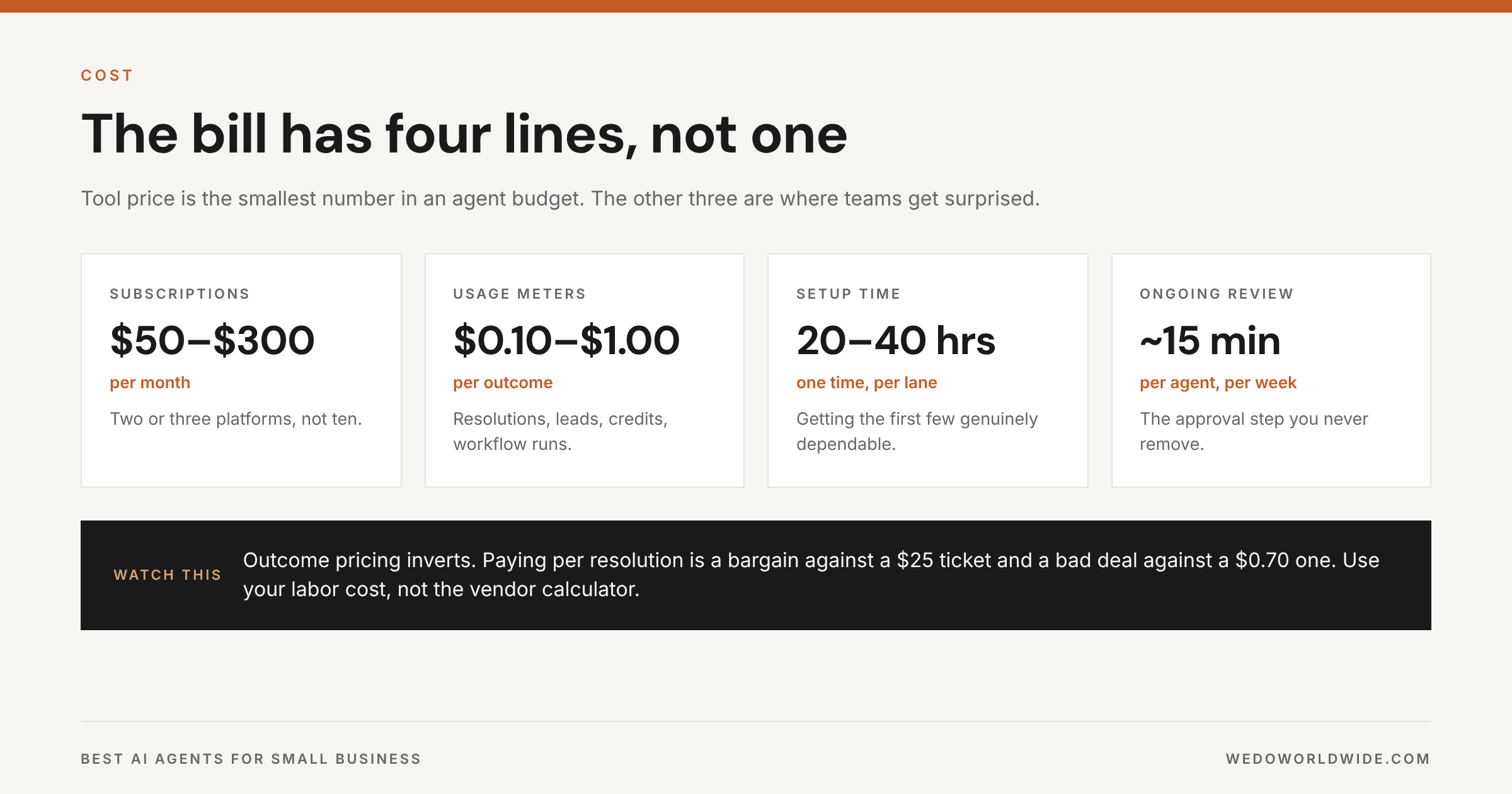
The tools aren't the real investment. Your time is. Expect 20 to 40 hours to get the first few agents dependable. Then add the ongoing minutes you spend reviewing output.
Usage-based pricing has two traps:
Outcome pricing can flip on you. Paying per resolution is a bargain against a $25 support ticket. It's a bad deal against a $0.70 one. Do the math with your own labor cost, not the vendor's ROI calculator.
Cheap tools with expensive cleanup aren't cheap. A $29 agent that needs three hours of fixing every week is the most expensive line in your stack. We broke down our own numbers in AI Agent ROI: what running 40+ agents costs and saves.
05 / give-every-agent-an-autonomy-level
Give Every Agent an Autonomy Level
Set how much freedom each agent gets before it starts. That was the best decision we made. We stopped asking "can this agent do the job?" and started asking "how much rope does it get?"
Forbes describes a five-level autonomy model for small business agents. It runs from scripted chatbot up to coordinated multi-agent systems. The advice: start at levels two and three and earn your way up. That matches our experience exactly.
It matches the risk data too. Forbes cites Gartner projecting roughly 40% of enterprise applications will ship task-specific agents by the end of 2026. That's up from under 5% in 2025. Meanwhile, Deloitte expects over 40% of agentic projects to be scrapped by 2027 without proper governance.
Adoption isn't the hard part anymore. Governance is.
Our rule: every agent output is a draft until a person approves it. Emails stay drafts. Reports stay private links. Anything that leaves the building gets a human name on it. Delegation without oversight is negligence with extra steps.
06 / roll-it-out-in-30-days
Roll It Out in 30 Days
Prove one lane in 30 days. Don't rebuild your operation in one heroic weekend.
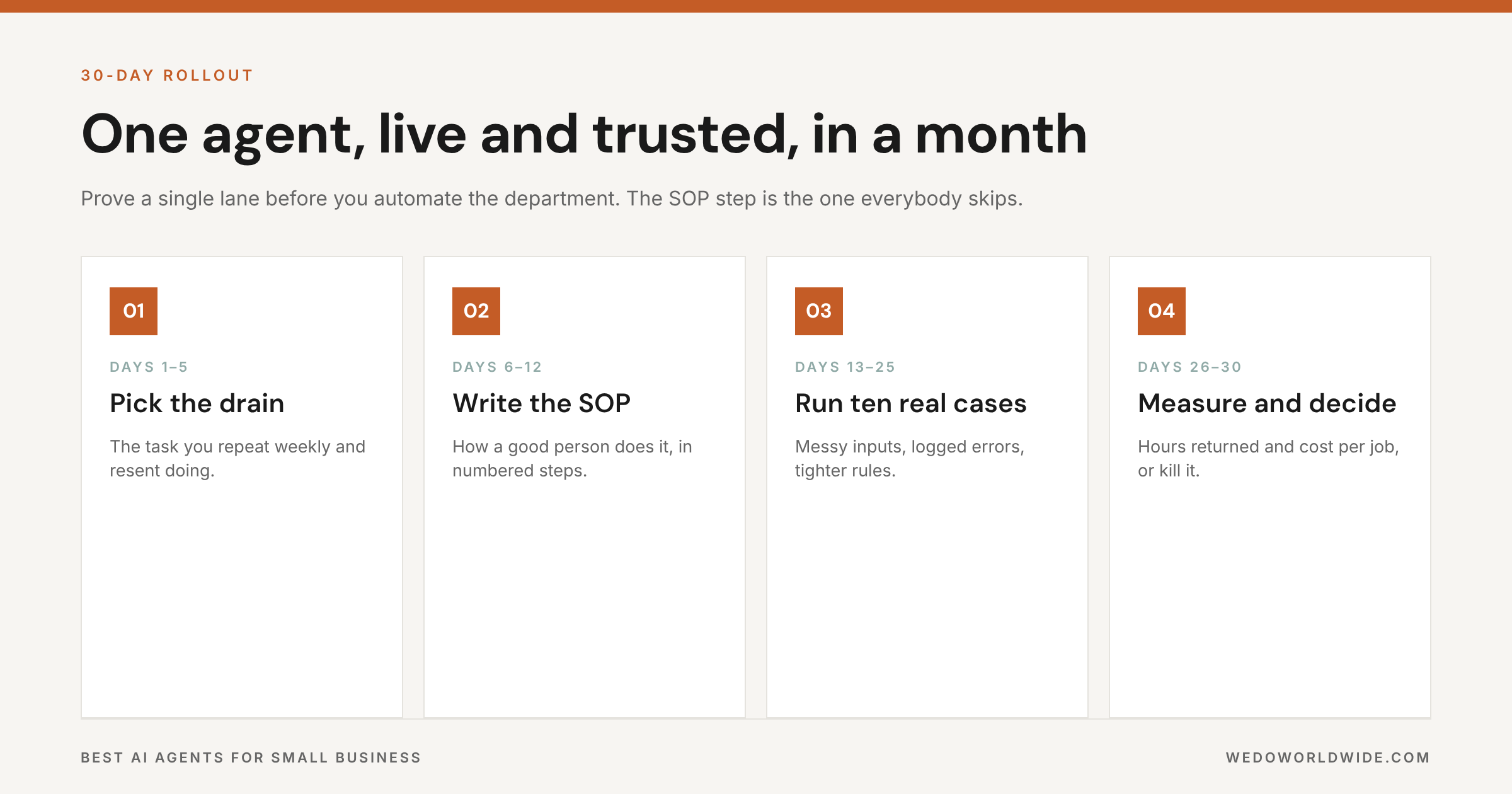
Most people skip the SOP step (standard operating procedure, the written how-to). It's the step that decides whether an agent still runs in month three or quietly stops getting used.
An agent is only as good as the procedure it can follow. The same is true of a new hire. We wrote up the full model in the framework we're building so small businesses can delegate to AI. Agents are employees. Skills are SOPs.
07 / what-mistakes-waste-the-budget
What Mistakes Waste the Budget?
Five mistakes burn most of the money. We've watched each one happen.
1. Buying a platform before naming a job. "We need AI" isn't a requirement. "Our invoices are 40 days late and I chase them manually" is.
2. Starting with the highest-stakes task. Nobody's first agent should write to customers unsupervised. Start where a mistake is cheap and visible.
3. Measuring activity instead of outcomes. Runs completed don't count. Count hours returned, tickets resolved, invoices collected, and leads qualified.
4. Treating it as set-and-forget. The first month is calibration, not handover. Check outputs daily, then weekly, then monthly as trust builds.
5. Betting the business on one vendor. Model quality and pricing will both change again this year. Keep the job, the SOP, and the memory yours. Then the model underneath is a setting, not a wall you built the house against.
08 / the-takeaway
The Takeaway
Don't chase the smartest agent in 2026. Name one job you're tired of doing. Write down how a good person does it. Hand it to the cheapest agent that passes the five tests. Keep your name on the final approval.
Do that once and you'll know more about AI agents than any listicle can teach you. Do it five times and your small business runs like a much bigger one.
We build and run agent stacks for small teams every day. We start with an audit of where your hours go. See how WE•DO approaches AI Operations. Or book a strategy call and we'll map the first three agents worth your money.