Most AI agent pilots don't fail loudly.
Nobody files a post-mortem (a written review of what went wrong). There's no outage. The agent gets built. It gets demoed. Two people say "that's really cool." Then it quietly stops getting used.
Six weeks later someone asks what happened to it. The honest answer: nothing happened to it. That was the problem.
By the end, you'll know:
- The five reasons pilots stall, and the fix for each
- A 30-minute triage for a pilot that's slipping right now
- The four signs a pilot will survive its 30-day review
- How to rebuild a dead pilot without starting over
It's about a 9-minute read. Short on time? Skip to the 30-minute triage and stop there.
We run 40+ agents in production at WE•DO. They cover content, reporting, meeting prep, and internal ops. The running inventory is in 40 AI Agents Every Growth Team Should Have. We've also killed a fair number of them.
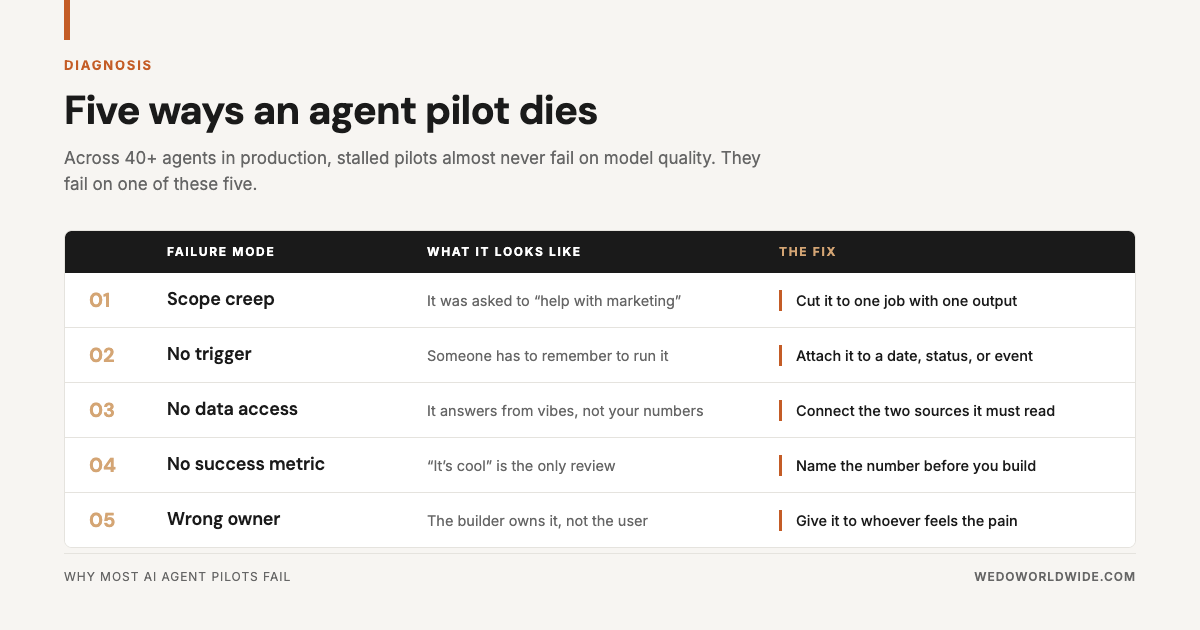
The pattern is consistent enough to be useful. Pilots almost never die because the model wasn't smart enough. They die from how the pilot was scoped, triggered, connected, measured, and owned.
Below are the five failure modes we see most, what each looks like from the inside, and the fix.
01 / is-the-model-the-problem
Is the Model the Problem?
Almost never. When a pilot stalls, the instinct is to blame the model. Wrong model. Bad prompt. Needs better reasoning.
Current models can handle "read this brief, check this draft against it, and flag what's missing." When that job doesn't get done reliably, look at the system around the model:
- what starts it
- what it can see
- what counts as success
- who cares if it stops
That's good news. Those are all design decisions. You can fix them without waiting for a better model.
02 / failure-mode-1-the-scope-was-a-wish-not-a-job
Failure Mode 1: The Scope Was a Wish, Not a Job
What it looks like: the pilot was chartered to "help the content team move faster" or "support our SEO work." Everyone nodded. Nobody could describe the output.
A wish has no edges. So the agent gets a bit of everything: some research, some drafting, some QA. Then a light reporting layer someone asked for in week two. Each addition is reasonable. Together they make an agent that's mediocre at five jobs and trusted for none.
Why it kills the pilot: if the output is undefined, you can't measure quality. Unmeasurable work doesn't get adopted. People go back to doing it themselves. At least then they know what they're getting.
The fix: write the job in one sentence with no "and" in it.
- "QA every draft against its brief before human review."
- "Turn approved keyword opportunities into task-ready briefs."
If your sentence needs an "and," you have two agents. Build the first one.
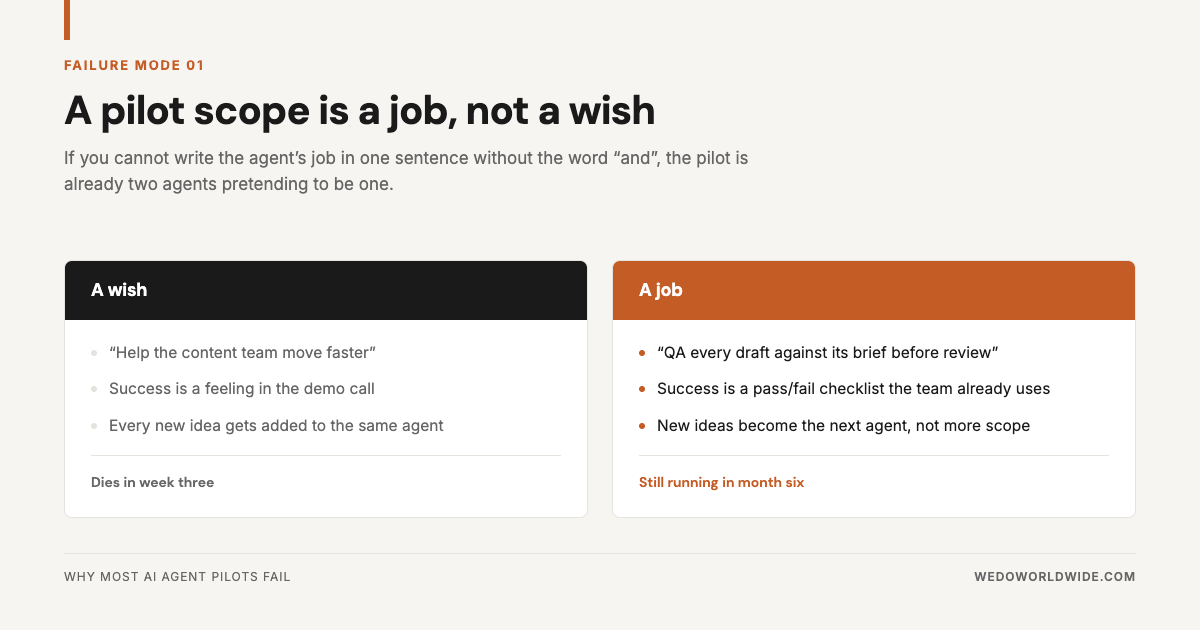
Narrow scope also makes the pilot cheap to judge. One job, one output, one standard. You'll know inside two weeks whether it works.
03 / failure-mode-2-nobody-built-the-trigger
Failure Mode 2: Nobody Built the Trigger
What it looks like: the agent works. But to use it, someone has to open a tool, paste in context, and run it.
Week one, three people use it because it's new. Week two, only the champion still runs it. Week three, it comes out when a deadline hurts. Week four, the pilot is declared "not sticky."
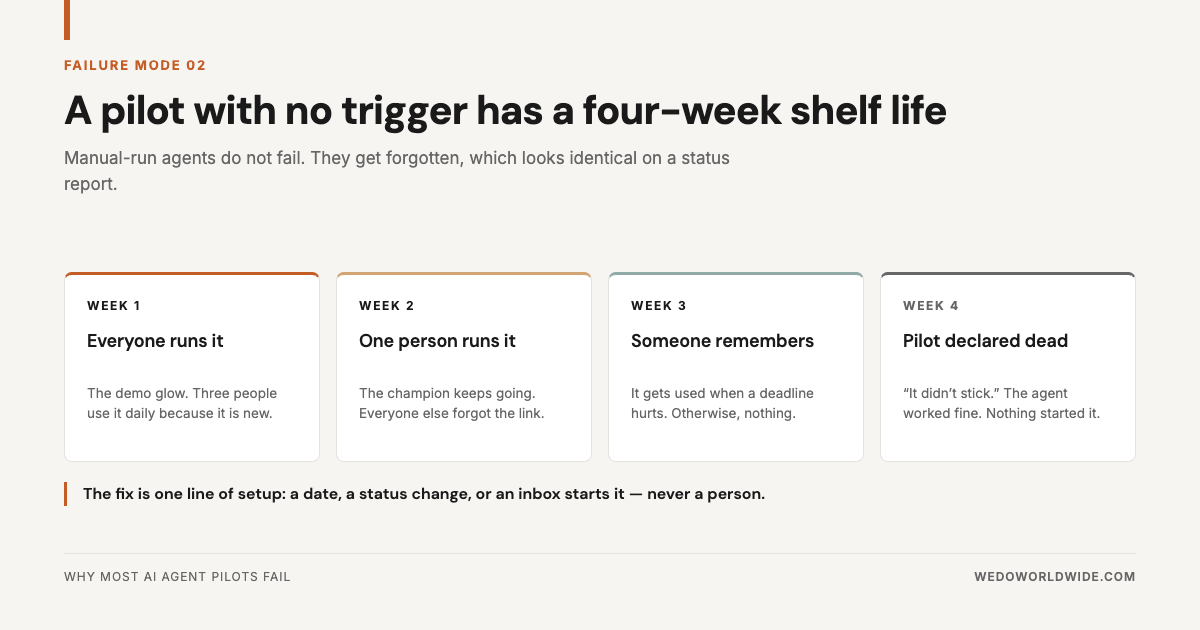
Why it kills the pilot: a manual-run agent competes with muscle memory. Muscle memory wins. On a status report, usage decay looks exactly like a quality problem. That's how good agents get shut down for the wrong reason.
The fix: something other than a person has to start it. That's the trigger (the event that kicks off the agent automatically). Good triggers include a status change, a due date, an assignment, a new form response, a scheduled run, or an inbound email. Setup usually takes under an hour. It's the biggest single change you can make to a stalling pilot.
Here's the test. Can you name what starts your agent without a human in the sentence? If not, you don't have an agent yet. You have a tool with extra steps. That line (assisted versus autonomous) is the one we draw in AI Tools for Business Automation.
What this looked like for us
Our meeting-prep agent spent its first two weeks as a manual tool. It worked well. It got used maybe twice. The output was good. Remembering to ask for it was the bottleneck.
We changed one thing. It now starts 24 hours before any client call on the calendar. It posts the brief straight to the task. Nobody types a prompt.
Usage went from occasional to every call. It stopped being a thing we'd built and became a thing we relied on.
Same model. Same instructions. Different trigger.
04 / failure-mode-3-the-agent-could-not-reach-the-rea
Failure Mode 3: The Agent Could Not Reach the Real Data
What it looks like: the agent produces confident, generic output. Recommendations that could apply to any company. Reports that restate the question. Content that reads like the writer has never seen your account.
Why it kills the pilot: an agent with no live context is guessing, and everyone can tell. One round of plausible-but-wrong output burns the trust you need for adoption. Worse, the team concludes "AI isn't there yet." The real story is "we never gave it the numbers."
The fix: before building, list every source the agent must read to do the job once. Connect those. Only those.
- content QA agent: the brief, the draft, and the internal link map
- reporting agent: GA4 and Search Console
- meeting-prep agent: the task history and the transcript
Two or three well-chosen sources beat ten connected ones. Every extra source is another chance for the agent to pull something irrelevant and reason from it.
We wrote up the full layered version in The AI Marketing Agent Tech Stack. The short version: context quality moves output quality more than model choice does.
05 / failure-mode-4-there-was-no-success-metric
Failure Mode 4: There Was No Success Metric
What it looks like: the review meeting is a vibe check. Someone shares an output. Everyone agrees it's impressive. The pilot runs on enthusiasm until enthusiasm runs out.
Why it kills the pilot: no metric means no defense. When budget or attention gets tight, the pilot has nothing to point at. Nobody can tell "this needs two more iterations" from "this will never work." So pilots get abandoned right before they'd have gotten good.
The fix: name the number before you build. Not a dashboard. One number:
- hours per week the team gets back
- cycle time from brief to publish-ready draft
- number of outputs shipped without rework
- percentage of runs that need human correction
Then take a baseline (today's number, before the agent). Ten minutes of "how long does this take us today?" is enough. That's what makes the 30-day review a decision instead of an opinion. Without a baseline, a 40% improvement and a rounding error look identical.
The same discipline makes automated reporting worth trusting. We covered that in AI Client Reporting at Scale.
06 / failure-mode-5-the-wrong-person-owned-it
Failure Mode 5: The Wrong Person Owned It
What it looks like: the builder is the only person who runs it, defends it, and notices when it breaks. The people whose work it should change stay politely uninvolved.
Why it kills the pilot: builders optimize for capability. Users optimize for relief. A builder-owned agent grows features nobody asked for. Meanwhile, the friction that blocks adoption goes unfixed. When the builder moves to another project, the pilot ends with them.
The fix: hand ownership to whoever feels the pain. They set the standard for good output. They decide when it's ready. They complain when it stops.
That complaint is the health metric that matters most. If nothing breaks noticeably when the agent goes down, it was never load-bearing (holding up real work).
Still deciding what to hand over in the first place? Our delegation framework is the practical version of that conversation.
07 / how-to-diagnose-a-stalling-pilot-in-30-minutes
How to Diagnose a Stalling Pilot in 30 Minutes
Don't rebuild it. Ask these five questions in order. The first one you can't answer cleanly is your real problem.
- Can you say its job in one sentence? If no: scope creep. Cut it to one output.
- What starts it without a human? If nothing: no trigger. Attach it to a real event.
- Which two data sources does it read? If none: no access. Connect them before iterating.
- What number tells you it worked? If unclear: no metric. Nobody can defend the pilot.
- Who complains when it breaks? If only the builder: wrong owner. Hand it to the user.
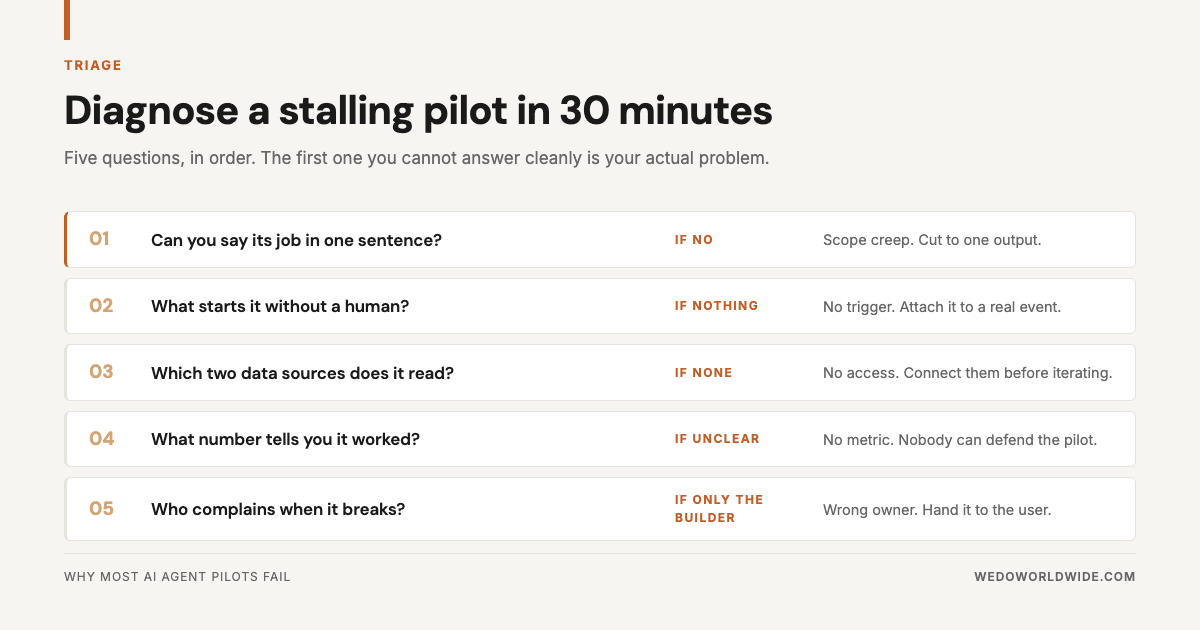
Answer them honestly. The fix is usually one change, not a rewrite. In our experience, question two is the most common miss. Question four is the most expensive to ignore.
08 / what-does-a-surviving-pilot-look-like-at-30-days
What Does a Surviving Pilot Look Like at 30 Days?
It has four properties. None are about output quality, because output quality is downstream of all four.
- It runs on its own. Zero manual starts in the last 14 days. That proves the trigger is real, not aspirational.
- Someone who didn't build it uses it. At least one non-builder relies on the output. Ownership moved to the pain.
- The output lands where work happens. A comment, a doc, or a task. Not a chat window. No copy-paste tax.
- It has a number attached. Hours saved, cycle time, or throughput. That's what survives a budget meeting.
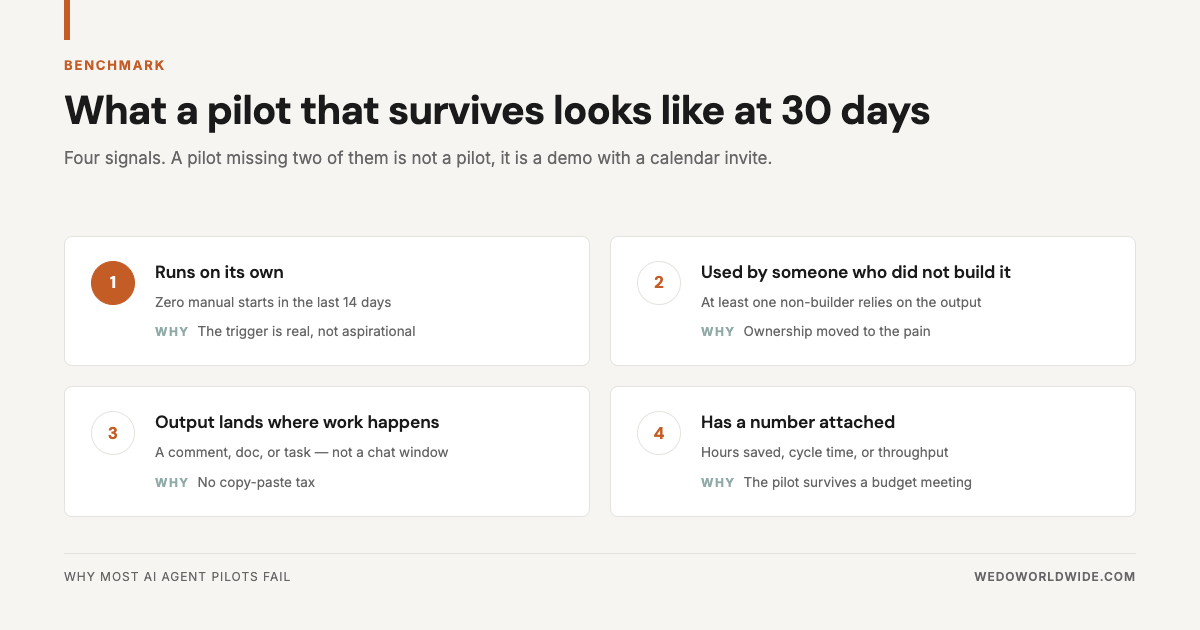
Hitting all four? It's ready to expand. That means building the next agent beside it, not adding jobs to this one.
Missing two? That's not a failure yet. It's a pilot with a known defect and a clear fix.
09 / can-you-rebuild-a-failed-pilot-without-starting
Can You Rebuild a Failed Pilot Without Starting Over?
Usually, yes. Most dead pilots are recoverable, and the salvage job is smaller than people expect.
- Keep the job, cut it in half. Pick the single most valuable slice. Drop the rest.
- Give it a trigger. Attach it to an event that already happens in your workflow. Don't create a new ritual.
- Connect two sources, not ten. The ones it can't do the job without.
- Write down the number. Baseline it this week.
- Move the owner. From the builder to the person whose week it changes.
- Re-run it on last month's real work. Compare the output against what your team shipped. That's the most honest test available.
If it still fails after that, it's a real "no." Most of the time it isn't.
10 / final-takeaway
Final Takeaway
Failed AI agent pilots are rarely a technology verdict. They're a design verdict.
The agents that survive in our stack all look the same from a distance:
- one job
- a trigger nobody has to remember
- two or three trusted data sources
- a number attached
- an owner who notices when it stops
The agents we killed were missing at least two of those. Every time.
If your pilot is stalling, skip "is the model good enough?" Ask "which of these five is broken?"
You can answer that one this week.
Running an AI pilot that's stalling? We're happy to help diagnose it. Schedule a strategy call.