Most small companies are paying for AI and still doing the work by hand. AI enablement is the part everyone skips: hooking the tools to real workflows, with an owner, a review step, and a place the output lands.
You bought the seats. Somebody on your team is using them for email drafts. Nothing else about how your business runs has changed.
That is AI adoption. It is not AI enablement, and the gap between the two is where most small business AI budgets go to die. Enterprise companies close it with a $200,000 engagement and an 18 month roadmap. You do not have either, and you do not need them.
This page is the whole playbook: what AI enablement actually means, how it differs from AI consulting and from buying more tools, the four phase framework we use with every client, what it costs, how long it takes, and what happens in the first 90 days. We run it on ourselves first. More than 40 agents work inside our own operation right now, and the framework below is the one that put them there.
What is AI enablement?
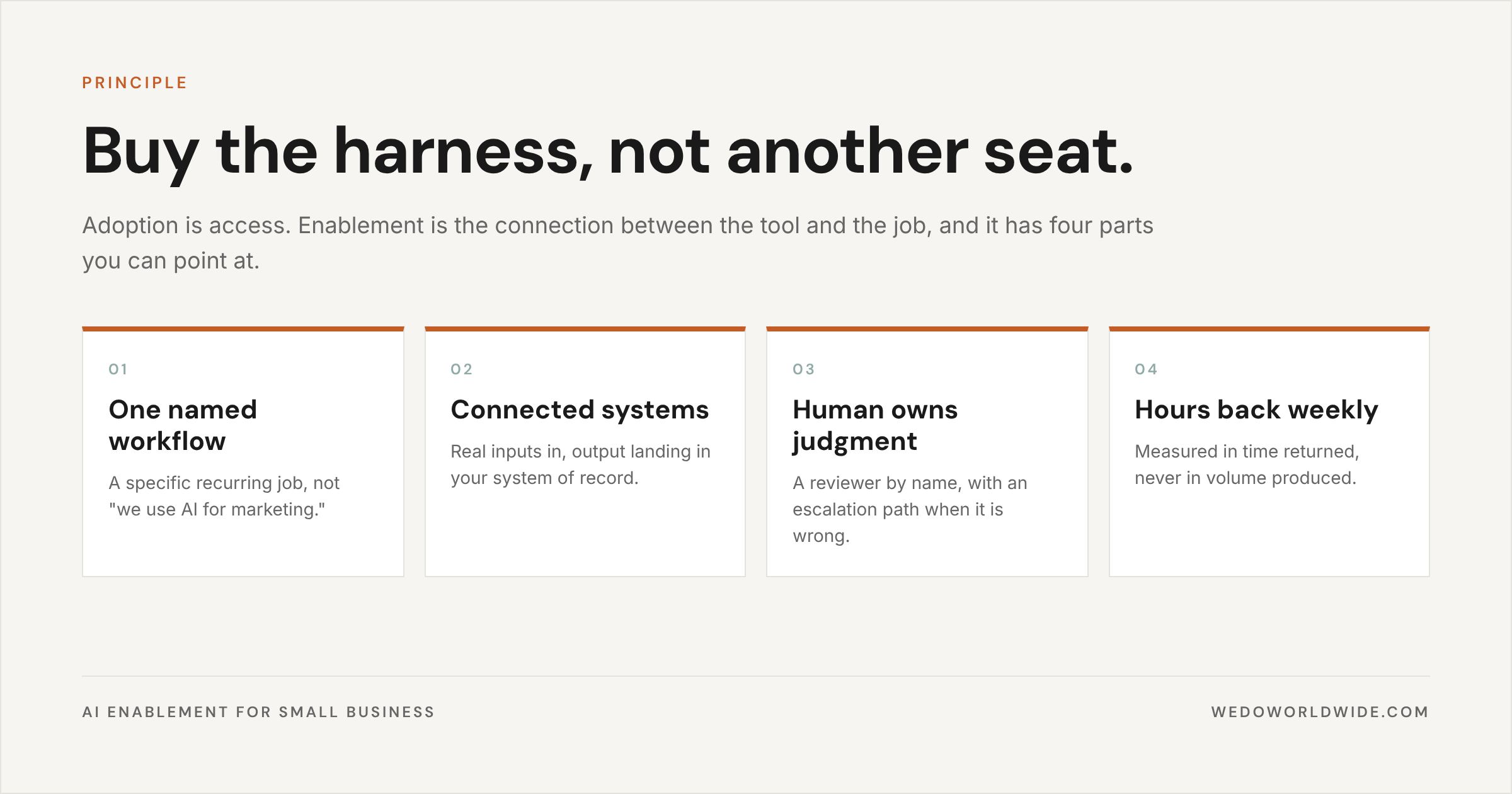
AI enablement is the work of connecting AI to the jobs your business already does every week: auditing where the hours go, building the workflow, training the people who run it, and operating it with clear ownership and measurement. Buying a tool is a purchase. Enablement is what turns that purchase into capacity.
The practical difference shows up in four questions an enabled team can answer and an unenabled team cannot:
- Which recurring job did we hand off? Named, not "we use AI for marketing."
- What does the workflow need before it can run? The transcript, the brief, the analytics, the CRM record.
- Where does the output land? A task, a doc, a draft in the CMS, not a chat window somebody has to copy from.
- Who reviews it, and what happens when it is wrong? A person, by name, with an escalation path.
If your answer to any of those is "it depends who you ask," you do not have a tooling problem. You have a harness problem.
AI enablement vs AI consulting vs buying AI tools
These three get sold interchangeably, and they are not the same purchase. Here is the honest split.
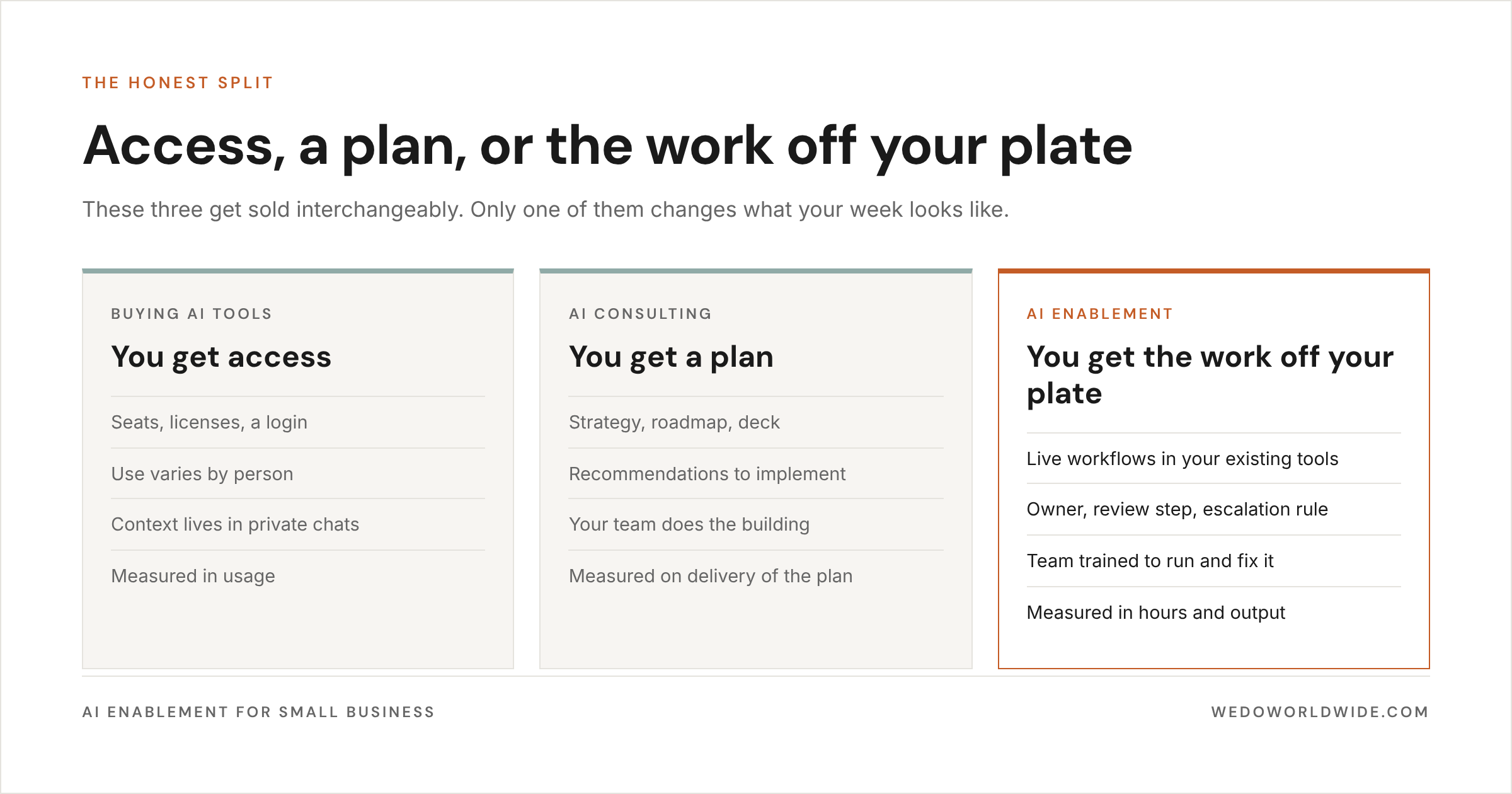
The test: after the engagement ends, does a job that used to consume your week still consume it? Consulting can leave that answer unchanged. Enablement cannot.
There is a fourth term worth separating out. AI implementation is a single deployment with a start date, an end date, and a deliverable. Enablement is the layer underneath it: the data access, the standard operating procedure, the training, and the governance that every future implementation reuses. Implement without enabling and you rebuild the foundation for every new tool.
Who AI enablement is for
This works best for companies with roughly 5 to 50 employees where the same three symptoms show up together:
- The owner is still in the workflow. Reporting, client updates, invoicing, or follow up runs through one person who cannot step away from it.
- The work is recurring and rule bound in the middle. Judgment at the edges, copy and paste in between.
- Adding headcount is the only current plan for growth. Capacity is capped by hours, not by demand.
Small is an advantage here. You do not need a steering committee to approve a pilot, and you do not need six months of vendor evaluation. You need one named workflow and someone willing to measure the before and after.
It is a bad fit in three cases, and we will tell you so in the first conversation: the work is genuinely bespoke every time, your records live on paper or in disconnected spreadsheets with no standard format, or nobody on the team can free up two to four hours to learn the new process. The third one kills more rollouts than the first two combined.
The AI enablement framework: Audit, Build, Train, Operate
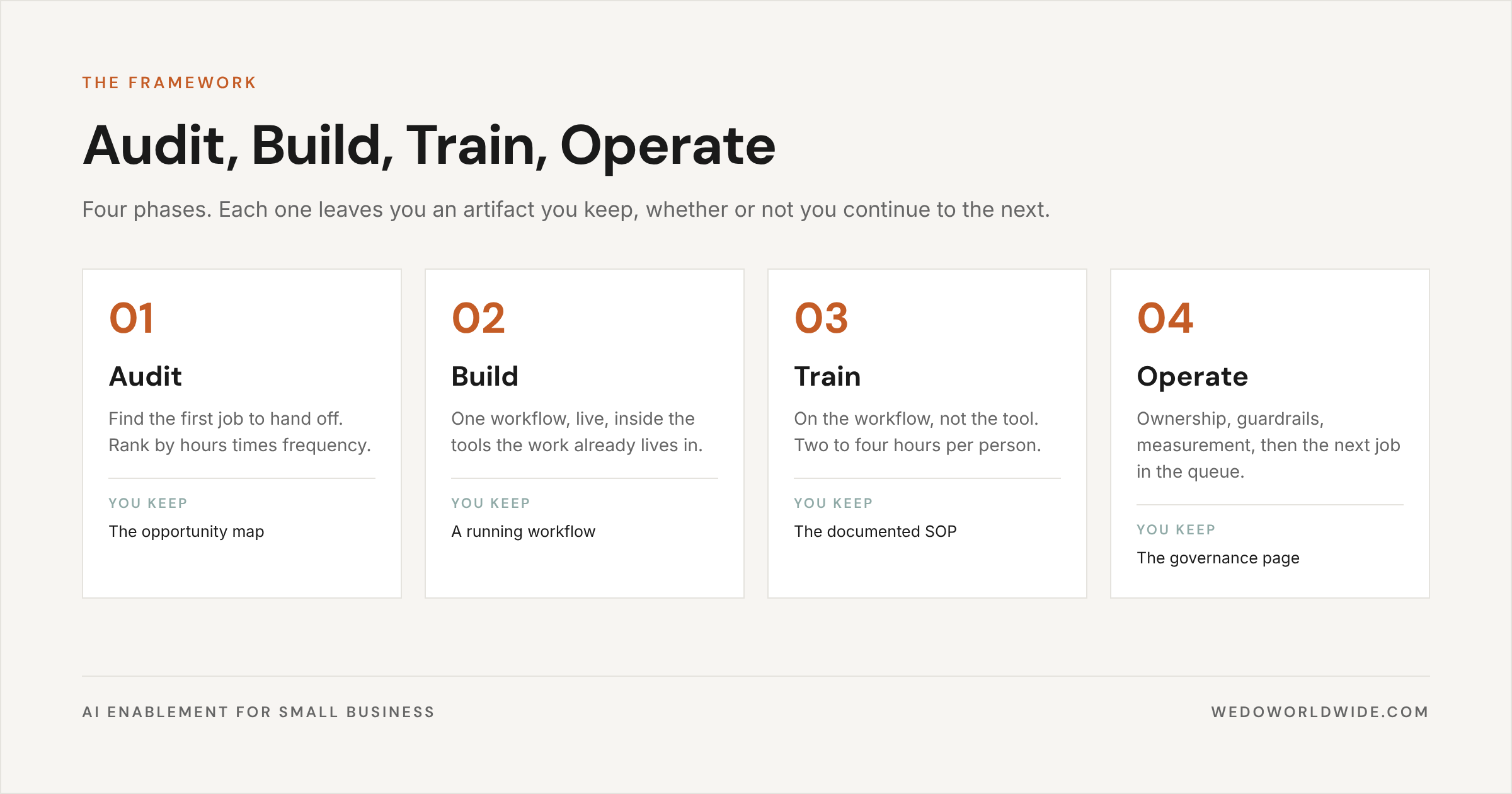
Four phases. Each one produces an artifact you keep whether or not you continue to the next.
1. Audit: find the first job to hand off
Do not start with tools. Start with a list of what your team does every week that nobody enjoys and everybody repeats.
For each candidate, write down the trigger, the inputs, the decision points, the output, and the owner. That single page tells you more than any vendor demo. Good candidates share three traits: they happen at a predictable frequency, the middle of the work follows rules, and the output has an obvious home.
Rank by hours multiplied by frequency, then cut anything where the judgment cannot be separated from the mechanics. What remains is your queue, in order.
2. Build: one workflow, live, in the tools you already have
Scope discipline is the whole game here. "Review every new content draft against its approved brief and flag the gaps" is a workflow. "Run our marketing" is a wish.
Build it inside the systems the work already lives in, so nobody has to move the output by hand. Then run it against your real inputs, including the messy and incomplete ones. Where it invents details or misses context, fix the instructions and the source connections before you touch the model.
3. Train: on the workflow, not the tool
A one hour tool demo does not create adoption. Your team needs to know when to reach for the workflow, what to give it, how to tell a good output from a confident wrong one, and where to report failures.
Budget two to four hours per person up front, then 30 minutes a week of guided practice for the first month. Document it: purpose, owner, input checklist, output example, review rule. That is what turns one person's knack into a team capability.
4. Operate: ownership, guardrails, and the next job
Governance for a 20 person company fits on one page and answers three questions: what can run without review, what requires a human check before it leaves the building, and what AI does not touch at all.
Then measure the things that matter: hours returned per week, missed steps eliminated, time from insight to action, consistency against the brief or SOP. Volume of AI output is not a result. Review monthly for the first quarter, then quarterly.
Where the hours actually hide
Across our own operation and the ones we build for clients, the same handful of jobs come off the plate first. They are boring on purpose. Boring is what makes them reliable.
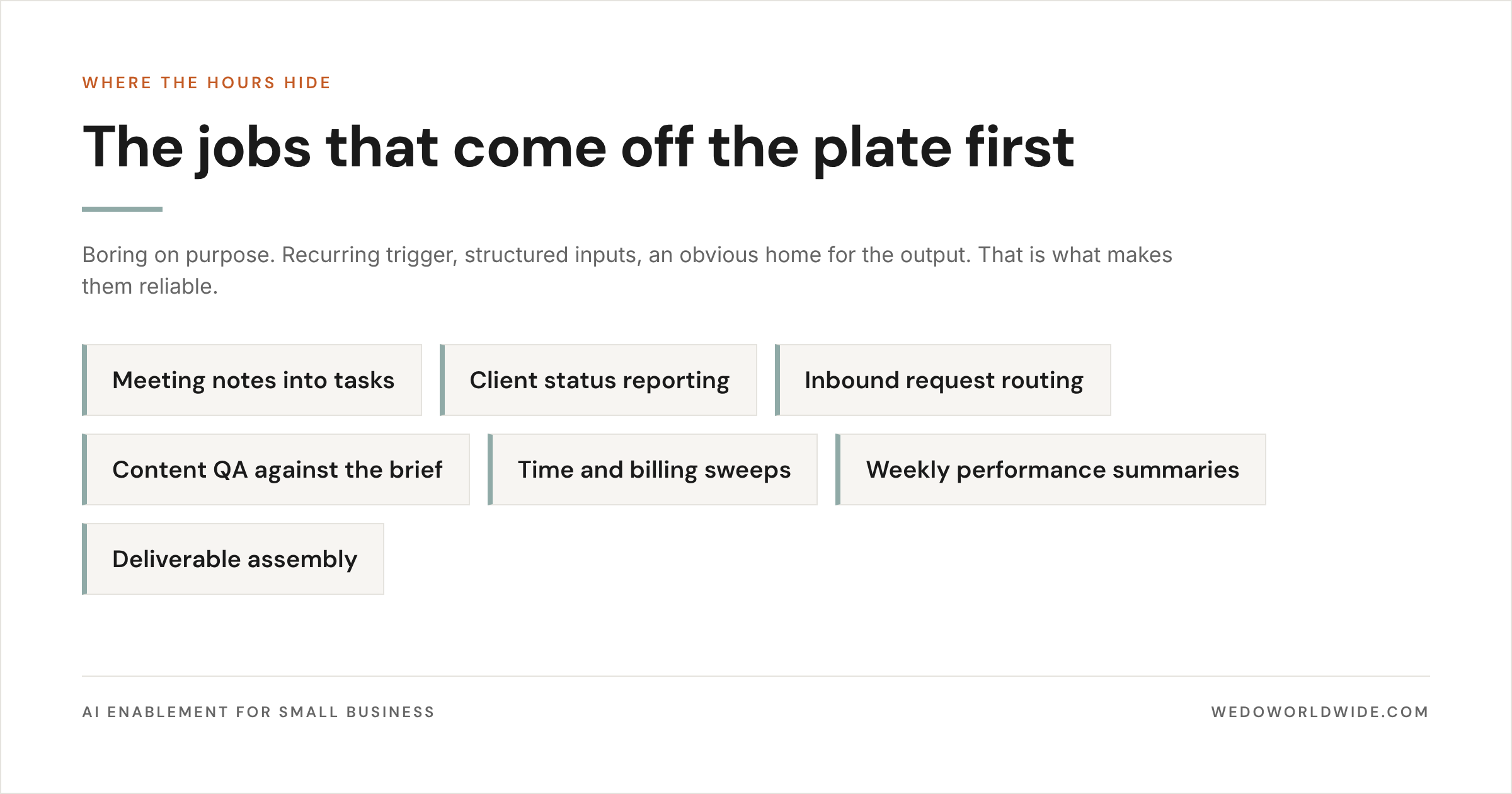
Take the most common one. A client call generates decisions, blockers, and follow ups. Somebody listens back, types them into tasks, and assigns owners. The input is defined (the transcript), the output is defined (tasks in your project tool), and the judgment stays with you: you still decide what matters and what ships. The agent takes the copy and paste. Same job, same people, better system.
AI enablement examples by business type
The pattern does not change much across industries. The named job does. Four versions of the same first hand off:
Notice what is consistent. In every case the machine takes the assembly and the routing, and the person keeps the judgment, the money decisions, and the brand. That split is the whole design principle. Get it wrong in either direction and the workflow either creates cleanup or never gets used.
We run this on ourselves first
We did not build this offer on a whiteboard. We built it because we got tired of our own grind.
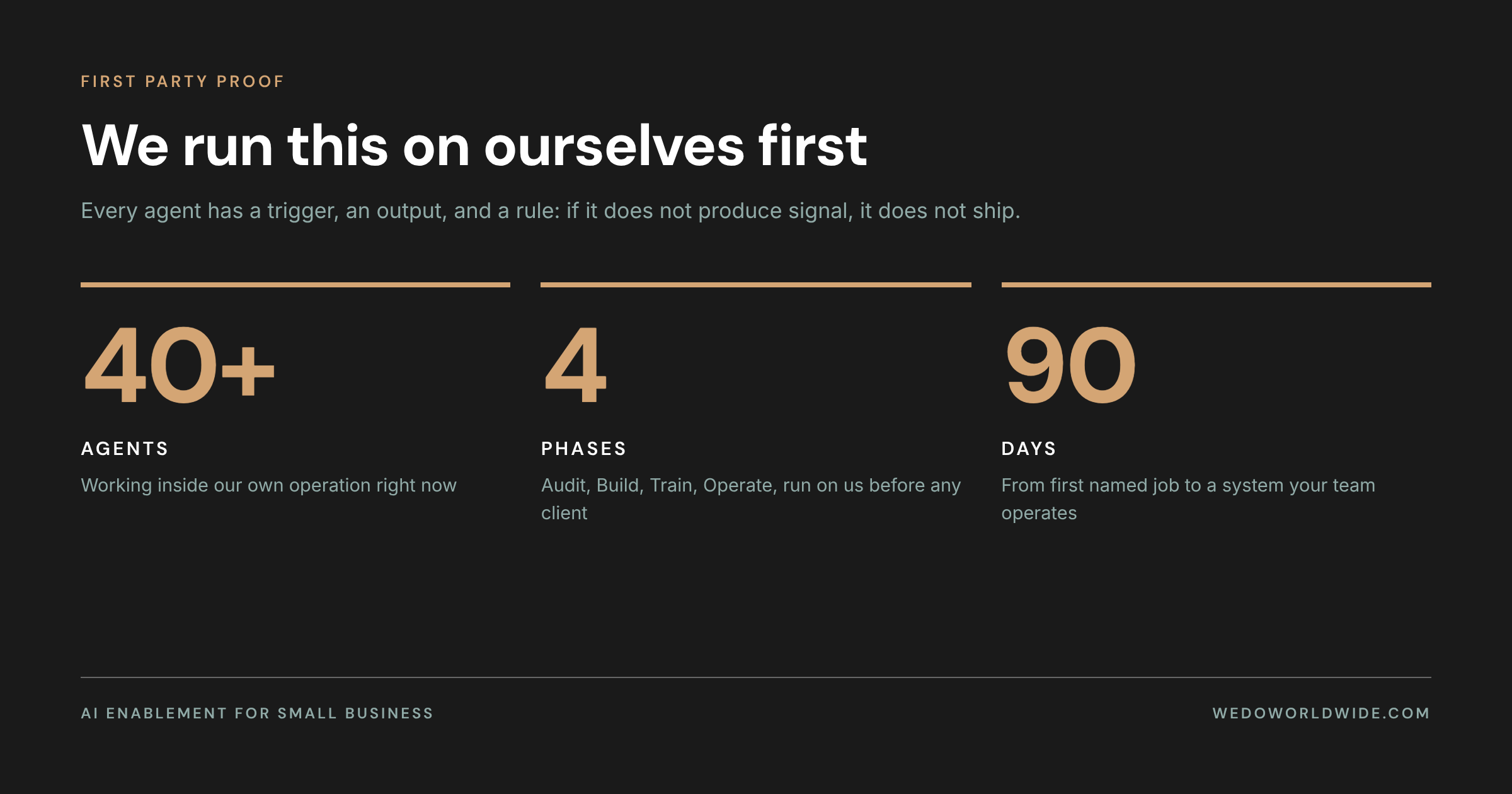
Every agent in that count has a trigger, an output, and a rule: if it does not produce signal, it does not ship. None of them brainstorm. That constraint is the reason they are still running.
What AI enablement costs and how long it takes
Enterprise AI enablement consulting runs into six figures across 12 to 18 months. That model does not fit a 20 person company, so we built a ladder instead. Every rung is a standalone purchase, and every rung leaves you with something you keep.
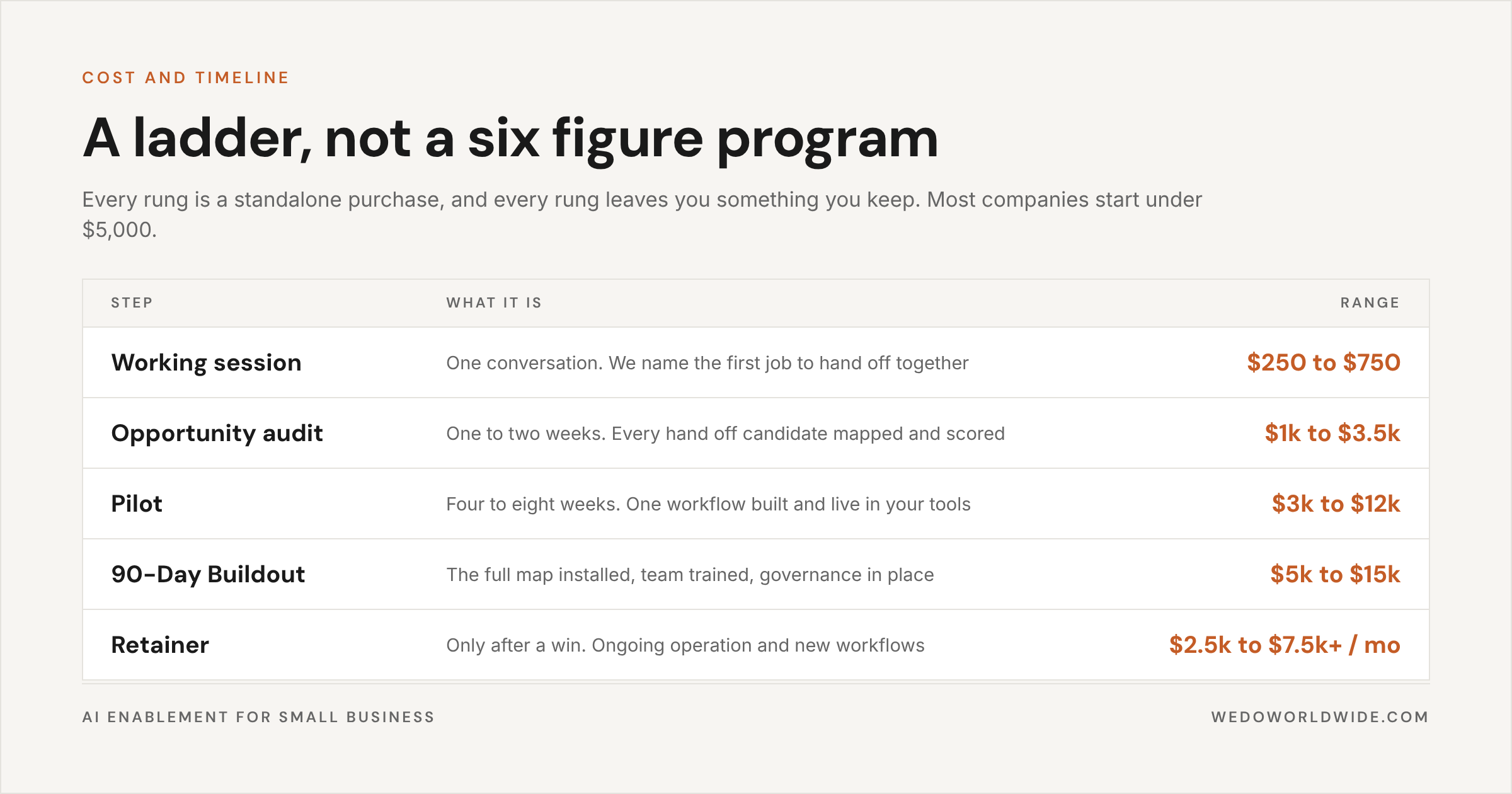
Most companies start under $5,000 and see measurable results inside 90 days. You do not have to buy the top of the ladder to find out whether this works.
What the 90-Day AI Operations Buildout includes
Five ways AI enablement fails
- Starting with a tool. The tool is not the strategy. Start with the job that eats your week.
- Scoping the whole department. Broad scope makes quality and ownership impossible to see. One workflow, proven, then the next.
- Letting the output land outside your systems. If a human still has to move the result by hand, you automated the easy half.
- Treating a demo as training. Adoption needs practice, examples, documentation, and a way to report failures.
- Measuring volume instead of value. More generated content is not better marketing. Hours returned and errors eliminated are the numbers.
Find your first job to hand off
Start with the 90-Day AI Operations Buildout, or start smaller with a working session and leave with one named workflow. Either way, the intake takes 15 minutes and we use it to pick a workflow, not to sell you a stack.
Start the AI enablement intake or see the AI enablement service.
FAQ
What does AI enablement mean?
AI enablement is the process of connecting AI to the recurring work a business already does: auditing where time goes, building workflows inside existing tools, training the team to run them, and operating them with clear ownership, guardrails, and measurement. Buying a tool gives you access. Enablement gives you capacity.
How is AI enablement different from AI adoption?
Adoption is buying seats and using them occasionally. Enablement is hooking the work up: a defined trigger, defined inputs, an output that lands in your system of record, and a human who owns the review. Adoption is a moment. Enablement is an operating change.
How much does AI enablement cost for a small business?
Enterprise engagements run $200,000 or more over 12 to 18 months. For a small business, a working session runs $250 to $750, an opportunity audit $1,000 to $3,500, a single workflow pilot $3,000 to $12,000, and a full 90 day buildout $5,000 to $15,000. Most companies start under $5,000.
How long before we see results?
A single workflow pilot goes live in four to eight weeks and the hours show up immediately after. A full buildout across the priority workflows takes 90 days. If a vendor quotes you 18 months, they are selling you an enterprise program.
What is the best first AI use case for a small business?
Pick a job with a recurring trigger, structured inputs, and an obvious home for the output. Meeting notes into tasks, client status reporting, inbound request routing, and content QA against a brief are stronger starting points than anything strategic.
Do we need clean data before we start?
You need organized data, not perfect data. If you can export your customer list as a usable file and your team works in shared systems rather than personal drives, you are ready. If your records are on paper or scattered across untracked spreadsheets, spend two to four weeks organizing first. That is not a delay, it is the highest return work available to you.
Go deeper
- AI Enablement vs AI Consulting: which one should you hire?
- How to Choose an AI Enablement Company
- How Much Does AI Enablement Cost for a Small Business?
- The AI Readiness Checklist: score your business first
- AI Automation for Small Business: where to start
- The 90-Day AI Operations Playbook
- AI Agents for Small Business
- AI Operations: the 90-day buildout