Seven questions to ask on the first call. Three of them a reseller can't answer. Plus the four situations where the honest advice is to hire no one yet.
Part of our guide to AI enablement for small business.
You're about to buy help you can't evaluate yet.
The bill runs anywhere from $3,500 to $180,000. The category is two years old. The credentials can't be verified. And every firm on page one of Google uses the same four words: readiness, governance, adoption, scale.
Harvard Business Review puts roughly 80% of AI projects in the "never fully deployed" pile. Most didn't fail on the technology. They failed because nobody changed how the work gets done. The vendor was never on the hook for that part.
So use this guide against us as much as for us. It's a 9-minute read. Short on time? Read the seven questions and stop there.
By the end, you'll know:
- The seven questions that separate a firm that runs AI systems from one that resells licenses
- How to score the answers on a live call
- What the work costs when someone publishes a real number
- The four conditions where you shouldn't hire anybody, including WE•DO
01 / what-is-an-ai-enablement-company-supposed-to-do
What Is an AI Enablement Company Supposed to Do?
It connects AI to a job your business already does. AI enablement comes with an owner, a review step, and a place the output lands. It's not tool selection. It's not a training session. It's the wiring between a tool you likely already pay for and a workflow that runs on somebody's Tuesday.
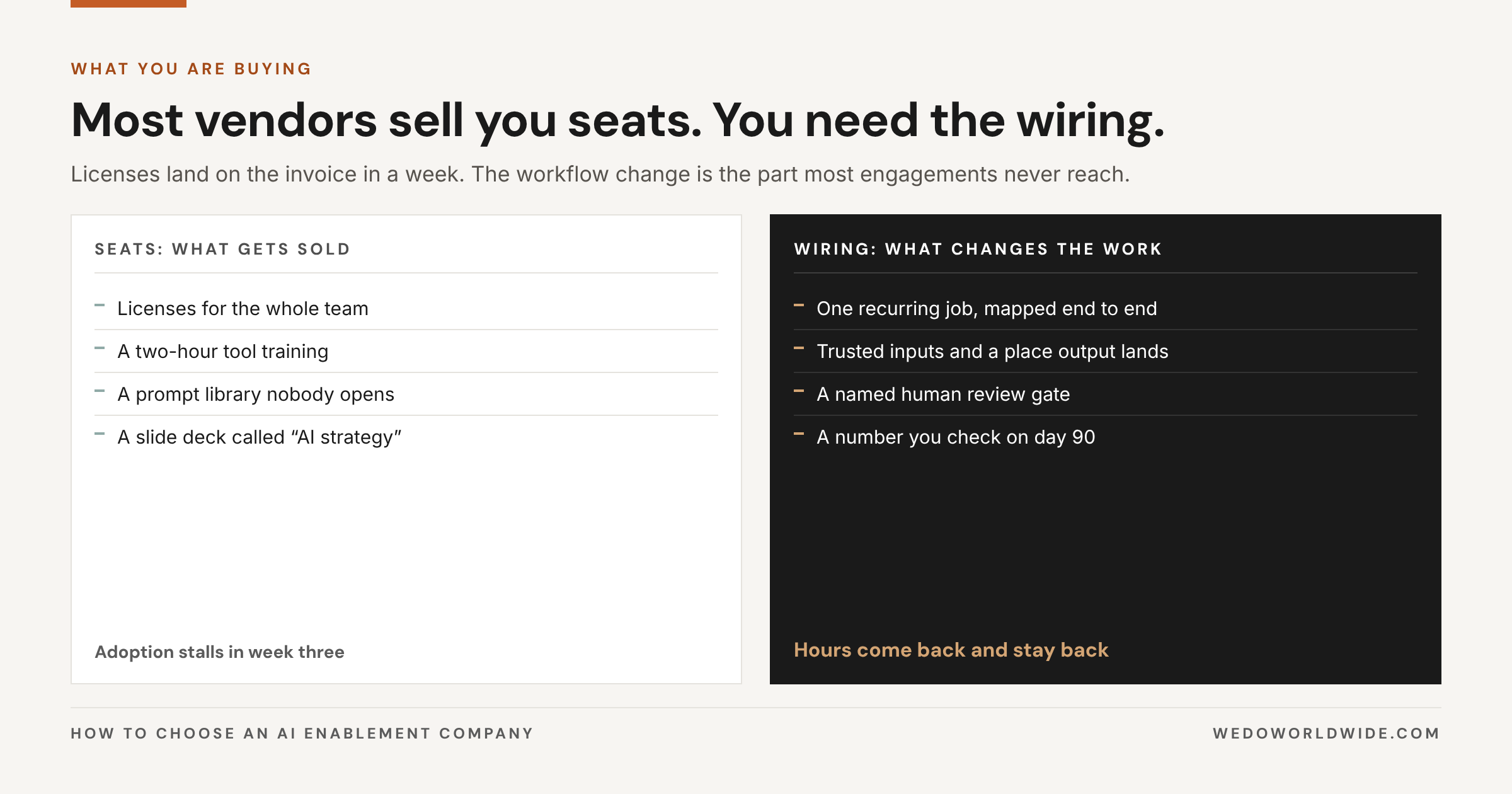
The license is the cheap part. You can buy seats for a twenty-person team this afternoon.
What you can't buy this afternoon are the decisions:
- Which recurring job goes first
- What the model is allowed to touch
- Who reads the output before a client does
- What happens when the workflow breaks in month four
A good enablement partner shows up to that conversation with opinions. A weak one shows up with a platform.
02 / enablement-consulting-agency-or-reseller-whos-on
Enablement, Consulting, Agency, or Reseller: Who's on the Call?
Four business models use nearly identical language, so find out which one you're talking to first. Do it before you compare prices. Otherwise you're comparing a strategy document to a working system.
| Model | What you get | What it leaves you holding |
|---|---|---|
| AI consulting | Assessment, roadmap, prioritized use cases | The build. Consultants hand you a plan, not a running workflow. |
| AI enablement | One or more workflows built, owned internally, with governance and training | Ongoing expansion, which is a fair thing to leave. |
| AI automation agency | Automations they host and operate for you | Dependency. Ask what happens to the workflow if you cancel. |
| License reseller | Seats, onboarding, a prompt library | Everything. This is the model behind much of that 80% failure rate. |
None of these is illegitimate. A reseller is a fine buy if what you need is seats. The failure comes when you buy seats and expect the operating change.
Buying campaign execution rather than operations? That's a different comparison. We wrote it up in what an AI marketing agency does.
03 / what-should-you-ask-on-the-first-call
What Should You Ask on the First Call?
Ask these seven questions. Numbers two, five, and seven can't be answered from a deck. The stall you hear is the answer.
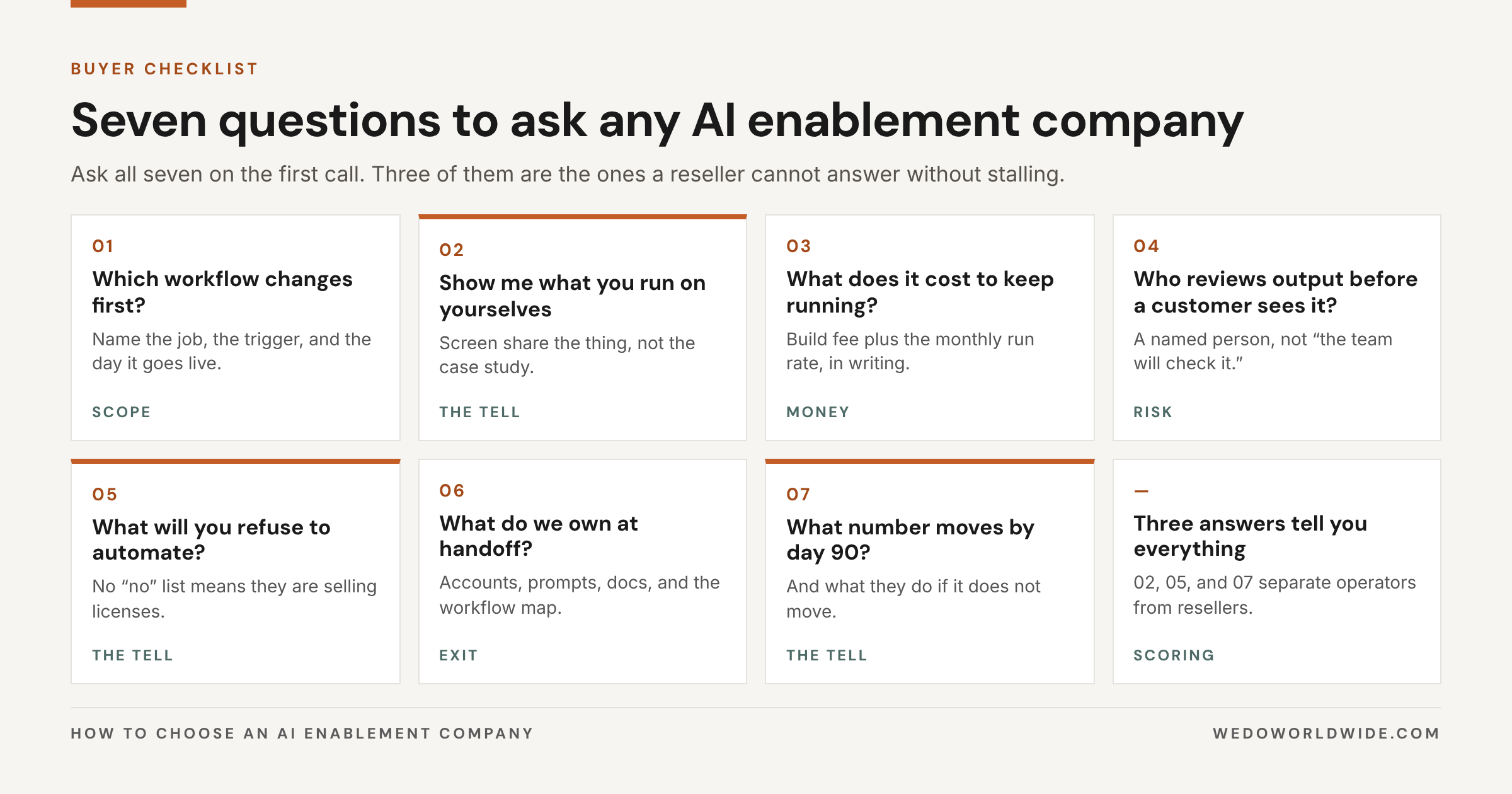
01. Which workflow changes first, and on what date?
A serious answer names the job, the trigger, and a rough go-live date. For example: "Your weekly client reporting, triggered every Monday off the GA4 pull, drafted by day 21." (GA4 is Google Analytics 4.)
A weak answer names a phase. If the first deliverable is a discovery readout with no build attached, you're buying a document. Our own version of that sequencing is in the AI enablement framework.
What good sounds like: they ask which job eats your team's week before they say a single tool name.
02. Show me what you run on yourselves
This is the one that ends calls. Ask them to screen share an AI workflow their own company depends on. Right now, in the meeting. Not a client case study. Not a demo environment. The thing they'd notice was broken by Thursday.
A firm that has built for itself will show you something unglamorous. Real internal systems are unglamorous. A firm that hasn't will offer a case study instead.
That's not automatically disqualifying. But it tells you exactly who will be learning on your budget.
Why it works: nobody can fake an internal system live. It exists or it doesn't.
03. What does the build cost, and what does it cost to keep running?
You need two numbers, and most quotes carry only one. The build fee is easy.
The run rate is harder. It's model and API usage (the per-call fees AI providers charge), per-seat licenses, and the hours someone spends when the workflow breaks.
A $12,000 build at $900 a month is a different decision than a $12,000 build at $90 a month. Don't find out which one you bought in month four.
04. Who reviews the output before a customer sees it?
The answer has to be a role, not a hope. "The team will check it" isn't ownership. It's the gap that gets workflows quietly turned off after an embarrassing send.
Ask them to write the review gates into the scope of work:
- What ships without review
- What needs a human pass
- What AI isn't allowed to touch at all
05. What will you refuse to automate for us?
Every operator who has shipped this work has a list. Ours has three items. Anything where a wrong answer costs a client relationship. Anything requiring judgment about a person. Pricing decisions.
A vendor with no list has either never hit the wall or is optimizing for scope. Both get expensive.
What good sounds like: they volunteer the list before you ask, and they can tell you the incident that put an item on it.
06. What do we own when you leave?
Get this in writing before kickoff:
- The accounts and API keys, in your name
- The prompts and system instructions, in your documentation
- The workflow map
- A named internal owner who has run it at least twice without help
If the workflow only runs while the invoice does, you didn't buy enablement. You hired an operator.
07. What number moves by day 90, and what happens if it does not?
Ask them to commit to one metric before you sign. Hours returned per week, error rate, response time, or output per person.
Then ask the harder half. What do they do if the number stays flat?
A firm that has run enough of these has an answer. Usually it's some version of "we rebuild the lane at no cost, or we tell you to stop." A firm that hasn't will tell you AI takes time.
Any vendor can answer one, three, four, and six from a template. Two, five, and seven require having done the work.
04 / how-do-you-score-what-you-hear
How Do You Score What You Hear?
Score one thing: does anything specific happen after the contract is signed? You're not grading enthusiasm or polish.
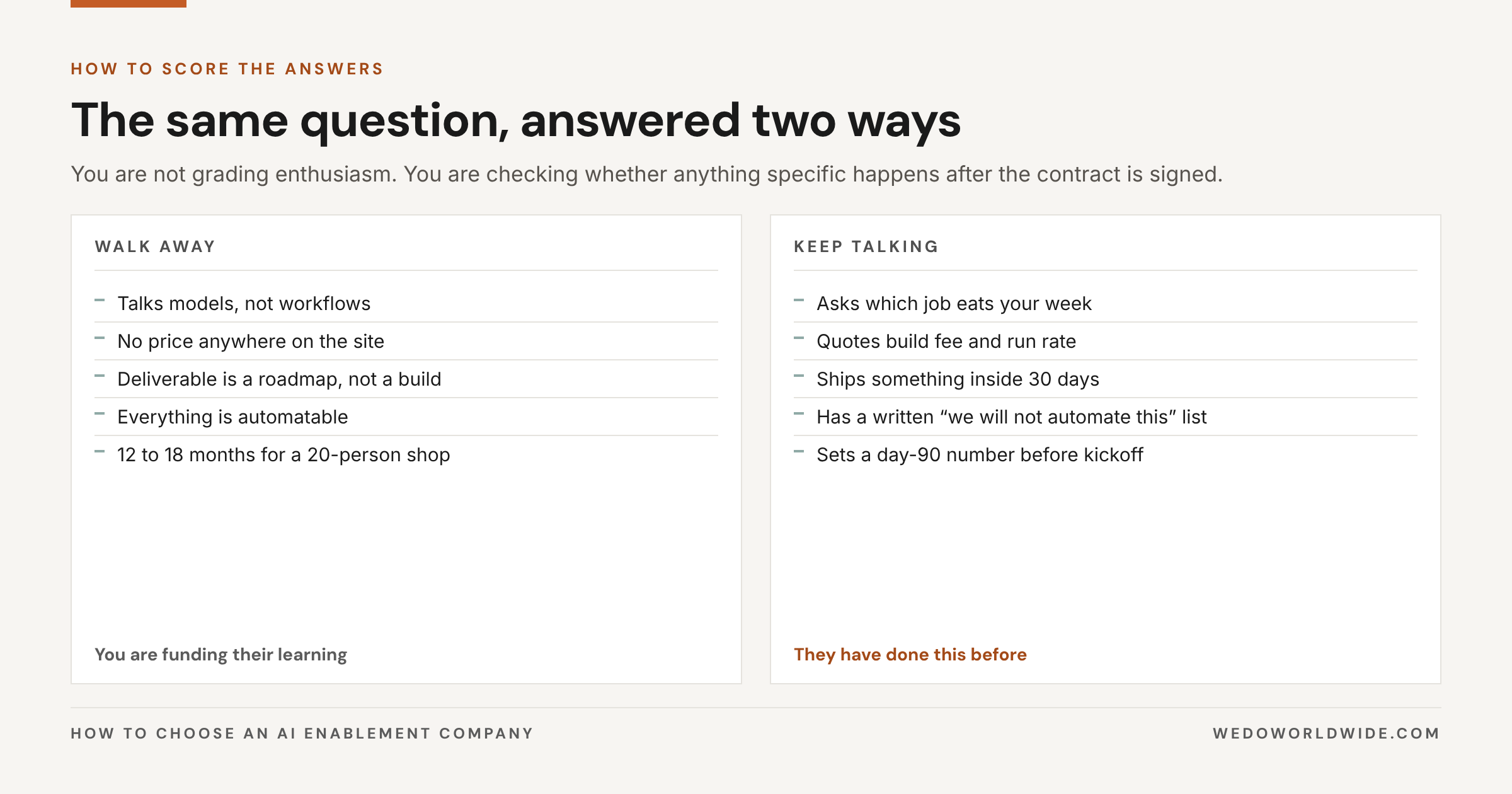
One more filter costs you nothing. Before the call, search the firm's site for a price. Not a range in a PDF you trade your email for. A real number on a page.
Almost nobody in this category publishes one. The ones who do have usually scoped the work enough times to know what it takes.
05 / what-does-ai-enablement-cost
What Does AI Enablement Cost?
For a company of 5 to 100 people, expect $3,000 to $15,000 to get one workflow live. Ongoing programs run $5,000 to $20,000 a month.
Enterprise engagements are a different animal: $200,000 to $500,000 over 12 to 18 months. That's not your engagement. Any firm quoting you that shape of program is selling a governance framework you'll never staff.
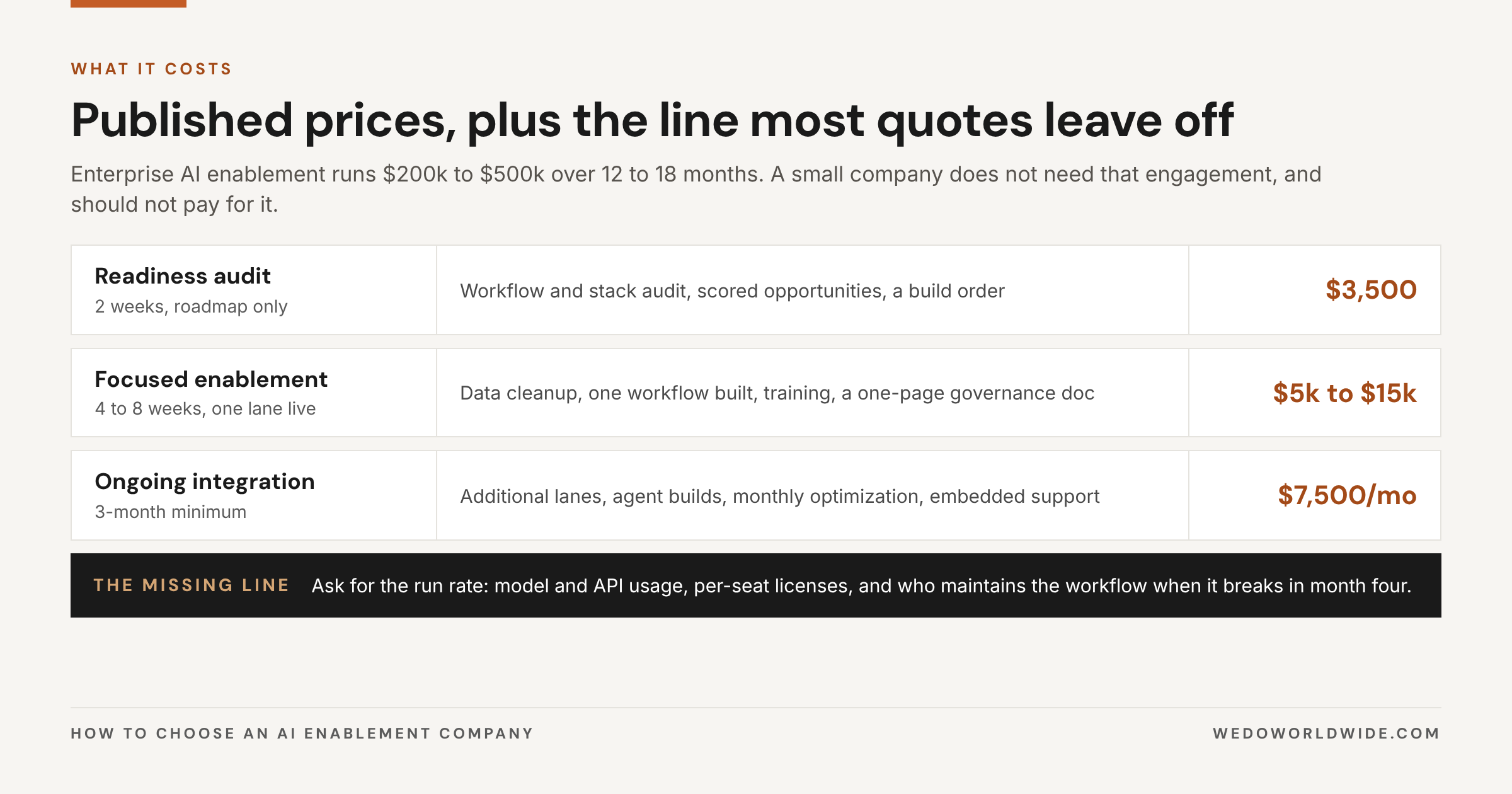
Here's the honest read on those tiers:
- The audit is worth it only if you don't know which job to start with. Most owners do know.
- The focused engagement is where the return lives. One live workflow with an internal owner makes the second one cheap.
- The monthly tier makes sense once you've proven a lane and want three more.
Our own scope and pricing for each sits on the AI Operations services page.
Whatever you pay, hold the vendor to two comparisons. What would it cost to hire a person to do this job? What would it cost to keep doing it by hand for another year? If the enablement work can't beat both, don't buy it.
06 / when-should-you-not-hire-anyone
When Should You Not Hire Anyone?
Hold off if any of these four is true: no repeatable process, data on paper, no time for training, or headcount reduction as the goal. Most firms leave this section out. That's why it's the most useful one.
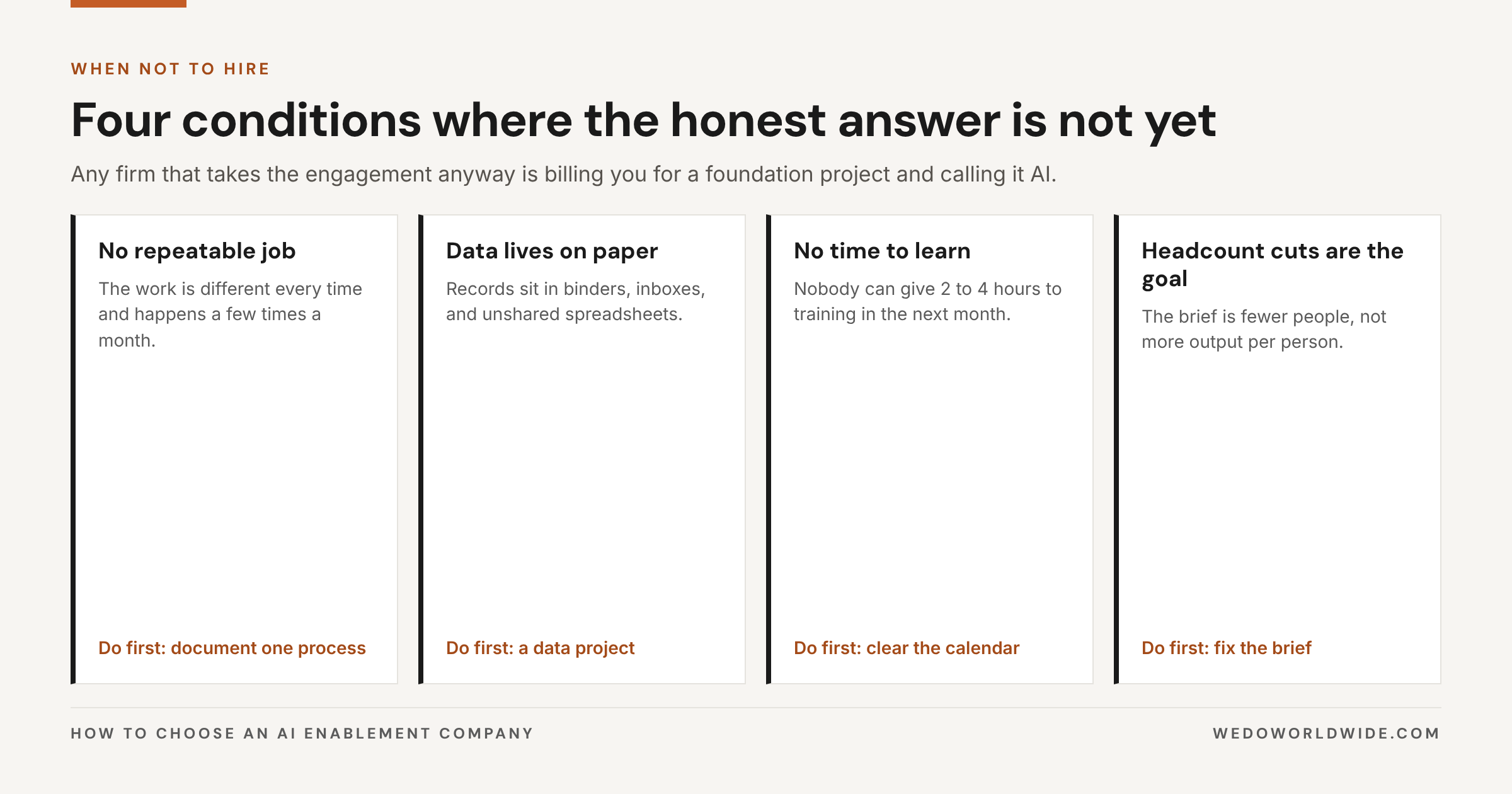
The pattern across all four: AI enablement amplifies a process that already exists. It doesn't create one.
So spend four weeks documenting a workflow and cleaning up where its data lives. That's the highest-return part of the project. You can do it without a vendor.
The headcount case deserves a closer look. If the brief is fewer people, say so internally before you hire anyone. The work looks completely different when the goal is fewer people rather than more output per person. A partner who finds out later will build you the wrong thing.
07 / how-should-you-evaluate-wedo
How Should You Evaluate WE•DO?
The same way: WE•DO does this work, so here are our answers to our own questions, in public.
- What we run on ourselves: more than 40 AI agents handle our own research, briefs, reporting, and QA. We screen share it first. It's the only credential in this category that can't be faked. The full roster is in 40 AI agents every growth team should have.
- Our prices: published. A $3,500 readiness audit. Focused engagements at $5,000 to $15,000. Ongoing integration at $7,500 a month, with a three-month minimum.
- What we refuse to automate: final client-facing approvals, judgments about a person, and pricing.
- What you own: the accounts, the prompts, the documentation, and an internal owner who has run the workflow without us.
- Where we're a bad fit: pre-revenue companies, businesses with no repeatable process, and anyone who wants a governance framework rather than a working system.
If a competing firm answers those five better than we do, hire them. That's the point of publishing it.
08 / what-should-you-do-on-your-next-vendor-call
What Should You Do on Your Next Vendor Call?
Open with question two. Ask them to show you an AI workflow their own company depends on, live, before anything else. Then ask five and seven.
Within fifteen minutes you'll know if the rest of the call is worth having. You'll also skip the proposal review.
If the answers show you're not ready, that's a good outcome. Document one process. Get your data somewhere a tool can reach it. Come back in a month with a much cheaper problem.
Want to run these seven questions on us? Book a working session. We'll screen share what we run internally and tell you which of your jobs we'd take first. If the answer is that you shouldn't hire anyone yet, we'll say so plainly.