Both firms will send you a proposal that says AI strategy. Only one is still around when the thing breaks in week six.
Part of our guide to AI enablement for small business.
That decides what you own at the end: a document, or a system that runs.
Harvard Business Review puts the share of AI projects that never reach full deployment at roughly 80%. Few of those died from a bad strategy. They died because nobody built the thing. Or nobody could run it after it was built.
By the end, you'll know:
- What each one delivers, and what exists on day 30
- What each one costs at small-business scale
- The five questions that tell you which one to hire
- The four cases where a consultant is the better buy
It's an 8-minute read. If you only need the answer, stop after the next section.
WE•DO sells one of these two things. We'll say which one, out loud, further down.
01 / whats-the-short-answer
What's the short answer?
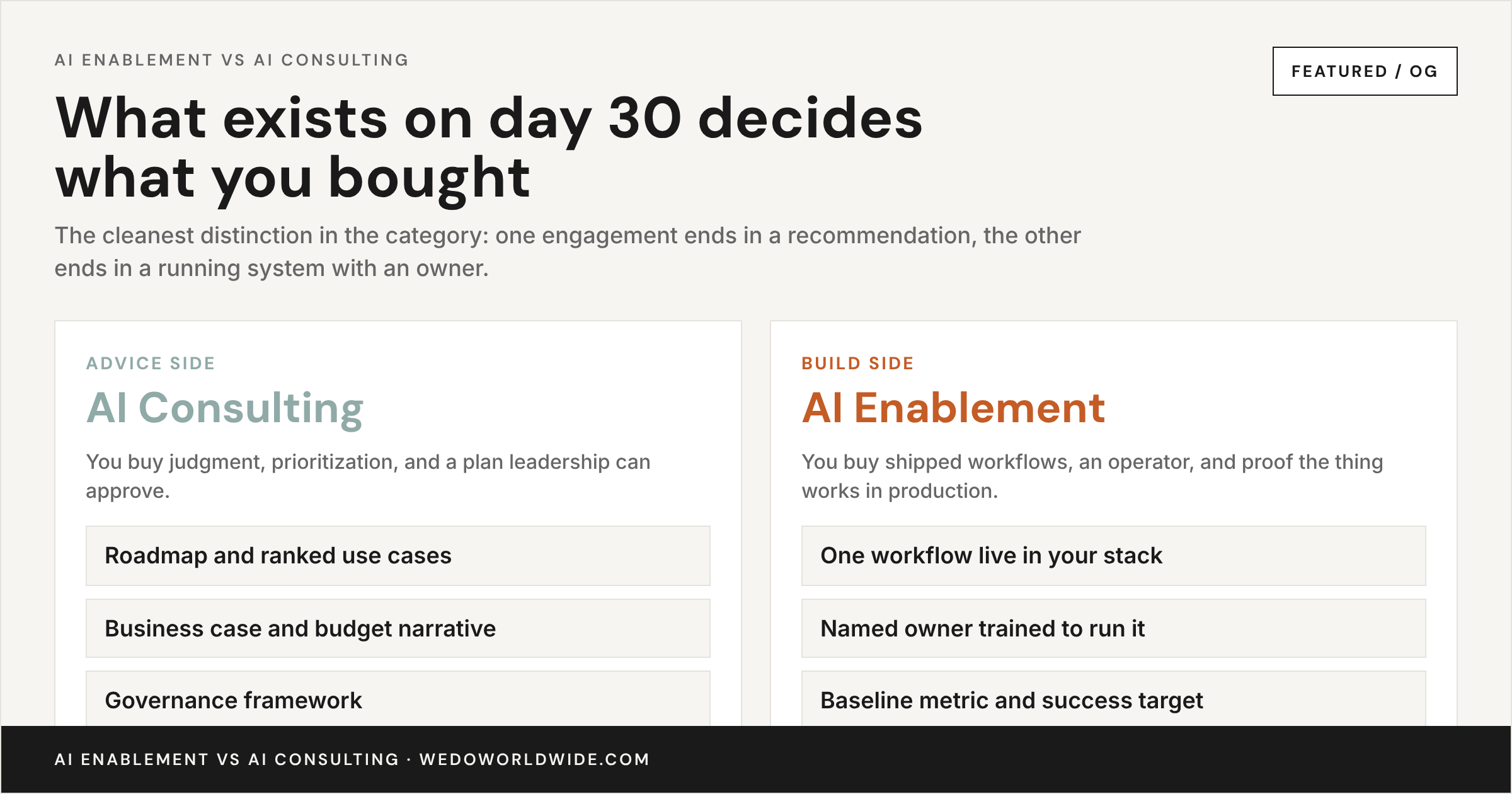
AI consulting is advisory work. You get a recommendation: a roadmap, ranked use cases, a readiness assessment, a business case.
AI enablement is delivery work. You get a running system. That means workflows inside your stack (the software you already use) and automations doing real jobs. It also means people trained to run them, plus a governance policy short enough that someone reads it.
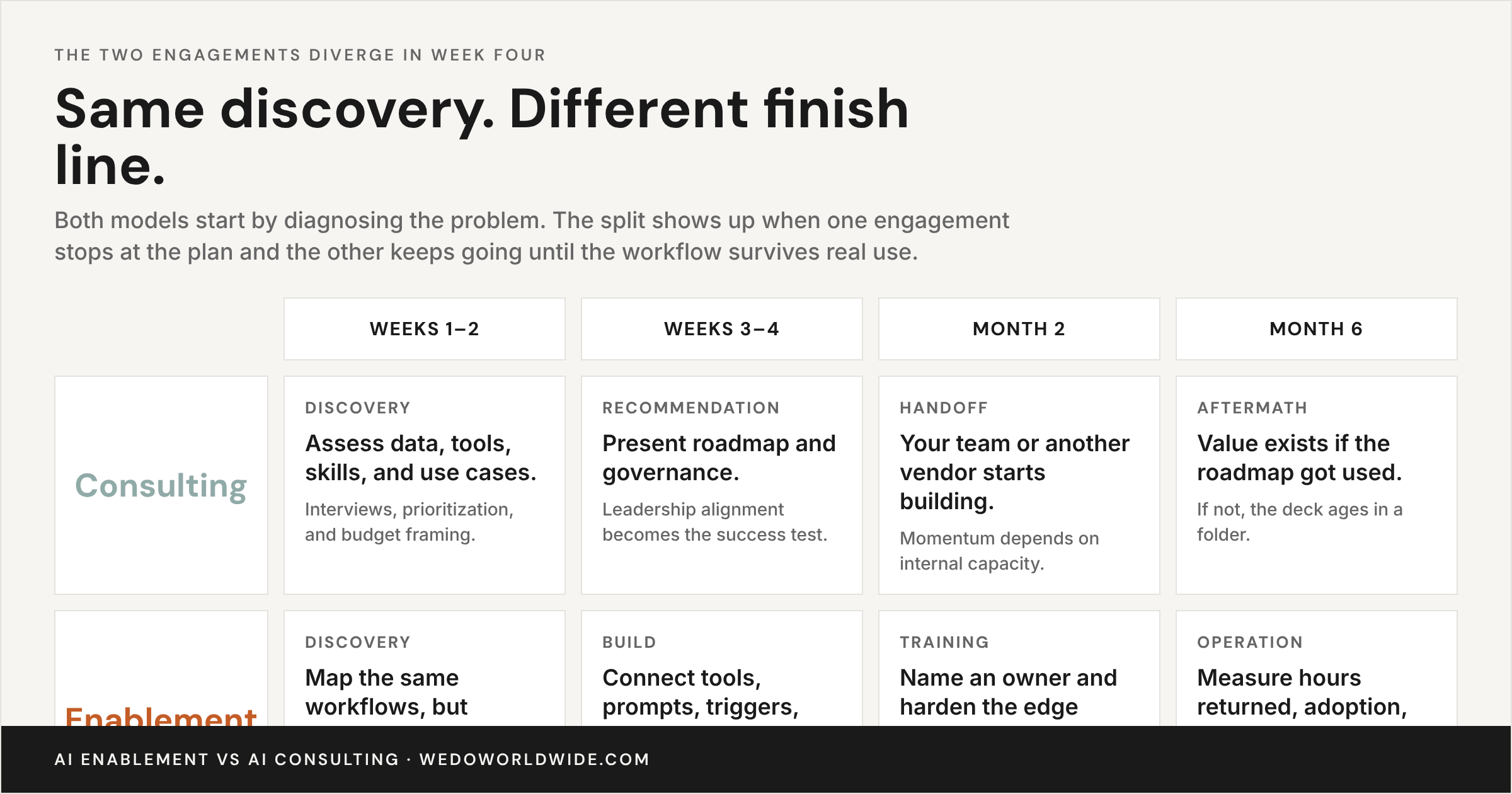
Both start with the same discovery. A consulting engagement peaks at the findings presentation. An enablement engagement peaks in production, usually four to six weeks later.
| The question | AI consulting | AI enablement |
|---|---|---|
| What you buy | Judgment and prioritization | Built systems and operating capability |
| What exists on day 30 | A roadmap, a business case, a governance framework | One workflow live, a trained owner, a measured baseline |
| Who does the building | Your team, or a separate implementation vendor | The partner, alongside your team |
| How you know it worked | Leadership agrees on the plan | Hours returned per week, error rate, adoption |
| Where it fails | The roadmap outlives the appetite to build it | Thin data, or nobody freed up to learn the tools |
| Right call when | The problem is what to do and in what order | The problem is that nothing has shipped |
One more term gets mixed in. AI adoption is neither of these. It's the outcome: the share of your team using the thing in daily work. Consulting and enablement are both bets on adoption. Only one is on the hook for it.
02 / what-does-ai-consulting-deliver
What does AI consulting deliver?
A good consulting engagement delivers four things:
- A readiness assessment across data, tooling, and skills
- A ranked set of use cases tied to business outcomes
- A governance model (the rules for what AI can and can't do)
- A budget story that survives a leadership meeting
That's real work. It's worth real money when the constraint is clarity.
Look at who owns that market. Search ai consulting and page one is BCG, IBM, EY, Slalom, and The Hackett Group. A Reddit thread from r/consulting sits near the top. Buyers are saying out loud what the category struggles with.
Slalom surveyed 2,000 leaders and published the gap plainly:
- 68% believe they're keeping pace with AI
- 93% report workforce barriers
- Only 21% have enterprise-wide use cases
- 90% plan to increase spend, while few can measure ROI
A separate KPMG study found only about half of employees say their company has the strategy, training, and governance to support AI at all.
Advice isn't the bottleneck. Almost every company we talk to knows which three things to automate. They've known for two quarters.
03 / what-does-ai-enablement-deliver
What does AI enablement deliver?
Enablement is judged on four artifacts. None of them is a document:
- Workflows connected to the tools you already pay for. Your CRM, project management, email platform, and analytics, talking to each other.
- Automations or agents doing a named job. A job with a start trigger, an output, and an error path. A demo doesn't count.
- A trained operator. One person who can change the prompt, read the log, and fix the break. No support ticket needed.
- Governance you can read in a minute. What AI does unreviewed, what needs a human check, what's off limits.
WE•DO runs its own agency this way. That's the only reason we have numbers to publish:
- 40 plus AI workflows in production
- Content output up 10x
- Reporting time down 60%
- Team adoption at 85%
One reporting job used to take five hours of manual assembly. It now runs in about 30 minutes. That's how we produce 100 plus client reports a month without a reporting team. The full teardown is in 40 AI marketing agents for growth teams.
Here's what doesn't work. Enablement fails too, in predictable ways. If your data lives in paper files or twelve disconnected spreadsheets, you need a data project first. If nobody can give up two to four hours for training, adoption stalls at week three. A good build won't save it. We cover both traps in AI enablement: the complete guide for business leaders.
04 / which-five-questions-decide-what-you-need
Which five questions decide what you need?
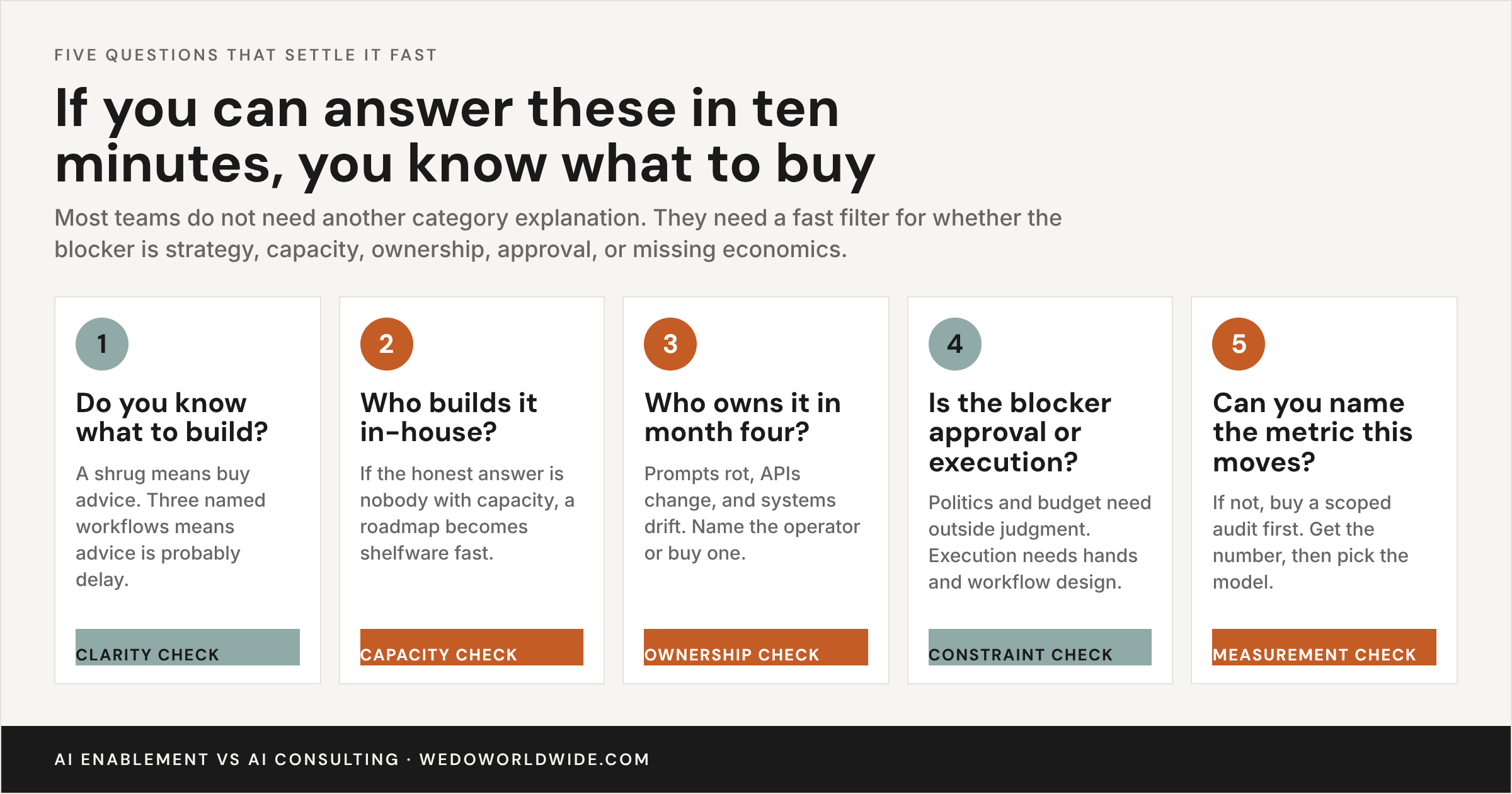
Answer these five before you take a sales call.
- Do you know what to build? If the answer is a shrug, buy advice. If you can name the three workflows, advice is a delay.
- Who builds it in-house? If the honest answer is nobody with capacity, a roadmap becomes a to-do list nobody starts.
- Who owns it in month four? Systems drift. Prompts rot, APIs (the connections between tools) change, staff turn over. Name the owner or buy the operator.
- Is your blocker approval or execution? Politics and budget need an outside opinion. Execution needs hands.
- Can you name the metric this moves? If not, buy neither yet. Buy a scoped audit, get the number, then decide.
Four of those five point at execution. That matches what we see in our pipeline. The plan is rarely the missing piece. The missing piece is someone to build the thing and stay on it.
05 / what-does-each-one-cost
What does each one cost?
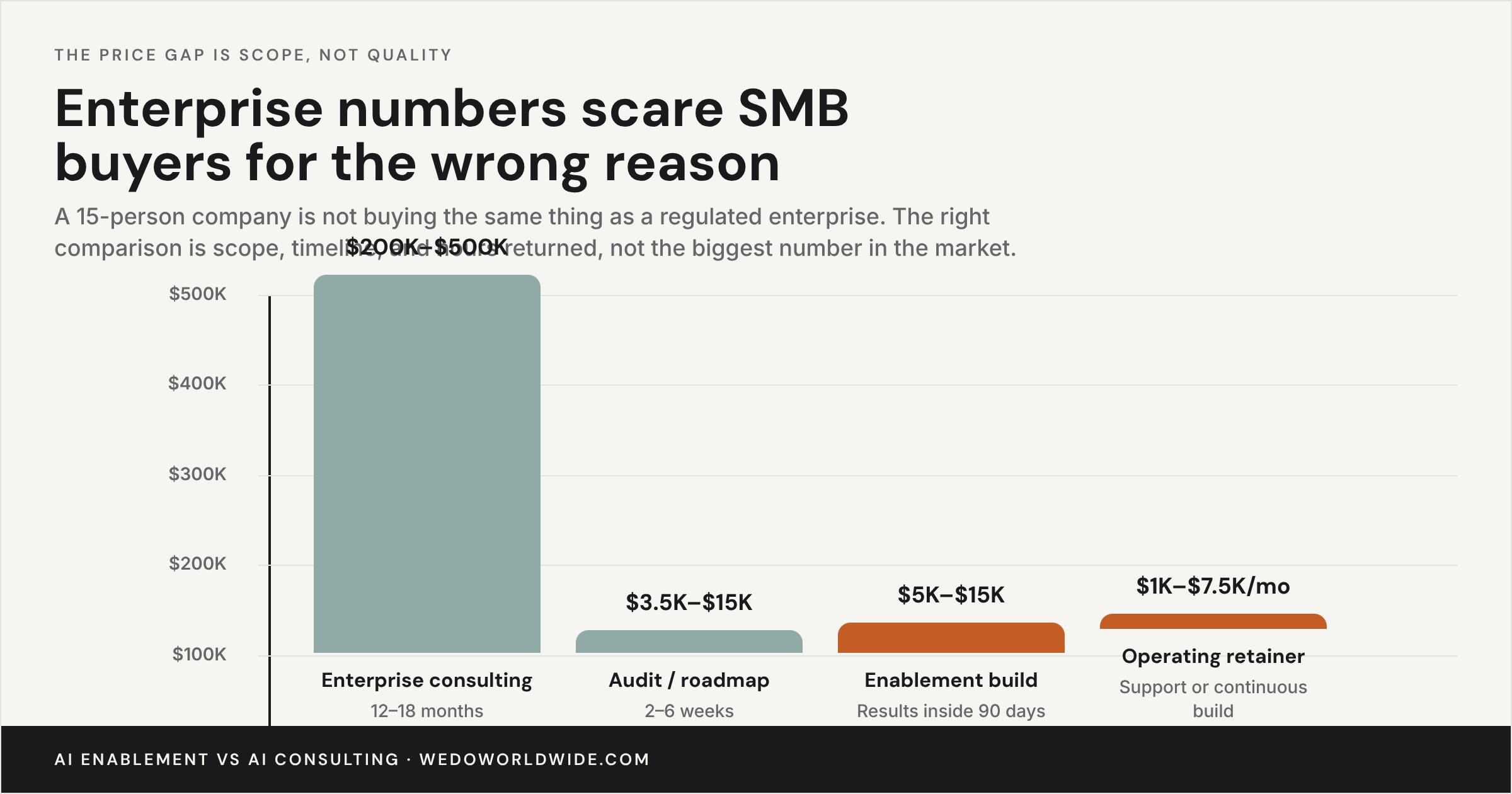
At the enterprise level, AI enablement runs $200,000 to $500,000 and up. Timelines run 12 to 18 months. That figure is why most owners of 30-person companies assume this isn't for them.
The small and mid-size market prices nothing like that:
- Audit or roadmap only: $3,500 to $15,000, delivered in two to six weeks.
- Focused enablement build: $5,000 to $15,000, with measurable results inside 90 days.
- Ongoing operating retainer: $1,000 to $3,000 a month for support and light additions. Up to $7,500 a month for continuous build work.
- Independent consultants: $100 to $300 an hour.
- Team training: roughly $600 for a half day, $1,200 for a full day.
Scope explains the gap between $200,000 and $8,000. Quality doesn't. An enterprise buys governance for thousands of employees across regulated systems. A 15-person company buys two or three automations and the training to run them.
Judge the fee by the hours it returns each month. Say an $8,000 build gives back six hours a week. At a $65 loaded rate (salary plus overhead), it pays for itself in about five months. Then it keeps paying.
For pricing tailored to smaller teams, read our small business AI consulting guide.
06 / when-does-consulting-beat-enablement
When does consulting beat enablement?
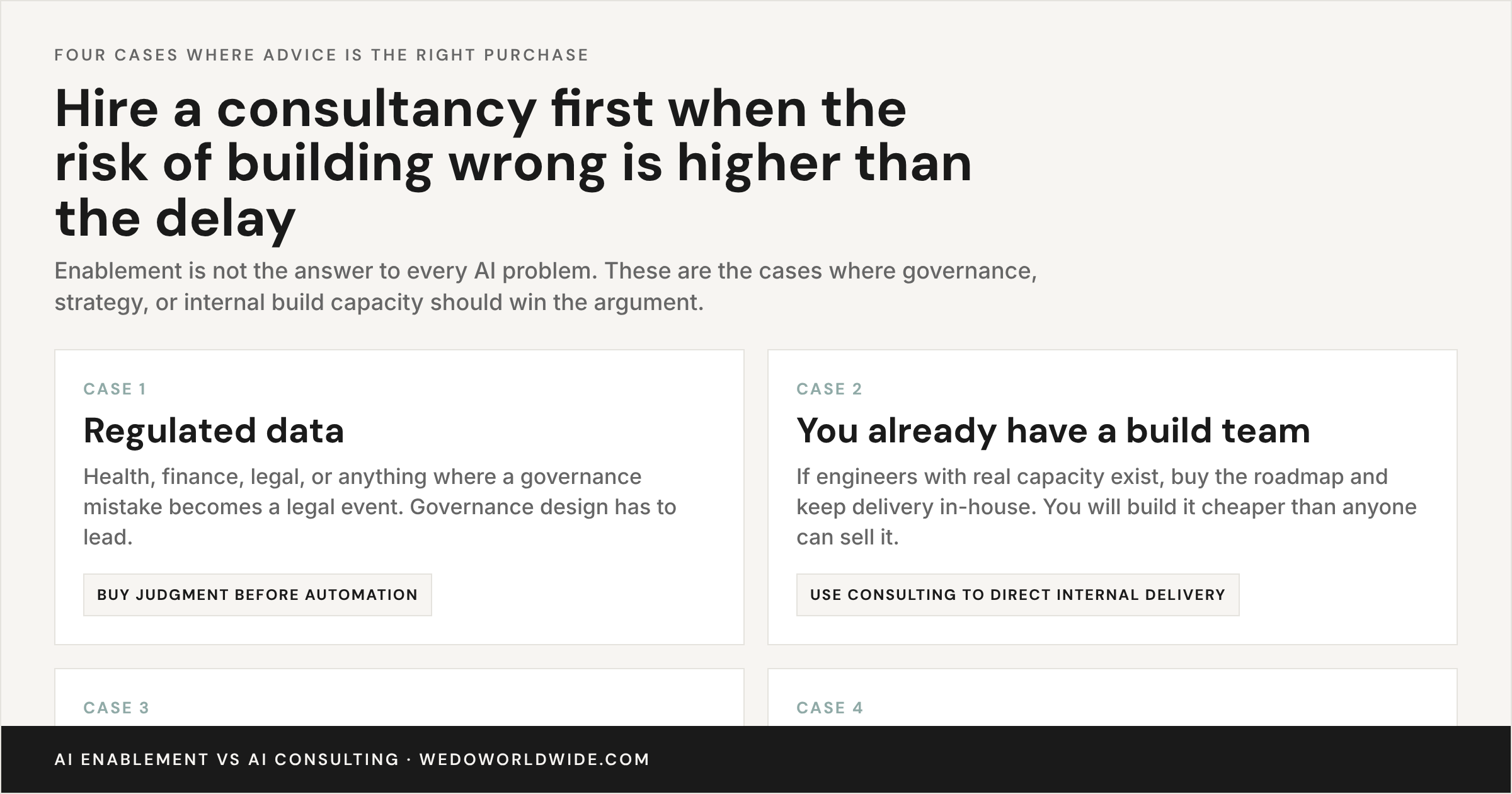
In four situations. WE•DO builds systems for a living, and we still tell people to hire a consultancy in these.
1. Regulated data
Health records, financial data, legal files. Here a governance mistake is a legal event. So governance design has to lead. And it should come from people who do only that.
2. You have a real build team
Got engineers with spare capacity? Buy the roadmap and keep delivery in-house. You'll build it cheaper than anyone can sell it to you. Our build vs buy framework for AI tooling walks the math.
3. The output is a decision, not a workflow
Board narrative, diligence for an acquisition, a category bet. Nothing needs to be built. Something needs to be decided.
4. You're still asking whether to do this at all
That's a strategy question. It deserves a strategy answer. Don't let anyone, including us, sell you a build while it's still open.
07 / how-do-you-tell-what-a-vendor-is-selling
How do you tell what a vendor is selling?
Ask five questions on the first call. The labels won't help. Consultancies advertise implementation, and build shops advertise strategy. These questions make the category obvious:
- What exists on day 30 that doesn't exist today?
- Who operates this in month four, by name and role?
- Show me something you built that is in production right now. Screen share it.
- Tell me about an engagement that failed and what you changed after.
- What does the handoff cost, and what happens if we stop paying you?
Question three does most of the work. A firm that can't screen-share a live workflow is selling advice with an implementation slide attached. That's a fine thing to buy, if you know that's what you're buying.
Weighing an agency against hiring internally? The same logic applies. We ran the numbers in in-house vs agency vs freelancer for AI marketing.
08 / what-is-wedo-out-loud
What is WE•DO, out loud?
WE•DO is an enablement partner. We build the workflows and stay until they run. Our own agency runs on the same systems we install.
We do sell an audit: $3,500, two weeks. It exists to scope a build. It doesn't end the engagement, and we say that before you pay.
Need a roadmap, an outside opinion, and a document your board will respect? Hire a consultancy. We'll tell you that on the call. We'd rather do that than take a build fee for work that isn't ready.
09 / where-should-you-start
Where should you start?
Start with the metric, not the category. Pick the one workflow eating the most hours this month. Put a number on it. Then decide: do you need someone to tell you what to do, or someone to do it?
If it's the second, our AI Operations service starts with a two-week readiness audit. It ends in a scoped build you can start on. If it's the first, we'll point you somewhere better and mean it.