Nobody in this industry publishes numbers.
So you sit on a discovery call for thirty minutes. You hear "it depends on scope." You leave with no price.
Part of our guide to AI enablement for small business.
Here are the real costs. They break into four things you'll pay for, with honest ranges for the three ways to get it done.
By the end, you'll know:
- The four cost buckets in every AI budget, with typical ranges
- What DIY, a contractor, and an agency each cost (and each one's risk)
- What WE•DO charges, in dollars
- The cheapest way to start: $20 and a weekend
It's a 9-minute read. If you only want the floor, skip to the last section.
01 / what-are-the-four-cost-buckets
What are the four cost buckets?
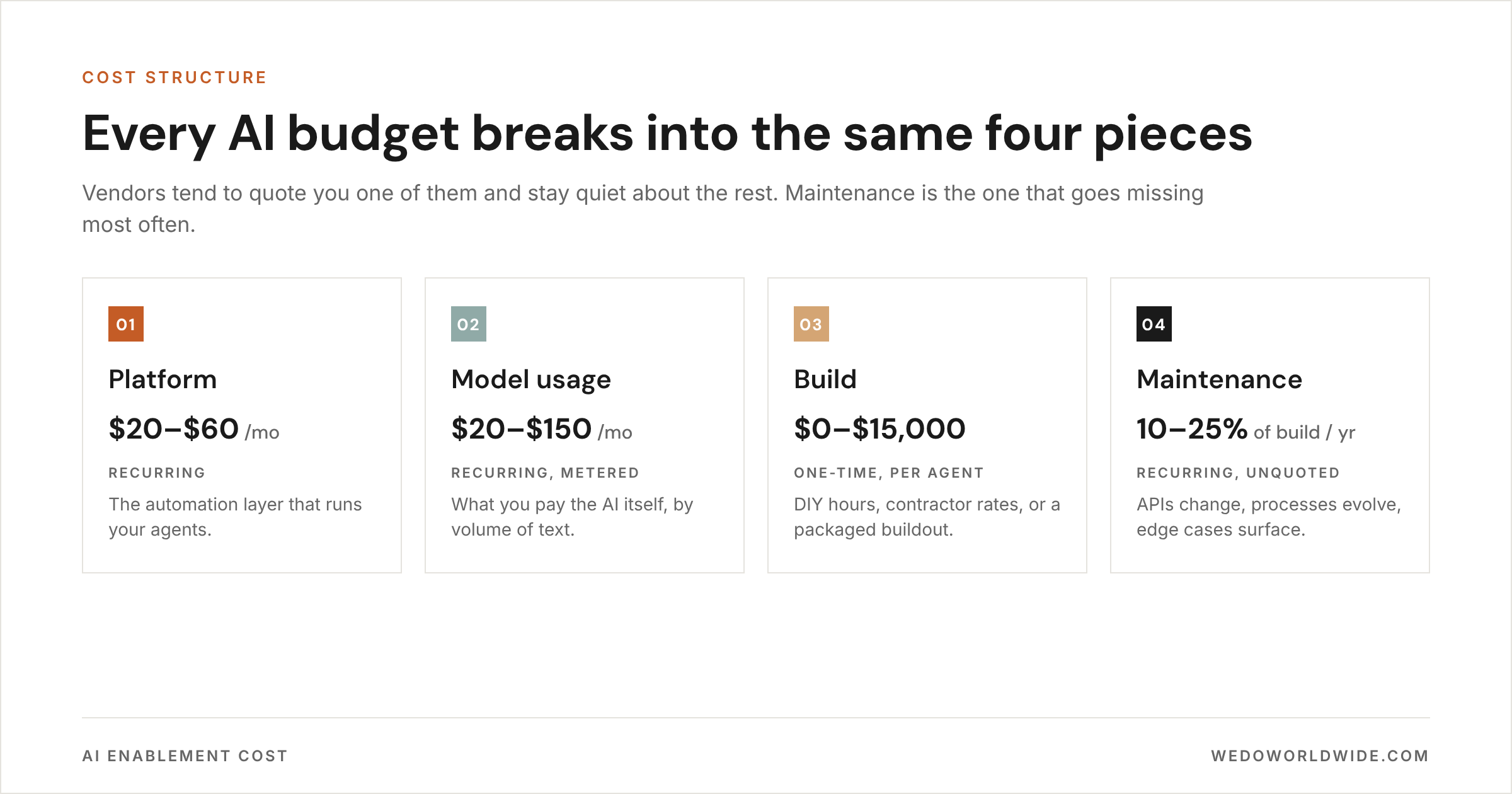
Every AI enablement budget splits into the same four pieces: platform, model usage, build, and maintenance. Vendors tend to quote you one. They stay quiet about the rest.
1. Platform costs
This is the automation layer that runs your agents.
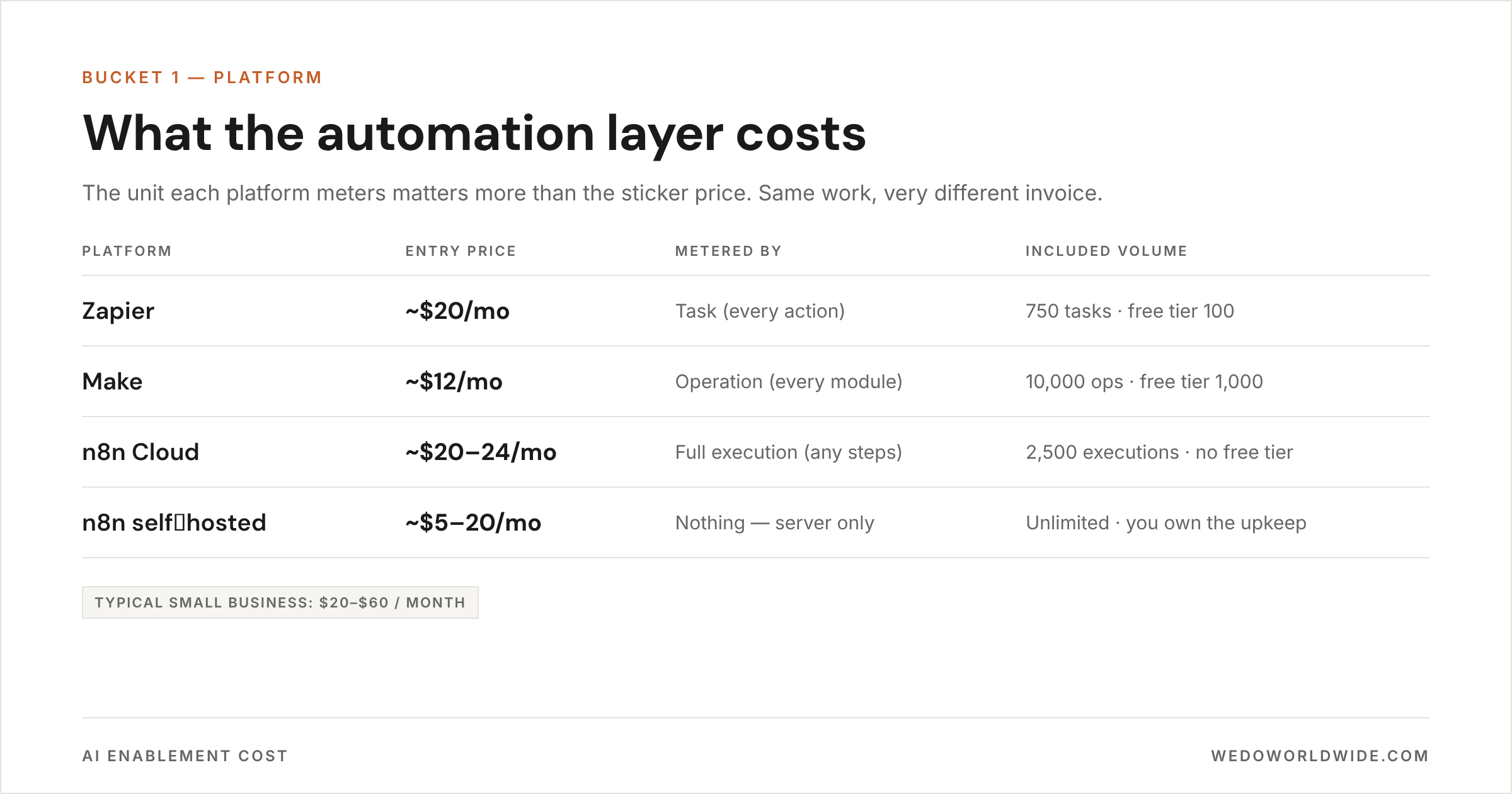
- Zapier: free tier at 100 tasks a month (two-step Zaps only). Paid starts around $20/mo for 750 tasks. Metered per task, meaning every action in every run.
- Make: free tier at 1,000 operations. Core starts around $12/mo for 10,000 operations. Metered per operation. It counts like Zapier but costs less per unit.
- n8n Cloud: Starter runs about $20 to $24/mo for 2,500 executions. Metered per full workflow execution, so step count doesn't change the bill.
- n8n self-hosted: the license is free. You pay roughly $5 to $20/mo for a small server, and you own the upkeep.
Most small businesses land between $20 and $60 a month here.
The variable that bites is per-task pricing. Take a six-step workflow that fires a thousand times a month. On Zapier, that's six thousand tasks. On n8n, it's one thousand executions.
Same work. Very different invoice.
2. Model usage
This is what you pay the AI itself.
For a small business running a handful of agents, it's usually $20 to $150 a month.
A per-seat subscription like Claude or ChatGPT covers hands-on use. Agents usually run on API access (a metered connection your software calls directly). That's billed by volume.
Content generation is the expensive category. It reads and writes a lot of text. Routing and sorting agents are cheap. They read a little and write a little.
People overestimate this bucket at the start. Once usage settles, it's smaller than they feared.
3. Build cost
This is getting the agent working. It's the big variable, and it's a one-time cost per agent.
DIY. Free in cash, expensive in hours. A first simple agent takes most people 4 to 12 hours, false starts included. Once you know your platform, later agents take 2 to 4.
Contractor. $75 to $200 an hour. A well-scoped single agent is usually 5 to 15 hours. That's $500 to $3,000 per agent.
Agency. Usually packaged, not hourly. Expect $3,000 to $15,000 for a multi-agent buildout. The price moves with agent count and how messy the integrations are.
4. Maintenance
This is the bucket nobody quotes.
Agents need upkeep. Tools change their APIs (the connections apps use to talk to each other). Your process evolves. Edge cases show up that the original build never planned for.
Budget 10 to 25% of build cost a year. Or plan on a few hours a month of someone's attention.
Across our own forty-agent fleet, maintenance is about 23% of total AI spend. Build is 41%. Platform fees are 22%. Model usage is 14%.
If you'd told me at the start that maintenance would outweigh model costs, I wouldn't have believed you. The full breakdown is in what running 40+ agents costs and saves.
02 / which-of-the-three-paths-fits-your-budget
Which of the three paths fits your budget?
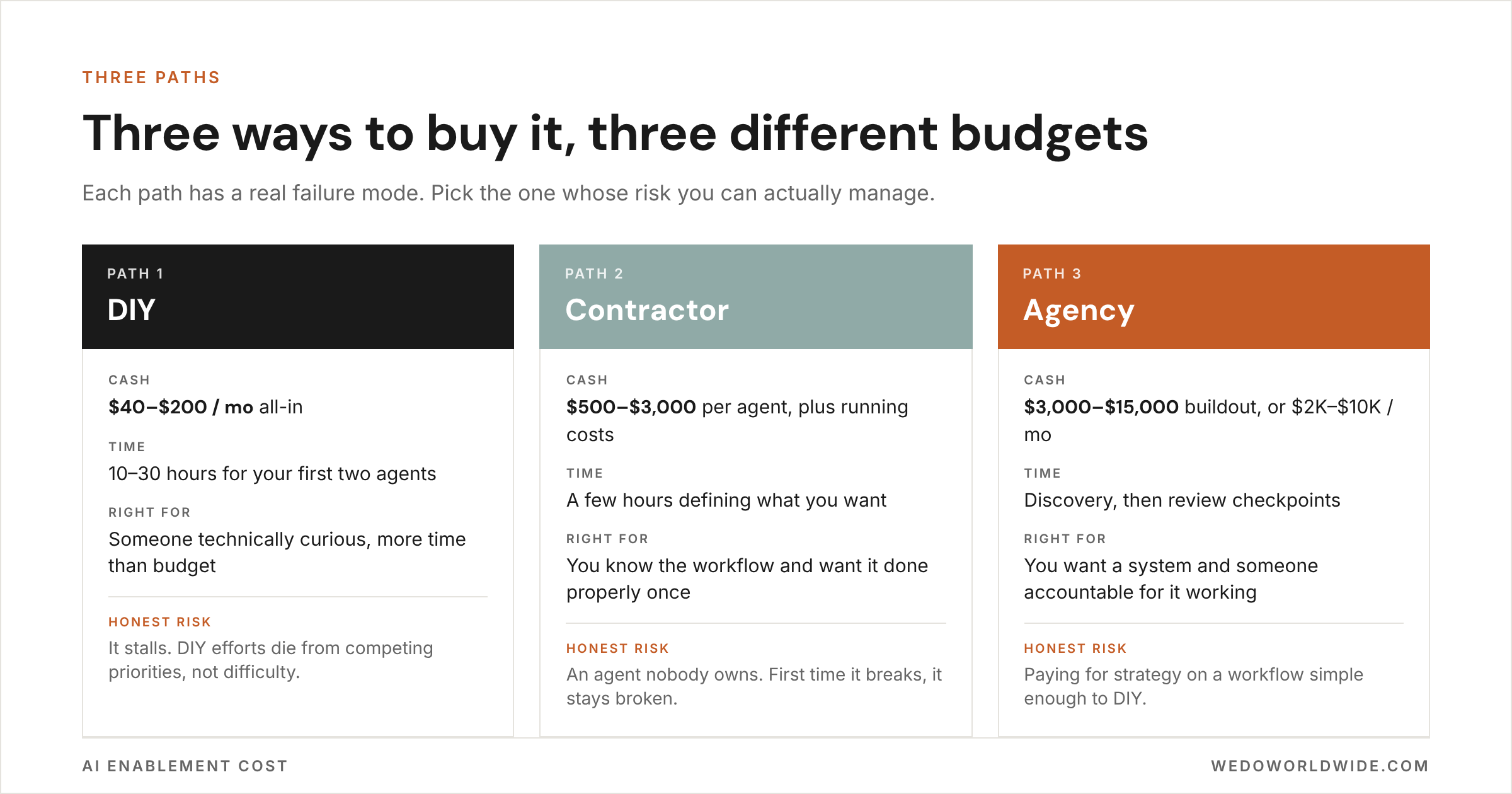
Pick DIY if you have more time than money, a contractor if you know the exact workflow, and an agency if you want a whole system someone owns. Here's what each costs.
Path 1: DIY
Cash cost: $40 to $200 a month, all-in Time cost: 10 to 30 hours to get your first two agents running Right for: Businesses with someone technically curious and more time than budget
You'll build something that works. You'll also lose a weekend learning why your first trigger didn't fire.
The upside: you end up able to maintain and extend what you built.
The honest risk: the project stalls because the builder has a day job. Most DIY AI efforts die from competing priorities. Technical difficulty is rarely the killer.
Path 2: Contractor
Cash cost: $500 to $3,000 per agent, plus $40 to $200/mo running costs Time cost: A few hours of your time defining what you want Right for: You know exactly which workflow to automate and want it done right once
It's a good fit when the scope is clear and self-contained.
It's a weak fit when you don't know what to build yet. You'll pay a contractor to figure that out at implementation rates.
The honest risk: you get an agent nobody owns. Contractors build and leave. If nobody inside understands it, the first time it breaks, it stays broken.
Path 3: Agency or fractional
Cash cost: $3,000 to $15,000 for a buildout, or $2,000 to $10,000 a month ongoing Time cost: A discovery process, then review checkpoints Right for: Businesses that want a system, not a single agent, and someone accountable for it working
You're buying the diagnosis as much as the build. Which workflows to automate. In what order. With what gates (human approval steps).
For a lot of businesses, that sequencing call is worth more than the code.
The honest risk: paying for strategy you didn't need, on a workflow simple enough to handle yourself.
03 / what-does-wedo-charge
What does WE•DO charge?
Since I'm asking you to trust numbers, here are ours.
AI Workflow Audit: $997, one-time. We map your operations and find the three to five highest-impact automation opportunities. You get a prioritized 90-day roadmap in five business days. There's no obligation to build with us. Several clients have taken the roadmap and built it themselves.
90-Day AI Operations Buildout: from $5,000/month, three months. The audit is included. We design, build, test, and deploy three to five custom agents. We wire them into your existing tools, train your team, and support you for 30 days after handoff.
Ongoing AI Operations: custom, month to month. We run the system and change it as the business grows.
The audit exists because of one common, expensive mistake: building the wrong agent well. A thousand dollars to learn what to build is cheap insurance. The alternative is a fifteen-thousand-dollar build nobody uses.
04 / what-drives-cost-up
What drives cost up?
Four things, in order of impact.
Integration mess. If your data lives in systems with poor or no APIs, build cost multiplies. An agent that reads a Google Sheet is cheap. One that reads a legacy system with no API is a project.
Undefined scope. "Help our marketing team move faster" costs three times what "QA every draft against its brief before human review" costs. Someone has to do the defining either way. At build rates, it's more expensive.
Agent count. Each agent is mostly independent work. Five agents cost close to five times one agent. Shared architecture does bring the marginal cost down.
High-consequence output. Anything client-facing or financial needs more testing, better gates, and careful error handling. That's real extra work, and it's worth paying for.
05 / what-drives-cost-down
What drives cost down?
Four choices, all made before you build.
Pick workflows with existing triggers. If something already happens on a schedule or a status change, you're most of the way there.
Start with two data sources, not ten. Every extra integration adds build time and more places to break.
Accept a human gate. An agent that must be right with no one watching costs far more. An agent that only needs to be right enough for a ten-second human approval costs much less.
Build one, then reuse. Our fortieth agent took a fraction of the time our first one did. The architecture and patterns were already settled.
06 / what-do-you-get-back
What do you get back?
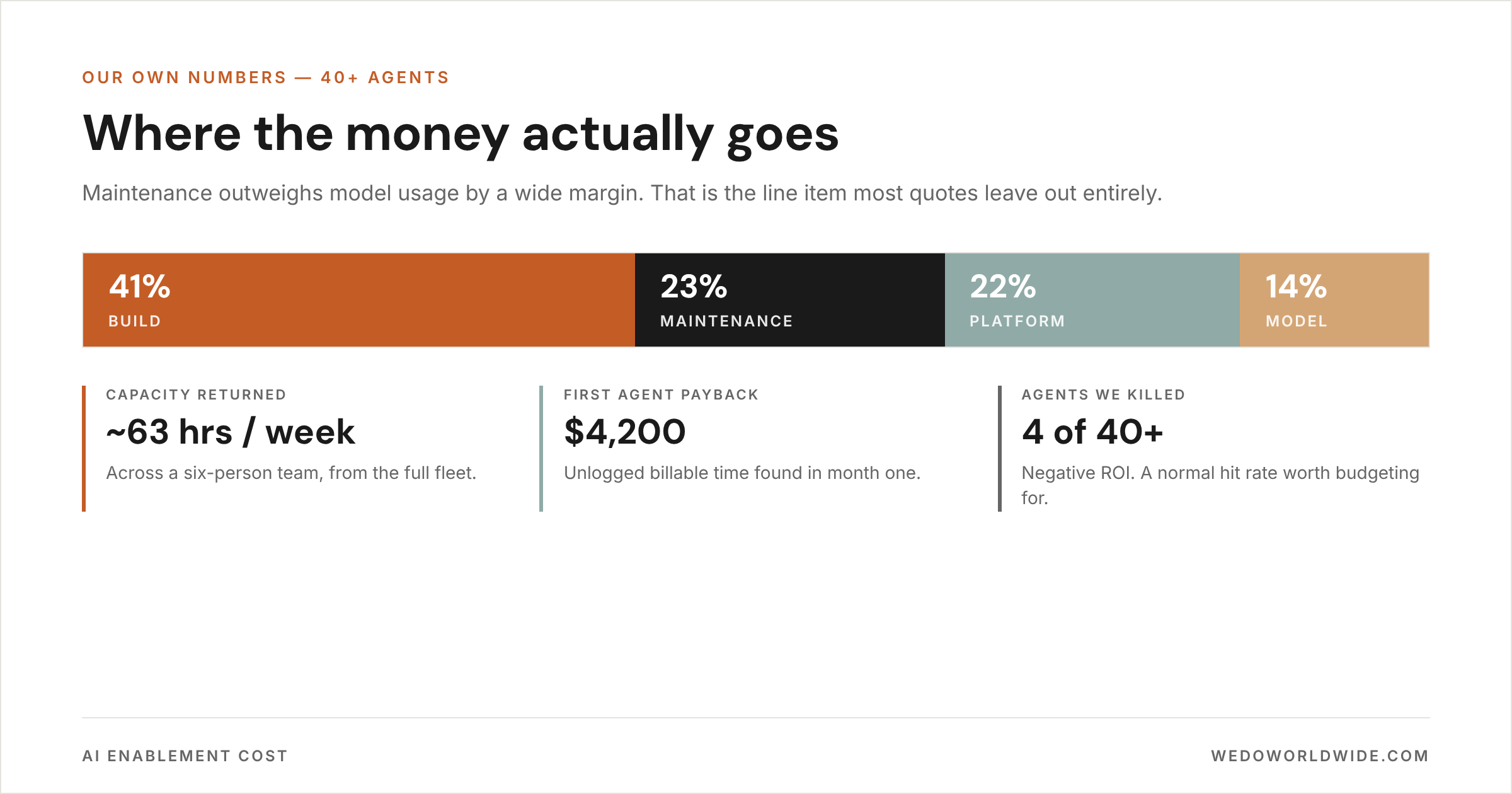
For us, roughly 63 hours of capacity a week, across a six-person team. Cost only means something against that return.
Build is our largest line item. It's shrinking as a share over time.
Our first agent found $4,200 in unlogged billable time in its first month. That covered the entire program.
Your numbers will differ. The shape usually holds: the right first agent tends to pay for the next several.
Now the other direction. Four of our agents had negative ROI. We built them, they didn't earn their keep, and we killed them.
That's a normal hit rate. Budget for it emotionally as well as financially.
07 / whats-the-cheapest-way-to-start
What's the cheapest way to start?
If budget is the constraint, here's the floor:
- A free Make or Zapier tier
- A $20 AI subscription
- One workflow you already understand
- A weekend
Total cash cost: $20. If it works, you have proof. If it doesn't, you learned something for the price of a lunch.
Want a shortlist first? We compared the options in the best AI agents for small business.
The expensive mistake isn't spending too little. It's paying for capability before you decide what job you're handing over.
Want to know what your first agent should be? The audit answers that, and the roadmap is yours to take anywhere. Book a free AI Workflow Audit →