Your agent keeps shipping off-brand work. The model isn't the problem.
Your context is.
Most brand systems were built for humans: a PDF, a Figma file, a long wiki page. Plus a hundred unwritten rules in a creative director's head. A designer can absorb that mess and fill the gaps. An agent can't. It picks from what's written down. When the system is vague, the output gets vague too.
That's why atomic design matters again.
This takes about 9 minutes to read. If you only want the steps, skip to the 30-day rollout.
By the end, you'll know:
- Why off-brand AI output is an information architecture problem, not a prompt problem
- How atomic design and design tokens give an agent a path to the right answer
- What a doctrine layer is and what goes in it
- A 30-day sequence to make one workflow agent-ready
Brad Frost's original Atomic Design model was never only a way to organize buttons. It turned abstract brand decisions into concrete pages through a hierarchy of reusable parts. In 2026, that hierarchy matters more. Agents are now one of the builders.
01 / why-does-ai-output-drift-off-brand
Why does AI output drift off-brand?
Ambiguity. That's the real failure mode.
Tell a human to "make it feel premium" and they'll work from precedent. They know which past page had the right tension. They know which proof block felt credible. They know which CTA (call to action) sounded confident without turning into agency mush.
An agent hears the same phrase and has to invent the details. Which type scale? Which spacing rhythm? Which button treatment, which evidence pattern, which analogy to avoid? That's how you get output that's usable but obviously generic.
This isn't hypothetical. In How our agents build on-brand pages with design.md, Vercel explains that its first try at design guidance for agents left too much open. So the company rebuilt the system around a public design.md, a stylesheet, and an eval loop (a repeatable test that scores output against known failures).
Here's what its comparison test found:
- Pages built with
design.mdtriggered 39 known failures. - The same scenarios without it triggered 91.
- That's a 57% reduction.
Vercel is careful about the limits here, and it should be. Six pages isn't proof of universal quality. But it's clear evidence of one thing. Once a recurring failure is named and encoded, it tends to stay gone.
Atlassian found the same pattern from a different angle. In Teaching AI to speak our design language, the team moved design-system knowledge out of scattered docs. It went into structured, machine-readable schemas. The comparison was against agents working without an MCP (Model Context Protocol, a standard way to hand tools and data to an agent). The structured setup:
- produced 11% fewer errors
- finished tasks 34% faster
- cut token usage by 16%
- reduced tool calls by 26%
The lesson: better AI output starts with information architecture. Copy and prompts come second.
02 / how-does-atomic-design-help-an-agent
How does atomic design help an agent?
It gives the agent a hierarchy to walk, from small parts up to whole pages.
Frost described atomic design as five levels: atoms, molecules, organisms, templates, and pages. Skip the chemistry metaphor. The useful part is the move from isolated ingredients to connected systems.
- Atoms are the elemental pieces: labels, inputs, buttons, colors, type decisions.
- Molecules combine those atoms into simple reusable units.
- Organisms turn molecules into higher-order sections.
- Templates show how those sections fit together structurally.
- Pages replace placeholders with real content and test the system in context.
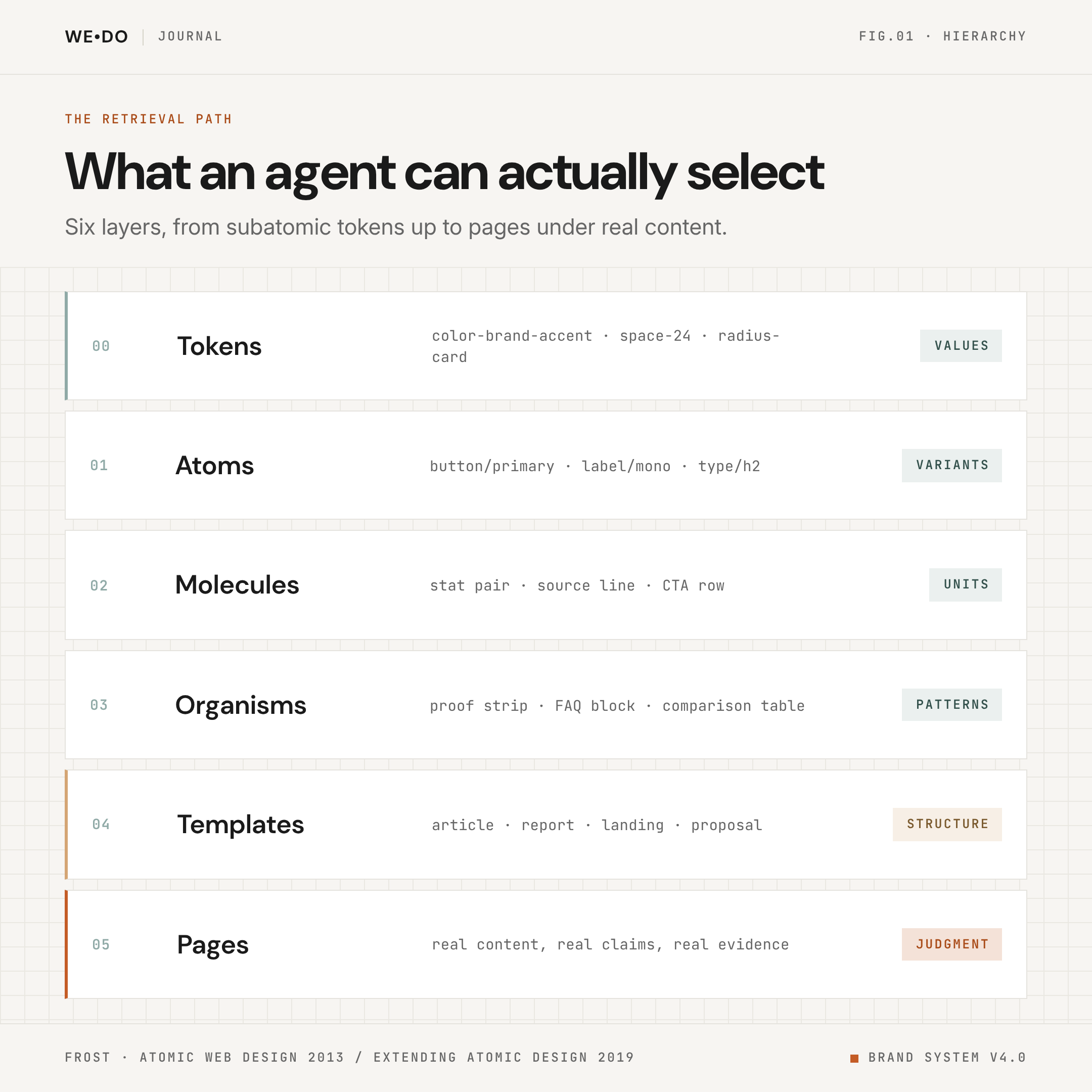
That last step matters more for AI than most teams realize.
Frost frames pages as the place where the system proves itself with real content. That's exactly where weak AI output gets exposed. A polished button won't save you if the hierarchy is wrong. Or the proof is buried. Or the CTA is soft. Or the whole thing sounds like it was written for a different company.
Atomic design gives humans a shared vocabulary. It also gives agents a retrieval path.
Say the request is "use the proof section pattern." With an explicit system, the agent finds the right organism. Then the supporting molecule. Then the correct atom-level treatment. Without hierarchy, every request is a fresh guess.
03 / where-do-design-tokens-fit
Where do design tokens fit?
Tokens are the machine entry point.
In Extending Atomic Design, Frost later called design tokens the "subatomic particles" of atomic design. (A token is a named, reusable design value.) It's a useful way to think about AI-ready brand systems.
Tokens are where machine selection gets easy.
A token isn't "something warm but modern." It's color-brand-accent, space-24, radius-card, font-heading-700, status-human-gate. A machine can retrieve that. It can reuse it. It can apply it the same way every time.
Newer design tools help here too. In Introducing our MCP server: Bringing Figma into your workflow, Figma explains what its MCP server does. It hands agents variable definitions, styles, and design-system context directly. That changes the workflow. The model no longer has to guess which red, which spacing token, or which component variant the designer meant. It can look up the real thing.
Here's the limit: tokens only solve the lower layers.
They tell the agent what values exist. They don't say whether the page should lead with the benchmark, the recommendation, or the before-and-after. They don't say when an accent block is earned. Or when a testimonial is too weak to carry the argument.
That's where doctrine comes in.
04 / what-is-brand-doctrine-and-why-do-agents-need-it
What is brand doctrine, and why do agents need it?
Doctrine is the written record of how your brand makes decisions.
Most style guides explain what a brand looks like.
Far fewer explain how it decides.
AI exposes that gap faster than anything else.
A mature system needs a doctrine layer that answers questions like these:
- What counts as proof, and what counts as decoration?
- Where is accent allowed to interrupt, and where should restraint win?
- Which page structures exist for which reader jobs?
- What anti-patterns should never ship, even if the layout is technically correct?
- Which claims require methodology, caveats, or human sign-off?
Vercel's design.md does exactly this. It names typography and layout primitives. It also names the bad patterns the company never wants to see again. Then it routes each fix into the narrowest layer that will hold: prose guidance, stylesheet, or automated checks.
Atlassian's structured content does the same job differently. It doesn't ask agents to scan a monorepo (one big shared code repository), screenshots, and loose docs, then guess the "right" answer. It gives them clear schemas for components, tokens, lint rules, content standards, and accessibility requirements.
Different implementation. Same lesson.
If judgment stays trapped in human memory, the agent can't reuse it.
05 / what-goes-in-an-ai-ready-brand-system
What goes in an AI-ready brand system?
Eight layers, from the smallest rule up to the final page.
A prompt file alone won't get you on-brand work. Neither will a component library alone. You need a system the model can walk from top to bottom.
Here's the stack:
- Tokens for color, type, spacing, radius, motion, and semantic states.
- Atoms with explicit names and allowed variants.
- Molecules and organisms that represent repeatable patterns: stat strips, pricing cards, FAQ blocks, proof modules, event streams, comparison tables.
- Templates that define page-level jobs: article, landing page, report, service page, proposal.
- Doctrine that states the operating rules: what the system optimizes for, what it refuses, when it needs evidence, and where humans still make the final call.
- Examples that show the system under real content, not abstract placeholders.
- Retrieval surfaces that expose the system at generation time: structured docs, MCP-connected libraries, design-system search, prompt files, or code-adjacent rules.
- Evals that turn repeated review comments into durable improvements.
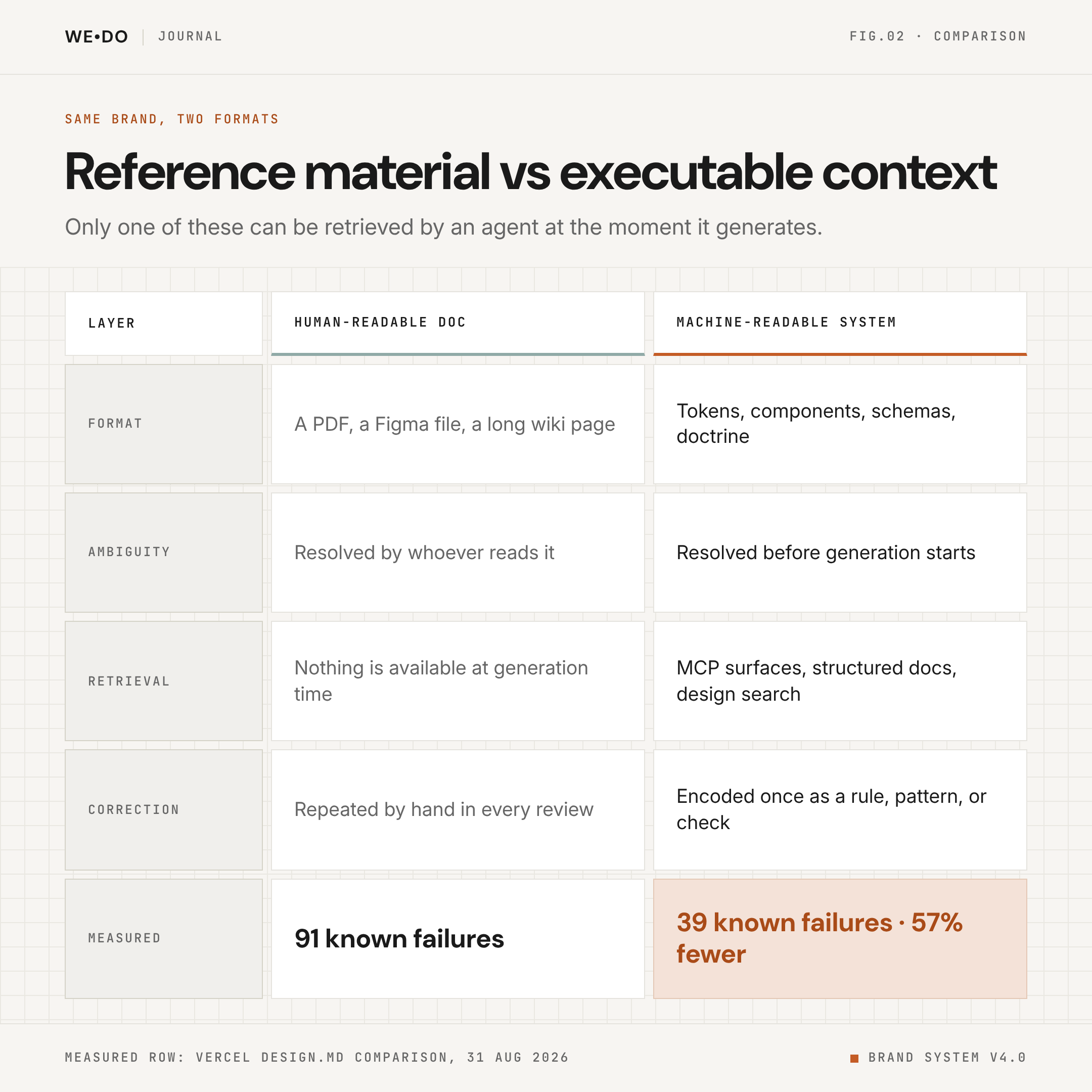
That's why "give the model the brand PDF" keeps underperforming.
A PDF is reference material.
A system is executable context.
06 / why-should-marketing-teams-care
Why should marketing teams care?
Because marketing teams already hand agents brand-heavy work. It's easy to file this under product design. It isn't.
Marketing teams use agents to draft landing pages, shape case studies, and summarize benchmarks. They also rewrite nurture flows, build report pages, and create internal deliverables. Every one of those jobs depends on brand judgment. When the system is vague, every run needs more correction. Retries rise. Token costs rise. Trust drops.
Our own AI-content data at WE•DO points the same way. Here's what isn't working: several posts in our AI cluster get seen but not clicked.
/blog/ai-blog-content-pipelinepulled 13,859 impressions and only 5 clicks from Jun 1 to Sep 8, 2026./blog/ai-enablementpulled 1,584 impressions and 3 clicks over the same window.
That's not a reason to publish more vague awareness content. It's a reason to sharpen the structure. Make the reader's job obvious. Lead with the strongest evidence sooner.
This article is part of that fix. We're not selling "AI, but thoughtful." We're not selling "design systems, but updated." Our position is simpler: brand consistency for agents is an operational systems problem. Teams that solve it will ship faster with less cleanup.
07 / where-should-you-start
Where should you start?
Start smaller than a rebrand. One repeatable workflow with explicit rules is enough.
You don't need a perfect enterprise design system before AI gets useful.
Pick a recurring artifact: a blog post, a performance report, a proposal, a landing page. Then work backward from the corrections your reviewers keep making by hand.
If the note is always "the proof section feels weak," turn it into something selectable:
- which proof blocks are allowed
- what order they appear in
- how specific the evidence needs to be
- what caveats must stay visible
- what CTA the page earns after making that claim
If the note is always "this feels generic," don't settle for the vague complaint. Name the real failure. Maybe it's headline structure. Maybe it's overused accent color. Maybe it's a hero that spends 300 pixels on mood before making an argument. Maybe it's feature copy with no proof.
Once the correction is explicit, the agent can follow it.
Once it's testable, the system can improve over time.
08 / how-do-you-roll-this-out-in-30-days
How do you roll this out in 30 days?
One layer per week. For most teams, the rollout looks like this:
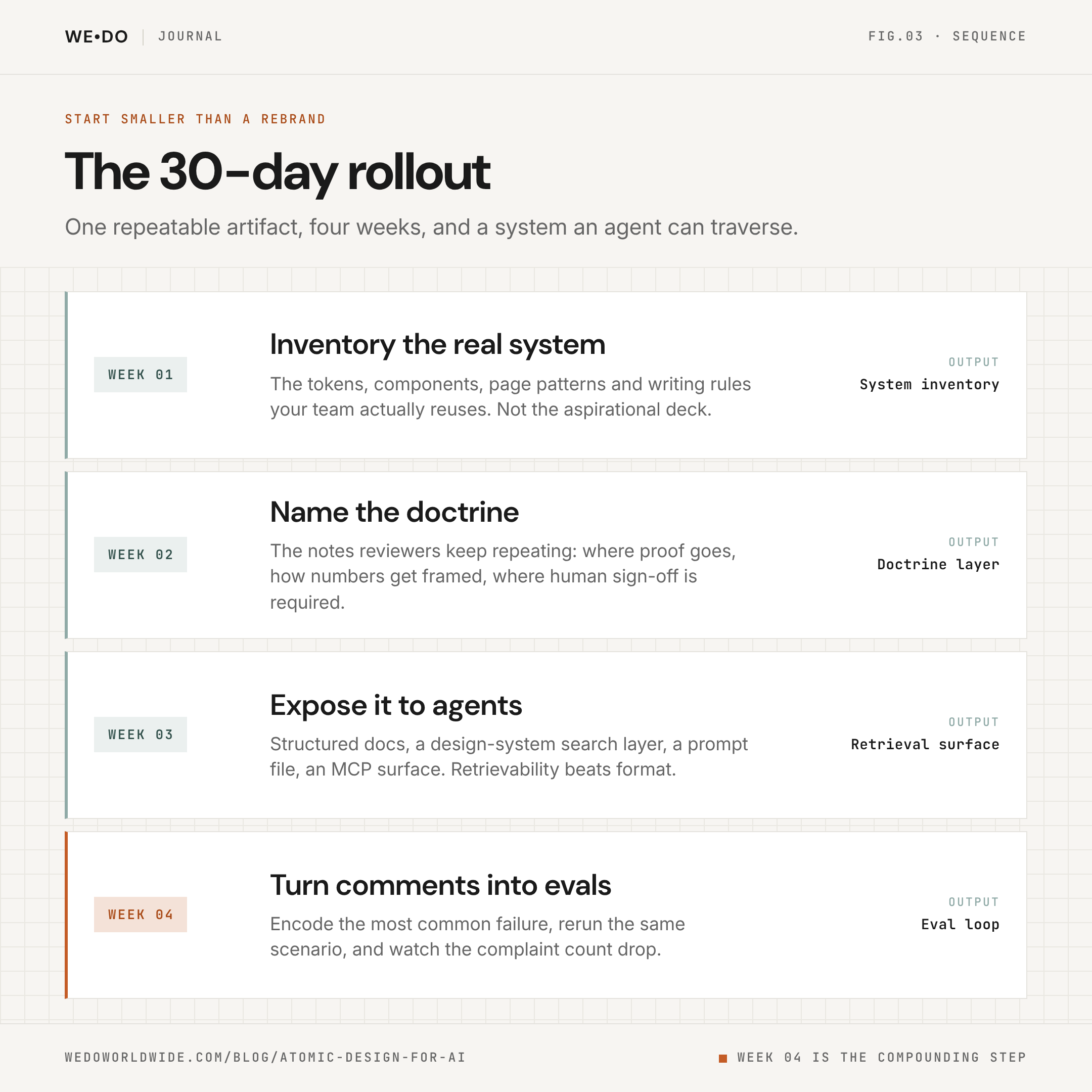
Week 1: inventory the real system
List the tokens, components, page patterns, proof modules, and writing rules your team reuses today. Not the aspirational deck. The real system. Cut anything nobody follows.
Week 2: name the doctrine
Write down the rules reviewers keep repeating. Where proof goes. How numbers get framed. When a chart needs methodology. Which language is too soft, which visuals are off-limits, and where a human has to review.
Week 3: expose it to agents
Put the system where machines can reliably retrieve it. That could be structured docs, a design-system search layer, or a prompt file. It could be an MCP surface or code-adjacent rules. The format matters less than whether the agent can find it.
Week 4: turn comments into evals
Take the most common failure and encode it:
- If it's a judgment call, write the rule.
- If it's a repeatable mechanic, turn it into a reusable pattern.
- If a machine can detect it, add a check.
Then rerun the same scenario. Did the complaint count drop?
That last step separates a one-off fix from a system that compounds.
09 / the-bottom-line
The bottom line
AI doesn't kill the need for brand systems. It raises the penalty for weak ones.
If your brand only lives in a mood board and tribal knowledge, your agents will keep inventing. Give them tokens, components, templates, doctrine, and examples they can retrieve at generation time. Then they get sharper, faster, and cheaper to run.
The teams that win here won't have the most prompts.
They'll have the clearest systems.
If you want a second set of eyes, bring us the one correction your team keeps making by hand. We'll help you turn it into a rule.