I read the Pro-Human AI Declaration the other morning before I dug into my inbox. I figured it would be a list of demands aimed at big tech companies, the kind of thing that has nothing to do with a plumber or a bookkeeper or a five-person agency. Some of it is. But a lot of it read like the rules we already run WE•DO by, and that got my attention.
So this post covers three things:
- What the declaration actually says, in plain English
- Why WE•DO is endorsing it
- Four of its ideas you can use in your own business this week, no tech background needed
Already know what the declaration is? Skip down to the four ideas.
01 / what-is-the-pro-human-ai-declaration
What is the Pro-Human AI Declaration?
It's a public statement, published in March 2026 at humanstatement.org, about how AI should be built and used. Think of it as a short list of ground rules that people and organizations can sign on to.
The heart of it is one line:
"Artificial intelligence should serve humanity."
The rest is organized into five areas:
- Keeping humans in charge. People decide what AI gets to do, and there's always a way to shut it off.
- Avoiding concentration of power. A handful of companies shouldn't control everything.
- Protecting the human experience. Families, kids and real relationships come first.
- Human agency and liberty. Your data and your choices stay yours.
- Responsibility and accountability. If an AI system causes harm, someone is responsible.
The people who've signed it are a pretty mixed group. You'll find AI researcher Yoshua Bengio next to the American Federation of Teachers, SAG-AFTRA (the actors' union) and the AFL-CIO Tech Institute, plus hundreds of other people and organizations. The site also points to a March 2026 poll of 1,004 likely US voters where 80% said they want humans in charge of AI with strong oversight.
02 / why-wedo-is-endorsing-it
Why WE•DO is endorsing it
Here's my two cents. AI tools are showing up in small businesses a lot faster than anyone is writing rules for them, and if you wait for Washington to sort it out, you'll be waiting a while. You don't have to. You can set your own rules today, in your own shop, and this declaration is a really good place to borrow them from.
It also lines up with how we already work:
- Every AI agent we run (an agent is basically an AI assistant that can take actions for you, like sending an email or updating a task) reports to a named person on our team.
- That person can switch it off.
- Nothing goes to a client or goes live on a website until a person says yes.
That's why I'm putting WE•DO's name behind it, and why I'd like you to read it too.
03 / four-ideas-you-can-use-this-week
Four ideas you can use this week
Most of the declaration is written for the big AI companies and the people who regulate them. But a few of its principles translate straight into how a small business uses AI day to day. These are the four I'd start with.
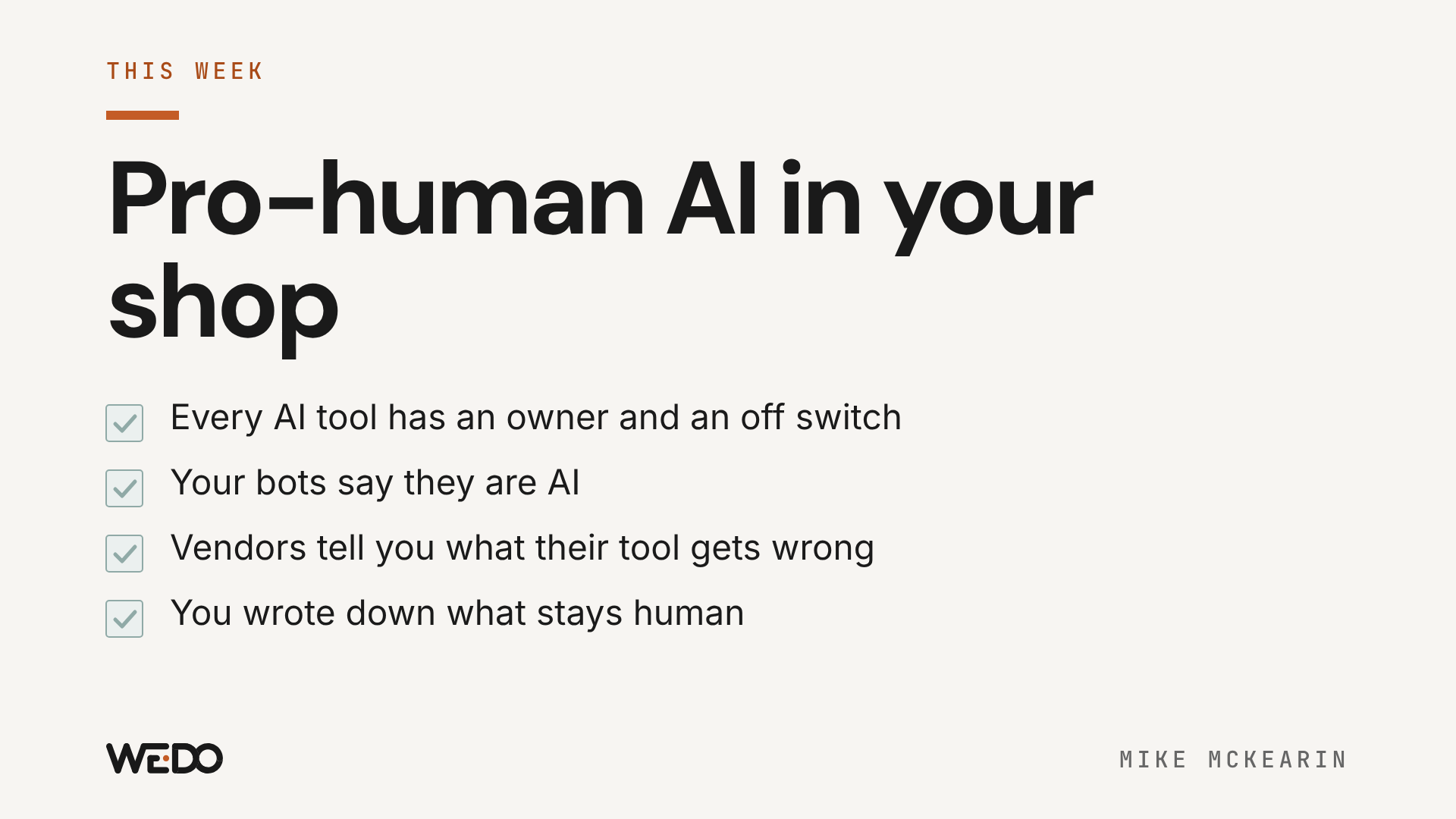
1. Give every AI tool an owner and an off switch
The declaration says powerful AI systems "must have mechanisms that allow human operators to promptly shut them down." You're probably not running anything that powerful, but the idea scales down nicely.
Picture this. A customer gets the same automated text three times in an hour, and they call to complain. Who on your team knows which tool sent it, and how to stop it? If the answer is "uh, maybe Sarah set that up last year," that's the gap.
Here's the fix, and it takes about as long as a cup of coffee:
- List every AI tool or automation that talks to a customer. Chatbots, auto-replies, scheduling tools, review request texts, all of it.
- Next to each one, write the name of the person who owns it.
- Write down how that person turns it off today.
- Anything without an owner gets paused until it has one.
2. Let people know when they're talking to AI
Two principles cover this. One asks that AI-made content that could pass for human be clearly labeled. The other says AI should always identify itself as artificial.
If you've got a chatbot on your website or an AI answering your phones, have it say so right up front. One sentence does it:
"Hi, I'm an AI assistant for [your business]. I can answer most questions, or I can get you to a person."
People are pretty forgiving of a bot. They're a lot less forgiving when they find out later they were talking to one and nobody told them.
3. Ask your AI vendors what their tool gets wrong
The declaration asks AI companies for "clear, accurate and honest representations" of what their systems can and can't do. You can hold the salesperson on the other end of a demo to the same standard.
Before you buy any AI tool, ask two questions:
- What does it get wrong most often?
- What happens when it doesn't know the answer?
A vendor who answers both plainly is worth a trial. A vendor who says "it doesn't really make mistakes" just told you everything you need to know. Honestly, I wouldn't buy an AI tool that can't tell me what it gets wrong, and we set up our own agents to say "I don't know" before they guess.
4. Decide what stays human
Two more principles round this out. One asks for AI that empowers people "rather than enfeeble their users." Another says AI shouldn't replace "the foundational relationships that give life meaning."
In a small business, that turns into a short list of jobs you decide AI won't do. Ours includes:
- Hiring
- Letting someone go
- Hard conversations with clients
Write your list down and share it with your team. Then you can hand AI the busywork on purpose (the scheduling, the reminders, the first draft of the newsletter), so the hours it gives back go to the people you serve.
04 / quick-questions
Quick questions
Do I need to be technical to do any of this? Nope. Everything above is a list, a sentence or a question. If you can write a to-do list, you can do it.
Does endorsing the declaration cost anything? No. The site has a free form where you can endorse it as an individual or on behalf of your business.
Is this anti-AI? We use AI all day at WE•DO. The declaration is about keeping a person in charge of it, and so is everything above.
05 / thats-it
That's it
Read the full declaration when you've got a few minutes. If it fits how you want to run your business, add your name.
Then pick one of the four ideas and try it this week. I'd start with the owner and the off switch. And if you'd like help putting these guardrails around the AI you already use, that's exactly what our AI Audit is for.