Your team can make AI drafts all day. Rankings still don't move.
That's not an AI problem. It's an operating model problem.
Most teams can generate outlines, spin up drafts, and summarize competitor pages. What they can't do reliably is decide what deserves to exist. Or what should rank. Or what needs human judgment, and what happens after a page goes live.
By the end, you'll know:
- The six decisions an AI content strategy makes before a draft ships
- Where AI should do the work, and where a human must slow it down
- How to build a quality gate with a named owner for each check
- When to measure a new page (14, 30, 60, and 90 days)
- How to roll out one workflow in 90 days without automating everything at once
It's about a 10-minute read. If you only need the model, stop after the first two sections.
01 / what-is-an-ai-content-strategy
What is an AI content strategy?
It's the loop behind your SEO content, not a prompt library.
An AI content strategy covers how you pick topics and define each page's job. It sets the workflow, enforces quality, and plans internal links. Then it feeds performance back into the next decision.
AI handles repeatable analysis and production support. Humans keep the calls that affect trust, positioning, and revenue.
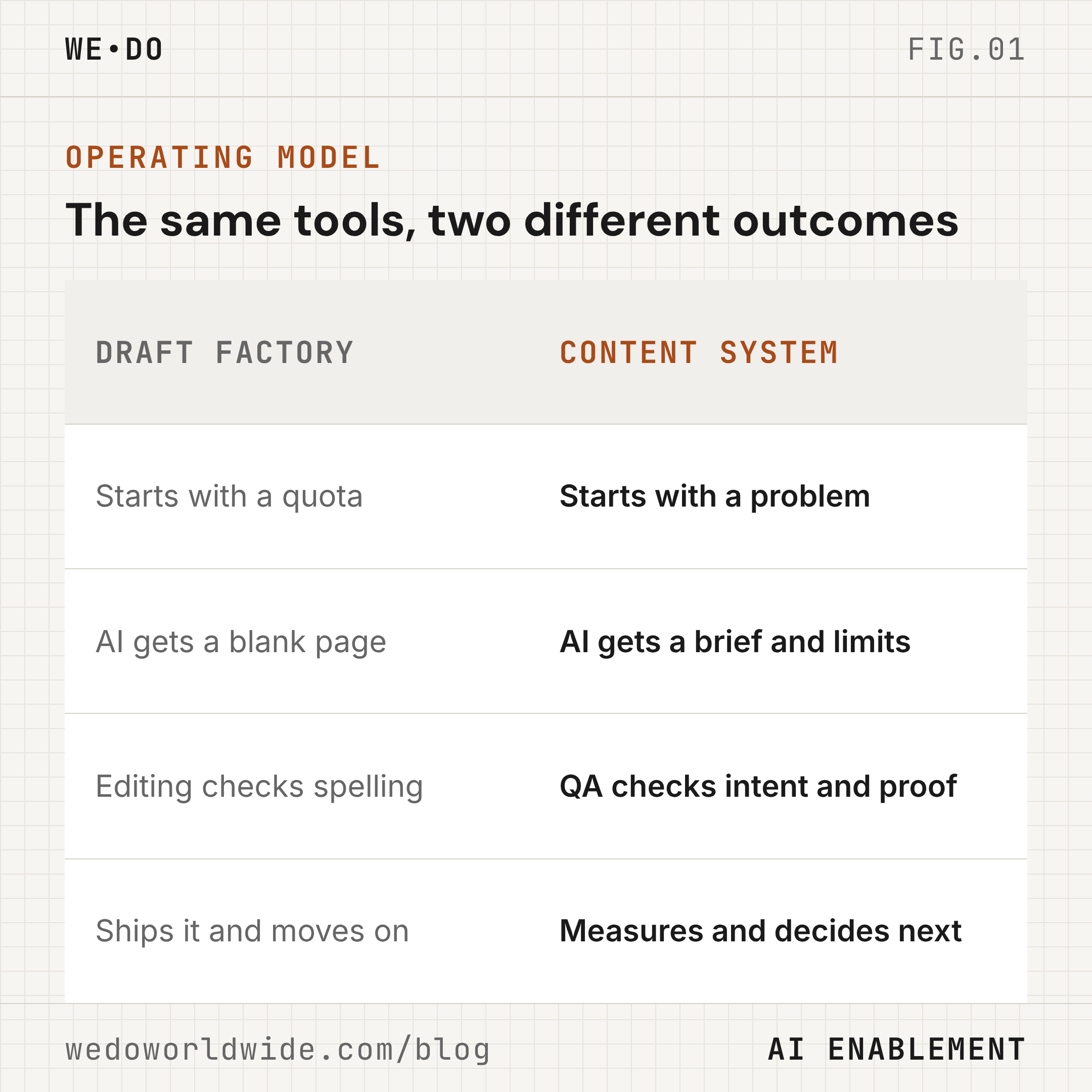
That's the line between a content engine and a draft factory.
Why most AI content programs stall
They create motion without traction.
The draft count climbs. Organic performance doesn't. Internal links stay messy. Briefs get thinner. The team saves time in the wrong places, then spends it cleaning up weak work.
Banning AI won't fix it. Slowing down won't either. Give AI a better role.
A lot of teams say "AI strategy" when they mean AI output. They want a faster path from keyword to draft. That can help. It's not the strategic layer.
Strategy decides:
- which business problem is worth solving
- which search behavior proves that problem exists
- what kind of page fits the opportunity
- where AI can safely cut manual work
- where a human must slow the workflow down
- how results change the next piece of content
If your system only answers "How do we publish more?", you don't have a strategy yet. You have a speed problem dressed up as ambition.
02 / what-should-an-ai-content-strategy-decide
What should an AI content strategy decide?
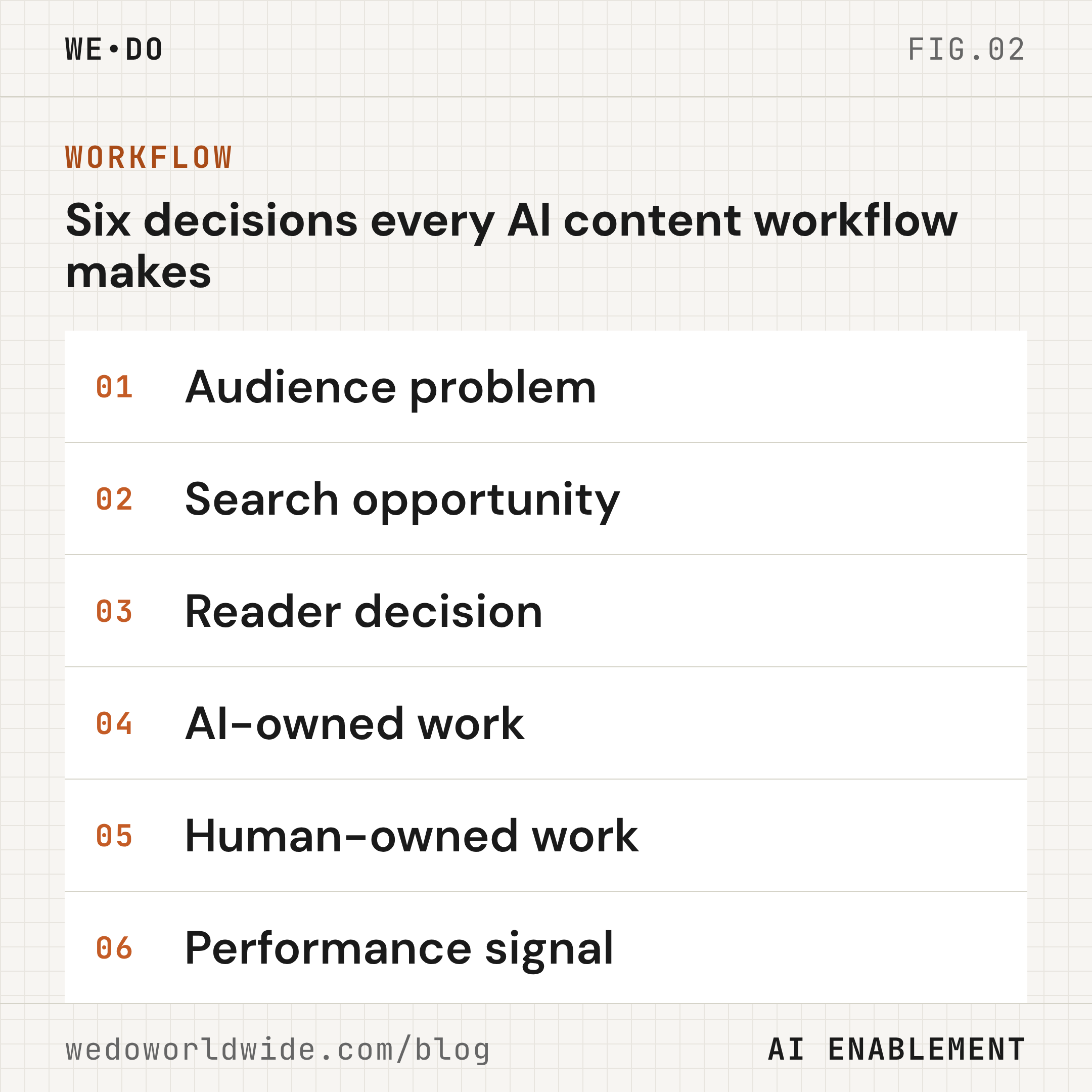
Six things, before a draft ever ships.
1. Which audience problem deserves a page
Start with the person, the problem, and the decision behind the search. Keyword demand matters. Buyer context matters more.
"Write about AI content" is not a strategy.
This is: "Help a marketing leader build an AI-assisted SEO workflow. It should improve quality, internal linking, and performance. It shouldn't turn the team into a draft mill." That's a real job to be done.
2. Which search opportunity supports the business
The keyword isn't the strategy. It's evidence.
Most results for these queries cover tools, ideation, or content operations in general. Fewer cover the practical SEO system: research, briefs, human approval, internal links, performance feedback, and rollout.
That gap is where a better page gets built.
3. What the page helps the reader decide
Every page needs a clear next decision. Explanation alone isn't enough.
Should the reader audit their workflow? Rebuild the brief process? Define approval gates? Connect Search Console and GA4 (Google's search and analytics tools) into a refresh loop?
If the article doesn't help the reader choose a next step, it's still too soft.
4. Which work AI should own
AI is strongest where the work is repeatable and easy to check:
- expanding keyword themes
- clustering questions
- summarizing SERP (search results page) patterns
- drafting metadata options
- comparing coverage gaps
- checking on-page consistency
- surfacing candidate internal links
- flagging anomalies in reporting
5. Which work humans must keep
Humans own the parts that shape credibility:
- choosing the audience and angle
- deciding whether a query is worth pursuing
- setting the point of view
- verifying claims
- adding first-party examples
- approving tone and positioning
- deciding whether the CTA (call to action) matches intent
The more a decision affects trust, the less you should automate it blindly.
6. Which performance signals change the next cycle
Without a feedback loop, a strategy becomes a factory.
Which queries appeared? Which pages earned impressions but weak CTR (click-through rate)? Which internal links got clicked? Which topics pulled in the wrong audience?
If none of that reaches the next brief, the workflow isn't finished.
03 / how-do-you-build-the-workflow
How do you build the workflow?
Build it as a loop with checkpoints. Not a straight line from prompt to publish.
Research: find demand and tension
AI can expand a seed topic and classify intent. It can summarize top-ranking pages, spot repeated subtopics, and surface nearby commercial language. That helps. Pattern-finding across a messy SERP is slow work by hand.
A strategist still answers the business question. If we earn visibility here, will we attract the right problem?
Here's where weak programs go off track. They pick a topic for its volume, not because it leads to a useful conversation.
A lower-volume keyword tied to a live service problem can beat a broader phrase. The broad one often brings curiosity clicks and nothing else.
Brief: turn the opportunity into a quality contract
A strong brief defines:
- the reader
- the primary and supporting search terms
- the current SERP pattern
- the claims that need evidence
- the internal links that matter
- the CTA path
- the sections that set the page apart from generic coverage
AI can gather those ingredients fast. A human approves the angle and the boundaries.
Treat the brief as a contract, not a longer outline. It says what the page must do. It says what the page must not drift into. And it says what "good enough to publish" means.
Draft: give AI boundaries, not a blank page
"Write a blog post about AI content strategy" gets you a page that sounds like everything already ranking.
A better workflow hands AI the full context:
- the audience and business problem
- the approved angle
- the source pack
- the required sections
- the claims to avoid
- the voice rules
- the commercial destination
That turns the draft from a hallucination risk (made-up facts) into a usable asset.
Even then, the first draft isn't the deliverable. Human editing adds the trade-offs and sharper positioning a model can't produce on its own.
SEO and brand QA: test the work against the job
A real QA pass checks more than spelling and keyword placement. It asks whether the page:
- answers the query early
- adds original value beyond the top ten results
- makes accurate claims
- sounds like the brand
- links logically
- keeps structured data (schema markup) aligned with the visible text
Google is direct about this in its guidance on using generative AI content. Generative AI is useful for research and adding structure. Using it to generate many pages without adding value for users may violate the spam policy on scaled content abuse.
The takeaway is simple. Don't automate your way around usefulness.
Publish and distribute: automate the boring parts carefully
Good automation targets: formatting, metadata entry, image handling, link checks, distribution packaging, and status updates. They repeat, they're easy to test, and they're expensive to do by hand again and again.
That doesn't mean every page should auto-publish the moment a draft exists. High-risk content still needs named approval.
A human owner signs off when the page:
- introduces a new offer
- makes claims that need verification
- shapes how a service is positioned
Automation should remove friction, not accountability.
Measure and refresh: feed performance into the next decision
After you publish, watch:
- indexing and rendering
- new query patterns
- CTR and position shifts
- engagement quality
- internal-link behavior
- conversion signals
Google confirms that sites showing up in AI features like AI Overviews and AI Mode are included in normal Search Console reporting. The same SEO basics still apply. Allow crawling. Make content findable through internal links. Provide a good page experience. Keep important content in text. Make structured data match the visible text. See AI features and your website.
Measure those basics before chasing a new AI visibility metric.
04 / how-do-you-add-a-human-quality-gate-before-anyth
How do you add a human quality gate before anything ships?
Define a visible gate with an owner for every check.
Not a vague "someone will review it later." A real gate, with names.
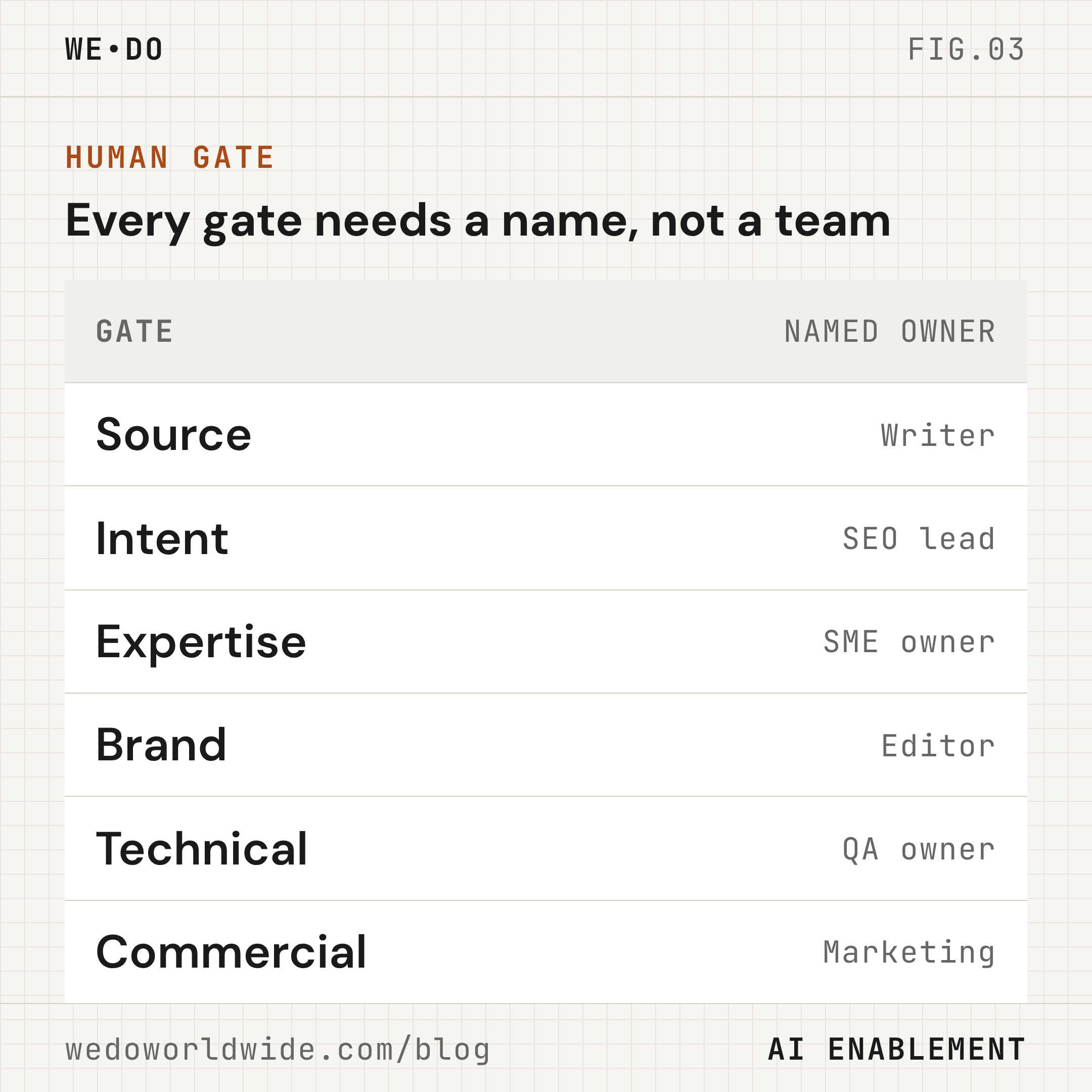
Most teams don't need more than that at the start. They need clarity.
If nobody owns the gates, the workflow optimizes for completion. That's how low-trust content gets published by accident.
05 / when-should-you-plan-internal-links
When should you plan internal links?
Before the draft is written. Internal links are where the workflow becomes a system.
Many teams still treat linking as the last pass. The draft looks good, someone drops in a few related URLs, done. That misses the point. Links shape both discoverability and commercial flow, so plan them up front.
Every new article needs three things:
- one primary destination
- two or three supporting links that go deeper on the topic
- at least one existing page that will link into it once it's live
For this post, the commercial destination is AI operations and workflow automation. Supporting paths lead to SEO and content marketing services, the six-phase AI blog content pipeline, AI content briefs from keyword to outline, and optimizing content for search and answer engines.
Don't add links because a checklist says you need eight. Add them because the reader needs the next answer.
06 / how-do-you-measure-the-loop
How do you measure the loop?
Give each page a measurable job before launch. Then check it at 14, 30, 60, and 90 days.
Before launch, confirm the target queries, baseline impressions, current rankings, destination links, and conversion path.
- Day 14: fix discovery and rendering problems.
- Day 30: tighten the title, intro, structure, or link placement based on CTR and position.
- Day 60: expand, merge, or sharpen the angle as new query themes show up.
- Day 90: decide whether to refresh, scale, rebuild, or stop.
This protects the team from two lazy conclusions:
- it ranked, so it worked
- it didn't rank yet, so the strategy failed
Neither is enough. Visibility is an input. Business movement is the output. Measure both.
07 / how-do-you-roll-it-out-in-90-days
How do you roll it out in 90 days?
Pick one lane and make it dependable first.
The common mistake is automating everything at once. Don't build blog production, social distribution, email repurposing, reporting, and refresh logic in one giant project.
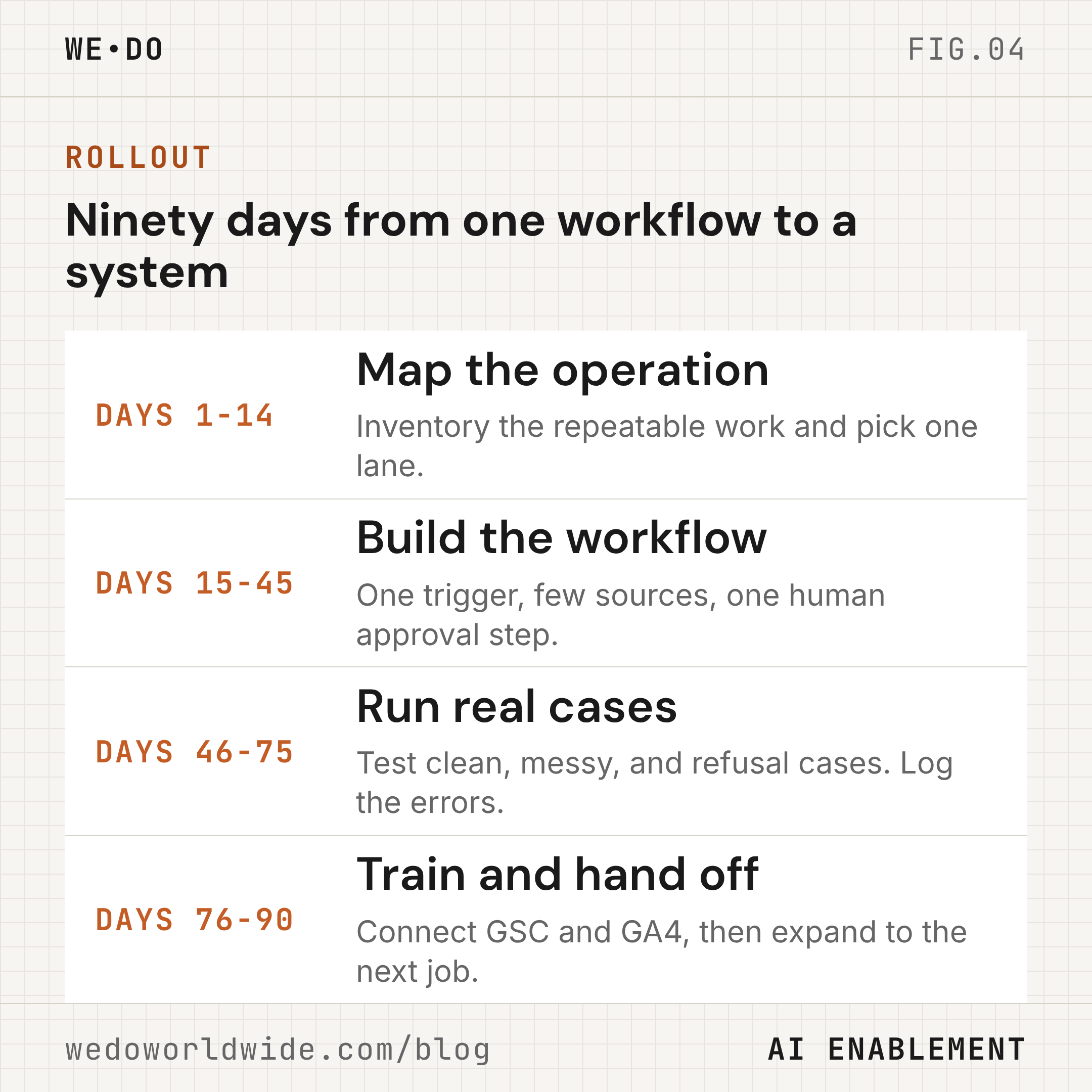
Days 1 to 14: map the operation
List the repeatable work: keyword expansion, brief production, draft QA, internal-link research, publishing support, refresh triage, and reporting summaries.
Choose one job with:
- clear triggers
- predictable inputs
- visible manual effort
- a structured output
Write down the owner, the systems involved, and what failure looks like.
Days 15 to 45: build the workflow
Keep the first version narrow. One trigger. Two to four trusted sources. A small tool set. One output format. One human approval point.
The first workflow isn't there to impress anyone. It's there to prove the system saves time without lowering the bar.
Days 46 to 75: run real cases
Test at least five real jobs:
- a clean case
- a messy one with missing context
- one with conflicting source signals
- one that should be escalated
- one that should be refused outright
This is where the operating model gets stronger. Track revision load, accuracy issues, and missed steps. Track whether the output gets used, not only minutes saved.
Days 76 to 90: train and hand off
Connect the Search Console and GA4 checks. Build a refresh queue. Review which outputs created useful movement, not which runs completed.
Expand into nearby jobs only after the first lane is stable. That's how an AI content workflow becomes a real content system.
08 / what-doesnt-work
What doesn't work?
Five habits turn AI content into draft volume.
Optimizing for output count. More drafts isn't a growth metric. If volume rises without better visibility, engagement, or conversions, the workflow isn't working.
Feeding the model generic context. A keyword with no audience, source pack, approved angle, or offer context produces interchangeable copy.
Removing the approval step. When nobody owns the final call, the system optimizes for completion.
Leaving internal links for the end. A page without a destination is an isolated asset, not part of a strategy.
Automating every channel at once. Prove one lane before adding the next.
09 / the-takeaway
The takeaway
The goal isn't more words, faster. It's better content decisions, made consistently.
Use AI to remove repetitive research, formatting, checking, and routing. Keep humans responsible for audience, evidence, expertise, judgment, and approval.
Then close the loop. Measure what earned attention, what built trust, what moved the reader forward, and what should change next.
That's how a team gets speed without giving up what search engines and buyers still reward: useful content from people who know what they're doing.
If your workflow makes plenty of drafts but not enough qualified movement, AI operations is a good next conversation. WE•DO designs the workflow, connects the tools, trains the team, and keeps the system pointed at outcomes.